
美日利差

Search documents
日本央行加息预期难改长期利差
Jin Tou Wang· 2025-12-12 02:44
Group 1 - The core viewpoint of the articles revolves around the fluctuations in the USD/JPY exchange rate, influenced by the Bank of Japan's potential interest rate hike and the persistent long-term interest rate differential between the US and Japan [1][2] - The Bank of Japan's Governor Ueda has signaled a hawkish stance, with a 91% market expectation for a 25 basis point rate hike in December, driven by anticipated wage increases and high inflation [1] - Despite the short-term support for the yen, the long-term outlook remains weak due to the significant interest rate differential, which exceeds 5 percentage points, maintaining the attractiveness of USD assets [1] Group 2 - The focus will shift to Japan's labor cash income data and US initial jobless claims, which are critical for the Bank of Japan's rate decision and the USD's performance [2] - The continuous depreciation of the yen is exacerbating inflationary pressures in Japan, increasing import costs and complicating the government's efforts to alleviate living costs [2] - The Bank of Japan faces a dilemma: raising rates could curb depreciation and inflation but may hinder economic recovery, while delaying hikes could intensify pressures, impacting the long-term trajectory of the yen [2]
解码日本央行加息效应与逻辑
Qi Huo Ri Bao Wang· 2025-12-12 00:59
Core Viewpoint - The Bank of Japan is expected to raise interest rates in its upcoming meeting, which contrasts with the easing policies of other major economies, raising concerns about macro liquidity tightening. However, the short-term impact of this meeting is anticipated to be limited [1]. Group 1: Interest Rate Policy and Inflation - Japan's monetary policy has been misaligned with other major economies, leading to a significant interest rate differential, which peaked at nearly 560 basis points in 2023, contributing to the depreciation of the yen [2]. - The depreciation of the yen has increased inflationary pressures in Japan, necessitating a response from the Bank of Japan. The core CPI has remained above 2% since 2022, indicating the end of the deflationary era [3]. - The current fiscal reality, with Japan's debt-to-GDP ratio exceeding 200%, limits the space for interest rate increases. The average interest payment ratio is beginning to rise, indicating a reduced tolerance for higher rates [3]. Group 2: Future Rate Hikes and Economic Outlook - The expected path for interest rate increases in Japan is gradual, with projections suggesting a rise from 0.5% to around 1% over the next 1-2 years. A more significant increase would require stronger economic growth and nominal income [4]. - The anticipated interest rate environment is characterized by a "misalignment" where the U.S. is expected to lower rates while Japan raises them, leading to a compression of the interest rate differential [5]. Group 3: Yen Carry Trade Dynamics - The yen carry trade is structured in layers, with the top layer consisting of short-term speculative positions, the middle layer involving significant leveraged positions in high-yield assets, and the bottom layer comprising long-term Japanese overseas asset holdings [7]. - The middle layer of high-leverage positions is most susceptible to market shocks, while the bottom layer is more stable and less likely to trigger immediate sell-offs [8]. Group 4: Market Reactions and Long-term Implications - The potential for a liquidity shock exists if the Bank of Japan's rate hikes are more aggressive than expected, particularly if accompanied by a weakening U.S. economy leading to rapid Fed rate cuts [9]. - Current macro conditions do not fully support a liquidity crisis, as the market has already adjusted to the anticipated rate hikes, and the concentration of high-leverage positions has decreased significantly [10]. - In the long term, the global capital flow direction may change, impacting the carry trade logic and leading to a potential revaluation of global duration assets [11].
日元逆袭时刻?日银加息暗藏大惊喜
Jin Tou Wang· 2025-12-08 02:25
12月8日(周一)在日本央行加息预期陡增与美联储降息窗口开启的双重背景下,美元兑日元汇率近期陷 入剧烈博弈,市场对政策拐点的敏感程度持续攀,美元兑日元报154.97,较前一交易日下跌0.28,跌幅 0.2382%,当日最高触及155.38,最低下探154.92,展现出政策预期驱动下的窄幅震荡特征。此前该汇 率曾一度跌至157关口附近,创下近10个月新低,距离市场普遍认为的日本当局干预线160仅一步之遥。 日本央行的政策转向预期成为搅动汇率走势的核心变量。日本央行行长植田和男12月1日明确释放加息 信号,称将在12月19日的货币政策会议上考虑提高政策利率的利弊,若经济展望符合预期便会采取行 动。这一"鹰派"表态彻底改变市场预期,两周前市场对日本央行12月加息的概率预期仅为30%,如今已 飙升至76%,明年1月加息概率更是高达近90%。背后逻辑在于日本经济的矛盾处境:一方面,10月日 本核心CPI同比上升3.0%,连续50个月同比上升,物价涨幅持续扩大,通胀压力倒逼政策收紧;另一方 面,日本第三季度GDP出现负增长,虽被植田和男判断为"暂时现象",但经济复苏乏力仍限制着加息节 奏。受加息预期推动,日本10年期国债 ...
新消费的“年尾行情“,持续性如何?
Hu Xiu· 2025-12-01 10:43
Group 1 - The article discusses the recent trends in gold prices, highlighting a significant point to watch as expectations for a Federal Reserve interest rate cut rise, leading to a decline in the US dollar index and a corresponding increase in precious metals like gold and silver, as well as base metals such as copper and aluminum [3] - The anticipated peak of this trend is expected around December 10, coinciding with the Federal Reserve's interest rate decision, with a cautionary note on potential short-term pullbacks following the realization of these gains [3] - The US stock market is experiencing a dual effect of benefiting initially from rate cut expectations but may face pressure post-decision due to narrowing interest rate differentials between the US and other major economies, potentially leading to capital outflows [3] Group 2 - The narrowing of the 10-year Treasury yield spread between China and the US could result in some US dollar funds returning to markets like China and Japan, especially if the Bank of Japan raises interest rates in December, which would further compress the US-Japan yield spread [3] - The recent rise of the Japanese yen against the US dollar is seen as an early signal of capital returning to Japan [3]
日本经济与政策面 多重矛盾发酵
Jin Tou Wang· 2025-11-28 02:26
Core Viewpoint - The USD/JPY exchange rate continues to show a strong oscillating pattern, influenced by both internal economic pressures in Japan and external factors such as U.S. Federal Reserve policy expectations [1][2]. Internal Factors - Japan's economic fundamentals are under pressure, with Q3 GDP declining at an annualized rate of 1.8%, marking a return to negative growth after six quarters. Key contributors to this decline include shrinking exports and a significant drop in private residential investment [1]. - The Japanese government's economic stimulus plan of 21.3 trillion yen raises concerns about potential fiscal deterioration, leading to a "sell Japan" trade sentiment that pressures both the yen and Japanese government bonds [1]. - The Bank of Japan's cautious approach to normalizing monetary policy is evident, with ongoing political pressures causing market concerns about the pace of interest rate hikes [1]. External Factors - Market expectations indicate an 84.7% probability of a 25 basis point rate cut by the Federal Reserve in December, contributing to a relatively stable USD/JPY interest rate differential [2]. - Morgan Stanley suggests that if the Fed initiates a series of rate cuts, the USD/JPY could depreciate by nearly 10% over the next few months, potentially reaching the 140 level by Q1 2026 [2]. - The recent weakness of the yen has drawn significant attention from Japanese authorities, with Finance Minister Shunichi Suzuki mentioning the possibility of intervention, and the Economic and Fiscal Policy Minister emphasizing close monitoring of speculative currency behavior [2]. Technical Analysis - The USD/JPY is currently trading within a critical range of 156-157, with resistance near the 160 intervention level and support around 155.80 [3]. - The Relative Strength Index (RSI) is at approximately 58, indicating that there is still potential for upward movement, although momentum appears to be waning [3]. - Key signals to watch include potential currency market intervention by Japanese authorities and the outcomes of the Federal Reserve's December policy decision and the Bank of Japan's rate meeting on December 19 [3].
日元干预警报利差博弈升温
Jin Tou Wang· 2025-11-21 03:03
Core Viewpoint - The USD/JPY exchange rate is experiencing strong fluctuations, with the current trading price at 157.37, reflecting a 0.56% increase from the previous day, driven by the divergence in monetary policy between the US and Japan [1][2]. Group 1: Monetary Policy Divergence - The Bank of Japan has maintained its benchmark interest rate at 0.5% for the sixth consecutive time, while the Federal Reserve remains cautious about potential interest rate cuts, supporting a hawkish stance [2]. - Japan's core CPI rose by 2.9% year-on-year in September, exceeding the target for 18 consecutive months, but internal divisions regarding potential rate hikes persist within the Bank of Japan [2]. Group 2: Yen Performance and Market Sentiment - The yen has depreciated over 3% since October, making it the weakest currency among G10 currencies, and is approaching intervention thresholds set by the Japanese Ministry of Finance [3]. - US Treasury Secretary Janet Yellen's comments respecting Japan's monetary policy autonomy have fueled speculation about potential market interventions by Japanese authorities [3]. Group 3: Technical Analysis - The USD/JPY has established a clear upward channel, with current prices near the upper boundary, focusing on the 157.00-157.50 range for short-term trading [4]. - Key resistance is identified between 157.80-158.00, while support levels are at 156.80 and 156.50; a breach of these levels could indicate further price movements [4]. - Technical indicators show bullish signals, with the MACD indicating accumulating bullish momentum and the RSI at 62, suggesting a strong market condition [4].
政策博弈下的贬值压力与干预隐忧并存 日元贬至10个月新低
Xin Hua Cai Jing· 2025-11-20 09:11
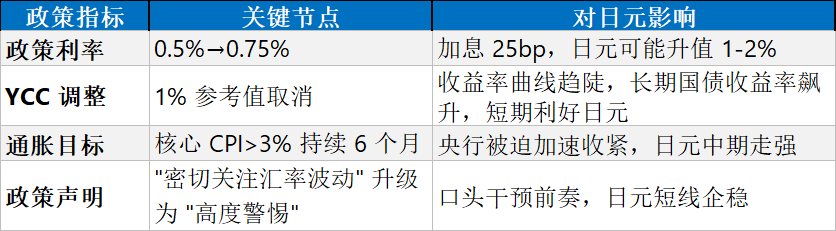
Core Viewpoint - The Japanese yen is experiencing significant depreciation against the US dollar, influenced by various factors including government fiscal expansion policies, the Bank of Japan's monetary policy normalization, and widening interest rate differentials between the US and Japan [1][2][3] Group 1: Currency Exchange Dynamics - The USD/JPY exchange rate reached 157.48, the highest level since January 2025, reflecting a 5% appreciation since October 4, 2023 [1] - The nominal effective exchange rate of the yen fell to 71.4, nearing the low point observed during the intervention in July 2024 [1] - The depreciation of the yen is coupled with rising Japanese government bond yields, with the 10-year yield hitting 1.825%, the highest since the 2008 financial crisis [1][2] Group 2: Fiscal Policy and Economic Impact - The Japanese government is pushing for a comprehensive economic strategy exceeding 20 trillion yen, which includes child subsidies and energy assistance, raising concerns about debt sustainability as the current debt-to-GDP ratio stands at 260% [2] - Japan's GDP contracted by 0.4% quarter-on-quarter in Q3, marking the end of six consecutive quarters of growth, indicating weak domestic and external demand [2] Group 3: Monetary Policy and Market Sentiment - The market's expectation for a rate hike by the Bank of Japan in December is only at 57%, as the central bank maintains a policy rate of 0.5% despite core CPI exceeding the 2% target for 36 consecutive months [2][3] - The Japanese government opposes interest rate hikes, arguing that inflation has not yet reached a sustainable level, which conflicts with the Bank of Japan's logic of a wage-price positive cycle [2][3] Group 4: Market Reactions and Predictions - Financial institutions have lowered their forecasts for the yen, with JPMorgan adjusting its prediction for the USD/JPY exchange rate to 156 by the end of 2025 [4] - Key upcoming events include the announcement of the stimulus plan on November 21 and the Bank of Japan's monetary policy meeting in December, which could significantly influence the yen's trajectory [4] Group 5: Policy Indicators and Potential Outcomes - A potential increase in the policy rate from 0.5% to 0.75% could lead to a 1-2% appreciation of the yen [5] - Continuous inflation above 3% for six months may force the Bank of Japan to tighten monetary policy, leading to a medium-term strengthening of the yen [5] - The government's focus on monitoring exchange rate fluctuations may signal a prelude to verbal interventions, potentially stabilizing the yen in the short term [5]

花旗预计美元兑日元将在第四季度达到140日元
Sou Hu Cai Jing· 2025-09-11 00:56
Core Viewpoint - Citigroup indicates that the appointment of a pro-reflation figure as Japan's next Prime Minister will not hinder the normalization of the Bank of Japan's monetary policy [1] Group 1: Currency Exchange Rate Expectations - Analysts, including Osamu Takashima, predict that the narrowing of the interest rate differential between the US and Japan may exert downward pressure on the USD/JPY exchange rate over time [1] - The USD/JPY exchange rate is expected to peak around 150 this summer before retreating to approximately 140 in the fourth quarter [1] - In a risk-on environment, the downward pressure on the yen is increasing, as the Fed's potential rate cuts could boost the US stock market [1] Group 2: Key Levels for USD/JPY - The current outlook suggests limited downside for the USD/JPY exchange rate, with a potential bottom around 145 [1] - The key resistance level for the USD/JPY exchange rate remains at 148 [1]
长期日债收益率创1999年来新高!日企避雷长债埋隐患
Di Yi Cai Jing· 2025-08-22 07:00
Group 1 - Japanese government bond yields have reached multi-decade highs, with the 20-year yield at 2.655% and the 30-year yield at 3.185%, reflecting significant increases from earlier this year [3][5] - The rise in yields is driven by fiscal pressures, political instability, and changes in trade dynamics, leading to a recalibration of investor risk perception [3][4] - Domestic investors, including life insurance companies, have reduced their holdings of Japanese government bonds by 1.35 trillion yen since October 2024, indicating a decline in demand [4] Group 2 - Japanese corporations are shifting from issuing long-term bonds to short-term financing, with approximately 75% of bond issuances this fiscal year concentrated in maturities of 5 years or less [6] - The trend towards shorter maturities is influenced by rising interest rate expectations and increased caution among investors regarding duration risk [6][7] - The increase in short-term bond issuance may lead to higher short-term financing costs and increased refinancing risks for companies [6][7] Group 3 - The rise in Japanese bond yields is expected to impact the Japanese economy and global equity markets, potentially suppressing corporate investment and household spending [7] - The Bank of Japan's decision to slow down its quantitative tightening reflects concerns over the economic risks associated with rising yields [7] - Analysts warn that the surge in bond yields could lead to a significant adjustment in global markets, as the relative attractiveness of equities diminishes [7]

银河证券:美联储人事变动预期升温 市场押注9月降息
Zhi Tong Cai Jing· 2025-08-11 00:51
Group 1: Global Economic Overview - The first meeting between US and Russian leaders in four years is scheduled for August 15, which may impact geopolitical dynamics [1] - The US has imposed additional tariffs on India, leading to a pause in defense cooperation [1] - The Federal Reserve's personnel changes are raising expectations for interest rate cuts in September, while the Bank of Japan hints at potential future rate hikes [1] Group 2: Domestic Economic Indicators - July's CPI remained flat year-on-year, while core CPI has risen for three consecutive months, indicating a mild improvement in macroeconomic conditions [1] - The decline in PPI has narrowed, reflecting the effects of policies aimed at expanding domestic demand [1] - Foreign trade growth reached a year-to-date high, with both imports and exports showing year-on-year increases [1] - The A-share market is experiencing a recovery in sentiment, with margin trading balances returning to 2 trillion yuan [1] Group 3: Commodity Market Insights - Gold prices experienced fluctuations but ended higher, driven by a weakening labor market and expectations of Fed rate cuts, alongside increased demand for safe-haven assets due to geopolitical risks [1] - Oil prices saw a decline due to heightened trade tensions between the US and India, raising concerns over demand, while OPEC+ continues to increase production [1] Group 4: Bond Market Analysis - US Treasury yields rose slightly as Fed officials maintained a cautious stance on monetary policy, increasing uncertainty around rapid rate cuts [2] - Chinese bond yields fell slightly due to stable inflation indicators, supporting expectations for moderate monetary easing [2] Group 5: Currency Market Trends - The US dollar index fell as July non-farm payroll growth slowed and unemployment rose to 4.3%, reinforcing expectations for a rate cut in September [3] - The USD/JPY pair saw fluctuations, supported by the US 10-year Treasury yield maintaining an advantage over Japanese bonds [3] Group 6: Equity Market Performance - Global stock markets performed well, buoyed by weaker US non-farm data that enhanced expectations for Fed rate cuts, boosting risk appetite [3] - US tech giants reported better-than-expected earnings, particularly in AI and cloud sectors, further supporting market confidence [3]