
全球资产配置

Search documents
美元周期拐点将至?利用A股核心资产+东南亚市场构建抗波动组合!
Jin Rong Jie· 2025-05-22 04:52
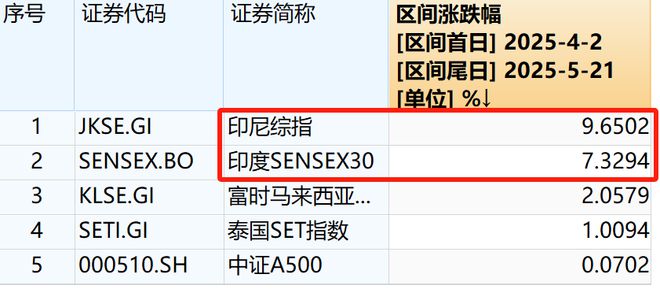
Group 1 - The core viewpoint of the articles emphasizes the importance of global asset allocation, particularly highlighting the potential of emerging markets as a counterbalance to the high valuations and risks associated with major tech stocks in developed markets [1][3]. - Morgan Stanley has upgraded its rating on emerging market stocks to "overweight," indicating a bullish stance and suggesting that these markets could provide significant investment opportunities, especially as they have underperformed developed markets by 40% over the past four years [1][2]. - Emerging market stocks have shown a notable recovery this year, with Indonesia's index rising by 10% and India's SENSEX30 increasing by 7%, outperforming the A500 index [1][2]. Group 2 - The report highlights that the forward P/E ratio for emerging market stocks is 12.4 times, significantly lower than the 19.1 times for developed markets, suggesting a potential for capital inflow as global investors currently have low exposure to these markets [1][2]. - The article points out that trade volumes within emerging markets have reached historical highs, with China exporting more to Southeast Asia than to the U.S., indicating a shift in trade dynamics [5]. - Specific opportunities are identified in markets like India, which has a large untapped mobile data user base, and Indonesia, where the digital economy is poised for significant growth due to its geographical characteristics [5].

startrader:美联储政策变数加剧 港股资金回流压力显现
Sou Hu Cai Jing· 2025-05-21 02:17
Core Viewpoint - The Federal Reserve's policy path has become a focal point for global markets, with expectations of a potential interest rate cut in 2025 being challenged by rising inflation risks and a resilient labor market [1][3]. Group 1: Economic Indicators - The U.S. core PCE price index rose by 2.8% year-on-year in April, exceeding expectations for three consecutive months, indicating persistent inflationary pressures [3]. - Factors contributing to inflation include rising energy prices, localized supply chain tensions, and sticky wage growth in the labor market [3]. - Fed Chairman Jerome Powell suggested that if inflation remains above the 2% target, the timeline for rate cuts could be pushed back to 2026 [3]. Group 2: Market Reactions - A delay in rate cuts could enhance the attractiveness of U.S. dollar assets, leading to a negative correlation with capital inflows into Hong Kong stocks [3]. - Historical data shows that during the Fed's rate hike cycle in 2022, capital outflows from Hong Kong stocks exceeded 10 billion HKD in a single day, with the Hang Seng Index dropping by 15% [3]. - Currently, despite Hong Kong stocks being undervalued, tightening external liquidity may offset this valuation advantage, as indicated by a decrease in the overweight ratio of global emerging market funds in Hong Kong stocks from 5.2% to 3.1% [3]. Group 3: Investment Strategies - The company recommends focusing on defensive sectors such as utilities and telecommunications, which have stable cash flows and are less impacted by external liquidity shocks [5]. - It is advised to use currency hedging tools, such as USD/HKD forward contracts or offshore RMB options, to mitigate the risk of asset depreciation due to a stronger dollar [5]. - Investors should closely monitor Fed officials' speeches and economic data releases to identify potential trading opportunities, particularly in response to employment and inflation data [5].

中外资管巨头齐聚鹏城,热议大变局下全球资产配置机遇与挑战
Zhong Guo Ji Jin Bao· 2025-05-20 13:44
5月20日,来自欧美、中东及东南亚等全球十多个国家和地区的600多名中外嘉宾齐聚深圳,出席由中国 基金报主办的首届全球资产管理论坛系列活动。此次论坛围绕"大变局下的全球资产重估与配置"主题展 开探讨,是目前在深举办的国际化程度最高、行业影响力最大的资管盛会。 搭建全球资管沟通交流平台 以当下"小满"收获未来"大成" 当前,世界正经历百年未有之大变局:国际政治格局在重塑,全球经济秩序在调整,前沿技术的快速发 展正推动新一轮产业革命,社会思潮与文化正多元碰撞,全球治理体系正面临困境与革新。全球资产定 价逻辑应如何调整,资产管理行业运营应如何变革,方能在适应这一系列变化的同时,更好地服务实体 经济,并惠及广大投资者? 作为紫荆文化集团旗下的财经传媒机构,中国基金报始终坚持专业化、国际化、平台化发展战略,致力 于搭建全球资产管理行业与中国地方政府、金融机构及企业沟通交流的平台。 本次论坛的成功举办,标志着中国资产管理行业在全球舞台的话语权进一步提升。通过深港联动、中外 机构对话,论坛不仅为境内外投资者搭建了政策解读与经验交流的平台,更向国际社会传递了中国坚持 高水平开放的决心,论坛成果将为大变局下的全球资管行业注入信 ...
全球资产配置每周聚焦:关税和地缘紧张局势缓解,权益上涨黄金回调-20250518
Shenwan Hongyuan Securities· 2025-05-18 12:15
Global Asset Price Review - The geopolitical situation has eased, leading to a general rise in equity assets. Key events include the announcement of a ceasefire between India and Pakistan, progress in US-China trade talks, and support for a ceasefire in Ukraine by President Putin. This has resulted in increased global risk appetite, with the S&P 500 and Nasdaq 100 showing significant gains [9][10] - As of May 16, 2025, the US 10-year Treasury yield rose by 6 basis points to 4.43%, and the US dollar index increased to 101.0. The US CPI's unexpected decline has boosted market risk appetite, with the S&P 500 rising by 5.27%, outperforming developed and emerging markets [9][10] - Commodity prices saw a decline in gold by 3.72%, while Brent crude oil prices increased by 2.27% [9][10] Global Fund Flows - There has been a significant outflow of domestic capital from the Chinese stock market, while passive foreign investments have surged into it. In the past week, domestic capital outflow from the Chinese stock market amounted to $4.529 billion, while foreign capital inflow was $0.059 billion [16] - In the US, fixed income funds saw an inflow of $6.82 billion, and equity funds experienced an inflow of $21.34 billion, indicating a strong preference for US markets [16] Global Asset Valuation - The implied equity risk premium (ERP) for A-shares remains significantly higher than that of overseas markets. The historical percentile for the CSI 300 and Shanghai Composite Index's implied ERP stands at 81% and 72%, respectively, while the S&P 500, Dow Jones, and Nasdaq have ERPs of 3%, 2%, and 6% [9][10] - The risk-adjusted returns for US equities have marginally increased, with the dynamic risk-adjusted return percentiles for the S&P 500 and Nasdaq 100 rising to 42% and 32%, respectively [9][10] Global Asset Risk Indicators - The proportion of bullish sentiment among US retail investors has risen by 6.48%, with over 80% of S&P stocks trading above their 20-day moving average [9][10] - In the A-share market, over 60% of stocks are above their 20-day moving average, indicating strong momentum. The options market shows a significant increase in bullish sentiment, with a notable rise in call option open interest for the CSI 300 [9][10] Global Economic Data - The US CPI unexpectedly decreased, with April's year-on-year growth at 2.3%, down from 2.4%. This decline in inflation may reduce the urgency for interest rate cuts, especially following positive developments in US-China trade negotiations [9][10]
桥水突然变阵!科技股大甩卖,黄金成新宠?帮主郑重深度解析
Sou Hu Cai Jing· 2025-05-16 16:26
Core Insights - Bridgewater Associates, the world's largest hedge fund, has significantly reduced its holdings in technology stocks while increasing its investment in gold ETFs, indicating a strategic shift in asset allocation [1][3][4] Group 1: Investment Strategy - In the first quarter, Bridgewater cut its position in the S&P 500 ETF by nearly 60%, reducing its stake from 22% to 8.7% [3] - Major technology stocks were heavily reduced: Google A shares by 16%, Nvidia by 18.74%, and Meta by 31% [3] - However, Bridgewater increased its positions in Microsoft and Amazon, suggesting a selective approach rather than a blanket bearish stance on technology [3] Group 2: Gold Investment - Bridgewater has made gold ETFs a significant part of its portfolio, purchasing 110,600 shares of SPDR Gold ETF, making it the sixth-largest holding [3][4] - Ray Dalio stated that gold is the only asset that can hedge against sovereign currency risks, with the correlation between gold and the S&P 500 dropping to -0.18, indicating gold's potential as a safe haven during stock market downturns [3][4] Group 3: Market Conditions - The fund's actions are influenced by rising interest rate expectations from the Federal Reserve, which typically negatively impacts high-valuation technology stocks [4] - Geopolitical tensions, particularly in the Middle East and Asia, are also contributing to a cautious investment environment, prompting global central banks to buy 228 tons of gold in the first quarter, 34% above the five-year average [4] Group 4: Focus on Chinese Assets - While reducing exposure to U.S. tech stocks, Bridgewater has aggressively increased its holdings in Chinese companies, notably Alibaba, which saw an increase from 255,000 shares to 5.66 million shares, valued at $748 million [4] - This strategy reflects a belief in the potential of Chinese assets to provide a counterbalance to risks in U.S. markets [4] Group 5: Investment Recommendations - Investors are advised to be cautious with technology stocks, particularly those with inflated valuations, while considering opportunities in established companies like Microsoft and Apple [5] - A recommendation is made to allocate a portion of investments to gold, given its long-term support from Fed rate expectations and geopolitical risks [5] - Chinese assets are highlighted as having significant growth potential, particularly in e-commerce and cloud computing, while cautioning against companies with compliance risks [5]
正因为他是巴菲特,不是“巴韭特”
虎嗅APP· 2025-05-16 14:09
Group 1 - The article discusses the disparity between GDP growth and stock market performance in China and Japan, highlighting that Buffett's investment choices are based on company fundamentals rather than macroeconomic indicators [4][6][10] - It emphasizes that nominal GDP growth, which includes price increases, is a more relevant metric for assessing economic health compared to real GDP growth [6][8] - The article points out that while China's nominal GDP growth is 4.23%, the profits of A-share companies are declining, with a projected drop of -2.3% for all A-shares and -12.9% for non-financial companies [6][7] Group 2 - The article explains that Japanese companies benefit from a significant portion of their revenue coming from overseas, which contributes to their profit growth, while Chinese companies have a lower overseas revenue share [8][9] - It discusses the concept of beta and alpha in investment, noting that A-shares have low beta returns but relatively easier alpha opportunities due to the presence of many retail investors [10][11] - The article highlights that the high volatility of the A-share market makes it challenging for investors to achieve consistent returns, contrasting it with the more stable performance of the Japanese market [20][21] Group 3 - The article identifies several reasons for the challenges in the A-share market, including high new stock issuance prices, low dividends, and the impact of small enterprises on overall market performance [14][16][17] - It suggests that changes in these factors could improve the investment landscape for A-shares, particularly as the government encourages higher dividend payouts [18] - The article concludes that while A-shares present significant alpha opportunities for certain investors, the overall market remains difficult for average retail investors due to its speculative nature [27][28]

跨境ETF霸屏涨幅榜,沙特ETF涨超5%,纳指科技ETF、标普消费ETF涨超3%
Sou Hu Cai Jing· 2025-05-14 05:26
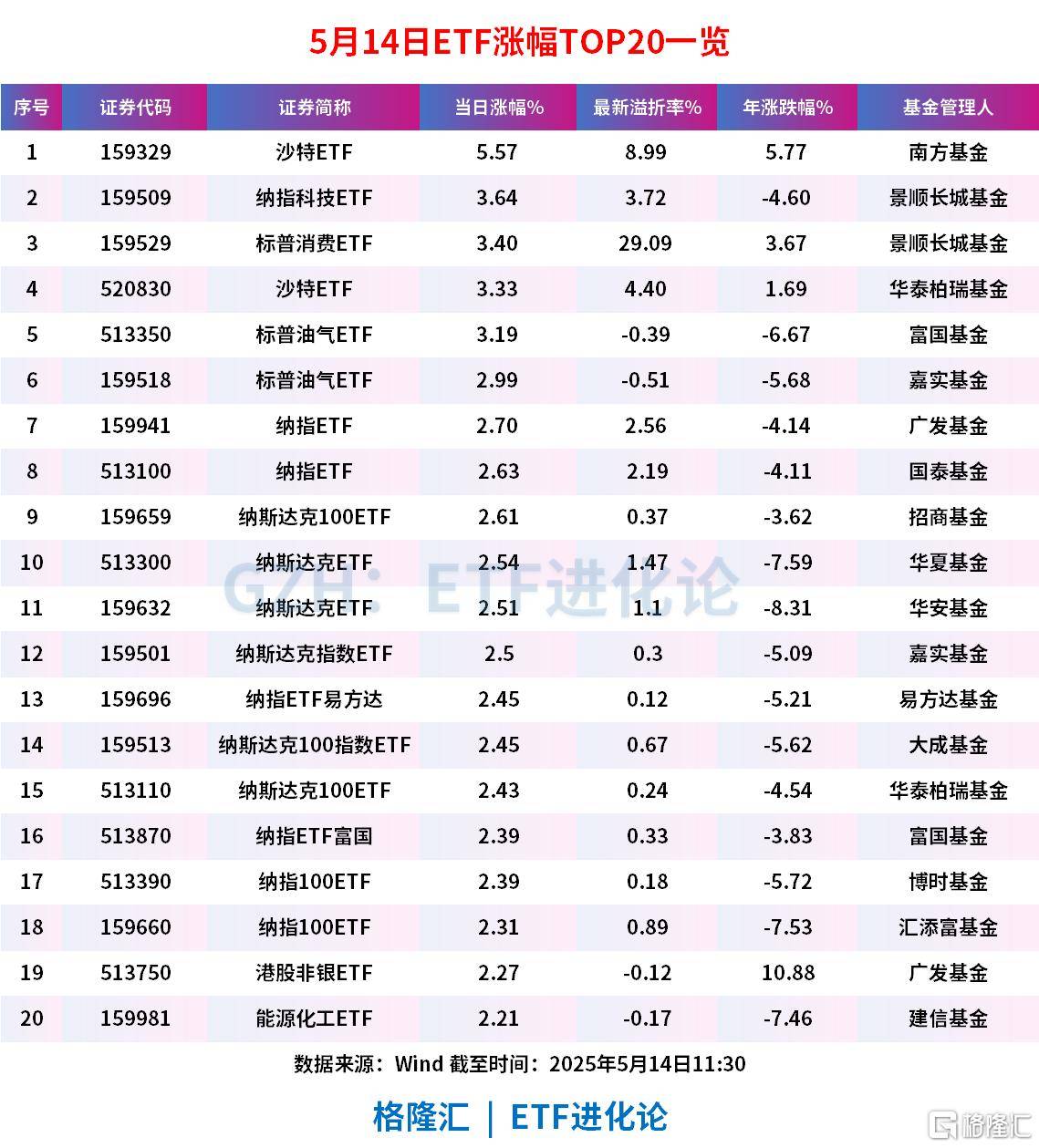
Core Viewpoint - The resurgence of cross-border ETFs has led to significant price increases across various funds, driven by positive market sentiment following favorable inflation data and a temporary trade truce between the US and China [1][5][10]. Group 1: ETF Performance - The Southern Fund's Saudi ETF, Invesco's Nasdaq Tech ETF, and Invesco's S&P Consumer ETF saw increases of 5.57%, 3.64%, and 3.4% respectively, with latest premium/discount rates at 8.99%, 3.72%, and 29.09% [1][3]. - The S&P Oil & Gas ETFs from Franklin Templeton and Harvest Fund increased by 3.19% and 2.99% respectively, reflecting a broader rise in oil prices [1][3]. - The Nasdaq index rose for the second consecutive day, with Franklin Templeton's Nasdaq ETF and Cathay Fund's Nasdaq ETF increasing by 2.7% and 2.63% respectively [1][3]. Group 2: Market Context - Global stock markets continued to rise, with the S&P 500 and Nasdaq indices gaining 0.72% and 1.61% respectively, attributed to lower-than-expected inflation data and improved investor sentiment following the US-China trade truce [5][6]. - The S&P 500 index has recovered its losses for the year, now up 0.1%, after a significant drop earlier due to escalating trade tensions [5][6]. - The recent signing of a $142 billion arms deal between the US and Saudi Arabia, along with Nvidia's commitment to supply advanced AI chips, has further bolstered market optimism [6][10]. Group 3: Economic Indicators - The US Consumer Price Index rose by 2.3% year-on-year in April, below the expected 2.4%, marking the lowest level since February 2021 [10]. - Despite the favorable inflation data, the 10-year US Treasury yield increased by 2.4 basis points to 4.481%, indicating a complex market reaction [10]. - Market analysts suggest that the upcoming month may see fluctuations in the S&P 500 index between 5500 and 5800 points, supported by corporate buybacks and trade agreements [10].
抢滩企业出海与全球资产配置新浪潮 全球家族办公室2.0时代高峰论坛在穗举行
2 1 Shi Ji Jing Ji Bao Dao· 2025-05-13 15:44
Group 1 - The "Global Family Office 2.0 Era Summit" held in Guangzhou focused on the challenges and solutions for family enterprises in global asset allocation amidst a reshaping economic landscape [1] - The summit attracted high-net-worth families, family office practitioners, cross-border investment institutions, and policy researchers from the Guangdong-Hong Kong-Macao Greater Bay Area [1] - Hong Kong is rapidly becoming an attractive hub for family offices in the Asia-Pacific region due to its "one country, two systems" advantage, international financial system, and favorable tax policies [1] Group 2 - The "New Capital Investor Entry Program" and tax reduction policies are being implemented in Hong Kong, contributing to the formation of a new family office ecosystem centered on intergenerational inheritance, cross-border services, and compliance [1] - Lauren Nan from Finakey emphasized the importance of "cultural capital + trust structure" as a dual-driven model for family wealth sustainability, highlighting the need to anchor values as core assets in a rapidly changing global capital market [1] - Wang Xianzhe from VentureFront discussed alternative investment trends in the "Trump 2.0 era," focusing on Web3, RWA (Real World Assets on-chain), and ESG asset allocation opportunities [2] Group 3 - The roundtable discussion highlighted the need for collaboration in building a cross-border family office ecosystem in the Greater Bay Area, leveraging the technological manufacturing base of Guangzhou and Shenzhen alongside Hong Kong's financial advantages [2] - The "Nansha Financial 30 Measures" aim to attract diverse investment institutions, including sovereign wealth funds and family offices, to enhance cross-border financial innovation and cooperation [2][3] - The People's Bank of China and the Guangdong Provincial Government are promoting high-level openness and financial services to support entrepreneurship and innovation in response to changing external environments [3]
全球资产配置每周聚焦:中美瑞士谈判提升全球风险偏好,美国散户看涨比例大幅提升-20250511
Shenwan Hongyuan Securities· 2025-05-11 09:45
2025 年 05 月 11 日 中美瑞士谈判提升全球风险偏好, 美国散户看涨比例大幅提升 ——全球资产配置每周聚焦 (20250502-20250509) 证 相关研究 - 证券分析师 金倩婧 A0230513070004 jinqj@swsresearch.com 冯晓宇 A0230521080005 fengxy2@swsresearch.com 林遵东 A0230524100005 linzd@swsresearch.com 王胜 A0230511060001 wangsheng@swsresearch.com 研究支持 涂锦文 A0230123070009 tujw@swsresearch.com 联系人 涂锦文 (8621)23297818× tujw@swsresearch.com 本研究报告仅通过邮件提供给 中庚基金 使用。1 请务必仔细阅读正文之后的各项信息披露与声明 策 略 研 究 大 类 资 产 配 置 券 研 究 报 告 ⚫ 全球资产价格回顾:本周(20250502–20250509)市场聚焦美中新一轮经贸会谈,特朗普政府暗示可 能下调部分中国进口商品关税,阶段性提振乐观预期。1)利率 ...
汇率市场波动下,内地赴港买保险影响几何?
Mei Ri Jing Ji Xin Wen· 2025-05-06 14:41
Core Viewpoint - The recent fluctuations in exchange rates and the U.S. government's tariff policies have raised questions about the attractiveness of Hong Kong insurance products, particularly those denominated in U.S. dollars, for mainland Chinese customers [1][2][3]. Exchange Rate Impact - The depreciation of the U.S. dollar has led to a significant appreciation of Asian currencies, including the Hong Kong dollar and offshore renminbi, which may influence the appeal of Hong Kong insurance policies [1][3]. - Despite concerns, industry insiders believe that exchange rates are not the primary factor for customers purchasing Hong Kong insurance, as many are focused on long-term investment and asset diversification [1][4]. Insurance Premiums and Sales - The Hong Kong Insurance Authority reported that new insurance premiums from mainland visitors reached HKD 628 billion, a 6.5% increase year-on-year, with a dramatic 27-fold increase in individual life insurance premiums in 2023 compared to the previous year [2][4]. - The recent appreciation of the renminbi against the U.S. dollar effectively reduces the cost of purchasing insurance for mainland residents, potentially boosting sales [4]. Yield and Investment Considerations - The yield on Hong Kong insurance policies consists of guaranteed and expected returns, with guaranteed returns being low (around 0.5%) and expected returns potentially reaching 6.5% to 7% over the long term [6][8]. - Recent increases in U.S. Treasury yields may pressure the nominal returns of dollar-denominated insurance policies, leading to concerns about investment stability and customer willingness to purchase [6][7]. Regulatory Changes - The Hong Kong Insurance Authority plans to implement new guidelines for dividend insurance products, setting a maximum illustrative rate of 6.0% for HKD products and 6.5% for non-HKD products, effective July 2025 [7][8]. - This regulatory change may lead to a decrease in expected yields, prompting customers to consider prepaying premiums to take advantage of current rates before the changes take effect [8]. Market Dynamics - The insurance market is experiencing a surge in sales due to promotional activities and the appeal of multi-currency asset allocation for customers seeking to diversify their investments [4][8]. - The long-term nature of insurance products (10 years or more) means that short-term fluctuations in exchange rates may not significantly impact customer decisions [7].