
新旧动能转换

Search documents
济南,一口气发了四只基金
投中网· 2025-11-19 10:09
Core Insights - The article highlights the recent surge in investment activity in Jinan, Shandong Province, with four funds launched in five days, totaling 11.3 billion yuan, indicating a strong integration of industry and capital in the region [6][7][12]. Fund Launches - Four funds were established in Jinan, focusing on various sectors including low-altitude economy, industrial mother machines, and mining [6][8]. - The first fund, Shanjin Mining Equity Investment (Jinan) Partnership, has a scale of 1 billion yuan and is backed by major local players including Shanghai Jinlan Investment and Shandong Gold Venture Capital [8][9]. - The second fund, led by Jinan Erji Machine Tool, focuses on high-end CNC machine tools and robotics, with a total scale of 300 million yuan [10][11]. Government Initiatives - The Jinan government has initiated two major funds for the aerospace (low-altitude) industry, each with a target scale of 5 billion yuan, aimed at advancing related sectors [12][13]. - The establishment of these funds aligns with Jinan's three-year action plan for the aerospace information industry, which has been a priority in government reports since 2021 [12][13]. Investment Framework - Jinan's recent fund launches are part of a broader "6+N" fund cluster framework, aiming to establish six guiding funds with a total target of 60 billion yuan over five years [15][16]. - This framework is designed to attract market-driven capital to support local industries, particularly in smart manufacturing and advanced technologies [15][16]. Regional Investment Climate - Shandong Province has seen a significant increase in the number of newly established funds, ranking fourth nationally, with 378 financing events reported this year [19][20]. - The province's strong industrial base, particularly in energy, steel, and machinery manufacturing, provides ample investment opportunities for venture capital and private equity firms [19][20]. Systematic Investment Approach - The Shandong government has established a systematic approach to capital deployment, with a focus on the "new and old kinetic energy conversion" strategy, leading to the creation of 150 funds and investments in over 1,700 projects [20][21]. - This strategic focus has resulted in significant investments in local unicorns and specialized enterprises, enhancing the region's attractiveness for investors [20][21].


25万亿+15万亿!山东金融这两大核心指标实现“双突破”
Zheng Quan Shi Bao Wang· 2025-11-19 06:06
Core Insights - Shandong's financial sector is set to achieve significant milestones by May 2025, with social financing expected to exceed 25 trillion yuan and foreign and domestic currency loan balances surpassing 15 trillion yuan by November 2024, indicating early fulfillment of the "14th Five-Year Plan" goals [1] Group 1: Financial Growth and Performance - Over the past five years, Shandong's financial sector has experienced rapid growth, with social financing scale growth consistently exceeding the national average for 25 consecutive quarters and loan balance growth leading the nation for 20 consecutive quarters, providing continuous financial support to the real economy [1] - The average interest rate for newly issued corporate loans in Shandong has decreased to 3.61% as of September 2025, down 1.06 percentage points from the end of 2020, while the average interest rate for personal housing loans has dropped to 3.05%, a significant reduction of 2.2 percentage points [2] Group 2: Targeted Financial Support - Shandong's financial sector has focused on key areas such as technological innovation and rural revitalization, securing a total of 864.45 billion yuan in funding, and providing 378 billion yuan in financing for 343 cultural tourism projects, thereby stimulating domestic demand and consumption [2] - During the "14th Five-Year Plan" period, inclusive loans for small and micro enterprises increased by 1.27 trillion yuan, with an annual growth rate of 24.69%, while inclusive agricultural loans rose by 480.24 billion yuan, growing at an annual rate of 15.67%, expanding financial services to a broader audience [2] Group 3: Financial Innovation and Risk Management - Shandong has leveraged its three financial reform pilot zones to drive innovation, with loans to innovative enterprises in Jinan's pilot zone increasing by 176.7% since its approval, and over 100 innovative reform results emerging from the Qingdao wealth management pilot zone [3] - The financial sector has effectively managed risks, resolving 815.98 billion yuan in non-performing loans over five years, with total industry capital and provisions exceeding 1.1117 trillion yuan, ensuring no systemic risks arise [3] - The foreign exchange hedging ratio for enterprises has improved from 16.83% in 2020 to 30.39% by September 2025, aiding foreign trade enterprises in navigating market fluctuations [3] Group 4: Future Outlook - Shandong's financial sector aims to continue deepening supply-side structural reforms and optimizing the financial ecosystem to ensure that financial resources are more precisely directed towards key areas and weak links in the real economy, supporting the construction of a modern socialist strong province [4]
11月18日热门路演速递 | 华泰、中金、瑞银把脉投资主线,小米、拼多多业绩会揭晓答案
Wind万得· 2025-11-18 05:48
Group 1 - The core viewpoint of the article emphasizes the potential validation of the AI investment boom and the impact of global fiscal expansion combined with monetary policy on the market, as well as the transition of domestic economic drivers and the possibility of substantial improvement in corporate profits next year [2] Group 2 - The article discusses the increasing divergence between new and old economies in China and the US, highlighting that the bull markets in stocks and bonds are not mutually exclusive. It notes that with continued global fiscal policy easing, monetary policy is expected to follow suit, and China's trade surplus and fiscal deficit are at record highs, providing support for the economy and stock market [4] Group 3 - The focus is on three core drivers for China's power equipment sector: increased exports, accelerated capital expenditure in nuclear power, and technological upgrades, along with the transformation of electricity consumption structures driven by AI data centers [6] Group 4 - The article raises questions about whether Xiaomi's automotive segment will be the highlight of its financial report, the impact of the SU7's sales on profit margins, and how the mobile business will maintain growth amidst intense price competition, as well as the new directions for its automotive and AIoT strategies for the coming year [8] Group 5 - The article highlights Pinduoduo's strategy for "high-quality development" and questions whether its domestic e-commerce growth can continue to outpace the industry, the financial pressure from Temu's rapid expansion, and how the company will navigate the increasingly complex international environment [10]


——10月经济数据点评:总量有压力,降息空间正在打开
Changjiang Securities· 2025-11-17 12:12
Report Industry Investment Rating - No relevant content provided Core Viewpoints - In October 2025, economic data growth slowed down overall under a high base, with both supply and demand sides weakening synchronously, and growth in industry, investment, consumption, and exports all decelerating. The transformation between old and new drivers continued, with service consumption and high - end manufacturing remaining resilient, showing a characteristic of "traditional sectors under pressure, emerging sectors providing support". There was a divergence between volume and price performance, and it may be difficult to sustainably drive industrial product prices. The window for interest rate cuts is expected to open from the fourth quarter of this year to the first quarter of next year. Instead of speculating on the timing of interest rate cuts, it is advisable to seize the opportunity to take action before the implementation [2][8][9]. Summary by Relevant Catalogs Industrial Production - In October, the year - on - year growth rate of industrial added value dropped to 4.9%, 1.6 percentage points lower than the previous value and lower than market expectations. The month - on - month growth rate of 0.17% was also weaker than the seasonal level, affected by the high - base effect, fewer working days, and weakening external demand orders. The year - on - year growth rate of export delivery value turned negative to - 2.1%. In terms of sectors, the year - on - year growth rate of the mining industry decreased by 1.9 percentage points to 4.5%, and the manufacturing industry had the greatest drag, with its year - on - year growth rate decreasing by 2.4 percentage points to 4.9%. However, high - end manufacturing showed outstanding performance, with the added value of the automobile and railway, ship equipment manufacturing industries increasing by 16.8% and 15.2% year - on - year respectively, and the computer and communication equipment manufacturing industry growing by 8.9% [5][8][9]. Investment - In October, the year - on - year growth rate of single - month fixed - asset investment dropped to - 11%, the lowest since March 2020. Private investment declined at an accelerated pace, with the year - on - year decline in single - month investment widening by 7.9 percentage points to - 16.8%. Infrastructure and real estate were the main drags, pulling down the year - on - year growth rate by 3.6 and 3.0 percentage points respectively. The year - on - year decline in single - month real estate investment widened to - 23.2%, and the declines in sales area and amount widened to - 19.6% and - 25.1% respectively. Insufficient funds for real estate enterprises restricted the start and completion of projects, and construction and installation projects pulled down the year - on - year growth rate of fixed - asset investment by 7 percentage points. The year - on - year decline in single - month investment in broad - based infrastructure widened to - 12.1%, and it remains to be seen whether the investment of policy - based financial instruments will translate into physical work. The year - on - year growth rate of single - month investment in the manufacturing industry decreased by 4.7 percentage points to - 6.7%. Weak domestic demand and tariff uncertainties inhibited corporate capital expenditures, but investment in equipment and tools still maintained a relatively high growth rate of 6.9%, indicating that equipment renewal policies still played a supporting role [8][9]. Consumption - In October, the year - on - year growth rate of total retail sales of consumer goods slightly decreased to 2.9%. On the one hand, it was affected by the weakening of automobile sales, with the year - on - year growth rate of retail sales of automobiles at - 6.6%. After excluding automobiles, the year - on - year growth rate of total retail sales of consumer goods was 4.0%, 0.8 percentage points faster than in September. On the other hand, household appliances also had a negative impact, with the consumption amount decreasing by 14.6% year - on - year, possibly due to the fading effect of "trade - in" subsidies and the high - base effect. Service consumption showed resilience, with the year - on - year growth rate of catering revenue rising to 3.8%, and the cumulative growth rate of service retail sales from January to October accelerating to 5.3%, 0.9 percentage points higher than the growth rate of retail sales of goods during the same period. The holiday economy drove the recovery of consumption related to culture, sports, entertainment, and tourism. In terms of structure, demand for durable goods such as gold and silver jewelry (37.6%) and communication equipment (23.2%) was strong, but consumption in the automobile and real - estate chains remained sluggish, and the recovery of domestic demand was uneven [8][9]. Price and Policy Outlook - In October, the narrowing decline of PPI indicated an improvement in prices, but the industrial added value after excluding price factors weakened significantly, and fixed - asset investment had been negative for four consecutive months. There was a divergence between volume and price performance, and it may be difficult to sustainably drive industrial product prices. If the "volume" further slows down, the actual improvement and sustainability of prices may be limited. In this context, the necessity of increasing monetary policy support may rise. The window for interest rate cuts is expected to open from the fourth quarter of this year to the first quarter of next year. It is expected that the yield of the active 10 - year treasury bond (tax - free) will decline to 1.65% - 1.7% this year, and the yield of the taxable bond will decline to 1.7% - 1.75% [8][9].
消费如何自然提升:打通与就业和收入的循环
Sou Hu Cai Jing· 2025-11-16 16:20
Core Insights - The "14th Five-Year Plan" emphasizes the importance of strengthening the real economy, with a focus on technological self-reliance and promoting domestic demand as key tasks [2][4][6] - Consumption promotion is not merely about increasing the production of new consumer goods but involves creating more opportunities for consumption through market liberalization and public services [2][9][12] Group 1: Economic Strategy - The plan prioritizes the reinforcement of the manufacturing sector as a foundation for economic development, with technology as a crucial driver for new economic momentum [4][5][15] - The shift from investment-driven growth to a dual-engine model of investment and demand is highlighted as a significant strategic adjustment [4][6] Group 2: Consumption Dynamics - Current consumer spending in China is approximately 37%, significantly lower than the 50% target and 70% in developed countries, indicating a need for structural changes in consumption patterns [7][10] - The focus on service consumption is increasing, with a call for a balanced approach that respects individual needs and promotes diverse consumption opportunities [8][10] Group 3: Social and Cultural Factors - Encouraging personal pursuits and cultural activities, such as street dancing and singing, is seen as essential for stimulating consumption and creating a vibrant economic cycle [2][12][13] - Addressing social concerns, such as healthcare and education, is crucial for boosting consumer confidence and spending [11][12] Group 4: Technological and Industrial Development - The plan aims to leverage new productive forces to lead various industries towards modernization, emphasizing the integration of technology into traditional sectors [15][18] - The importance of maintaining a complete industrial chain and self-sufficiency in technology and resources is underscored as a response to global competition [19]
2025年10月经济数据点评:经济短期回落,政策发力下全年经济发展目标可期
KAIYUAN SECURITIES· 2025-11-16 12:44
事件点评 2025 年 11 月 16 日 经济短期回落,政策发力下全年经济发展目标可期 固定收益研究团队 ——2025 年 10 月经济数据点评 陈曦(分析师) 王帅中(联系人) chenxi2@kysec.cn 证书编号:S0790521100002 wangshuaizhong@kysec.cn 证书编号:S0790125070016 事件:国家统计局公布 2025 年 10 月经济数据,规上工增当月同比增长 4.9%(前 值为+6.5%,下同),环比增长 0.17%(+0.64%);社零当月同比增长 2.9%(+3.0%), 固投累计同比减少 1.7%(-0.5%)。 10 月生产消费短期回落的可能原因 10 月规模以上工业增加值同比环比均有所回落。10 月生产端受双节假期前部分 需求提前释放,企业为应对节前备货而提前安排生产,叠加中美关系再度紧张对 制造业出口的扰动及工作日数量减少的影响,规模以上工业增加值同比环比均有 所下滑。此前公布的 PMI 数据中已有显示,10 月制造业生产指数为 49.7%,5 月以来首次落入收缩区间,同时 10 月出口自 2025 年 3 月以来首次负增长,两项 数据已对 ...
10月经济:新动能加快塑造,政策持续加力
2 1 Shi Ji Jing Ji Bao Dao· 2025-11-15 23:39
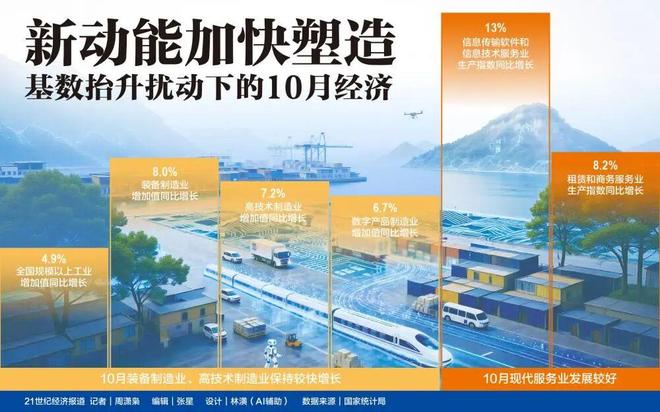
Economic Overview - In October, some economic indicators showed a downward trend due to last year's high base, deep adjustments in the real estate sector, and weak domestic demand [2][6] - Despite the downturn, there were positive signs such as a rebound in service retail sales driven by the National Day and Mid-Autumn Festival holidays, indicating significant consumption potential [2][6] Industrial Performance - The industrial added value for October grew by 4.9% year-on-year, a decline of 1.6 percentage points from the previous month, marking the lowest monthly growth this year [6][12] - The manufacturing sector is transitioning towards high-end production, with equipment manufacturing increasing by 8%, outpacing overall industrial growth [6][10] Investment Trends - From January to October, fixed asset investment (excluding rural households) decreased by 1.7%, with infrastructure investment down by 0.1% and real estate development investment down by 14.7% [7][14] - High-tech sectors such as aerospace and information services saw significant investment growth, with aerospace manufacturing up by 19.7% and information services up by 32.7% [7][12] Trade Dynamics - In October, the total import and export volume grew by 0.1% year-on-year, with exports declining by 0.8% and imports increasing by 1.4% [8][9] - The trade growth slowdown was attributed to last year's high base, with some exports delayed from September due to typhoons [9][10] Policy Measures - The government is implementing policies to enhance the adaptability of supply and demand in consumer goods, aiming to stimulate consumption and investment [3][13] - Recent policies include the introduction of 500 billion yuan in new policy financial tools and the acceleration of local government bond usage to support effective investment [13][14] Economic Outlook - Despite the challenges, the overall economic operation remains stable, with a GDP growth of 5.2% in the first three quarters, laying a solid foundation for achieving the annual target of around 5% [12][15] - Analysts suggest that additional policy measures may be necessary to counteract weak demand and support economic recovery, particularly in the real estate sector [14][15]
10月经济:新动能加快塑造,政策持续加力
21世纪经济报道· 2025-11-15 23:31
Economic Overview - In October, economic indicators showed a downward trend due to factors such as last year's high base, deep adjustments in the real estate sector, and weak domestic demand [1][4] - Despite the downturn, there were positive signs in the economy, particularly in service retail sales, which rebounded due to the National Day and Mid-Autumn Festival holidays, indicating significant consumption potential [1][11] Production and Investment - The industrial added value and service production index both recorded their lowest monthly growth rates of the year in October, with industrial added value growing by 4.9%, down 1.6 percentage points from the previous month [5][11] - Fixed asset investment (excluding rural households) decreased by 1.7% year-on-year from January to October, with infrastructure investment down by 0.1% and real estate development investment down by 14.7% [6][12] Trade and Exports - In October, the total import and export volume grew by only 0.1%, with exports declining by 0.8% and imports increasing by 1.4%, reflecting a significant drop in growth compared to previous months [7][11] Policy Measures - The State Council is implementing measures to enhance the adaptability of supply and demand in consumer goods, aiming to stimulate consumption and improve project funding arrangements [2][12] - Recent policies include the accelerated deployment of 500 billion yuan in new policy financial tools and the utilization of 500 billion yuan in local government debt limits to boost effective investment [12][14] Economic Challenges and Outlook - The economy faces challenges from weak domestic demand and structural issues, necessitating stronger growth policies to reverse the current downward trend and promote recovery [13][14] - Despite the pressures, achieving the annual growth target of around 5% remains likely, with expectations for further fiscal and monetary policy support in the coming months [13][14]

宏观经济专题研究:年度展望之三:“促转型”下的产业格局
Guoxin Securities· 2025-11-15 09:42
Group 1: Economic Transition Insights - China is in a critical phase of economic transition, where the shift from old to new growth drivers is essential for overcoming growth bottlenecks and achieving high-quality development[1] - By 2027, emerging industries are expected to surpass traditional industries in terms of value added, with a projected value of approximately CNY 17.5 trillion for old industries and CNY 14.3 trillion for new industries in 2024[2] - The financial restructuring accompanying industrial transformation has been effective, with the non-performing loan ratio of major banks remaining stable compared to the previous transition period (1998-2002) when it exceeded 25%[2] Group 2: Employment and Structural Changes - Emerging industries have limited direct employment absorption capacity, with the construction industry employing between 12 to 20 million people, significantly outpacing the 6 million in high-tech manufacturing sectors[2] - The service sector's employment share is expected to structurally increase, which may take a longer time to address structural employment issues[2] - The transition from old to new economic drivers is characterized by a gradual shift in employment dynamics, requiring the widespread adoption of new business models and scenarios[2] Group 3: Industry Development Trends - Key emerging sectors such as semiconductors, software development, and maritime equipment are identified as future pillars of the economy, transitioning from "technological breakthroughs" to "commercial realization" phases[3] - The analysis of export comparative advantage indicates significant potential in sectors like optical instruments and chip manufacturing, which are crucial for national strategic goals[3] - The industrial lifecycle analysis shows that industries like software development and gaming are in a growth phase, with capital expenditure focused on technological upgrades and revenue growth[3]
10月经济数据点评:内需增速放缓,看好增长质量
Orient Securities· 2025-11-15 09:18
Economic Overview - Domestic demand growth is slowing, but the quality of growth is expected to improve[6] - Fixed asset investment cumulative year-on-year decreased from -0.5% to -1.7%, slightly below expectations[6] - Real estate development investment has a cumulative year-on-year decline of over -14%[6] Consumption Insights - Retail sales cumulative year-on-year increased by 0.8% compared to the end of last year, indicating resilience in consumer spending[6] - Consumption in sectors like beverages, tobacco, and cosmetics improved by 7.9%, 2.5%, and 1% respectively, while home appliances and automobiles saw declines of -14.6% and -6.6%[6] Export and Production Trends - Export delivery value decreased by -2.1% year-on-year, significantly lower than the previous value of 3.8%[6] - Industrial added value decreased from 6.5% to 4.9% year-on-year, reflecting a slowdown in production[6] Policy and Investment Outlook - New policy financial tools totaling 500 billion yuan have been fully deployed, expected to drive total project investment of about 7 trillion yuan[6] - The government's commitment to support the economy remains strong, despite the time lag in policy effects[6] Risk Factors - The rapid changes in industry dynamics due to "anti-involution" may lead to employment pressures[6]