
市场情绪

Search documents
中信期货晨报:国内商品期货多数上涨,焦煤、硅铁涨幅居前-20250807
Zhong Xin Qi Huo· 2025-08-07 03:37
1. Report Industry Investment Rating - Not mentioned in the provided content 2. Core Viewpoints of the Report - For domestic assets, there are mainly structural opportunities; in the second half of the year, the policy - driven logic will be strengthened, and the probability of incremental policy implementation is higher in the fourth quarter. Overseas, concerns about the decline in US employment and economic slowdown are rising, increasing the expectation of Fed rate cuts in the second half of the year, which is beneficial to gold. In the long - term, the weak US dollar pattern continues, and non - US dollar assets should be watched while being vigilant against volatility jumps [5]. 3. Summary by Relevant Catalogs 3.1 Macro Highlights - **Overseas Macro**: In the early part of the week, the market's bets on Fed rate cuts decreased due to better - than - expected Q2 GDP, tariff easing, hawkish signals from the Fed's July meeting, and an increase in June PCE. However, the non - farm payrolls in July were below expectations, with significant downward revisions in May and June, and a rise in the unemployment rate under the backdrop of a three - month decline in the labor participation rate, increasing concerns about US economic downturn and Fed rate cuts. Attention should be paid to US inflation data on August 12, Fed Chair Powell's speech at the Jackson Hole meeting from August 21 - 23, August non - farm payrolls, and the selection of the Bureau of Labor Statistics director and Fed leadership changes [5]. - **Domestic Macro**: Against the backdrop of stable and progressive domestic economic operation in the first half of the year, the overall tone of the Politburo meeting in July was to improve the quality and speed of using existing policies, with relatively limited incremental policies. The comprehensive PMI in July was still above the critical point. The progress of negotiations between the US and economies such as China and Mexico should be monitored [5]. - **Asset Views**: For major asset classes, domestic assets present mainly structural opportunities. Overseas, concerns about US employment and economic slowdown are rising, increasing the expectation of Fed rate cuts, which is favorable for gold. In the long run, the weak US dollar pattern persists, and non - US dollar assets should be focused on while being cautious of volatility jumps [5]. 3.2 Viewpoint Highlights 3.2.1 Financial - **Stock Index Futures**: After events are settled, the crowding of funds is released. With insufficient incremental funds, the short - term judgment is oscillatory upward [6]. - **Stock Index Options**: The collar strategy strengthens the volatility structure. With upward - trending volatility, the short - term judgment is oscillatory [6]. - **Treasury Bond Futures**: The market continues to digest the information from the Politburo meeting. Concerns include unexpected tariffs, unexpected supply, and unexpected monetary easing. The short - term judgment is oscillatory [6]. 3.2.2 Precious Metals - **Gold/Silver**: As the US fundamentals weaken and the market returns to the logic of restarting the rate - cut cycle, precious metals are oscillating strongly. Concerns include Trump's tariff policy and the Fed's monetary policy. The short - term judgment is oscillatory upward [6]. 3.2.3 Shipping - **Container Shipping to Europe**: Attention should be paid to the game between the peak - season expectation and the implementation of price increases. Concerns include tariff policies and shipping companies' pricing strategies. The short - term judgment is oscillatory [6]. 3.2.4 Black Building Materials - **Steel**: With disruptions in coking coal supply, the futures price shows a strong performance. Concerns include the progress of special bond issuance, steel exports, and molten iron production. The short - term judgment is oscillatory [6]. - **Iron Ore**: With a healthy fundamental situation, the price is oscillating. Concerns include overseas mine production and shipment, domestic molten iron production, weather conditions, port ore inventory changes, and policy dynamics. The short - term judgment is oscillatory [6]. - **Coke**: The fundamentals have not changed significantly, and there is no expectation of price increases in the near future. Concerns include steel mill production, coking costs, and macro sentiment. The short - term judgment is oscillatory [6]. - **Coking Coal**: Supply disruptions continue, and the futures price has risen. Concerns include steel mill production, coal mine safety inspections, and macro sentiment. The short - term judgment is oscillatory [6]. - **Silicon Ferroalloy**: Market sentiment has improved, and the futures price is strongly oscillatory. Concerns include raw material costs and steel procurement. The short - term judgment is oscillatory [6]. - **Manganese Ferroalloy**: The sentiment in the black chain is positive, and the futures price is strongly oscillatory. Concerns include cost prices and foreign quotes. The short - term judgment is oscillatory [6]. - **Glass**: Spot sales and production are weak, and prices in Hubei are continuously decreasing. Concerns include spot sales and production. The short - term judgment is oscillatory [6]. - **Soda Ash**: Some soda ash plants have resumed production, and freight rates have declined. Concerns include soda ash inventory. The short - term judgment is oscillatory [6]. 3.2.5 Non - ferrous Metals and New Materials - **Copper**: The US non - farm payrolls data was below expectations, putting pressure on the copper price. Concerns include supply disruptions, unexpected domestic policies, less - than - expected dovishness from the Fed, less - than - expected recovery in domestic demand, and economic recession. The short - term judgment is oscillatory downward [6]. - **Alumina**: The number of warehouse receipts has increased, and the alumina price is under oscillatory pressure. Concerns include unexpected delays in ore resumption, unexpected over - recovery of electrolytic aluminum production, and extreme sector trends. The short - term judgment is oscillatory downward [6]. - **Aluminum**: Attention should be paid to the height of inventory accumulation, and the aluminum price is oscillating. Concerns include macro risks, supply disruptions, and less - than - expected demand. The short - term judgment is oscillatory [6]. - **Zinc**: With the rebound of black - series prices, the zinc price has slightly recovered. Concerns include macro - turning risks and unexpected increases in zinc ore supply. The short - term judgment is oscillatory downward [6]. - **Lead**: There is still support at the cost end, and the lead price is oscillating. Concerns include supply - side disruptions and a slowdown in battery exports. The short - term judgment is oscillatory [6]. - **Nickel**: The LME nickel inventory has exceeded 210,000 tons, and the nickel price is weakly oscillatory. Concerns include unexpected macro and geopolitical changes, Indonesian policy risks, and less - than - expected supply release. The short - term judgment is oscillatory downward [6]. - **Stainless Steel**: The price of nickel iron has continued to rise, and the stainless - steel futures price has closed up. Concerns include Indonesian policy risks and unexpected demand growth. The short - term judgment is oscillatory [6]. - **Tin**: The market atmosphere has improved, and the tin price has slightly rebounded. Concerns include the expectation of Wa State's resumption of production and changes in demand improvement expectations. The short - term judgment is oscillatory [6]. - **Industrial Silicon**: Market sentiment is fluctuating, and the silicon price is oscillating. Concerns include unexpected supply - side production cuts and unexpected photovoltaic installations. The short - term judgment is oscillatory [6]. - **Lithium Carbonate**: The market direction is unclear, and the lithium carbonate price is oscillating. Concerns include less - than - expected demand, supply disruptions, and new technological breakthroughs. The short - term judgment is oscillatory [6]. 3.3 Energy and Chemicals - **Crude Oil**: Geopolitical expectations are fluctuating, and attention should be paid to Russian oil risks. Concerns include OPEC+ production policies and Middle - East geopolitical situations. The short - term judgment is oscillatory [8]. - **LPG**: Supply pressure continues, and the cost end dominates the rhythm. Concerns include the progress of crude oil and overseas propane costs. The short - term judgment is oscillatory [8]. - **Asphalt**: The pressure on the spot market has increased, and the high - valued asphalt price has finally declined. Concerns include unexpected demand. The short - term judgment is downward [8]. - **High - Sulfur Fuel Oil**: High - sulfur fuel oil is regarded as weak. Concerns include crude oil and natural gas prices. The short - term judgment is downward [8]. - **Low - Sulfur Fuel Oil**: The price of low - sulfur fuel oil futures has weakened following crude oil. Concerns include crude oil and natural gas prices. The short - term judgment is downward [8]. - **Methanol**: The rebound of the coal end has had some impact, and methanol is oscillating. Concerns include macro - energy and upstream - downstream device dynamics. The short - term judgment is oscillatory [8]. - **Urea**: Domestic supply and demand cannot provide strong support, and export - driven effects are less than expected. Urea will oscillate in the short term. Concerns include export policy trends and the elimination of production capacity. The short - term judgment is oscillatory [8]. - **Ethylene Glycol**: Typhoons have affected the arrival rhythm, and the expectation in August has shifted to inventory accumulation. Concerns include the inflection point of port inventory accumulation and device recovery. The short - term judgment is oscillatory [8]. - **PX**: Market sentiment has cooled, and the price has returned to fundamental pricing. Concerns include the maintenance rhythm of downstream PTA and seasonal changes in gasoline profits. The short - term judgment is oscillatory [8]. - **PTA**: Multiple devices have unexpectedly shut down briefly, and the processing fee is still under pressure. Concerns include the planned shutdown of mainstream devices and the intensity of polyester joint production cuts. The short - term judgment is oscillatory [8]. - **Short - Fiber**: The improvement in downstream demand is limited, and there is an expectation of continuous inventory accumulation for short - fiber. Concerns include the procurement rhythm and start - up of downstream yarn mills. The short - term judgment is oscillatory [8]. - **Bottle Chip**: The production cut scale in August will continue to exceed 20%, and the support below the processing fee has increased. Concerns include the future start - up of bottle chips. The short - term judgment is oscillatory [8]. - **Propylene**: It mainly follows market fluctuations and oscillates in the short term. Concerns include oil prices and domestic macro factors. The short - term judgment is oscillatory [8]. - **PP**: The support from oil and coal still shows differences, and PP is oscillating. Concerns include oil prices and domestic and international macro factors. The short - term judgment is oscillatory [8]. - **Plastic**: There is a slight impact from the coal end, and plastic is oscillating. Concerns include oil prices and domestic and international macro factors. The short - term judgment is oscillatory [8]. - **Styrene**: The commodity sentiment has improved, and attention should be paid to the implementation of policy details. Concerns include oil prices, macro policies, and device dynamics. The short - term judgment is oscillatory [8]. - **PVC**: It has returned to weak - reality pricing, and the futures price is oscillating downward. Concerns include expectations, costs, and supply. The short - term judgment is oscillatory [8]. - **Caustic Soda**: The pressure on the spot market is emerging, and caustic soda is running weakly. Concerns include market sentiment, start - up, and demand. The short - term judgment is oscillatory [8]. 3.4 Agriculture - **Oils and Fats**: Yesterday, soybean oil was strong, and there is a strong expectation of a month - on - month increase in Malaysian palm oil production in July. Concerns include US soybean weather and Malaysian palm oil production and demand data. The short - term judgment is oscillatory upward [8]. - **Protein Meal**: During the peak season of aquaculture, rapeseed meal is stronger than soybean meal. Concerns include US soybean weather, domestic demand, macro factors, and Sino - US and Sino - Canadian trade disputes. The short - term judgment is oscillatory [8]. - **Corn/Starch**: Market sentiment continues to be weak, and the futures price is oscillating at the bottom. Concerns include less - than - expected demand, macro factors, and weather. The short - term judgment is oscillatory [8]. - **Hogs**: The expectation of production cuts has caused fluctuations, and the futures price has rebounded. Concerns include breeding sentiment, epidemics, and policies. The short - term judgment is oscillatory [8]. - **Rubber**: Positive macro factors have driven up the rubber price. Concerns include production - area weather, raw material prices, and macro changes. The short - term judgment is oscillatory [8]. - **Synthetic Rubber**: Tight raw material supply supports the futures price. Concerns include significant fluctuations in crude oil prices. The short - term judgment is oscillatory [8]. - **Pulp**: The weak trend of the futures price remains unchanged, and attention should be paid to reverse arbitrage during the decline. Concerns include macro - economic changes and fluctuations in US dollar - denominated quotes. The short - term judgment is oscillatory [8]. - **Cotton**: The impact of macro factors has weakened, and cotton price trading has returned to fundamentals. Concerns include demand and inventory. The short - term judgment is oscillatory [8]. - **Sugar**: The marginal supply pressure has increased, and the sugar price is under downward pressure. Concerns include imports. The short - term judgment is oscillatory [8]. - **Log**: The fundamentals have changed little, and it should be treated within a range. Concerns include shipment volume and dispatch volume. The short - term judgment is oscillatory downward [8].
减产预期扰动,生猪盘面反弹
Zhong Xin Qi Huo· 2025-08-07 02:37
1. Report Industry Investment Ratings - **Oils and Fats**: Oscillating with a slight upward bias [8] - **Protein Meal**: Oscillating [9] - **Corn/Starch**: Oscillating with a slight downward bias [10] - **Hogs**: Oscillating [11] - **Natural Rubber**: Oscillating [13] - **Synthetic Rubber**: Oscillating [15] - **Cotton**: Oscillating [16] - **Sugar**: Long - term: oscillating with a downward bias; Short - term: maintain the view of shorting on rebounds [17] - **Pulp**: Oscillating [18] - **Logs**: Oscillating with a slight downward bias [19] 2. Core Views of the Report The report analyzes multiple agricultural products, including oils and fats, protein meal, corn/starch, hogs, rubber, cotton, sugar, pulp, and logs. It provides insights into their market trends, supply - demand relationships, and price outlooks. For example, the hog market shows a pattern of "weak present + strong future" due to policy - induced production - cut expectations; the oils and fats market is expected to be oscillating with a slight upward bias considering overseas bio - diesel demand and domestic export expectations [11][8]. 3. Summary According to Relevant Catalogs 3.1 Market Views 3.1.1 Oils and Fats - **Industry Information**: MPOA data shows a 9.01% month - on - month increase in estimated Malaysian palm oil production in July. The overall estimated production is 1.84 million tons. ITS and AmSpec data indicate a decline in July's Malaysian palm oil exports [8]. - **Logic**: Due to the expected high yield of US soybeans and concerns about demand, US soybeans fell on Tuesday. Domestic oils showed a differentiated trend, with soybean oil being stronger. The global and domestic supply - demand situation of different oils varies, with soybean oil having inventory increases and export expectations, palm oil facing inventory pressure, and rapeseed oil having high inventory [8]. - **Outlook**: In the short - term, palm oil and soybean oil are likely to be stronger, influenced by the expected increase in overseas bio - diesel demand and domestic soybean oil export expectations [8]. 3.1.2 Protein Meal - **Industry Information**: On August 6, 2025, international soybean trade premiums and discounts showed different trends. The average profit of Chinese imported soybean crushing increased [9]. - **Logic**: Internationally, the good growth of US soybeans and the expected high yield, along with changes in trade relations and CFTC net short positions, affect the market. Domestically, in the short - term, due to the peak season of aquaculture, rapeseed meal is stronger than soybean meal. In the long - term, there is a potential supply gap in the fourth quarter [9]. - **Outlook**: In the next two weeks, the inventory of soybean meal may reach a peak. Spot and basis prices may oscillate at a low level. The far - month contracts are expected to strengthen [9]. 3.1.3 Corn/Starch - **Industry Information**: The average domestic corn price and the closing price of the main contract decreased [10]. - **Logic**: On the supply side, there are differences in the judgment of channel inventory, and the auction transaction rate of imported corn is low. On the demand side, downstream acceptance of high - priced grains is low. Policy - wise, the transaction rate and premium of imported corn are decreasing [10]. - **Outlook**: In the short - term, there is uncertainty in the old - crop inventory reduction. After the new - crop is listed, there is a downward pressure on prices [10]. 3.1.4 Hogs - **Industry Information**: On August 6, the spot price of hogs in Henan decreased slightly, while the futures closing price increased [11]. - **Logic**: The proposed meeting by the China Animal Husbandry Association to discuss sow production cuts triggered market sentiment. In the short - term, large - scale farms are actively reducing weight and inventory, but the inventory of secondary - fattening by smallholders is high. In the medium - term, the supply is expected to increase. In the long - term, policies may lead to a reduction in production capacity [11]. - **Outlook**: The hog market shows large fluctuations. The spot and near - month contracts are under pressure, while the far - month contracts are influenced by production - cut expectations [11]. 3.1.5 Natural Rubber - **Industry Information**: The prices of various rubber products in Qingdao Free Trade Zone remained stable, and the prices of raw materials in the Thai market increased slightly [13]. - **Logic**: The macro - environment is favorable, and there is some speculative sentiment in the market. The supply is limited due to the rainy season, and the demand is relatively stable in the short - term [13]. - **Outlook**: In the short - term, it follows the overall commodity sentiment, and attention should be paid to capital sentiment [13]. 3.1.6 Synthetic Rubber - **Industry Information**: The prices of butadiene rubber and butadiene showed different trends [15]. - **Logic**: The BR futures rose slightly, driven by natural rubber and the macro - environment, and supported by the tight supply of butadiene. However, the fundamental driving force is not clear [15]. - **Outlook**: It will generally maintain an oscillating range, and attention should be paid to device changes [15]. 3.1.7 Cotton - **Industry Information**: As of August 6, the number of registered warrants and the closing price of Zhengzhou cotton increased slightly [16]. - **Logic**: In the 2025/2026 season, the global cotton supply is expected to be abundant. The downstream demand is in the off - season, and the inventory is at a low level compared to the same period. The price is oscillating within a range [16]. - **Outlook**: It will oscillate within the range of 13,500 - 14,300 yuan/ton, and attention should be paid to the 11 - 1 reverse spread [16]. 3.1.8 Sugar - **Industry Information**: On August 6, the closing price of Zhengzhou sugar decreased [17]. - **Logic**: In the long - term, the new season is expected to have a loose supply. In the short - term, the supply pressure will increase due to the peak production and export season in Brazil and the concentrated import in China [17]. - **Outlook**: In the long - term, the price is expected to oscillate with a downward bias. In the short - term, it is recommended to short on rebounds [17]. 3.1.9 Pulp - **Industry Information**: The prices of various pulp products in Shandong remained stable or decreased slightly [18]. - **Logic**: The futures price fluctuated at a low level. The supply of broad - leaf pulp is abundant, the demand is weak, and the overseas market is also weak. However, the recent increase in domestic broad - leaf pulp prices is worth noting [18]. - **Outlook**: It is expected to oscillate widely, and attention can be paid to the low - absorption long - matching opportunity when the main contract falls to 5,200 - 5,250 yuan/ton [18]. 3.1.10 Logs - **Industry Information**: After the first - month delivery of logs, the short - term fundamentals changed little [19]. - **Logic**: The new foreign quotation has increased, but the domestic market is in the off - season. There are both positive and negative factors in the market, and the supply pressure is gradually easing [19]. - **Outlook**: The market is intertwined with multiple factors. It is recommended to operate within the range of 800 - 850, and the industrial side can participate in hedging according to its own costs [19]. 3.2 Variety Data Monitoring The report also mentions data monitoring for various products such as oils and fats, corn/starch, hogs, rubber, cotton, sugar, pulp, and logs, but specific data details are not provided in the text [22][53][72].
建信期货MEG日报-20250807
Jian Xin Qi Huo· 2025-08-07 01:44
行业 MEG 日报 日期 2025 年 08 月 07 日 料油) 021-60635738 lijie@ccb.ccbfutures.com 期货从业资格号:F3031215 021-60635737 renjunchi@ccb.ccbfutures.com 期货从业资格号:F3037892 业硅)028-8663 0631 penghaozhou@ccb.ccbfutures.c om期货从业资格号:F3065843 021-60635740 pengjinglin@ccb.ccbfutures.c om期货从业资格号:F3075681 021-60635570 liuyouran@ccb.ccbfutures.com 期货从业资格号:F03094925 021-60635727 fengzeren@ccb.ccbfutures.com 能源化工研究团队 研究员:李捷,CFA(原油燃 研究员:任俊弛(PTA、MEG) 研究员:彭浩洲(尿素、工 研究员:彭婧霖(聚烯烃) 研究员:刘悠然(纸浆) 研究员:冯泽仁(玻璃纯碱) 期货从业资格号:F03134307 请阅读正文后的声明 | 表1:期货行情 | | | ...
贝伦贝格多资产策略与研究主管Ulrich Urbahn表示:市场情绪依然脆弱,因为投资者正在判断关税对盈利能力和供应链的真正影响
Sou Hu Cai Jing· 2025-08-06 19:41
贝伦贝格多资产策略与研究主管Ulrich Urbahn表示:市场情绪依然脆弱,因为投资者正在判断关税对盈 利能力和供应链的真正影响。然而,优质欧洲股票具有韧性的基本面,以及美联储即将降息的预期,均 有助于稳定风险偏好。 ...
市场情绪亮红灯,美股多头再添一忧
智通财经网· 2025-08-06 11:44
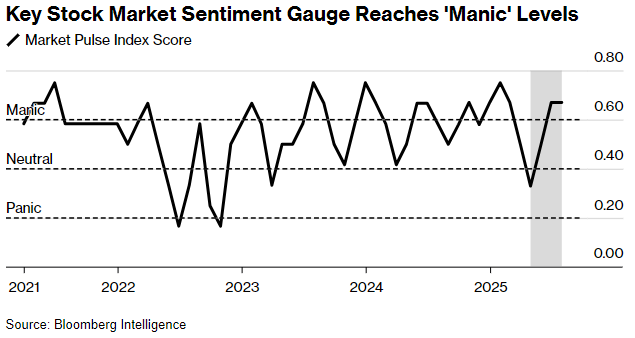
Core Viewpoint - The strong rebound in the U.S. stock market may soon cool down, raising concerns among bulls as the Bloomberg Intelligence Market Pulse Index indicates that investor sentiment may be overheated [1][4]. Group 1: Market Sentiment and Indicators - The Bloomberg Intelligence Market Pulse Index reached the "euphoria" zone last month, suggesting that investor sentiment is at a high level, which historically leads to weaker returns in the following three months [1][4]. - The S&P 500 index rebounded nearly 30% from its April low, despite signs of weakness in the U.S. economy and labor market [1]. - The index recorded a value of 0.6 in July, remaining in the "euphoria" zone for the second consecutive month, which historically correlates with lower average returns for the Russell 3000 index in the following three months [4][5]. Group 2: Historical Context and Predictions - Historical data shows that when the Market Pulse Index enters the "euphoria" zone, the average return for the Russell 3000 index over the next three months is only 2.9%, while it can reach 9% when in the "panic" zone [4]. - Analysts from Morgan Stanley and Evercore predict potential market corrections of 10% and 15%, respectively, indicating a consensus on the likelihood of a downturn [4][5]. - Seasonal factors are also a concern, as August and September are historically the worst-performing months for the S&P 500 index [4]. Group 3: Investor Behavior and Market Dynamics - The recent surge in the Market Pulse Index is partly attributed to a resurgence in meme stocks, with retail investors flocking to speculative stocks like Opendoor Technologies and Kohl's [5]. - The Market Pulse Index is based on six indicators, including price breadth and high-yield bond spreads, with a reading of 0.7 in July indicating extreme risk appetite [6]. - Continuous readings above 0.6 typically suggest mean reversion in the stock market, with small-cap stocks expected to underperform large-cap stocks in the following months [7].

国投期货化工日报-20250806
Guo Tou Qi Huo· 2025-08-06 11:06
Report Industry Investment Ratings - Urea: ★☆☆ (Predicted to have a bullish trend, but the market is not very operable) [1] - Methanol: ★★★ (Predicted to have a clear bullish trend, and there are still relatively appropriate investment opportunities) [1] - Pure Benzene: ★☆☆ (Predicted to have a bullish trend, but the market is not very operable) [1] - Styrene: ★★★ (Predicted to have a clear bullish trend, and there are still relatively appropriate investment opportunities) [1] - Polypropylene: ☆☆☆ (The short - term long/short trend is in a relatively balanced state, and the market is not very operable, it is recommended to wait and see) [1] - Plastic: ★☆☆ (Predicted to have a bullish trend, but the market is not very operable) [1] - PVC: ★☆☆ (Predicted to have a bullish trend, but the market is not very operable) [1] - Caustic Soda: ★★★ (Predicted to have a clear bearish trend, and there are still relatively appropriate investment opportunities) [1] - PX: ★★★ (Predicted to have a clear bullish trend, and there are still relatively appropriate investment opportunities) [1] - PTA: ☆☆☆ (The short - term long/short trend is in a relatively balanced state, and the market is not very operable, it is recommended to wait and see) [1] - Ethylene Glycol: ★★★ (Predicted to have a clear bullish trend, and there are still relatively appropriate investment opportunities) [1] - Short Fiber: ★☆☆ (Predicted to have a bullish trend, but the market is not very operable) [1] - Glass: ★☆☆ (Predicted to have a bullish trend, but the market is not very operable) [1] - Soda Ash: ☆☆☆ (The short - term long/short trend is in a relatively balanced state, and the market is not very operable, it is recommended to wait and see) [1] - Bottle Chip: ★★★ (Predicted to have a clear bullish trend, and there are still relatively appropriate investment opportunities) [1] - Propylene: ★★★ (Predicted to have a clear bullish trend, and there are still relatively appropriate investment opportunities) [1] Core Viewpoints - The report analyzes the market conditions of various chemical products, including supply, demand, price trends, and provides corresponding investment ratings based on these factors [1][2][3][5][6][7][8] Summary by Related Catalogs Olefins - Polyolefins - Propylene futures fluctuated around the 5 - day moving average. Low prices, improved downstream product profits, and reduced supply due to unexpected shutdowns of local PDH plants supported the price [2] - Polyolefin futures had a narrow - range intraday fluctuation. Polyethylene's short - term production is expected to increase, with both supply and demand rising recently. Polypropylene's prices are stable, and some offers are tentatively raised, but downstream procurement is weak [2] Pure Benzene - Styrene - Pure benzene prices rebounded. Domestic supply increased, demand was weak, but port inventory decreased. There is an expected improvement in supply - demand in the third - quarter and pressure in the fourth - quarter [3] - Styrene futures prices declined. The expected output of a new plant may have a negative impact, and the supply - demand fundamentals are weak [3] Polyester - PTA prices rebounded. New plant production and increased output from existing plants pressured the supply, but production cuts may boost the market. PX may face demand decline if PTA production cuts increase [5] - Ethylene glycol prices rebounded. Supply is expected to continue to rise, and there is an expected increase in demand [5] - Short fiber prices followed the raw materials and sales improved. There is limited new capacity this year, and the peak - season demand is expected to boost the industry [5] - Bottle chip's low - start operation led to stable inventory, but over - capacity is a long - term pressure [5] Coal Chemical Industry - Methanol prices rose slightly. Coastal olefin plants have low operation rates, and ports are expected to accumulate inventory. In the long - term, the approaching peak - season demand should be monitored [6] - Urea market sentiment cooled. The Indian tender price boosted the spot market, but short - term supply - demand is loose, and the focus is on export policy changes [6] Chlor - Alkali - PVC prices fluctuated strongly. Cost support increased, but supply increased and demand was weak, so short - term prices are expected to fluctuate weakly [7] - Caustic soda prices fluctuated weakly. Comprehensive profit improved, but long - term supply pressure remains, and prices are expected to be under pressure [7] Soda Ash - Glass - Soda ash prices fluctuated. High - price resistance led to a downward shift. Supply is high, and the long - term market is weak, but prices are unlikely to fall below the previous low [8] - Glass prices fluctuated. Mid - stream sales led to a decline in spot prices, and the market is in a state of inventory accumulation [8]
华宝期货黑色产业链周报-20250804
Hua Bao Qi Huo· 2025-08-04 14:13
1. Investment Rating - No investment rating for the industry is provided in the report. 2. Core Views - **Overall**: The black - series market has entered a high - level consolidation period due to the disappointment of policy increment expectations from important domestic meetings. The market trading focus has returned to the industrial fundamentals [12]. - **Steel Products**: The short - term market fluctuations are large, and it is recommended to wait and see. Attention should be paid to macro - policies and downstream demand [9]. - **Iron Ore**: In the short term, it will operate within a range. After the disappointment of policy expectations, the market will enter a policy vacuum period, and the price will fluctuate at a high level. The i2601 contract price is expected to be in the range of 745 yuan/ton - 780 yuan/ton, and the outer - market FE09 contract price is in the range of 98.5 - 103 US dollars/ton [12]. - **Coking Coal and Coke**: The market speculation sentiment has cooled down, and the short - term price fluctuations have intensified. It is recommended to wait and see. Attention should be paid to coal production data, the sustainability of high daily iron - water production of steel mills, and changes in imported coal clearance [13]. - **Ferroalloys**: After important meetings, the market sentiment has cooled down. The alloy price is expected to follow the black - metal market trend, and the short - term fluctuation range may increase. Attention should be paid to steel procurement and supply - side policy implementation [14]. 3. Summary by Directory 3.1 Week - on - Week Market Review - **Futures Prices**: The prices of most varieties in the black - series futures market declined last week. For example, the price of rebar RB2510 dropped from 3356 yuan/ton on July 25th to 3203 yuan/ton on August 1st, a decrease of 4.56%. The price of coking coal JM2601 dropped from 1318.5 yuan/ton to 1092.5 yuan/ton, a decrease of 17.14% [7]. - **Spot Prices**: The spot prices of most varieties also showed a downward trend. For example, the price of HRB400E Φ20 rebar in Shanghai dropped from 3430 yuan/ton to 3360 yuan/ton, a decrease of 2.04%. The price of Rizhao Port's quasi - first - grade coke dropped from 1430 yuan/ton to 1380 yuan/ton, a decrease of 3.50% [7]. 3.2 This Week's Black - Series Market Forecast - **Steel Products** - **Logic**: The macro - sentiment has a greater impact on the market. The blast - furnace utilization rate and daily iron - water output of 247 steel mills decreased slightly, while the average capacity utilization rate and operating rate of 90 independent electric - arc furnace steel mills increased. The fundamentals of steel products are neutral to bearish, and the market is mainly influenced by macro and market sentiment [9]. - **View**: Wait and see due to large short - term fluctuations [9]. - **Attention Points**: Macro - policies and downstream demand [9]. - **Iron Ore** - **Logic**: The policy expectations have failed to materialize. On the supply side, the support from external mines is gradually weakening, and the supply may increase in the medium term. On the demand side, the daily iron - water output has declined, but the demand still has some resilience. The inventory is expected to be stable or increase slightly in the short term [12]. - **View**: It will operate within a range in the short term, and the price will fluctuate at a high level [12]. - **Attention Points**: Military parade production - restriction policies, the Fed's interest - rate cut expectations, and the supply recovery speed [11]. - **Coking Coal and Coke** - **Logic**: The market speculation sentiment has cooled down. The coal - coke futures prices have oscillated and declined. The production of some Shanxi coal mines has decreased, and the demand for coking coal still has some resilience. The inventory is affected by factors such as production and demand [13]. - **View**: Wait and see due to intensified short - term price fluctuations [13]. - **Attention Points**: Coal production data, the sustainability of high daily iron - water production of steel mills, and changes in imported coal clearance [13]. - **Ferroalloys** - **Logic**: The market sentiment has cooled down. On the supply side, the production of silicon - manganese and silicon - iron has increased. On the demand side, the demand for silicon - manganese has increased slightly, while the demand for silicon - iron has decreased. The inventory situation of the two is different. The cost side has certain support [14]. - **View**: The price will follow the black - metal market trend, and the short - term fluctuation range may increase [14]. - **Attention Points**: Tariff policy changes, domestic macro - policies, terminal demand, steel mill profits and production, and domestic production - restriction policies [14]. 3.3 Product Data - **Steel Products** - **Rebar**: Last week, the output was 211.06 tons (a week - on - week decrease of 0.9 tons), the apparent demand was 203.41 tons (a week - on - week decrease of 13.17 tons), and the total inventory increased by 7.65 tons [16]. - **Hot - Rolled Coil**: Last week, the output was 322.79 tons (a week - on - week increase of 5.3 tons), the apparent demand was 320 tons (a week - on - week increase of 4.76 tons), and the total inventory increased by 2.79 tons [33]. - **Iron Ore** - **Port Inventory**: The total inventory of imported ore at 45 ports was 13657.90 tons last week, a week - on - week decrease of 132.48 tons [47]. - **Steel Mill Inventory and Consumption**: The inventory of 247 steel mills was 9012.09 tons, a week - on - week increase of 126.87 tons, and the daily consumption was 299.46 tons/ day, a week - on - week decrease of 1.64 tons [55]. - **Global Shipment**: The global total shipment was 3200.9 tons last week, a week - on - week increase of 91.8 tons [69]. - **Coking Coal and Coke** - **Inventory**: The total inventory of coke was 915.4 tons last week, a week - on - week decrease of 2.83 tons; the total inventory of coking coal was 2493.29 tons, a week - on - week decrease of 37.96 tons [98][106]. - **Profit and Utilization Rate**: The average profit per ton of coke for independent coking enterprises was - 45 yuan last week, a week - on - week increase of 9 yuan, and the capacity utilization rate was 73.7%, a week - on - week increase of 0.2% [115]. - **Ferroalloys** - **Spot Price**: The price of semi - carbonate manganese ore in Tianjin Port was 35 yuan/dry ton - degree last week, a week - on - week increase of 0.5 yuan; the price of silicon - manganese was 5720 yuan/ton, a week - on - week increase of 20 yuan; the price of silicon - iron was 5500 yuan/ton, unchanged from the previous week [131]. - **Production and Demand**: The output of silicon - manganese was 190820 tons last week, a week - on - week increase of 4340 tons; the demand for silicon - manganese was 123715 tons, a week - on - week increase of 45 tons [137][144]. - **Inventory**: The inventory of silicon - manganese was 164000 tons on August 1st, a week - on - week decrease of 41000 tons; the inventory of silicon - iron was 65590 tons, a week - on - week increase of 3460 tons [148].
美股7月十次创新高背后的“危险信号”:企业高管狂卖自家股票
Zhi Tong Cai Jing· 2025-08-04 13:11
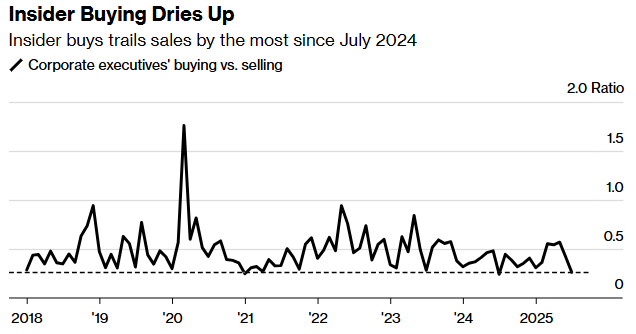
7 月份,投资者们纷纷涌入美国股市,使得标普500指数在一个月内创下了10次历史新高,但有一个重 要的群体却与他们背道而驰:企业高管们。据Washington Service收集的数据,上个月仅在151家标普500 指数成分公司中,有内部人员自行购入了公司股票,这一数字是至少自2018年以来的最低水平。尽管企 业内部人员在7月份的抛售行为较6月份有所放缓,但购入量的下降幅度更大,使得购销比达到了一年来 的最低水平。 与市场情绪分化 高管们的偏好下降是在股市上涨势头似乎逐渐减弱之时发生的,甚至在周五的抛售之前就已经如此。在 经历了6月份5%的涨幅和5月份6.2%的涨幅之后,标准普尔500指数在7月份上涨了2.2%。不过,这三个 月的上涨行情突然使得标普500指数估值过高,其市盈率已接近23倍(远高于10年平均值约18倍)。 因此,企业领导层采取谨慎态度(因为他们最了解自己的企业状况)这一现象,可能表明他们对自身市场 估值存在担忧,同时也担心特朗普总统实施的全面全球关税政策会对公司业绩造成负面影响。 Roundhill Investments首席执行官Dave Mazza表示:"目前,企业高管们的行事方式与机构投 ...
量化择时周报:模型提示情绪进一步提升,密切关注后续指标波动-20250804
Shenwan Hongyuan Securities· 2025-08-04 03:13
Group 1 - The market sentiment index has risen to 3.2, up from 1.8 the previous week, indicating a bullish outlook, but caution is advised as high sentiment levels can lead to sensitive directional changes [10][4][8] - The price-volume consistency indicator has increased, suggesting higher capital activity and reduced divergence in market sentiment, while the financing ratio continues to decline [13][4] - The total trading volume for the week remained high, with the peak on Thursday at 1961.849 billion RMB and a significant drop on Friday to 1619.884 billion RMB [17][4] Group 2 - The industry performance shows a clear upward trend in anti-involution related sectors, with basic chemicals and electronics leading the gains, while automotive, environmental, and oil sectors lag behind [26][29] - The short-term scores for most industries have generally decreased, with computer, media, communication, and food and beverage sectors showing slight increases [33][34] - The model indicates a preference for small-cap growth styles, with the RSI model also suggesting a growth style advantage, although the 5-day RSI has decreased compared to the 20-day RSI [36][37]
钢材周度策略报告:把拳头收回来,是为了更有力打出去-20250804
Hua An Qi Huo· 2025-08-04 01:47
1. Report Industry Investment Rating There is no relevant content provided in the report. 2. Core Viewpoints of the Report - This week, the inventory of the five major steel products increased by 153,900 tons to 1.35189 million tons, ending a four - week decline and reaching a seven - week high. The social inventory increased by 153,900 tons, and the steel mill inventory increased slightly by 1,000 tons. Specifically, the social inventory of rebar increased by 111,700 tons, while the steel mill inventory decreased by 35,200 tons. The weekly output decreased slightly, and the apparent demand decreased by 6.08% or 131,700 tons to 2.0341 million tons, the lowest in five months. The output increase of hot - rolled coils was greater than the inventory increase, and the apparent demand rebounded by 47,600 tons to 3.2 million tons. The apparent demand for cold - rolled and medium - thick plates fluctuated relatively little [2]. - Currently, the proportion of industrial logic is gradually increasing, and policy expectations are decreasing. After important events such as Sino - US tariff negotiations, the Politburo meeting, and the US interest - rate meeting have concluded, market sentiment has significantly cooled. In the short term, prices have entered a period of volatile consolidation, but the upward trend is expected to remain unchanged, although the momentum has slowed. In the later stage, attention should be paid to whether terminal demand can show better - than - expected performance [2]. - In the short term, the market will experience volatile consolidation, while in the long term, the upward trend remains unchanged [2]. 3. Summary According to the Catalog 3.1 Market Review and Price Performance 3.1.1 Futures and Spot Trend Review - Futures market: This week, the main RB2510 rebar contract retraced, closing at 3,205 yuan/ton, a week - on - week decrease of 89 yuan/ton, with a position of 1.816 million lots, a decrease of 90,000 lots. The main HC2510 hot - rolled coil contract slightly retraced, closing at 33,902 yuan/ton, a week - on - week decrease of 66 yuan/ton, with a position of 1.4339 million lots, a decrease of 73,800 lots [5]. - Spot market: This week, the spot price of rebar moved lower. As of July 31, the price of HRB400E 20MM in Beijing decreased by 60 yuan/ton to 3,270 yuan/ton compared with last week. The spot price of hot - rolled coils also moved lower. As of July 31, the price of Benxi Steel 5.75*1500*C:Q235B in Tianjin decreased by 30 yuan/ton to 3,370 yuan/ton compared with last week [6]. 3.1.2 Spread Changes - Futures - spot spread: This week, the basis of the main RB2510 rebar contract compared with the HRB400E 20MM spot in Shanghai was 165 yuan/ton, a change of +91 yuan/ton compared with the previous week. The basis of the main HC2510 hot - rolled coil contract compared with the 5.5*1500*C:Q235B:Ansteel spot in Shanghai was 40 yuan/ton, a change of +57 yuan/ton compared with the previous week [11]. - Inter - monthly spread: This week, the RB2601 - RB2510 spread was 56 yuan/ton, a change of +13 yuan/ton compared with the previous week. The HC2601 - HC2510 spread was 7 yuan/ton, a change of - 4 yuan/ton compared with the previous week [12]. - Rebar - hot - rolled coil spread: This week, the HC2510 - RB2510 spread was 185 yuan/ton, a change of +34 yuan/ton compared with the previous week. The HC2601 - RB2601 spread was 136 yuan/ton, a change of +17 yuan/ton compared with the previous week [13]. 3.2 Supply - Demand Situation Analysis 3.2.1 Supply - This week, the blast furnace operating rate of 247 steel mills surveyed by Mysteel was 83.46%, unchanged from last week and 2.18 percentage points higher than last year. The steel mill profitability rate was 65.37%, an increase of 1.73 percentage points from last week and 58.88 percentage points higher than last year. The daily average pig iron output was 2.4071 million tons, a decrease of 15,200 tons from last week but an increase of 40,900 tons compared with last year [20]. - The total weekly output of the five major steel products was 867,420 tons, a week - on - week increase of 450 tons. The increase was mainly in cold - and hot - rolled coils, while the output of other varieties decreased to varying degrees [20]. - The profitability rate of 247 steel mills continued to increase to 65.37%, reaching a high in more than nine months. The blast furnace operating rate remained unchanged at 83.46% for the third consecutive week. The blast furnace iron - making capacity utilization rate decreased to 90.24%, and the daily average pig iron output continued to decline by 15,200 tons to 2.4071 million tons, but the year - on - year increase still reached 1.73% [20]. 3.2.2 Demand - Recently, the State Council approved the construction of a hydropower project in the lower reaches of the Yarlung Zangbo River with a total investment of 1.2 trillion yuan, indicating good prospects for future infrastructure steel demand. - On the 31st, the third round of Sino - US economic and trade negotiations ended, and both sides agreed to extend the tariff truce period originally due to expire on August 12 by 90 days. The tariffs on China remained the same as before. There are signs of easing in Sino - US trade frictions and expectations of future Fed rate cuts. It is expected that the path for the implementation of the off - season logic will be less smooth, and demand will maintain a certain level of resilience. Currently, the demand for hot - rolled coils is still stronger than that for rebar, and this pattern is expected to continue for some time due to the arrival of the seasonal off - season for building materials [30]. 3.2.3 Inventory - This week, the social inventory of steel products in major cities across the country was 942,370 tons, a week - on - week increase of 152,900 tons. The inventory of steel mills by variety was 409,520 tons, a week - on - week increase of 1,000 tons. The total inventory of social and steel mills was 1.35189 million tons, a week - on - week increase of 153,900 tons. The overall inventory is at a low level compared with the same period, and steel mills have significantly reduced their inventory, transferring it downstream, continuing a certain de - stocking trend [36]. 3.2.4 Profit - The profitability rate of 247 steel mills continued to increase to 65.37%, reaching a high in more than nine months. The blast furnace operating rate remained unchanged at 83.46% for the third consecutive week. The blast furnace iron - making capacity utilization rate decreased to 90.24%, and the daily average pig iron output continued to decline by 15,200 tons to 2.4071 million tons, but the year - on - year increase still reached 1.73% [47]. - With the recovery of profits, electric - arc furnace steel mills continued to increase production and resume production, resulting in a significant increase in the operating rate and capacity utilization rate. However, due to poor steel sales, the overall recovery amplitude narrowed. As of July 30, the average operating rate of 87 independent electric - arc furnace steel mills in the country increased by 2.19% to 74.21%, and the capacity utilization rate increased by 1.56% to 57.05%, both reaching an eight - week high [47]. 3.2.5 Raw Material Prices - Affected by domestic policies this week, the prices of major raw materials fluctuated significantly. The price of Tangshan steel billets decreased by 100 yuan/ton to 3,097 yuan/ton, and the price of 61.5% PB powder decreased by 17 yuan/ton to 765 yuan/ton [56]. 3.3 Summary and Investment Suggestions - This week, the inventory of the five major steel products increased by 153,900 tons to 1.35189 million tons, ending a four - week decline and reaching a seven - week high. The social inventory increased by 153,900 tons, and the steel mill inventory increased slightly by 1,000 tons. Specifically, the social inventory of rebar increased by 111,700 tons, while the steel mill inventory decreased by 35,200 tons. The weekly output decreased slightly, and the apparent demand decreased by 6.08% or 131,700 tons to 2.0341 million tons, the lowest in five months. The output increase of hot - rolled coils was greater than the inventory increase, and the apparent demand rebounded by 47,600 tons to 3.2 million tons. The apparent demand for cold - rolled and medium - thick plates fluctuated relatively little [60]. - Currently, the proportion of industrial logic is gradually increasing, and policy expectations are decreasing. After important events such as Sino - US tariff negotiations, the Politburo meeting, and the US interest - rate meeting have concluded, market sentiment has significantly cooled. In the short term, prices have entered a period of volatile consolidation, but the upward trend is expected to remain unchanged, although the momentum has slowed. In the later stage, attention should be paid to whether terminal demand can show better - than - expected performance [60].