
资金面

Search documents
广发期货日评-20250912
Guang Fa Qi Huo· 2025-09-12 06:44
1. Report Industry Investment Ratings No specific industry investment ratings are provided in the report. 2. Core Views - In September, the direction of the second - half monetary policy is crucial for the equity market. A - shares may enter a high - level shock pattern after a large increase, and the risk has been largely released [2]. - The 10 - year Treasury bond interest rate has strong gaming power around 1.8%, and an incremental drive is needed to choose a direction. The bond market shows a differentiated trend with the long - end being weak and the short - end being strong [2]. - The U.S. employment market continues to weaken, the ECB keeps policy unchanged, and gold shows a sideways consolidation. Silver is in the $40 - 42 range for short - term trading [2]. - The shipping index (European line) is in a weak shock, and a 12 - 10 spread arbitrage can be considered [2]. - Steel prices are suppressed by factors such as falling apparent demand and coking coal resumption. Iron ore prices are strong, while coking coal and coke prices are weak [2]. - The U.S. core CPI meets expectations, and the expectation of interest rate cuts heats up again. The prices of base metals such as copper, aluminum, and zinc are affected by different factors [2]. - The oil market is worried about marginal supply increments, dragging oil prices down. The chemical products market has different supply - demand situations and price trends [2]. - The agricultural products market is affected by factors such as production expectations and supply - demand contradictions, with different price trends for different varieties [2]. - Special commodities like soda ash, glass, and rubber have different market performances and trading suggestions [2]. - In the new energy sector, polysilicon has a rising price due to increasing production cut expectations, and lithium carbonate maintains a tight balance [2]. 3. Summary by Related Catalogs Financial - **Stock Index**: After a large increase, A - shares may enter a high - level shock. Sell near - month put options at support levels to collect premiums [2]. - **Treasury Bond**: The 10 - year Treasury bond interest rate is at a critical point. Adopt a wait - and - see strategy and focus on changes in the capital market, equity market, and fundamentals in the short term [2]. - **Precious Metals**: For gold, buy cautiously at low prices or sell out - of - the - money options. For silver, conduct short - term band trading in the $40 - 42 range and sell out - of - the - money options at high volatility [2]. Black - **Steel**: Steel prices are suppressed. Adopt a wait - and - see strategy [2]. - **Iron Ore**: Buy iron ore 2601 contracts at low prices in the range of 780 - 830 and consider an iron ore - coking coal long - short strategy [2]. - **Coking Coal**: Sell coking coal 2601 contracts at high prices in the range of 1070 - 1170, and the iron ore - coking coal long - short strategy is favorable [2]. - **Coke**: Sell coke 2601 contracts at high prices in the range of 1550 - 1650, and the iron ore - coke long - short strategy is favorable [2]. Non - ferrous Metals - **Copper**: The futures price is close to the mainstream cost range, and the short - term downward space is limited. The main contract reference range is 79500 - 81500 [2]. - **Aluminum and Related Alloys**: Aluminum prices are affected by macro - factors and cost support, with different reference ranges for different contracts [2]. - **Zinc**: The expectation of interest rate cuts improves, boosting zinc prices. The main contract reference range is 21500 - 23000 [2]. - **Tin**: The fundamentals remain strong, and the tin price is in a high - level shock. The operating range is 285000 - 265000 [2]. Energy and Chemicals - **Crude Oil**: Concerns about marginal supply increments drag oil prices down. Adopt a short - side strategy and pay attention to support levels [2]. - **Urea**: High short - term supply pressure drags down the price. Adopt a wait - and - see strategy and pay attention to the support level of 1630 - 1650 yuan/ton [2]. - **PX and PTA**: The supply - demand expectations in September are different, and the prices are in a shock range. For PTA, consider a TA1 - 5 rolling reverse spread strategy [2]. - **Other Chemical Products**: Each chemical product has different supply - demand situations and trading suggestions, such as short - fiber, bottle - grade polyester, ethylene glycol, etc. [2] Agricultural Products - **Grains and Oils**: Different grains and oils are affected by factors such as production expectations and supply - demand contradictions, with different price trends and trading suggestions [2]. - **Sugar and Cotton**: Sugar prices are affected by overseas supply prospects, and cotton has low old - crop inventories, with different trading suggestions [2]. - **Livestock and Poultry Products**: The livestock and poultry products market is affected by factors such as supply - demand contradictions and sales rhythms, with different price trends [2]. Special Commodities - **Soda Ash**: The market lacks a main trading logic and is in a narrow - range shock. Adopt a short - selling strategy on rebounds [2]. - **Glass**: The market is affected by production lines and spot market sentiment. Adopt a wait - and - see strategy [2]. - **Rubber**: The macro - sentiment fades, and rubber prices are in a shock - down trend. Adopt a wait - and - see strategy [2]. New Energy - **Polysilicon**: Due to increasing production cut expectations, the price is rising. Adopt a wait - and - see strategy [2]. - **Lithium Carbonate**: The market maintains a tight balance. Adopt a wait - and - see strategy, and the main contract reference range is 70000 - 72000 yuan [2].
日评-20250912
Guang Fa Qi Huo· 2025-09-12 03:40
Report Summary 1. Report Industry Investment Ratings No specific industry investment ratings are provided in the report. 2. Core Views - In September, the direction of the second - half monetary policy is crucial for the equity market. After A - shares have accumulated significant gains, they may enter a high - level shock pattern, and the risk has been largely released [2]. - The 10 - year Treasury bond interest rate has strong gaming power around 1.8%, and an incremental driver is needed to choose a direction. The long - end of Treasury bonds is weak while the short - end is strong [2]. - The U.S. employment market continues to weaken, the ECB keeps policy unchanged, and gold shows a sideways consolidation [2]. - The container shipping index (European line) main contract is weakly volatile [2]. - Steel prices are suppressed by factors such as declining apparent demand and coking coal复产 [2]. - The U.S. core CPI meets expectations, and the expectation of interest rate cuts has heated up again [2]. - There is a high supply pressure in the short - term for some energy and chemical products, and the market needs to pay attention to industrial demand rhythm [2]. - For agricultural products, there are different supply - demand situations, such as the abundant supply expectation for sugar and the low inventory of old - crop cotton [2]. 3. Summary by Categories Financial - **Stock Index**: The stock index has a volume - increasing rise with the resonance of technology and finance. It is recommended to sell near - month put options at the support level to collect premiums [2]. - **Treasury Bond**: Uncertain about the direction, investors are advised to wait and see in the short - term, and pay attention to the capital market, equity market, and fundamentals [2]. - **Precious Metals**: Gold should be bought cautiously at low prices or sell out - of - the - money gold options. Silver should be traded in the range of 40 - 42 dollars and sell out - of - the money options at high volatility [2]. - **Container Shipping Index (European Line)**: Consider the 12 - 10 spread arbitrage as the main contract is weakly volatile [2]. Black - **Steel**: It is recommended to wait and see due to factors suppressing steel prices [2]. - **Iron Ore**: Buy the iron ore 2601 contract at low prices in the range of 780 - 830 and go long on iron ore and short on coking coal [2]. - **Coking Coal**: Short the coking coal 2601 contract at high prices in the range of 1070 - 1170 [2]. - **Coke**: Short the coke 2601 contract at high prices in the range of 1550 - 1650 [2]. Energy and Chemical - **Crude Oil**: Adopt a short - side thinking, with support levels for WTI at [61, 62], Brent at [64, 65], and SC at [465, 475] [2]. - **Urea**: Wait and see as the short - term high - supply pressure drags down the market [2]. - **PX**: Treat the short - term oscillation in the range of 6600 - 6900 [2]. - **PTA**: Oscillate in the range of 4600 - 4800 in the short - term and conduct TA1 - 5 rolling reverse arbitrage [2]. - **Short - fiber**: Follow the raw materials, with the processing fee oscillating in the range of 800 - 1100 [2]. - **Bottle Chip**: The supply and demand may both decline in September, and the processing fee fluctuates in the range of 350 - 500 yuan/ton [2]. - **Ethylene Glycol**: Look for EG1 - 5 reverse arbitrage opportunities [2]. - **Caustic Soda**: Wait and see [2]. - **PVC**: Hold short positions [2]. - **Pure Benzene**: Follow styrene and oil prices in the short - term [2]. - **Styrene**: Do low - buying operations on EB10 and expand the EB11 - BZ11 spread at a low level [2]. - **Synthetic Rubber**: The price fluctuates in the range of 11400 - 12500 [2]. - **LLDPE**: Oscillate in the short - term [2]. - **PP**: Stop profit on short positions at 6950 - 7000 [2]. - **Methanol**: Conduct range operations in the range of 2350 - 2550 [2]. Agricultural - **Soybean Meal**: Operate in the range of 3050 - 3150 for the 01 contract [2]. - **Hog**: The market has limited supply - demand contradictions, and pay attention to the subsequent slaughter rhythm [2]. - **Corn**: Short at high prices [2]. - **Oil**: The short - term P main contract may test the 9000 support [2]. - **Sugar**: Pay attention to the support at around 5500 [2]. - **Cotton**: Wait and see on a single - side basis [2]. - **Egg**: Control the position of previous short positions as the market rebounds [2]. - **Apple**: The main contract runs around 8100 [2]. - **Jujube**: The main contract fluctuates around 11000 [2]. Special Commodities - **Soda Ash**: Short on rebounds [2]. - **Glass**: Wait and see and pay attention to the spot market sentiment during the peak season [2]. - **Rubber**: Wait and see [2]. - **Industrial Silicon**: The price may fluctuate in the range of 8000 - 9500 yuan/ton, and pay attention to the silicon industry conference [2]. New Energy - **Polysilicon**: Wait and see as the production cut expectation rises and the price increases [2]. - **Lithium Carbonate**: Wait and see mainly, with the main contract running around 7 - 7.2 million [2].
国债期货:资金面改善期债走势分化 长端偏弱短端偏强
Jin Tou Wang· 2025-09-12 02:07
Market Performance - The majority of government bond futures closed higher, with the 30-year main contract down 0.11% at 114.740, the 10-year main contract up 0.07% at 107.580, the 5-year main contract up 0.14% at 105.590, and the 2-year main contract up 0.06% at 102.410 [1] - The yield on 2-5 year government bonds decreased by 1-2 basis points, while the yield on the 30-year government bond increased by over 1 basis point [1] - The 30-year "25 Super Long Special Government Bond 02" yield is reported at 2.105%, the 10-year "25 Coupon Government Bond 11" at 1.805%, and the same maturity "25 National Development Bond 15" at 1.962% [1] Funding Conditions - The central bank announced a 7-day reverse repurchase operation of 292 billion yuan at a fixed rate of 1.40%, with a total bid amount of 292 billion yuan and a successful bid amount of 292 billion yuan [2] - On the same day, 212.6 billion yuan of reverse repos matured, resulting in a net injection of 79.4 billion yuan [2] - The overnight repurchase weighted average rate for deposit institutions fell over 5 basis points back below 1.4%, while the rates for non-bank institutions' pledged certificates and credit bonds hovered around 1.45% [2] Operational Suggestions - The easing of the funding environment supports the recovery of mid-term bonds, but the impact of increased redemption fees for bond funds is still being felt, alongside a strong stock market putting pressure on long-term bonds [3] - The overall yield curve is steepening, and short-term bond market bullish sentiment remains insufficient, indicating a sensitivity to negative news [3] - Investors are advised to remain cautious and observe market conditions, particularly focusing on funding trends and the central bank's reverse repurchase operations, as well as the potential impact of August economic data on market expectations for monetary easing [3]
【笔记20250911— 债市速效救心丸:央妈重启买债】
债券笔记· 2025-09-11 11:45
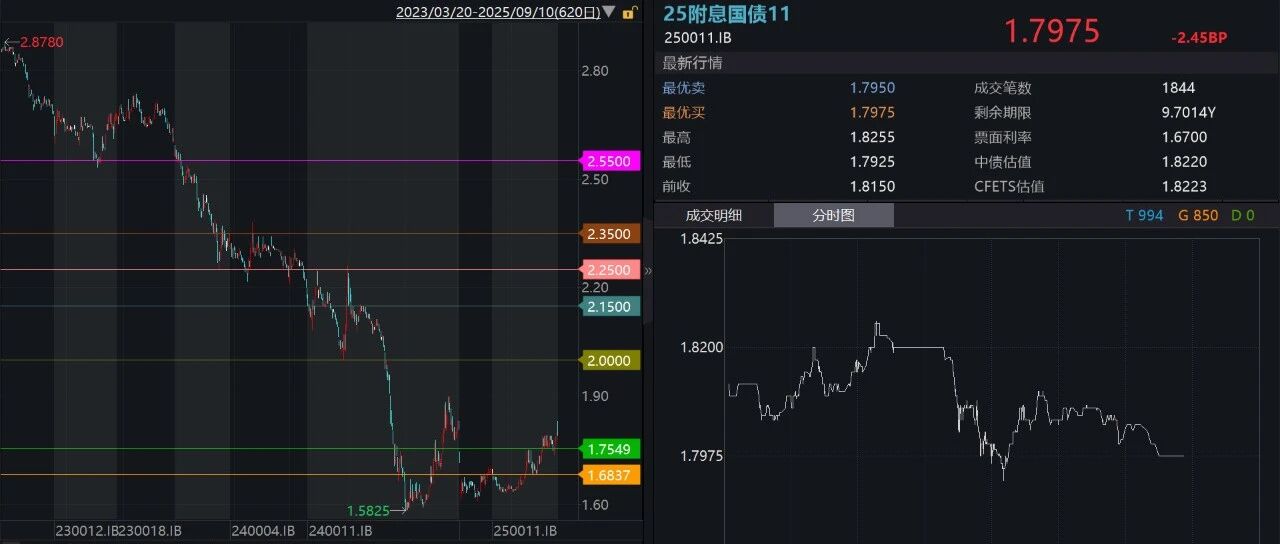
Core Viewpoint - The article discusses the recent actions of the central bank in the bond market, highlighting the mixed performance of the stock market and the bond market, as well as the implications of the central bank's bond purchasing strategy for market sentiment and investor behavior [3][5]. Group 1: Central Bank Actions - The central bank conducted a 7-day reverse repurchase operation of 292 billion yuan, with a net injection of 79.4 billion yuan after 212.6 billion yuan of reverse repos matured [3]. - The funding rates showed a slight decline, with DR001 around 1.37% and DR007 around 1.48% [3]. Group 2: Market Performance - The stock market showed strong performance, with an increase of over 1% in the morning session, while bond yields exhibited divergence, particularly with the 10-year government bond yield fluctuating between 1.8125% and 1.7975% [5][7]. - The sentiment in the bond market improved compared to the previous day, with the 10-year government bond yield reaching a low of 1.7925% during the day [5]. Group 3: Investor Sentiment and Market Dynamics - The article notes that the central bank's potential resumption of bond purchases has become a "quick fix" for bond market bulls, reflecting a shift in market sentiment [5]. - There is a commentary on the evolving understanding of market dynamics, emphasizing that investors are now more influenced by stock market performance, rumors, and market emotions rather than just fundamental, policy, and funding factors [5].

债市日报:9月11日
Xin Hua Cai Jing· 2025-09-11 07:55
Market Overview - The bond market showed signs of recovery on September 11, with the main government bond futures rising in the afternoon and most closing higher, while interbank bond yields initially increased before declining [1][2] - The People's Bank of China (PBOC) conducted a net injection of 79.4 billion yuan in the open market, with most funding rates continuing to rise [1][5] Bond Futures and Yields - The closing prices for government bond futures showed mixed results: the 30-year main contract fell by 0.11% to 114.740, while the 10-year contract rose by 0.07% to 107.580 [2] - Interbank yields for major bonds fluctuated, with the 10-year government bond yield decreasing by 0.75 basis points to 1.8075% [2] International Bond Markets - In North America, U.S. Treasury yields fell across the board, with the 10-year yield down by 4.21 basis points to 4.047% [3] - In Asia, Japanese bond yields generally increased, while in the Eurozone, yields for 10-year bonds in France, Germany, and Italy also declined [3] Primary Market Activity - The China Export-Import Bank's 1-year and 3-year financial bonds had bid yields of 1.3556% and 1.7377%, respectively, with bid-to-cover ratios of 2.21 and 1.99 [4] - Jilin Province's local bonds saw bid-to-cover ratios exceeding 21 times, indicating strong demand [4] Funding Conditions - The PBOC announced a 7-day reverse repo operation with a fixed rate of 1.40%, resulting in a net injection of 79.4 billion yuan for the day [5] - Short-term Shibor rates mostly increased, with the overnight rate down by 5.6 basis points to 1.369% [5] Institutional Insights - Huatai Securities noted that the recent bond market adjustment has fundamental backing, but institutional behavior has a more direct impact, suggesting potential opportunities for trading [6] - Long-term forecasts indicate that the bond market may continue to experience weak fluctuations, with expectations of a return to a 1.6% yield for the 10-year government bond by year-end [6]
市场分析:成长行业领涨,A股小幅上行
Zhongyuan Securities· 2025-09-10 10:52
Market Overview - On September 10, the A-share market experienced slight fluctuations, with the Shanghai Composite Index facing resistance around 3827 points[2] - The Shanghai Composite Index closed at 3812.22 points, up 0.13%, while the Shenzhen Component Index rose 0.38% to 12557.68 points[7] - Total trading volume for both markets reached 20,042 billion yuan, slightly lower than the previous trading day[3] Sector Performance - Industries such as mining, communication services, gaming, and cultural media performed well, while energy metals, jewelry, wind power equipment, and batteries lagged[3] - Over 50% of stocks in the two markets saw gains, with notable increases in communication, tourism, and cultural media sectors[7] Valuation Metrics - The average price-to-earnings (P/E) ratios for the Shanghai Composite and ChiNext indices are 15.53 times and 46.83 times, respectively, above the median levels of the past three years[3] - The trading volume has consistently exceeded 20,000 billion yuan in recent days, indicating strong market activity[3] Economic and Policy Environment - The State Council has emphasized the need to consolidate the economic recovery, with multiple favorable policies in place to support the market[3] - Monetary policy is expected to maintain a "moderately loose" stance, focusing on structural policies[3] Investment Recommendations - Short-term investment opportunities are suggested in sectors such as communication equipment, semiconductors, electronic components, and consumer electronics[3] - Global capital is flowing into the A-share market, with domestic savings increasingly shifting towards capital markets, providing a continuous source of incremental funds[3]

国债期货日报-20250910
Nan Hua Qi Huo· 2025-09-10 10:22
Report Summary 1. Report Industry Investment Rating No relevant information provided. 2. Core View of the Report - The report suggests focusing on the central bank's attitude. Given the continued weakness in the bond market and the potential for further decline in Treasury bond futures the next day, it is recommended to wait and see for now [1][3]. 3. Summary by Related Catalogs a. Market Performance - On Wednesday, Treasury bond futures opened and closed lower across the board. The decline of medium - and long - term varieties intensified in the afternoon, and spot bond yields rose across the board, with larger increases in the medium - and long - term. The open market had a net injection of 7.49 billion, but the capital market remained tight, with DR001 rising to around 1.43% [1]. - The prices of all contracts on the Treasury bond futures market decreased on September 10, 2025. For example, TS2512 dropped from 102.39 to 102.348, a decline of 0.042; TF2512 fell from 105.58 to 105.445, a decline of 0.135; T2512 decreased from 107.785 to 107.505, a decline of 0.28; and TL2512 dropped from 115.76 to 114.87, a decline of 0.89 [4]. - The contract positions of TS2512, T2512, and TL2512 increased, while that of TF2512 decreased. The trading volume of all main contracts increased [4]. b. Intraday News - The Ministry of Finance re - issued 5 - year Treasury bonds with a weighted winning bid rate of 1.5973% and a marginal rate of 1.6216%, and re - issued 50 - year Treasury bonds with a winning bid rate of 2.2227% [2]. - In August, China's CPI turned negative year - on - year, dropping 0.4%, while the core CPI rose to 0.9%, and the year - on - year decline of PPI narrowed to 2.9% [2]. c. Market Analysis - The bond market continued its weak performance in the morning, and the decline intensified in the afternoon as the A - share market rebounded. Although the central bank increased its injection in the open market, the capital market did not improve. The winning bid situation of the re - issued 5 - year and 50 - year Treasury bonds in the primary market was better than expected, but it did not boost the secondary market sentiment. The economic data in August had a neutral impact on the bond market [3]. - After the futures market closed, spot bond yields continued to rise, indicating that Treasury bond futures may continue to decline the next day [3].
债市机构行为周报(9月第1周):利率波动“基金化”-20250907
Huaan Securities· 2025-09-07 13:18
1. Report Industry Investment Rating No information provided in the content. 2. Core View of the Report - The pricing power of funds in the bond market has further increased, and there are still short - term long - trading opportunities. The high correlation between funds and interest rate trends has been further strengthened this year, and low interest rate fluctuations imply the enhancement of funds' pricing power in the bond market. Some "unexplained" interest rate increases may be due to the lack of bond - receiving institutions. The impact of fund institutional behavior on interest rate fluctuations may further expand, and short - term redemption pressure is controllable [2][11][15] 3. Summary According to the Directory 3.1 This Week's Institutional Behavior Review - **Correlation between funds and interest rates**: The high correlation between funds and interest rate trends is not new. Since 2024, the behavior of funds and interest rate trends have shown high correlation, and this year, the low - level fluctuation of interest rates has implied the further improvement of funds' pricing power in the bond market, which may be related to bank wealth management outsourcing [2][11][12] - **"Unexplained" interest rate increases**: This phenomenon may be related to the lack of bond - receiving institutions. Insurance institutions have reduced their allocation of national bonds since 2024, and rural commercial banks' intention to buy more as the interest rate adjusts is gradually decreasing [15] 3.2 Yield Curve - **Treasury bonds**: Short - term yields increased, while medium - and long - term yields decreased. The 1Y yield increased by 3bp, the 3Y yield increased by 1bp, the 5Y yield decreased by 2bp, the 7Y yield decreased by 1bp, the 10Y yield decreased by 1bp, the 15Y yield increased by 3bp, and the 30Y yield decreased by 3bp [17] - **China Development Bank bonds**: Yields decreased overall. The 1Y yield increased by 1bp, the 3Y yield decreased by 1bp, the 5Y yield decreased by about 2bp, the 7Y yield decreased by 2bp, the 10Y yield decreased by about 1bp, the 15Y yield decreased by 2bp, and the 30Y yield decreased by 1bp [17] 3.3 Term Spread - **Treasury bonds**: The interest spread increased, and the short - term spread narrowed while the long - term spread was differentiated. The 1Y - DR001 interest spread remained flat overall, and the 1Y - DR007 interest spread increased by 10bp [20] - **China Development Bank bonds**: The interest spread increased, and the short - term spread narrowed while the long - term spread was differentiated. The 1Y - DR001 interest spread increased by 2bp, and the 1Y - DR007 interest spread increased by about 8bp [22] 3.4 Bond Market Leverage and Funding Situation - **Leverage ratio**: It decreased to 107.14%. From September 1st to September 5th, 2025, the leverage ratio fluctuated and increased within the week. As of September 5th, it was about 107.14%, up 0.30pct from last Friday and 0.07pct from Monday [25] - **Average daily trading volume of pledged repurchase**: From September 1st to September 5th, the average daily trading volume of pledged repurchase was about 7.3 trillion yuan, a decrease of 0.24 trillion yuan compared with last week. The average daily trading volume of overnight pledged repurchase was 7.6 trillion yuan, a decrease of 0.43 trillion yuan month - on - month. The average overnight trading volume accounted for 88.35%, an increase of 2.89pct month - on - month [28][33] - **Funding situation**: Bank - based fund outflows first increased and then decreased. The main fund inflow party was funds, and the outflows of money market funds first decreased and then increased. DR007 and R007 fluctuated and decreased [34] 3.5 Duration of Medium - and Long - Term Bond Funds - **Median duration**: The median duration of medium - and long - term bond funds decreased. As of September 5th, the median duration (de - leveraged) was 2.77 years, a decrease of 0.04 years from last Friday; the median duration (including leverage) was 2.95 years, a decrease of 0.16 years from last Friday [45] - **Duration of different types of bond funds**: The median duration (including leverage) of interest - rate bond funds decreased to 3.75 years, a decrease of 0.16 years from last Friday; the median duration (including leverage) of credit bond funds decreased to 2.72 years, a decrease of 0.12 years from last Friday [51] 3.6 Category Strategy Comparison - **Sino - US interest rate spread**: It widened overall. The 1Y spread widened by 23bp, the 2Y spread widened by about 12bp, the 3Y spread widened by 13bp, the 5Y spread widened by 8bp, the 7Y spread widened by 11bp, the 10Y spread widened by 11bp, and the 30Y spread widened by 7bp [55] - **Implied tax rate**: The short - term spread narrowed, and the long - term spread was differentiated. As of September 5th, the 1Y spread between China Development Bank bonds and treasury bonds narrowed by about 1bp, the 3Y spread narrowed by 2bp, the 5Y spread changed by less than 1bp, the 7Y spread narrowed by 1bp, the 10Y spread widened by 1bp, the 15Y spread narrowed by 5bp, and the 30Y spread widened by 2bp [56] 3.7 Bond Lending Balance Changes - On September 5th, the lending concentration of active 10Y treasury bonds, active 10Y China Development Bank bonds, and active 30Y treasury bonds increased; the lending concentration of the second - active 10Y China Development Bank bonds decreased, and the lending concentration of the second - active 10Y treasury bonds remained unchanged. In terms of institutions, the lending of large - scale banks and other institutions decreased, while that of small - and medium - sized banks and securities firms increased [57]
股指黄金周度报告-20250905
Xin Ji Yuan Qi Huo· 2025-09-05 11:22
Report Summary 1. Report Industry Investment Rating No investment rating information is provided in the report. 2. Core Viewpoints - In the short - term, corporate earnings have not significantly improved. After repeated digestion of previous policy benefits, market bullish sentiment has cooled. There is a risk of adjustment in stock indices due to profit - taking pressure. Gold has accelerated its short - term rise driven by the Fed's interest rate cut expectations and risk - aversion sentiment, but attention should be paid to the risk of increased volatility [42]. - In the medium - to long - term, the valuation of stock indices is mainly dragged down by the decline in corporate earnings growth at the molecular end, while the support at the denominator end comes from the recovery of risk appetite. Stock indices are expected to maintain a wide - range oscillation. Gold may face a deep - adjustment risk due to the fading of uncertainties from US tariff policies, the potential easing of the Russia - Ukraine conflict, and the repeated digestion of the Fed's September interest rate cut expectations [42]. 3. Summary by Relevant Catalogs 3.1. Macroeconomic Data - In August 2025, the official manufacturing PMI was 49.4, remaining in the contraction range for 5 consecutive months. Industrial production expansion accelerated, demand improved marginally, but external demand faced significant downward pressure, and the business climate of small and medium - sized enterprises remained weak [3][4]. 3.2. Stock Index Fundamental Data - **Corporate Earnings**: Due to weak terminal demand, downstream enterprises face great operating pressure. They cannot transfer production costs to end - consumers, resulting in a long - standing phenomenon of increasing revenue without increasing profits. Some industries are still in the active de - stocking phase, with finished - product inventories continuing to decline [18]. - **Funding and Liquidity**: The margin balance in the Shanghai and Shenzhen stock markets decreased slightly. The central bank conducted 1.0684 trillion yuan of 7 - day reverse repurchase operations this week, resulting in a net withdrawal of 1.2047 trillion yuan [22]. 3.3. Gold Fundamental Data - **Inflation and Consumption**: The US core PCE price index in July increased by 2.9% year - on - year (previous value: 2.8%), rising for 3 consecutive months and reaching a new high since February. Personal consumption expenditure increased by 0.5% month - on - month, 0.2 percentage points faster than the previous month. US tariff policies are affecting prices, suppressing consumer confidence and consumption expenditure [28]. - **Inventory**: Shanghai gold futures' warehouse receipts and inventory have been rising, indicating an increase in physical gold delivery demand and a resurgence of bullish sentiment in the market [39]. 3.4. Strategy Recommendation - **Stock Indices**: Although the official manufacturing PMI rebounded slightly in July, the economic recovery foundation is not solid, with insufficient demand being the main contradiction. The previous sharp rise in stock index futures was driven by multiple factors such as policies, funds, and sentiment. However, the inflection point of corporate earnings growth has not arrived. As policy benefits are repeatedly digested, the market's bullish sentiment has cooled, and short - term adjustments are expected [41]. - **Gold**: Multiple Fed officials have made dovish remarks, suggesting that a September interest rate cut is highly likely. The controversy over Trump's dismissal of Fed Governor Cook has intensified market concerns about central bank independence, driving up the gold price to a new record high. Attention should be paid to the risk of increased volatility [41].
30年国债ETF(511090)红盘上扬,近5日“吸金”6.56亿元续创新高!
Sou Hu Cai Jing· 2025-09-04 03:24
Group 1 - The 30-year Treasury ETF (511090) has increased by 0.57%, with the latest price at 121.62 yuan as of September 4, 2025 [1] - The trading volume for the 30-year Treasury ETF was active, with a turnover of 15.96% and a transaction value of 4.853 billion yuan, while the average daily transaction value over the past month was 10.203 billion yuan [1] - The latest scale of the 30-year Treasury ETF reached a new high of 30.387 billion yuan, despite a recent net outflow of 79.6382 million yuan [1] Group 2 - The People's Bank of China conducted a 7-day reverse repurchase operation of 229.1 billion yuan at a fixed rate of 1.40%, with a net withdrawal of 150.8 billion yuan on that day [1] - Tianfeng Securities anticipates that the liquidity will remain reasonably ample, supported by increased fiscal spending and effective central bank measures, despite potential disturbances in mid to late September [1]