
产能过剩

Search documents
双星新材Q225业绩符合业绩预告;行业产能依然过剩
2025-08-31 16:21
Summary of the Conference Call for 双星新材 (Double Star New Materials) Company Overview - **Company Name**: 江苏双星彩塑新材料股份有限公司 (Double Star New Materials) - **Industry**: Special Chemicals, specifically focusing on polyester films (BOPET) for packaging, printing, and functional films for electronics and new energy sectors [doc id='10'][doc id='8']. Key Financial Performance - **Q2 2025 Performance**: - Revenue: 2Q revenue was 2.626 billion RMB, down 7% year-on-year [doc id='1']. - Net Loss: The company reported a net loss of 1.49 billion RMB, which was at the lower end of the forecast [doc id='1']. - Sequential Decline: 2Q revenue decreased by 10% quarter-on-quarter, with net loss expanding to 1.07 billion RMB, more than doubling from Q1 [doc id='1']. - Margins: 2Q gross margin was -1.5% and net margin was -8.6%, compared to +3.9% and -3.1% in Q1 respectively [doc id='1']. Revenue Breakdown - **Optical Films**: Revenue from optical films was 1.183 billion RMB, accounting for 45% of total revenue, down 8% year-on-year with a gross margin of 5% [doc id='8']. - **New Energy Films**: Revenue contribution from new energy films dropped 98%, falling from 8% in Q1 to nearly zero, attributed to capacity shifts to other products [doc id='8']. - **BOPET Films**: Revenue from BOPET films increased by 10%, but gross margin was -13% [doc id='8']. Industry Context - **Capacity Issues**: The industry continues to face overcapacity, with domestic BOPET capacity growing by 3.5% year-on-year in H1 2025, although the growth rate is slowing [doc id='8']. - **Utilization Rates**: Industry capacity utilization is projected to decline from 74% in 2022 to 65.6% in H1 2025 [doc id='8']. Future Outlook - **Guidance**: The company did not provide specific guidance for future performance [doc id='3']. - **Valuation**: The stock maintains a "Buy" rating with a target price of 7.30 RMB, corresponding to a 19x PE for 2026E and 0.7x PB [doc id='3']. Analyst Insights - **Risks**: Potential risks include slower-than-expected ramp-up of production capacity, increased competition in optical films and photovoltaic backsheet films, and weaker-than-expected demand in related industries [doc id='11']. - **Market Sentiment**: Analysts rated the industry structure as stable (score of 3) and indicated no significant changes in regulatory or government environments [doc id='13']. Important Metrics - **Market Capitalization**: 6.51 billion RMB (approximately 0.91 billion USD) [doc id='4']. - **Stock Performance**: The stock price as of August 27, 2025, was 5.67 RMB, with a 52-week price range of 6.46-4.19 RMB [doc id='4']. Conclusion The financial performance of 双星新材 indicates significant challenges, particularly with increasing losses and declining margins amidst an overcapacity situation in the industry. The outlook remains cautious, with analysts maintaining a "Buy" rating based on future potential despite current struggles.

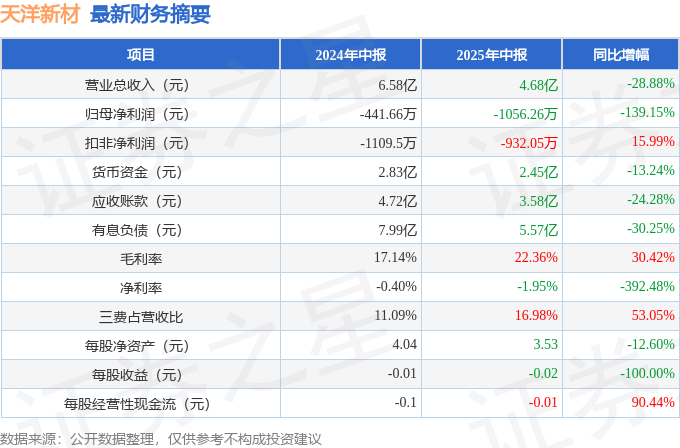
天洋新材2025年中报简析:净利润同比下降139.15%,三费占比上升明显
Zheng Quan Zhi Xing· 2025-08-30 23:25
Core Viewpoint - Tianyang New Materials (603330) reported a significant decline in revenue and net profit for the first half of 2025, indicating ongoing financial challenges and a need for strategic adjustments in operations [1][3]. Financial Performance - Total revenue for the first half of 2025 was 468 million yuan, a decrease of 28.88% year-on-year [1]. - The net profit attributable to shareholders was -10.56 million yuan, down 139.15% compared to the previous year [1]. - The gross margin improved to 22.36%, an increase of 30.42% year-on-year, while the net margin fell to -1.95%, a decrease of 392.48% [1]. - The total of financial, sales, and management expenses reached 79.52 million yuan, accounting for 16.98% of total revenue, which is a 53.05% increase year-on-year [1]. Business Model and Strategy - The company's business model relies heavily on capital expenditure, necessitating careful evaluation of capital projects and their financial viability [3]. - In response to the oversupply in the photovoltaic industry, the company is implementing strategies to enhance operational efficiency and reduce losses, including optimizing production plans and restructuring [7]. - The company aims to focus on high-margin, high-growth applications in the membrane materials market, leveraging over 20 years of expertise in polymer materials [7]. Cash Flow and Debt Management - The cash flow situation is concerning, with cash and cash equivalents to current liabilities at only 47.45%, and the average operating cash flow over the past three years being negative [4]. - The company has a debt ratio of 23.06% for interest-bearing liabilities, indicating potential financial strain [4]. Market Position and Future Outlook - The company is actively developing specialized encapsulation films for new battery technologies like TOPCon and heterojunction cells, aiming to adapt to market demands [5]. - The electronic glue segment has seen a revenue increase of 30.88% in 2024, with a focus on expanding into sectors such as new energy vehicles and consumer electronics [8].


半年巨亏29亿,152亿江西首富李仙德“压力山大”
Sou Hu Cai Jing· 2025-08-30 12:56
Core Viewpoint - JinkoSolar reported a significant decline in performance for the first half of 2025, with revenue dropping by 32.63% year-on-year to 31.831 billion yuan and a net loss of 2.909 billion yuan compared to a profit of 1.2 billion yuan in the same period last year, primarily due to intensified competition and falling prices in the photovoltaic market [2][5][6]. Financial Performance - The company achieved revenue of 31.831 billion yuan in the first half of 2025, a decrease of 32.63% year-on-year [5]. - The net profit attributable to shareholders was -2.909 billion yuan, a decline of 342.38% compared to a profit of 1.2 billion yuan in the previous year [5][6]. - The non-recurring net profit was -3.175 billion yuan, a staggering drop of 1560.33% year-on-year [5]. - The net cash flow from operating activities was -3.812 billion yuan, attributed to a decrease in received sales payments [7]. Market Context - The photovoltaic industry is experiencing severe challenges, with many players facing similar performance declines. In the first quarter of 2025, 31 A-share listed photovoltaic companies reported a combined net loss of 12.58 billion yuan, a year-on-year increase of 274.3% [7]. - Over 40 companies have announced delistings, bankruptcies, or mergers since 2024 [7]. - The industry is facing overcapacity, with domestic manufacturers' production capacity exceeding 1100 GW, while optimistic demand for 2025 is projected at 600 GW globally and 250 GW in China [8]. Strategic Response - JinkoSolar is focusing on technological innovation, global market expansion, and efficient operations to address the challenges posed by supply-demand imbalances and price declines [9]. - The company has reduced its R&D expenses to 1.175 billion yuan, a decrease of 56.95% year-on-year, with R&D expenditure accounting for 3.69% of revenue, down from 5.78% [7]. Leadership and Wealth Impact - The wealth of the founder, Li Xian De, has significantly decreased, with the family's net worth dropping by 6.31 billion yuan to 15.2 billion yuan compared to the previous year, and by 20.1 billion yuan from its peak in 2023 [3][10].


碳酸锂数据日报-20250829
Guo Mao Qi Huo· 2025-08-29 03:20
Group 1: Report Industry Investment Rating - No information provided Group 2: Core View of the Report - The fundamentals have weak support for the futures price, and it is expected to be mainly in a weak oscillation [3] Group 3: Summary by Related Catalogs Lithium Compound Prices - SMM battery - grade lithium carbonate average price is 80,000 yuan/ton, down 1,600 yuan/ton [1] - SMM industrial - grade lithium carbonate average price is 77,700 yuan/ton, down 1,600 yuan/ton [1] Lithium Futures Contracts - Lithium carbonate 2605 closing price is 76,300 yuan/ton, down 2.38% [1] - Lithium carbonate 2606 closing price is 76,100 yuan/ton, down 2.24% [1] - Lithium carbonate 2607 closing price is 75,960 yuan/ton, down 2.34% [1] - Lithium carbonate 2608 closing price is 76,240 yuan/ton, down 2.48% [1] - Lithium carbonate 2509 closing price is 78,140 yuan/ton, down 2.18% [1] Lithium Ore Prices - Lithium spodumene concentrate (CIF China) average price is 889 US dollars, down 31 US dollars [1] - Lithium mica (Li20: 1.5% - 2.0%) price is 1,205 yuan, down 40 yuan [2] - Lithium mica (Li20: 2.0% - 2.5%) price is 1,915 yuan, down 55 yuan [2] - Phosphorus lithium aluminum stone (Li20: 6% - 7%) price is 6,425 yuan, down 285 yuan [2] - Phosphorus lithium aluminum stone (Li20: 7% - 8%) price is 7,500 yuan, down 275 yuan [2] Cathode Material Prices - Lithium iron phosphate (power - type) average price is 35,205 yuan, down 385 yuan [2] - Ternary material 811 (polycrystalline/power - type) average price is 145,900 yuan [2] - Ternary material 523 (single - crystal/power - type) average price is 119,100 yuan, down 300 yuan [2] - Ternary material 613 (single - crystal/power - type) average price is 123,925 yuan [2] Price Spreads - The spread between battery - grade and industrial - grade lithium carbonate is 2,300 yuan/ton [2] - The spread between battery - grade lithium carbonate and the main contract is 1,860 yuan, down 880 yuan [2] - The spread between the near - month and the first - continuous contract is - 100 yuan, down 40 yuan [2] - The spread between the near - month and the second - continuous contract is 0 yuan, down 180 yuan [2] Inventory - Total inventory (weekly, tons) is 141,136 tons, a change of - 407 tons [2] - Downstream inventory (weekly, tons) is 52,800 tons, an increase of 1,293 tons [2] - Other inventory (weekly, tons) is 45,000 tons, an increase of 1,810 tons [2] - Registered warehouse receipts (daily, tons) is 28,957 tons, an increase of 1,480 tons [2] Profit Estimation - The cash cost of外购 lithium spodumene concentrate is 76,440 yuan, and the profit is 2,418 yuan [3] - The cash cost of外购 lithium mica concentrate is 80,022 yuan, and the profit is - 3,245 yuan [3] Industry Event - A meeting on the lithium iron phosphate material branch council was held on August 22 to discuss solutions for eliminating backward production capacity and low - carbon transformation of the entire industrial chain [3] Supply and Demand Situation - Although there is a reduction in production at the Jiangxi mica end, overseas mines, overseas salt lakes, and domestic compliant mines have formed a supplement, mainly a structural adjustment on the supply side. On the demand side, weekly production is basically stable, with products moving from upstream to downstream but limited actual consumption [3]
锂电行业洗牌加速
投中网· 2025-08-29 02:35
Core Viewpoint - The article discusses the significant shift in the lithium battery industry, highlighting the overcapacity and the urgent need for Chinese lithium battery companies to seek international capital markets, particularly through IPOs in Hong Kong, to address financial pressures and enhance global competitiveness [5][7][14]. Group 1: Market Dynamics - The Hong Kong stock market is becoming a strategic supply station for lithium battery companies, with a nearly threefold increase in IPO fundraising in Q1 2025 compared to the previous year, marking the best start since 2021 [5]. - As of June 2025, there were 240 IPO applications on the Hong Kong Stock Exchange, nearly double the number from 2024, with lithium battery companies leading the charge [5][8]. - The global demand for power batteries is projected to reach 1000-1200 GWh by 2025, while the total planned capacity in the industry is as high as 4800 GWh, indicating a severe supply-demand imbalance [8]. Group 2: Financial Pressures - The lithium battery industry is experiencing structural pressures, including severe overcapacity, intense price competition, accelerated technological iteration, and tight cash flow, pushing companies to seek foreign capital [7][9]. - Many companies are facing deteriorating cash flow, with an average collection period of 103 days and a payment period of 255 days, leading to significant cash flow challenges [8]. - The average debt ratio for some companies exceeded 70% in the first half of 2025, indicating a growing liquidity crisis that necessitates new financing channels [9]. Group 3: Globalization Strategy - The urgent need for a globalization strategy is driving Chinese lithium battery companies to international capital markets, as local production is increasingly required due to geopolitical factors [11][12]. - The construction of localized production facilities in Europe, Southeast Asia, and North America is becoming essential for Chinese companies to integrate into global supply chains and meet local production requirements [11][12]. - The opportunity presented by the slow development of local battery companies in Europe and the U.S. creates a market window for Chinese firms to establish a presence and benefit from substantial local funding [12]. Group 4: Capital Market Changes - The tightening of IPO approvals in the A-share market has led many companies to seek more certain alternatives, such as the Hong Kong market, which offers a more accommodating environment for new listings [14]. - The Hong Kong capital market has shown greater inclusivity and efficiency, with recent regulatory changes aimed at expediting the IPO process for technology companies [14]. - Differences in valuation logic between A-share and Hong Kong markets influence companies' decisions, with Hong Kong investors placing a higher value on global competitiveness and long-term technological barriers [16][17]. Group 5: Strategic Implications - The choice to list in Hong Kong is not merely a response to overcapacity and financing pressures but also a strategic move to align with global capital narratives and enhance brand reputation [18]. - By entering the international capital market, companies can improve governance transparency and brand image, which are crucial for long-term global competitiveness [18].


反内卷影响详细测算:牛市的逻辑:产能过剩下行拐点到来
Xinda Securities· 2025-08-29 02:04
Group 1: Industrial Capacity and Economic Trends - As of Q2 2025, China's industrial capacity reached 186.7 trillion yuan, accounting for 135.7% of GDP, down from 144.9% in Q4 2022[11] - China's industrial capacity has undergone three expansion phases: 2018, 2021, and 2023-2024[14] - The first capacity surplus occurred in 2015-2016, the second in 2020 due to the pandemic, and the third began in 2023, driven by capacity expansion and weak demand[30] Group 2: "Anti-Involution" Policy Impacts - The "anti-involution" policy is expected to create a turning point for declining capacity surplus and rising PPI, improving corporate profitability[7] - Historical data shows that each resolution of capacity surplus and recovery of PPI has led to a bull market in capital markets[61] - The capital market is anticipated to enter a bull market as a result of the "anti-involution" policy, similar to past instances in 2016-2017 and 2020-2021[61] Group 3: Risks and Future Considerations - Risks include slower-than-expected progress on "anti-involution," geopolitical risks, and potential deviations from historical patterns[3] - The need for demand-side measures to balance growth dynamics is emphasized, as reliance on manufacturing growth may weaken[60] - Enhancing non-manufacturing dynamics is crucial for achieving balanced growth, with potential strategies including infrastructure investment and boosting consumer spending[60]
扣非净利亏损、核心项目延期,新安股份内忧外患
Xin Lang Cai Jing· 2025-08-29 00:31
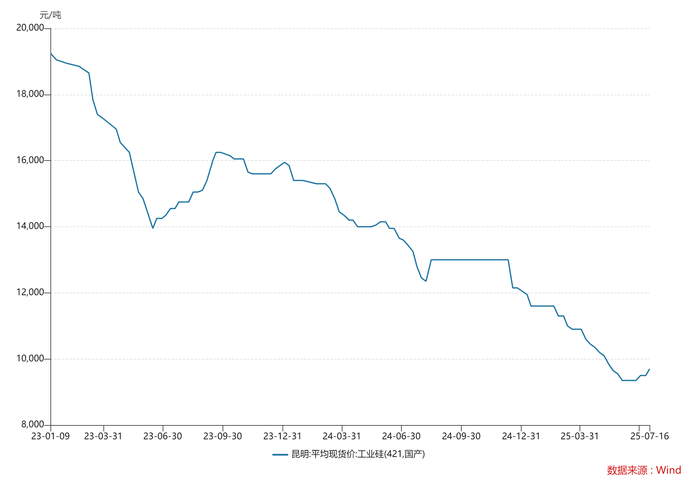
Core Viewpoint - New An Co., Ltd. is facing severe challenges due to industry overcapacity and declining prices in the silicon-based new materials sector, leading to significant financial losses and a negative net profit for the first time since its listing [1][14]. Group 1: Financial Performance - In the first half of 2025, New An reported total revenue of 8.058 billion yuan, a year-on-year decrease of 5.07%, and a net profit attributable to shareholders of 69.0734 million yuan, down 47.71% [1]. - The company's non-recurring net profit was -23.9177 million yuan, a dramatic decline of 197.73%, indicating that its core business is in a loss-making state [1]. - The reliance on government subsidies (64.39 million yuan) and non-current asset disposals (51.77 million yuan) to support profits raises concerns about the sustainability of its earnings [1]. Group 2: Industry Context - The silicon-based new materials sector, particularly organic silicon, has seen a significant increase in production capacity, with total domestic organic silicon capacity reaching 3.2 million tons by the end of 2024 [3][12]. - Despite a compound annual growth rate of 10.7% in apparent consumption from 2017 to 2024, the rapid expansion of capacity has led to a supply-demand imbalance [3][12]. - The price of industrial silicon has plummeted, with a decline of 23% from the end of 2023 to the end of 2024, and further dropping to 9,350 yuan per ton by mid-2025, resulting in a significant impact on profitability [3][5]. Group 3: Asset and Cash Flow Management - New An has recognized asset impairment risks, with a total impairment provision of 83.93 million yuan in the first half of 2025, including a 68.54 million yuan provision for inventory [5][6]. - The company's accounts receivable reached 2.157 billion yuan, a year-on-year increase of 7.68%, with a staggering ratio of accounts receivable to net profit at 4,195.51% [6]. - Continuous negative cash flow from operating and investing activities, amounting to -1.72 billion yuan in the first half of 2025, indicates a weak ability to generate cash from core operations [7]. Group 4: Strategic Challenges - New An's major project, the organic silicon synthesis project, has been delayed from September 2025 to March 2026 due to changing market conditions and increased competition [13]. - The company is still pursuing upstream industrial silicon capacity expansion despite the declining prices, raising questions about the viability of this strategy [14]. - The overall situation reflects a structural issue within the organic silicon industry, where overcapacity and price wars are severely compressing profit margins [14].

财说|扣非净利亏损、核心项目延期,新安股份内忧外患
Xin Lang Cai Jing· 2025-08-28 23:12
Core Viewpoint - New An Co., Ltd. is facing its most severe test since its listing due to industry-wide overcapacity and declining prices in the silicon-based new materials sector, leading to significant financial losses and a negative net profit for its main business [1][15]. Company Performance - In the first half of 2025, New An Co. reported total revenue of 8.058 billion yuan, a year-on-year decrease of 5.07%, and a net profit attributable to shareholders of 69.0734 million yuan, down 47.71% year-on-year [1]. - The company's non-recurring net profit was -23.9177 million yuan, a staggering year-on-year drop of 197.73%, indicating that its main business is in a loss-making state [1]. - The company has relied heavily on government subsidies (64.39 million yuan) and non-current asset disposals (51.77 million yuan) to support its profits [1]. Industry Context - New An Co. operates in two main business segments: crop protection and silicon-based new materials, with the latter being the focus of market attention and previously driving high valuations [2]. - The company has a total organic silicon monomer production capacity of 500,000 tons per year, with approximately 80% used for self-produced downstream products [2]. Market Challenges - The organic silicon intermediate DMC market price has significantly declined, with domestic total capacity reaching 3.2 million tons by the end of 2024, leading to a supply-demand imbalance despite a compound annual growth rate of 10.7% in consumption from 2017 to 2024 [3]. - The price of industrial silicon has plummeted, with the average price dropping from 15,900 yuan per ton at the end of 2023 to 9,350 yuan per ton by mid-2025, representing a 23% decline [3][5]. Financial Strain - New An Co. has recognized asset impairment provisions totaling 83.93 million yuan in the first half of 2025, with inventory impairment losses reaching 68.54 million yuan [5]. - The company's accounts receivable balance was 2.157 billion yuan, a year-on-year increase of 7.68%, indicating significant pressure on cash flow management [6]. - The company's cash flow from operating and investing activities has been negative, with net cash flows of -1.72 billion yuan in the first half of 2025 [7]. Debt and Liquidity Concerns - Although the asset-liability ratio has decreased slightly, the company's non-current liabilities due within one year have surged by 171% to 529 million yuan, indicating increased repayment pressure [10]. - The current and quick ratios are approaching critical levels, with the current ratio at 1.33 and the quick ratio at 0.97 [10]. Project Delays - New An Co. has postponed its key project, the organic silicon synthesis project, from September 2025 to March 2026 due to changes in macroeconomic conditions and intensified market competition [14]. - The company is facing a broader industry challenge of overcapacity and declining prices, leading many firms to slow down investment to avoid losses [14][15]. Overall Industry Outlook - The challenges faced by New An Co. reflect structural issues within the organic silicon industry, where rapid capacity expansion is not matched by demand growth, leading to intense price competition and compressed profit margins [15]. - The company's ongoing plans to expand industrial silicon capacity may pose further risks in a declining price environment [15].
大越期货聚烯烃早报-20250828
Da Yue Qi Huo· 2025-08-28 08:56
Report Information - Report Title: Polyolefin Morning Report [2] - Report Date: August 28, 2025 [2] - Analyst: Jin Zebin from Dayue Futures Investment Consulting Department [3] Industry Investment Rating - Not provided in the report Core Viewpoints - The LLDPE and PP markets are expected to show a volatile trend today. For LLDPE, the overall fundamentals are neutral, with factors such as cost support and anti - involution policy as positives, while weak demand is a negative. For PP, the fundamentals are also neutral, with cost support and anti - involution policy as positives and weak demand as a negative [4][6][8][9] Summary by Content LLDPE Overview - **Fundamentals**: In July, China's official manufacturing PMI was 49.3%, down 0.4 percentage points month - on - month, in contraction for 4 consecutive months. Caixin's July manufacturing PMI dropped from 50.4 to 49.5. July exports were $321.78 billion, up 7.2% year - on - year. A reform plan for the petrochemical and refining industry is expected to be introduced in September. The overall demand for agricultural films is below expectations, and the film production start - up rate is low. The current spot price of LLDPE delivery products is 7310 (-40), and the overall fundamentals are neutral [4] - **Basis**: The basis of the LLDPE 2601 contract is - 54, with a premium/discount ratio of - 0.7%, indicating a bearish signal [4] - **Inventory**: PE comprehensive inventory is 487,000 tons (-78,000), neutral [4] - **Disk**: The 20 - day moving average of the LLDPE main contract is flat, and the closing price is below the 20 - day line, showing a bearish signal [4] - **Main Position**: The net position of the LLDPE main contract is short, and the short position is increasing, indicating a bearish signal [4] - **Expectation**: The LLDPE main contract is expected to fluctuate today, with anti - involution policy expectations rising again, weak agricultural film demand, and neutral industrial inventory [4] - **Likely Factors**: Cost support and anti - involution policy are positive factors; weak demand is a negative factor [6] PP Overview - **Fundamentals**: Similar to LLDPE in macro data. The downstream is gradually entering the peak season, and the demand for pipes and plastic weaving has improved slightly. The current spot price of PP delivery products is 7050 (+0), and the overall fundamentals are neutral [8] - **Basis**: The basis of the PP 2601 contract is 29, with a premium/discount ratio of 0.4%, neutral [8] - **Inventory**: PP comprehensive inventory is 539,000 tons (-34,000), neutral [8] - **Disk**: The 20 - day moving average of the PP main contract is downward, and the closing price is below the 20 - day line, showing a bearish signal [8] - **Main Position**: The net position of the PP main contract is short, and the short position is decreasing, indicating a bearish signal [8] - **Expectation**: The PP main contract is expected to fluctuate today, with anti - involution policy expectations rising again, slightly improved downstream demand, and neutral industrial inventory [8] - **Likely Factors**: Cost support and anti - involution policy are positive factors; weak demand is a negative factor [9] Market Data - **LLDPE**: The spot price of delivery products is 7310 (-40), the 01 contract price is 7364 (-38), the basis is - 54 (-2), the PE comprehensive factory inventory is 487,000 tons (-78,000), and the social inventory is 562,000 tons (+6,000) [11] - **PP**: The spot price of delivery products is 7050 (+0), the 01 contract price is 7021 (-25), the basis is 29 (+25), the PP comprehensive factory inventory is 539,000 tons (-34,000), and the social inventory is 260,000 tons (-1,000) [11] Supply - Demand Balance Sheets - **Polyethylene**: From 2018 - 2024, the production capacity, output, and apparent consumption generally showed an upward trend, with fluctuations in import dependence and consumption growth rate. The expected production capacity in 2025 is 43.195 million tons, with a growth rate of 20.5% [16] - **Polypropylene**: From 2018 - 2024, the production capacity, output, and apparent consumption also generally increased, with changes in import dependence and consumption growth rate. The expected production capacity in 2025 is 4.906 million tons, with a growth rate of 11.0% [18] Main Logic and Risk Points - **Main Logic**: Cost and demand, driven by domestic macro - policies [7][10] - **Risk Points**: Sharp fluctuations in crude oil prices and international policy games [7][10]
便宜的肉蛋,贵的生意:零售商的“薄利困境”
Hu Xiu· 2025-08-28 06:26
Group 1 - The core issue in the pork and egg markets is a significant price drop due to oversupply, with pork prices falling below 6 yuan/kg and egg prices dropping below 3 yuan/kg in some regions [3][6][11] - The average price of fresh pork has decreased by 33% year-on-year, while the wholesale price of pork has seen a decline of 34.8% [4][6] - The number of breeding sows is currently at 40.43 million, exceeding the normal level, indicating continued high supply of pigs in the market [8] Group 2 - The decline in pork and egg prices is not an isolated event but reflects a broader issue of supply exceeding demand, leading to a price collapse [7][11] - The Consumer Price Index (CPI) has been negatively impacted by falling food prices, particularly pork, which has contributed to a 0.4 percentage point decrease in CPI [16][21] - Retailers are facing pressure as the price drop in staple items like pork and eggs affects overall consumer price perception, leading to reduced profit margins [18][24] Group 3 - Retailers are adjusting their strategies by focusing on overall basket profitability rather than just the margins on pork and eggs, treating them as customer acquisition costs [26][30] - There is a shift towards offering higher-margin products to attract middle and high-income consumers while also catering to price-sensitive customers with private label products [30][31] - The price drop has exposed structural issues within the retail industry, prompting a reevaluation of market positioning and cost management strategies [32]