宏观政策

Search documents
财政政策加力支撑经济回升
Jing Ji Ri Bao· 2025-11-30 22:39
除了组织财政收入,财政运行的另外一面,是通过实施财政政策促进经济发展。今年以来,更加积极的 财政政策持续发力,加大支出强度,优化支出结构,加强对重点领域的支出保障。民生、科技等重点领 域支出的增速抢眼,其中,社会保障和就业支出增长9.3%,教育支出增长4.7%,科学技术支出增长 5.7%,节能环保支出增长7%。这些支出,充分显示出更多资金资源"投资于人"以及支持科技创新的政 策导向。同时,专项债券、超长期特别国债等各类政府债券加快发行使用,增强经济发展动能。 当前,宏观政策需要继续着力稳就业、稳企业、稳市场、稳预期,稳住经济基本盘。党的二十届四中全 会提出,宏观政策要持续发力、适时加力。实现今年全年经济社会发展目标,以及推动"十五五"良好开 局,宏观政策肩负重任。 今年财政收入增幅持续回升,反映出当前经济运行总体平稳、稳中有升的态势。宏观政策需要保持力 度、靠前发力、适时加力,继续稳就业、稳企业、稳市场、稳预期,稳住经济基本盘。 近日发布的前10个月财政收支情况显示,全国一般公共预算收入月度增幅继续提高,累计增幅稳步回 升;一般公共预算支出保持增长,重点领域支出得到保障。财政政策如何持续发力、适时加力,推动实 ...
需求改善带动生产趋稳 11月制造业PMI回升
Shang Hai Zheng Quan Bao· 2025-11-30 18:29
需求改善带动生产趋稳 11月制造业PMI回升 ◎记者 陈芳 国家统计局服务业调查中心和中国物流与采购联合会11月30日发布的数据显示,11月,制造业采购经理 指数(PMI)为49.2%,比10月上升0.2个百分点。其中,新出口订单回升提振制造业,特别是拉动中小 企业景气度改善;受年底重点项目加快推进影响,建筑业景气度回升。 专家分析,11月,制造业景气度小幅回升,市场信心有所改善,但三大PMI指数仍位于荣枯线以下,应 加大宏观政策实施力度,推动全年经济平稳收官。 制造业出口趋稳 从制造业的分项指数看,出口需求回升,尤其是消费品制造业出口较10月好转。需求改善带动制造业生 产趋稳运行,企业销售加快。 11月,制造业新订单指数为49.2%,比10月上升0.4个百分点。其中,新出口订单指数从10月45.9%回升 至11月的47.7%,回升了1.7个百分点,明显改善。 中国物流信息中心分析师文韬表示,11月制造业出口是全面性地趋稳,制造业四大行业以及大中小企业 的新出口订单指数全部较10月上升。其中,消费品制造业新出口订单指数较10月上升超过2个百分点。 在需求端带动下,制造业生产活动也呈现企稳态势。11月,制造业生 ...
高盛2026宏观展望,今年经济开局,政策加码稳5%增长?
Sou Hu Cai Jing· 2025-11-30 14:47
关键时刻政策密集出手,降息、财政扩张、楼市消费新政齐上阵,这波组合拳能否稳住5%增长目标? 背后的逻辑和看点值得细细说道。 2025年的经济走势真是让人猜不透,一边是出口逆势狂飙给市场送惊喜,一边是房地产和消费拖后腿让 人捏把汗。 十五五"开局这盘棋,到底能不能下赢?关键还得看政策这波神操作。 新能源车出口大增 哈喽大家好,今天小无带大家聊聊"十五五"开局的经济大棋局。一边是出口顶着关税压力逆势狂飙,成 为稳增长的硬核支撑;一边是房地产、消费深陷调整泥潭,拖累经济步伐。 先说说最让人意外的出口表现,简直是逆袭中的战斗机!谁能想到,美国对华关税4月飙到100%以上, 5月才回落至30%。 这么折腾下来,中国全年出口增速居然有望冲到8%,而且各行各业都跟着发力。这可不是靠运气,也 不是短期抢出口能撑起来的,而是中国制造业实打实的硬实力。 现在咱们的出口早就不是单一产品厉害,而是形成了技术、产业链、服务一条龙的综合优势。 冶金、化工这些老产业通过升级改造,既保住了质量又没乱涨价,传统市场守得牢,新兴市场也打得 开。 | 举办时间 | 国外劳商 | 会议名称 | 王霞 | 地点 | | --- | --- | --- ...


2026年财政政策展望:“开门红”下的积极续力
Guoxin Securities· 2025-11-28 14:57
证券研究报告 | 2025年11月28日 2026年财政政策展望 ——"开门红"下的积极续力 经济研究 · 宏观专题 0755-81982035 S0980524090003 S0980525110002 证券分析师:田地 证券分析师:王奕群 tiandi2@guosen.com.cn wangyiqun1@guosen.com.cn 请务必阅读正文之后的免责声明及其项下所有内容 请务必阅读正文之后的免责声明及其项下所有内容 收入端:税收收入逆势回暖 今年财政运行特征:前高后低 图:税收回暖,非税下滑 图:印花税表现较好,四大主要税种都在正增长 资料来源:Wind、国信证券经济研究所整理 资料来源:Wind、国信证券经济研究所整理 请务必阅读正文之后的免责声明及其项下所有内容 • 目前财政收入处于回升通道,1-10月增速0.8%,高于预算(0.1%)。 • 税收收入持续回暖,与经济数据有所分化。税收收入的增速今年整体呈现波动回升的趋势,到10月累计同比来到1.7%。 其中个人所得税11.5%,增值税4.0%,消费税2.4%,企业所得税1.9%。 • 非税收入持续下行。一是激励,去年基数较高,主要是缺口较大,地 ...
国债期货日报:PMI发布在即,国债期货涨跌分化-20251128
Hua Tai Qi Huo· 2025-11-28 05:21
Report Investment Rating No information provided. Core Viewpoints The bond market fluctuates between stable growth and easing expectations. Affected by the stock market and bond fund fee regulations, along with differences in the Fed's interest - rate cut expectations and increased global trade uncertainties, the inflow of foreign capital is uncertain. Short - term attention should be paid to the policy signals at the end of the month [1][2][3]. Summary by Directory 1. Interest Rate Pricing Tracking Indicators - **Price Indicators**: China's CPI (monthly) has a环比 of 0.20% and同比 of 0.20%; China's PPI (monthly) has a环比 of 0.10% and同比 of - 2.10% [9]. - **Monthly Economic Indicators**: Social financing scale is 437.72 trillion yuan, with a环比 increase of 0.64 trillion yuan and a环比 change rate of + 0.15%; M2同比 is 8.20%, down 0.20% with a环比 change rate of - 2.38%; Manufacturing PMI is 49.00%, down 0.80% with a环比 change rate of - 1.61% [10]. - **Daily Economic Indicators**: The US dollar index is 99.55, down 0.03 with a环比 change rate of - 0.03%; The US dollar against the offshore RMB is 7.0739, down 0.004 with a环比 change rate of - 0.05%; SHIBOR 7 - day is 1.43, down 0.03 with a环比 change rate of - 1.93%; DR007 is 1.45, down 0.03 with a环比 change rate of - 1.90%; R007 is 1.51, down 0.02 with a环比 change rate of - 1.24%; The 3 - month inter - bank certificate of deposit (AAA) is 1.59, up 0.00 with a环比 change rate of + 0.21%; The AA - AAA credit spread (1Y) is 0.10, up 0.00 with a环比 change rate of + 0.21% [10]. 2. Overview of the Treasury Bond and Treasury Bond Futures Market - **Closing Prices and Price Changes**: On November 27, 2025, the closing prices of TS, TF, T, and TL are 102.39 yuan, 105.77 yuan, 107.90 yuan, and 114.42 yuan respectively, with price changes of 0.01%, - 0.01%, - 0.06%, and - 0.01% respectively [3]. - **Net Basis Spreads**: The average net basis spreads of TS, TF, T, and TL are - 0.034 yuan, 0.037 yuan, - 0.046 yuan, and - 0.787 yuan respectively [3]. 3. Overview of the Money Market Funding Situation - **Fiscal Situation (2025 Jan - Oct)**: General public budget revenue has a year - on - year growth of 0.8%, with tax revenue improving for eight consecutive months, but non - tax revenue dragging down the overall growth rate. General public budget expenditure has a year - on - year increase of only 2%, slowing down for three consecutive months [2]. - **Financial Situation**: At the end of October, social financing and credit maintained low - level expansion, government bond issuance was still strong, and the financing demand of enterprises and residents was weak. M1 declined, and the M2 - M1 gap widened, indicating weak business vitality in the real economy [2]. - **Central Bank Operations**: On November 27, 2025, the central bank conducted a 356.4 billion - yuan 7 - day reverse repurchase operation at a fixed interest rate of 1.4% [2]. - **Money Market Repo Rates**: The main term repo rates for 1D, 7D, 14D, and 1M are 1.314%, 1.425%, 1.508%, and 1.520% respectively, and the repo rates have recently declined [2]. 4. Spread Overview - **Inter - period Spreads and Cross - variety Spreads**: The report presents various inter - period spreads and cross - variety spreads of treasury bond futures, such as 4*TS - T, 2*TS - TF, etc [27][37][38]. 5. Two - year Treasury Bond Futures - **Implied Interest Rate and Yield**: Implied interest rate and treasury bond maturity yield of the two - year treasury bond futures main contract are presented, along with the IRR of the TS main contract and its relationship with the funding rate [36][39]. - **Basis and Net Basis Trends**: The three - year basis and net basis trends of the TS main contract are shown [47]. 6. Five - year Treasury Bond Futures - **Implied Interest Rate and Yield**: Implied interest rate and treasury bond maturity yield of the five - year treasury bond futures main contract are presented, along with the IRR of the TF main contract and its relationship with the funding rate [49]. - **Basis and Net Basis Trends**: The three - year basis and net basis trends of the TF main contract are shown [53]. 7. Ten - year Treasury Bond Futures - **Implied Yield and Yield**: Implied yield and treasury bond maturity yield of the ten - year treasury bond futures main contract are presented, along with the IRR of the T main contract and its relationship with the funding rate [56]. - **Basis and Net Basis Trends**: The three - year basis and net basis trends of the T main contract are shown [57]. 8. Thirty - year Treasury Bond Futures - **Implied Yield and Yield**: Implied yield and treasury bond maturity yield of the thirty - year treasury bond futures main contract are presented, along with the IRR of the TL main contract and its relationship with the funding rate [63]. - **Basis and Net Basis Trends**: The three - year basis and net basis trends of the TL main contract are shown [69]. Strategies - **Unilateral Strategy**: With the decline of repo rates and the fluctuation of treasury bond futures prices, a neutral stance is taken on 2603 [4]. - **Arbitrage Strategy**: Pay attention to the decline of the 2603 basis [4]. - **Hedging Strategy**: There is medium - term adjustment pressure, and short - side investors can use far - month contracts for appropriate hedging [4].
黑色建材日报-20251128
Wu Kuang Qi Huo· 2025-11-28 05:14
1. Report Industry Investment Rating No information provided in the report. 2. Core Viewpoints of the Report - The steel demand has officially entered the off - season. The price of steel products is likely to continue the weak shock in the short term, but with the implementation of policies and the improvement of the macro - environment, the steel demand is expected to have a marginal inflection point later [2]. - The iron ore price is expected to run within the shock range. If the molten iron output continues to decline, the ore price may decline periodically within the range [5]. - The ferroalloy price has declined significantly, but there is still hope for the positive impact of macro - events in December on the market sentiment. It is recommended to pay attention to the inflection point of market sentiment [9]. - For the black sector, it may be more cost - effective to look for positions to do rebounds rather than continue to short [10]. - The industrial silicon price is expected to run in shock in the short term, paying attention to periodic emotional disturbances [14]. - The polysilicon price fluctuates widely within the range, and the focus is on the progress of the platform company and the price feedback of the industrial chain [16]. - The glass price is expected to continue the shock trend at the bottom, and the space for further decline is limited [19]. - The soda ash is expected to maintain a weak operation before the glass demand improves substantially [21]. 3. Summary According to Relevant Catalogs Steel Market Information - The closing price of the rebar main contract was 3093 yuan/ton, down 6 yuan/ton (- 0.19%) from the previous trading day. The registered warehouse receipts were 37919 tons, with a month - on - month decrease of 0 tons. The position of the main contract was 1.069617 million lots, a decrease of 131083 lots month - on - month. In the spot market, the aggregated price of rebar in Tianjin was 3200 yuan/ton, a decrease of 10 yuan/ton month - on - month; the aggregated price in Shanghai was 3240 yuan/ton, a decrease of 10 yuan/ton month - on - month [1]. - The closing price of the hot - rolled coil main contract was 3293 yuan/ton, down 11 yuan/ton (- 0.33%) from the previous trading day. The registered warehouse receipts were 113732 tons, with a month - on - month decrease of 0 tons. The position of the main contract was 0.876319 million lots, a decrease of 58870 lots month - on - month. In the spot market, the aggregated price of hot - rolled coils in Lecong was 3310 yuan/ton, a decrease of 10 yuan/ton month - on - month; the aggregated price in Shanghai was 3290 yuan/ton, with no change month - on - month [1]. Strategy Viewpoint - The supply and demand of rebar have both declined, and the inventory has been continuously depleted, showing a neutral overall performance. The output of hot - rolled coils has increased, the apparent demand has slightly declined, and the inventory has only been slightly depleted. South Korea's new anti - dumping tax policy will have a certain impact on steel exports. Overall, the steel demand has entered the off - season, and the inventory pressure of hot - rolled coils still exists. It is necessary to pay attention to the actual progress of the production reduction rhythm [2]. Iron Ore Market Information - The main contract of iron ore (I2601) closed at 799.50 yuan/ton, with a change of + 0.31% (+ 2.50). The position changed by - 5496 lots to 414300 lots. The weighted position of iron ore was 934200 lots. The spot price of PB powder at Qingdao Port was 799 yuan/wet ton, with a basis of 49.48 yuan/ton and a basis rate of 5.83% [4]. Strategy Viewpoint - In terms of supply, the overseas iron ore shipping volume has decreased month - on - month. In the shipping end, the shipping volumes of Australia and Brazil have both decreased. The shipping volumes of the four major mines have all decreased month - on - month. The shipping volume of non - mainstream countries has increased to the highest level of the year, and the near - end arrival volume has increased month - on - month. In terms of demand, the daily average molten iron output was 2.3468 million tons, a decrease of 16000 tons month - on - month. Due to the weakening of demand and the decline of profits, the number of blast furnaces under maintenance has increased significantly, and the number of blast furnaces that can be restarted in a short time is low. The profitability rate of steel mills has fallen to the lowest level in the same period of the past three years, and the proportion of profitable steel mills is 35%. In the inventory end, the port inventory has increased month - on - month, and the steel mill inventory has been slightly consumed. Overall, the iron ore inventory is still high, but there are still structural contradictions, and the spot has certain support. The iron ore price is expected to run within the shock range, and if the molten iron output continues to decline, the ore price may decline periodically [5]. Manganese Silicon and Ferrosilicon Market Information - On November 27, the main contract of manganese silicon (SM601) closed down 0.07% at 5626 yuan/ton. In the spot market, the spot price of 6517 manganese silicon in Tianjin was 5630 yuan/ton, converted to the disk price of 5820 yuan/ton, a decrease of 20 yuan/ton month - on - month, with a premium of 192 yuan/ton over the disk. The main contract of ferrosilicon (SF603) closed down 0.48% at 5390 yuan/ton. In the spot market, the spot price of 72 ferrosilicon in Tianjin was 5400 yuan/ton, with no change month - on - month, with a premium of 10 yuan/ton over the disk [7][8]. Strategy Viewpoint - In the past week, the market risk appetite has weakened comprehensively. The ferroalloy price has declined significantly, but with the change of market expectations and the possible end of the decline of coking coal prices, although the pressure of price decline still exists, there is hope for the positive impact of macro - events in December on the market sentiment. It is recommended to pay attention to the inflection point of market sentiment and the corresponding price inflection point, and pay attention to overseas emotional fluctuations. For the black sector, it may be more cost - effective to look for positions to do rebounds. The fundamentals of manganese silicon are not ideal, and attention should be paid to the situation of manganese ore. The fundamentals of ferrosilicon have no obvious contradictions and drivers, and the operability is relatively low [9][10]. Industrial Silicon and Polysilicon Industrial Silicon - Market Information: The closing price of the main contract of industrial silicon (SI2601) was 9115 yuan/ton, with a change of + 1.05% (+ 95). The weighted contract position changed by - 23518 lots to 409946 lots. In the spot market, the market price of non - oxygen - passing 553 in East China was 9350 yuan/ton, with no change month - on - month, and the basis of the main contract was 235 yuan/ton; the market price of 421 was 9800 yuan/ton, an increase of 50 yuan/ton month - on - month, and the basis of the main contract was - 115 yuan/ton after converting to the disk price [12]. - Strategy Viewpoint: The industrial silicon price rebounded slightly in the short term, and the support below was acceptable. The weekly output of industrial silicon continued the downward trend, and the supply continued to shrink. The weekly output of polysilicon declined, and the maintenance of some enterprise bases was carried out smoothly. The organic silicon raised the spot price after the industry joint price - support meeting, but the output did not reach the expected reduction amplitude. The net export in October decreased significantly. The cost - end factors provided support for the industrial silicon disk. Overall, the current situation of industrial silicon has not changed significantly, and the price is expected to run in shock in the short term, paying attention to periodic emotional disturbances [13][14]. Polysilicon - Market Information: The closing price of the main contract of polysilicon (PS2601) was 55235 yuan/ton, with a change of - 1.18% (- 660). The weighted contract position changed by + 866 lots to 255238 lots. In the spot market, the average price of N - type granular silicon was 50.5 yuan/kg, with no change month - on - month; the average price of N - type dense material was 51 yuan/kg, with no change month - on - month; the average price of N - type re - feeding material was 52.3 yuan/kg, an increase of 0.05 yuan/kg month - on - month, and the basis of the main contract was - 2935 yuan/ton [15]. - Strategy Viewpoint: Polysilicon is still in a tug - of - war between reality and expectation. The production schedule in November has decreased, and the weekly output data has gradually declined, and the production reduction expectation has been fulfilled. The downstream silicon wafer output is expected to decline month - on - month compared with October. In the future, the supply - demand pattern of polysilicon may improve marginally under the large - scale reduction of supply, but the short - term de - stocking amplitude is expected to be limited. The prices of silicon wafers and battery cells have loosened, and the price pressure still exists under the weak demand. The upstream silicon material quotation is relatively firm, facing the price feedback pressure from the downstream. Under the weak reality background, the expectation of storage and the establishment of the platform company continue to tug at the disk, and the disk price is easy to fall or rise rapidly under the news disturbance. The focus in the future is still on the progress of the platform company and the price feedback of the industrial chain. In addition, the spread between near - and far - month contracts has intensified, and attention should be paid to the unstable risk caused by the rapid conversion of capital sentiment [16]. Glass and Soda Ash Glass - Market Information: On Thursday afternoon at 15:00, the main contract of glass closed at 1041 yuan/ton, up 0.39% (+ 4) on the day. The quotation of large plates in North China was 1070 yuan, with no change from the previous day; the quotation in Central China was 1080 yuan, with no change from the previous day. The weekly inventory of float glass sample enterprises was 62.362 million boxes, a decrease of 0.941 million boxes (- 1.49%) month - on - month. The top 20 holders of long orders reduced their long positions by 70889 lots today, and the top 20 holders of short orders reduced their short positions by 59259 lots today [18]. - Strategy Viewpoint: The expectation of cold repair of glass production lines in December has increased, and the supply is expected to shrink to a certain extent. The downstream processing orders are insufficient, and enterprises mostly purchase on demand, resulting in a lack of strong support for prices. With the decline of soda ash prices, the market's expectation of glass prices has further weakened. Overall, the current glass valuation is at a relatively low level, and the glass price is expected to continue the shock trend at the bottom, and the space for further decline is limited [19]. Soda Ash - Market Information: On Thursday afternoon at 15:00, the main contract of soda ash closed at 1176 yuan/ton, up 0.09% (+ 1) on the day. The quotation of heavy soda ash in Shahe was 1146 yuan, an increase of 1 yuan from the previous day. The weekly inventory of soda ash sample enterprises was 1.5874 million tons, a decrease of 57000 tons (- 1.49%) month - on - month. Among them, the inventory of heavy soda ash was 0.8468 million tons, a decrease of 40500 tons month - on - month, and the inventory of light soda ash was 0.7406 million tons, a decrease of 16500 tons month - on - month. The top 20 holders of long orders reduced their long positions by 8830 lots today, and the top 20 holders of short orders reduced their short positions by 9343 lots today [20]. - Strategy Viewpoint: Last week, some devices were under maintenance, driving the industry's operating rate to decline slightly, but it failed to reverse the market's oversupply situation. The demand shows differentiation. The demand for light soda ash is stable, and the tight local supply has pushed up the quotation. The demand for heavy soda ash is still weak, and the orders of glass factories in Shahe area are insufficient, and the price has been under pressure to decline several times this week. Although the rising coal price at the cost end provides certain support for soda ash, the high inventory and weak demand always constitute the main negative driving force. Before the glass demand improves substantially, the soda ash is expected to maintain a weak operation [21].
综合晨报-20251128
Guo Tou Qi Huo· 2025-11-28 02:56
Report Industry Investment Ratings No relevant content provided. Core Views of the Report - The market shows mixed trends across various commodities, with geopolitical factors, supply - demand dynamics, and policy expectations influencing prices. Each commodity has its own unique supply - demand situation and price - influencing factors, and the overall market lacks a unified trend [2][4][21] - For financial products such as stocks and bonds, geopolitical and macro - economic factors also play important roles, and short - term caution is recommended [48][49] Summary by Commodity Categories Energy - **Crude Oil**: Night - time international oil prices rose slightly. Market expectations for a cease - fire in the Russia - Ukraine conflict are still wavering. OPEC may maintain its production policy, and the increasing expectation of a December Fed rate cut boosts oil prices [2] - **Fuel Oil & Low - sulfur Fuel Oil**: The fuel oil market showed a differentiated performance overnight. High - sulfur fuel oil rose slightly with the cost of crude oil, while low - sulfur fuel oil was weak. In the future, the overall contradiction is limited, with high - sulfur fuel oil affected by geopolitical risks and low - sulfur fuel oil having sufficient supply [22] - **Asphalt**: The commercial inventory of asphalt is decreasing faster. The December production plan is lower year - on - year and month - on - month. The demand will decline seasonally, and the market is expected to be loose at the end of the year, putting pressure on prices [23] Metals - **Precious Metals**: Overnight, precious metals showed a volatile performance. The uncertainty of interest rate cuts and geopolitical prospects led to high - level oscillations. On the first day of the listing of platinum futures, the price fluctuated sharply, and attention should be paid to the strategy of shorting volatility [3] - **Base Metals**: - **Copper**: The average copper price this year was strong. Next year, the growth rate gap between supply and demand may narrow, and the price increase will be supported by factors such as liquidity and demand for green carbon and intelligent computing. Short - term, a small amount of chasing up can be attempted [4] - **Aluminum**: Overnight, Shanghai aluminum continued to oscillate. The inventory decreased, and the demand has resilience but lacks highlights. The industry has limited contradictions, and the price will mainly oscillate [5] - **Zinc**: Overseas funds have a strong influence. The domestic ore supply is tightening, and the bottom support is strong, but the consumption outlook is under pressure. The short - term price will oscillate in the range of 22,200 - 23,000 yuan/ton [8] - **Lead**: The LME lead inventory is at a high level, and the decline of the external market has slowed down. The domestic supply and demand are relatively balanced, and the price will oscillate in the range of 16,800 - 17,500 yuan/ton [9] - **Nickel & Stainless Steel**: Shanghai nickel oscillated, and the market sentiment was cold. The cost support of stainless steel continued to decline, and the price is recommended to be shorted on rebounds [10] - **Tin**: Overnight, LME tin turned down. Shanghai tin broke through 300,000 yuan and then adjusted. Pay attention to the inventory changes this week. It is recommended to short on rallies and hedge risks with call options [11] - **Ferroalloys**: - **Silicon Manganese**: The market has an increasing expectation of coal mine supply guarantee. The production is at a relatively high level, the inventory is slowly increasing, and the bottom support is expected to move down [19] - **Silicon Iron**: The market has an increasing expectation of coal mine supply guarantee. The demand has resilience, the supply is at a high level, and the bottom support will be tested [20] Chemicals - **Urea**: The urea futures price continued to rise, and the spot market rose slightly. The supply is sufficient, and the demand has increased in the short term, but the supply - demand surplus pattern is expected to continue [24] - **Methanol**: There is a game between strong expectations and weak reality. The short - term can consider unilateral long or positive spread trading, but the high inventory in ports may suppress the price increase [25] - **Pure Benzene**: The US gasoline crack spread has weakened. The domestic device load has been slightly adjusted down, and the price will oscillate [26] - **Benzene Ethylene**: The supply - demand structure has been slightly improved, the profit has been repaired, and the price will continue to oscillate [27] - **Polypropylene, Plastic & Propylene**: The supply of propylene in Shandong is slightly tight, and the price has risen, but the cost pressure on downstream products may limit the increase. The supply of polyethylene is stable, and the demand is weakening [28] - **PVC & Caustic Soda**: PVC is oscillating. The export situation may improve, and the price may stop falling and stabilize. Caustic soda is also oscillating, with high inventory and weak demand [29] - **PX & PTA**: The short - term supply - demand of PX is weakening, but the medium - term is expected to be strong. PTA is driven by cost, and the processing margin is expected to be repaired [30] - **Ethylene Glycol**: The weekly output has decreased, and the supply has improved marginally, but the medium - term is still weak [31] - **Short - fiber & Bottle - grade Chip**: Short - fiber has no new investment pressure, and the price fluctuates with raw materials. Bottle - grade chip demand is weakening, and the cost is the main driving factor [32] Agricultural Products - **Grains & Oilseeds**: - **Soybeans & Soybean Meal**: The domestic soybean supply is sufficient, the soybean meal inventory is at a high level, and the supply is loose. Pay attention to the signing and implementation of the Sino - US economic and trade agreement and South American weather [36] - **Soybean Oil & Palm Oil**: The overseas supply - demand of palm oil is weak, but the marginal negative factors have eased. Soybean oil is affected by the price of US soybeans, and attention should be paid to US soybean exports and South American weather [37] - **Rapeseed Meal & Rapeseed Oil**: The focus of the rapeseed market is on the customs clearance and crushing of Australian rapeseeds. The external market has a short - term boost to rapeseed meal, and a wait - and - see strategy is recommended [38] - **Corn**: The north port corn price is firm, and the supply and transportation of northeast corn are a concern. The downstream inventory is low, and the replenishment intention has increased. Wait for the signing of the Sino - US trade agreement and pay attention to the sales progress of new corn in the northeast [40] - **Livestock & Poultry Products**: - **Hogs**: The number of fertile sows has decreased, and the industry is reducing production capacity. The short - term price is weak, and the long - term may form a double - bottom pattern [41] - **Eggs**: The market is trading on the expectation of a decline in future inventory. The long - term supply pressure is expected to ease, and the fundamentals are expected to improve [42] - **Cash Crops**: - **Cotton**: US cotton has rebounded. The domestic cotton cost provides support, and the sales progress is fast. The cotton yarn market is weak, and a wait - and - see strategy is recommended [43] - **Sugar**: The international sugar supply is sufficient. The expected sugar production in Guangxi in the 25/26 season is relatively good, and attention should be paid to the production situation [44] - **Apples**: The futures price is oscillating at a high level. The short - term price is strong, but the long - term may face inventory pressure. Pay attention to the de - stocking situation [45] - **Wood**: The futures price is oscillating. The low inventory provides support, and a wait - and - see strategy is recommended [46] - **Paper Pulp**: The futures price has continued to fall. The domestic port inventory is at a high level, the supply is loose, and the demand is weak. A wait - and - see strategy is recommended [47] Others - **Shipping**: The container shipping index (European line) shows a differentiated trend. The far - month contract is under pressure from the resumption of navigation expectations, and the near - month contract is dragged down by the weak spot market. Consider the reverse spread strategy for near - month contracts [21] - **Financial Products**: - **Stock Index**: The stock market closed down, and the futures index also fell. Geopolitical and macro - economic factors have an impact. A wait - and - see and defensive strategy is recommended [48] - **Treasury Bonds**: The treasury bond futures closed down, and the market is trading lightly. The price will oscillate weakly in the range, and cautious operation is recommended [49]
59502.9亿元、1.9%,增长!透过数据看工业新增长点多 企业效益结构优化
Yang Shi Wang· 2025-11-27 07:34
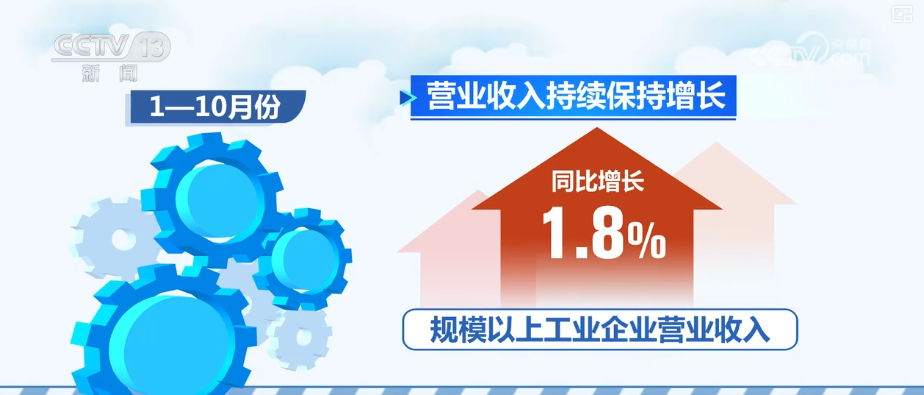
Core Insights - The overall profit of industrial enterprises above designated size in China showed stable growth from January to October, with a total profit of 59,502.9 billion yuan, representing a year-on-year increase of 1.9% [3][7] - The equipment manufacturing industry experienced a significant profit increase of 7.8%, contributing 2.8 percentage points to the overall profit growth of industrial enterprises [5][7] - High-tech manufacturing also performed well, with profits rising by 8.0%, surpassing the average growth rate of all industrial enterprises by 6.1 percentage points [8][11] Group 1 - From January to October, the total profit of industrial enterprises above designated size reached 59,502.9 billion yuan, with a year-on-year growth of 1.9% [3] - The revenue of these enterprises also saw a year-on-year increase of 1.8%, indicating sustained growth [3] - The profit growth of the equipment manufacturing sector was a key driver for the overall industrial profit increase, highlighting the sector's importance in the industrial economy [7] Group 2 - The high-tech manufacturing sector demonstrated robust performance, with an 8.0% increase in profits, indicating a positive trend in this area [8][11] - The structural optimization of industrial enterprise efficiency is evident, with traditional industries showing signs of improved productivity and profitability [11] - The ongoing integration of technological and industrial innovation is supporting the stability and recovery of industrial profits, with macroeconomic policies expected to further enhance enterprise performance [14]
国债期货日报:公募赎回扰动反复,国债期货全线收跌-20251127
Hua Tai Qi Huo· 2025-11-27 02:42
Report Industry Investment Rating There is no information provided regarding the report's industry investment rating. Core Viewpoints The bond market is oscillating between stable growth and easing expectations. Influenced by the stock market, along with differences in the Fed's interest - rate cut expectations and increased global trade uncertainties, the inflow of foreign capital is uncertain. In the short term, attention should be paid to the policy signals at the end of the month [1][2][3]. Summary by Directory 1. Interest Rate Pricing Tracking Indicators - **Price Indicators**: China's CPI (monthly) has a 0.20% month - on - month and year - on - year increase, while China's PPI (monthly) has a 0.10% month - on - month increase and a - 2.10% year - on - year decrease [9]. - **Monthly Economic Indicators**: Social financing scale is 437.72 trillion yuan, with a 0.64 trillion yuan increase and a 0.15% growth rate; M2 year - on - year is 8.20%, down 0.20% or - 2.38%; Manufacturing PMI is 49.00%, down 0.80% or - 1.61% [10]. - **Daily Economic Indicators**: The US dollar index is 99.58, down 0.23 or - 0.23%; The US dollar against the offshore RMB is 7.0775, down 0.017 or - 0.24%; SHIBOR 7 - day is 1.45, up 0.02 or + 1.40%; DR007 is 1.47, up 0.02 or + 1.40%; R007 is 1.51, down 0.02 or - 1.24%; The 3 - month inter - bank certificate of deposit (AAA) is 1.58, with no change in value and a - 0.02% change rate; The AA - AAA credit spread (1Y) is 0.10, up 0.01 or - 0.02% [10]. 2. Overview of the Treasury Bond and Treasury Bond Futures Market - **Closing Prices and Fluctuations**: On November 26, 2025, the closing prices of TS, TF, T, and TL were 102.37 yuan, 105.74 yuan, 107.85 yuan, and 114.29 yuan respectively, with fluctuations of - 0.05%, - 0.22%, - 0.36%, and - 0.86% [3]. - **Net Basis Spreads**: The average net basis spreads of TS, TF, T, and TL were - 0.027 yuan, 0.075 yuan, - 0.109 yuan, and 0.131 yuan respectively [3]. 3. Overview of the Money Market Funding Situation - **Fiscal Situation**: From January to October 2025, fiscal revenue showed a mild recovery, with general public budget revenue increasing by 0.8% year - on - year. Tax revenue improved for eight consecutive months, but non - tax revenue dragged down the overall growth rate. General public budget expenditure increased by only 2% year - on - year, slowing down for three consecutive months [2]. - **Financial Situation**: At the end of October, social financing and credit expanded at a low level, government bond issuance remained strong, and the financing demand of enterprises and residents was weak. M1 declined, and the M2 - M1 gap widened, indicating weak business vitality and a return from current to time deposits [2]. - **Central Bank Operations**: On November 26, 2025, the central bank conducted 213.3 billion yuan of 7 - day reverse repurchase operations at a fixed interest rate of 1.4% [2]. - **Money Market Rates**: The main term repurchase rates of 1D, 7D, 14D, and 1M were 1.316%, 1.453%, 1.507%, and 1.519% respectively, and the repurchase rates have rebounded recently [2]. 4. Spread Overview The report provides multiple spread analysis charts, including the inter - term spread trends of various treasury bond futures varieties and the spread between spot bond term spreads and futures cross - variety spreads [29][36][39]. 5. Two - Year Treasury Bond Futures The report presents charts on the implied interest rate of the two - year treasury bond futures main contract and the treasury bond yield to maturity, the IRR of the TS main contract and the funding rate, and the three - year basis and net basis trends of the TS main contract [38][42][50]. 6. Five - Year Treasury Bond Futures Charts are provided on the implied interest rate of the five - year treasury bond futures main contract and the treasury bond yield to maturity, the IRR of the TF main contract and the funding rate, and the three - year basis and net basis trends of the TF main contract [52][56]. 7. Ten - Year Treasury Bond Futures The report includes charts on the implied yield of the ten - year treasury bond futures main contract and the treasury bond yield to maturity, the IRR of the T main contract and the funding rate, and the three - year basis and net basis trends of the T main contract [59][60]. 8. Thirty - Year Treasury Bond Futures Charts are presented on the implied yield of the thirty - year treasury bond futures main contract and the treasury bond yield to maturity, the IRR of the TL main contract and the funding rate, and the three - year basis and net basis trends of the TL main contract [66][73]. Strategies - **Unilateral Strategy**: As the repurchase rate falls and the treasury bond futures price oscillates, the 2603 strategy is neutral [4]. - **Arbitrage Strategy**: Pay attention to the decline of the 2603 basis [4]. - **Hedging Strategy**: There is medium - term adjustment pressure, and short - side investors can use far - month contracts for appropriate hedging [4].
2025搜狐财经年度论坛议程公布,吴晓求、刘纪鹏、阎学通等20余位重磅嘉宾齐聚,共探中国经济韧性
Sou Hu Cai Jing· 2025-11-26 04:25
Core Viewpoint - The 2025 Sohu Finance Annual Forum will be held in Beijing on November 27, featuring over 20 experts from academia, industry, and investment sectors discussing key topics such as macro policies, industrial upgrades, corporate internationalization, capital market reforms, and international dynamics [2]. Group 1: Forum Structure - The forum will include a morning session with prominent scholars and business leaders discussing economic trends and real estate transformation [2]. - Notable entrepreneurs will explore innovation in industry competition, while experienced industry professionals and renowned fund managers will share insights on investment management and asset allocation [2]. Group 2: Afternoon Session Focus - The afternoon session will feature discussions on China's economy, stock market development, new consumer dynamics, and international situations by leading experts [2]. - Entrepreneurs will share their experiences on maintaining long-term strategies and building core competitiveness amidst cyclical fluctuations and external challenges, embodying the spirit of modern entrepreneurship [2].