
以旧换新政策

Search documents
珠海冠宇(688772):业绩释放加速,新技术周期消费领军企业再起航
Guoxin Securities· 2025-09-01 09:02
Investment Rating - The investment rating for Zhuhai Guanyu (688772.SH) is "Outperform the Market" [6][19]. Core Views - The company is experiencing accelerated performance release, with a new technology cycle positioning it as a leading consumer battery enterprise. In H1 2025, the company achieved a net profit of 117 million yuan, a year-on-year increase of 15%, and revenue of 6.098 billion yuan, also up 14% year-on-year [1][4]. - The company's consumer battery sales are steadily growing, maintaining its industry-leading position. In H1 2025, the estimated sales volume of consumer batteries reached approximately 200 million units, a year-on-year increase of over 17% [2][15]. - The company is focusing on high-rate scenarios in its dynamic storage battery segment, with revenue from its subsidiary Zhejiang Guanyu reaching 973 million yuan in H1 2025, a year-on-year increase of 140% [3][17]. Summary by Sections Financial Performance - In H1 2025, the company reported revenue of 6.098 billion yuan, a 14% increase year-on-year, and a net profit of 117 million yuan, also up 15% year-on-year. In Q2 2025, revenue reached 3.599 billion yuan, a 29% year-on-year increase and a 44% quarter-on-quarter increase, with a net profit of 141 million yuan, marking a 53% year-on-year increase [1][9]. - The gross margin for Q2 2025 was 24.65%, up 3.27 percentage points quarter-on-quarter, while the net margin was 3.47%, up 5.73 percentage points quarter-on-quarter [1][9]. Sales and Market Position - The company estimates that in H1 2025, consumer battery sales reached approximately 200 million units, with year-on-year growth rates of 7% for laptop batteries, 43% for mobile phone batteries, and 80% for other consumer batteries [2][15]. - The self-supply ratio of consumer battery cells reached 44.43%, an increase of 3.68 percentage points year-on-year [2][15]. Technological Advancements - The company is set to launch steel-shell battery products in H2 2025, which are expected to double in price compared to traditional soft-pack batteries, potentially driving revenue and profit growth [2][16]. - The company has established a solid-state lithium battery experimental line, providing a core platform for future technological breakthroughs [2][16]. Dynamic Storage Battery Segment - The dynamic storage battery segment is focusing on high-rate applications, with revenue from Zhejiang Guanyu reaching 973 million yuan in H1 2025, a year-on-year increase of 140% [3][17]. - The company has secured significant partnerships with major automotive manufacturers for low-voltage batteries and has seen over 200% year-on-year growth in drone battery revenue [3][17]. Profit Forecast Adjustments - The profit forecast has been adjusted, with expected net profits of 610 million yuan, 1.401 billion yuan, and 1.808 billion yuan for 2025, 2026, and 2027 respectively, reflecting year-on-year growth rates of 42%, 130%, and 29% [4][19].

爱玛科技(603529):2025年上半年利润同比提升,产品及渠道拓展促进增长
Guoxin Securities· 2025-09-01 08:20
Investment Rating - The report maintains an "Outperform the Market" rating for the company [4][25][6] Core Views - The company achieved a revenue of 13.03 billion yuan in H1 2025, representing a year-on-year growth of 23.0%, and a net profit of 1.21 billion yuan, up 27.6% year-on-year, driven by policies stimulating demand for electric two-wheelers [1][8] - The gross margin for H1 2025 was 19.2%, an increase of 1.4 percentage points year-on-year, while the net margin was 9.5%, up 0.4 percentage points year-on-year, indicating improved profitability due to the old-for-new policy and alleviation of price wars [2][13] - The company is actively expanding its product lines and channels, including launching new product lines targeting women and technology, which is expected to enhance sales and market share [3][20] Financial Performance - The company forecasts net profits of 2.623 billion yuan, 3.137 billion yuan, and 3.726 billion yuan for 2025, 2026, and 2027 respectively, with corresponding earnings per share of 3.02 yuan, 3.61 yuan, and 4.29 yuan [4][25] - The projected price-to-earnings (PE) ratios for 2025, 2026, and 2027 are 12, 10, and 9 respectively, indicating a favorable valuation outlook [4][25] Product and Channel Development - The company plans to increase its terminal store count from 30,000 in 2023, aiming to enhance sales efficiency and reach more customers [21][23] - The electric three-wheeler segment is expected to become a new growth point, with sales projected to reach 550,000 units in 2024, reflecting a year-on-year growth of 28.9% [24][3]

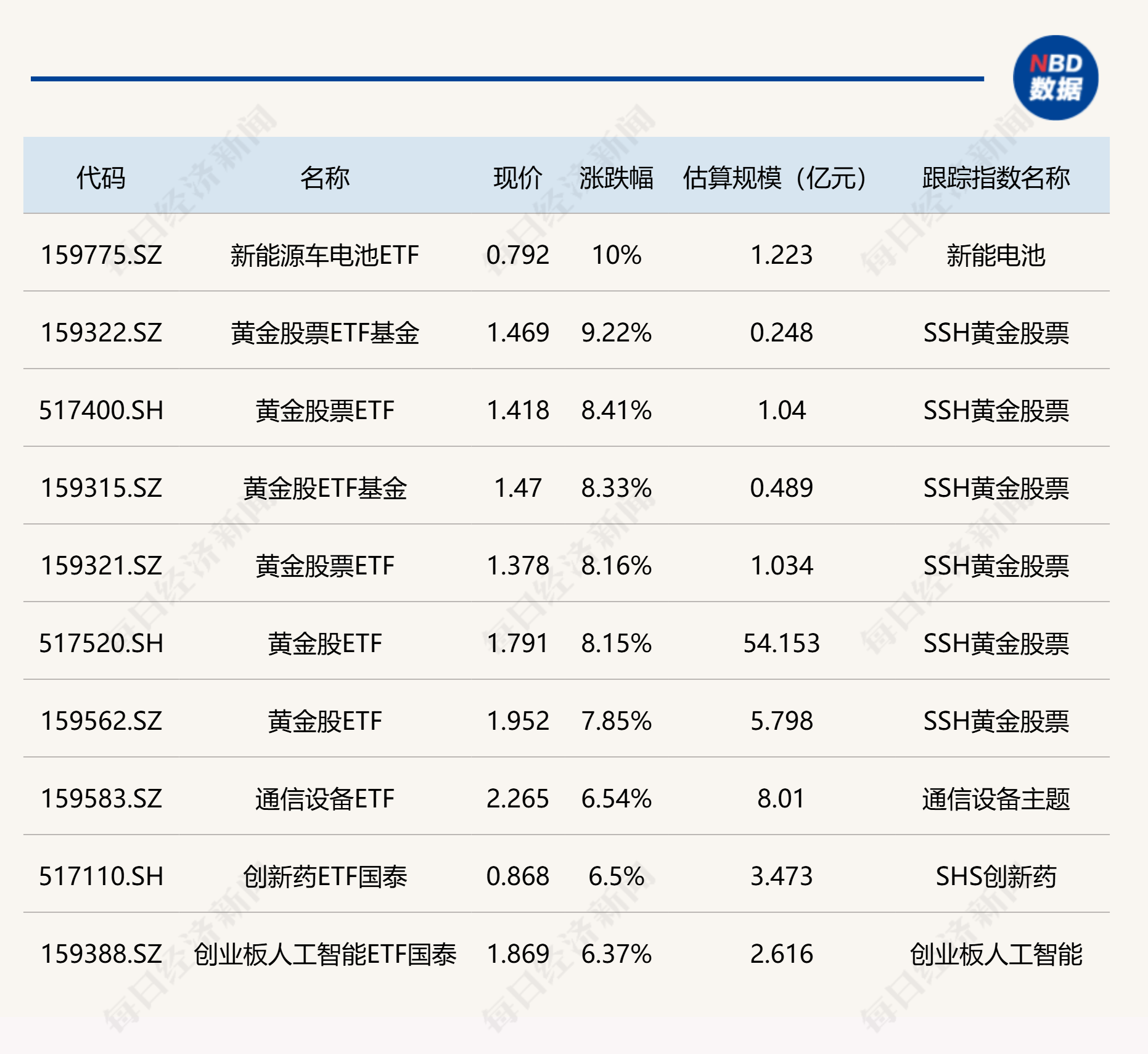
ETF今日收评 | 新能源车电池ETF涨停,黄金股相关ETF涨超8%
Sou Hu Cai Jing· 2025-09-01 07:48
Market Overview - The market experienced fluctuations throughout the day, with the ChiNext Index leading gains while the Shanghai Composite Index showed narrow fluctuations [1] - Gold concept stocks saw a collective surge, while large financial stocks underwent adjustments, with insurance stocks leading the decline [1] ETF Performance - The New Energy Vehicle Battery ETF reached a limit-up increase of 10%, while gold-related ETFs rose over 8% [2] - Specific ETFs such as the Gold Stock ETF and its variants showed significant gains, with increases ranging from 8.15% to 9.22% [2] Sector Analysis - Analysts suggest that the anticipated interest rate cuts by the Federal Reserve may support commodity prices, including gold and silver, leading to a bullish outlook from several international financial institutions [3] - Conversely, the Nasdaq Technology ETF fell over 2%, and Hong Kong automotive-related ETFs dropped more than 1% [3][4] Automotive Sector Outlook - Brokerages indicate that the vehicle sales performance in 2024 is expected to exceed expectations due to the vehicle trade-in policy, with continued support for automotive consumption in 2025 [5] - The automotive sector is projected to enter a phase of high sales prosperity, driven by event catalysts and industry trends [5]

爱玛科技系列二-半年报点评:2025年上半年利润同比提升,产品及渠道拓展促进增长【国信汽车】
车中旭霞· 2025-09-01 07:30
Core Viewpoint - The electric two-wheeler industry is approaching a high prosperity turning point due to policy support and market optimization, with Aima Technology expected to benefit from improved profit margins and enhanced product and channel strategies [2][3]. Financial Performance - In H1 2025, Aima Technology achieved revenue of 13.03 billion, a year-on-year increase of 23.0%, and a net profit of 1.21 billion, up 27.6% year-on-year. Q2 2025 revenue was 6.80 billion, a 20.6% year-on-year increase and a 9.1% quarter-on-quarter increase, with net profit at 610 million, up 30.1% year-on-year [9][8]. - The company's gross margin in H1 2025 was 19.2%, an increase of 1.4 percentage points year-on-year, while the net margin was 9.5%, up 0.4 percentage points year-on-year. In Q2 2025, the gross margin was 18.9%, a year-on-year increase of 1.3 percentage points, but a slight decline of 0.7 percentage points quarter-on-quarter [15][18]. Product and Channel Development - Aima launched various product lines in February 2025, including female, technology, commercial vehicles, and three-wheeled products, aiming to meet diverse user needs and enhance market share [3][20]. - The company plans to expand its terminal store count from 30,000 in 2023, which is a 50% increase from 20,000 in 2021, to further boost sales and market penetration [25][28]. Electric Three-Wheeler Business - Aima's electric three-wheeler sales reached 550,000 units in 2024, a year-on-year increase of 28.9%. The company is introducing high-end models to strengthen its product lineup and capture growth opportunities in this segment [5][28].

铸造铝合金产业链周报-20250831
Guo Tai Jun An Qi Huo· 2025-08-31 08:11
Report Industry Investment Rating - Not provided in the content Core Viewpoints of the Report - The price of cast aluminum alloy fluctuated strongly this week, reaching a high of 20,555 yuan/ton. As the traditional consumption peak season of "Golden September and Silver October" approaches, downstream demand may see a slight recovery, but the degree of demand improvement remains to be further observed. The current industry operating rate shows a divergence. Large enterprises have relatively abundant orders and a slightly increased operating rate, while small and medium-sized enterprises face more severe problems such as raw material shortages and production losses, with some reduction or suspension of production. In addition, the policy of canceling tax rebates has been fermenting this week, and the market is full of wait-and-see sentiment. Some enterprises are considering adopting a more cautious business strategy and plan to reduce or suspend production to avoid the risks of policy uncertainty. Overall, both cost support and policy pressure strongly support the price of recycled aluminum, and the price of cast aluminum alloy may continue to fluctuate strongly in the short term [7]. - As of August 29, the inventory of aluminum alloy ingot factories + social inventory increased by 0.34 million tons from the previous week to 11.58 million tons, and the inventory remains at a high level. In the upstream, the amount of waste generated at the end in August was still lower than expected, and the supply of waste aluminum raw materials was limited. In the downstream, in the fourth week of August (August 18 - August 24), domestic automobile sales were 473,000 vehicles, a month-on-month increase of nearly 10%, and fuel vehicles performed better than new energy vehicles. Overall, the effect of the trade-in policy is prominent, and the fourth batch of funds will be released as planned in October, which will help stabilize consumer confidence and continuously boost automobile consumption. With the arrival of "Golden September and Silver October", the growth of automobile sales is expected to improve month-on-month [7]. Summary by Relevant Catalogs Supply Side Waste Aluminum - Waste aluminum production is at a high level, and social inventory is at a medium-to-high level in history [10]. - Waste aluminum imports are at a high level, with a relatively fast year-on-year growth rate. In July 2025, the import of aluminum waste and scrap was 16.05 million tons, a year-on-year increase of 18.68%, and the cumulative import was 117.27 million tons, a cumulative year-on-year increase of 8.35% [14]. - The scrap-to-primary aluminum price difference shows an oscillating trend [19]. Recycled Aluminum - The spot price of cast aluminum alloy increased slightly, and the spread between ADC12 and A00 converged significantly [26]. - The regional spread of cast aluminum alloy weakened, showing certain seasonal patterns [31]. - The weekly operating rate of cast aluminum alloy increased slightly, and the monthly operating rate continued to rise [36]. - The cost of ADC12 is mainly composed of waste aluminum, and the current estimated cost is above the break-even line [38]. - The factory inventory of cast aluminum alloy decreased, while the social inventory continued to increase [43]. - The import window for cast aluminum alloy is temporarily closed [47]. - Regarding recycled aluminum rods, the production and inventory data are provided. The production shows certain fluctuations, and the factory inventory also varies by region [50][52]. Demand Side Terminal Consumption - The production of fuel vehicles declined, which was transmitted to the die-casting consumption [57].
潍柴动力 | 2025Q2:业绩符合预期 发动机龙头加速转型【民生汽车 崔琰团队】
汽车琰究· 2025-08-30 14:56
Group 1 - The company reported a revenue of 113.15 billion yuan for H1 2025, a year-on-year increase of 0.59%, while the net profit attributable to shareholders was 5.64 billion yuan, a decrease of 4.40% year-on-year [2] - In Q2 2025, the company achieved a revenue of 55.69 billion yuan, a year-on-year decrease of 0.75%, and a net profit of 2.93 billion yuan, down 11.23% year-on-year [3] - The company plans to distribute a cash dividend of 3.58 yuan per 10 shares, totaling approximately 368 million yuan [2] Group 2 - The company’s product structure is continuously optimized, with stable growth in various businesses including engines, complete vehicles, smart logistics, and agricultural machinery [5] - The sales of engines reached 362,000 units, with the M series large-bore engines selling over 5,000 units, a year-on-year increase of 41% [5] - The company’s overseas subsidiary, KION GROUP AG, achieved a revenue of 5.5 billion euros in H1 2025 [5] Group 3 - The expansion of the old-for-new policy for heavy trucks is expected to boost domestic demand, with an estimated 76,000 new vehicles potentially driven by the policy [6] - The company is positioned as a leader in the domestic engine sector, continuously extending its product line and enhancing core competitiveness [7] - Revenue projections for 2025-2027 are estimated at 226.92 billion yuan, 237.24 billion yuan, and 244.36 billion yuan respectively, with net profits of 12.12 billion yuan, 13.90 billion yuan, and 15.45 billion yuan [9]

家电周报:三大白电2025年9月排产数据发布 海尔智家推出首次中期分红
Xin Lang Cai Jing· 2025-08-30 12:31
Group 1 - The home appliance sector underperformed the CSI 300 index this week, with the Shenwan household appliance index declining by 0.9% while the CSI 300 index rose by 2.7% [1] - Key companies such as Guangfeng Technology and Ecovacs led the gains with a rise of 6.5%, while companies like Beike and Gree Electric faced declines of 6.2% and 5.6% respectively [1] - The production data for major white goods in September 2025 shows a total output of 27.07 million units, a decrease of 7.2% compared to the same period last year [1] Group 2 - In September 2025, the production of household air conditioners was 10.75 million units, down 12.0% year-on-year; refrigerators produced were 8.21 million units, down 6.3%; and washing machines saw production of 8.11 million units, down 1.1% [1] - Haier Smart Home announced its first mid-term dividend, proposing a cash dividend of RMB 2.69 per 10 shares, totaling over RMB 2.5 billion [1] Group 3 - In July 2025, the online sales volume of hair dryers decreased by 6.44% to 932,200 units, while sales revenue increased by 11.46% to RMB 209 million, with an average price rise of 19.16% to RMB 223.9 per unit [2][3] - The online sales volume of electric shavers increased by 21.32% to 927,700 units, with sales revenue rising by 23.61% to RMB 164 million, and an average price increase of 1.90% to RMB 177.0 per unit [2][3] Group 4 - The investment focus includes the white goods sector, which is characterized by low valuations, high dividends, and stable growth, with expectations for a boost from trade-in policies and rising copper prices [4] - Recommendations include leading companies such as Hisense, Midea, Haier, and Gree, as well as companies like Ousheng Electric and Dechang Co., which are expected to benefit from large customer orders and improved profitability [4] - The demand for core components in the white goods sector is expected to exceed expectations, with recommendations for companies like Huaxiang Co., Shun'an Environment, and Sanhua Intelligent Control, which are positioned to benefit from the industry's growth [4]



联影医疗等来“换新潮”
Hua Er Jie Jian Wen· 2025-08-30 05:32
Core Viewpoint - In the first half of 2025, United Imaging Healthcare (688271.SH) reported revenues and net profits of 6.016 billion yuan and 999.8 million yuan, respectively, marking year-on-year growth of 12.79% and 4.59% [1] Revenue Performance - After experiencing its first revenue decline since listing due to the impact of the old-for-new policy last year, United Imaging Healthcare has returned to a growth trajectory [1] - The MR (Magnetic Resonance) segment, which is the main revenue driver, generated 1.968 billion yuan in the first half of 2025, reflecting a significant year-on-year increase of 16.81% [1] - In contrast, the CT segment faced challenges from low-price competition, resulting in a revenue decline to 1.515 billion yuan, down over 6% year-on-year [1][2] Product Development - United Imaging Healthcare is focusing on high-end CT technology, having received approval for the "uCT Ultima," China's first photon-counting spectral CT, which offers advantages in spatial resolution and multi-energy spectrum imaging [3] - The service revenue, including maintenance, reached 816 million yuan, showing a nearly 30% year-on-year increase, but only accounted for just over 10% of total revenue [3] Profitability and Market Position - The overall gross margin for United Imaging Healthcare in the first half of 2025 was 47.93%, while the gross margin for service-related business exceeded 60% [4] - There is potential for improvement in the service revenue share, as compared to the "GPS trio" (GE Healthcare, Philips Healthcare, Siemens Healthcare), which has service revenue accounting for over 30% [4] International Business - International business is a significant aspect of United Imaging Healthcare's performance, with overseas revenue reaching 1.142 billion yuan in the first half of 2025, representing a year-on-year growth of 22.48% and accounting for 19% of total revenue, an increase of 1.5 percentage points year-on-year [5][6]

ST易购: 2025年半年度报告
Zheng Quan Zhi Xing· 2025-08-29 18:22
Core Viewpoint - Suning.com reported a slight increase in revenue for the first half of 2025, with a total revenue of 25.89 billion yuan, representing a 0.44% year-on-year growth. However, the company faced challenges in profitability due to increased competition and rising costs, leading to a significant increase in net profit attributed to shareholders, which reached 48.69 million yuan, a 230.03% increase compared to the previous year [1][10][11]. Company Overview and Key Financial Indicators - Company Name: Suning.com Co., Ltd. - Stock Code: 002024 - Total Assets: 119.89 billion yuan, a 0.72% increase from the previous year [1][10]. - Net Assets: 12.49 billion yuan, a 0.45% increase from the previous year [1][10]. - Basic Earnings Per Share: 0.0054 yuan, a 237.50% increase year-on-year [1][10]. Financial Performance - Revenue: 25.89 billion yuan, up 0.44% year-on-year [1][10]. - Net Profit Attributable to Shareholders: 48.69 million yuan, up 230.03% year-on-year [1][10]. - Cash Flow from Operating Activities: 1.49 billion yuan, down 33.48% year-on-year [1][10]. - Total Expenses: Decreased by 0.53% due to improved internal management efficiency [11][13]. Business Operations - The company focused on enhancing its retail service capabilities, particularly in the home appliance and 3C sectors, with a 11.7% increase in offline store sales [1][10]. - The number of retail cloud franchise stores reached 10,100, with 297 new stores opened in the second quarter of 2025 [1][10]. - The company implemented a full-channel development strategy, resulting in a 14.45% increase in comparable store sales for home appliance and 3C stores [1][10]. Market Strategy - Suning.com capitalized on the "old-for-new" subsidy policy, expanding its product categories eligible for subsidies from 8 to 12 [1][10]. - The company enhanced its supply chain management through AI and big data technologies, improving demand forecasting and procurement efficiency [1][10]. - The company maintained a focus on user needs, continuously upgrading service products to enhance customer experience [1][10]. Competitive Landscape - The retail market remains highly competitive, with price wars impacting overall profit margins. The company reported a 1.25% decline in overall gross margin due to increased competition and a higher proportion of low-margin consumer electronics sales [11][12]. - Suning.com is committed to balancing short-term profitability with long-term growth, focusing on resource optimization and operational efficiency [13][14].

中国重汽(03808):H1业绩稳健增长,看好内外双驱
HTSC· 2025-08-29 10:59
Investment Rating - The report maintains a "Buy" rating for the company with a target price of HKD 29.24 [7][8] Core Views - The company has shown steady growth in H1 2025, achieving revenue and net profit of RMB 50.87 billion and RMB 3.43 billion, respectively, with year-on-year increases of 4.2% and 4.0% [1][5] - The company continues to offer high dividends, declaring an interim dividend of RMB 0.68 per share, with a payout ratio of approximately 55% [1][5] - The outlook for H2 2025 is optimistic due to the ongoing implementation of the vehicle replacement policy and the commencement of the Yarlung Tsangpo River project, which is expected to boost domestic sales [1][3] Summary by Sections Financial Performance - In H1 2025, the company's gross margin was 15.1%, an increase of 0.4 percentage points year-on-year, driven by enhanced scale effects with heavy truck sales reaching 136,500 units, up 9.2% year-on-year [2] - Heavy truck revenue for H1 2025 was RMB 44.23 billion, also reflecting a 4.0% year-on-year increase [2] - The company maintained a stable expense structure, with a sales expense ratio of 3.5% and an administrative expense ratio of 4.7% [2] Market Demand and Strategy - The heavy truck market in China saw cumulative sales of 539,200 units in H1 2025, a year-on-year increase of 6.88% [3] - The company outperformed the industry with domestic sales of 67,500 units, up 19.3% year-on-year, leading in several niche markets [3] - The company is actively expanding its presence in the new energy vehicle sector, with sales of new energy heavy trucks reaching 9,376 units, a significant increase of 220.3% year-on-year [3] Export Performance - The company maintained its position as the leading exporter of heavy trucks in China, with H1 2025 export sales of 69,000 units, a slight increase of 0.8% year-on-year [4] - The company plans to deepen its overseas market expansion, particularly in traditional markets like Africa and Southeast Asia, while also targeting high-end markets such as Saudi Arabia and Morocco [4] Profit Forecast and Valuation - The company is projected to achieve net profits of RMB 6.73 billion, RMB 7.91 billion, and RMB 8.45 billion for the years 2025, 2026, and 2027, respectively, reflecting year-on-year growth rates of 15%, 18%, and 7% [5][10] - The report adjusts the target price to HKD 29.24 based on a price-to-earnings ratio of 11 times for 2025 [5][10]