
宽财政

Search documents
2026债市,或比预期好一点
Xin Lang Cai Jing· 2025-12-10 13:52
Group 1 - The core viewpoint of the articles indicates that the bond market in 2025 is expected to face significant challenges, transitioning from a "bullish long, bearish short" to a "bullish short, bearish long" market, making it increasingly difficult to generate returns [1][38] - Key variables affecting the bond market include "expansive fiscal policy," "stable monetary policy," "strong risk appetite," "strict regulation," and "weak reality," which are expected to shape the market dynamics in 2026 [1][38] - The fiscal deficit for 2025 is projected to increase by 2.9 trillion yuan compared to 2024, reaching a historical high since 2021, with a total deficit of 5.66 trillion yuan [1][39] Group 2 - The "expansive fiscal policy" is likely to continue into 2026, with a projected broad fiscal deficit of 15.1 to 15.9 trillion yuan, although the contribution to economic growth may be more stable than in 2025 [2][50] - The monetary policy in 2025 acted more as a supporting role, with expectations for 2026 to potentially see a shift towards a more expansive monetary policy, which could exceed market expectations [3][55] - Regulatory measures in 2025 have led to stricter behaviors among institutions, impacting the bond market, with asset management institutions likely to maintain lower bond allocation ratios [4][56] Group 3 - The macroeconomic indicators have shown marginal weakening since early 2025, but have not significantly influenced asset pricing, as the bond market has been more closely tied to equity market performance [5][38] - The bond market is expected to experience a "slow start, fast finish" rhythm in 2026, with potential for significant movements in the second and third quarters as monetary policy evolves [6][38] - The overall sentiment in the bond market is anticipated to remain cautious, with the need to monitor macroeconomic events that could trigger changes in monetary policy [6][55]

2026年投资展望系列之四:2026债市,或比预期好一点
HUAXI Securities· 2025-12-10 12:12
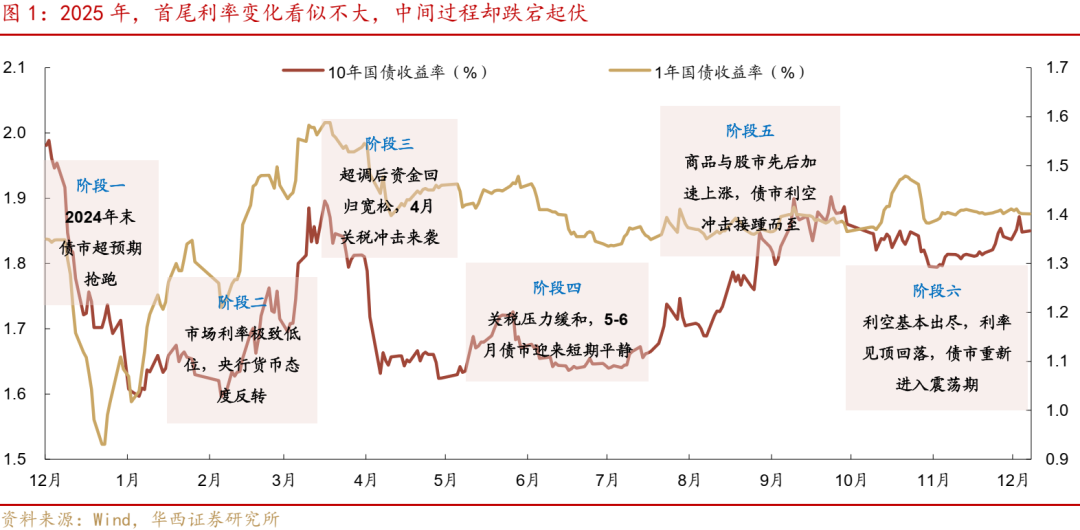
Group 1: Market Overview - The bond market in 2025 faced significant challenges, contrasting with the smooth trends of 2023-2024, with long-term interest rates experiencing volatility, starting at 1.61% and ending at 1.80%[1] - The shift from a "bull market for long bonds and bear market for short bonds" to a "bull market for short bonds and bear market for long bonds" increased the difficulty of obtaining returns exponentially[1] - Key variables influencing the market included expansive fiscal policy, stable monetary policy, strong risk appetite, strict regulation, and weak economic realities[1] Group 2: Fiscal Policy Insights - The broad fiscal deficit for 2025 increased by CNY 2.9 trillion compared to 2024, reaching a record high since 2021[2] - The fiscal deficit rate was set at 4.0% for 2025, up from 3.8% in 2024, marking a historical high[2] - Special government bonds were increased to CNY 1.3 trillion in 2025, with an additional CNY 500 billion allocated for major banks' capital replenishment[2] Group 3: Monetary Policy Expectations - The monetary policy in 2025 acted as a supporting role, with slower-than-expected implementation, characterized by a "slow start" in monetary easing[3] - There is a possibility that monetary policy could exceed expectations in 2026, transitioning from a stable to a more expansive stance if macroeconomic events trigger such changes[3] - The central bank's structural monetary policy may shift towards more targeted measures rather than broad-based cuts, impacting the bond market dynamics[4] Group 4: Regulatory Environment - 2025 was marked by strict regulations affecting financial institutions, with significant changes in wealth management and fund redemption policies[5] - The impact of regulatory changes on asset allocation could lead to a lower proportion of bond investments by asset management institutions, affecting the credit market[5] Group 5: Economic Indicators and Inflation - Economic indicators showed marginal weakening in 2025, but did not significantly influence asset pricing, as equity markets drove risk appetite higher[6] - Inflation expectations are anticipated to rise from low levels, potentially impacting asset pricing in 2026[6]
热点思考 | 日本宽财政,市场忽视了什么?(申万宏观·赵伟团队)
申万宏源宏观· 2025-11-30 16:05
Core Viewpoint - In November, Prime Minister Fumio Kishida officially launched an economic stimulus plan, leading to a depreciation of the yen and increased inflationary pressures. The combination of Japan's expansionary fiscal policy and tight monetary policy may pose risks for carry trade reversals, necessitating vigilance regarding the divergence in monetary policies between the Bank of Japan and the Federal Reserve [2][8]. Group 1: Economic Stimulus Plan - Kishida's economic stimulus plan totals 21.3 trillion yen (approximately 135 billion USD), slightly exceeding market expectations of 17 trillion yen. The fiscal deficit rate for Japan is projected to rise significantly in 2026 [3][9]. - The stimulus plan focuses on three main areas: 55% (11.7 trillion yen) for inflation subsidies and social welfare, 34% (7.2 trillion yen) for strategic industry investments, and 8% (1.7 trillion yen) for defense and diplomacy [3][15]. Group 2: Impact on GDP and Inflation - The expansionary fiscal policy may elevate Japan's GDP growth by 0.5 percentage points in 2026, although this contribution is lower than that of the U.S. and Germany. The fiscal deficit rate is expected to increase by 1.77 percentage points in 2026 [4][23]. - While inflation subsidies may temporarily lower overall inflation rates, they could simultaneously increase core inflation pressures in the medium term due to rising real incomes and a weaker yen [4][29]. Group 3: Monetary Policy and Carry Trade Risks - The combination of high inflation and a weak yen makes it difficult for Kishida's expansionary fiscal policy to align with the Bank of Japan's monetary policy, which may lead to a tightening stance. Recent hawkish signals from the Bank of Japan have raised expectations for interest rate hikes [5][35]. - The divergence between the yen and U.S. dollar interest rates may trigger a reversal in carry trades, as the yen has been systematically undervalued due to market pricing in fiscal expansion risks and policy uncertainties [5][41]. - Current conditions suggest that while the potential for carry trade reversals exists, the impact may be milder compared to previous instances, such as in August 2024 [5][47].

资金面整体均衡 债券收益率震荡下行
Jin Rong Shi Bao· 2025-11-27 02:22
Core Viewpoint - The external environment remains complex and uncertain as of Q4 2025, necessitating supportive monetary policies to stabilize the financial market and bolster domestic economic recovery [1] Group 1: Monetary Policy and Market Conditions - The People's Bank of China (PBOC) continues to implement a supportive monetary policy stance, utilizing various tools to ensure liquidity arrangements across short, medium, and long terms [1][2] - In October, the PBOC announced the resumption of government bond trading, which temporarily boosted market confidence and contributed to a balanced and loose funding environment [2][3] - The average daily trading volume and balance in the interbank currency market saw a slight increase, with major repo rates declining [1][2] Group 2: Market Transactions and Liquidity - In October, the interbank market recorded a total transaction volume of 172.8 trillion yuan, representing a month-on-month decrease of 18.4% and a year-on-year decrease of 3.3% [1] - The PBOC's open market operations included a net injection of 200 billion yuan from government bond trading and a net injection of 4 trillion yuan from reverse repos [2][3] - The overall funding environment remained loose, with the PBOC's actions ensuring stability despite significant market fluctuations due to tax periods [4] Group 3: Bond Market Dynamics - In October, the bond market saw a total issuance of 3.87 trillion yuan, a month-on-month decrease of 20.6% but a year-on-year increase of 5.2% [5] - Long-term bond yields experienced fluctuations, with the yield curve flattening; specific yields for various maturities showed mixed movements, with some declining and others slightly increasing [5][6] - The resumption of government bond trading is expected to stabilize the yield curve and reduce financing costs for the real economy [3][6] Group 4: Interest Rate Swaps and Trading Activity - The interest rate swap curve shifted downward in October, with significant declines in long-end rates; daily trading volume in interest rate swaps increased [7] - The average daily transaction volume for RMB interest rate swaps reached 186 billion yuan, reflecting a month-on-month growth of 23.4% [7] - The trading of standard bond forwards and interest rate options also saw substantial increases, indicating heightened market activity [7]
建信期货国债日报-20251120
Jian Xin Qi Huo· 2025-11-20 10:42
Report Information - Report Title: Treasury Bond Daily Report [1] - Date: November 20, 2025 [2] - Researcher: He Zhuoqiao, Huang Wenxin, Nie Jiayi [3] - Team: Macro Financial Team [4] 1. Report Industry Investment Rating - Not provided in the content 2. Report Core View - The negative factors in the bond market have basically been released, and November has entered a stage of accumulating positive factors. The bond market environment has improved. Considering the central bank's bond - purchasing and the slowdown of economic momentum, there is support at the bottom of treasury bond futures. Investors should seize the opportunity to lay out positions at low prices. In the short term, weak economic data and the passing of the tax - payment peak may boost the market's expectation of monetary easing and reduce disturbances to the bond market [11][12] 3. Summary by Directory 3.1 Market Review and Operation Suggestions - **Market Condition**: Affected by the tightening of inter - bank funds and stock market fluctuations, the sentiment in the bond market was weak, and treasury bond futures closed down across the board. The yields of major inter - bank interest - bearing bonds changed narrowly, with the yield of the 10 - year treasury bond active bond 250016 rising 0.3bp to 1.8080%. The money market was tight in the morning and gradually loosened in the afternoon. The central bank achieved a net injection of 1.15 billion yuan. The weighted overnight interest rate of inter - bank deposits fell 10.64bp to 1.4221%, and the 7 - day rate fell 1.08bp to 1.5131%. The 1 - year AAA certificate of deposit rate fluctuated narrowly around 1.62 - 1.64% [8][9][10] - **Conclusion**: Since June, domestic economic indicators have continued to weaken. Exports turned negative in October, and price indicators remained low. Currently, loose monetary and fiscal policies are being strengthened. The restart of treasury bond trading brings direct buying demand to the bond market. The impact of wide - credit effects on the bond market should be limited. The bond market's negative factors have basically been released, and it is in a stage of accumulating positive factors. Although there are still some uncertain disturbances, overall, the bond market environment has improved, and investors should seize the opportunity to lay out positions at low prices [11][12] 3.2 Industry News - Diplomatic events: The Chinese Ministry of Foreign Affairs was dissatisfied with the results of the Sino - Japanese consultation, and the Chinese side demanded that Japan correct its wrong remarks. The US modified the transparency rules for patent invalidation applications, which was a discriminatory restriction on Chinese enterprises, and the Chinese side would closely monitor the situation [13] - Domestic policies: The Chinese Premier called for free trade and strengthened cooperation within the SCO. Local financial departments are actively deploying the reserve work for special bond projects in 2026, and multiple "two - major" construction projects have started, which is expected to maintain a moderate growth rate of infrastructure investment [13][14] 3.3 Data Overview - **Treasury Bond Futures Market**: Presented the trading data of treasury bond futures on November 19, including contract details such as opening price, closing price, settlement price, price change, trading volume, and open interest [6] - **Money Market**: Included the changes in SHIBOR term structure and trend, and the changes in inter - bank pledged repurchase weighted interest rate and inter - bank deposit pledged repurchase rate [28][32] - **Derivatives Market**: Showed the Shibor3M interest rate swap fixed - rate curve (mean) and the FR007 interest rate swap fixed - rate curve (mean) [34]
建信期货国债日报-20251119
Jian Xin Qi Huo· 2025-11-19 10:28
Report Information - Report Title: Treasury Bond Daily Report [1] - Date: November 19, 2025 [2] - Researcher: He Zhuoqiao, Huang Wenxin, Nie Jiayi [3] Industry Investment Rating - Not provided in the report Core Viewpoints - The current negative factors in the bond market have basically been released, and November has entered a stage of accumulating positive factors. The bond market environment has improved, with the bottom of Treasury bond futures supported by the central bank's bond purchases. Considering the slowdown in economic momentum, expectations of monetary easing are likely to heat up again. It is advisable to seize opportunities to buy on dips. In the short term, the release of weak economic data is expected to boost market expectations of monetary easing, but this week's tax payment period may cause disturbances, and long - term varieties are expected to outperform short - term ones [12] Summary by Directory 1. Market Review and Operation Suggestions - **Market Performance**: A - share weakness boosted risk - aversion sentiment, but the tax payment period tightened the capital market, resulting in narrow fluctuations across the board in Treasury bond futures. The yields of major inter - bank interest rate bonds also fluctuated narrowly. The yield of the 10 - year Treasury bond active bond 250016 rose 0.15bp to 1.8040% [8][9] - **Funding Market**: Monday was the tax declaration deadline, and the impact of the tax period will continue for 2 - 3 working days. The capital market tightened further. The central bank achieved a net injection of 3.7 billion yuan. The inter - bank capital sentiment index rose significantly, with the overnight weighted average rate of inter - bank deposits rising 1.66bp to 1.5285%, and the 7 - day rate fluctuating around 1.5239%. The medium - and long - term funds were stable, and the 1 - year AAA certificate of deposit rate fluctuated narrowly around 1.62 - 1.64% [10] - **Economic Fundamentals**: Since June, domestic economic indicators have continued to weaken, especially in the investment sector, which has accelerated its decline. Exports, which were the main support for the economy, turned negative in October. With weak domestic demand and low price indicators, the economic fundamentals still face pressure [11] - **Policy**: Currently, loose monetary and fiscal policies are being intensified. The restart of Treasury bond trading has brought direct buying demand to the bond market. The effect of loose fiscal policies on credit expansion may not be significant in the short term, and the impact on the bond market should be limited. The central bank may increase its efforts to support economic growth, and the space for monetary easing is expected to expand [12] 2. Industry News - Diplomatic: China has lodged solemn representations and strong protests against Japanese Prime Minister Kaochi Sanae's wrong remarks on Taiwan. Premier Li Qiang has no arrangements to meet with Japanese leaders during the G20 Summit [13] - Financial: The Fourth China - Germany High - Level Financial Dialogue was jointly chaired by Chinese Vice - Premier He Lifeng and German Vice - Chancellor and Finance Minister Christian Lindner. Both sides welcomed cross - listing of depositary receipts between the two countries and agreed to promote the interconnection of financial infrastructure [13] - Fiscal: From January to October this year, China's national fiscal revenue was 18.65 trillion yuan, a year - on - year increase of 0.8%. In October, the national fiscal revenue was 2.26 trillion yuan, a year - on - year increase of 3.2%. From January to October, national fiscal expenditure was 22.58 trillion yuan, a year - on - year increase of 2% [13] - Foreign Exchange: In October, the bank settlement surplus was 17.7 billion US dollars, narrowing month - on - month. Cross - border capital inflows increased in October, and the average monthly cross - border payment surplus in September and October was 24 billion US dollars [14] - Real Estate: Since the beginning of this year, the real estate market has shown a trend of being dominated by second - hand housing transactions and gradually stabilizing. From January to October, the online signing area of second - hand housing transactions increased by 4.7% year - on - year, accounting for 44.8% of the total transactions [14] 3. Data Overview - **Treasury Bond Futures Market**: The report provides data on the trading of Treasury bond futures contracts on November 18, including opening prices, closing prices, settlement prices, price changes, trading volumes, open interests, and changes in open interests [6] - **Money Market**: The report presents data on the term structure and trends of SHIBOR, as well as changes in the weighted average interest rates of inter - bank pledged repurchase and inter - bank deposit pledged repurchase [28][32] - **Derivatives Market**: The report shows the Shibor3M interest rate swap fixing curve (mean) and the FR007 interest rate swap fixing curve (mean) [34]
大跌之后的几条建议
表舅是养基大户· 2025-11-18 13:33
Group 1 - The article discusses the recent global market downturn, highlighting a liquidity shock that has led to a collective decline in various asset classes, including global stocks, cryptocurrencies, and gold, with the Asia-Pacific region experiencing the largest drop of over 3% in Japan and South Korea [4][8]. - It emphasizes the importance of maintaining core positions in quality equity investments, particularly in a low-interest-rate environment, and suggests that the main investment themes remain unchanged despite market fluctuations [7][10]. - The article advises investors to lower their expectations and set realistic benchmarks for returns, suggesting that the focus should be on long-term investment in quality companies rather than short-term gains [13][15]. Group 2 - The article highlights the need for investors to avoid crowded trades and to be cautious about entering popular sectors unless they have a deep understanding of industry trends, using examples from the lithium battery sector and the banking sector to illustrate the risks of chasing hot stocks [17][22]. - It advocates for dynamic portfolio balancing and the acquisition of undervalued assets, suggesting that investors should assess their holdings and consider diversifying across different sectors and regions to mitigate risks [24][27]. - The article mentions the performance of the Hong Kong stock market, noting the impact of significant capital raises on valuations and the mixed results from companies like Xiaomi, which reported a 20% year-on-year revenue increase but faces concerns about sustaining growth in its automotive business [34].
建信期货国债日报-20251113
Jian Xin Qi Huo· 2025-11-13 02:37
Report Summary 1. Report Industry Investment Rating No relevant information provided. 2. Core View of the Report - The bond market environment has improved. The negative factors in the bond market have basically been released, and November is a stage of accumulating positive factors. Although there are some uncertain disturbances, considering the central bank's bond - buying operations, the bottom of Treasury bond futures is supported. With the slowdown of economic momentum, the expectation of monetary easing is expected to heat up again. It is recommended to pay attention to this week's economic activity data and the central bank's outright reverse - repurchase operations and seize the opportunity to buy on dips [11][12]. 3. Summary by Relevant Catalogs 3.1行情回顾与操作建议 (Market Review and Operation Suggestions) - **Market Conditions**: The third - quarter monetary policy implementation report released last night sent a signal of monetary easing, and the marginal improvement of the money market today boosted the bond market sentiment, leading to an overall rise in Treasury bond futures. The yields of major term interest - bearing bonds in the inter - bank market declined slightly. The yield of the 10 - year Treasury bond active bond 250016 was reported at 1.7990%, down 0.5bp [8][9]. - **Money Market**: The pressure on the money market has marginally eased. The central bank made a net injection of 1300 billion yuan today. The inter - bank money sentiment index declined slightly, indicating a marginal reduction in capital pressure. The weighted overnight rate of inter - bank deposits fell 9bp to 1.42%, and the 7 - day rate fell 2.22bp to 1.49%. The medium - and long - term funds were stable, and the 1 - year AAA certificate of deposit rate fluctuated narrowly around 1.62 - 1.64% [10]. - **Conclusion**: The domestic economic indicators have been weakening since June, especially the investment sector has accelerated its decline, and the export growth turned negative in October. Although the inflation data rebounded over the weekend, the demand - side improvement was not obvious. Currently, the combination of loose monetary policy and loose fiscal policy has been intensified. The restart of Treasury bond trading has brought direct buying demand to the bond market. The impact of loose fiscal policy on the bond market should be limited in the short term. Overall, the bond market environment has improved, and there is support at the bottom of Treasury bond futures [11][12]. 3.2行业要闻 (Industry News) - The US announced a one - year suspension of the implementation of the export control penetration rule. The Chinese Ministry of Commerce responded that this was an important measure for the US to implement the consensus reached in the China - US economic and trade consultations in Kuala Lumpur. - The central bank's third - quarter monetary policy implementation report pointed out that it will implement a moderately loose monetary policy, keep social financing conditions relatively loose, and continue to improve the monetary policy framework. - The Chinese Minister of Commerce had a video meeting with the German Federal Minister for Economic Affairs and Climate Action to exchange views on China - Germany and China - EU economic and trade issues. - Mexico postponed the increase of tariffs on Chinese goods, and the EU considered forcing member states to remove Huawei and ZTE equipment. The Chinese Ministry of Foreign Affairs urged the EU to provide a fair, transparent, and non - discriminatory business environment for Chinese enterprises. The US announced a one - year suspension of the 301 investigation on China's shipbuilding and other industries, and China announced corresponding counter - measures [13][14]. 3.3数据概览 (Data Overview) - **Treasury Bond Futures Market**: Includes information on the trading data of Treasury bond futures contracts (such as opening price, closing price, settlement price, etc.), the spread between main - contract tenors, the spread between main - contract varieties (e.g., 2 - year vs 30 - year, 10 - year, 5 - year; 5 - year vs 30 - year, 10 - year; 10 - year vs 30 - year), and the trend of main - contract prices [6][15][16]. - **Money Market**: Involves the term - structure changes and trends of SHIBOR, as well as the changes in the weighted average interest rate of inter - bank pledged repurchase and the interest rate of inter - bank deposit - pledged repurchase [28][32]. - **Derivatives Market**: Presents the fixed - rate curves of Shibor3M interest - rate swaps and FR007 interest - rate swaps [34].
黄金比特币创新高!美政府停摆与日本新首相推升全球“双宽”预期
Di Yi Cai Jing· 2025-10-09 03:25
Core Viewpoint - The global political rightward shift, along with trends of expansive fiscal and monetary policies, indicates increased uncertainty from geopolitical friction and greater unsustainability of global government debt, raising the probability of the economy moving from a soft landing to moderate overheating [1] Market Strategy - Short-term risk appetite for US stocks is expected to weaken due to the ongoing government shutdown, while in the medium term, the combination of right-wing policies and dual expansionary fiscal and monetary measures is likely to lead to geopolitical risks, economic overheating, and weakened fiat currency credit, with expected asset performance ranking as gold > copper > stocks [1] Major Events Impacting Markets - The US government shutdown and the election of Kishi Nobuo as the president of the Liberal Democratic Party in Japan are the two main events driving market sentiment [2] - The US government shutdown, which began on October 1, is expected to last longer than market expectations, leading to increased risk aversion and a rise in gold and Bitcoin prices, with both assets reaching historical highs [2][3] Economic Data - The US ADP employment data showed a negative growth of 32,000 jobs in September, significantly below the expected increase of 51,000, indicating weakness in the labor market [5] - The ISM manufacturing PMI improved to 49.1, while the services PMI fell to 50, reflecting mixed signals in the US economy [5] Political Developments in the US - The US federal government entered a shutdown due to a failure to pass a temporary spending bill, primarily over disagreements on healthcare spending, with potential economic impacts being limited based on historical precedents [6][7] - The shutdown is expected to delay the release of key economic data, including non-farm payrolls and CPI, which are crucial for Federal Reserve monetary policy decisions [7] Political Developments in Japan - Kishi Nobuo's election as the new president of the Liberal Democratic Party is expected to lead to a continuation of expansionary fiscal and monetary policies, which may delay the Bank of Japan's interest rate hike process [8][9] - Kishi's economic policies are characterized by a commitment to "more responsible" fiscal expansion, with a focus on coordinating closely with the Bank of Japan [9]
债市专题研究:国庆假期要闻汇总及思考
ZHESHANG SECURITIES· 2025-10-08 08:44
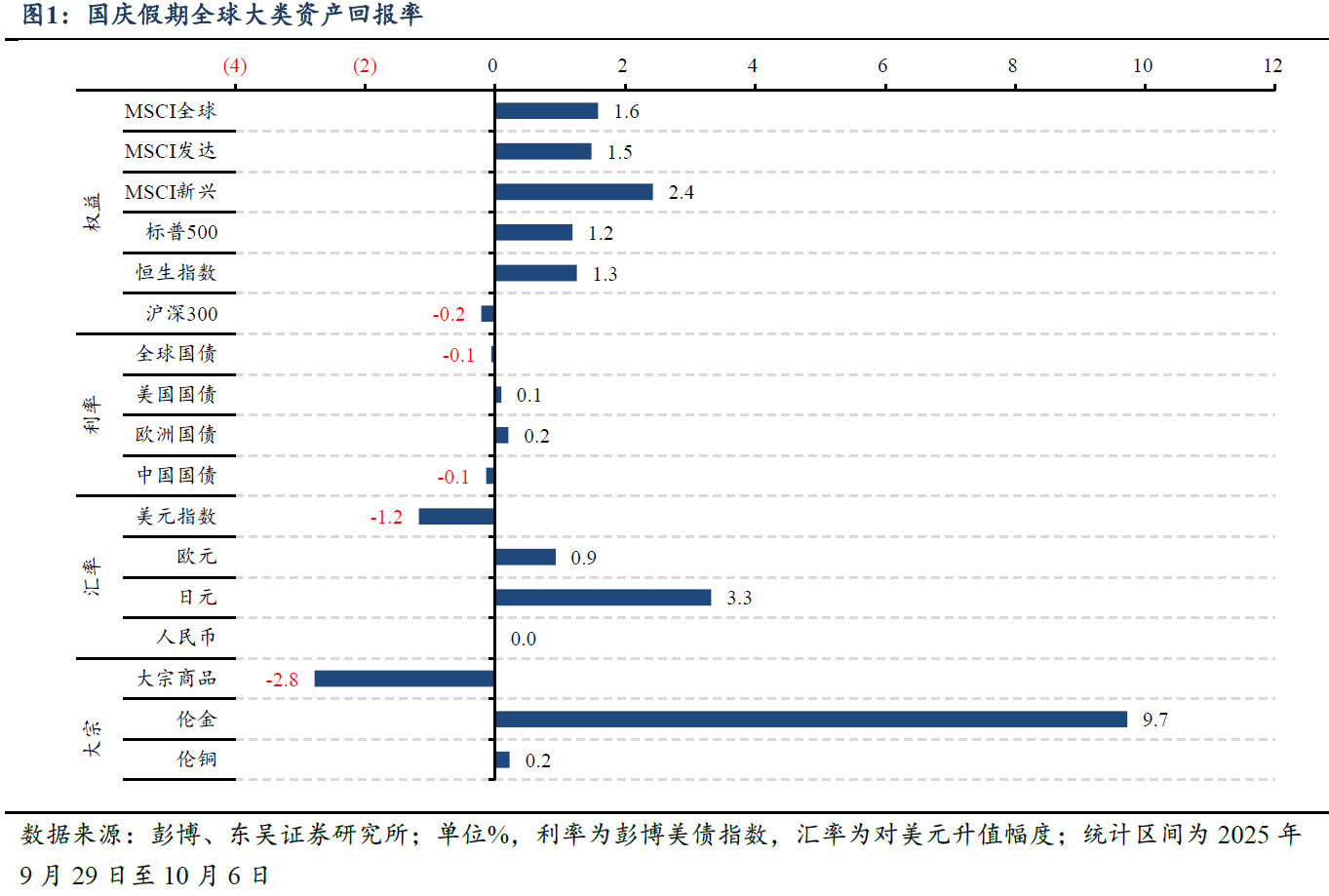
Industry Investment Rating No information provided in the report. Core Views - During the National Day holiday, there were two major trading themes in global assets: the US government shutdown and the victory of Sanae Takaichi as the president of Japan's Liberal Democratic Party. The global risk appetite is expected to rise driven by liquidity. Japanese stock indices and gold led the gains, while long - term bond yields in major countries such as the US and Japan increased due to concerns about loose fiscal policies and debt sustainability [1][11]. Summary by Directory 1. Holiday News Summary and Thoughts - **US Government Shutdown**: On the evening of September 30, the US Senate failed to pass the annual appropriation bill, leading to a government shutdown. The core reason is the disagreement between the two parties on medical insurance welfare spending. The shutdown may delay important economic data releases and the Fed's interest - rate cut decision. The market's concern about the unsustainability of US government debt has increased [11][12]. - **Sanae Takaichi's Victory**: On October 4, Sanae Takaichi won the Liberal Democratic Party's presidential election. Her victory implies a high probability of becoming Japan's prime minister. Her policy style is expected to continue "Abenomics", with a combination of loose fiscal and monetary policies, which may lead to a strong Japanese stock market, a weak Japanese bond market, and a weak yen. The market's expectation of a Japanese interest - rate hike in October has been postponed [12][13]. - **Gold Price Increase**: During the National Day holiday, the COMEX gold price rose 2.49% in three trading days. The rise is driven by the Fed's interest - rate cut expectation, geopolitical risks, and central banks' gold purchases. The US government shutdown further boosted gold's safe - haven demand [14]. 2. Global Asset Class Performance - **Equity Assets**: During the National Day holiday (October 1 - 6), equity asset prices generally rose, with Japanese stock indices performing outstandingly. In the domestic market, A - shares were on holiday, and Hong Kong stocks rose first and then fell. Overseas, most global stock indices rose after the Fed's September interest - rate cut. Sanae Takaichi's victory pushed up the Japanese stock market [15][19]. - **Commodity Market**: The US government shutdown drove up the safe - haven demand for precious metals. Gold, silver, and copper prices rose significantly, while crude oil prices generally fell [19]. - **Bond Market**: Affected by the US government shutdown and concerns about the sustainability of loose fiscal policies, US 10 - year Treasury bond yields first decreased and then increased, with a net increase of 2.0BP. Japanese bonds showed a steepening trend, with 10 - year Treasury bond yields rising 1.5BP. Italian and German 10 - year Treasury bond yields also increased [20]. 3. Overseas News Summary - **US Government Shutdown and Data Delays**: Key economic data were postponed due to the government shutdown. The new ADP employment was negative, but the decline slowed down. The US 9 - month manufacturing PMI was still in the contraction range, but the contraction speed slowed down, and the non - manufacturing PMI rose significantly [27][30]. - **US 9 - month ISM Manufacturing PMI**: The 9 - month ISM manufacturing PMI was 49.1%, a slight increase from the previous month. Except for output, supplier delivery, and prices, other sub - items were in the contraction range. The output item had the largest month - on - month increase, while new export orders had the largest decline [32]. - **Eurozone Inflation**: In September, the Eurozone CPI increased slightly year - on - year, and the core CPI decreased month - on - month. The PPI decreased both year - on - year and month - on - month [36]. - **Sanae Takaichi's Victory and BOJ Expectations**: Sanae Takaichi won the Liberal Democratic Party's presidential election, and the market's expectation of a BOJ interest - rate hike in October was postponed [39]. 4. Domestic News Summary - **Travel**: During the National Day holiday, the cross - regional population flow and private travel volume increased compared with the same period last year. Domestic and international flight operations also increased, especially international flights [44][45]. - **Movies**: During the National Day holiday, the number of moviegoers and box office revenue were close to those of 2024 but far lower than those of 2019. The number of movie screenings was significantly higher than that of 2019 [51]. - **City Subways**: The subway ridership in most first - tier cities decreased during the National Day holiday [51]. - **Catering**: Catering consumption was booming during the National Day holiday. The order volume of "Must - eat List" restaurants increased significantly, and the sales of key retail and catering enterprises increased year - on - year [58]. - **Real Estate**: Shanghai's second - hand housing transactions decreased compared with 2024, while Beijing's real estate market was active during the National Day holiday. The real - estate market's "stabilization" still needs further confirmation [58][61].