盈利修复

Search documents
机构称港股“处于盈利修复启动初期”,聚焦恒生ETF(159920)、恒生国企ETF(159850)一键布局
Mei Ri Jing Ji Xin Wen· 2025-12-19 02:44
Group 1 - The Hong Kong stock market opened positively on December 19, with the Hang Seng Index rising by 0.53%, the National Enterprises Index by 0.58%, and the Hang Seng Technology Index by 0.81% [1] - Popular ETFs such as the Hang Seng ETF (159920) and the Hang Seng National Enterprises ETF (159850) saw gains of over 1% in early trading [1] - The U.S. core CPI for November increased by 2.6% year-on-year, marking the lowest level since 2021, which has strengthened market expectations for the Federal Reserve to cut interest rates next year [1] Group 2 - CITIC Securities believes that the current bull market for Hong Kong stocks is at a mid-stage, with liquidity cycles leading since global central banks began cutting rates in 2023 [1] - The valuation level has reached the historical upper-middle range, with the Hang Seng Index's PE fluctuating between 10 and 11 [1] - The overall profit recovery for Hong Kong stocks is still in its early stages, with a relatively gentle slope expected for profit recovery, primarily concentrated in structurally prosperous sectors [1] Group 3 - Notable investment targets include the core broad-based Hong Kong stocks: Hang Seng ETF (159920), AI and platform economy: Hang Seng Technology Index ETF (513180), and focusing on the development of Chinese enterprises in Hong Kong: Hang Seng National Enterprises ETF (159850) [2]
奥瑞金(002701):出售海外资产优化资产结构 深化波尔合作
Xin Lang Cai Jing· 2025-12-18 06:34
Core Viewpoint - The company plans to sell 80% equity of its subsidiary, Benna Belgium, to Rexam Limited for approximately €110.4 million, aiming to optimize asset structure and enhance operational efficiency [1] Group 1: Transaction Details - The overall enterprise value of Benna Belgium is €138 million, with the adjusted transaction amount expected to be between €50 million and €60 million [1] - The transaction has received antitrust approval in Germany [2] Group 2: Strategic Focus - The sale is part of a strategy to optimize asset structure, improve operational efficiency, and reduce management costs, while deepening the global strategic partnership with Ball Corporation [3] - The expected investment income from this transaction is projected to exceed 10% of the company's most recent audited net profit, enhancing current operating performance [3] Group 3: Market Outlook - The domestic two-piece can business is expected to recover gradually, supported by rising aluminum prices and improved industry concentration [4] - The company is accelerating its overseas capacity layout, with significant production planned in Thailand and Kazakhstan, which is anticipated to improve profit margins [4] - The three-piece can business is stable, with strong relationships with major clients like Red Bull, contributing to consistent cash flow [4] Group 4: Profit Forecast and Investment Recommendation - The company is optimistic about the metal packaging industry's restructuring, with projected net profits for 2025-2027 at ¥1.346 billion, ¥1.314 billion, and ¥1.489 billion, reflecting a year-on-year growth of 70%, -2%, and 13% respectively [5] - The current market capitalization corresponds to a valuation of approximately 12 times for 2026, maintaining a "buy" rating [5]

奥瑞金(002701):出售海外资产优化资产结构,深化波尔合作
Huafu Securities· 2025-12-18 05:05
Investment Rating - The report maintains a "Buy" rating for the company, expecting a relative increase of over 20% against the market benchmark index within the next six months [6][19]. Core Views - The company plans to sell part of its overseas subsidiary's equity to optimize its asset structure and enhance operational efficiency, which is expected to deepen its strategic partnership with Rexam Limited [3][4]. - The overall enterprise value of the Belgian subsidiary is €138 million, with the base consideration for the 80% stake set at €110.4 million, and the adjusted transaction amount anticipated to be between €50 million and €60 million [3]. - The transaction has received German antitrust approval, indicating regulatory support for the asset sale [3]. - The company is focusing on high-quality capacity construction and optimizing its asset structure by divesting non-core assets, which is expected to improve cash flow and reduce leverage [4]. - The domestic two-piece can business is expected to recover gradually, supported by rising aluminum prices and a more concentrated market environment [5]. - The company is accelerating its overseas capacity layout, with significant production planned in Thailand and Kazakhstan, which is anticipated to enhance profitability due to higher margins in international markets [5]. Financial Summary - The company forecasts net profits of ¥1.346 billion, ¥1.314 billion, and ¥1.489 billion for the years 2025, 2026, and 2027 respectively, reflecting a growth rate of 70%, -2%, and 13% [6][7]. - Revenue projections for 2025, 2026, and 2027 are ¥22.187 billion, ¥23.070 billion, and ¥23.811 billion, with growth rates of 62%, 4%, and 3% respectively [7]. - The current market capitalization corresponds to a valuation of approximately 12 times the expected earnings for 2026 [6].
11月:煤价环比上涨,反内卷初心未变 | 投研报告
Zhong Guo Neng Yuan Wang· 2025-12-18 02:03
山西证券近日发布煤炭月度供需数据点评:2025年1-11月,原煤累计产量实现44.02亿吨,同比增 1.4%,同比增速边际下滑。11月当月实现4.27亿吨,同比降0.5%,环比增4.93%。25年1-11月固定资产 投资同比降2.6%,其中制造业投资增1.9%、基建投资降1.1%、房地产投资降15.9%。25年1-11月火电累 计增速实现-0.7%;焦炭累计增速实现3.2%;生铁累计增速实现-2.3%;水泥累计增速实现-6.9%;11月 火电增速实现4.2%;焦炭增速实现2.3%;生铁增速实现-8.7%;水泥增速实现-8.2%。 价格:11月煤炭价格环比超预期上涨。25年以来虽然山西优混5500动力煤、京唐港主焦煤、天津港二级 冶金焦均价有所调整,但11月当月三个品种均价环比均有不同程度上涨。11月各品种环比增幅动力煤> 焦炭炼>焦煤。 点评与投资建议: 11月煤价由涨转跌。11月大部分时间煤价延续10月份的上涨趋势,核心逻辑为电厂补库。在下游电厂完 成补库后,煤价旺季有所回落。从价格季节分布来看,2025年和2024年以及2023年的煤价季节性走势规 律一致,均呈现出"淡季不淡"和"旺季不旺"。前期价格超预 ...
盈风聚势启新程:2026年股指期货年度展望
Guo Lian Qi Huo· 2025-12-17 09:46
Report Industry Investment Rating No information provided in the content. Core Viewpoints - In 2026, the market logic is expected to shift from liquidity-driven to profit-recovery - driven. The strategic adjustment of "building a strong domestic market" and the "anti - involution" policy will improve domestic demand and deflation expectations. Multiple leading indicators suggest that PPI may enter an upward channel, and corporate profit recovery is expected, but the repair strength may be weaker than in 2021. The market may continue to re - balance in the short - term, with the large - cap value style having an advantage, and profit - recovery opportunities will be the key theme for the A - share market in 2026 [4]. Summary by Directory I. Indexes Break through the Oscillation Pattern 1.1 Market Review: Ample Liquidity as the Core Driver of Index Market - In the 2025 annual report, it was predicted that the index market would show an "N" shape, driven by the ample liquidity from the "rush - to - export" expectation. However, China's exports maintained strong resilience after the "rush - to - export" trend cooled, and the obvious profit - repair trend was delayed. The A - share market oscillated in Q1, adjusted in April due to Trump's "reciprocal tariff" remarks, and then rose as policies took effect. In Q3, multiple factors supported the market, and in Q4, the driving force shifted from liquidity to profit - repair expectation [8]. 1.2 Industry Performance: Precious Metals Lead the Non - ferrous Metals Industry - In 2025, industry performance was significantly differentiated. Precious - metal - related non - ferrous metals led the increase due to Trump's tariff policy, the Middle East situation, and the Fed's interest - rate cut expectation. As of December 16, communication, non - ferrous metals, and electronics had high gains, while food and beverage and coal had losses. Different styles dominated at different times, and the large - cap value style became attractive in Q4 [11]. 1.3 Index Basis: Multiple Factors Lead to Increased Index Discount - The A - share market's trading activity increased in 2025, and the small - and medium - cap style was strong. The market - neutral strategy's scale expanded, increasing the hedging demand for stock - index futures. High dividend payouts and the decline of snowball products also contributed to the deepening discount of stock - index futures [13][14]. II. Market Valuation: Focus on Profit - Driven Valuation Digestion 2.1 CSI 500 and CSI 1000 Indexes: Significant Valuation Repair - As of December 16, the price - to - book ratios of the CSI 500 and CSI 1000 indexes were at relatively high historical levels, at 72.84% and 50.04% of the past 10 - year levels respectively [19]. 2.2 SSE 50 and CSI 300 Indexes: Valuation Divergence - As of December 16, the price - to - earnings ratios of the SSE 50 and CSI 300 indexes were at relatively high historical levels, while the price - to - book ratios were relatively lower. This divergence was due to the valuation recovery since September 2024, and future profit levels will be crucial for digestion and repair [22]. 2.3 Index Crowding: Large - Cap Value Style May Continue to Dominate - The index crowding degree reflects market allocation enthusiasm. In 2025, the small - and medium - cap growth style was popular in most of the year, but the large - cap value style became more attractive in Q4 due to its low valuation and high profit certainty [24][25]. 2.4 Stock - Bond Cost - Effectiveness: Lower Priority of Relative Valuation Attention - The stock - bond cost - effectiveness indicator shows that the stock market is at a relatively low level. With the Fed's interest - rate cuts and the narrowing of the China - US monetary - policy cycle gap, the domestic interest - rate cut window is opening. In the current situation, the priority of relative valuation attention can be shifted, and more attention can be paid to other driving factors [28][31]. 2.5 Valuation Summary - After the continuous valuation repair in 2025, the A - share market's relative valuation advantage over bonds has weakened but is not at an extreme level. There is a differentiation in the market, and the large - cap value style is expected to continue to dominate [33]. III. Supply and Demand Drive, Profit Level Recovery Expected 3.1 Strategic Adjustment of "Insufficient Domestic Demand" Response, Marginal Relief of Consumption Downturn Expected - China's economic problem has been insufficient domestic demand. The policy response is shifting from short - term demand stimulation to long - term market cultivation and system construction. The "construction of a strong domestic market" aims to improve residents' purchasing power and consumption confidence, which is expected to relieve the consumption downturn [34][35]. 3.2 "Anti - Involution" Improves Deflation Expectations, Profit Level Recovery Expected - PPI is expected to enter an upward channel in 2026 and turn positive year - on - year around mid - year. Fiscal, credit, and monetary data all indicate a turning point in the industrial - product price cycle. The profit level has shown an initial recovery trend [41][42]. IV. Asset Allocation Transfer Signs Appear, Capital Account Pressure May Continue to Ease 4.1 Interest - Rate Decline and Dividend Improvement Drive Asset Allocation Transfer - In 2025, the LPR was lowered, and bank deposit rates decreased, making deposits less attractive. At the same time, listed companies increased shareholder returns. As a result, funds flowed from the banking system to the non - banking financial sector, bringing incremental liquidity to the A - share market [50][53]. 4.2 Change in Dominant Factors of the US Dollar, Capital and Financial Account Pressure May Ease - The US dollar's role is changing from a counter - cyclical asset to a pro - cyclical asset due to the expansion of US debt and geopolitical risks. The weakening of the US dollar is expected to support the RMB exchange rate and ease the pressure on China's capital and financial accounts [58][61]. 4.3 Exports Maintain Resilience, Current Account May Face Pressure in H1 2026 - China's exports are expected to remain stable in 2026, with a "low - then - high" growth pattern. Exports may face pressure in H1 due to a high base in 2025 and difficulties in the US market's import recovery. However, the diversification of the export market and the upgrade of export - product competitiveness will provide support [64][67]. V. Summary: Profit - Level Repair Strength May Be the Key Driving Factor - In 2026, the market's core driving force is expected to shift to profit repair. Policies will improve domestic demand and deflation expectations, and multiple indicators suggest PPI may rise and corporate profits may recover. Asset allocation transfer and a favorable capital environment will support the market. The A - share market is expected to rise in an oscillatory manner, with the large - cap value style being attractive in the short - term [72]. - Short - term strategy: The index may continue to oscillate, and the previous long - IF and short - IM hedging portfolio is recommended to be held. Directional traders can enter the market at low prices based on profit - repair expectations. - Medium - and long - term strategy: The current valuation repair is ahead of profit recovery. The profit - recovery situation will be crucial for the market. The stock - index market may see a resonance between profit and valuation in 2026 [73].
市场“慢牛”与投资“求真”——中信保诚基金2026年展望:基本面、科技、新消费与出海
Xin Lang Cai Jing· 2025-12-09 08:47
Group 1 - The A-share market achieved multiple historical records in 2025, with a significant recovery in market confidence driven by technology and new consumption [2][14] - The total market capitalization of A-shares surpassed 100 trillion yuan in June 2025, and trading volume reached a historical high in August, indicating deep recovery in market participation and confidence [14] - The rise of new consumption, exemplified by successful products like Labubu and the global box office success of "Nezha 2," injected new growth momentum into the consumption sector [14] Group 2 - After the National Day holiday, the market experienced fluctuations, particularly in the technology sector, due to both external factors like the Federal Reserve's interest rate expectations and internal profit-taking [15] - Despite short-term volatility, the core narrative supporting market optimism remains unchanged, with expectations of a reasonably ample domestic liquidity environment and gradual recovery in corporate earnings [15] Group 3 - The market style in 2026 is expected to become more balanced and refined, moving away from being dominated by a single style [16] - The investment focus is anticipated to shift towards AI applications, with a transition from infrastructure to actual applications and commercialization [16] - Companies with solid performance in AI applications, domestic substitution, and overseas expansion are likely to attract market attention due to their high growth potential [16] Group 4 - From a financial perspective, 2026 may exhibit characteristics of "profit handover," with key areas of focus including the "computing power-storage-power-manufacturing" chain and the commercialization of application endpoints [17] - Monitoring order and profit recovery progress will be crucial, alongside attention to supply-side reforms and capital market optimizations [17] Group 5 - The key investment factor in 2026 is expected to be the ability to deliver on fundamental performance, with a shift in market scrutiny towards the quality of earnings growth and sustainability of business models [18] - Companies with core technologies and clear commercialization paths in sectors like AI, pharmaceuticals, and high-end manufacturing are likely to stand out [18] Group 6 - Positive factors include ongoing anti-involution policies improving the corporate profit environment and a long-term trend of asset allocation towards equity markets, potentially leading to substantial incremental capital [19] - The upward trend in industries like AI, semiconductors, and smart vehicles may provide clear investment lines [19] Group 7 - Opportunities are expected to arise in new consumption areas, particularly those integrating AI technology, such as intelligent companionship and interactive entertainment [21] - The AI computing infrastructure and consumer electronics driven by AI innovations are anticipated to see significant growth, alongside the international expansion of healthcare sectors [21]
股指:牛市新阶段,关注IC机会
Hua Tai Qi Huo· 2025-11-30 11:29
Report Industry Investment Rating No relevant content provided. Core Viewpoints - In 2026, the domestic and overseas macro - liquidity is expected to maintain a resonant and loose state, with sufficient market capital. The stock market has become an important outlet for funds, and the liquidity support for the stock market will be further strengthened. The securitization rate increase will be one of the core drivers [6]. - It is necessary to pay attention to the profit repair progress in the second stage of the bull market. The profit bottom of the entire A - share market is expected to appear at the end of 2025 or the beginning of 2026, and the market may shift from the previous structural differentiation to full - scale spread, driving the four major indexes upward. The Shanghai Composite 50 and CSI 300 indexes are expected to rise steadily, while the CSI 500 and CSI 1000 indexes may have stronger performance - driven market conditions [6]. - Under the guidance of the capital market policies promoted by the new "Nine - National - Point Plan", the stock index market will tend to the mid - and large - cap style in the long term. In 2026, the market driven by profit and industry policies will focus on the cycle and technology sectors, and the performance of the CSI 500 index will be more prominent [7]. Summary by Directory I. Internal and External Liquidity Remains Abundant 1. The US is Expected to Continue Cutting Interest Rates - The US labor market is weak, with indicators such as the continuous rise in the number of initial jobless claims and a peak in corporate lay - offs in October 2025. The unemployment rate of high - skilled groups has reached a new high since 2022 [12]. - The deterioration of the labor market has strengthened the Fed's expectation of interest rate cuts. The current round of interest rate cuts may last until the end of 2026, with the target rate possibly falling below 1%, and the cumulative rate cut may exceed 300 basis points [13]. 2. Domestic Liquidity Remains Ample - The domestic economy faces pressure in investment, export, and consumption, but still maintains a stable and progressive overall trend. New productive forces are growing, and the necessity of continuing loose monetary and active fiscal policies in 2026 is more prominent [17]. - The central bank has ensured reasonable and ample liquidity through various tools. The policy interest rate has remained stable, and the market interest rate has run at a low level. The M1 - M2 scissors - gap has continued to narrow, indicating an improvement in the activation of funds [23]. 3. The Ranking of Stock Index Investment Rises - The yields of traditional assets such as bonds and real estate have declined, while the performance of the equity market has been excellent. The gap in yields between traditional and equity assets has widened [26]. - Policy guidance, such as encouraging insurance funds to increase equity allocation and optimizing the investment scope of public funds, has accelerated the flow of funds into the equity market. Various types of funds are increasing their equity market allocation [27]. II. Focus on Profits in the Second Stage of the Bull Market 1. System Optimization Consolidates the Foundation for a Long - Term Bull Market - The new "Nine - National - Point Plan" in 2024 is a milestone for the capital market to turn to fundamental investment. In 2025, the regulatory authorities further optimized the system in terms of investment and financing reform, market stability, and opening - up [48]. 2. The Profit Inflection Point is Approaching - China's economic growth is expected to remain at around 4% in 2026, providing support for the capital market. The market is transitioning from a liquidity - driven to a fundamentals - driven stage, and corporate profit repair is the core concern [53]. - The prices of upstream industrial products and inflation levels are key factors. Metal prices have strengthened, and PPI is expected to enter a mild repair channel in 2026. The profit repair of the cycle sector is highly certain [54]. - The profit of the entire A - share market (excluding finance and petroleum and petrochemical sectors) is expected to bottom out at the end of 2025 or the beginning of 2026. The performance of the CSI 500 and CSI 1000 indexes may be stronger [62]. 3. Stock Index Investment Tends Towards Large - Cap Indexes - The "Buffett Indicator" of the A - share market shows that there is still room for the securitization rate to increase. The market investment style is tilting towards large - cap stocks, and the performance of the CSI 500 index may be more prominent in 2026 [68].
收评:创业板指跌逾1%,煤炭、石油等板块下挫,银行板块逆市拉升
Sou Hu Cai Jing· 2025-11-20 07:41
Core Viewpoint - The A-share market experienced a decline on November 20, with major indices falling, indicating a short-term struggle around the 4000-point mark, influenced by external and internal factors affecting technology valuations [1] Market Performance - The Shanghai Composite Index fell by 0.4% to 3931.05 points, the Shenzhen Component Index decreased by 0.76% to 12980.82 points, and the ChiNext Index dropped by 1.12% to 3042.34 points [1] - Over 3800 stocks in the market closed in the red, with total trading volume across the Shanghai, Shenzhen, and Beijing markets reaching 17.227 billion yuan [1] Sector Analysis - Sectors such as coal, oil, tourism, food and beverage, agriculture, and semiconductors saw declines, while the banking sector performed positively [1] - Active sectors included lithium mining, Hainan Free Trade Zone, and PCB concepts [1] Investment Outlook - According to Huaxin Securities, the A-share market is currently in a phase of oscillation around the 4000-point level, with three main factors contributing to market volatility: the rebound of the external dollar index, accumulation of profit-taking in technology stocks, and disappointing earnings reports from some tech companies [1] - Key indicators suggest a short-term consolidation signal, but no peak signals have been observed, indicating that the bull market is still in its mid-stage [1] - The market is expected to remain volatile in November, with a focus on low-position rebounds, earnings recovery, and technology policy themes [1]

有机硅、磷化工爆发,清水源2连板,闻泰科技尾盘逼近涨停
2 1 Shi Ji Jing Ji Bao Dao· 2025-11-07 07:46
Core Viewpoint - The A-share market is expected to experience a "slow bull" trend in 2026, driven by asset replacement logic, capital market reforms, and enhanced economic transformation dynamics [4]. Market Performance - On November 7, A-share indices experienced a pullback, with the Shanghai Composite Index down 0.25%, the Shenzhen Component down 0.36%, and the ChiNext Index down 0.51%. The total market turnover exceeded 2 trillion, with over 3,100 stocks declining [1]. - Notable sectors included lithium battery electrolyte and phosphorus chemicals, with stocks like Fujian Development and Dongyue Silicon Material hitting the daily limit [1][2]. Sector Analysis - The robotics sector faced declines, with companies like Lixing Co. and Zhejiang Rongtai experiencing significant drops [3]. - The technology sector is highlighted as a key investment area, focusing on self-controlled growth in areas such as computing power, semiconductors, and AI applications [6][7]. Economic Outlook - The capital market is expected to benefit from ongoing reforms, which enhance its investment appeal and resilience against risks [4]. - Analysts predict that the earnings recovery cycle may begin in the first half of 2026, transitioning from an "asset revaluation" phase to a "profit recovery" phase [5]. Investment Strategies - Institutions suggest focusing on four main investment lines: technology growth, PPI improvement, global competitiveness, and domestic consumption recovery [6]. - Emphasis is placed on new energy strategies, particularly in emerging fields like new energy storage, hydrogen energy, and nuclear fusion [7].

ETF日报 | 寒王大涨超9%!科技半导体卷土重来?
Sou Hu Cai Jing· 2025-11-06 07:33
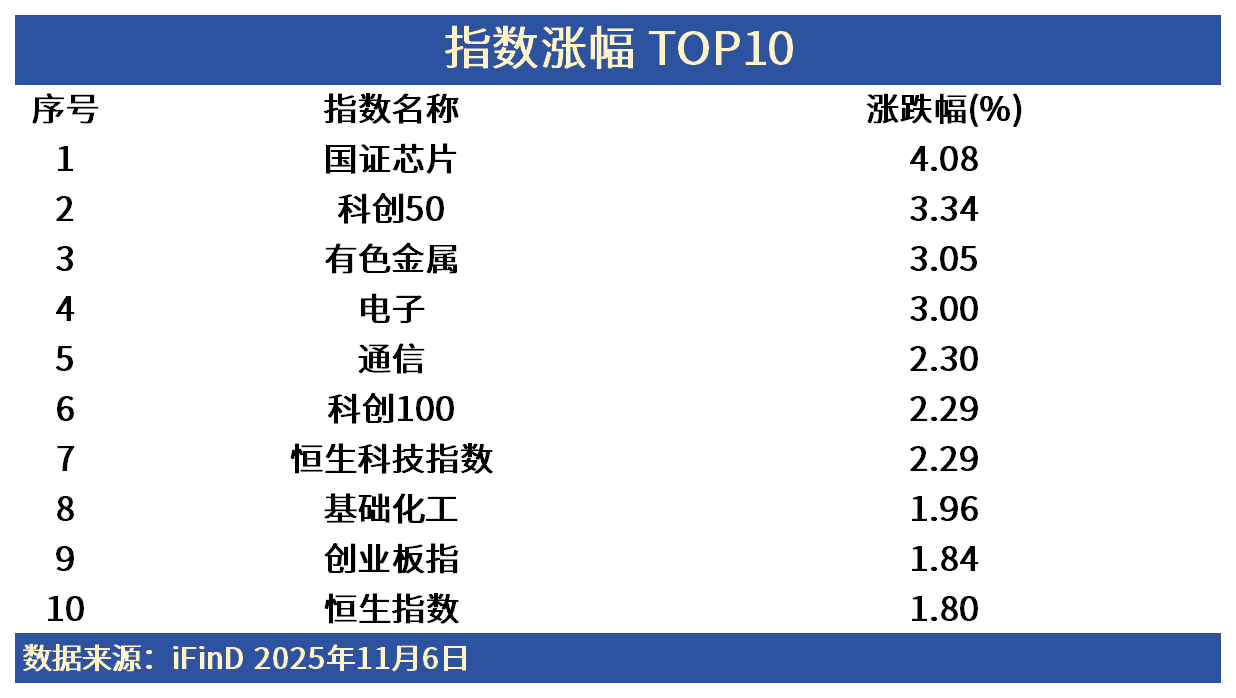
Group 1: Market Performance - As of November 6, 2025, the National Chip Index, Sci-Tech 50, and Electronics sectors showed significant gains of 4.08%, 3.34%, and 3.00% respectively [1][5] - The semiconductor industry is experiencing a price increase, with DDR5 spot prices soaring by 25%, and quarterly increases expected to reach 30%-50% [3] Group 2: Company Developments - SK Hynix has completed negotiations with NVIDIA for HBM4 supply, with prices confirmed at approximately $560, which is over 50% higher than HBM3E prices [2] - Samsung Electronics anticipates growth in AI and traditional server demand by 2026, with a projected shortage of mobile chips in Q4 [2] Group 3: Investment Opportunities - Citic Securities suggests focusing on the domestic semiconductor supply chain, particularly on companies like Changxin Storage, which is expanding production significantly [3] - Open Source Securities highlights the potential for AI Agent market growth, predicting a rise from $5.1 billion in 2024 to $47.1 billion by 2030, with a CAGR of 44.8% [3] Group 4: Sector Trends - The technology sector is expected to remain a key focus, with a shift from "asset revaluation" to "profit recovery" anticipated in 2026 [4] - The semiconductor industry is projected to benefit from increased domestic demand for materials due to geopolitical tensions and a push for self-sufficiency [4] Group 5: ETF Performance - The semiconductor ETF (159801) has seen a net inflow of 296 million yuan over five days, reflecting strong investor interest [4] - The semiconductor equipment ETF (560780) has experienced a 428% increase in shares year-to-date, leading its category [4]