资金流动

Search documents
国泰海通|海外策略:港股可选消费板块盈利预期下修
国泰海通证券研究· 2025-09-02 11:58
Core Viewpoint - Global markets experienced mixed performance last week, with increased trading activity and heightened market observation. There are indications from multiple Federal Reserve officials suggesting a potential interest rate cut in September, with market expectations of approximately two rate cuts within the year. Additionally, economic forecasts for both the US and China have been marginally revised upwards, while earnings expectations for US tech stocks in 2026 continue to be upgraded, and those for Hong Kong stocks have been slightly downgraded [1]. Market Performance - Global markets showed mixed results last week, with MSCI Global down by 0.4%, MSCI Developed down by 0.4%, and MSCI Emerging down by 0.6%. In the bond market, French 10Y government bond yields saw a significant increase. In commodities, silver prices led the gains. Currency-wise, the US dollar strengthened, the British pound depreciated, the Japanese yen remained stable, and the Chinese yuan appreciated. Sector-wise, the materials sector in Hong Kong led the gains, while the energy sector in the US showed relative strength [2]. Trading Sentiment - Overall trading sentiment in global stock markets improved last week, with increased trading volumes in indices such as the Hang Seng Index, S&P 500, European Stoxx 50, and Nikkei 225, while the Korean Kospi 200 saw a decline in trading volume. Investor sentiment in Hong Kong and the US decreased but remained at historically high levels. Volatility increased in Hong Kong, US, and European markets, while it decreased in Japan. Valuations for both developed and emerging markets saw a decline compared to the previous week [2]. Earnings Expectations - Earnings expectations for Hong Kong's consumer discretionary sector were downgraded last week. Comparatively, US earnings expectations for 2025 showed the best performance, followed by European and Hong Kong markets, with Japan lagging. Specifically, Hong Kong's Hang Seng Index 2025 EPS forecast was revised down from 2190 to 2140. The S&P 500's 2025 EPS forecast was adjusted from 268 to 269, while the Eurozone STOXX 50's 2025 EPS forecast was slightly increased from 335 to 336 [3]. Economic Expectations - Economic forecasts for both the US and China were revised upwards last week. The Citigroup US Economic Surprise Index increased, benefiting from expectations of Federal Reserve rate cuts and strong earnings reports from tech leaders like Nvidia. Conversely, the European Economic Surprise Index declined, likely due to a drop in the Eurozone Economic Sentiment Index in August. China's Economic Surprise Index rose, attributed to policy expectations, increased retail participation, and structural highlights in earnings reports [3]. Capital Flows - Global macro liquidity showed a slight easing last week. Recent comments from several Federal Reserve officials indicated a potential rate cut in September. As of August 29, futures market implied rates suggested expectations of approximately 2.2 rate cuts by the Federal Reserve this year, an increase from the previous week. Last week, US dollar liquidity tightened marginally. In terms of micro liquidity, July saw capital inflows primarily into India, Europe, Hong Kong, and South Korea, with flexible foreign capital and net inflows into Hong Kong stocks last week [4].


X @外汇交易员
外汇交易员· 2025-08-18 03:30
Deposit Trends - In July, household deposits decreased by 1100 billion (1.1 trillion) RMB, a year-on-year increase of 780 billion (0.78 trillion) RMB [1][2] - Corporate deposits decreased by 1500 billion (1.5 trillion) RMB in July, a year-on-year decrease of 320.9 billion RMB [1] - Non-bank deposits increased by 2100 billion (2.1 trillion) RMB in July, a year-on-year increase of 1400 billion (1.4 trillion) RMB [1][2] - Government deposits increased by 861.7 billion RMB in July, a year-on-year increase of 358.2 billion RMB [1] - The shift of deposits from residents to non-bank institutions is evident [1][2] Market Implications - Historically, a surge in non-bank deposits often reflects a trend of residents moving savings into the stock market [1] - Increased non-bank deposits are associated with residents directly entering the market via bank-securities transfers and indirectly via investments in equity funds and wealth management products [1][2] - Historically, significant year-on-year increases in non-bank deposits have corresponded with surges in new account openings and rising margin loan balances, often accompanied by positive stock market performance [1] Monetary Environment - The growth of social financing (TSF) in July was supported by government bonds, with the rolling year-on-year growth rate of new TSF continuing to rise [2] - The structure of social financing is relatively weak, with slight declines in short-term and medium-to-long-term loans to both residents and enterprises, indicating relatively sluggish demand for real economy credit [2] - With limited economic activity, resident deposits continue to be activated, with M1 growth continuing to rise in July while the M2-M1 spread continues to narrow [2] - As deposit rates continue to fall this year, coupled with continued improvement in stock market profitability, resident deposits are gradually flowing into the capital market to seek higher returns, and resident investment behavior is showing a gradual trend of becoming more active [2]
国泰海通|海外策略:财报季全球盈利预期齐上修
国泰海通证券研究· 2025-08-12 14:20
Market Performance - Global markets rebounded last week, with MSCI Global up by 2.3%, MSCI Developed up by 2.4%, and MSCI Emerging up by 1.8% [1] - The Hong Kong cyclical sector led the gains, while US tech and consumer discretionary sectors performed well, and European financials and real estate showed strong performance [1] - US 10Y Treasury yields increased, and oil prices saw significant gains [1] Trading Sentiment - Trading volume increased in US and European markets, while Japanese and Korean markets saw a decrease [1] - Investor sentiment in Hong Kong decreased but remained at historical highs, while US investor sentiment increased and also reached historical highs [1] - Volatility decreased in Hong Kong, US, and European markets, while Japanese market volatility increased [1] - Overall valuations in developed and emerging markets improved compared to the previous week [1] Earnings Expectations - Earnings expectations were revised upward across major markets, with Japanese stocks showing the best performance in 2025 EPS expectations [2] - Hong Kong's Hang Seng Index 2025 EPS expectation was revised from 2192 to 2194 [2] - US S&P 500 Index 2025 EPS expectation was revised from 267 to 268 [2] - European STOXX 50 Index 2025 EPS expectation remained unchanged at 335 [2] Economic Expectations - China's economic expectations were marginally revised upward, influenced by positive policy sentiments and overseas technology developments [2] - The US and European economic surprise indices declined, affected by various geopolitical and economic factors [2] Capital Flows - Global macro liquidity expectations remained stable, with a slight increase in expectations for US Federal Reserve rate cuts following the non-farm payroll data [3] - As of August 8, market expectations indicated a 2.3 rate cut by the Federal Reserve this year, a decrease from the previous week [3] - There was a net inflow into Hong Kong stocks from the southbound trading, while foreign capital outflow from Hong Kong stocks was noted [3]

国泰海通|策略:内资热钱加速流入,局部交易已拥挤
国泰海通证券研究· 2025-07-21 12:00
Market Overview - The trading heat continues to rise, with new issuance of equity funds and accelerated inflow of financing funds, while retail investor activity increases and foreign capital turns to outflow [1][2] - The average daily trading volume exceeds 1.5 trillion, indicating a marginal increase in market sentiment [1] Market Sentiment - Market sentiment is on the rise, with the average daily trading volume of the entire A-share market exceeding 1.5 trillion, and the turnover rate of the Shanghai Composite Index falling to 88% [1] - The number of daily limit-up stocks has decreased to 59, with the maximum consecutive limit-up stocks being 8, and the sealing rate dropping to 70.2% [1] Fund Flows - New issuance of public equity funds has increased to 12.6 billion, with an ordinary stock position rising by 0.1% [2] - Foreign capital has seen a net outflow of 1.4 million USD, with the northbound capital transaction proportion dropping to 11.6% [2] - The net inflow of financing reached 28.57 billion, with the transaction proportion rising to 9.7% [2] Industry Allocation - There is a notable divergence in funding within the electronics sector, with financing and ETF allocations increasing while foreign capital allocation decreases [3] - The net inflow in financing for the computer sector is 4.42 billion and for the electronics sector is 3.07 billion [3] - The non-bank financial sector and media sectors saw net inflows of 0.71 billion and 0.57 billion respectively in ETFs [3] Hong Kong and Global Fund Flows - The southbound capital inflow has decreased to 21.46 billion, representing the 76th percentile since 2022 [4] - Global foreign capital primarily flows into developed markets, with the US and Japan seeing inflows of 3.02 billion and 1.16 billion respectively [4]

港股爆涨竟是IPO功劳,A股会刷副本吗?
Sou Hu Cai Jing· 2025-07-08 12:51
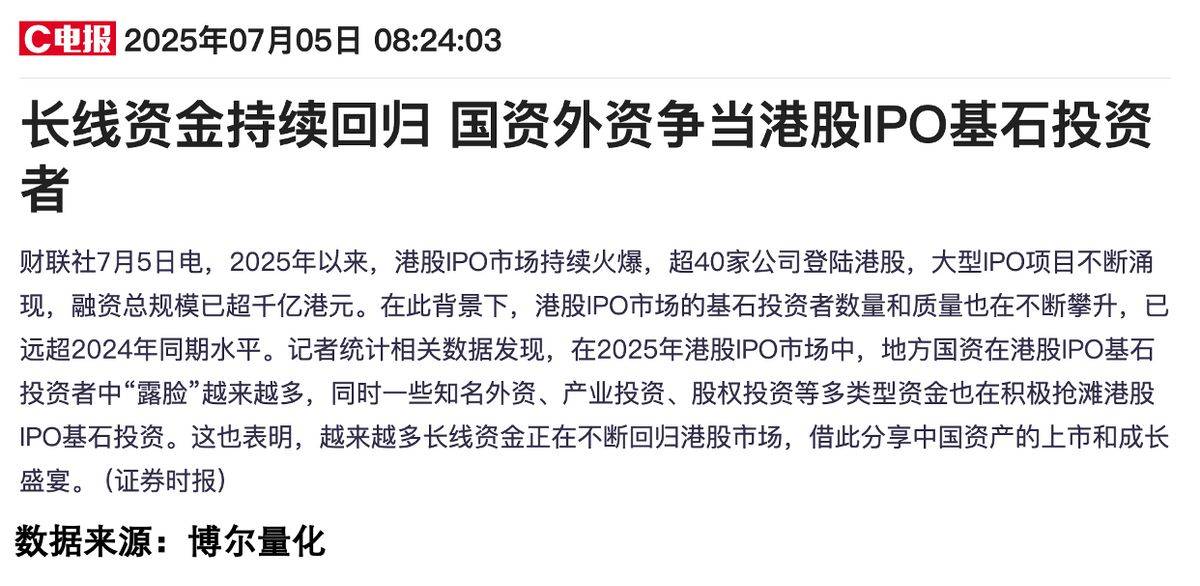
Group 1 - The Hong Kong Stock Exchange raised 107 billion HKD in the first half of the year, with 42 IPOs and an average daily trading volume of 40 billion HKD for 210 ETP products, indicating a vibrant fundraising environment [2][4] - Retail investors feel disconnected from the market's success, often missing out on opportunities despite the overall market growth, as exemplified by the experience of a retail investor who failed to secure shares in a popular IPO [4][2] - The disparity between market movements and retail investor experiences highlights the challenges of navigating the financial landscape, where significant capital flows often go unnoticed by individual investors [2][4] Group 2 - Historical data suggests that market movements are often driven by concentrated capital behaviors, with key periods accounting for a significant portion of annual returns [5][7] - A comparison between traditional K-line charts and quantitative systems reveals the underlying dynamics of capital flow, showcasing the difference between surface-level analysis and deeper insights into market behavior [7][10] - The importance of understanding the "language of trading" is emphasized, where announcements may not have the expected impact if not accompanied by corresponding capital movements [8][10] Group 3 - The influx of 107 billion HKD into the market leaves traces that can be analyzed, such as changes in stock weightings or shifts in derivatives market positions, which can provide insights into institutional trading strategies [11][13] - The phenomenon of "shakeout behavior" often indicates that large funds are accumulating shares, leading to confusion among retail investors about stagnant stock prices despite strong fundamentals [13][11] - The increasing complexity of the financial market creates greater information asymmetry, making it essential for investors to utilize quantitative tools to gain insights into capital flows and identify potential investment opportunities [14][11]

投资者微观行为洞察手册·6月第3期:全球资本流向非美,国内杠杆资金加快扩张
GUOTAI HAITONG SECURITIES· 2025-06-30 11:14
Market Overview - The overall trading activity in the market has significantly increased, with the average daily trading volume rising from 1.2 trillion to 1.5 trillion CNY[1] - The Shanghai Composite Index turnover rate has increased to the 85th percentile, while the STAR Market turnover rate has reached the 40th percentile[1] - The proportion of stocks rising has increased to 88.6%, with a median weekly return of 4.4%[3] Capital Flow Insights - Net inflow of southbound funds has risen to 28.4 billion CNY, marking a 96th percentile since 2022[3] - Foreign capital has seen a net outflow of 3.74 million USD from the A-share market[39] - Financing funds have net bought 25.6 billion CNY, with the total margin balance increasing to over 1.8 trillion CNY[3] Fund Issuance and Performance - The issuance scale of new equity funds has decreased to 15.9 billion CNY, down from 25.7 billion CNY[31] - The private equity confidence index has slightly declined, while the positions have marginally increased[37] - The average return of funds has shown a significant improvement, with most funds reporting positive returns year-to-date[33] Sector Performance - The trading concentration in certain sectors has increased, with seven industries having turnover rates above 90%, including comprehensive finance and defense[2] - The electronic and computer sectors have the highest average daily trading volumes, at 1829.61 billion CNY and 1684.80 billion CNY respectively[20] - Notable inflows in financing funds were observed in the computer sector (+4.94 billion CNY) and non-bank financials (+3.93 billion CNY), while real estate saw outflows (-0.24 billion CNY)[3] Risk Considerations - There are potential risks related to data collection methods and measurement errors, as well as biases from third-party data sources[3]
DLSM:本周美元回落非美走强,汇率变动能否引发新一轮资金流动?
Sou Hu Cai Jing· 2025-06-15 15:26
Group 1 - The recent volatility in the foreign exchange market highlights the sensitivity of global capital to macroeconomic expectations and geopolitical situations [1][4] - The US dollar index has declined, dropping below the 98 mark, with a weekly decrease of 1.07%, marking one of the weakest performances in recent months [1] - The market's increasing bets on the Federal Reserve's potential interest rate cuts are closely linked to the dollar's decline, despite high inflation levels [1][4] Group 2 - Non-US currencies have generally appreciated, with the euro surpassing 1.16 against the dollar, reaching its highest level since November 2021, indicating a more stable monetary policy outlook in the Eurozone compared to the US [3] - The British pound has also strengthened due to falling real interest rates and reduced political uncertainty, despite ongoing structural growth challenges [3] - The appreciation of the Canadian dollar and Japanese yen reflects different underlying factors, with the former benefiting from rising oil prices and the latter acting as a traditional safe haven amid escalating geopolitical tensions [3] Group 3 - The weakening of the dollar may have significant implications for global capital flows, potentially reducing financing costs for emerging markets and alleviating liquidity pressures for countries reliant on external debt [4] - A weaker dollar typically leads to lower pricing costs in international commodity markets, contributing to recent increases in oil and gold prices [4] - Changes in exchange rates could impact export competitiveness, with the appreciation of the euro and pound potentially diminishing their relative price advantages in exports [4] Group 4 - The current foreign exchange market dynamics are increasingly influenced by global policy expectations and risk pricing mechanisms rather than solely by individual economies' fundamentals [5] - The collective appreciation of non-US currencies introduces new variables into market capital flows, necessitating a more systematic approach to understanding the structural changes behind exchange rate fluctuations [5]
外国机构(FII)扭转了亚洲股市连续七个月的净流出趋势!5 月净流入 120 亿美元
Zhi Tong Cai Jing· 2025-05-27 08:41
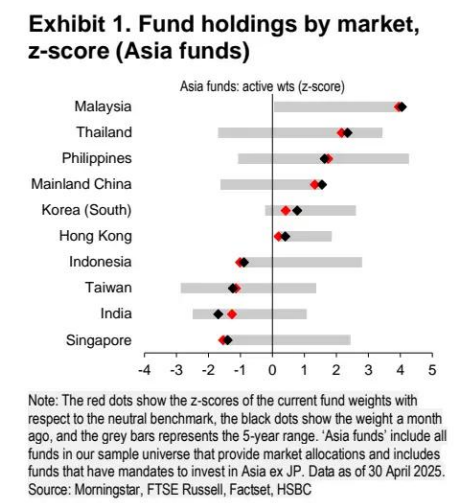
Group 1 - In April, Asian and emerging market funds reduced their overweight positions in mainland China, although their holdings remain close to multi-year highs [1][7][16] - Global funds have gradually increased their holdings in mainland China over the past few months, but these levels are still significantly lower than those reached in 2021 [8][19] - Asian funds slightly increased their holdings in Taiwan, but their allocation relative to the benchmark index remains near historical lows [1][16] Group 2 - Foreign institutional investors (FII) injected approximately $12 billion into Asian stock markets outside of China as of May, marking the strongest monthly inflow in a year and a half [1][19] - Almost all markets experienced inflows, primarily driven by Taiwan and India, with Taiwan's inflow reaching its highest monthly level since the end of 2023 [19][20] - Despite remaining net buyers in the Indian stock market, the inflow scale has been relatively modest [20] Group 3 - Asian and emerging market funds reduced their low allocations to mainland China, South Korea, and Hong Kong, while also decreasing their low allocation to India [7][16] - Funds have shifted to a neutral allocation for South Korea, reflecting a reduction in risk exposure across most ASEAN markets, except for the Philippines [7][16] - Since January 2024, foreign funds have become net buyers in the Vietnamese stock market, indicating a shift in investment trends [22]
国泰海通|策略:降温的背后:轮动降速,ETF与外资流出,南下活跃
国泰海通证券研究· 2025-05-26 14:53
Market Overview - The overall trading heat in the market has slightly decreased, with a decline in market sentiment and a drop in the average daily trading volume from 12.7 trillion to 11.7 trillion CNY [1] - The average daily number of stocks hitting the daily limit has decreased to 69, with the maximum consecutive limit hits being 5 [1] - The proportion of stocks that rose has dropped to 30%, and the median weekly return for all A-shares has fallen to -1.44% [1] Fund Flows - Financing funds continue to flow in, while ETF funds are experiencing outflows [2] - The new issuance scale of equity funds has increased to 9.5 billion CNY, with existing public fund positions rising by 0.2% [2] - Foreign capital has seen a net outflow of 700 million USD, with the inflow scale of A-shares dropping to a historical percentile of 7.6% [2] - The net inflow of financing has been 2 billion CNY, with the transaction volume proportion rising to 8.2% [2] Industry Allocation - There is a significant divergence in funding between foreign capital and margin financing in the automotive and electric new energy sectors, with financing funds increasing while foreign capital is decreasing [3] - The net inflow in the automotive sector is 2.79 billion CNY, while the computer sector has seen a net outflow of 1.41 billion CNY [3] - In the ETF market, the defense and military industry has seen a net inflow of 1.74 billion CNY, while the medical and electric new energy sectors have experienced outflows of 3.71 billion CNY and 1.75 billion CNY, respectively [3] Hong Kong and Global Fund Flows - Southbound capital inflow has accelerated, with a net inflow of 19 billion CNY, ranking in the 73rd percentile since 2022 [4] - Foreign capital has seen a net outflow of 721 million USD from Hong Kong stocks [4] - Developed markets have generally attracted foreign capital inflows, with the US and France leading in net inflows of 2 billion USD and 760 million USD, respectively [4]