AI投资

Search documents
一周观点:美元体系裂痕出现或将难以修复,美股易跌难涨-20260208
Huafu Securities· 2026-02-08 11:49
华福证券 2026 年 02 月 08 日 策 略 研 究 策 略 定 期 报 美元体系裂痕出现或将难以修复,美股易跌难涨 ——周观点 投资要点: 近期观点 1、 全球宏观定价逻辑继续由"需求驱动"向"供给约束定价" 切换,中国供给秩序强化进入盈利与价格数据验证阶段,资产定价权 逐步向供给端集中。 2、 美元信用长期承压的叙事未发生改变,美国通过居民部门维 持需求的路径边际趋弱,全球需求扩张机制或面临结构性收缩风险。 告 3、 全球资金配置逻辑继续演绎"短期盾与长期矛",大宗商品 与黄金仍受避险资金支撑,但其上涨逻辑偏信用避险而非需求扩张, 中期空间或存在上限。 4、 美国资产上涨越来越依赖 AI 投资与财政驱动,而非居民部门 杠杆,长期 ROE 中枢下移趋势未变。 5、 中国定价资产或将成为年度风格主线,重点围绕供给约束强 化与 ROE 趋势性回升,顺周期重资产行业的盈利弹性开始释放。 6、 中期看好围绕中国 PPI 复苏相关的投资机会,煤炭,钢铁, 化工,建材,农业等顺周期行业,看好中国优势重资产龙头。 7、 长期看好保险,央国企,反内卷,中概互联网。 风险提示 全球制造业复苏受阻;中美关系改善不及预期; ...
AI影响了多少出口
SINOLINK SECURITIES· 2026-02-08 08:22
帮我 AI 贸易已经成为了全球贸易中不可忽视的重要部分。中国作为全球最大的 AI 商品出口国,美国作为全球 AI 投 资扩张的领头羊,美国 AI 投资能否维持高位决定了今年中国出口高景气度能否延续。同时,BIS 研究显示,在 此前几次投资热潮退坡时(如 90 年代互联网泡沫、2010 年前后的页岩投资),美国 GDP 增速降幅均超过 1 个百 分点,如果美国 AI 泡沫破裂,负面溢出效应或导致美国经济大幅回落进而拖累全球经济和一般贸易。 风险提示 本文对 AI 贸易商品的数据部分基于估算数据,估算方法或存在一定偏差。 AI 投资不确定性较高,AI 投资带来的 AI 贸易不确定性也在提升,关注 AI 投资变化对贸易的影响。 全球 AI 贸易政策正在发生较大变化,美国对等关税等对 AI 贸易的影响也还在延续,关注政策变化对 AI 贸易的影响。 敬请参阅最后一页特别声明 1 扫码获取更多服务 宏观经济报告 AI 投资已成为全球经济不可忽视的部分。2025 年前三季度,广义 AI 投资拉动美国实际 GDP 同比增速 0.8 个百 分点,成为美国经济增长的重要引擎。BIS 数据显示,从 2022 年开始 AI 投资在美 ...

“沾上OpenAI就没吸引力了!”华尔街开始“清算”OpenAI概念股,谷歌大涨36%成赢家
美股研究社· 2026-02-06 10:55
Core Viewpoint - The sentiment on Wall Street regarding OpenAI has dramatically reversed, with previously favored stocks now facing sell-offs, while Alphabet has emerged as a major winner in the AI sector, with its stock price rising approximately 36% since October of last year [5][7]. Group 1: Market Sentiment Shift - Investors are increasingly skeptical about OpenAI's financial sustainability, despite its signing of several billion-dollar contracts, leading to concerns about its ability to fulfill commitments [8]. - The market narrative has shifted from favoring OpenAI to preferring Alphabet, as highlighted by analysts who note that the reliance on OpenAI for revenue has become a liability for companies like Microsoft and Oracle [9][10]. Group 2: Alphabet's Performance - Alphabet's AI investments have generated significant returns across the company, with CEO Sundar Pichai reporting over 750 million monthly active users for Google Gemini, an increase from 650 million in the previous quarter [12]. - Google Cloud revenue surged by 48% in the December quarter, exceeding Wall Street expectations, which has bolstered investor confidence [12]. Group 3: Broader Market Dynamics - A Deutsche Bank report indicates that the AI investment frenzy has entered a "cleansing" phase, with the S&P 500's performance largely supported by Alphabet, while many other tech stocks have experienced significant declines [7][14]. - The report emphasizes a decisive shift in market sentiment from a belief that all tech stocks would succeed to a more brutal reality of clear winners and losers, with Alphabet being the standout performer [14][15].





市场坠入“狂震模式”!白银两日暴跌超20%创纪录 韩国股市重挫暴露“高贝塔”脆弱性
智通财经网· 2026-02-06 01:29
智通财经APP获悉,在周四重挫20%后,白银价格继续下探。由于流动性急剧枯竭,这个正在艰难寻底 的市场出现了剧烈的价格震荡。于此同时,全球科技抛售潮加剧冲击,标普受到巨大冲击之时,韩国股 市也遭遇重挫。 现货白银在亚洲早盘交易中一度跌至每盎司64美元,较1月29日创下的历史高点回落逾40%,彻底抹去 了上个月全部惊人涨幅。黄金价格亦连续第二日下跌。 抛售潮席卷韩国 全球风险资产抛售潮席卷至韩国,拖累该国多家科技巨头股价大跌,这揭示了今年全球表现最佳股市的 脆弱一面。 周五,韩国综合股价指数一度暴跌逾5%,随后跌幅收窄。三星电子和SK海力士盘中均跌超4.8%。此前 一个交易日,外资净卖出额高达4.99万亿韩元(约合34亿美元),创历史纪录。由于Kospi 200期货重挫超 5%,韩国证券交易所一度暂停了程序化交易的卖单指令。韩元对美元汇率亦进一步走弱。 作为英伟达等顶级超大规模计算公司的主要供应商,韩国芯片制造商的股价正日益受到全球AI投资情 绪起伏的影响。尽管在本轮抛售中硬件股相对抗跌(受业务中断担忧冲击最重的是软件股),但周五的下 跌表明,市场对更广泛的AI生态系统的情绪正在迅速恶化。 "韩国股市因美股跌势 ...
知名分析师张忆东履新
2 1 Shi Ji Jing Ji Bao Dao· 2026-02-05 09:17
Group 1 - Zhang Yidong, a prominent strategist and chief economist, has officially joined Guotai Junan Securities, taking on roles in the executive committee and as head of the equity research department [1][4] - His departure from Industrial Securities was motivated by a desire to focus on overseas markets, particularly in Hong Kong, as part of his career transition [3][4] - Zhang has a strong academic background and extensive experience in the industry, having worked for nearly 20 years at Industrial Securities and received numerous awards for his research [4] Group 2 - Zhang Yidong maintains a positive outlook for the Chinese stock market in 2026, emphasizing the importance of structural opportunities and long-term growth over short-term economic fluctuations [5] - He identifies four key areas for investment in 2026: AI and technology, dividend assets in a low-interest environment, value discovery in traditional industries, and strategic assets like gold and rare earths [5] - Zhang highlights the return of foreign capital to China, particularly through passive ETFs and active management strategies, indicating an increased allocation towards Chinese assets [7]

知名分析师张忆东履新
21世纪经济报道· 2026-02-05 09:13
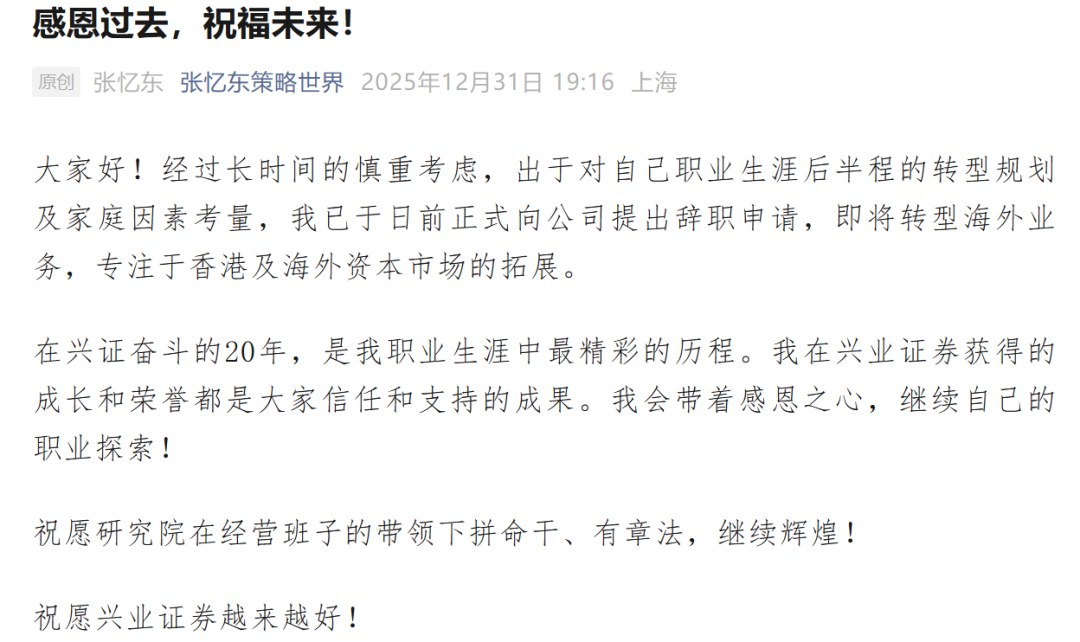
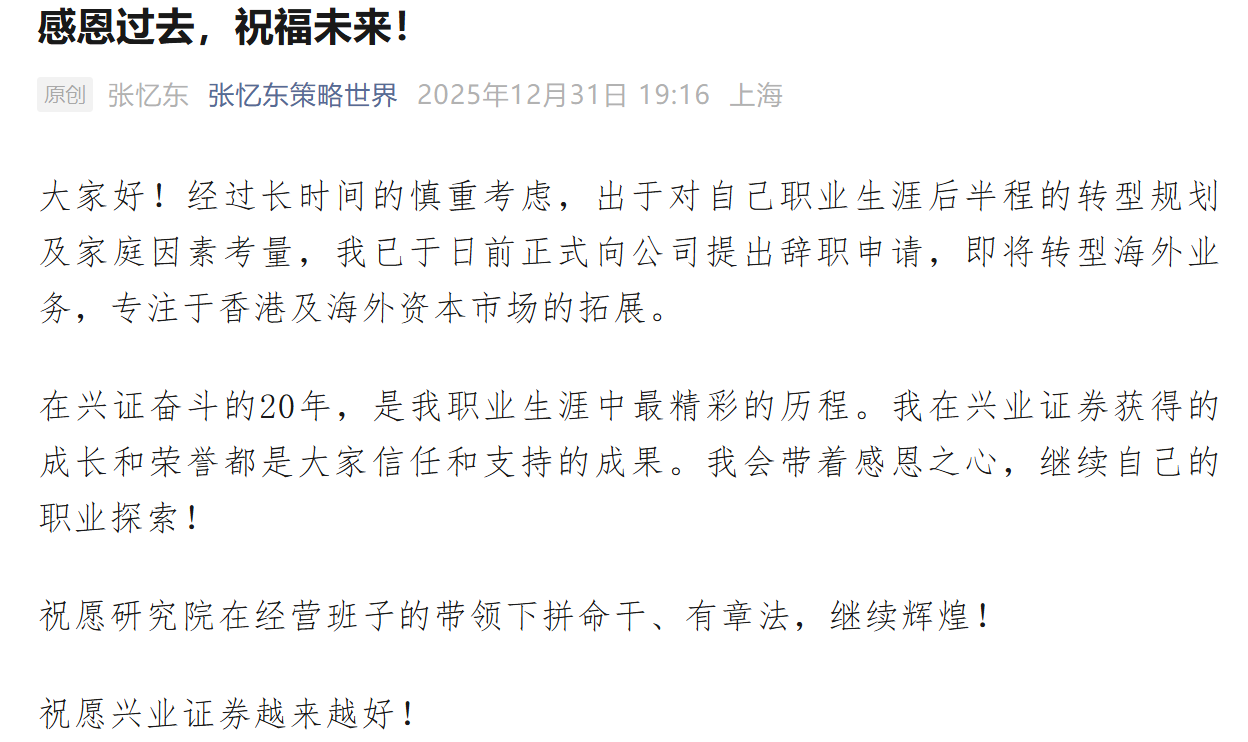
记者丨 孙永乐 编辑丨巫燕玲 2月5日,21世纪经济报道记者获悉,原兴业证券全球首席策略分析师、研究院联席院长、海外 研究中心总经理,知名海外策略分析师张忆东,已正式加盟国泰海通,拟出任海通国际证券执 委会委员,股票研究部主管及首席经济学家。 目前,这一任命尚未公开披露,截至2月5日,在证券业协会官网仍无法查询到张忆东的个人从 业登记信息。 正式转型海外业务 去年12月31日,张忆东在个人公众号"张忆东策略世界"发布声明称:"经过长时间的慎重考 虑,出于对自己职业生涯后半程的转型规划及家庭因素考量,我已于日前正式向公司提出辞职 申请,即将转型海外业务,专注于香港及海外资本市场的拓展。" 当时,兴业证券经济与金融研究院对此回复21世纪经济报道记者:"研究院充分尊重其个人选 择,并对张忆东为卖方研究及海外研究业务发展所作出的杰出贡献表示衷心感谢。" 公开资料显示,张忆东,复旦大学国际金融系学士、硕士,上海交通大学上海高级金融学院 EMBA,是卖方研究领域最具影响力的策略分析师之一,2001年至今已深耕行业24年,先后 十余次获得海外相关奖项评选第一名,是总量领域首位钻石分析师。 在兴业证券,张忆东工作了将近20年 ...

转型海外业务!张忆东履新海通国际
2 1 Shi Ji Jing Ji Bao Dao· 2026-02-05 08:31
Group 1 - Zhang Yidong, a prominent strategist and chief economist, has officially joined Guotai Junan and will serve as a member of the executive committee of Haitong International Securities and head of the equity research department [1][2][3] - Zhang has over 24 years of experience in the industry and has been recognized multiple times as a leading analyst in overseas awards, making significant contributions to the development of sell-side research and overseas research business [3] - His recent research outlook for 2026 indicates strong confidence in China's macro economy, A-shares, and Hong Kong stocks, emphasizing the importance of structural opportunities and long-term development over short-term economic perceptions [4][6] Group 2 - Zhang's investment strategy for 2026 includes focusing on four key areas: AI investments, low-interest-rate opportunities in traditional sectors, value discovery in traditional industries, and strategic assets like gold and rare earths [5] - He highlights the importance of structural opportunities in China's economy, particularly in high-level technological self-reliance, domestic consumption, and the transformation of traditional industries [6] - Zhang notes a shift in capital flows, with passive ETF funds returning to China and an increase in foreign investment allocation, particularly in the context of the renminbi's appreciation [6]
淡水泉投资:今年AI投资逻辑有望从总量向结构转变
Zheng Quan Ri Bao· 2026-02-05 07:56
(文章来源:证券日报) 展望后市,淡水泉投资相关人士表示,市场驱动逻辑有望从估值修复转向盈利支撑,从全年时间节点来 看,上半年尤其是四月底前,是一个值得重点把握的布局窗口。此外,资金对核心资产的青睐将主要围 绕科技创新、中国企业全球化等主题展开,以AI为例,今年AI投资逻辑有望从总量向结构转变。未 来,本公司将重点关注供给紧张、约束明显且市场认知尚未充分挖掘的板块或资产,尤其是国内算力基 建在先进制程突破与供应链自主可控进程中所带来的机会。 当前市场流动性保持宽松,投资者风险偏好处于高位,资金集中流向具备成长逻辑的方向。近日,淡水 泉(北京)投资管理有限公司(以下简称"淡水泉投资")相关人士向记者表示,开年以来,资金从商业 航天、AI应用产业链,到电网设备、金属、油气、化工等板块快速轮动,市场交易情绪活跃,更多体 现出投资者对中国资产的信心稳步回升。伴随着风险偏好进一步回暖,市场开始期待更具持续性的走强 格局。 ...
2026 十大全球经济“猜想”
Sou Hu Cai Jing· 2026-02-05 06:53
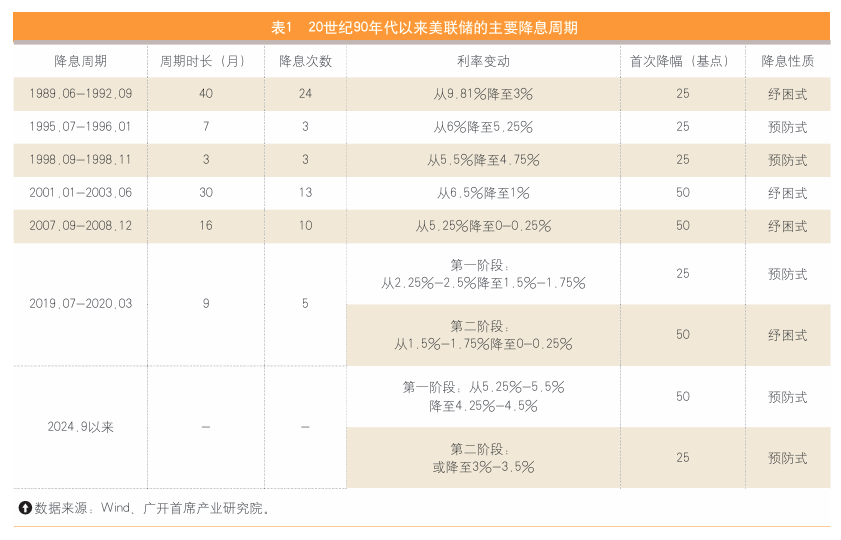
Group 1 - The global economy is transitioning from "high volatility" to "new equilibrium," facing new uncertainties and challenges while instability and imbalance are somewhat reduced [2][4] - In 2026, a series of positive factors are expected to drive global economic recovery, including expansionary fiscal policies, loose monetary policies, and an AI investment boom [4][5] - Global GDP growth is projected to be between 2.9% and 3.1% in 2026, slightly lower than in 2025, with developed economies growing below 2% and emerging markets, especially in Asia, continuing to be the main growth drivers [5] Group 2 - The global trade environment shows signs of partial recovery, with the U.S. likely to pragmatically adjust aggressive trade protection measures and deepen multilateral cooperation [8][9] - However, new protectionist forces may emerge, particularly in developed economies like Europe, which may impose "rules-based" barriers to trade [9] Group 3 - Inflation pressures remain in developed economies, with service prices showing stickiness and tariff impacts having delayed effects [13][10] - Global inflation is expected to decrease from 4.2% in 2025 to between 3.2% and 3.6% in 2026, with most developed economies approaching a 2% target [11] Group 4 - The Federal Reserve's interest rate cut uncertainty is increasing, with potential further cuts in 2026 depending on economic conditions and inflation expectations [14][15] - The political landscape and economic data may influence the Fed's decisions on interest rates, with pressures from the Trump administration complicating the situation [15] Group 5 - Many countries are expected to increase fiscal policy efforts in 2026 to counter economic downturn risks, with significant public investment planned in various sectors [17][18] - However, some countries face constraints on fiscal expansion due to high debt levels and external pressures [18] Group 6 - U.S.-China economic relations may experience a phase of easing, with the U.S. adjusting its stance towards China and seeking selective cooperation in non-sensitive areas [21][22] - This shift is driven by economic interdependence and political considerations ahead of the 2026 midterm elections [22] Group 7 - Countries are increasingly prioritizing supply chain "self-sufficiency" due to geopolitical risks and technological competition, leading to a restructuring of supply chains in strategic sectors [24][25] Group 8 - Global stock markets are expected to experience cautious optimism, with potential for upward movement driven by interest rate cuts and AI investments, but structural differentiation may increase [26][27] - Emerging markets are likely to attract more investment due to favorable conditions, while U.S. markets may face volatility and risks associated with high valuations [28] Group 9 - The U.S. dollar is anticipated to remain weak, influenced by lower interest rates and various economic factors, with fluctuations expected within a range [29][30] Group 10 - Gold prices are projected to remain strong amid geopolitical risks and a weakening dollar, although there may be short-term corrections due to various market factors [33][34]
德银警示“科技自噬”! 除去谷歌,AI泡沫其实早就碎了一地
美股IPO· 2026-02-05 04:02
Core Viewpoint - Deutsche Bank warns that the era of "tech self-consumption" has arrived, where AI investments have shifted from broad gains to a "winner-takes-all" scenario, with many tech stocks experiencing significant pullbacks of up to 80% from their peaks. The S&P 500 index is largely supported by Alphabet, which has surged 75% in six months, adding $1.7 trillion in market value, while other major tech stocks have retraced between 5% and 25% [1][3][6][11]. Group 1 - The report titled "Tech eats itself" highlights a brutal reshuffling within the tech sector, indicating that while the S&P 500 remains near historical highs, this is primarily due to defensive sector rotations and the exceptional performance of a few tech giants [3][12]. - Deutsche Bank's analysis reveals that many tech stocks related to AI, software, and private equity have faced severe declines, with some experiencing pullbacks of nearly 80% from their 52-week highs [3][6]. - The report emphasizes that the apparent stability of the S&P 500 is misleading, as it is heavily reliant on Alphabet's performance, which has counterbalanced losses from other companies in the "Magnificent Seven" [6][9]. Group 2 - Alphabet's stock has risen nearly 25% in the past three months and an astonishing 75% over the last six months, translating to a market value increase of approximately $1.7 trillion [8][11]. - The report indicates a significant shift in market sentiment, moving from the belief that "every tech stock is a winner" to a more brutal reality where a clear distinction between winners and losers is emerging [12][14]. - Companies that can effectively deploy AI tools that are cost-effective, scalable, and capable of delivering meaningful productivity improvements are likely to be the long-term beneficiaries in this new market environment [14]. Group 3 - The report warns that if more members of the "Magnificent Seven" fall into the "loser" category, the impact could extend beyond the tech sector and spill over into the broader macroeconomic landscape [15]. - The focus of the market is shifting from whether AI can change the economy to how quickly and in what manner it will rewrite the competitive advantages of existing tech companies [16].