
自主可控

Search documents
港股异动 东方电气(01072)尾盘涨近7% G50自主燃机实现出海 有望贡献利润弹性
Jin Rong Jie· 2025-11-28 08:06
Core Viewpoint - The stock of Dongfang Electric (01072) has seen a significant increase, rising nearly 7% at the close, with a current price of HKD 21.26 and a trading volume of HKD 237 million. This surge is attributed to the commencement of a 50 MW combined cycle power project in Kazakhstan, where Dongfang Turbine Co., Ltd. is supplying three domestically developed G50 heavy-duty gas turbines, marking a milestone for China's F-class gas turbines in international markets [1]. Company Developments - Dongfang Electric's G50 heavy-duty gas turbine has successfully entered commercial operation and is now being exported, indicating a successful international expansion of its technology [1]. - The global market for gas turbines is experiencing tight supply, positioning Dongfang Electric to potentially benefit significantly from this demand [1]. Analyst Insights - Huatai Securities has issued a report expressing optimism about the profit elasticity contributed by the G50 heavy-duty gas turbine's international sales, maintaining a "buy" rating for both A and H shares of Dongfang Electric [1].
港股异动 | 东方电气(01072)尾盘涨近7% G50自主燃机实现出海 有望贡献利润弹性
Zhi Tong Cai Jing· 2025-11-28 07:59
Core Viewpoint - The stock of Dongfang Electric (01072) has seen a significant increase, rising nearly 7% towards the end of trading, with a current price of 21.26 HKD and a trading volume of 237 million HKD, following the commencement of a 50 MW combined cycle power project in Kazakhstan [1] Group 1: Company Developments - Dongfang Electric's subsidiary, Dongfang Turbine Co., Ltd., has provided three self-developed 50 MW heavy-duty gas turbines (G50) for the Kazakhstan project, marking the first international deployment of China's self-developed F-class heavy-duty gas turbines [1] - The G50 heavy-duty gas turbine has achieved commercial operation and international deployment, indicating a successful milestone for Dongfang Electric's R&D efforts [1] Group 2: Market Outlook - Huatai Securities has released a report indicating that the global supply of gas turbines is tight, and Dongfang Electric is expected to benefit significantly from this situation [1] - The firm maintains a "buy" rating for both A and H shares of Dongfang Electric, highlighting the profit elasticity contribution from the G50 heavy-duty gas turbine's international sales [1]
东方电气尾盘涨近7% G50自主燃机实现出海 有望贡献利润弹性
Zhi Tong Cai Jing· 2025-11-28 07:47
Core Viewpoint - Dongfang Electric (600875) has seen a significant stock price increase, rising nearly 7% at the close, with a current price of 21.26 HKD and a trading volume of 237 million HKD, following the commencement of a 50 MW combined cycle power project in Kazakhstan [1] Group 1: Project Development - The project in Kazakhstan's Zhambyl region features three domestically developed 50 MW heavy-duty gas turbines (G50) provided by Dongfang Steam Turbine Co., marking the first international deployment of China's self-developed F-class heavy-duty gas turbines [1] Group 2: Market Outlook - Huatai Securities has released a report indicating that Dongfang Electric's G50 heavy-duty gas turbine has achieved commercial operation and international deployment; the global gas turbine production is under pressure, suggesting that Dongfang Electric is poised to benefit significantly [1] - The report expresses optimism regarding the profit elasticity contributed by the G50 heavy-duty gas turbine's international sales, maintaining a "buy" rating for both A and H shares of Dongfang Electric [1]
化工困境反转预期较强,聚焦石化ETF(159731)布局机会
Mei Ri Jing Ji Xin Wen· 2025-11-28 05:01
Group 1 - The A-share market is showing weakness, while the CSI Petrochemical Industry Index is rising, currently up approximately 0.35%, with leading stocks including Hengyi Petrochemical, Xingfa Group, and Chuanfa Longmang [1] - The Petrochemical ETF (159731) has seen net inflows in 9 out of the last 10 trading days, totaling 25.75 million yuan [1] - Guosen Securities suggests three main investment themes: 1) resource and overseas supply chains under macro mid-term trends, 2) technology "AI+" under strong industrial trends, and 3) policy-driven "anti-involution" and self-sufficiency [1] Group 2 - The Petrochemical ETF (159731) and its linked funds (017855/017856) closely track the CSI Petrochemical Industry Index, with the basic chemical industry accounting for 60.8% and the oil and petrochemical industry for 32.2%, indicating potential benefits from policies aimed at anti-involution, structural adjustments, and phasing out outdated capacity [1]
——2025年12月A股及港股月度金股组合:宽幅震荡,静待风起-20251128
EBSCN· 2025-11-28 03:50
Market Overview - In November, the A-share market experienced a general decline, with the STAR Market 50 index dropping the most by 7.1%, while the Shanghai 50 index fell the least by 1.3%. Other major indices such as CSI 300, ChiNext, and CSI 1000 saw declines of -2.7%, -4.5%, and -3.4% respectively. The performance across industries showed significant divergence, with sectors like comprehensive services, banking, and media leading in gains [1][8][10] - The Hong Kong stock market also showed a volatile trend in November, influenced by fluctuations in the Federal Reserve's interest rate expectations and increasing concerns over the AI bubble. As of November 26, 2025, the Hang Seng Hong Kong 35 index rose by 1.1%, while the Hang Seng Index and Hang Seng China Enterprises Index saw minimal changes of 0.1% and -0.1%, respectively. The Hang Seng Technology Index dropped by 4.9% [1][10][11] A-share Insights - The market is believed to still be in a bull phase, but may enter a period of wide fluctuations in the short term. Compared to previous bull markets, there remains considerable room for index growth, but the emphasis on a "slow bull" policy may prioritize the duration of the bull market over its magnitude. Short-term catalysts appear weak, leading to a potential focus on defensive and consumer sectors, while TMT and advanced manufacturing sectors are recommended for mid-term attention [2][13][14][16][19] - In the context of market fluctuations, defensive sectors such as banking, utilities, and coal, along with consumer sectors like food and beverage, are highlighted as potential areas for investment. Historical trends suggest that previously lagging sectors may perform better during periods of market turbulence [16][17] Hong Kong Market Insights - The outlook for the Hong Kong market remains positive, with expectations of continued upward movement due to strong overall profitability and relatively low valuations. The "dumbbell" strategy is recommended, focusing on technology growth and high dividend stocks. Key areas of interest include domestic policies supporting self-sufficiency in chips and high-end manufacturing, as well as independent internet technology companies [3][21][24] - The report emphasizes the importance of high dividend, low volatility strategies, particularly in sectors such as telecommunications, utilities, and banking, which can provide stable returns [21][24] Stock Recommendations - For December 2025, the A-share stock selection includes: Sunlord Electronics, Zhongji Xuchuang, Huayou Cobalt, Sinopec, PetroChina, Zhengguang Co., Haier Smart Home, Hengli Hydraulic, Hangcha Group, and Goldwind Technology [26][27] - The recommended stocks for the Hong Kong market include: Tencent Holdings, China Mobile, China Tower, CNOOC Services, Huiju Technology, Sinopec Engineering, and AIA Group [30][31]




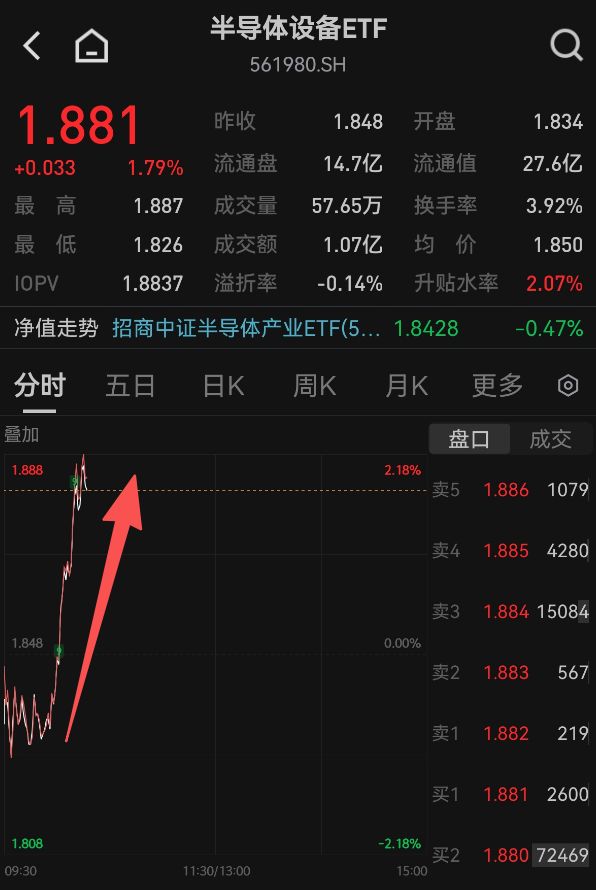
半导体设备ETF(561980)放量拉涨1.79%!标的指数年内涨超47%,高弹性领跑同类
Jin Rong Jie· 2025-11-28 03:25
Core Viewpoint - The semiconductor equipment sector is experiencing significant upward movement, driven by rising demand for storage chips and the overall growth in the semiconductor market, particularly influenced by AI and domestic technology needs [1][4]. Group 1: Semiconductor Equipment Performance - The semiconductor equipment ETF (561980) saw a notable increase of 1.79% in early trading on November 28, with a trading volume exceeding 100 million [1]. - Key stocks within the ETF, such as Jingyi Equipment, TuoJing Technology, and TianYue Advanced, experienced substantial gains, with increases of 9.53%, over 7%, and over 6% respectively [1]. Group 2: Market Trends and Data - The average spot prices for DDR4 and DDR5 chips increased by 75.93% and 101.77% month-over-month as of October 31, with year-to-date increases of 430.08% and 230.80% respectively [3]. - NAND product prices also rose significantly, with 256GB and 512GB SSDs increasing by 29.73% and 33.33% month-over-month, and year-to-date increases of 57.89% and 60.31% [3]. Group 3: Industry Outlook - The AI-driven demand for DRAM and NAND is expected to significantly boost the market, with a projected global storage supercycle emerging due to supply-demand imbalances [3]. - China's advanced storage capabilities are anticipated to become a core growth area in global storage capacity, with potential production capacity expansion exceeding tenfold [3]. Group 4: Import and Sales Growth - China's semiconductor manufacturing equipment imports reached $5.757 billion as of September 2025, marking a year-over-year increase of 35.20%, with October imports at $3.855 billion, up 25.90% [4]. - The global semiconductor sales have shown consistent growth since early 2023, with a year-over-year increase of 25.13% globally and 14.94% in China as of September 2025 [4]. Group 5: ETF Performance and Composition - The semiconductor equipment ETF (561980) has achieved a year-to-date increase of over 47%, with the maximum increase exceeding 80% during the period [6]. - The index primarily focuses on midstream and upstream companies in the semiconductor supply chain, with the top five stocks accounting for approximately 57% of the index weight [7].

谷歌叙事持续发酵,半导体设备ETF(159516)领涨超2.3%
Mei Ri Jing Ji Xin Wen· 2025-11-28 03:05
Group 1 - Google's narrative continues to gain traction, with the AI sector experiencing ongoing growth, particularly in the upstream semiconductor equipment field, as evidenced by the semiconductor equipment ETF (159516) rising over 2.3% during trading [1][3] - The semiconductor equipment ETF (159516) has seen a significant increase in shares, growing over 150% year-to-date, with a current scale of nearly 6 billion, making it the largest among similar products [1][10] - The optical circuit switch (OCS) technology, which allows direct transmission of data using light without converting signals to electrical form, is being deployed by Google in its data centers, showcasing its advantages in energy efficiency and speed [3][4] Group 2 - The demand for advanced computing power driven by the global AI wave is boosting the high-end chip and related manufacturing sectors, with domestic semiconductor industry "domestic substitution" becoming a necessity rather than an option [7] - The semiconductor equipment ETF (159516) is highlighted as a key investment opportunity, reflecting the strong growth momentum in the semiconductor industry chain amid complex global dynamics [7][9] - The ETF tracks the CSI Semiconductor Materials and Equipment Theme Index, representing the fundamental progress in the equipment and materials sector, making it a focus for investors [9][10]

国盛证券:战略性、战术性看好A股资产 尤其是AI、新质生产力、自主可控、出海主线
智通财经网· 2025-11-27 05:38
Core Viewpoint - The report from Guosheng Securities suggests a strategic and tactical bullish outlook on A-share assets, driven by the anticipated rise of new economic drivers and forces in China during the "14th Five-Year Plan" period, particularly in advanced manufacturing and technology [2][3] Group 1: Investment Strategy - The report emphasizes the importance of investing in China, highlighting that each era has its core assets that reflect the macroeconomic environment, with the upcoming period expected to attract global resources and create a bull market in equities [2] - The focus is on four main investment themes: "All in AI, new productive forces, self-control, and going global" [1][2] Group 2: Asset Allocation - A-shares are viewed positively, with a focus on a "dumbbell strategy" where investments are concentrated at both ends: technology growth and dividend stocks, while rotating through mid-range assets [3] - The report identifies key sectors for investment, including technology related to self-control and domestic substitution, as well as long-duration low-yield assets like dividend stocks [3] Group 3: Market Conditions - The domestic bond market is expected to experience fluctuations, with the 10-year government bond yield projected to range between 1.5% and 1.9% due to various economic factors [4] - In the U.S. market, the report anticipates volatility in U.S. stocks, with a downward trend in U.S. Treasury yields and a weakening dollar, influenced by AI narratives and fiscal policies [5][6] Group 4: Commodity Outlook - The report notes a broad presence of bullish options in commodities, with precious metals like gold and silver benefiting from trends such as "de-dollarization" and "debt monetization" [6] - Specific commodities such as copper, aluminum, and rare earths are expected to gain from energy transition and technological advancements, as well as geopolitical tensions [6]

熊园:年度策略——2026年资产展望
Sou Hu Cai Jing· 2025-11-27 04:48
Core Viewpoint - The report emphasizes the potential for new economic momentum and forces to emerge in China during the "14th Five-Year Plan" period, suggesting a strategic and tactical bullish outlook on A-share assets, particularly in sectors related to AI, new productivity, self-sufficiency, and international expansion [1][2][11]. Policy Perspective - The "14th Five-Year Plan" is seen as a critical period for China's economic and technological advancement, with expectations for a robust policy push to achieve a strong start in 2026, marking the beginning of a new economic cycle and technological revolution [2][10][23]. Market Configuration - A strategic and tactical positive outlook on A-share assets is recommended, focusing on a "dumbbell strategy" that emphasizes both high-growth technology sectors and stable dividend-paying stocks in a low-interest-rate environment [3][4][5]. - The report anticipates a volatile domestic bond market, with the 10-year government bond yield expected to fluctuate between 1.5% and 1.9% [6]. U.S. Market Outlook - The U.S. stock market is expected to experience volatility, with support for large tech stocks driven by AI narratives, while the U.S. Treasury yield curve is projected to steepen [7]. - The dollar is anticipated to remain weak, influenced by liquidity conditions and geopolitical factors, while the overall economic environment in the U.S. is expected to remain supportive [7][8]. Commodity Market Insights - There is a broad presence of bullish options in commodities, with precious metals like gold and silver benefiting from trends such as "de-dollarization" and "debt monetization" [8]. - Specific commodities such as lithium, copper, and rare earths are expected to perform well due to energy transition and defense demands [8][10]. Investment Strategy - The report suggests that the investment opportunities during the "15th Five-Year Plan" will focus on technology, industry, and new productivity, with a strong emphasis on high-quality economic growth and maintaining reasonable growth rates [23][24].
两创板块联手上攻,科创板50ETF(588080)、创业板ETF(159915)标的指数均涨超2%
Mei Ri Jing Ji Xin Wen· 2025-11-27 03:09
Core Viewpoint - The A-share technology sector is experiencing a significant rally, driven by key concepts such as solid-state batteries, advanced packaging, semiconductors, CPO, and storage chips, leading to a strong performance in related indices [1] Group 1: Market Performance - As of 10:05 AM, the Sci-Tech Innovation Board 50 Index rose by 2.4%, while the ChiNext Index increased by 2.1% [1] - The Sci-Tech Innovation Board 50 Index consists of 50 stocks with high market capitalization and liquidity, with over 65% of its composition from the semiconductor industry [1] - The ChiNext Index is made up of 100 stocks from the ChiNext market, with approximately 60% of its composition from AI hardware and the new energy industry chain [1] Group 2: Investment Outlook - According to Guosen Securities, the foundation for the current slow bull market remains intact due to sustained global technology investment enthusiasm, ongoing "anti-involution" policies, and increased household savings entering the market [1] - There is potential for continued strength in A-share indices, with a focus on strong industry trends in technology, particularly in "AI+" and policy-driven "anti-involution" and self-controllable sectors [1] Group 3: Investment Products - The Sci-Tech Innovation Board 50 ETF (588080) and ChiNext ETF (159915) are leading products in their respective indices, with management fees of only 0.15% per year, providing investors with a low-cost way to invest in leading technology innovation companies [1]
