劳动力市场

Search documents
通胀趋势上行而劳动力趋弱,联储降息节奏不改,黄金持续受益 | 投研报告
Zhong Guo Neng Yuan Wang· 2025-09-16 06:09
Core Viewpoint - The non-ferrous metal sector experienced a weekly increase of 3.76% from September 8 to September 12, ranking among the top in all primary industries, driven by improved demand and liquidity conditions [1][2]. Summary by Category Overall Market Performance - The non-ferrous metal sector's performance included a 5.13% increase in precious metals, a 1.35% rise in energy metals, a 4.10% increase in industrial metals, a 4.39% rise in minor metals, and a 2.45% increase in new metal materials [1][2]. Industrial Metals - Copper prices rose due to expectations of interest rate cuts, with LME copper closing at $10,068 per ton (up 1.72%) and SHFE copper at ¥81,060 per ton (up 1.15%) as of September 12 [3]. - Supply constraints are anticipated as domestic copper smelting plants undergo large-scale maintenance, and Japanese smelters may reduce output due to tight copper concentrate supplies [3]. - Demand for copper is showing slight improvement, particularly in photovoltaic component production and electric vehicle sales, although construction and home appliance sectors remain weak [3]. Aluminum - Aluminum prices increased with LME aluminum at $2,701 per ton (up 3.78%) and SHFE aluminum at ¥21,120 per ton (up 2.05%) as of September 12 [4][5]. - The operating rates of downstream aluminum processing enterprises have improved, and social inventory of electrolytic aluminum decreased by 0.27% to 629,800 tons [5]. Precious Metals - Gold prices benefited from rising inflation trends and a weakening labor market, with COMEX gold closing at $3,680.70 per ounce (up 1.12%) and SHFE gold at ¥834.22 per gram (up 2.28%) as of September 12 [6]. - The U.S. PPI for August recorded a year-on-year increase of 2.6%, while CPI showed a monthly increase of 0.4%, indicating ongoing inflationary pressures [6].
Charles Payne: Fed ignored cracks in labor market
Youtube· 2025-09-15 20:00
Federal Reserve and Economic Outlook - The Senate is set to vote on President Trump's nominee for the Federal Reserve Board, Steven Myron, with potential confirmation before the Fed's meeting where interest rate cuts are expected [1] - President Trump criticized Fed Chairman Jerome Powell for being late on interest rate cuts, claiming that high rates are negatively impacting the housing market [2][3] - Goldman Sachs anticipates five rate cuts, with three expected this year, indicating a shift in market expectations regarding Fed actions [4][5] Housing Market Dynamics - The housing market is showing signs of life, with an increase in inventory and a decrease in prices across 39 out of 50 metro cities, as reported by K Schiller [9] - President Trump believes that a rate cut could significantly boost the housing market, supported by recent job data indicating a stable labor market [10] - The affordability of homes is a critical issue, with discussions around how financing options affect buyers' decisions [9][24] Labor Market and Economic Indicators - There are concerns about the labor market showing signs of weakness, which could impact the effectiveness of interest rate cuts on housing and overall economic health [26][28] - The trajectory of interest rate changes is deemed more important than the immediate impact of a single rate cut [31][32] Tesla's Market Activity - Elon Musk made headlines by purchasing 2.5 million shares of Tesla for approximately $1 billion, marking his largest purchase since 2020 and signaling confidence in the company's future [34] - The stock price of Tesla rose significantly following Musk's purchase, reflecting positive market sentiment [34][36] - Insider buying is generally viewed as a positive indicator, although the scale of Musk's purchase relative to his wealth raises questions about its impact [39]
降息箭在弦上,美债将如何演绎?
Guotai Junan Securities· 2025-09-15 11:35
Economic Indicators - The U.S. Treasury market is showing significant sensitivity to economic cooling signals, with a notable decline in yields, particularly in the long end, where the 30-year Treasury yield dropped by 30 basis points since the beginning of the month[6] - The 5-year Treasury yield fell nearly 10 basis points following the release of August non-farm payroll data, reflecting a strong correlation with the Bloomberg Labor Market Surprise Index[7] - The U.S. Bureau of Labor Statistics revised non-farm employment numbers down by 910,000 over the past year, marking the largest revision since 2000, which indicates potential issues with statistical methods in the post-pandemic era[8] Labor Market Insights - The New York Fed's survey indicates that the probability of unemployed individuals finding a job within three months has decreased to 44.9%, while the probability of being unemployed within the next year has risen to 39.1%[8] - The market widely anticipates three rate cuts of 25 basis points each within the year due to the weakening labor market[8] Federal Reserve Policy - Fed Chair Jerome Powell's stance has shifted to a more dovish tone, emphasizing employment downside risks and removing the "zero lower bound" language from policy statements, reinforcing the "maximum employment" goal[14] - Political pressures on the Fed are increasing, with President Trump publicly pressuring Powell and pushing for appointments of pro-Trump individuals to the Fed Board, raising concerns about the Fed's independence[15] Market Dynamics - The current market pricing for long-term rates reflects caution due to uncertainties surrounding policy, fiscal sustainability, and the Fed's independence, with long-term rates potentially offering attractive duration exposure as short-term rates decline rapidly[17] - Short-term Treasuries are viewed as a "safe haven" but carry structural risks due to their high reflection of rate cut expectations, which compresses yield potential[19]
高盛策略师David Kostin:2026年股价将再度加速
Sou Hu Cai Jing· 2025-09-15 09:40
Core Viewpoint - The stock market is beginning to overlook weak labor data, with expectations for stock prices to accelerate again next year, supported by anticipated interest rate cuts from the Federal Reserve [1] Group 1: Labor Market and Profitability - The recent slowdown in the labor market is viewed as a temporary phenomenon, which is seen as a positive for corporate profits [1] - A decrease in labor costs is expected to open the door for Federal Reserve interest rate cuts, benefiting the stock market [1] - Labor cost growth changes of 100 basis points are projected to impact the earnings per share of the S&P 500 index by 0.7% [1]

全球“央行超级周”再现
Di Yi Cai Jing Zi Xun· 2025-09-15 08:01
Core Viewpoint - The upcoming "central bank super week" will see major decisions from the Federal Reserve, Bank of Japan, Bank of Canada, and Bank of England regarding interest rates, with expectations of rate cuts primarily driven by labor market weaknesses and inflation concerns [2][3]. Federal Reserve - The Federal Reserve is expected to cut interest rates by 25 basis points during its meeting on September 16-17, bringing the federal funds rate to a range of 4.00% to 4.25% [3][4]. - Recent data shows a rise in the Consumer Price Index (CPI) by 0.4% in August, indicating persistent inflation, while weekly jobless claims have increased to 263,000, the highest level in nearly four years [3][4]. - Market expectations suggest a 76% probability of three rate cuts by the end of the year, with the first cut anticipated in September [3][4]. - Analysts indicate that the Fed's focus is shifting from inflation to employment and economic weakness, with political pressures also influencing its decisions [4][5]. Bank of Japan - The Bank of Japan is expected to maintain its current interest rate of 0.5% during its meeting on September 19, despite recent trade agreements with the U.S. [6][7]. - Political uncertainty has increased following the resignation of Prime Minister Shigeru Ishiba, which may affect the Bank of Japan's future monetary policy decisions [6][7]. - Market expectations for a rate hike in October have decreased, with a high probability (98%) that the rate will remain unchanged [7]. Bank of England - The Bank of England's recent decision to cut rates by 25 basis points was contentious, with a 5-4 vote reflecting concerns over medium-term inflation pressures [6][8]. - Upcoming economic data releases, including unemployment rates and CPI, will provide further insights into the UK's economic health and influence future monetary policy [8]. - The Bank of England's Deputy Governor has indicated that while current rates may not be at neutral levels, further easing could risk reversing policy direction later [8]. Bank of Canada - The Bank of Canada is expected to restart rate cuts on September 17, with a 90% probability of a 25 basis point reduction, bringing the rate down to 2.5% [9]. - Recent economic indicators, including a rise in unemployment and a contraction in GDP, suggest significant downward pressure on the Canadian economy [9]. - Analysts believe that the Bank of Canada will adopt a cautious approach, potentially implementing further cuts in October due to ongoing trade uncertainties with the U.S. [9].


美国就业数据初步基准修正能告诉我们关于经济的什么信息-US Daily_ What Do the Preliminary Benchmark Revisions to Payrolls Tell Us About the Economy_ (Abecasis)
2025-09-15 02:00
Summary of Key Points from the Conference Call Industry Overview - The report discusses the labor market in the United States, specifically focusing on the revisions to payroll employment growth as announced by the Bureau of Labor Statistics (BLS) [2][3]. Core Insights and Arguments - **Preliminary Revision of Jobs**: The BLS announced a preliminary revision of -911,000 jobs to payroll employment growth between April 2024 and March 2025, indicating a significant downward adjustment [2][3]. - **Impact on Job Growth**: The revision suggests that job growth averaged only 71,000 jobs per month during the period, compared to the previously reported 147,000 jobs per month [6]. - **Sector Distribution**: The downward revision was broad-based across industries, with the largest impacts seen in leisure and hospitality, professional and business services, manufacturing, and trade sectors. Transportation and utilities were the only sectors not experiencing downward revisions [11]. - **Small vs. Large Businesses**: The slowdown in job growth was more pronounced in small- and medium-sized businesses, which saw near-zero payroll growth, while large businesses experienced a 1.7% year-over-year payroll growth [20]. Additional Important Insights - **Productivity Growth**: The revisions are expected to lead to upward adjustments in productivity growth estimates, with nonfarm productivity growth likely revised to 1.7% year-over-year [40]. - **Labor Market Tightness**: Other indicators suggest that the labor market has softened significantly, with the underlying pace of job growth estimated to have decelerated to about 25,000 jobs per month, below the breakeven rate of 70,000 jobs per month needed to stabilize the unemployment rate [43][49]. - **Birth-Death Model Concerns**: The BLS's birth-death model, which estimates job creation from business openings and closings, is likely overstating payroll growth by about 30,000 jobs per month [24]. - **Future Revisions**: The BLS will incorporate these revisions into the establishment survey with the January employment report released in February, which will also revise job growth estimates for the remainder of 2025 [32]. Conclusion - The significant downward revision in payroll employment growth highlights potential weaknesses in the labor market, particularly among small and medium-sized businesses. The implications for productivity growth and economic indicators such as GDP and GDI are noteworthy, suggesting a need for careful monitoring of labor market trends moving forward [36][40].
本周,美国、英国、日本迎来大日子
Sou Hu Cai Jing· 2025-09-15 00:32
Core Viewpoint - The focus of the global financial market this week is on the anticipated interest rate cuts by major central banks, particularly the Federal Reserve, following Trump's return to the presidency [1] Group 1: Central Bank Decisions - The Federal Reserve is expected to cut rates by 25 basis points, influenced by a softening labor market and pressure from the White House [2] - The Bank of Canada is also expected to lower rates to 2.5% amid weak employment and economic contraction [3] - Other developed economies, such as the Bank of England and the Bank of Japan, are likely to maintain their current rates, with the latter still on a tightening path [2][3] Group 2: Economic Indicators - U.S. retail sales are projected to grow by 0.3% month-on-month, indicating consumer resilience despite concerns over labor market weakness and rising prices [3] - In Canada, inflation is expected to slightly rise to 2% in August, while core inflation remains around 3% [3] - Key economic data from Japan, including trade balance and CPI, will be closely monitored for inflation trends [4] Group 3: Regional Developments - In Europe, the UK is expected to maintain its inflation rate at 3.8%, with the Bank of England likely to keep the base rate at 4% [5] - The European Central Bank will hold a two-day meeting, with important economic data from Germany and the Eurozone set to be released [6] - In Latin America, Brazil's GDP indicators suggest an economic slowdown, while the central bank is expected to maintain high interest rates [9]
美国经济正处于一个关键转折点
Di Yi Cai Jing· 2025-09-14 13:02
Group 1 - The core point of the article highlights the challenges faced by the Federal Reserve, where prioritizing the labor market may exacerbate inflation, while neglecting it could lead to recession [1] - The August non-farm payroll report revealed only 22,000 new jobs, significantly below the market expectation of 75,000, indicating a cooling labor market [2][3] - The ISM services PMI report showed a strong expansion in the services sector, contrasting with the weak employment report, suggesting a complex economic landscape [1][4] Group 2 - The report indicates that the labor market is still creating jobs, but the growth rate is far below the threshold needed to maintain stable unemployment rates, raising concerns about a potential recession [3] - The unemployment rate increased to 4.3% in August, the highest since 2021, while the broader U6 unemployment rate stands at 7.9%, indicating a potential underestimation of labor market slack [5][6] - The average hourly wage growth is reported at 3.7%, but when adjusted for money supply inflation, the real purchasing power is declining, highlighting structural issues in the economy [7] Group 3 - Following the employment report, the market reacted sharply, with the S&P 500 index dropping nearly 1% and bond yields declining, while gold prices surged, reflecting concerns over the dollar's purchasing power [8] - The strong performance of the ISM services report suggests that GDP growth may accelerate in the coming quarters, despite the cooling labor market [4][8] - Overall, the article emphasizes that while the U.S. economy has not entered a recession, there are significant imbalances that need to be monitored [8]
既怕丢工作,又怕物价涨,美国消费者信心已跌至五个月新低!
Jin Shi Shu Ju· 2025-09-12 14:52
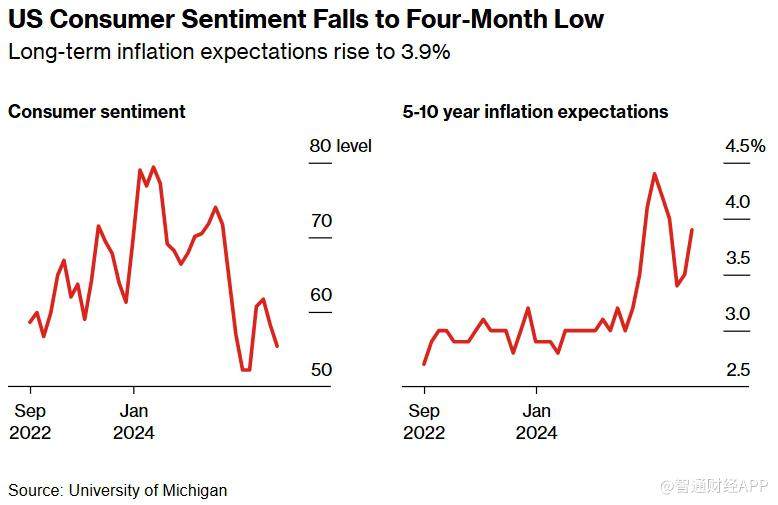
Core Insights - In September, U.S. consumer confidence dropped to its lowest level since May, with long-term inflation expectations rising for the second consecutive month due to concerns over the labor market and prices [2][3]. Group 1: Consumer Confidence - The preliminary consumer confidence index for September fell from 58.2 in August to 55.4, below market expectations [3]. - The current conditions index decreased from 61.7 in August to 61.2, while the expectations index dropped from 55.9 to 51.8 [4]. Group 2: Inflation Expectations - Consumers expect a 4.8% annualized increase in prices over the next year, unchanged from the previous month [3]. - Long-term inflation expectations for the next five to ten years rose to 3.9%, up from 3.5% the previous month [3]. Group 3: Labor Market Concerns - There is a significant increase in consumers' perceived probability of personal unemployment, indicating heightened anxiety about potential negative developments in the labor market [3]. - Recent data shows a substantial slowdown in the labor market, with only 22,000 jobs added in August [3]. Group 4: Tariff Concerns - Approximately 60% of surveyed consumers expressed concerns regarding tariffs, contributing to the decline in consumer confidence [4]. - Confidence among Republicans and independents fell to a four-month low, while there was a slight improvement among Democrats [4].
美国9月消费者信心降至四个月低点 通胀预期连续第二个月上升
智通财经网· 2025-09-12 14:31
Core Insights - The consumer confidence in the U.S. unexpectedly declined to its lowest level since May, indicating ongoing concerns about the job market and inflation [1][5] - The Michigan Consumer Sentiment Index fell to 55.4 in September, down from 58.2 in August, and below all economists' forecasts in a Bloomberg survey [1] - Long-term inflation expectations rose for the second consecutive month, with consumers anticipating a 4.8% increase in prices over the next year and a jump in 5-10 year inflation expectations to 3.9% from 3.5% in August [1] Economic Indicators - The labor market is showing signs of significant slowdown, with only 22,000 jobs added in August, marking the lowest increase of the year [5] - Consumer prices are rising at the fastest rate of the year, particularly in essential household expenses like groceries and gasoline [5] - Approximately 60% of survey respondents mentioned tariff issues, reflecting ongoing uncertainty in trade policies that is negatively impacting consumer sentiment [5] Consumer Sentiment Breakdown - The current conditions index decreased from 61.7 in August to 61.2 in September, while the expectations index fell from 55.9 to 51.8 [5] - Sentiment among Republicans and independents dropped to a four-month low, while Democrats showed a slight improvement in their outlook [5] - The survey was conducted between August 26 and September 8, capturing a snapshot of consumer sentiment during this period [5]