
核心CPI

Search documents
美国通胀“发令枪”——美国6月CPI点评
申万宏源研究· 2025-07-17 01:17
Overview - The core CPI data for June in the US was slightly weaker than expected, but the inflation effects of tariffs are becoming more evident [3][7][38] - The June CPI year-on-year was 2.7%, slightly above the market expectation of 2.6%, while the core CPI was 2.9%, matching expectations [3][38] - The market reacted to the data with a temporary decline in the 10Y Treasury yield and the US dollar index, which later recovered, indicating a focus on future inflation expectations [11][38] Structure - The main drivers of the CPI rebound include rising oil prices, core goods (excluding new and used cars), and non-rent services [4][39] - The energy CPI for June increased by 0.9% month-on-month, recovering from a previous decline of -1.0%, reflecting global oil price increases [4][39] - Core goods inflation showed signs of warming, with a month-on-month increase of 0.2%, driven by clothing, toys, and audio-visual equipment, indicating the impact of tariffs [20][39] - Rent inflation slightly slowed to 0.2% month-on-month, while core non-rent service inflation rebounded, particularly in medical, transportation, and entertainment services [4][39] Outlook - The second half of the year may see continued upward pressure on inflation, with the third quarter being a critical verification period for tariff inflation effects [5][28][40] - The Federal Reserve is expected to initiate rate cuts in September, with two cuts anticipated within the year, despite potential inflation increases [5][34][40] - The combination of moderate inflation increases and weakening employment may influence the Fed's decision-making [34][40]


美国通胀“发令枪”——美国6月CPI点评
赵伟宏观探索· 2025-07-16 12:25
Overview - The core CPI data for June in the US was slightly weaker than expected, but the inflation effects of tariffs are becoming more evident. The CPI year-on-year was 2.7%, slightly above the market expectation of 2.6%, while the core CPI was 2.9%, matching expectations. The month-on-month core CPI was 0.2%, below the expected 0.3% [3][38] - The 10-year US Treasury yield and the US dollar index initially fell but later rebounded, indicating market expectations of stronger future inflation [11][38] Structure - The main drivers of the CPI rebound in June were crude oil, core goods (excluding new and used cars), and non-rent services. The energy CPI rose by 0.9% month-on-month, compared to a previous decline of 1.0%, reflecting the increase in global oil prices [4][39] - Core goods inflation showed signs of warming, with the core goods CPI rising by 0.2% month-on-month, indicating the gradual impact of tariffs. However, the CPI for new and used cars remained weak, with used car prices dropping by 0.7% [20][39] - Rent inflation slightly slowed, with a month-on-month increase of 0.2%, down from 0.3% in May. However, core non-rent service inflation rebounded, with medical, transportation, and entertainment services showing month-on-month increases [39][40] Outlook - The second half of the year may see continued upward pressure on US inflation, with the third quarter being a critical verification period for tariff inflation effects. The combination of increased tariff revenues and strong cost-pass-through willingness from US companies may lead to a rise in inflation [5][28] - The Federal Reserve is expected to initiate interest rate cuts in September, with two cuts anticipated within the year, despite the potential for rising inflation in the third quarter [34][40]

7月16日电,波兰6月核心CPI同比上涨3.4%;符合预期;6月核心CPI环比增长0.3%,符合预期。
news flash· 2025-07-16 12:06
智通财经7月16日电,波兰6月核心CPI同比上涨3.4%;符合预期;6月核心CPI环比增长0.3%,符合预 期。 ...
美国6月CPI:关税传导效应显现,商品通胀抬头,核心PCE将何去何从?
Sou Hu Cai Jing· 2025-07-16 11:06
Group 1 - The recent consumer price index (CPI) data for June shows a complex picture influenced by tariffs, with core CPI rising only 0.2% month-over-month, slightly below market expectations [1] - Core goods prices have seen a significant increase for the first time since February, particularly in household items and clothing, indicating the impact of tariffs on consumer prices [2] - Financial institutions predict that the core personal consumption expenditures (PCE) index will outperform core CPI, with expected month-over-month growth between 0.29% and 0.34%, which may reduce the likelihood of interest rate cuts by the Federal Reserve [1][5] Group 2 - Core CPI year-over-year growth increased from 2.8% to 2.9%, while core goods prices rose by 0.2%, marking the strongest performance since February 2023 [1] - The trade-weighted effective tariff rate in the U.S. has risen to 14%-15%, significantly higher than the previous year's 2.5%, with an estimated 50% of tariff costs expected to be passed on to consumers [2] - The anticipated core PCE growth of 0.34% in June is driven by stock market rebounds and rising prices in investment-related services, reinforcing the Federal Reserve's current monetary policy stance [5]
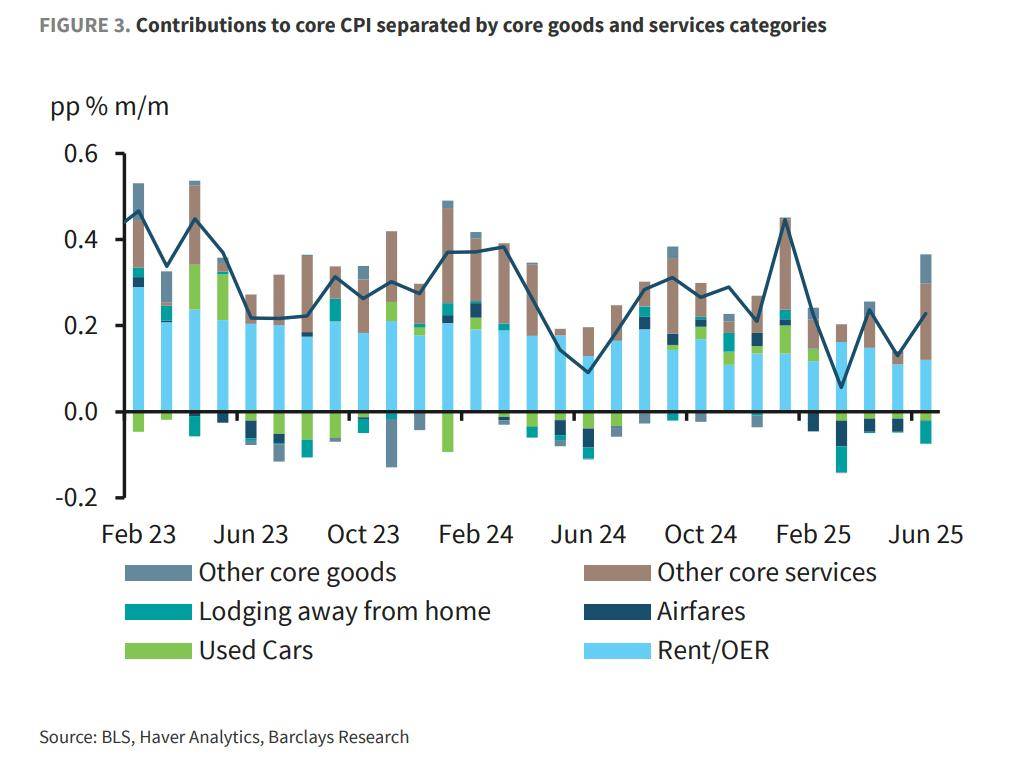
美国6月CPI证实关税传导,商品通胀时隔4个月再抬头,核心PCE可能更“猛”?
Hua Er Jie Jian Wen· 2025-07-16 08:58
Group 1 - The core viewpoint indicates that the tariff transmission effect has begun to manifest, with June's CPI data revealing structural changes despite appearing weak on the surface [1][2][4] - June's core CPI increased by 0.23% month-on-month, slightly below market expectations, while the year-on-year rate rose from 2.8% to 2.9%, indicating a mild inflationary trend [2][4] - Core commodity prices saw a notable increase of 0.2% in June, marking the first significant rise since February, with household goods and clothing prices experiencing substantial hikes due to tariffs [2][4] Group 2 - The report highlights that household goods prices rose by 0.98%, the largest increase since January 2022, while clothing and entertainment goods also saw price increases [4] - Barclays estimates that the effective tariff rate in the U.S. is between 14-15%, significantly higher than last year's 2.5%, with about 50% of tariff costs expected to be passed on to consumers [4] - The anticipated core PCE is projected to rise by 0.34% month-on-month, driven by a rebound in the stock market and increased investment-related services, reinforcing the Federal Reserve's current policy stance [7]
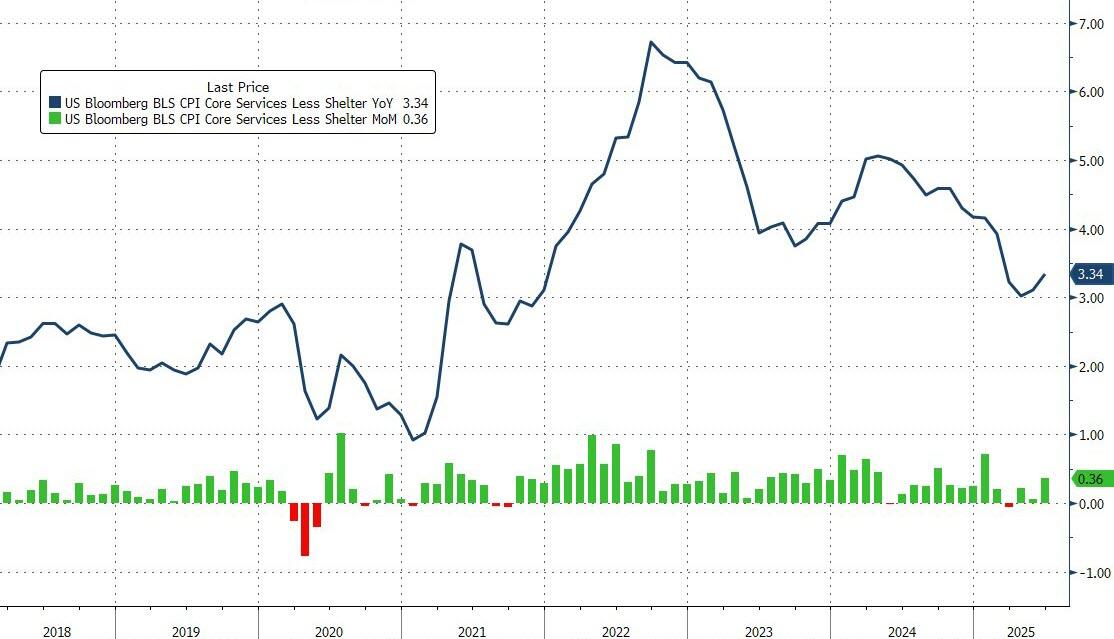
美国6月核心CPI回升但低于预期,料本月议息会议将继续按兵不动
SPDB International· 2025-07-16 08:21
Inflation Data - The core CPI inflation rate in the U.S. rose from 0.13% in May to 0.23% in June, but remained below the market expectation of 0.3%[1] - Overall CPI increased from 0.08% in May to 0.29% in June, meeting market expectations[1] - Year-on-year, the overall CPI inflation rate increased by 0.3 percentage points to 2.7%, while the core CPI rose by 0.1 percentage points to 2.9%[1] Employment Data - Non-farm payrolls increased by 147,000 in June, significantly above the market expectation of 106,000[1] - The unemployment rate unexpectedly fell from 4.244% in May to 4.112% in June[1] - Labor force participation rate declined to 62.3% in June from 62.4% in May, indicating a weakening labor market[1] Tariff Impact - Core commodity prices saw a month-on-month increase from -0.04% in May to 0.2% in June, suggesting the impact of tariffs is beginning to manifest[2] - The inflation rate for clothing rebounded to 0.43% in June from -0.42% in May, likely due to seasonal changes[2] - The anticipated impact of tariffs on inflation is expected to be more pronounced in the July-August data, with core commodity CPI likely to continue rising[3] Federal Reserve Outlook - The June inflation and employment data, combined with renewed tariff concerns, largely eliminate the possibility of a rate cut in July[6] - The Federal Reserve is expected to maintain the current policy rate and continue its wait-and-see approach, with potential rate cuts anticipated in September[6] - If new tariffs are implemented post-August 1, the Fed may delay its rate cut decisions further, but may need to adopt a more aggressive rate-cutting path next year due to the impact on inflation and economic growth[6]
新闻解读20250609
2025-07-16 06:13
Summary of Conference Call Notes Industry or Company Involved - The discussion primarily revolves around the China-U.S. trade negotiations and their implications for various industries, particularly focusing on strategic resources like rare earth elements and the automotive sector. Core Points and Arguments 1. **China-U.S. Negotiations**: The negotiations in London are expected to yield positive outcomes within a week, particularly concerning rare earth exports and potential easing of technology restrictions [1] 2. **China-Europe Trade Talks**: Recent communications from the Ministry of Commerce suggest that substantial progress may be made in negotiations with Europe, especially in the electric vehicle sector, where Chinese manufacturers are making price commitments to avoid price wars in Europe [2] 3. **Inflation Data**: The National Bureau of Statistics reported a slight decrease in the Consumer Price Index (CPI) by 0.1% and a significant drop in the Producer Price Index (PPI) by 3.3%, indicating economic challenges despite some positive interpretations of the data [3][4] 4. **Core CPI Insights**: Excluding volatile items like oil and food, the core CPI increased by 0.6%, suggesting underlying price stability despite the overall inflation decline [4] 5. **Export Performance**: In May, China's exports showed a surprising increase of 6.3%, despite significant tariffs imposed by the U.S., indicating resilience in the face of trade pressures [5] 6. **Policy Environment**: The policy landscape in June is described as stagnant, with limited new initiatives following the principles established in April, leading to a narrow impact on the market [6] 7. **Price Competition**: The competitive pricing environment, exacerbated by government subsidies, is leading to price wars among companies, which could further compress profit margins [7] 8. **Market Sentiment and Trading Volume**: The trading volume in the Shanghai and Shenzhen markets has rebounded to approximately 1.3 trillion, reflecting improved market sentiment and potential recovery opportunities [8][9] 9. **Brokerage Sector Performance**: The brokerage sector is highlighted as a key player in the market recovery, benefiting from increased trading activity and overall market sentiment [9] 10. **Future Market Outlook**: There is optimism for market performance in June, especially if additional catalysts emerge to boost market temperatures [10] Other Important but Possibly Overlooked Content - The discussion emphasizes the importance of understanding the nuances behind economic data, suggesting that not all declines in inflation indicators are negative and that some sectors may be experiencing improved margins despite overall price pressures [4][5]
通胀未显著超出预期 国际白银惨遭猛烈抛售
Jin Tou Wang· 2025-07-16 02:08
Group 1 - The core viewpoint of the articles indicates a decline in silver prices, with the latest closing price at $37.70 per ounce, down 1.13% from the previous day [1] - As of July 15, the silver ETF holdings decreased to 14,856.02 tons, a reduction of 110.22 tons from the previous day, reflecting a bearish sentiment in the market [2] - The recent CPI data showed a month-on-month increase of 0.3% in June, which is the largest rise since January, leading to slight adjustments in market expectations regarding potential interest rate cuts by the Federal Reserve [2][3] Group 2 - Federal Reserve Chairman Jerome Powell's cautious stance on inflation suggests that the Fed may remain careful regarding interest rate cuts, despite the moderate inflation data [3] - The upcoming PPI data is anticipated to provide further market guidance, with potential implications for interest rate expectations and gold prices [3] - The silver market experienced volatility, opening at $38.16, reaching a high of $38.39, and closing at $37.70, indicating a significant downward movement after an initial rise [4]
铜:国内现货坚挺,支撑价格
Guo Tai Jun An Qi Huo· 2025-07-16 02:06
Report Summary 1) Report Industry Investment Rating - Not provided in the given content 2) Core View of the Report - The domestic copper spot market is firm, which supports the copper price [1] 3) Summary by Relevant Catalogs [Fundamental Tracking] - **Futures Prices**: The closing price of the Shanghai Copper main contract was 78,090 with a daily decline of 0.40%, and the night - session closing price was 78,070 with a decline of 0.03%. The LME Copper 3M electronic disk closed at 9,658 with a daily increase of 0.15% [1] - **Trading Volume and Open Interest**: The trading volume of the Shanghai Copper main contract was 81,666, an increase of 2,530 from the previous day, and the open interest was 169,930, a decrease of 2,274. The trading volume of the LME Copper 3M electronic disk was 14,553, a decrease of 6,083, and the open interest was 279,000, a decrease of 1,048 [1] - **Futures Inventory**: The Shanghai Copper inventory was 50,133, an increase of 15,754, and the LME Copper inventory was 110,475, an increase of 850. The LME Copper注销仓单 ratio was 11.43%, a decrease of 3.05% [1] - **Price Spreads**: The LME copper ascension and premium increased by 13.80 to - 48.27. The bonded area warehouse receipt premium increased by 3 to 50, and the bonded area bill of lading premium increased by 3 to 66. The price of Shanghai 1 bright copper decreased by 300 to 72,800 [1] [Macro and Industry News] - **Macro News**: In the US, the core CPI in June increased by 2.9% year - on - year and 0.2% month - on - month, lower than expected for five consecutive months. Trump said that the US reached an agreement with Indonesia to impose a 19% tariff, lower than the threatened level last week. The EU said there were large gaps in positions between the US and the EU in some areas [1] - **Industry News**: Copper traders are shipping copper to Hawaii to take advantage of huge tariff trade. First Quantum Minerals' investment in Prospect Resources is crucial for extending the life of the Sentinel mine in Zambia. China's imports of copper ore and concentrates in June were 2.35 million tons, and the cumulative imports from January to June were 14.754 million tons, a year - on - year increase of 6.4%. The imports of unwrought copper and copper products in June were 464,000 tons, and the cumulative imports from January to June were 2.633 million tons, a year - on - year decrease of 4.6%. In the first half of this year, Azerbaijan's copper concentrate production soared nearly 12 times to about 1,200 tons [1][3] [Trend Intensity] - The copper trend intensity is 0, indicating a neutral state [3]
王有捐:上半年CPI总体平稳 PPI低位运行
Sou Hu Cai Jing· 2025-07-15 23:17
Group 1: Consumer Price Trends - Consumer prices remained generally stable in the first half of the year, with CPI down 0.1% year-on-year, consistent with the first quarter [2] - In June, CPI turned from decline to an increase of 0.1%, influenced by international commodity price fluctuations and effective domestic demand policies [2] - Core CPI, excluding food and energy, rose 0.4% year-on-year in the first half, with a 0.1 percentage point increase compared to the first quarter [2][4] Group 2: Food Price Dynamics - Food prices decreased by 0.9% year-on-year in the first half, with the decline narrowing by 0.6 percentage points compared to the first quarter [2] - Prices for fresh fruits and aquatic products increased by 2.7% and 0.8%, respectively, contributing approximately 0.08 percentage points to CPI [2] - Pork prices averaged a 3.8% increase in the first half, while beef prices saw a 6.9% decline [2] Group 3: Energy Price Trends - Energy prices fell by 3.2% year-on-year in the first half, with the decline expanding by 2.1 percentage points compared to the first quarter [3] - Gasoline prices dropped by 7.1%, contributing approximately 0.25 percentage points to the CPI decline [3] Group 4: Producer Price Index (PPI) Trends - PPI decreased by 2.8% year-on-year in the first half, with a notable decline of 3.6% by June [5] - International commodity price fluctuations led to a mixed price trend in domestic oil and non-ferrous metal industries [5] - Oil and gas extraction prices averaged a 9.6% decline, while non-ferrous metal smelting prices increased by an average of 6.2% [5] Group 5: Export and Industry Price Pressures - Uncertainties in the global trade environment led to price declines in export-oriented industries, with textiles and metal products down 2.3% year-on-year [6] - Sufficient supply and weak demand contributed to price declines in coal and electricity production, with coal prices down 15.4% [7] Group 6: Policy Impact on Prices - Macro policies have stabilized prices in certain industries, with the price of new energy vehicle manufacturing down 1.6%, a reduction narrower than in the first quarter [7] - Consumer demand policies have led to price increases in discretionary consumption sectors, with prices for arts and crafts up 12.3% [7]