
股债跷跷板效应

Search documents
“债牛”放缓!股债“跷跷板效应”再现,拐点来了?
证券时报· 2025-07-01 10:20
对于今年6月以来的债市,西部证券认为,大行持续买短债,央行买断式逆回购有力呵护,叠加基本面数 据表现偏弱、地缘政治冲突加剧,债市利好因素累积增多,收益率基本处于下行通道,但止盈情绪升温制 约债市进一步上涨空间,市场博弈利差挖掘行情。 在近期A股市场震荡走高之际,市场风险情绪好转,国债期货各品种均有所回落。 6月30日,30年期国债期货盘中大跌0.5%,自6月23日以来最大回撤幅度超过1%。不过,7月1日,30年 期国债期货价格有所反弹,一度涨超0.3%。 分析人士指出,近期期债市场回落主要是受资金面收敛、风险偏好回升以及债券供应放量等因素影响。进 入7月份,在基本面偏弱和流动性偏宽松的情况下,债市或逐步走强。 债市进入震荡市 今年以来,在货币政策节奏变化、市场流动性松紧转换以及海外事件驱动等多因素作用下,债市告别单边 牛市,进入震荡市。 今年6月下旬,随着中东局势降温,市场避险情绪走弱,风险偏好再度回归,股债跷跷板打压债市,国债 期货各品种均有所回落。 30年期国债期货自6月23日以来,最大回撤幅度超过1%,10年期国债期货回撤幅度接近0.3%,5年期国 债期货和2年期国债期货也出现了不同程度回撤。 7月1日 ...

股债“跷跷板效应”显现
Qi Huo Ri Bao· 2025-07-01 02:13
Core Viewpoint - The bond futures market has experienced a decline since late June, influenced by factors such as tightening liquidity, rising risk appetite, and increased bond supply. However, as the fundamentals remain weak and liquidity is expected to be loose, the bond market may gradually strengthen in July [1][2]. Group 1: Market Dynamics - The bond futures market has seen a pullback due to a tightening of the funding environment, with interbank market rates rising significantly, particularly DR007 which increased from around 1.5% to over 2%, marking a new high in over a month [1]. - The A-share market's continuous rise has created a "see-saw effect" with the bond market, as major indices reached yearly highs, leading to a shift of funds from the bond market to the stock market, particularly affecting long-term government bond futures [1]. - The issuance of bonds surged in June, with local government special bonds and ultra-long-term treasury bonds contributing to supply shocks in the bond market. The net financing of local government special bonds reached 529.2 billion yuan in the last week of June, a record high for the year [1]. Group 2: Future Expectations - Analysts expect that as the basic economic pressures increase and liquidity remains loose, the bond market is likely to strengthen in July. The anticipated decline in domestic demand and the weakening momentum of enterprises in the third quarter will further transmit pressure to the economy [2]. - The central bank's recent monetary policy meeting indicated a shift towards a more flexible approach to policy implementation, suggesting that the expectation of loose liquidity will gradually rise, which is favorable for the bond market [2]. - Key areas to monitor in July include changes in monetary policy and market liquidity, the impact of fiscal policy and bond supply, and economic data and expectations [3].
宝城期货国债期货早报-20250701
Bao Cheng Qi Huo· 2025-07-01 01:21
Report Summary 1. Report Industry Investment Rating - No investment rating provided in the report. 2. Core View of the Report - The overall view of treasury bond futures is to fluctuate in the short - term. Although the marginal improvement of manufacturing PMI puts pressure on treasury bond futures prices, the need for a loose monetary environment provides support, so they will mainly fluctuate and consolidate in the short - term [1][5]. 3. Summary According to Relevant Catalogs 3.1 Variety View Reference - Financial Futures Stock Index Sector - For TL2509, the short - term view is "fluctuation", the medium - term view is "fluctuation", the intraday view is "fluctuation with a weak bias", and the overall view is "fluctuation". The core logic is the marginal improvement of manufacturing PMI data [1]. 3.2 Main Variety Price Market Driving Logic - Financial Futures Stock Index Sector - The varieties include TL, T, TF, TS. The intraday view is "fluctuation with a weak bias", the medium - term view is "fluctuation", and the reference view is "fluctuation". The core logic is that treasury bond futures fluctuated and corrected yesterday. The manufacturing PMI in June was 49.7, showing an upward trend compared with 49.5 last month, and the new order index returned to the expansion range. This reduces the urgency of future interest rate cuts and puts pressure on treasury bond futures prices. Also, the rapid recovery of risk appetite in the stock market has strengthened the stock - bond seesaw effect, reducing investors' preference for treasury bonds. However, the need for policy support for domestic demand recovery means a loose monetary environment is still needed, providing strong support for treasury bond futures [5].
固定收益周报:择券空间继续收窄-20250630
Huaxin Securities· 2025-06-30 09:33
Group 1: Industry Investment Rating - No information provided in the report regarding the industry investment rating Group 2: Core Viewpoints - In the contraction cycle, the cost - performance ratio of stocks and bonds trends towards bonds, and the equity style trends towards value. Currently, long - term bonds have a slightly better cost - performance ratio than value - type equity assets. If the value - type equity assets continue to decline, there may be a good entry window. The top - down broad - based portfolio view is 80% equity value style and 20% 30 - year Treasury bond ETF. The new convertible bond portfolio has 0 equity - type convertible bond position and 70% total position, all allocated to value - style double - low and low - price convertible bonds (bond - like assets) [4] Group 3: Summary of Related Catalogs 1. Stock, Bond, and Convertible Bond Market Review - Last week, the A - share market oscillated upwards driven by sentiment and funds, with significant differentiation. Financial technology, small - cap growth, and micro - cap stocks performed strongly, while financial heavy - weight stocks were under pressure. The sector rotation accelerated. The computing power industry chain was boosted by NVIDIA's new high, the digital currency concept rose by the limit under the stimulation of Hong Kong's digital asset policy, the Xiaomi SU7 pre - sale stimulated the consumer electronics chain, military stocks strengthened in the middle of the week, and the non - ferrous metal sector was stimulated by factors such as shipping risks in the Strait of Hormuz, the weakening of the US dollar, and arms exports. The Hong Kong stock market was also differentiated, with innovative drugs under pressure and virtual asset license concept stocks soaring. Safe - haven assets were under pressure, with gold falling due to the easing of the Middle East situation and WTI crude oil plummeting to a 27 - month low. The domestic bond market oscillated due to the stock - bond seesaw effect, and the selling pressure of long - term bonds was relatively large, with the 30 - year Treasury bond futures experiencing a short - term diving market [2] - Last week, factors such as the strengthening of the underlying stocks, the continuous high - level oscillation of convertible bond valuations supported by the rigid demand of "fixed - income +" funds, and the repair of photovoltaic varieties led the CSI Convertible Bond Index to break through the previous high. Currently, the cost - performance ratio of convertible bonds is limited. On the one hand, the median price of the entire convertible bond market has risen to 123 yuan. On the other hand, the valuation has remained at a relatively high level, and the space for bond selection has narrowed. Overall, the proportion of inert convertible bonds with pending valuation adjustment is the largest and has further increased. Last week, the median conversion premium rate decreased from 32.5% to 30.8% (historical quantile 63%), the implied volatility increased from 27.1% to 29.6% (historical quantile 63%), and the median implied volatility difference increased from - 17% to - 15% (historical quantile 36%). Last week, the valuations of convertible bonds in some industries were actively increased, and there were even cases where the convertible bonds rose while the underlying stocks fell, such as in the banking, food, agriculture, transportation, and media industries. Currently, industries with relatively large bond - selection spaces include banking, non - ferrous metals, automobiles, and commercial trade, with mostly double - low and equity - type convertible bonds with good elasticity. In terms of market sentiment, the weekly average trading volume of the entire convertible bond market last week was 5.63 billion yuan, a 6% decrease from the previous week. The trading of traditional speculative bonds such as newly - issued bonds, low - rated convertible bonds, and double - high convertible bonds continued to be sluggish [3] 2. Market Outlook and Strategy Recommendation - From the perspective of large - scale asset allocation, in the contraction cycle, the cost - performance ratio of stocks and bonds trends towards bonds, and the equity style trends towards value. At the current point, long - term bonds have a slightly better cost - performance ratio than value - type equity assets. If the value - type equity assets continue to decline, there may be a good entry window. The top - down broad - based portfolio view is 80% equity value style and 20% 30 - year Treasury bond ETF. Therefore, the equity - type convertible bond position of the latest convertible bond portfolio is 0, and all are allocated to value - style double - low and low - price convertible bonds (bond - like assets), with a total position of 70%. Among them, low - price convertible bonds with a value style have a relatively long remaining time and the expectation of downward adjustment. The liquidity brought by the delisting of bank convertible bonds should be gradually deployed at low levels. Value - style double - low convertible bonds currently have dual advantages in terms of underlying stocks and convertible bonds: the industries of the underlying stocks generally have low valuations; in terms of convertible bonds, they are mainly high - rated convertible bonds, with valuations continuously suppressed and scarcity gradually increasing. The convertible bond broad - based portfolio underperformed the CSI Convertible Bond Index by 0.24 percentage points last week. Since its establishment in July 2024, the convertible bond broad - based portfolio has outperformed the CSI Convertible Bond Index by 15.85 percentage points in cumulative terms, with a maximum drawdown of 7.7% (the maximum drawdown of the CSI Convertible Bond Index during the same period was 7.5%) [4][5] 3. Performance of the Convertible Bond Market - **By industry**: Different industries showed different performances in terms of convertible bond yields, corresponding underlying stock yields, conversion premium rate changes, etc. For example, the communication industry had a convertible bond yield of 3.59% and a corresponding underlying stock yield of 5.63%, with a conversion premium rate change of - 2.50 percentage points; the national defense and military industry had a convertible bond yield of 3.31% and a corresponding underlying stock yield of 7.52%, with a conversion premium rate change of - 4.26 percentage points [13] - **By bond attributes**: Low - price convertible bonds, inert convertible bonds, double - low convertible bonds, equity - type convertible bonds, and double - high convertible bonds also had different performances. For example, low - price convertible bonds had a yield of 1.96%, and the corresponding underlying stocks had a yield of 3.26%, with a conversion premium rate change of - 2.17 percentage points [14] - **By rating**: Convertible bonds of different ratings, such as AAA, AA +, AA, etc., showed different yields, corresponding underlying stock yields, and conversion premium rate changes [15] - **By underlying stock market value**: Convertible bonds corresponding to underlying stocks of different market values had different performances. For example, convertible bonds corresponding to underlying stocks with a market value of over 20 billion yuan had a yield of 1.64%, and the corresponding underlying stocks had a yield of 2.04%, with a conversion premium rate change of - 0.59 percentage points [16] - **By convertible bond balance**: Convertible bonds with different balances also showed different performances. For example, convertible bonds with a balance of over 5 billion yuan had a yield of 1.49%, and the corresponding underlying stocks had a yield of 2.22%, with a conversion premium rate change of 0.18 percentage points [17] - **By listing duration**: Convertible bonds with different listing durations, such as old bonds, bonds listed for 3 - 4 years, etc., had different performances [18] 4. Characteristics of Convertible Bonds in Each Industry - Different industries had different characteristics in terms of the proportion of low - price convertible bonds, inert convertible bonds, double - low convertible bonds, equity - type convertible bonds, and double - high convertible bonds, as well as the median convertible bond price and conversion premium rate [19] 5. Rating, Scale, and Conversion Value of Convertible Bonds in Each Industry - Each industry showed different situations in terms of the proportion of convertible bonds of different ratings (AAA, AA +, etc.), different scales (market value ranges of underlying stocks, convertible bond balances), and conversion values [20]
央行的“为”与“不为”
Tianfeng Securities· 2025-06-29 07:16
Report Investment Rating No industry investment rating is provided in the report. Core Viewpoint In the short term, the market may continue to fluctuate as it awaits further confirmation of monetary policy. Subsequently, it is expected to break through the downward space and approach the low point. Although the liquidity in July may remain relatively loose, from the perspective of coordinating fiscal policies and managing market expectations, treasury bond trading may not necessarily occur during this window period. The amplitude and rhythm of the curve opening up space require reasonable assessment [35]. Summary by Directory 1. Stock Market Suppression, Bond Market First Weak then Strong, Curve Slightly Steepened - This week (June 23 - June 27), the cross - quarter and the stock - bond "seesaw" were the main factors influencing the bond market. The stock market's strength in the first half of the week suppressed the bond market, but the central bank's increased liquidity injection and insurance replenishment provided some support. In the second half of the week, the bond market recovered as the stock - bond linkage effect weakened and the stock market declined, along with uncertain industrial enterprise profit data [1][8]. - On a daily basis, the bond market showed different trends each day. By June 27, the yields of 1Y, 5Y, 10Y, and 30Y treasury bonds changed by - 1, + 0.4, + 0.7, and + 1.2 BP respectively compared to June 20, and the curve steepened slightly. Most yields of major - term certificates of deposit (CDs) increased [8]. 2. Cross - quarter Overall Secure, Bank Liability - side Pressure Controllable - This week, the overall funding situation was stable, with increased fluctuations approaching the quarter - end. The 7 - day funding rate rose significantly, and the government bond issuance scale was large in the first half of the week. However, the central bank's intention to support was obvious, with reverse repurchase injections exceeding 2 trillion yuan. CD issuance rates fluctuated slightly, and large - bank lending remained stable around 4 trillion yuan, indicating that cross - quarter funds were generally secure and bank liability - side pressure was relatively controllable [2][13]. - The 7 - day funding rate center increased, and the DR001 still ran below the policy rate. As of June 27, the weekly averages of DR001 and R001 changed by - 0.53 and + 0.58 respectively compared to the previous week, while those of DR007 and R007 changed by + 12.75 and + 24.03 BP respectively. The phenomenon of funding stratification became more prominent, and the funding pressure on non - bank institutions increased during the cross - quarter period [13]. 3. The "Actions" and "Inactions" of Central Bank Monetary Policy - In June, market discussions about whether the central bank would restart treasury bond trading intensified. Since June, large banks' purchases of short - term treasury bonds (especially 1 - 3Y) increased year - on - year and month - on - month, which made the market more likely to associate this with the restart of treasury bond trading operations [19]. - The central bank suspended treasury bond purchases in 2025 mainly due to the improvement of the government bond supply - demand relationship and to avoid creating strong market expectations. After the market adjustment in the first quarter, an expert view in the Financial Times on April 13 suggested that the central bank might buy new treasury bonds in the secondary market if the interest - rate increase pressure from expansionary fiscal policies weakened policy effectiveness [3][25]. - In the first half of 2025, the bond market's funding situation was volatile. Monetary policy showed more characteristics of dynamic equilibrium and contingency decision - making among multiple goals. The central bank's shift from "restraint" to "support" in liquidity injection corresponded to the change in policy goal priority from "risk prevention" to "stable growth" [4][29]. - Currently, the central bank's "inactions" may include: improved flexibility and precision in liquidity regulation in 2025, with June smoothly passing multiple liquidity tests; large banks' purchases of short - term treasury bonds may not directly equal the central bank's purchases; the central bank is still concerned about bond market interest - rate risks; and the government bond supply pressure decreased in June, with the next peak likely in August - September. Therefore, treasury bond trading may not necessarily occur in July, and the market may fluctuate in the short term [30][35]. 4. Next Week's Focus - June 30: China's official manufacturing PMI for June, Eurozone's M1/M2/M3 for May, Germany's CPI for June. - July 1: Eurozone's CPI for June, US ISM manufacturing PMI for June. - July 2: US ADP employment for June. - July 3: US non - farm payrolls for June, US ISM non - manufacturing PMI for June. - July 4: EU PPI for May [38][39].
瑞达期货宏观市场周报-20250627
Rui Da Qi Huo· 2025-06-27 09:33
Group 1: Report Industry Investment Rating - No relevant content provided Group 2: Core Views of the Report - A-shares' major indices strengthened collectively this week, with all but the Shanghai Composite Index rising over 2%. The four stock index futures also went up, and small and medium-cap stocks outperformed large-cap blue-chip stocks. Both domestic and overseas positive news boosted the market. The ceasefire between Iran and Israel improved market risk appetite, and the central bank's guidance on financial support for consumption and expansion of consumption enthusiasm for the consumer and financial sectors [8]. - This week, the yields of treasury bond cash bonds weakened collectively. The yields of 1 - 7Y bonds rose by about 0.10 - 1.60bp, and the yields of 10Y and 30Y bonds rose by about 0.5bp and 1.15bp to 1.65% and 1.85% respectively. The adjustment in the bond market was mainly due to the shift in risk appetite, and the ceasefire between Iran and Israel drove the equity market to strengthen, triggering a slight increase in interest rates [8]. - In May, China's imports and exports, fixed - asset investment, and industrial added - value declined year - on - year compared to the previous period, and the real estate market continued to decline. Only social retail sales increased due to new policies. The previously announced CPI and PPI data also indicated future price pressure. The possible improvement in Sino - US trade relations and the dovish stance of the Fed officials supported commodity prices [8]. - The US dollar may continue to fluctuate weakly in the short term, and the euro benefits from the weakening of the US dollar in the short term. The Japanese yen is caught between the expectation of interest rate hikes and trade frictions [12]. - In May, the profits of industrial enterprises above the national scale decreased significantly year - on - year, mainly affected by insufficient effective demand, falling industrial product prices, and the high - base effect. However, the profits of the equipment manufacturing industry and some emerging industries increased significantly [13]. Group 3: Summary by Directory 1. This Week's Summary and Next Week's Allocation Recommendations Stocks - The Shanghai and Shenzhen 300 Index rose 1.95%, and the Shanghai and Shenzhen 300 Stock Index Futures rose 2.78%. A - shares' major indices strengthened, and the four stock index futures went up. Small and medium - cap stocks were stronger than large - cap blue - chip stocks. The ceasefire between Iran and Israel and the central bank's guidance on consumption boosted the market. Market trading activity recovered significantly. Allocation recommendation: cautious waiting and seeing [8]. Bonds - The 10 - year treasury bond yield rose by 0.05% this week, with a weekly change of + 0.08BP, and the main 10 - year treasury bond futures fell by 0.11%. The yields of treasury bond cash bonds weakened, and the yields of 1 - 7Y, 10Y, and 30Y bonds rose. The bond market adjustment was due to the shift in risk appetite. Allocation recommendation: cautious waiting and seeing [8]. Commodities - The Wind Commodity Index fell 1.01%, and the China Securities Commodity Futures Price Index fell 1.60%. In May, China's economic data was mixed, and the possible improvement in Sino - US trade relations and the dovish stance of the Fed officials supported commodity prices. Allocation recommendation: buy on dips [8]. Foreign Exchange - The euro against the US dollar rose 1.51%, and the euro against the US dollar 2509 contract rose 1.31%. The US dollar was under pressure, the euro benefited from the weakening of the US dollar, and the Japanese yen fluctuated. Allocation recommendation: cautious waiting and seeing [8] 2. Important News and Events - Premier Li Qiang attended the opening ceremony of the 2025 Summer Davos Forum and emphasized China's support for economic globalization, free trade, and multilateralism [16]. - Six departments including the central bank issued a guidance on financial support for consumption, with a 500 billion yuan re - loan for service consumption and elderly care [16]. - A military parade will be held in Beijing on September 3 to commemorate the 80th anniversary of the victory of the Chinese People's War of Resistance against Japanese Aggression and the World Anti - Fascist War [16]. - China strongly condemned the US attack on Iran's nuclear facilities and called for a ceasefire and dialogue [16]. - Iran and Israel agreed to a full ceasefire [17]. - The US and the EU are about to reach a "reciprocal trade agreement" on multiple non - tariff trade disputes, but the lack of tariff issues in the draft adds uncertainty [17]. - The probability of the Fed cutting interest rates in July is small, but the Fed officials have released dovish signals [17]. 3. This Week's Domestic and Overseas Economic Data - China: The profit of industrial enterprises above the national scale in May decreased by 9.1% year - on - year, and the cumulative profit from January to May decreased by 1.1% [13]. - US: The first - quarter GDP annualized quarterly rate was revised down to - 0.5%, consumer spending growth was at a low level since 2020, and the consumer confidence index was lower than expected [12]. - Eurozone: The economy showed signs of stabilization, but the manufacturing PMI was still under pressure. There were differences within the ECB on the pace of interest rate cuts [12]. - Japan: Inflation pressure continued to rise, but exports were suppressed by the US - Japan tariff deadlock, and domestic demand was weak [12]. 4. Next Week's Important Economic Indicators and Economic Events - Key economic indicators to be released next week include China's June official manufacturing PMI, Germany's June unemployment rate and CPI monthly rate, the US's June ADP employment, unemployment rate, and non - farm payrolls, etc. [85]
公募基金总规模再创历史新高
Cai Jing Wang· 2025-06-27 04:21
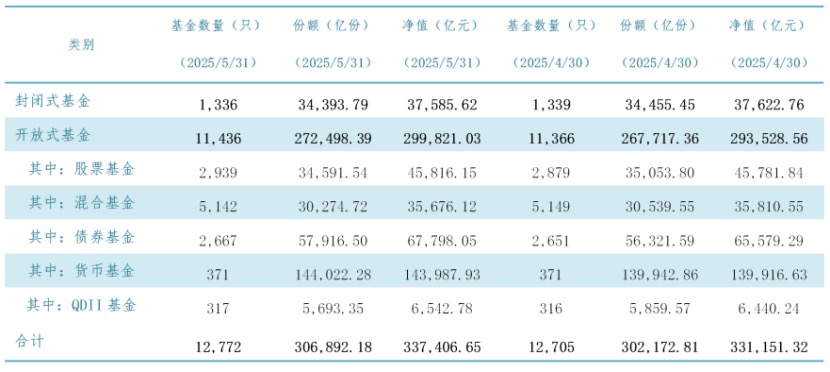
Core Insights - The total net asset value of public funds in China reached a new high of 33.74 trillion yuan as of the end of May 2025, reflecting an increase of 0.62 trillion yuan or 1.87% from the end of April 2025 [1][2] Fund Categories Summary - Closed-end funds: 1,336 funds with a net value of 3758.56 billion yuan, slightly decreased from April [2] - Open-end funds: 11,436 funds with a net value of 2998.21 billion yuan, increased from April [2] - Stock funds: 2,939 funds with a net value of 4581.61 billion yuan, showing a slight increase [2] - Mixed funds: 5,142 funds with a net value of 3567.61 billion yuan, slightly decreased [2] - Bond funds: 2,667 funds with a net value of 6779.80 billion yuan, increased by 221.88 billion yuan [2][3] - Money market funds: 371 funds with a net value of 1439.88 billion yuan, increased by 407.13 billion yuan [2][3] - QDII funds: 317 funds with a net value of 654.28 billion yuan, increased by 10.25 billion yuan [2] Market Trends - The growth in the fund market is primarily driven by money market and bond funds, as investors prefer low-risk, high-liquidity products amid poor performance in equity assets [3] - The bond ETF market has seen significant growth, with the total scale surpassing 360 billion yuan by June 24, 2025, marking a milestone in the sector [4] - Credit bond ETFs have shown remarkable growth, with some products increasing by approximately 416% in scale within five months [4] Regulatory and Industry Developments - The China Securities Regulatory Commission released a new action plan on May 7, 2025, aimed at promoting high-quality development in the public fund industry, introducing 25 specific measures [5] - The first batch of 26 new floating-rate funds has raised over 15 billion yuan, indicating strong market interest and participation [6]
博时基金张磊:解析债券ETF规模增长三大因素
Xin Lang Ji Jin· 2025-06-26 02:11
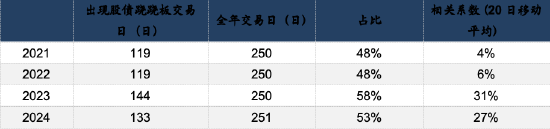
Core Viewpoint - The rapid growth of bond ETFs in China is driven by their scarcity, operational convenience, and the recent inclusion of credit bond ETFs in general pledge-style repurchase agreements, enhancing their attractiveness and liquidity [1][2][5]. Group 1: Growth of Bond ETFs - The total market size of bond ETFs has surpassed 360 billion yuan, with credit bond ETFs showing significant growth, particularly the Bosera Credit Bond ETF, which has recently exceeded 10 billion yuan in size [1]. - The scarcity of bond ETFs, such as the limited number of 30-year government bond index funds and convertible bond index funds, contributes to their appeal [2]. - The operational advantages of bond ETFs include low management fees, strong tool attributes, and transparent underlying assets, making them more attractive compared to traditional bond index funds [3][4]. Group 2: Institutional and Individual Participation - Institutional investors, including banks, insurance companies, and pension funds, dominate the bond ETF market, accounting for over 80% of the ownership structure, although individual investors are gradually increasing their participation [4]. - The recognition and acceptance of bond ETFs among individual investors are still in the early stages, but with increased investor education and product promotion, participation is expected to rise [4]. Group 3: Impact of Pledge Inclusion - The inclusion of multiple credit bond ETFs in general pledge-style repurchase agreements enhances their attractiveness by allowing investors to leverage their holdings for increased returns [5]. - The operational simplicity and low transaction costs associated with pledge transactions make credit bond ETFs particularly suitable for on-exchange investment needs [5]. - The liquidity of credit bond ETFs is significantly better than that of individual corporate bonds, and the continued growth in scale is expected to further enhance liquidity and meet customer trading demands [5]. Group 4: Stock-Bond Relationship - The "stock-bond seesaw" effect has been amplified in recent years, indicating a stronger inverse relationship between stock and bond market performances [6][7]. - The occurrence of days where stocks rise while bonds fall, or vice versa, has increased, with the proportion of such trading days rising to over 50% in recent years [6][7]. - The correlation between daily price movements of stocks and bonds has also increased, indicating a growing interdependence between the two asset classes [7].
股市震荡回暖,债市?盈情绪升温
Zhong Xin Qi Huo· 2025-06-24 07:24
1. Report Industry Investment Rating No information provided in the content. 2. Core Views of the Report - The geopolitical impact on stock index futures is controllable, and the A-share market is in a stage of oscillation to find a direction. The core contradiction lies in the need for policy support in the weak reality and the unclear impact of tariff events on the fundamentals. The marginal flow of funds determines the short - term market direction [1][7]. - For stock index options, sentiment repair continuity can be arranged. The trading volume of the options market increased, and the sentiment of each variety rebounded slightly. The defensive sentiment weakened, and the volatility reached the lowest level this year. It is advisable to use collar strategies or bull spreads and also consider light - position double - buying [2][8]. - In the case of treasury bond futures, the profit - taking sentiment may increase. The treasury bond futures mostly declined yesterday. Although the market's risk - aversion sentiment may have increased due to the conflict between Israel and Iran, the increase was limited. With the approaching of the end of the quarter and the acceleration of local bond issuance, the market is cautious about the capital side, and the 10Y treasury bond interest rate is near the key point [3][10]. 3. Summaries According to Relevant Catalogs 3.1 Market Views 3.1.1 Stock Index Futures - **Market Situation**: The A - share market oscillated and recovered yesterday, with the whole A - index rising 0.85%. The computer, military, and coal sectors led the gains, and the trading volume of the two markets was 1.15 trillion. The number of daily limit stocks increased to 83 [7]. - **Key Data**: The basis of IF, IH, IC, and IM current - month contracts was - 34.50 points, - 30.78 points, - 48.37 points, and - 76.82 points respectively, with a month - on - month change of 7.74 points, 6.14 points, 2.74 points, and - 12.03 points. The total positions of IF, IH, IC, and IM changed by 18334 lots, 12339 lots, 6879 lots, and 12238 lots [7]. - **Logic**: The geopolitical risk is the main variable in the news, but the market expects a low probability of the Strait of Hormuz being blocked. The core contradiction in the A - share market is the need for policy support in the weak reality and the unclear impact of tariff events. The recent depreciation of the Hong Kong dollar has suppressed the sentiment of the pharmaceutical and new - consumption sectors [1][7]. - **Operation Suggestion**: Stay on the sidelines [7]. 3.1.2 Stock Index Options - **Market Situation**: The underlying market opened low and closed high yesterday. The sentiment of small - cap stocks recovered. The trading volume of the options market was 4082 million yuan, a 5.08% increase from the previous trading day, with medium - to - high liquidity and active intraday trading [2][8][9]. - **Key Data**: The PCR of the 50ETF and CSI 1000 stock index futures showed different rebound strengths, with the 50ETF reaching the level at the end of May [8]. - **Logic**: The downward sentiment of each variety has eased, and the defensive sentiment has weakened. The volatility has reached the lowest level this year, and the cost - effectiveness of short - volatility is low [2][8]. - **Operation Suggestion**: Use collar strategies, bull spreads, and light - position double - buying [8]. 3.1.3 Treasury Bond Futures - **Market Situation**: Treasury bond futures mostly declined yesterday. The T main contract continued to decline in price after opening, rebounded in the afternoon, but still closed slightly lower. The TL main contract opened higher in the morning but turned down during the day [3][8][10]. - **Key Data**: The trading volume and positions of T, TF, TS, and TL current - quarter contracts changed to varying degrees. The central bank conducted 22.05 billion yuan of 7 - day reverse repurchases yesterday, with 34.2 billion yuan of reverse repurchases maturing [8]. - **Logic**: The conflict between Israel and Iran may have increased the market's risk - aversion sentiment, but the increase was limited. The stock market strengthened during the day, showing a stock - bond seesaw effect. The capital side was relatively stable, but the market was cautious due to the approaching end of the quarter and the acceleration of local bond issuance. The 10Y treasury bond interest rate is near the key point [3][10]. - **Operation Suggestion**: Adopt a trend strategy of oscillation, pay attention to short - hedging at low basis levels for hedging strategies, appropriately focus on the widening of the basis for basis strategies, and choose to steepen the curve in the medium - term for curve strategies [10]. 3.2 Economic Calendar - On June 23, 2025, the initial value of the Eurozone's June SPGI manufacturing PMI was 49.4, the same as the previous value; the initial value of the US June SPGI manufacturing PMI was 52, higher than the predicted value [11]. - On June 24, 2025, the German June IFO business climate index and the US June Conference Board consumer confidence index are yet to be announced [11]. - Other economic data such as the US initial jobless claims for the week ending June 21, 2025, and the Eurozone's June consumer confidence index final value are also scheduled for release in the following days [11]. 3.3 Important Information and News Tracking - **US Macroeconomics**: Federal Reserve Governor Bowman said that if inflation remains subdued, she may support a rate cut by the Fed in July. If inflation continues to decline or the job market weakens, the FOMC can cut interest rates [12]. - **Real Estate**: The Hangzhou Housing Provident Fund Management Center launched a service allowing employees to use their housing provident fund to directly pay the down - payment for newly built commercial housing in Hangzhou, with full online processing support. The online processing function for second - hand houses is under development and will be launched soon [12]. - **Stablecoins**: The Hong Kong "Stablecoin Ordinance" will come into effect on August 1, 2025. The Hong Kong Monetary Authority has set relatively strict standards for stablecoin issuers, with a high entry threshold. It is expected that only a few licenses will be issued initially, and the licensed stablecoins will have specific uses such as cross - border trade [12]. 3.4 Derivatives Market Monitoring - Information about stock index futures, stock index options, and treasury bond futures data is mentioned in the content, but no specific detailed summaries are provided in the text other than the data presented in the market views section [13][17][29].
周度金融市场跟踪:中美元首通电话,本周股市普遍上涨;债券市场先抑后扬,窄幅震荡(6月2日~6月6)-20250609
Bank of China Securities· 2025-06-09 08:49
宏观经济 | 证券研究报告 - 总量周报 2025年6月9日 周度金融市场跟踪 中美元首通电话,本周股市普遍上涨;债券市场 先抑后扬,窄幅震荡(6月2日-6月6) ■ 股票方面,本周 A 股迎来普涨,小盘股继续跑赢大盘股。全周累计看,沪深 300 本 周上涨 0.9%,中证 2000 上涨 2.3%。港股恒生指数本周上涨 2.2%。行业方面,本周 31个一级行业有26个上涨,通信、有色金属和电子行业领涨,家用电器、食品饮料 2 个消费类行业领跌。医药行业本周上涨 1.1%连续 7 周上涨。周内看. 本周由于端 午假期仅4个交易日。美东时间6月1日中午新闻报道白宫国家经济委员会主任哈西 特在接受采访时表示预计中美元首将于本周就关税问题进行会谈。周二至周四(6月 3-5日)市场在此预期下总体上涨,主要指数连续上涨3天,中证2000更是在周四收 至4月以来的最高点。周四(6月5日)晚间中美元首通电话,预期兑现后,周五(6 月6日)市场小幅回调。美股本周在中美元首通话预期以及周五非农数据超预期影响 下整体上涨。标普 500 指数上涨 1.5%,周五收盘标普 500 指数重回 6000点。纳斯达 克 100 指数上涨2 ...