流动性

Search documents
邢自强:出口消费承压下市场仍活跃,杠杆可控 + 资金入市成核心底气
Sou Hu Cai Jing· 2025-08-26 07:27
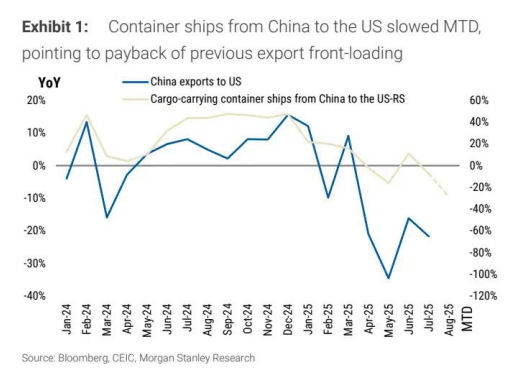
Economic Growth Observation - The economic growth in China is expected to slow down, with Morgan Stanley predicting a year-on-year growth rate of approximately 4.5% for Q3 2025, influenced by various weakening indicators observed in August [1] - Export growth is anticipated to decline from 7.2% in July to a range of 5%-6% in August due to high base effects and a pullback in prior export demand [1] - Domestic consumption remains weak, particularly in the automotive and home appliance sectors, with significant declines in sales despite government subsidies [3] - Infrastructure investment shows a slight recovery, but its sustainability is questioned due to a decrease in net financing from government bonds [5][7] Market Sentiment - Despite the economic slowdown, market sentiment in the A-share market remains resilient, supported by ample liquidity and proactive policy measures [10] - The liquidity environment has turned positive since June 2025, indicating a shift towards a more accommodating financial landscape [10] - There is a notable shift in residents' asset allocation from savings to capital markets, as evidenced by a significant drop in household deposits and a rise in non-bank financial institution deposits [13] Policy Response - The Chinese government is addressing core challenges categorized as "3D" (de-leveraging, insufficient demand, structural transformation) through targeted policy measures [17] - Recent government meetings have emphasized the continuity of cyclical policies and the acceleration of consumer support measures to bolster domestic demand [17] - The government is also considering capacity adjustments in the refining and petrochemical sectors to tackle overcapacity issues, which may lead to the exit or upgrade of outdated production capacities [17] Central Bank Stance - The central bank's recent monetary policy report indicates a shift towards prioritizing the quality of liquidity management rather than merely injecting liquidity to support the stock market [18] - The central bank has reduced the scale of net liquidity injections since June, reflecting a recognition of the current level of liquidity [18] Leverage Levels - Current leverage levels in the A-share market are deemed reasonable, with the margin trading balance exceeding 2 trillion RMB (approximately 290 billion USD), yet remaining below historical peaks [21] - The proportion of margin trading balance to free float market value is around 4.8%, slightly below the 10-year average of 4.9% [21] - Although there has been a recent increase in the proportion of margin trading volume to daily A-share turnover, it remains significantly lower than the peaks observed in 2020 and 2015 [24]

牛市还在加速
表舅是养基大户· 2025-08-25 13:28
Group 1 - The core viewpoint of the article highlights the strong performance of the Hong Kong and A-share markets, driven by significant capital inflows and favorable market conditions [1][2][3]. - In the Hong Kong market, major tech stocks like Tencent, Alibaba, and Xiaomi saw a net inflow of over 23 billion, indicating a solid capital base [1]. - The A-share market experienced a record trading volume of approximately 3.2 trillion, ranking as the second highest in history, reflecting increased investor activity [4][5]. Group 2 - The term "fast" refers to the rapid breakthrough of key index levels, with the Wind All A index surpassing 6000 points to 6100 points in just one trading day [7][8]. - The term "fierce" indicates a significant increase in financing balance, with net purchases exceeding 90 billion, marking a substantial acceleration in market activity [11]. - A new policy in Shanghai to relax housing purchase restrictions in areas outside the outer ring is expected to impact the real estate market and broader asset classes [14][17]. Group 3 - The article discusses the performance of the A500 and CSI 300 indices, which have surpassed their previous highs, indicating a recovery for investors who bought into broad-based ETFs [18][20]. - The article emphasizes the importance of quality equity investments in the current market environment, suggesting a favorable outlook for long-term investors [22][23]. - The bond market is also highlighted, with a notable decline in 30-year government bond yields, indicating a bullish trend in both stocks and bonds [26][28]. Group 4 - The article mentions the expansion of the Sci-Tech bond market, with a significant issuance scale of approximately 600 billion in the first half of the year, supporting the technology sector's growth [28][30]. - Recent developments in Sci-Tech bond ETFs, including their inclusion in the pledge financing system, are expected to attract more institutional investment [31][36]. - The article suggests that the Sci-Tech bond ETFs will benefit from strong liquidity and low management fees, making them an attractive option for investors [38].

X @Yuyue
Yuyue· 2025-08-25 12:56
Market Analysis - The $1 billion (1B) buy order for SOL may be insufficient to cover potential insider trading related to rumored cryptocurrency and stock market activities [1] - The most pressing issue is the on-chain ecosystem's liquidity [1] Liquidity & Ecosystem - Resolving exchange liquidity is crucial for the ecosystem to thrive [1]
每日投行/机构观点梳理(2025-08-25)
Jin Shi Shu Ju· 2025-08-25 11:56
Group 1 - Hedge funds have net bought Chinese stocks at the fastest pace in seven weeks, indicating a shift in market sentiment towards China [1] - Morgan Stanley's chief strategist for China believes the recent A-share rally is driven by improved liquidity, with funds moving from bonds and deposits to the stock market [1] - HSBC has raised its year-end target for the Shanghai Composite Index to 4000 points, citing abundant domestic liquidity and a potential 5% to 7% upside [1] Group 2 - Barclays and Societe Generale predict the Federal Reserve will cut rates by 25 basis points in September, influenced by Chairman Powell's shift in tone regarding employment risks [2] - Bank of America suggests that if the dollar weakens and the UK economy improves, the British pound could strengthen, with a forecast of GBP/USD reaching 1.45 in Q4 [2] Group 3 - Canadian dollar is under pressure due to trade uncertainties and expectations of further rate cuts by the Bank of Canada, with the currency hitting a three-month low [3] - Citigroup expects the 10-year U.S. Treasury yield to reach 4.10% by year-end, maintaining confidence in its long-term predictions [4] Group 4 - CITIC Securities anticipates three rate cuts by the Federal Reserve this year, each by 25 basis points, as Powell's comments align with their expectations [6] - China International Capital Corporation estimates that potential funds from household deposits entering the market could range from 5 to 7 trillion yuan [6] Group 5 - Huatai Securities indicates that the current economic conditions suggest a high probability of a 25 basis point rate cut by the Federal Reserve in September, with two additional cuts likely in Q4 [7] - China Merchants Macro reports that the Producer Price Index (PPI) likely bottomed out in June-July, with expectations for a rebound driven by global inventory cycles and oil prices [8] Group 6 - China Merchants Strategy recommends focusing on the entire rare earth sector, especially smaller companies, following new regulations that allow more firms to obtain mining quotas [9] - CITIC Securities notes that the current market rally is primarily driven by institutional investors rather than retail, emphasizing the importance of industry trends and performance [10] Group 7 - Huatai Securities maintains that coal prices are likely to remain supported due to high demand and supply constraints, suggesting a focus on companies with stable cash flows and high dividends [8] - Guotai Junan expects the Asian metallurgical coal market to continue recovering in Q3 2025, supported by inventory replenishment in India and potential rebounds in China [9] Group 8 - China Merchants Macro identifies September as a potential observation window for the appreciation of the Chinese yuan, which could lead to a comprehensive revaluation of Chinese assets [17][18] - The report suggests that if the yuan returns to the 6 range, it would enhance the attractiveness of Chinese equities, particularly in consumer sectors [18]
中邮因子周报:成长风格主导,流动性占优-20250825
China Post Securities· 2025-08-25 11:47
Quantitative Models and Construction 1. Model Name: GRU Model - **Model Construction Idea**: The GRU model is used to predict stock returns based on historical data and incorporates various factors to optimize portfolio performance [3][4][5] - **Model Construction Process**: - The GRU model is trained on historical data to capture temporal dependencies in stock returns - It uses multiple input features, including technical and fundamental factors, to predict future returns - The model is applied to different stock pools (e.g., CSI 300, CSI 500, CSI 1000) to evaluate its performance [5][6][7] - **Model Evaluation**: The GRU model demonstrates strong performance in most stock pools, with positive long-short returns across various factors. However, certain sub-models (e.g., `barra5d`) show occasional underperformance [5][6][7] 2. Model Name: Open1d and Close1d Models - **Model Construction Idea**: These models focus on short-term price movements and are designed to capture daily return patterns [8][31] - **Model Construction Process**: - Open1d and Close1d models are trained on daily open and close price data, respectively - They are evaluated based on their ability to generate excess returns relative to the CSI 1000 index [8][31] - **Model Evaluation**: These models show mixed performance, with occasional drawdowns relative to the benchmark index [8][31] 3. Model Name: Barra1d and Barra5d Models - **Model Construction Idea**: These models are based on the Barra factor framework and aim to capture short-term and medium-term return patterns [8][31] - **Model Construction Process**: - Barra1d focuses on daily factor returns, while Barra5d aggregates returns over a 5-day horizon - Both models are tested for their ability to generate excess returns relative to the CSI 1000 index [8][31] - **Model Evaluation**: Barra5d demonstrates strong year-to-date performance, significantly outperforming the benchmark, while Barra1d shows consistent but less pronounced gains [8][31] --- Model Backtest Results 1. GRU Model - **Excess Return**: Positive across most stock pools, with occasional underperformance in specific sub-models like `barra5d` [5][6][7] 2. Open1d Model - **Weekly Excess Return**: -0.01% - **Year-to-Date Excess Return**: 5.23% [32] 3. Close1d Model - **Weekly Excess Return**: -0.38% - **Year-to-Date Excess Return**: 3.64% [32] 4. Barra1d Model - **Weekly Excess Return**: 0.65% - **Year-to-Date Excess Return**: 3.80% [32] 5. Barra5d Model - **Weekly Excess Return**: 0.02% - **Year-to-Date Excess Return**: 6.44% [32] --- Quantitative Factors and Construction 1. Factor Name: Beta - **Factor Construction Idea**: Measures historical beta to capture market sensitivity [15] - **Factor Construction Process**: Historical beta is calculated based on the covariance of stock returns with market returns [15] 2. Factor Name: Momentum - **Factor Construction Idea**: Captures historical excess return trends [15] - **Factor Construction Process**: - Momentum = 0.74 * Historical Excess Return Volatility + 0.16 * Cumulative Excess Return Deviation + 0.1 * Historical Residual Return Volatility [15] 3. Factor Name: Volatility - **Factor Construction Idea**: Measures stock price fluctuations to identify high-volatility stocks [15] - **Factor Construction Process**: - Volatility = Weighted combination of historical residual return volatility and other metrics [15] 4. Factor Name: Growth - **Factor Construction Idea**: Focuses on earnings and revenue growth rates [15] - **Factor Construction Process**: - Growth = 0.24 * Earnings Growth Rate + 0.47 * Revenue Growth Rate [15] 5. Factor Name: Liquidity - **Factor Construction Idea**: Measures stock turnover to identify liquid stocks [15] - **Factor Construction Process**: - Liquidity = 0.35 * Monthly Turnover + 0.35 * Quarterly Turnover + 0.3 * Annual Turnover [15] --- Factor Backtest Results 1. Beta Factor - **Weekly Long-Short Return**: Positive [16][18] 2. Momentum Factor - **Weekly Long-Short Return**: Negative [16][18] 3. Volatility Factor - **Weekly Long-Short Return**: Positive [16][18] 4. Growth Factor - **Weekly Long-Short Return**: Positive [16][18] 5. Liquidity Factor - **Weekly Long-Short Return**: Positive [16][18]
大类资产周报:资产配置与金融工程A股领涨全球权益,股债负相关性达高位-20250825
Guoyuan Securities· 2025-08-25 11:44
Market Performance - A-shares led global equity markets with the Shanghai Composite Index rising by 3.49% and the ChiNext Index increasing by 5.85%[4] - The implied volatility of the 50ETF rose to 19.78%, indicating increased market uncertainty[4] - The Dow Jones reached a new high with a gain of 1.53%, while the Nasdaq experienced a slight decline of 0.58%[4] Bond Market Insights - The 30-year government bond futures fell by 1.43%, reflecting significant adjustments in the domestic bond market[4] - The negative correlation between stocks and bonds reached a historical high, highlighting the "see-saw effect" in market dynamics[4] Commodity Trends - International commodities showed strength, with Brent crude oil up by 2.14% and COMEX gold rising by 1.02%, driven by geopolitical risks and inflation hedging[4] - Domestic commodity prices generally declined, with the South China Commodity Index down by 0.44%[4] Currency Movements - The US dollar index decreased by 0.13%, while the offshore RMB appreciated by 0.24%[4] Asset Allocation Recommendations - For bonds, focus on high-grade credit bonds and adjust duration flexibly in a low-risk environment[5] - In overseas equities, consider opportunities in interest-sensitive sectors due to limited short-term rebound potential for the dollar[5] - For A-shares, maintain an overweight position in technology growth sectors, particularly electronics and AI hardware[5] Risk Factors - Key risks include policy adjustments, market volatility, geopolitical shocks, economic data validation risks, and liquidity transmission risks[6]
散户并非行情推动者!新旧资金正在接力,关注盈利改善兑现
天天基金网· 2025-08-25 07:46
Group 1 - The current market rally is primarily driven by institutional investors rather than retail investors, with a focus on industrial trends and earnings [2] - The market's settlement funds relative to circulating market value remain in a reasonable range, indicating ongoing profit accumulation [2] - Future market performance will depend on new allocation cues rather than just liquidity and abundant funds [2] Group 2 - Recent market highs are supported by ample liquidity, with positive signals from the movement of household deposits indicating improved domestic liquidity [3] - The consensus on an upward market trend is strengthening, with key factors such as domestic fundamentals and liquidity showing positive changes [3] - Strategic allocations should focus on sectors like AI, innovative pharmaceuticals, military, and large financial institutions [3] Group 3 - The Federal Reserve's dovish stance suggests a likely interest rate cut in September, which may improve dollar liquidity and benefit Hong Kong stocks [4] - The current market phase is characterized by a funding-driven environment, with a focus on sectors like innovative pharmaceuticals and domestic AI [4] - Analysts have revised upward profit forecasts for various sectors, indicating potential strong performance in those areas [4] Group 4 - The market is experiencing a "healthy bull" phase, with a focus on technology growth leading the way [9] - There are opportunities in low-valuation cyclical sectors that align with positive economic expectations [9] - Key areas for investment include Hong Kong internet, semiconductor equipment, software applications, and new consumption [9] Group 5 - The A-share market is expected to maintain an optimistic outlook, with liquidity indicators still favorable for equities [6] - Investment strategies should focus on high-growth sectors like semiconductor materials and biomedicine, while avoiding lagging industries [6] - The market sentiment is improving but has not reached overly optimistic levels seen in previous bull markets [6] Group 6 - The current bull market is supported by various sources of incremental capital, including long-term funds and active private equity [12] - The "migration of deposits" trend may become a significant source of new capital for the market [12] - Focus areas for investment should include new technologies and growth sectors, such as domestic AI applications and robotics [12]

股指期货周报:持续上攻,屡创新高-20250825
Cai Da Qi Huo· 2025-08-25 07:12
Group 1: Report Industry Investment Rating - Not provided Group 2: Core Viewpoints of the Report - Last week, the four stock index futures varieties continued to rise significantly, with relatively large increases in CSI 300 and CSI 500. The basis of the four stock index futures varieties remained in the futures discount mode, and the discount depth improved. The A - share market continued the previous general upward trend, with the Shanghai Composite Index breaking through the 2021 bull - market high and standing above 3800 points. Although there was sector rotation, there were still risks in the long - term view [4]. - The initiator and promoter of this round of market are not retail investors. The core clue of this round of market is around industrial trends and performance. There will be a relay process of new and old funds in the market, and the continuation of the future market requires new allocation clues [5]. - At the Jackson Hole Global Central Bank Annual Meeting on Friday night, Federal Reserve Chairman Powell expressed a clear signal of accelerating interest rate cuts, which provides a new basis for domestic monetary easing. More overseas funds will flow into A - shares. Next week, the stock index may accelerate the attack on the integer mark, and then it will be judged whether to further attack or oscillate and adjust according to the market sentiment and news. The four major stock index futures are still treated as oscillating strongly [6]. Group 3: Summary by Relevant Catalogs Market Review - Last week, the four stock index futures varieties continued to rise significantly, with relatively large increases in CSI 300 and CSI 500. The basis of the four stock index futures varieties remained in the futures discount mode, and the discount depth improved. The A - share market continued the previous general upward trend, with the Shanghai Composite Index breaking through the 2021 bull - market high and standing above 3800 points. As of August 22, there was sector rotation, but the low - level switching was not obvious. There were still risks in the long - term view [4]. Comprehensive Analysis - The initiator and promoter of this round of market are not retail investors. The core clue from the start to the acceleration of this round of market is around industrial trends and performance. There will be a relay process of new and old funds in the market, and the continuation of the future market requires new allocation clues rather than being restricted by liquidity [5]. Outlook for the Future Market - At the Jackson Hole Global Central Bank Annual Meeting on Friday night, Federal Reserve Chairman Powell expressed a clear signal of accelerating interest rate cuts, which provides a new basis for domestic monetary easing. More overseas funds will flow into A - shares. Next week, the stock index may accelerate the attack on the integer mark, and then it will be judged whether to further attack or oscillate and adjust according to the market sentiment and news. The four major stock index futures are still treated as oscillating strongly [6]
金属周期品高频数据周报:钼精矿创近29个月新高,钨精矿价格续创2011年以来新高水平-20250825
EBSCN· 2025-08-25 06:44
Investment Rating - The report maintains an "Overweight" rating for the steel and non-ferrous metals sectors [5] Core Insights - Molybdenum concentrate prices have reached a nearly 29-month high, while tungsten concentrate prices have hit the highest level since 2011 [2] - The liquidity indicators show that the M1 and M2 growth rate difference narrowed to -3.2 percentage points, marking a nearly 49-month high [11] - The construction and real estate sectors are showing mixed signals, with a notable increase in crude steel production [22] Summary by Sections Liquidity - The M1 and M2 growth rate difference was -3.2 percentage points in July 2025, up by 0.5 percentage points from the previous month [11] - The BCI small and medium enterprise financing environment index for July 2025 was 46.09, down 6.16% month-on-month [19] Construction and Real Estate Chain - The average daily crude steel production for key enterprises in early August increased by 4.64% month-on-month [22] - The national average capacity utilization rate for blast furnaces was 90.25%, with a slight increase of 0.03 percentage points [40] Industrial Products Chain - The operating rate for semi-steel tires was at a five-year high, with a current rate of 73.13%, up by 1.06 percentage points [2] - The prices for major commodities showed varied performance, with copper prices down by 0.29% and aluminum prices up by 0.34% [2] Price Movements - The price of rebar was 3,270 yuan/ton, down by 0.91% week-on-week [10] - Molybdenum concentrate prices reached 4,465 yuan/ton, up by 2.29% [2] - Tungsten concentrate prices were at 227,000 yuan/ton, reflecting a week-on-week increase of 12.94% [10] Valuation Metrics - The Shanghai Composite Index increased by 4.18%, with the commercial vehicle sector showing the best performance at +5.13% [4] - The PB ratio for the steel sector relative to the broader market is currently at 0.56, with a historical high of 0.82 [4] Real Estate Completion Chain - The cumulative year-on-year change in national commercial housing completion area from January to July 2025 was -16.50% [75] - The profit margins for titanium dioxide and flat glass remain low, with flat glass operating rates at 75.34% [77]
本周公开市场超2万亿逆回购到期 央行多措并举维稳流动性
Huan Qiu Wang· 2025-08-25 01:38
有分析师测算,截至8月22日,央行中期流动性净投放总额已达6000亿元,是上月的两倍,也是2025年2月以来最大规模的中期流动性净投放。该分析师认 为,尽管上半年宏观经济运行稳中向好,但央行仍在延续支持性货币政策立场,通过持续实施中期流动性净投放释放政策信号。 对于后续市场走势,业内普遍认为央行将继续保持流动性合理充裕。央行后续可能继续通过加量续做MLF并结合买断式逆回购操作,向市场注入中期流动 性,市场利率上行空间有限。 根据8月22日公告,央行将于8月25日开展6000亿元MLF操作,实现净投放3000亿元,这是央行连续第六个月加量续做MLF。8月以来,央行通过多次逆回购 操作实现净投放,并开展MLF操作,持续向市场注入流动性。在中长期流动性方面,8月买断式逆回购和MLF净投放量均达到3000亿元,超过7月水平。操 作时点安排也更为灵活,8月买断式逆回购两个期限品种分别于月初和月中投放,MLF投放日也提前至到期日前,与7月集中于月中投放的模式形成对比。 Wind数据显示,本周逆回购到期分布较为均匀,8月25日至29日分别有2665亿元、5803亿元、6160亿元、2530亿元和3612亿元到期。 【环球网 ...