
地缘政治因素

Search documents
黄金冲4315刷新高 降息预期差+技术多头延续
Jin Tou Wang· 2025-12-16 03:07
Core Viewpoint - The recent surge in gold prices is primarily driven by the market's increasing expectations for further interest rate cuts by the Federal Reserve, with gold reaching a recent high of approximately $4315 [1][2]. Group 1: Federal Reserve and Interest Rates - The Federal Reserve completed its third interest rate cut of the year last week, continuing a trend towards a more accommodative policy stance, which has significantly increased the relative attractiveness of non-yielding gold [2]. - The latest economic projections from the Federal Reserve convey a cautious tone, suggesting only one potential 25 basis point rate cut by the end of 2026, while financial markets are pricing in at least two more cuts this year, creating a disparity that supports gold prices [2]. Group 2: Economic Data and Market Impact - Key macroeconomic data, including non-farm payrolls, retail sales, and purchasing managers' index, have been delayed due to the U.S. government shutdown, which could lead to increased market volatility in the short term [2]. - If employment and consumption data indicate economic slowdown, it will reinforce expectations for rate cuts, potentially driving gold prices higher [2]. Group 3: Geopolitical Factors and Gold Demand - Geopolitical factors supporting gold have weakened, as positive signals from Ukraine peace negotiations have alleviated concerns about prolonged conflict, reducing gold's traditional safe-haven demand [2]. - The interplay between accommodative monetary policy and diminishing safe-haven attributes suggests that gold prices will be more directly influenced by U.S. macroeconomic data in the short term [2]. Group 4: Technical Analysis of Gold Prices - Gold prices are currently in a clear upward trend, with a mid-term bullish structure intact, as prices remain above key moving averages, indicating strong market momentum [3]. - The $4280 level serves as a primary support for short-term pullbacks, while the $4200 level is a critical defense area for bulls, suggesting that as long as prices hold above these levels, the bullish trend is likely to continue [3]. - The first resistance level for gold is around $4350, and if a breakout occurs, it could lead to testing the psychological $4400 level, which is near the upper boundary of the upward channel [3].
今日期货市场重要快讯汇总|2025年12月13日
Sou Hu Cai Jing· 2025-12-13 00:07
来源:喜娜AI 一、贵金属期货 贵金属市场呈现剧烈波动,现货黄金失守4260美元/盎司,日内跌0.47%[1],纽约期金同步下行,失守 4290美元/盎司,日内跌0.54%[2]。此前,现货黄金曾突破4350美元/盎司,日内涨1.65%[3]。 白银表现更为弱势,现货白银失守61美元/盎司,日内跌4.06%[4],纽约期银失守62美元/盎司,日内跌 4.02%[5];国内市场方面,白银连续主力合约日内跌幅扩大至3%,现报14329.00元[6]。 此外,美国商品期货交易委员会(CFTC)数据显示,截至11月18日当周,COMEX黄金投机客净多头 头寸削减7145份合约至96685份,白银期货投机客净多头头寸削减2607份合约至20933份[8]。 美联储政策预期成为市场焦点,特朗普表示倾向于提名前美联储理事凯文·沃什或前国家经济委员会主 任凯文·哈塞特执掌美联储,称沃什是首选人选[12],并施压要求降息,认为一年后利率应降至1%或更 低水平[13]。 此外,欧盟各国政府就无限期冻结俄罗斯央行在欧洲的资产达成一致,比利时、保加利亚、马耳他和意 大利投票赞成长期冻结,但利用资产援助乌克兰的决定需待欧盟峰会确定[1 ...
《能源化工》日报-20251212
Guang Fa Qi Huo· 2025-12-12 03:21
| 天然橡胶产业期现日报 | | | | | | | | --- | --- | --- | --- | --- | --- | --- | | 投资咨询业务资格:证监许可【2011】1292号 | 2025年12月12日 | | | | 寇帝斯 | Z0021810 | | 现货价格及基差 | | | | | | | | 品中 | | 12月11日 | 12月10日 | 涨跌 | 涨跌幅 | 单位 | | 云南国营全乳胶(SCRWF):上海 | | 14900 | 14850 | 50 | 0.34% | | | 全乳基差 | | -285 | -365 | 80 | 21.92% | 元/吨 | | 泰标混合胶报价 | | 14350 | 14450 | -100 | -0.69% | | | 非标价差 | | -835 | -765 | -70 | -9.15% | | | 品中 | | 12月11日 | 12月9日 | 涨跌 | 涨跌幅 | 单位 | | 杯胶:国际市场:FOB中间价 | | 49.46 | 49.03 | 0.43 | 0.88% | | | 胶水:国际市场:FOB中间价 | | 5 ...
油价陷反复震荡行情!市场紧盯俄乌和平谈判
Sou Hu Cai Jing· 2025-12-11 14:51
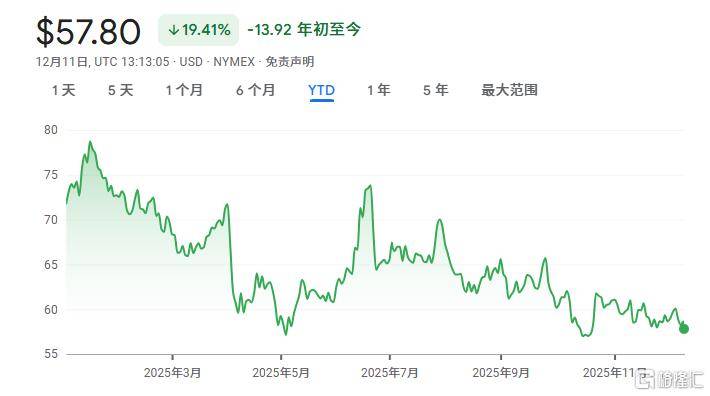
海外地缘政治扰动,原油市场震荡下跌。 截至发稿,WTI原油日内跌幅达2.00%,现报57.38美元/桶。 今年以来,WTI原油价格累计下跌约19%,为2020年以来表现最差的一年。 特朗普周三表示,美国在委内瑞拉海岸附近扣押了一艘受制裁的油轮。 此举不仅加剧了美国与委内瑞拉之间的紧张局势,也导致了油价小幅上涨。 据悉,特朗普一直在向委内瑞拉总统马杜罗施压,要求其下台;另外,他还多次提出美国军事干预委内 瑞拉的可能性。 对此,委内瑞拉政府谴责美国的扣押行动,称其为"公然盗窃"和"国际海盗行为"。 总统马杜罗声称,美国的军事集结旨在推翻他,并控制欧佩克国家的石油资源。 市场则担忧,两国之间不断升级的紧张局势,可能会造成石油供应中断。 市场焦点转向俄乌和平谈判 稍早前,美联储如期降息25个基点、美委地缘政治紧张,国际原油短暂温和反弹。 油价市场分歧 据美国能源信息署(EIA)数据显示,上周原油库存降幅低于市场预期,同时美国产量继续保持增长。 市场聚焦供给结构性过剩压力,或主导油价维持反复震荡行情。 不过LSEG石油分析师表示,到目前为止,此次扣押行动尚未波及市场;但如果事态进一步升级,将导 致原油价格剧烈波动。 眼 ...

光大期货能化商品日报-20251211
Guang Da Qi Huo· 2025-12-11 04:30
1. Report Industry Investment Rating No relevant content provided. 2. Core Viewpoints of the Report - The current decline in the oil market is only supported by geopolitical factors, and it is expected to fluctuate repeatedly, with oil prices continuing to move in a volatile manner [1][3]. - The Asian low - sulfur fuel oil market structure is under continuous pressure, and the high - sulfur fuel oil market is also facing pressure. It is expected that the current supply - driven market fundamentals may continue until January next year. The absolute prices of FU and LU are expected to remain in a low - level oscillation for the time being [3]. - The winter storage price of asphalt is likely to fall to a relatively low level in the past five years, and the short - term view of the disk is low - level oscillation [3][5]. - The price of PX is expected to be under pressure at the end of the year. The price of TA is expected to follow the cost and be under pressure, and the price center will decline. The price of ethylene glycol is under pressure, and the premium of the 05 contract over the 01 contract has widened [5]. - The rubber futures price has a small rebound due to the improvement of overseas production area weather, border conflicts affecting tapping work, and the rebound of raw material prices, but the demand support is limited [6]. - The methanol price has an upper limit, and it is expected to maintain a bottom - level oscillation [6]. - The polyolefin market will gradually shift from strong supply to weak demand, but as the valuation decreases, it is expected to tend to bottom - level oscillation [8]. - The PVC price is driven by a bearish fundamental situation, but as the basis has been repaired, it is expected to tend to bottom - level oscillation [8]. 3. Summary According to Relevant Catalogs 3.1 Research Views - **Crude Oil**: On Wednesday, the oil price showed a V - shape during the session. The WTI January contract closed up $0.21 to $58.46 per barrel, a gain of 0.36%. The Brent February contract closed up $0.27 to $62.21 per barrel, a gain of 0.44%. SC2601 closed at 440.5 yuan per barrel, down 3.8 yuan per barrel, a decline of 0.86%. The EIA inventory report showed that due to strong refining activities, last week, U.S. crude oil inventories decreased, while gasoline and distillate inventories increased. As of the week ending December 5, U.S. crude oil inventories decreased by 1.812 million barrels to 425.69 million barrels, with an expected decrease of 2.3 million barrels. The crude oil inventory at the Cushing delivery center in Oklahoma increased by 308,000 barrels to 21.6 million barrels. U.S. net crude oil imports increased by 212,000 barrels per day to 2.58 million barrels per day. Kazakhstan's early - December oil production decline slowed down. The situation in Ukraine and the U.S. seizure of a Venezuelan oil tanker may affect the oil market [1]. - **Fuel Oil**: On Wednesday, the main contract of fuel oil on the Shanghai Futures Exchange, FU2601, closed down 0.65% at 2,427 yuan per ton; the main contract of low - sulfur fuel oil, LU2602, closed down 0.17% at 3,009 yuan per ton. The Asian low - sulfur fuel oil market structure is under continuous pressure, and the high - sulfur fuel oil market is also facing pressure. It is expected that the current supply - driven market fundamentals may continue until January next year [3]. - **Asphalt**: On Wednesday, the main contract of asphalt on the Shanghai Futures Exchange, BU2602, closed down 0.24% at 2,940 yuan per ton. The social inventory rate this week was 23.86%, a month - on - month decrease of 0.56%; the total inventory level of domestic refinery asphalt was 27.21%, a month - on - month increase of 0.21%; the operating rate of domestic asphalt plants was 33.12%, a month - on - month decrease of 1.28%. It is estimated that the winter storage price of asphalt this year will probably fall to a relatively low level in the past five years, and the predicted winter storage price is between 2,800 - 2,900 yuan per ton [3]. - **Polyester**: TA601 closed at 4,616 yuan per ton yesterday, down 0.6%; the spot offer was at a discount of 20 yuan per ton to the 01 contract. EG2601 closed at 3,682 yuan per ton yesterday, down 0.24%, and the basis increased by 10 yuan per ton to - 13 yuan per ton, with the spot price at 3,668 yuan per ton. The PX futures main contract 601 closed at 6,746 yuan per ton, down 0.5%. The spot negotiation price was $832 per ton, equivalent to 6,785 yuan per ton in RMB, and the basis widened by 27 yuan per ton to 19 yuan per ton. The sales of polyester yarn in Jiangsu and Zhejiang were differentiated, with an average sales estimate of 60% - 70%. The restart time of a 1 - million - ton - per - year MEG plant in East China has been postponed for several months. A 550,000 - ton PTA plant in Taiwan, China has been shut down for maintenance recently and is expected to restart at the end of December. A 300,000 - ton polyester filament and a 250,000 - ton staple fiber plant in Xiaoshan have been shut down for maintenance recently [5]. - **Rubber**: On Wednesday, the main contract of Shanghai rubber, RU2605, rose 230 yuan per ton to 15,215 yuan per ton; the main contract of NR rose 190 yuan per ton to 12,270 yuan per ton; the main contract of butadiene rubber, BR, rose 155 yuan per ton to 10,605 yuan per ton. Due to the situation on the Thai - Cambodian border, it is expected that the daily production of rubber dry glue will decrease by 487,000 kilograms [6]. - **Methanol**: On Wednesday, the spot price in Taicang was 2,078 yuan per ton, the price in northern Inner Mongolia was 1,980 yuan per ton, the CFR China price was between $241 - 245 per ton, and the CFR Southeast Asia price was between $315 - 320 per ton. Iranian plant shutdowns will lead to a decline in arrivals from mid - December to January. The port inventory is expected to enter the destocking stage from mid - December this year to early January next year, but due to the slow unloading rhythm, the time for significant destocking may be postponed. Considering that the price of downstream polyolefins is difficult to rise significantly, the methanol price has an upper limit and is expected to maintain a bottom - level oscillation [6]. - **Polyolefins**: On Wednesday, the mainstream price of East China drawn wire was between 6,150 - 6,400 yuan per ton. The production profit of oil - based PP was - 586.43 yuan per ton, the production profit of coal - based PP was - 604.53 yuan per ton, the production profit of methanol - based PP was - 1,168 yuan per ton, the production profit of propane - dehydrogenated PP was - 1,474.42 yuan per ton; the production profit of externally - purchased propylene - based PP was - 519.93 yuan per ton. In terms of PE, the price of HDPE film was 7,881 yuan per ton, the price of LDPE film was 8,614 yuan per ton, and the price of LLDPE film was 6,833 yuan per ton. The supply will remain at a high level, and the downstream orders and operating rates will gradually weaken. It is expected that polyolefins will tend to bottom - level oscillation [8]. - **Polyvinyl Chloride (PVC)**: On Wednesday, the market price of PVC in East China decreased. The price of calcium - carbide - based type 5 material was between 4,300 - 4,420 yuan per ton, and the mainstream reference price of ethylene - based material was around 4,400 - 4,600 yuan per ton; the market price of PVC in North China was weakly adjusted, with the mainstream reference price of calcium - carbide - based type 5 material around 4,220 - 4,380 yuan per ton, and the mainstream reference price of ethylene - based material around 4,600 - 4,700 yuan per ton; the market price of PVC in South China decreased, with the mainstream reference price of calcium - carbide - based type 5 material around 4,340 - 4,480 yuan per ton, and the mainstream offer of ethylene - based material between 4,460 - 4,650 yuan per ton. Some plants are planned to reduce their loads this week, and the production is expected to decrease slightly. The domestic real estate construction will gradually slow down, and the operating rates of subsequent pipes and profiles will also gradually decline. The PVC price is expected to tend to bottom - level oscillation [8]. 3.2 Daily Data Monitoring - The report provides the spot price, futures price, basis, basis rate, and other data of various energy - chemical products on December 10 and 9, as well as the price changes and basis rate changes of these products [9]. 3.3 Market News - The EIA inventory report shows that due to strong refining activities, last week, U.S. crude oil inventories decreased, while gasoline and distillate inventories increased. As of the week ending December 5, U.S. crude oil inventories decreased by 1.812 million barrels to 425.69 million barrels, with an expected decrease of 2.3 million barrels. The crude oil inventory at the Cushing delivery center in Oklahoma increased by 308,000 barrels to 21.6 million barrels. U.S. net crude oil imports increased by 212,000 barrels per day to 2.58 million barrels per day [11]. - U.S. President Trump confirmed that the U.S. seized an oil tanker near Venezuela. Earlier, two U.S. officials revealed that the U.S. seized an oil tanker off the coast of Venezuela, and the operation was led by the U.S. Coast Guard [11]. 3.4 Chart Analysis - **4.1 Main Contract Prices**: The report presents the closing price charts of the main contracts of various energy - chemical products from 2021 to 2025, including crude oil, fuel oil, low - sulfur fuel oil, asphalt, LPG, PTA, ethylene glycol, short - fiber, LLDPE, polypropylene, PVC, methanol, styrene, 20 - number rubber, natural rubber, synthetic rubber, European - line container shipping, and p - xylene [13][14][15][16][18][19][21][23][24][25][27][28]. - **4.2 Main Contract Basis**: The report shows the basis charts of the main contracts of various energy - chemical products from 2021 to 2025, including crude oil, fuel oil, low - sulfur fuel oil, asphalt, ethylene glycol, PP, LLDPE, natural rubber, 20 - number rubber, p - xylene, synthetic rubber, and bottle chips [30][33][34][35][36][37][38][39]. - **4.3 Inter - period Contract Spreads**: The report provides the spread charts of various energy - chemical product contracts, including fuel oil, asphalt, European - line container shipping index, PTA, ethylene glycol, PP, LLDPE, and natural rubber [41][42][43][44][47][48][50][51][52][53][54][55][56][57]. - **4.4 Inter - variety Spreads**: The report shows the spread and ratio charts of various energy - chemical products, including crude oil internal and external markets, crude oil B - W spread, fuel oil high - low sulfur spread, fuel oil/asphalt ratio, BU/SC ratio, ethylene glycol - PTA spread, PP - LLDPE spread, and natural rubber - 20 - number rubber spread [58][59][60][61][62][64][66][70]. - **4.5 Production Profits**: The report presents the production profit charts of LLDPE and PP [67][68]. 3.5 Team Member Introduction - **Zhong Meiyan**: Assistant to the director of the research institute and director of the energy - chemical department, with a master's degree from Shanghai University of Finance and Economics. She has won the "Outstanding Analyst" award from the Shanghai International Energy Exchange in 2019, 2021, 2022, and 2023. Her team has won the Excellent Industrial Service Team Award from the Shanghai International Energy Exchange in 2021 and 2022, and the Best Industrial Product Analyst Award from the Futures Daily in 2023 and 2024 [72]. - **Du Bingqin**: Analyst for crude oil, natural gas, fuel oil, asphalt, and shipping. She has a master's degree in applied economics from the University of Wisconsin - Madison and a bachelor's degree in finance from Shandong University. She has won the Outstanding Energy - Chemical Analyst Award from the Shanghai Futures Exchange in 2022 and 2023, and the Best Industrial Product Analyst title from the Futures Daily in 2022, 2023, and 2024 [73]. - **Di Yilin**: Analyst for natural rubber and polyester. She has a master's degree in finance. She has won the "New - Star Analyst" award from the Shanghai Futures Exchange in 2023, the Excellent Author award from the "China Mold Information" magazine in 2023, and the "Best Industrial Product Futures Analyst" title from the Futures Daily in 2024 [74]. - **Peng Haibo**: Analyst for methanol, propylene, pure benzene, PE, PP, and PVC. He has a master's degree in engineering and is an intermediate economist. He has won the Excellent Author award from the "China Mold Information" magazine in 2024 [75].
欧洲股市微跌,投资者观望美联储会议,市场预期降息概率达85%
Jin Rong Jie· 2025-12-09 01:09
欧洲股市在周一出现微幅下跌,主要股指表现平淡。斯托克600指数收盘下跌0.2%,投资者对即将召开 的美联储政策会议保持谨慎观望态度。 市场普遍预期美联储将在本周的货币政策会议上宣布降息25个基点。据芝商所美联储观察工具显示,交 易员目前定价12月降息的概率约为85%。这一预期为全球金融市场带来不确定性,促使投资者在重要决 议前采取观望策略。 科技股和金融股成为欧洲股市的主要拖累因素。与此同时,旅游与休闲板块以及矿业板块表现相对较 好。个股方面,诺和诺德股价下跌5.8%,此前该公司宣布其口服版药物在阿尔茨海默病研究中未能达 到预期效果。 货币市场方面,美元在美联储会议前走低,欧元需求有所上升。投资者正在为本周多家全球央行的关键 决策做准备,其中美联储会议被视为最重要的事件。 金融监管政策的调整为市场带来新的流动性预期。相关部门下调了保险资金投资股票的风险因子,这释 放出增量资金入市的积极信号。 展望后市,分析师认为美联储的政策决定将为全球货币政策定下基调。瑞士央行、英国央行、欧洲央行 和日本央行在12月下旬的政策路径可能受到美联储决议结果的影响。 声明:市场有风险,投资需谨慎。本文为AI基于第三方数据生成,仅供 ...
俄乌局势反复扰动,国际油价保持区间震荡 | 投研报告
Sou Hu Cai Jing· 2025-12-08 02:31
Group 1: Oil Price Overview - As of December 5, 2025, Brent and WTI oil prices were $63.75 and $60.08 per barrel respectively, reflecting a slight increase due to geopolitical factors [1][2] - The international oil prices experienced fluctuations, initially declining but later rising due to the lack of agreements in the US-Russia meeting and attacks on the Russian "Friendship" pipeline [1][2] Group 2: Oil Supply and Demand in the US - As of November 28, 2025, US crude oil production was 13.815 million barrels per day, showing a slight increase of 0.1 thousand barrels per day [3] - The number of active drilling rigs in the US increased by 6 to 413 as of December 5, 2025, indicating a potential rise in production capacity [3] - US refinery crude oil processing volume rose to 16.876 million barrels per day, with a utilization rate of 94.10%, up by 1.8 percentage points [3] Group 3: US Oil Inventory - As of November 28, 2025, total US crude oil inventory increased by 824 thousand barrels to 839 million barrels, with strategic and commercial inventories also rising [4] - Gasoline and diesel inventories saw increases of 2.15% and 1.83% respectively, indicating a growing supply in the market [4] Group 4: Biofuel Prices - As of December 5, 2025, the FOB price for ester-based biodiesel remained stable at $1,165 per ton, while hydrocarbon-based biodiesel was priced at $1,875 per ton [5] - The price of biojet fuel in China was $2,300 per ton, down by $100 from the previous week, reflecting market adjustments [5] Group 5: Related Companies - Key companies in the sector include China National Offshore Oil Corporation (CNOOC), China Petroleum & Chemical Corporation (Sinopec), and China National Petroleum Corporation (CNPC), among others [6]
原油周报:俄乌局势反复扰动,国际油价保持区间震荡-20251207
Xinda Securities· 2025-12-07 12:57
Investment Rating - The report maintains a "Positive" investment rating for the oil processing industry, consistent with the previous rating [1]. Core Insights - International oil prices experienced slight fluctuations due to geopolitical factors, with Brent and WTI prices reaching $63.75 and $60.08 per barrel, respectively, as of December 5, 2025 [2][9]. - The report highlights an increase in U.S. crude oil production to 13.815 million barrels per day, with active drilling rigs rising to 413 [40]. - The refining capacity utilization in the U.S. increased to 94.10%, indicating strong demand for crude oil processing [51]. - The report identifies key companies in the sector, including China National Offshore Oil Corporation (CNOOC), China Petroleum & Chemical Corporation (Sinopec), and China National Petroleum Corporation (PetroChina) [3]. Summary by Sections Oil Price Review - As of December 5, 2025, Brent crude futures settled at $63.75 per barrel, up $1.37 (+2.20%) from the previous week, while WTI crude futures rose to $60.08 per barrel, an increase of $1.53 (+2.61%) [26]. Offshore Drilling Services - The number of global offshore self-elevating drilling platforms increased to 368, with a net addition of 2 platforms, while floating drilling platforms rose to 130 [29]. Crude Oil Supply - U.S. crude oil production reached 13.815 million barrels per day, with a slight increase of 0.1 million barrels per day from the previous week [40]. Crude Oil Demand - U.S. refinery crude oil processing volume increased to 16.876 million barrels per day, with a utilization rate of 94.10% [51]. Crude Oil Inventory - As of November 28, 2025, total U.S. crude oil inventories stood at 839 million barrels, reflecting a weekly increase of 824,000 barrels (+0.10%) [60]. Refined Oil Prices - In the North American market, as of December 5, 2025, average prices for diesel, gasoline, and jet fuel were $97.93, $77.61, and $87.74 per barrel, respectively [82].






白银价格首次站上58美元/盎司,大幅跑赢黄金
Huan Qiu Wang· 2025-12-02 01:51
Core Insights - International precious metals futures experienced a general increase, with COMEX gold futures rising by 0.24% to $4265.00 per ounce and COMEX silver futures increasing by 2.25% to $58.45 per ounce [1] - Spot silver prices reached a historic high, surpassing $58 per ounce for the first time, peaking at $58.84, with a year-to-date increase exceeding 100%, significantly outperforming gold [1] - COMEX silver futures traded above $59 per ounce for the first time, while the Shanghai Futures Exchange's main silver contract hit a new high of 13766 yuan per kilogram [1] - A report indicated that silver prices surged due to supply shortages exacerbated by trading interruptions, with a previous trading day seeing a price increase of up to 6% [1] Market Analysis - Analysts suggest that rising expectations for a Federal Reserve interest rate cut are contributing to a decline in the dollar, while the EU's energy interconnectivity plan is boosting industrial demand [3] - Geopolitical factors are also supporting the precious metals market, with silver standing out due to its dual role as both a financial and industrial asset [3]
美联储降息预期下降,商品有何影响
2025-11-26 14:15
Summary of Key Points from Conference Call Records Industry Overview - **Federal Reserve's Interest Rate Expectations**: The divergence in expectations regarding the Federal Reserve's interest rate cuts in December has increased, with dovish officials citing a weak labor market as support for cuts, while hawkish officials express concerns over inflation rebound, leading to increased policy uncertainty [1][3][4][5] - **Domestic Macro Economy**: The LPR remained unchanged in November, indicating that the central bank believes there is still room for monetary policy, but the marginal efficiency is declining, making further easing unlikely this year [1][7][8] Commodity Market Insights - **Black Commodities**: There is a significant divergence in the performance of black commodities. Coal and coke prices have dropped sharply, with coking coal down 9% and coke over 4%. In contrast, iron ore has shown relative strength, increasing by approximately 1.2% [1][9][12] - **Iron Ore Market**: Iron ore has performed better than other commodities recently, but with increased shipments and port arrivals, supply-demand conflicts may intensify, leading to potential price volatility in the short term [1][12] - **Precious Metals**: The precious metals market remains weak, with the gold-silver ratio hovering around 81. Factors such as internal divisions within the Federal Reserve and geopolitical tensions have limited upward momentum for gold [1][15] - **Oil Market**: The oil market is under pressure from a mid-term supply surplus, with IEA predicting continued oversupply in global oil markets this year and next, leading to a bearish outlook for oil prices [1][20] Specific Commodity Analysis - **Coking Coal and Coke**: The coking coal market is facing increased supply due to domestic production recovery and rising imports from Mongolia. The coke market is also under pressure, with limited price increases expected [1][13][14] - **Steel Market**: The rebar and hot-rolled coil markets are experiencing narrow fluctuations, with recent data showing improvements in both supply and demand, although overall market sentiment remains cautious [1][10][11] - **Nonferrous Metals**: The nonferrous metals market is generally weak, with copper prices expected to remain volatile but high. The aluminum market faces seasonal inventory increases, limiting upward price potential [1][17] - **New Energy Materials**: The polysilicon and industrial silicon markets are weak, while lithium carbonate prices have risen unexpectedly due to improved fundamentals, although risks of price declines remain [1][18][19] Additional Insights - **Market Sentiment**: The overall market sentiment is cautious due to mixed economic data and geopolitical uncertainties, impacting various commodity prices and investor strategies [1][6][17] - **Future Expectations**: The outlook for many commodities remains uncertain, with potential for volatility driven by supply-demand dynamics and macroeconomic factors [1][20][21][25]