
大宗商品

Search documents
韧性筑基,提质绘新:银河基金2026年度策略会精华观点来了
Sou Hu Cai Jing· 2026-01-12 07:20
Macro Economy - In 2025, China's consumer market showed a moderate recovery, with a retail sales growth of 4.0% year-on-year from January to November, although there was a decline in consumption in categories like home appliances and automobiles in the second half due to subsidy reductions and real estate adjustments [1] - The "14th Five-Year Plan" emphasizes economic development and aims for per capita GDP to reach the level of moderately developed countries by 2035, while also focusing on local development and the integration of technological and industrial innovation [1] Real Estate and Trade - Since mid-2025, there has been downward pressure on real estate transaction volumes, with a 26.6% year-on-year decline in transaction area and a 24.65% drop in transaction units in 30 major cities as of October [2] - Despite challenges in the real estate sector, foreign trade has shown resilience, with a 5.4% year-on-year increase in goods exports from January to November, and net exports exceeding 1 trillion USD [2] Technology Sector - In 2025, AI applications achieved significant scale, with a reduction in the "hallucination rate" of a popular AI model from 14% to 2% by the end of the year, leading to a surge in consumer applications [3] - By the end of 2025, global investment in Chinese assets through ETFs reached 831 billion USD, with 95 billion USD flowing into the technology sector, highlighting its importance for foreign investment [3] Semiconductor and AI - The semiconductor, communication, and robotics sectors performed well in 2025, with respective index increases of 127.57%, 45.93%, and 26.33%, driven by rising AI capital expenditures in North America and breakthroughs in domestic supply chains [4] - The AI sector is expected to transition into a monetization phase in 2026, with advancements in semiconductor technology and a focus on cost-effectiveness in the AI industry chain [4] New Energy Sector - The new energy sector in 2025 focused on energy storage and AIDC electrical equipment, with solid-state battery pilot lines and structural optimization in the photovoltaic industry driving temporary price increases [4] - Expectations for 2026 include the solid-state battery reaching a production inflection point [4] Commodities Sector - The non-ferrous metals sector saw an overall increase of 88.50% in 2025, supported by factors such as the Federal Reserve's interest rate cuts and supply chain disruptions [5] - The relationship between AI, new energy, and commodities is highlighted, with predictions of significant shortages in copper and lithium by 2035 [5] Consumer Sector - The consumer sector showed notable improvement in 2025, with a focus on "emotional consumption" and "brand overseas expansion," particularly in domestic appliances and electric vehicles [6] - The consumption sector is characterized by a "hot first half and a quiet second half," with a focus on channel transformation and community-oriented products [6] Pharmaceutical Sector - The pharmaceutical industry is expected to experience structural differentiation and value reassessment in 2026, focusing on innovation, international expansion, and policy reforms [7] - Significant breakthroughs in AI applications in healthcare are anticipated, including AI-assisted diagnostics and clinical transformations [7]
A股策略周报20260111:趋势仍在,结构再平衡-20260111
SINOLINK SECURITIES· 2026-01-11 13:41
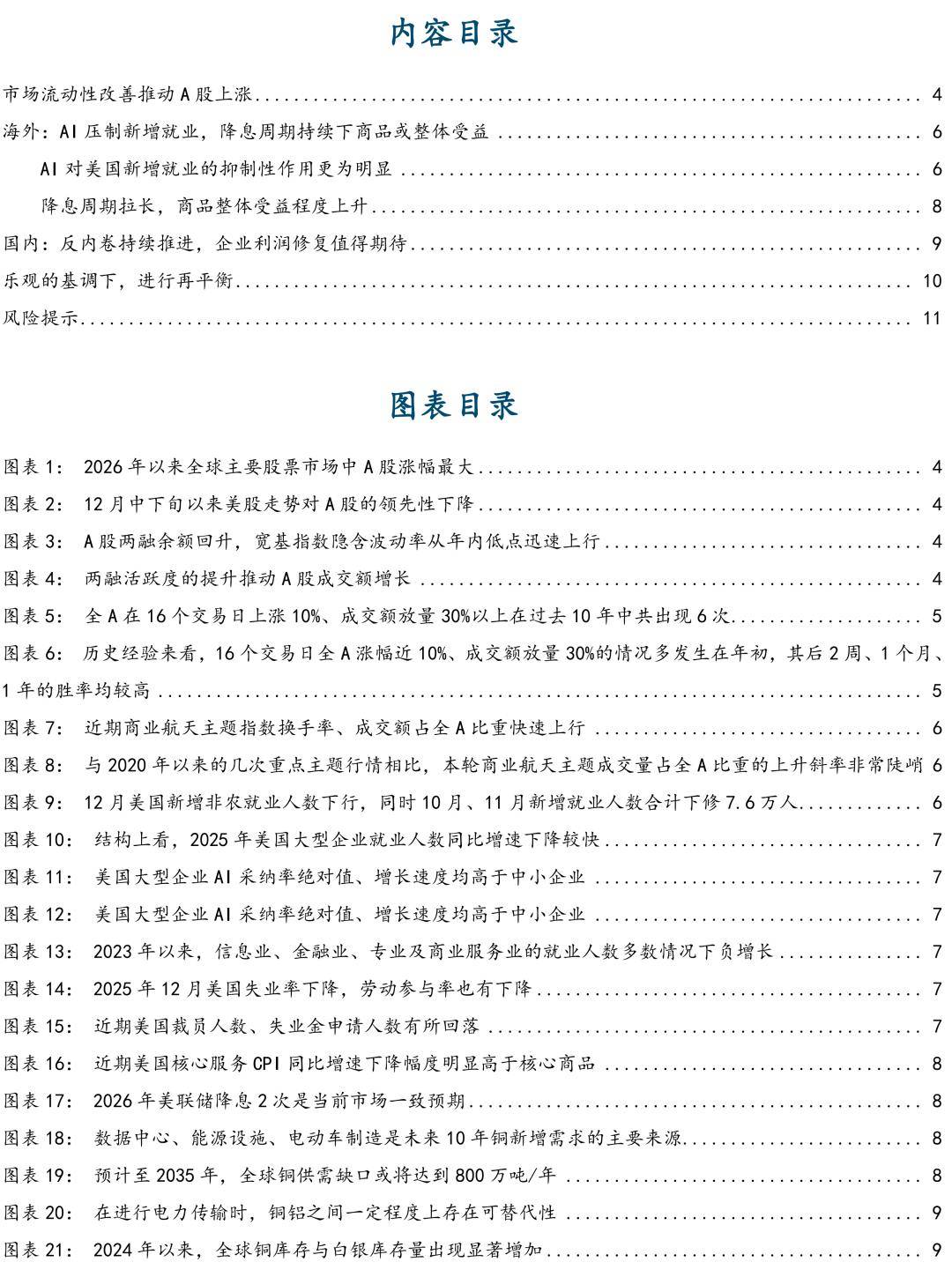
Group 1: Market Liquidity and A-Share Performance - The improvement in market liquidity has been a direct catalyst for the recent rise in A-shares, with margin trading balances increasing by over 125 billion yuan in just half a month, leading to a more than 35% increase in trading volume across the A-share market [3][13][22] - Historical data shows that similar situations, where the A-share market rose by nearly 10% over 16 trading days with trading volume expanding by over 30%, have occurred six times in the past decade, predominantly at the beginning of the year [3][18][22] - The recent surge in the commercial aerospace index has led to a significant increase in turnover rates and trading volume proportions, indicating a potential structural overheating in the market [3][22] Group 2: AI Impact on Employment and Economic Policy - The U.S. job market continues to face pressure, with December's non-farm payrolls adding only 50,000 jobs, below expectations, and a downward revision of 76,000 jobs for October and November [4][26][33] - The adoption of AI by large U.S. companies has significantly suppressed employment growth, particularly in the information, finance, and professional services sectors, which have collectively lost 344,000 jobs over the past three years [4][26][33] - The Federal Reserve's extended rate-cutting cycle is expected to benefit commodity markets, as inflation concerns related to AI investments are easing [4][40][41] Group 3: Domestic Economic Recovery and Policy Optimization - The Producer Price Index (PPI) for industrial enterprises in December showed a year-on-year increase, indicating a shift from price drag to price support for corporate revenues [5][56] - The Consumer Price Index (CPI) has also risen, with the core CPI maintaining its highest level in five years, reflecting a smoother transmission of prices from enterprises to consumers [5][56] - The ongoing anti-involution policies are expected to enhance corporate profitability, with regulatory measures aimed at preventing monopolistic practices and promoting fair competition [5][62] Group 4: Rebalancing and Investment Recommendations - The report suggests a positive outlook for A-shares, driven by improved liquidity and favorable domestic and international economic conditions [6][63] - Recommended investment areas include industrial resource products like copper, aluminum, and lithium, as well as sectors benefiting from the recovery of domestic manufacturing and consumer spending [6][63] - The report emphasizes the importance of capturing opportunities in sectors such as aviation, duty-free, and food and beverage, which are expected to benefit from increased consumer income and tourism recovery [6][63]
国金策略:趋势仍在,结构再平衡
Sou Hu Cai Jing· 2026-01-11 10:59
Group 1 - The recent improvement in market liquidity has driven the A-share market's rise, with historical patterns suggesting a strong performance in the upcoming period [1][5] - The A-share market has seen a significant increase in trading volume, with a 35% growth in total trading volume and a 10% rise in the overall A-share index over the past 16 trading days [2][14] - There is a notable structural overheating in the market, particularly in the commercial aerospace index, which has seen a sharp increase in turnover and trading volume [2][14] Group 2 - AI's negative impact on the U.S. employment market is becoming evident, with December's non-farm payrolls falling short of expectations and a downward revision of previous months' data [3][20] - The prolonged interest rate cut cycle by the Federal Reserve is expected to benefit commodity markets, as the demand for resources related to AI and new energy industries is increasing [3][33] - Geopolitical tensions are altering inventory behaviors among market participants, leading to increased stockpiling and a rise in copper and silver inventories [3][35] Group 3 - Domestic policies aimed at reducing "involution" are being implemented, with industrial prices showing signs of recovery, leading to improved corporate profitability [4][43] - The recent regulatory focus on the photovoltaic industry has raised concerns about the commitment to anti-involution policies, but the overall direction remains focused on improving corporate fundamentals [4][49] - The government is actively working on regulatory frameworks to support innovation while preventing monopolistic practices, which is expected to enhance corporate profitability in the long run [4][51] Group 4 - The report maintains an optimistic outlook for the A-share market, suggesting that the combination of improved liquidity, AI investments, and domestic policy support will lead to a favorable investment environment [5][52] - Recommended sectors include industrial resource products like copper, aluminum, and lithium, as well as equipment exports and consumer sectors benefiting from recovery trends [5][52]

鹏华固收+2026年投资展望:“固收+”投资机遇凸显,多风格特征产品矩阵适配多元配置需求
Jin Rong Jie· 2026-01-10 14:34
Core Viewpoint - The investment outlook for 2026 emphasizes structural opportunities in the market, particularly in the "fixed income +" sector, which is expected to face more opportunities than challenges under supportive policies [1][2]. Group 1: Macroeconomic Outlook - The core drivers of China's economic growth in 2026 are expected to be diverse, primarily supported by consumption growth and stable investment [2]. - Continued expansionary fiscal policies and moderate monetary policies are anticipated to reinforce economic stability and growth [2]. - Potential risks to the macroeconomic environment include external trade relations and pressures in the real estate market [2]. Group 2: Investment Opportunities in "Fixed Income +" - The "fixed income +" sector is viewed as having more opportunities than challenges, with a focus on differentiated investment strategies [3]. - Emphasis on equity assets (including convertible bonds) is expected to outperform traditional bonds, with strategies to enhance returns through market timing and asset selection [3]. - Key sectors for investment include finance, construction, materials, chemicals, and renewable energy, which are expected to offer good investment value in 2026 [3]. Group 3: Product Offerings and Strategies - The company has developed a comprehensive product line catering to various risk preferences, including low-risk and growth-oriented investment solutions [5][6]. - Specific products highlighted include low-volatility options like Penghua Fengze and Penghua Yongsheng, as well as mid-volatility products like Penghua Shuangzhai Baoli [5]. - The focus on quantitative strategies aims to balance equity and bond allocations dynamically, with products designed for long-term growth and stability [6]. Group 4: Market Dynamics and Professional Management - In a volatile market environment, "fixed income +" products are positioned as a quality choice for balancing risk and return [5]. - The professional management team is expected to leverage their expertise to navigate market fluctuations and optimize investment outcomes for clients [6]. - The commitment to continuous development in niche areas and enhanced product offerings is aimed at supporting investors in the evolving investment landscape of 2026 [6].
锡周报:供给小幅收缩叠加下游补库,锡价快速反弹-20260110
Wu Kuang Qi Huo· 2026-01-10 13:34
1. Report Industry Investment Rating - No relevant content provided. 2. Core Viewpoints of the Report - This week, tin prices rebounded significantly due to the recovery of risk appetite in commodities, the upward resonance of the non - ferrous sector, the weak supply of refined tin caused by the reduction of scrap in Jiangxi, and the replenishment of raw material inventory by downstream tin enterprises. The tin market supply and demand maintained a tight balance, and it is expected that tin prices will likely fluctuate at a high level in the short term [11][13]. 3. Summary According to Relevant Catalogs 3.1. Weekly Assessment and Strategy Recommendation - Cost side: In November 2025, the import of tin concentrates in China increased significantly, and the shortage of raw material supply was alleviated. The import volume of tin ore and concentrates was 15,099 tons, a month - on - month increase of 29.81% and a year - on - year increase of 24.42%. The imports from Myanmar and the Democratic Republic of the Congo showed different trends [12]. - Supply side: The operating rate of smelters in Yunnan remained high at 87.09% this week, with limited room for further improvement due to tight raw material supply. Jiangxi was affected by the shortage of scrap supply, with tight crude tin supply and low refined tin output [11][12]. - Demand side: Although the demand for consumer electronics entered the traditional off - season at the end of the year, the operating rate of tin solder enterprises remained stable supported by orders from emerging fields. Downstream enterprises adopted a low - inventory strategy, and spot procurement was mainly for rigid demand [11][12]. 3.2. Futures and Spot Market - No relevant content for summary other than the presentation of graphs about the basis of Shanghai tin main contract and LME tin premium (0 - 3). 3.3. Cost Side - The presentation of graphs about China's monthly tin ore production, tin ore imports, tin concentrate prices, and tin concentrate processing fees, but no specific data analysis and summary content provided. 3.4. Supply Side - The presentation of graphs about domestic refined tin monthly production, domestic recycled tin monthly production, tin production and operating rate in Yunnan and Jiangxi, refined tin export and import profits, domestic refined tin imports, and Indonesia's refined tin imports and exports, without specific data analysis and summary content. 3.5. Demand Side - China's semiconductor sales growth rate rebounded slightly, and global semiconductor sales maintained high growth. Graphs about the output of various downstream products such as computers, smartphones, home appliances, photovoltaic products, etc., and the operating rate of downstream solder enterprises and domestic tin apparent consumption were presented, but no specific data analysis and summary content provided [44]. 3.6. Supply - Demand Balance - The presentation of graphs about China's social inventory and LME inventory, without specific data analysis and summary content.
帮主郑重:原油铜金齐飞,市场在打什么算盘?
Sou Hu Cai Jing· 2026-01-10 05:01
Core Viewpoint - The recent rise in oil, copper, and gold prices reflects different underlying factors, with oil experiencing geopolitical tensions, copper driven by supply concerns and tariff fears, and gold acting as a safe haven amid economic uncertainty [3][4][5]. Oil Market - Oil prices have increased for three consecutive weeks, reaching around $59 per barrel, marking the longest streak since June of the previous year [3]. - The rise is influenced by geopolitical issues in Iran and Venezuela, but there are concerns about increasing global inventories and potential oversupply [3]. - Goldman Sachs indicates that client bearish sentiment towards oil is at a ten-year high, suggesting that the current price increase may not be sustainable [3]. Copper and Industrial Metals - Copper prices have surged, nearing $13,000 per ton, with many industrial metals experiencing a four-week price increase [4]. - The primary concern driving this surge is supply tightness and fears of potential U.S. tariffs, leading to increased shipments to the U.S. and creating a temporary "scarcity premium" [4]. - Analysts warn that price levels driven by policy expectations and stockpiling behaviors may reverse quickly if those expectations change [4]. Gold Market - Gold prices are also rising, driven by its appeal as a hedge against uncertainty and inflation [4]. - The mixed economic data from the U.S. suggests that the Federal Reserve may not take aggressive actions in January, maintaining a status quo that supports gold's safe-haven status [4]. - Unlike oil and copper, gold's price movements are less influenced by immediate supply-demand dynamics and more reflective of global monetary policy and market sentiment [4]. Investment Strategy - For cyclical commodities like oil and copper, investors are advised to avoid chasing prices amid mixed signals and to wait for clearer supply-demand indicators [5]. - Gold can serve as a stabilizing asset in investment portfolios to manage uncertainty, although expectations for short-term price surges should be tempered [5]. - The market's apparent excitement should not obscure the distinct narratives each commodity presents regarding economic conditions [5].

利好,多只,恢复大额申购
3 6 Ke· 2026-01-09 03:12
Core Viewpoint - The A-share market has rebounded to 4,000 points at the beginning of 2026, prompting several actively managed equity funds to reopen for large subscriptions, indicating a positive outlook for the market [1][2]. Fund Activity - Multiple fund companies, including Huaxia, China Europe, and Xinda Australia, have resumed large subscriptions for their actively managed equity funds, with notable performance among these funds [1][2]. - Huaxia Fund announced the removal of subscription limits for its Huaxia Large Cap Select Mixed Fund, which focuses on sectors like artificial intelligence and semiconductors, achieving a 19.19% annualized return, ranking first in its category [2]. - Xinda Australia Fund has also reopened large subscriptions for its Xinao Medical Health Mixed Fund, which has a one-year return of 69.09%, placing it in the top 10% of its category [2]. - New funds such as Guotai Haitong Zhaoyang Mixed Fund and Zhongyin Hong Kong Stock Connect Consumer Selected Mixed Fund have also opened for regular subscriptions shortly after their establishment [3]. Market Outlook - Analysts express optimism for the A-share market in 2026, driven by dual support from domestic and international liquidity, with a focus on sectors benefiting from rising commodity prices and emerging industries like AI [4][5]. - The market is expected to enter a phase of overall improvement and structural deepening, with global liquidity conditions and trends in AI as key drivers [4][5].
利好!多只,恢复大额申购
Zhong Guo Ji Jin Bao· 2026-01-08 15:02
Group 1 - The A-share market has returned to 4000 points at the beginning of 2026, reaching a nearly 10-year high, prompting several actively managed equity funds to reopen for large subscriptions [1][2] - Notable funds such as Huaxia, China Europe, and Xinda Australia have announced the resumption of large subscriptions, with Huaxia's fund achieving an annualized return of 19.19%, ranking first among its peers [2] - New funds like Guotai Haitong and Zhongyin Hong Kong Stock Connect have also opened for regular subscriptions shortly after their establishment, indicating a trend of increased investor interest [3] Group 2 - Analysts express optimism about the A-share market in 2026, citing dual support from domestic and international liquidity as a key driver for investment opportunities [4] - Investment opportunities are expected to arise from commodity price increases and emerging industries, particularly those related to artificial intelligence and specific materials for energy storage [4] - The overall investment environment is anticipated to improve, with a structural deepening of characteristics in the A-share market, driven by global liquidity and trends in AI [5]
PVC日报:震荡下行-20260108
Guan Tong Qi Huo· 2026-01-08 11:31
Report Summary - **Industry Investment Rating**: The report does not provide an investment rating for the PVC industry. Instead, it suggests a "wait - and - see" approach for PVC [1]. - **Core View**: The PVC market shows a trend of downward oscillation. Although the macro - environment is favorable, factors such as high inventory, weak downstream demand, and limited export demand put pressure on the PVC price. Therefore, it is recommended to wait and see [1]. Grouped by Report Sections 1.行情分析 (Market Analysis) - The upstream calcium carbide price in the northwest region is stable. The PVC operating rate increased by 1.40 percentage points to 78.63%, while the downstream operating rate decreased by 0.58 percentage points due to poor orders [1]. - Last week, export orders decreased slightly. The prices in the Indian market are low, and the demand is limited. The CFR India and CFR Southeast Asia prices dropped by 20 USD/ton and 30 USD/ton respectively [1]. - Social inventory continued to rise and remains high. The real estate market is still in the adjustment stage, with significant year - on - year declines in investment, new construction, construction, and completion areas from January to November 2025 [1]. - The weekly transaction area of commercial housing in 30 large - and medium - sized cities rebounded but is still at the lowest level in the same period in recent years. New production capacity, such as the 300,000 - ton/year Jiaxing Jiahua, has recently started trial production [1]. - The macro - environment is favorable, but the comprehensive gross margin of chlor - alkali is under pressure, and the output decline is currently limited, with high futures warehouse receipts [1]. 2.期现行情 (Futures and Spot Market) - The PVC2605 contract decreased by 0.99% to close at 4905 yuan/ton, with an increase of 4075 lots in open interest to 1,036,668 lots. The price fluctuated between 4871 yuan/ton and 4992 yuan/ton and was above the 20 - day moving average [2]. - The mainstream price of calcium - carbide - based PVC in East China dropped to 4650 yuan/ton on January 8. The basis of V2605 was - 255 yuan/ton, strengthening by 47 yuan/ton and remaining at a relatively low level [3]. 3.基本面跟踪 (Fundamental Analysis) - On the supply side, some devices such as Jiangsu Xinpu and Ningbo Hanwha resumed production. The PVC operating rate increased by 1.40 percentage points to 78.63%, at a neutral level in the same period in recent years [4]. - New production capacity, including Wanhua Chemical (500,000 tons/year), Tianjin Bohua (400,000 tons/year), Qingdao Gulf (200,000 tons/year), and Gansu Yaowang (300,000 tons/year), was put into operation in the second half of the year. Jiaxing Jiahua (300,000 tons/year) started trial production in December [4]. - On the demand side, the real estate market is still in adjustment. From January to November 2025, national real estate development investment was 785.91 billion yuan, a year - on - year decrease of 15.9%. Various indicators such as sales area, new construction area, and completion area all declined year - on - year [5]. - As of the week of January 4, the transaction area of commercial housing in 30 large - and medium - sized cities decreased by 26.09% week - on - week, at a relatively low level in the same period in recent years [5]. - As of the week of December 31, PVC social inventory increased by 1.45% week - on - week to 1.0766 million tons, 36.24% higher than the same period last year, remaining at a high level [6].
PVC日报:震荡上行-20260107
Guan Tong Qi Huo· 2026-01-07 11:28
Report Industry Investment Rating - The report suggests to take a wait - and - see approach towards PVC [1] Core Viewpoints - The upstream calcium carbide price in the northwest region is stable. The supply - side PVC operating rate has increased, while the downstream operating rate has decreased. The export orders have slightly decreased, and the social inventory continues to rise. The real estate is still in the adjustment phase, and although the macro - atmosphere is warm, the PVC market has inventory pressure and limited demand in the traditional off - season, so it is recommended to wait and see [1] Summary by Relevant Catalogs Market Analysis - The calcium carbide price in the northwest is stable. The PVC operating rate has increased by 1.40 percentage points to 78.63%, being at a neutral level in recent years. The downstream operating rate has decreased by 0.58 percentage points, and the export orders decreased last week. The Indian market price is low with limited demand. The social inventory continues to increase and is still high. The real estate from January to November 2025 is in adjustment, and the 30 - city commercial housing weekly trading area has rebounded but is still at a low level. New production capacity includes the trial production of 300,000 tons/year of Jiaxing Jiahua. The macro - atmosphere is warm, but the chlor - alkali comprehensive gross profit is under pressure. January is the traditional off - season for PVC in China [1] Futures and Spot Market - The PVC2605 contract increased in positions and fluctuated upwards, with a minimum price of 4,913 yuan/ton, a maximum price of 5,006 yuan/ton, and a closing price of 4,972 yuan/ton, up 2.01%. The position increased by 6,395 lots to 1,032,593 lots [2] Basis - On January 7, the mainstream price of calcium carbide - based PVC in East China rose to 4,670 yuan/ton, and the V2605 contract futures closing price was 4,972 yuan/ton. The current basis is - 302 yuan/ton, strengthening by 37 yuan/ton and at a low level [3] Fundamental Tracking - On the supply side, plants such as Jiangsu Xinpu and Ningbo Hanwha resumed production, and the PVC operating rate increased by 1.40 percentage points to 78.63%. New production capacity includes 500,000 tons/year of Wanhua Chemical, 400,000 tons/year of Tianjin Bohua, 200,000 tons/year of Qingdao Gulf, 300,000 tons/year of Gansu Yaowang put into production in the second half of the year, and 300,000 tons/year of Jiaxing Jiahua in trial production in December [4] - On the demand side, the real estate is in adjustment. From January to November 2025, the national real estate development investment was 785.91 billion yuan, a year - on - year decrease of 15.9%. The commercial housing sales area was 787.02 million square meters, a decrease of 7.8%. The commercial housing sales volume was 751.3 billion yuan, a decrease of 11.1%. The new housing start - up area was 534.57 million square meters, a decrease of 20.5%. The housing construction area was 6.56066 billion square meters, a decrease of 9.6%. The housing completion area was 394.54 million square meters, a decrease of 18.0%. As of the week of January 4, the 30 - city commercial housing trading area decreased by 26.09% week - on - week and was at a low level in recent years [5] - In terms of inventory, as of the week of December 31, the PVC social inventory increased by 1.45% week - on - week to 1.0766 million tons, 36.24% higher than the same period last year, and the inventory is still high [6]