
适度宽松货币政策

Search documents
存款再搬家!1月,居民存款少增超过3万亿元
Sou Hu Cai Jing· 2026-02-15 02:50
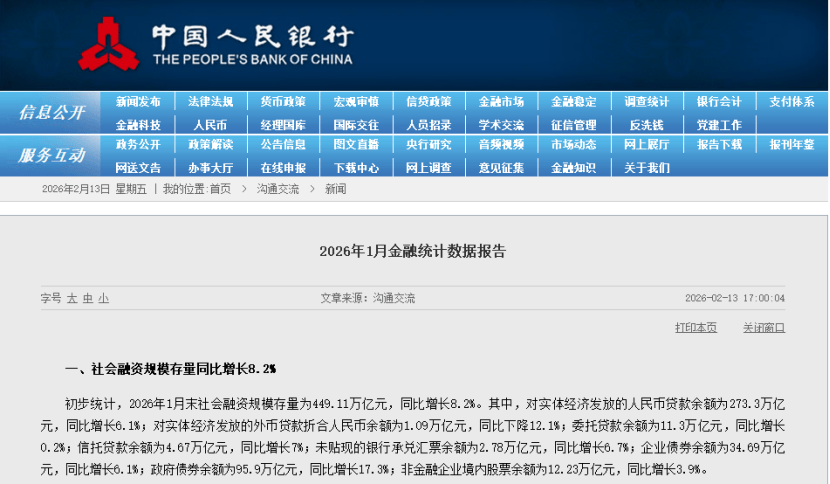
Group 1 - The central bank reported that as of the end of January 2026, the total social financing stock was 449.11 trillion yuan, reflecting a year-on-year growth of 8.2%, indicating support for stable growth in the real economy [5][6] - The broad money supply (M2) increased by 9.0% year-on-year, significantly outpacing the nominal GDP growth rate, which suggests a moderately loose monetary policy is in place to support economic stability [5][6] - In January 2026, new loans in renminbi amounted to 4.71 trillion yuan, a decrease of 420 billion yuan year-on-year, with residential loans contributing 456.5 billion yuan, showing an increase in both short-term and medium-to-long-term loans [5][6] Group 2 - In January 2026, residential deposits decreased by 3.39 trillion yuan year-on-year, while non-bank financial institutions saw an increase of 2.56 trillion yuan in deposits, indicating a shift in deposit allocation among residents [6][7] - The discussion around the maturity of over 50 trillion yuan in fixed deposits has led to a trend of "deposit migration," where residents are reallocating their savings towards higher-yielding assets [6][7] - Analysts suggest that the ongoing low growth rate of residential deposits compared to M2 indicates a potential shift of funds towards enterprises, government, or non-bank financial sectors, with implications for capital market dynamics [6][7]

透过1月金融数据看年初经济平稳开局 适度宽松货币政策发力见效
Yang Shi Wang· 2026-02-14 02:15
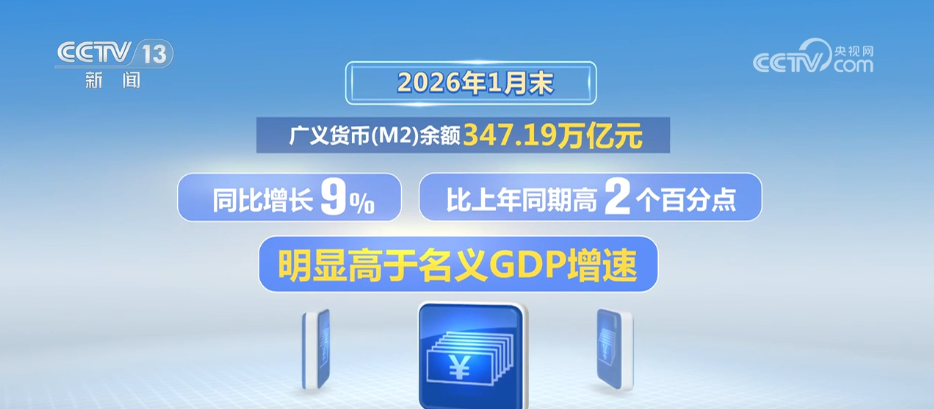
Core Viewpoint - The People's Bank of China reported a rapid growth in social financing scale and broad money supply (M2) as of the end of January, indicating a supportive monetary environment for economic recovery [3][4]. Monetary Supply and Financing - As of January 2026, the balance of broad money (M2) reached 347.19 trillion yuan, with a year-on-year growth of 9%, which is 2 percentage points higher than the same period last year, significantly exceeding the nominal GDP growth rate [3]. - The total social financing stock was 449.11 trillion yuan, growing by 8.2% year-on-year, which is 0.2 percentage points higher than the previous year [3]. Credit Growth - In January, new RMB loans increased by 4.71 trillion yuan, reflecting stable growth in total credit [5]. - The balance of RMB loans reached 276.62 trillion yuan, with a year-on-year growth of 6.1%, surpassing the nominal economic growth rate [7]. - Corporate loans increased by 4.45 trillion yuan, with medium- and long-term loans accounting for over 70%, providing substantial support for key sectors like manufacturing and emerging industries [7]. Personal Loans - Personal loans experienced stable growth, driven by pre-festival consumption activities, with diverse consumer demands being released [9]. - The extension of personal consumption loan interest subsidy policies until the end of 2026 is expected to enhance residents' consumption willingness, further supporting personal loan growth [9]. Financing Costs - The average interest rate for newly issued corporate loans in January was approximately 3.2%, about 20 basis points lower than the same period last year, while the average interest rate for new personal housing loans was 3.1%, remaining stable year-on-year [9]. - The low financing costs reflect a relatively abundant credit supply and the effectiveness of financial institutions in benefiting the real economy, which helps reduce the burden on enterprises and stimulate market vitality [9]. Foreign Exchange Market - In January, banks settled 20.048 billion yuan and sold 14.457 billion yuan in foreign exchange, indicating a stable operation of the foreign exchange market despite increased volatility in international financial markets [10]. - The net inflow of cross-border funds from non-bank sectors decreased by 20% compared to the previous month, influenced by seasonal factors [12].
M2余额增速达9%创近两年新高
Shang Hai Zheng Quan Bao· 2026-02-13 17:04
Core Viewpoint - The article highlights the significant recovery in credit demand and the positive impact of monetary policy on credit supply, indicating a favorable environment for investment and economic growth. Group 1: Credit Supply and Demand - Credit supply has shown stable growth, driven by a notable recovery in demand, with major projects being launched early in the year, leading to increased project loans [2] - In January, corporate loans increased by 4.45 trillion yuan, with medium to long-term loans rising by 3.18 trillion yuan, providing strong financial support for key sectors like manufacturing and emerging industries [2] - The release of consumer demand before the Spring Festival has also supported steady growth in personal loans, with various consumption needs driving this increase [2] Group 2: Financing Costs and Loan Structure - The average interest rate for newly issued corporate loans was approximately 3.2% in January, down about 20 basis points from the previous year, while personal housing loans remained stable at 3.1% [3] - The sustained low financing costs reflect the effectiveness of the moderately loose monetary policy, helping to reduce the financial burden on enterprises and stimulate their operational vitality [3] - The structure of credit is continuously optimizing, with financial resources increasingly directed towards high-quality development areas, as evidenced by the growth rates of inclusive small and micro loans and medium to long-term loans in the service sector [3][4] Group 3: Financial Support for Economic Transition - The shift in credit resources from traditional sectors to emerging fields is a natural result of economic structural transformation and an essential reflection of improved financial support for the real economy [4] - Financial institutions are increasingly motivated to optimize the structure of capital supply through market-driven incentives, enhancing their service capabilities [4]
1月末社会融资规模存量同比增长8.2% 金融有力支持年初经济平稳开局
Zheng Quan Ri Bao· 2026-02-13 15:29
Core Viewpoint - The People's Bank of China reported that as of the end of January 2026, the social financing scale and M2 growth rates indicate a moderately loose monetary policy, supporting a stable economic start to the year [1][2]. Group 1: Social Financing and Monetary Supply - As of January 2026, the social financing scale reached 449.11 trillion yuan, with a year-on-year growth of 8.2% [2]. - The M2 balance was 347.19 trillion yuan, reflecting a year-on-year increase of 9% [3]. - The increase in social financing and M2 is significantly higher than the nominal GDP growth rate, indicating effective monetary policy [1][2]. Group 2: Government and Corporate Financing - In January, government bond financing amounted to 976.4 billion yuan, an increase of 283.1 billion yuan compared to the previous year, representing 13.5% of the total social financing scale, the highest level since 2021 [2]. - Companies are increasingly utilizing a combination of loans and bonds for financing, indicating a shift towards diversified funding sources [3]. - The corporate loan balance increased by 4.45 trillion yuan in January, with over 70% of these being medium to long-term loans, supporting key sectors like manufacturing and emerging industries [4]. Group 3: Consumer Loans and Economic Activity - Personal loans showed stable growth due to increased consumer activity ahead of the Spring Festival, driven by diverse spending needs [5]. - The Ministry of Finance has extended the personal consumption loan interest subsidy policy until the end of 2026, enhancing consumer willingness to borrow [6]. - The overall demand side is showing signs of recovery, supported by favorable conditions for credit growth [4][6].
金融时报:贷款作为单一渠道的解释力度逐渐下降,宜更多关注社会融资规模和货币供应量指标
Xin Lang Cai Jing· 2026-02-13 10:05
Core Viewpoint - The article emphasizes that the ongoing moderate easing monetary policy and proactive government debt issuance are significant factors influencing financial support for the real economy in January [1] Group 1 - Industry experts suggest that relying solely on loans as a financial support channel is increasingly inadequate to reflect the overall financial backing for the real economy [1] - There is a growing need to focus on broader indicators such as social financing scale and money supply to better understand the total financial support for the real economy [1] - Various financing methods are becoming more interchangeable, leading to a diminishing explanatory power of loans as a single channel [1]
中国人民银行传递保持流动性充裕积极信号 2月份买断式逆回购净投放环比增加3000亿元
Zheng Quan Ri Bao· 2026-02-12 16:16
Group 1 - The People's Bank of China (PBOC) announced a reverse repurchase operation of 1 trillion yuan with a six-month term to maintain ample liquidity in the banking system, resulting in a net injection of 500 billion yuan after accounting for maturing operations [1] - In February, the net injection from reverse repos is expected to reach 600 billion yuan, an increase of 300 billion yuan compared to January, indicating a proactive approach to liquidity management [1] - Analysts suggest that the PBOC's actions signal a commitment to maintaining liquidity and stabilizing the financial market, especially during a month with increased credit demand and cash withdrawals due to the upcoming Spring Festival [1] Group 2 - The PBOC is expected to continue using both reverse repos and Medium-term Lending Facility (MLF) tools to inject liquidity, reflecting a sustained "moderately accommodative" monetary policy stance [2] - The PBOC's recent report emphasizes the importance of analyzing liquidity supply and demand, indicating a strategic approach to using various monetary policy tools to ensure liquidity remains ample [2] - Analysts believe that the urgency for a reserve requirement ratio (RRR) cut has decreased in the short term due to the large liquidity injections [2] Group 3 - The PBOC is focusing on improving the efficiency of existing policies rather than simply increasing them, suggesting a cautious approach to monetary policy adjustments [3] - While the possibility of an RRR cut remains, it is viewed as an important tool in the PBOC's policy arsenal, with potential for a more significant cut than the 0.5 percentage point reduction seen in 2025 [3] - The current average reserve requirement ratio stands at 6.3%, indicating room for future adjustments if necessary [3]
加量5000亿元 中国央行将开展1万亿元买断式逆回购操作
Zhong Guo Xin Wen Wang· 2026-02-12 12:38
Core Viewpoint - The People's Bank of China (PBOC) announced a 1 trillion yuan reverse repo operation to inject medium-term liquidity into the banking system, reflecting a continuation of a moderately accommodative monetary policy stance [1] Group 1: Monetary Policy Actions - The PBOC will conduct a 1 trillion yuan reverse repo operation on February 13, with a term of 6 months (182 days) [1] - This operation is an increase of 500 billion yuan compared to the 500 billion yuan of 6-month reverse repos maturing in February [1] - The action aims to stabilize the liquidity in the banking system and support government bond issuance and financial institutions' credit lending [1] Group 2: Economic Implications - The move signals a sustained effort to maintain ample liquidity in the market, aligning with the PBOC's monetary policy framework for 2026 [1] - It indicates the continued use of quantity-based policy tools to support economic stability [1]
适度宽松的货币政策效果逐步显现
Mei Ri Jing Ji Xin Wen· 2026-02-12 10:57
Group 1 - The central bank's monetary policy report indicates that the effects of moderately loose monetary policy in 2025 are gradually becoming evident, with social financing scale and broad money supply (M2) growing by 8.3% and 8.5% year-on-year, respectively, significantly outpacing nominal GDP growth [1] - The report highlights a strong credit support, with the growth rate of RMB loans around 7% after adjusting for local government debt impacts, and the interest rates for new corporate and personal housing loans remaining around 3.1% [1] - Key areas of loan growth include technology loans (up 11.5%), green loans (up 20.2%), and loans for the elderly care industry (up 50.5%), indicating a continuous optimization of credit structure [1] Group 2 - Direct financing has accelerated, with significant increases in government bonds, corporate bonds, and non-financial corporate domestic stock financing, particularly through the newly launched "Technology Board" for bond issuance, which exceeded 1.5 trillion yuan [2] - The shift in economic structure from traditional investment-driven growth to technology innovation and consumption-driven growth is emphasized, with direct financing models becoming more aligned with high-growth sectors [2] - The report states that the national economy maintained a steady growth trend in 2025, with GDP increasing by 5% year-on-year, achieving major development goals [2] Group 3 - The report notes that the Consumer Price Index (CPI) remained flat year-on-year, while the core CPI rose by 0.7%, indicating structural characteristics in price movements, with some sectors reflecting price increases due to high-quality economic development [4] - The government has introduced a package of policies to support domestic demand growth, which is expected to positively impact the economy and lead to a moderate recovery in prices [4] - The report highlights the importance of financial services adapting to the requirements of high-quality economic development, with a focus on supporting key areas such as expanding domestic demand and technological innovation [4] Group 4 - The report discusses the enhanced coordination between fiscal and monetary policies, with measures such as the implementation of interest subsidies for small and micro enterprises and the establishment of risk-sharing tools for private enterprises [7] - Three models of policy coordination are outlined: creating a favorable environment for government bond issuance, combining re-lending tools with fiscal subsidy policies, and sharing financing risks between fiscal and monetary policies [9] - The collaboration between fiscal and monetary policies aims to alleviate financing difficulties for small and micro enterprises, thereby promoting private investment [7][9] Group 5 - Recent trends show a slowdown in the growth of household and corporate deposits, while the scale of wealth management and asset management products has increased significantly, indicating a shift in asset allocation [10] - The report suggests that despite some deposits moving towards wealth management products, most will eventually return to the banking system, reflecting a change in deposit structure rather than a decrease in overall liquidity [12] - The central bank's flexible use of various tools has effectively met the liquidity needs of the banking system, with a net injection of 6 trillion yuan through open market operations in 2025 [10]
西南证券叶凡:适度宽松基调延续 精准发力稳增长与结构优化
Sou Hu Cai Jing· 2026-02-12 10:05
Core Viewpoint - The central policy intention of the fourth quarter report is to consolidate the economic recovery and create a stable, suitable, and precise monetary financial environment for the start of the "14th Five-Year Plan" [1][4]. Summary by Relevant Sections Monetary Policy Implementation - The policy tone remains "implementing a moderately loose monetary policy," aiming to create a suitable monetary financial environment for economic recovery and emphasizing counter-cyclical and cross-cyclical adjustments [2][3]. - Key tasks focus on five major initiatives: maintaining reasonable growth in monetary credit, reducing overall financing costs, optimizing credit structure, stabilizing the RMB exchange rate, and preventing and resolving financial risks [2][3]. Structural Tools and Coordination - The report details newly established or enhanced structural tools, such as 500 billion yuan for service consumption and elderly re-loans, and 200 billion yuan for technology innovation bond risk-sharing tools, indicating a more specific and stronger support for the "Five Major Articles" [2][3]. - It highlights the collaboration between fiscal and financial policies, introducing models like "re-loans + interest subsidies" or risk-sharing in areas such as equipment upgrades, small and micro enterprises, service consumption, and private enterprise bonds [2][3]. Economic Growth and Financial Stability - The report confirms the achievement of the annual GDP growth target of 5%, indicating that the moderately loose monetary policy effectively supported the real economy, with financing costs declining and credit structure continuously optimizing [3]. - It emphasizes the continuation of a moderately loose monetary policy to ensure relatively loose social financing conditions, aligning financial growth with economic growth and price expectations [3]. Risk Management and Future Directions - The establishment of the Macro-Prudential and Financial Stability Committee and the introduction of a one-time personal credit repair policy are part of a risk response framework that balances preventing systemic financial risks with supporting micro-entity vitality [3][4]. - The report links future work directly to supporting a good start for the "14th Five-Year Plan," emphasizing the acceleration of financial market system construction and high-level opening-up, such as the "Technology Board" in the bond market and the internationalization of the RMB [3][4].

银行:4Q25货币政策执行报告点评:新发贷款利率有望低位企稳,扩内需目标明确
GOLDEN SUN SECURITIES· 2026-02-12 01:24
Investment Rating - The report maintains an "Accumulate" rating for the banking sector [6]. Core Insights - The central bank continues to implement a moderately loose monetary policy, focusing on stabilizing economic growth and ensuring reasonable price recovery [1][9]. - The average weighted interest rate for new loans dropped to 3.15% in December 2025, with expectations for further stabilization at low levels [2][14]. - The report emphasizes the importance of expanding domestic demand as a key focus for monetary policy in 2026, with structural financial support for priority areas [3][12]. Summary by Sections Monetary Policy - The report reiterates the commitment to a moderately loose monetary policy, aiming to maintain liquidity and ensure that the growth of social financing and money supply aligns with economic growth and price level expectations [8][9]. - The central bank aims to enhance the effectiveness of monetary policy tools and support key areas such as technology innovation and consumption [9][10]. Interest Rates - The average weighted interest rate for new corporate loans decreased to 3.10%, while personal housing loan rates remained stable at 3.06% [2][14]. - The adjustment in policy language reflects a shift towards maintaining low financing costs rather than further reductions [2][3]. Domestic Demand Expansion - The report highlights the need for structural monetary policy tools to support domestic demand, with a focus on collaboration between the central bank and the Ministry of Finance [3][12]. - Specific measures include re-loan and interest subsidy policies aimed at equipment upgrades, small and micro enterprises, and consumption [12]. Banking Sector Stability - The report discusses the impact of deposit outflows on the banking sector, indicating that while there is a shift in deposit structure, overall liquidity remains stable [4]. - The implementation of a one-time credit repair policy is expected to improve the asset quality of banks and enhance personal loan issuance [4][12]. Investment Recommendations - The report suggests that 2026 will see a large-scale repricing of bank deposits, which is likely to optimize liability costs and support a narrowing of interest margins [5]. - It recommends focusing on high-dividend stocks in the current low-interest-rate environment [5].