
反内卷政策

Search documents
摩根大通:2026年重点关注四大投资主题
Guo Ji Jin Rong Bao· 2025-11-27 17:59
Core Viewpoint - Morgan Stanley maintains a constructive outlook on the CSI 300 index, projecting a target level of 5200 points by the end of 2026, driven by four major investment themes [1] Group 1: Investment Themes - The execution of "anti-involution" policies is expected to accelerate post the National People's Congress in March 2024, benefiting the net profit margin and return on equity of CSI 300 constituents [1] - Growth in global AI infrastructure capital expenditure is anticipated to favor Chinese suppliers, with more domestic stocks and AI monetization targets expected to benefit despite being in crowded growth sectors [1] - A favorable global macroeconomic environment, particularly in fiscal and monetary policy easing in 2026, will support overseas sales for listed companies [1] - The K-shaped recovery in consumption will benefit both low-end and luxury goods [1] Group 2: Potential Risks - There are three potential downside risks: a possible downward adjustment in Q4 earnings expectations for the CSI 300, particularly in the technology and healthcare sectors; the ongoing push for "high-quality development" may suppress excessive speculation and further pressure mid-range consumption; and despite a trade truce between China and the US, new confrontations may arise amid increasing regional tensions [2] Group 3: Stock Selection - Morgan Stanley has identified IT and healthcare A-shares that can capitalize on China's innovation opportunities, expecting a shift from value stocks to growth stocks by early 2026 [2] - The team has also selected leading A-share companies in sectors such as automotive, battery materials, lithium, photovoltaics, cement, chemicals, coal, steel, dairy, pork, liquor, and logistics that are poised to benefit from the "anti-involution" trend, indicating a shift from price/scale competition to quality competition over a decade [2]
数据点评 | 利润走低的“三重拖累”(申万宏观·赵伟团队)
赵伟宏观探索· 2025-11-27 16:04
Core Viewpoint - The significant decline in industrial enterprise profits in October is primarily attributed to a high base effect, weakened profit margins, and declining revenue, collectively referred to as the "triple drag" [2][10][79]. Revenue - In October, industrial enterprise revenue showed a notable decline, with a year-on-year growth rate of 1.8%, down from 2.4% in the previous month. The actual revenue growth rate, excluding price factors, fell by 6.8 percentage points to -1.4% [1][7][81]. - All three major industrial chains—petrochemical, metallurgy, and consumer—experienced significant revenue declines, with year-on-year reductions of 6.3, 6.6, and 6.3 percentage points, respectively [2][16][81]. Profitability - Industrial enterprise profits saw a substantial year-on-year decline of 27.1 percentage points to -5.5% in October, with the operating profit margin dropping by 20.9 percentage points to -6.1% [5][44][83]. - The profit margin decline is largely driven by increased expense ratios and other loss items, which saw significant reductions compared to the previous month [2][10][79]. Industry Analysis - Industries such as non-metallic products, rubber and plastics, and general equipment faced the most significant profit declines, with respective reductions of 2, 1.4, and 1.9 percentage points [3][19][20]. - The revenue of these industries also fell sharply, with non-metallic products, rubber and plastics, and electrical machinery experiencing year-on-year declines of 19.7%, 14.2%, and 9.5% [19][20]. Cost Structure - Industrial enterprises faced increasing cost pressures, with the cost rate reaching 85.6%, a relative high compared to recent years. The cost's impact on profit remained negative at -3.2% [3][27][28]. - The metallurgy and consumer chains reported cost rates of 86.1% and 85.1%, respectively, indicating a persistent high cost environment [27][28]. Future Outlook - The "anti-involution" policy is expected to be intensified, with improvements in underutilized capacity. However, cost pressures for industrial enterprises remain significant, necessitating further monitoring of policy effects [4][42][82]. - The ongoing profitability challenges are primarily due to rigid cost pressures stemming from downstream investment behaviors, with expectations for gradual alleviation as enterprises accelerate debt repayments [4][42][82].


工业企业效益数据点评(25.10):利润走低的三重拖累
Shenwan Hongyuan Securities· 2025-11-27 13:20
Revenue Performance - In October, industrial enterprises' cumulative revenue growth year-on-year was 1.8%, down from 2.4% in the previous month[6] - The actual revenue growth rate, excluding price factors, fell significantly by 6.8 percentage points to -1.4%[14] - Revenue from the petrochemical, metallurgy, and consumer chains decreased by 6.3, 6.6, and 6.3 percentage points respectively, resulting in year-on-year growth rates of -3.4%, -1.7%, and 1.8%[14] Profitability Analysis - Industrial enterprises' profits saw a substantial year-on-year decline of 31.3 percentage points to -8.8% in October[7] - The operating profit margin dropped by 20.9 percentage points to -6.1% compared to the previous month[34] - Profitability was negatively impacted by rising costs and other losses, with the cost rate for industrial enterprises at 85.6%, remaining at a relatively high level historically[24] Cost Structure - The cost rate for the metallurgy and consumer chains was 86.1% and 85.1%, respectively, indicating a year-on-year increase of 0.6% and stable compared to the previous year[24] - The overall cost pressure on profits remained negative, contributing -3.2% to profit year-on-year[24] Industry-Specific Insights - Industries such as non-metallic products, rubber and plastics, and general equipment experienced significant profit declines, with respective profit growth rates falling by 2, 1.4, and 1.9 percentage points[16] - The automotive, electrical machinery, and computer communication sectors also saw notable profit declines, with contributions to overall profit dropping by 3, 2.7, and 1.5 percentage points[16] Inventory Trends - By the end of October, finished goods inventory increased by 3.7% year-on-year, up from 2.8% in the previous month[6] - Actual inventory growth, excluding price factors, was 8.2% year-on-year, indicating stability in mid and downstream inventories[45]
数据点评 | 利润走低的“三重拖累”(申万宏观·赵伟团队)
申万宏源宏观· 2025-11-27 13:16
Core Viewpoint - The significant decline in industrial enterprise profits in October is primarily attributed to a high base effect, weakened profit margins, and declining revenue, collectively referred to as the "triple drag" [2][10][79]. Revenue - In October, industrial enterprise revenue showed a notable decline, with a year-on-year growth rate of 1.8%, down from 2.4% in the previous month. The actual revenue growth rate, excluding price factors, fell by 6.8 percentage points to -1.4% [1][7][81]. - All three major industrial chains—petrochemical, metallurgy, and consumer—experienced significant revenue declines, with year-on-year reductions of 6.3 percentage points each, resulting in respective growth rates of -3.4%, -1.7%, and 1.8% [2][16][81]. Profitability - Industrial enterprise profits saw a substantial year-on-year decline of 27.1 percentage points to -5.5% in October, with the operating profit margin dropping by 20.9 percentage points to -6.1% [5][44][83]. - The profit margin decline is largely driven by increased expense ratios and other loss items, which saw significant reductions compared to the previous month [2][10][79]. Industry Analysis - Industries such as non-metallic products, rubber and plastics, and general equipment faced the most significant profit declines, with respective reductions of 2, 1.4, and 1.9 percentage points, leading to profits of -0.6%, -0.5%, and -0.8% [3][19][20]. - The electrical machinery, computer communication, and automotive sectors also experienced notable profit declines, with respective reductions of 3, 2.7, and 1.5 percentage points [3][20]. Cost Structure - Industrial enterprises faced increasing cost pressures, with the cost rate reaching 85.6%, a relative high compared to recent years. The cost's negative impact on profit remained significant at -3.2% [3][27][82]. - The metallurgy and consumer chains reported cost rates of 86.1% and 85.1%, respectively, indicating a year-on-year increase of 0.6% and stability compared to the previous year [27][28]. Outlook - The "anti-involution" policy is being intensified, showing some improvement in the low capacity utilization issue. However, cost pressures for industrial enterprises remain high, necessitating further monitoring of policy effects [4][42][82]. - The ongoing profitability pressure is primarily due to rigid cost pressures stemming from downstream involution-style investments, with expectations for gradual alleviation of cost pressures and potential profit recovery in the future [4][42][82].

工业企业效益数据点评:利润走低的“三重拖累”
Shenwan Hongyuan Securities· 2025-11-27 13:12
Revenue Performance - In October, industrial enterprises' cumulative revenue growth was 1.8%, down from 2.4% in the previous month[6] - The actual revenue growth rate, excluding price factors, fell significantly by 6.8 percentage points to -1.4%[14] - Revenue from the petrochemical, metallurgy, and consumer chains decreased by 6.3, 6.6, and 6.3 percentage points respectively, resulting in year-on-year changes of -3.4%, -1.7%, and 1.8%[14] Profitability Analysis - Industrial enterprises' profits dropped sharply, with a year-on-year decline of 31.3 percentage points to -8.8% in October[7] - The operating profit margin fell by 20.9 percentage points to -6.1% compared to the previous month[35] - Profit contributions from non-metallic products, rubber and plastics, and general equipment industries decreased significantly, impacting overall profits by 2, 1.4, and 1.9 percentage points respectively[16] Cost Structure - The cost rate for industrial enterprises was 85.6%, remaining at a relatively high level historically, with a negative impact on profit growth of -3.2%[24] - The metallurgy and consumer chains had cost rates of 86.1% and 85.1%, respectively, indicating persistent cost pressures[24] - The agricultural and food sectors saw significant increases in cost rates, with respective month-on-month increases of 46 basis points, 31.7 basis points, and 17.5 basis points[24] Inventory Trends - By the end of October, the inventory of finished products increased by 0.9 percentage points to 3.7% year-on-year[6] - Actual inventory growth, excluding price factors, was 8.2% year-on-year, indicating stable inventory levels in the mid and downstream sectors[46] Future Outlook - The "anti-involution" policy is expected to alleviate cost pressures gradually, but the effectiveness of these policies remains to be seen[34] - Continued monitoring of the impact of external factors, such as international oil prices and domestic industrial demand recovery, is crucial for future profitability[53]
重点关注,资金偷偷布局这个方向
Sou Hu Cai Jing· 2025-11-27 12:30
Core Viewpoint - The A-share market is at a critical point of style rebalancing by the end of 2025, with the ongoing "anti-involution" policy reshaping investment logic in cyclical industries [1][4] Group 1: Market Dynamics - Since Q3 2025, the A-share market has shown a significant "technology + cyclical" dual-driven pattern, indicating a transition from a single growth line to a balanced allocation of "growth + value" [1] - The technology sector has experienced a substantial cumulative increase, with the electronics industry rising by 45% and the communication equipment sector by over 38%, significantly outperforming the CSI 300 index's 14.7% [4] - The concentration of institutional holdings in the technology sector has reached nearly historical peaks, with TMT sector holdings exceeding 40.16%, indicating a risk of overcrowding [4] Group 2: Policy Impact - The Ministry of Industry and Information Technology has proposed three major measures for the chemical industry in 2026, signaling a shift from mere advocacy to substantial implementation of the "anti-involution" policy [4] - The "anti-involution" policy has extended to industry self-discipline, with products like long silk, PTA, and urea achieving industry collaboration through "production limits to maintain prices + price alliances + punitive agreements" [10] Group 3: Chemical Industry Insights - The chemical industry is experiencing a supply-side improvement driven by "downward capacity cycles + policy-guided elimination," with fixed asset investments in the chemical raw materials and products manufacturing sector decreasing by 5.6% year-on-year from January to September 2025 [5][6] - The demand side is supported by both domestic recovery and overseas improvement, with textile and apparel exports increasing by 8.7% year-on-year from January to October 2025 [12] Group 4: Investment Opportunities - Investment opportunities in the chemical industry under the "anti-involution" wave include selecting leading companies with strong management systems and cost advantages [14] - Specific sectors to focus on include: 1. Petrochemicals: Expected to see a turning point due to supply contraction and demand upgrades [15] 2. Coal chemicals: Benefiting from policy catalysts and cost advantages, with potential for profit recovery [16] 3. Polyester filament and PTA: Leading sectors in the implementation of the "anti-involution" policy, currently entering an inventory digestion phase [17]
重点关注,资金偷偷布局这个方向
格隆汇APP· 2025-11-27 10:46
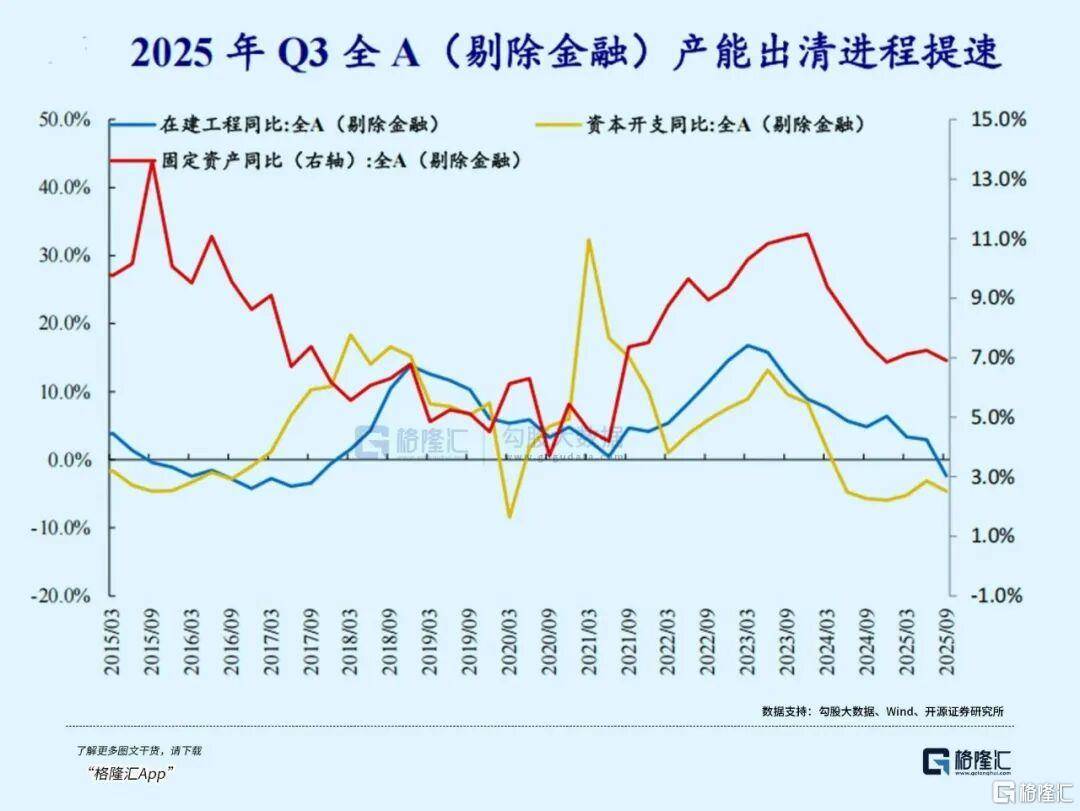
Core Viewpoint - The A-share market is at a critical point of style rebalancing by the end of 2025, with the ongoing "anti-involution" policy reshaping the investment logic in cyclical industries [2] Group 1: Market Dynamics - Since Q3 2025, the A-share market has shown a significant "technology + cyclical" dual-driven pattern, indicating a transition from a single growth line to a balanced allocation of "growth + value" [4] - The performance improvement in cyclical sectors is sustainable, with a 23% year-on-year increase in the exit scale of backward production capacity in industries like chemicals and non-ferrous metals as of Q3 2025 [4] Group 2: Drivers of Market Style Shift - Three main supports for the current market style switch include: 1. The technology sector's significant cumulative increase, with the electronics industry up 45% and communication equipment over 38% year-to-date as of November 2025, far exceeding the 14.7% rise of the CSI 300 index [6] 2. Institutional holdings in the technology sector nearing historical peaks, with TMT sector holdings surpassing 40.16% [6] 3. Clear policy signals from the Ministry of Industry and Information Technology regarding the chemical industry, enhancing the certainty of supply-side contraction in cyclical industries [6] Group 3: Chemical Industry Insights - The core logic for supply-side improvement in the chemical industry is driven by "downward capacity cycles + policy-guided exit," with fixed asset investment in the chemical raw materials sector decreasing by 5.6% year-on-year from January to September 2025 [8][11] - The chemical industry has significant advantages over traditional cyclical industries in capacity optimization efficiency, industry collaboration, and high-end transformation paths [12] Group 4: Demand Recovery - The recovery in demand for the chemical industry is supported by both domestic and overseas factors, with domestic engines including improved real estate conditions and a resurgence in textile exports [13][14] - China's chemical product sales have maintained the top global position, with sales amounting to approximately €2.24 trillion in 2023, accounting for 43.1% of global sales [16][17] Group 5: Investment Opportunities in the Chemical Sector - Investment opportunities in the chemical industry under the anti-involution wave include: 1. Selecting leading companies with strong management and cost control [20] 2. Focusing on three reversal areas: petrochemicals, coal chemicals, and polyester filament + PTA, with specific companies highlighted for their potential [21][22][23]





2025年第四季度中国经济观察-毕马威
Sou Hu Cai Jing· 2025-11-27 03:41
Core Insights - The report indicates that China's economy is expected to achieve its annual growth target of around 5% for 2025, with a stable performance in the first three quarters, where the actual GDP grew by 5.2% year-on-year, surpassing the previous year's level [1][11][24] - However, the economic growth rate slowed in the third quarter to 4.8%, down 0.4 percentage points from the second quarter, primarily due to the implementation of "anti-involution" policies, reduced policy intensity, and ongoing weakness in the real estate sector [1][11][24] - The report highlights a divergence between domestic and external demand, as well as between supply and demand, with manufacturing investment experiencing rare negative growth due to external uncertainties and "anti-involution" policies [1][11][24] Economic Performance - In the first three quarters, the actual GDP growth was 5.2%, with the third quarter showing a slowdown to 4.8%, reflecting a "high first, low second" trend [1][11][24] - The manufacturing sector faced negative growth for the first time since Q3 2020, influenced by "anti-involution" policies and a decline in real estate demand [1][11][24] - Service consumption and emerging export categories demonstrated resilience, becoming significant supports for economic growth [1][11][24] Investment Trends - Fixed asset investment saw a year-on-year decline of 0.5% in the first three quarters, with a significant drop to -6.2% in Q3, driven by weak real estate sales and reduced local government spending on infrastructure [1][11][15] - The report anticipates a recovery in manufacturing and infrastructure investment in Q4, supported by new policy measures and a more favorable external environment [1][11][15] - Real estate investment remains a major drag on fixed asset investment, with a decline from -12.1% in Q2 to -19.2% in Q3 [1][11][15] Consumption Insights - Social retail sales growth slowed to 4.5% year-on-year in the first three quarters, with Q3 showing a further decline to 3.5% [1][11][14] - Service consumption maintained strong resilience, with service retail sales growing by 5.2%, outperforming goods retail growth [1][11][14] - Online retail sales increased by 9.8%, with non-physical goods online retail sales surging by 26.7% [1][11][14] Export Performance - Exports grew by 6.1% year-on-year in the first three quarters, with Q3 growth rising to 6.5% [1][11][16] - The growth was bolstered by a 12.6% increase in exports to non-US markets, effectively offsetting declines in exports to the US [1][11][16] - High-end manufacturing and green product exports showed significant growth, with integrated circuit exports rising by 31.4% and electric passenger vehicle exports increasing by 51.2% [1][11][16] Policy Focus - The report emphasizes a shift in policy focus towards high-quality development, with an emphasis on innovation and domestic demand [1][11][6] - Recent macroeconomic policies have aimed to stabilize domestic demand, with significant financial tools and local debt issuance to support project construction and debt repayment [1][11][6] - The implementation of the "14th Five-Year Plan" highlights the direction for the next five years, focusing on building a modern industrial system and enhancing innovation efficiency [1][11][6]

供应收缩预期再度升温,多晶硅领涨新能源金属
Zhong Xin Qi Huo· 2025-11-27 01:42
Report Industry Investment Rating No relevant content provided. Core Viewpoints of the Report - Supply contraction expectations have intensified again, with polysilicon leading the rise in new energy metals. In the short - to - medium term, lithium carbonate has stopped falling due to tight supply - demand, and polysilicon prices may rise due to supply contraction expectations. In the long term, silicon supply contraction is expected, and the supply - demand surplus of lithium carbonate is narrowing [3]. - For industrial silicon, there is a situation of weak supply and demand during the dry season, and the price will fluctuate. For polysilicon, policy expectations have risen again, and the price will fluctuate and rebound. For lithium carbonate, demand expectations have boosted the price, which will oscillate at a high level [4]. Summary by Related Catalogs 1. Market Views Industrial Silicon - **Viewpoint**: During the dry season, supply and demand are both weak, and the silicon price will oscillate [8]. - **Information Analysis**: As of November 26, 2025, the spot price of industrial silicon is stable. The domestic inventory is 448,200 tons, a month - on - month decrease of 0.8%. In October, the domestic monthly output was 452,000 tons, a month - on - month increase of 7.5% and a year - on - year decrease of 3.8%. The export volume in October was 45,073 tons, a month - on - month decrease of 35.8% and a year - on - year decrease of 30.8%. The new photovoltaic installed capacity in October was 12.6GW, a month - on - month increase of 30.43% and a year - on - year decrease of 38.3%. The organic silicon industry may enter a production - cut and price - support stage [8]. - **Main Logic**: On the supply side, the number of open furnaces in the southwest has decreased rapidly, and the supply in the northwest fluctuates slightly. On the demand side, the demand from polysilicon and organic silicon industries may decline, and the demand from the aluminum alloy industry has limited growth. The social inventory is still at a high level, and attention should be paid to the progress of new warehouse receipts registration [8]. - **Outlook**: If the organic silicon industry cuts production, the demand for industrial silicon will weaken further, but the short - term market sentiment is volatile, so the price will oscillate [8]. Polysilicon - **Viewpoint**: Policy expectations have risen again, and the polysilicon price will fluctuate and rebound [8]. - **Information Analysis**: As of November 26, 2025, the average transaction price of N - type re -投料 is 53,200 yuan/ton, unchanged from the previous week. The number of warehouse receipts on the Guangzhou Futures Exchange is 7,270 lots. In October, the export volume decreased by 58% year - on - year, and the import volume decreased by 39.1% year - on - year. From January to October, the domestic new photovoltaic installed capacity increased by 39.5% year - on - year. The China Photovoltaic Industry Association will promote industry self - discipline and "anti - involution" work [9]. - **Main Logic**: Macroscopically, policy expectations have risen. In terms of supply, production in the southwest will decrease during the dry season, and long - term attention should be paid to the impact of anti - involution policies. In terms of demand, the demand has weakened since November. Overall, the demand has declined marginally, but the supply is also shrinking, and the anti - involution policy is expected to strengthen, so the price will maintain a wide - range oscillation [10][11]. - **Outlook**: The anti - involution policy can boost the price, but the demand is weakening, so the price will show a wide - range oscillation [11]. Lithium Carbonate - **Viewpoint**: Demand expectations have boosted the price, which will oscillate at a high level [8]. - **Information Analysis**: On November 26, 2025, the closing price of the lithium carbonate main contract increased by 0.99% to 96,340 yuan/ton, and the total position increased by 22,323 lots to 1,055,957 lots. The spot price of battery - grade lithium carbonate increased by 750 yuan/ton to 92,800 yuan/ton [11][12]. - **Main Logic**: Currently, supply and demand are both strong, and de - stocking is expected to continue from November to December. The supply is growing strongly but is restricted by ore shortages. The demand is good, and speculative demand may emerge. The social inventory is de - stocking, and attention should be paid to the resumption of production at Jiuxiaowo. In the long term, a bullish view is recommended [13]. - **Outlook**: In the short term, supply and demand are in a tight balance, and the price will oscillate at a high level [13]. 2. Market Monitoring No specific content provided for analysis. 3. Commodity Index - On November 26, 2025, the comprehensive index of CITIC Futures commodities showed that the commodity index was 2,241.06, up 0.12%; the commodity 20 index was 2,543.53, up 0.04%; the industrial products index was 2,200.67, up 0.03%; the PPI commodity index was 1,336.40, down 0.13% [54]. - The new energy commodity index on November 26, 2025, was 451.43, with a daily increase of 0.35%, a decrease of 0.33% in the past 5 days, an increase of 6.41% in the past month, and an increase of 9.47% since the beginning of the year [55].
20cm速递|创业板50ETF国泰(159375)涨超2.2%,科技成长主线或成中期焦点
Mei Ri Jing Ji Xin Wen· 2025-11-26 22:55
Core Viewpoint - The ChiNext 50 Index is expected to benefit from the technology growth theme in 2026, despite a short-term market style shift towards dividend stocks. The index's performance is anticipated to return to a focus on technology growth in the medium term due to the relative earnings growth of "technology and value" not having reversed, and the TMT sector's trading density remaining low [1]. Group 1: Market Trends - The current market style is temporarily rebalancing towards dividend stocks, but the growth potential in technology sectors remains strong [1]. - The ChiNext 50 Index, which has a high proportion of emerging industries, is projected to see a net profit growth rate for 2026-2027 that exceeds the average level of the Wind All A Index [1]. Group 2: Sector Performance - The index's constituent stocks are primarily concentrated in high-growth sectors such as power equipment and biomedicine, indicating a combination of high growth potential and good liquidity [1]. - There are signs of overheating in specific areas such as AI hardware and semiconductor equipment, suggesting a potential shift in market focus towards AI applications and consumer electronics [1]. Group 3: Future Outlook - The performance turning point for technology companies is expected to emerge around 2025-2026, supported by policies aimed at improving corporate profitability in the context of "anti-involution" [1]. - The ChiNext 50 ETF (159375) tracks the ChiNext 50 Index (399673) and has shown a daily fluctuation of up to 20%, reflecting the overall performance of well-known, large-cap, and liquid companies in the ChiNext market [1].
