
估值修复

Search documents
焦炭基本面呈现改善迹象 期货价格震荡偏强运行
Jin Tou Wang· 2025-07-14 07:14
Group 1 - The core viewpoint from Hengtai Futures indicates that coking coal is experiencing a strong fluctuation, with the market dynamics between coking coal and steel intensifying, leading to a slight decrease in coking coal demand and ongoing inventory accumulation pressure [2] - According to the analysis from Fangzheng Zhongqi Futures, coking coal has officially entered a price increase cycle, with total inventory beginning to decline, although production remains constrained due to previous environmental restrictions [3] - The overall sentiment in the market suggests that coking coal prices are currently undervalued, with expectations of a recovery trend, while short-term price increases may have already priced in future gains [3]
7/13文华商品强势上涨,下周是持续高开高走还是昙花一现
Sou Hu Cai Jing· 2025-07-13 14:00
Group 1: Market Trends - The Wenhua Commodity Index experienced a significant fluctuation, breaking through the 162-point resistance level but quickly falling back, indicating a false breakout signal [3] - The commodity index has undergone a complete wave correction since peaking in October 2021 and is currently in a new upward phase, with the third wave of growth just beginning [3] - The internal structure of the index shows clear differentiation, with the coal sector leading the market due to supply-side reform expectations and active procurement from downstream steel mills [3] Group 2: Policy Impact - The "anti-involution" policy has catalyzed a rebound in the South China Commodity Index, which has risen over 6% since June and more than 2% in July, driven by low valuations and marginal improvements in fundamentals [5] - The glass market has shown a notable response to policy expectations, with a significant increase in production and sales rates, particularly in Hubei, leading to a substantial reduction in national inventory [7] Group 3: Sector Performance - The commodity market is experiencing a clear divergence, with strong price increases in sectors related to the new energy industry, black metals, building materials, and chemicals, while agricultural products remain relatively weak [8] - The black metal sector continues its rebound, with notable price increases in rebar and raw materials, while non-ferrous metals are experiencing volatility [8] Group 4: Future Outlook - The continuation of the strong market performance depends on three key variables: the realization of policy expectations, the matching of supply and demand rhythms, and the degree of demand fulfillment during peak seasons [10] - Historical data indicates that the fourth quarter is a traditional peak demand season for glass, with significant construction activity expected, which could positively impact prices if inventory reductions continue [11] - The commodity market is at a crossroads, with seasonal patterns suggesting an upcoming demand peak in the second half of the year, particularly for coal, oil, and petrochemical products [10][11]


帮主郑重:银行股凭啥能“逆袭”黄金和纳指?
Sou Hu Cai Jing· 2025-07-12 07:30
Core Viewpoint - The recent surge in bank stocks has outperformed gold and the Nasdaq, marking a significant shift in market dynamics [1][3]. Group 1: Bank Stock Performance - The five major banks in China (Industrial and Commercial Bank of China, Agricultural Bank of China, China Construction Bank, Bank of China, and Postal Savings Bank) have reached historical highs, contributing to the A-share market's recovery to 3,500 points [3]. - The China Securities Bank Index has shown a remarkable increase since 2024, surpassing both gold and the Nasdaq in returns, establishing itself as a global high-yield asset champion [3]. Group 2: Reasons for Bank Stock Surge - The valuation of bank stocks has undergone significant repair, with price-to-book (PB) ratios declining faster than return on equity (ROE) in previous years, leading to an undervalued state that has now begun to correct [3]. - The introduction of policies in 2022 aimed at stabilizing the real estate market has alleviated financial risks, thereby improving the asset quality of banks and boosting investor confidence [3]. Group 3: Dividend Appeal - Current bank stocks offer an average dividend yield exceeding 4%, with some Hong Kong bank stocks reaching over 9%, making them more attractive compared to traditional savings [4]. - The downward trend in interest rates has positioned bank stocks as reliable "cash cows," providing stable dividends and appealing to investors seeking consistent returns [4]. Group 4: Market Dynamics - Although gold has seen price increases due to a decline in trust in the dollar system, its long-term performance remains tied to the dollar's strength [4]. - The Nasdaq has faced challenges due to changing interest rate expectations and overvaluation concerns in some tech stocks, leading to a shift in capital towards bank stocks [4]. Group 5: Long-term Outlook - The ongoing recovery of the Chinese economy, indicated by rising manufacturing PMI, is expected to positively influence bank credit demand [5]. - The push for financial openness and the accelerated internationalization of banks present significant growth opportunities in the future [5].





需求韧性较强 预计螺纹钢处于小幅修复行情
Jin Tou Wang· 2025-07-11 06:45
Core Viewpoint - The rebar futures market is experiencing a slight upward trend, with the main contract reaching a peak of 3149.00 yuan and currently trading at 3132.00 yuan, reflecting a 1.06% increase [1] Group 1: Market Analysis - The total production of five major steel varieties is 8.7272 million tons, a decrease of 124,400 tons week-on-week [1] - The total inventory of five major steel varieties stands at 13.3958 million tons, a slight decrease of 350 tons week-on-week [1] - The consumption of five major steel varieties is 8.7307 million tons, down 1.4% [1] Group 2: Institutional Perspectives - Guodu Futures suggests operating within the range of 2900-3150 yuan/ton for the rebar 2510 contract, emphasizing the importance of monitoring local production restriction policies [1] - Everbright Futures anticipates that the rebar market will continue to experience a slight upward trend in the short term, supported by a decrease in production and a slight decline in inventory [1] - Hengtai Futures expects a small recovery in the rebar market under low valuation conditions, with a focus on the dual drivers of industry benefits and valuation recovery [2]
今年以来港股公司回购额突破千亿港元 行业龙头多次大手笔操作
Zheng Quan Ri Bao· 2025-07-10 16:07
Core Viewpoint - The Hong Kong stock market is experiencing a significant increase in share buybacks, indicating that companies are recognizing their undervalued stock prices and are actively working to optimize their capital structures [1][2][3]. Group 1: Buyback Trends - As of July 10, 2023, 206 Hong Kong-listed companies have initiated buyback plans, involving a total amount of 100.7 billion HKD, surpassing both the previous year and the total for 2023 [1][2]. - Major companies like Tencent Holdings, HSBC, and AIA have led the buyback trend, with their combined buyback amounts exceeding 75% of the total market buybacks [4]. - The buyback activity is not limited to traditional sectors but has expanded to include consumer and healthcare industries, reflecting a broader market confidence [4][5]. Group 2: Market Sentiment and Economic Factors - The current buyback wave is seen as a response to low valuations, with companies signaling their belief in their intrinsic value and the potential for market recovery [2][3]. - The supportive policy environment, including new regulations from the Hong Kong Stock Exchange, has provided companies with greater flexibility for capital operations [2][3]. - The trend indicates a shift in corporate governance, with companies increasingly focusing on shareholder returns and capital efficiency, especially in a low-growth environment [3][5]. Group 3: Future Outlook - Analysts expect the buyback trend to continue, supported by strong financial capabilities and the ongoing valuation mismatch in sectors like technology and finance [5]. - The buybacks are anticipated to boost market sentiment, stabilize stock prices, and enhance the attractiveness of blue-chip stocks in the long term [5][6]. - The dual drivers of buybacks and supportive policies are creating opportunities for investors, although caution is advised regarding external market conditions [6].



转债市场日度跟踪20250710-20250710
Huachuang Securities· 2025-07-10 14:47
1. Report Industry Investment Rating No relevant content provided. 2. Core Viewpoints of the Report - Today, the convertible bond market followed the equity market's upward trend, with valuations rising on a month - on - month basis. The trading sentiment in the convertible bond market weakened [1]. - The convertible bond price center increased, and the proportion of high - price bonds rose. The overall weighted average closing price of convertible bonds was 124.13 yuan, up 0.43% from yesterday [2]. - Valuations increased. The fitted conversion premium rate for 100 - yuan par value was 25.30%, up 0.71 pct from yesterday [2]. - In the industry performance, more than half of the underlying stock industry indices rose, with 17 industries rising in the A - share market and 18 in the convertible bond market [3]. 3. Summary by Related Catalogs 3.1 Market Main Index Performance - The CSI Convertible Bond Index rose 0.40% month - on - month, the Shanghai Composite Index rose 0.48%, the Shenzhen Component Index rose 0.47%, the ChiNext Index rose 0.22%, the SSE 50 Index rose 0.62%, and the CSI 1000 Index rose 0.25% [1]. - Small - cap value stocks were relatively dominant. Small - cap value stocks rose 1.06%, while large - cap growth stocks rose 0.14% [1]. | Index Code | Index Name | Closing Price | Daily Change (%) | Weekly Change (%) | Monthly Change (%) | YTD Change (%) | | --- | --- | --- | --- | --- | --- | --- | | 000832.CSI | CSI Convertible Bond | 450.71 | 0.40 | 1.43 | 3.45 | 8.72 | | 889033.WI | Convertible Bond Equal - Weighted | 213.99 | 0.28 | 0.99 | 2.56 | 10.04 | | 8841324.WI | Convertible Bond Index | 1960.13 | 0.34 | 1.94 | 4.41 | 18.75 | | 884257.WI | Convertible Bond Pre - plan | 1713.71 | 0.21 | 1.32 | 5.18 | 17.43 | | 000001.SH | Shanghai Composite Index | 3509.68 | 0.48 | 1.59 | 3.23 | 4.71 | | 399001.SZ | Shenzhen Component Index | 10631.13 | 0.47 | 2.10 | 3.72 | 2.08 | | 399006.SZ | ChiNext Index | 2189.58 | 0.22 | 3.10 | 6.22 | 2.24 | | 000016.SH | SSE 50 Index | 2756.93 | 0.62 | 1.26 | 2.61 | 2.69 | | 000852.SH | CSI 1000 Index | 6406.57 | 0.25 | 1.54 | 3.02 | 7.53 | [7] 3.2 Market Capital Performance - The trading volume in the convertible bond market was 66.907 billion yuan, a 1.57% decrease from the previous day. The total trading volume of the Wind All - A Index was 1.515068 trillion yuan, a 0.81% decrease from the previous day [1]. - The net outflow of main funds from the Shanghai and Shenzhen stock markets was 21.158 billion yuan, and the yield of the 10 - year Treasury bond rose 1.70 bp to 1.66% [1]. 3.3 Convertible Bond Price and Valuation - The overall closing - price weighted average of convertible bonds was 124.13 yuan, up 0.43% from yesterday. The closing price of equity - biased convertible bonds was 164.25 yuan, down 0.91%; that of bond - biased convertible bonds was 115.18 yuan, up 0.46%; and that of balanced convertible bonds was 124.13 yuan, up 0.29% [2]. - The proportion of bonds with a closing price above 130 yuan was 33.19%, up 1.57 pct from yesterday. The largest change in proportion was in the 100 - 110 (including 110) range, with a proportion of 3.19%, down 1.08 pct from yesterday. There were 2 bonds with a closing price below 100 yuan [2]. - The median price was 125.74 yuan, up 0.51% from yesterday. The fitted conversion premium rate for 100 - yuan par value was 25.30%, up 0.71 pct from yesterday. The overall weighted par value was 94.96 yuan, up 0.51% from yesterday [2]. 3.4 Industry Performance - In the A - share market, the top three rising industries were real estate (+3.19%), petroleum and petrochemicals (+1.54%), and steel (+1.44%); the top three falling industries were automobiles (-0.62%), media (-0.54%), and national defense and military industry (-0.41%) [3]. - In the convertible bond market, the top three rising industries were environmental protection (+2.50%), coal (+1.39%), and non - bank finance (+0.95%); the top three falling industries were communications (-0.92%), agriculture, forestry, animal husbandry and fishery (-0.67%), and media (-0.24%) [3]. - In terms of different sectors: - Closing price: The large - cycle sector rose 0.81%, the manufacturing sector rose 0.05%, the technology sector fell 0.22%, the large - consumption sector rose 0.12%, and the large - finance sector rose 0.66% [3]. - Conversion premium rate: The large - cycle sector decreased 1.1 pct, the manufacturing sector increased 0.32 pct, the technology sector increased 0.024 pct, the large - consumption sector decreased 0.13 pct, and the large - finance sector decreased 0.34 pct [3]. - Conversion value: The large - cycle sector rose 1.12%, the manufacturing sector fell 0.41%, the technology sector fell 0.25%, the large - consumption sector rose 0.07%, and the large - finance sector rose 0.96% [3]. - Pure - bond premium rate: The large - cycle sector rose 1.0 pct, the manufacturing sector rose 0.046 pct, the technology sector fell 0.28 pct, the large - consumption sector rose 0.11 pct, and the large - finance sector rose 0.77 pct [4]. 3.5 Industry Rotation - Real estate, petroleum and petrochemicals, and steel led the rise. For example, real estate had a daily increase of 3.19% in the underlying stock market, and its PE (TTM) 3 - year quantile was 97.80%, and PB (LF) 3 - year quantile was 51.03% [53].
一个月4.6倍涨幅或还不是北海康成-B(01228)的终点?
智通财经网· 2025-07-09 11:46
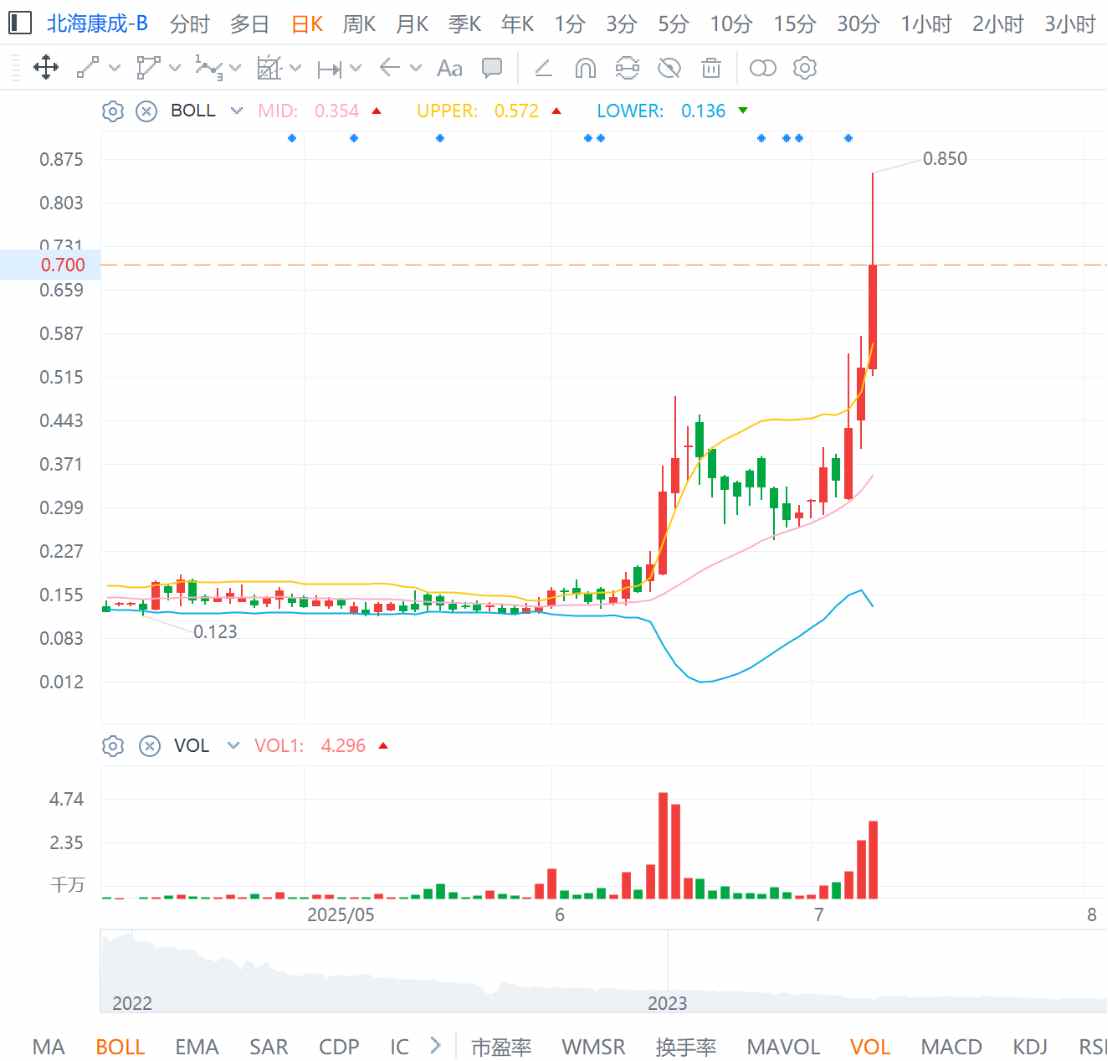
Core Viewpoint - The stock price of Beihai Kangcheng-B (01228) has experienced a significant surge, with a maximum increase of 165.63% over three trading days, indicating strong investor optimism regarding its innovative value and potential business development (BD) achievements [1][2][9]. Price Movement and Technical Analysis - After reaching a peak of 0.48 HKD on June 16, the stock showed signs of overbuying and subsequently underwent a technical correction, with a drop to 0.28 HKD by June 27, representing a decline of 41.67% from the high [2][4]. - The decline in stock price from June 18 to June 27 occurred without a corresponding increase in trading volume, indicating a lack of panic selling and a potential for recovery [4][5]. - On June 30, the stock began to recover, with a notable increase in trading volume, suggesting a shift in market sentiment and the potential for a new upward trend [5][6]. Market Sentiment and Trading Activity - The trading activity from July 2 to July 8 showed a consistent increase in volume alongside rising stock prices, indicating a strong buying interest from investors [5][7]. - The top net buyers among brokerage firms included Futu Securities and Yao Cai, reflecting a clear trend of domestic investors accumulating shares [7]. Policy and Market Impact - Recent policy measures from the National Healthcare Security Administration and the National Health Commission aimed at supporting innovative drug development have positively influenced market sentiment towards Beihai Kangcheng [9]. - The launch of the domestically developed enzyme replacement therapy for Gaucher disease, known as Velaglucerase beta (Goreining), marks a significant milestone for the company, potentially disrupting the market dominated by imported drugs [9][10]. Valuation Perspective - Despite the substantial price increases, the company's current price-to-sales (PS) ratio stands at 3.15, significantly lower than the industry average of 7.98, suggesting room for further valuation recovery [11].
海隆控股(1623.HK)更新报告:完成全部复牌指引 治理重塑完成 估值修复值得期待
Ge Long Hui· 2025-07-09 10:06
Core Insights - 海隆控股于2024年4月2日暂停买卖,因审计过程中发现与俄罗斯附属公司相关的未决审计事项,涉及2022年10月至2023年12月与MTC公司的交易结构 [1] - 公司成立独立调查委员会,聘请安永进行法证调查,并完成内部控制审查和管理层重整,已达成港交所复牌条件 [1][2] - 2024年核心经营数据展现出韧性,全年实现收入人民币46.68亿元,同比增长9.8% [2][3] Governance and Compliance - 公司完成所有六项复牌指引,包括独立调查、补发财报、内控审查、管理层调整和改善合规架构 [1][2] - 调查期间对相关责任人进行了降职、记过或解除雇佣,并新增内部审计和法务合规部门职能 [2] - 内部监控顾问确认未发现重大控制缺陷,港交所据此认定公司复牌条件达成 [2] Financial Performance - 毛利总额为人民币11.22亿元,毛利率维持在24.0% [3] - 经营利润达到人民币3.72亿元,反映出良好的运营杠杆效果 [3] - 尽管受到汇率波动与融资成本上升影响,全年净利润为人民币3,007万元,经营现金流稳定 [3] Market Valuation - 海隆当前估值处于历史低位,停牌前股价报HK$0.113,复牌后有望迎来情绪修复与基本面再定价 [3][4] - 估值支撑因素包括风险释放后的安全边际及中东、东南亚项目的高交付确定性 [4] - 公司已进入估值重建与信用恢复的早期阶段,具备从停牌事件中修复并重获市场定价权的基础 [4]
海澜之家20250708
2025-07-09 02:40
Summary of Conference Call for Hailan Home (海澜之家) Company Overview - **Company**: Hailan Home (海澜之家) - **Industry**: Apparel and Retail Key Points and Arguments Store Expansion and Performance - Hailan Home's store opening numbers in the first half of the year fell short of expectations, but an acceleration in openings is anticipated in the second half, with a total of over 50 new stores expected for the year [2][3] - In late June, Hailan Home announced the opening of nearly 10 new stores, with expectations to open at least 5 to 8 new stores in July, indicating a significant increase in store opening pace in the third quarter [3] Financial Performance and Outlook - The second quarter performance was relatively strong compared to other brands, with a projected net profit margin of 8% in Q3 and close to 4% in Q4, marking the lowest levels in the past five to six years [4] - Despite uncertainties regarding tariffs, the overall profit is expected to grow due to new customer acquisitions and operational leverage [4][5] Valuation and Investment Potential - Hailan Home's current valuation is approximately 14-15 times earnings, with a dividend yield of about 6%, indicating investment value given the company's business and valuation elasticity [2][6] - The apparel industry outlook for the second half is optimistic, with expectations for retail growth and valuation recovery opportunities [6] Manufacturing Sector Insights - The investment outlook for the manufacturing sector has improved due to the implementation of ASEAN tariffs, which are lower than previous rates, enhancing the attractiveness of manufacturing companies [7] - The impact of tariffs on the fundamental performance or absolute profit of manufacturing companies is limited; however, the risk of efficiency loss due to delayed tariff implementation is a concern [8][9] Regional Tax Advantages - Vietnam has a relatively low tax rate compared to other ASEAN countries, benefiting leading manufacturers like Jinyuan International (金苑国际), Huali Group (华利集团), and Jiansheng Group (建盛集团) that have established substantial production capacity in Vietnam [10] Company-Specific Developments - **Jinyuan International**: Valuation is attractive at around 8 times earnings with a dividend yield close to 8%. The company is expected to rise to a leading position in the sports apparel sector due to strong growth potential and risk mitigation [11] - **Huali Group**: The company has solid fundamentals and is expected to see profit growth despite tariff uncertainties. Current valuation is around 15 times earnings, indicating a bottoming out of valuations [12] - **Nobon Co., Ltd.**: A small manufacturing company with strong performance in the first half of the year, expected to benefit from new business developments in the second half [13] Recommended Companies in the Textile and Apparel Sector - Recommended companies include Jinyuan International, Huali Group, and Nobon Co., Ltd., each with distinct growth potential and investment value in the textile and apparel sector [14][15]


可转债周报:“反内卷”背景下如何配置转债-20250708
Changjiang Securities· 2025-07-08 12:53
Report Summary 1. Report's Industry Investment Rating The provided content does not mention the industry investment rating. 2. Core Viewpoints of the Report - The convertible bond market continued a mild recovery this week, with a style focused on stable allocation. The market center of gravity shifted from growth to low - valuation and fundamental - improvement directions. The "anti - involution" policy continued to advance, and the expectation of optimizing the supply - demand pattern of cyclical industries such as steel, building materials, and automobiles increased, which was expected to drive the emergence of structural opportunities for convertible bonds. [2][6] - In terms of valuation, the parity range stretched overall, while the valuation in the market - price range compressed overall with some structural differentiation. The implied volatility increased slightly, and the marginal improvement of sentiment might require attention to short - term overheating risks. [2][6] - Among individual bonds, medium - duration bonds with elasticity and positive - stock catalysis expectations performed prominently. The primary - market supply advanced steadily, with frequent clause - gaming and redemption announcements, reflecting the continuous local capital - gaming willingness. It was recommended to focus on medium - term valuation repair and rotation opportunities driven by policies on the basis of defense. [2][6] 3. Summary According to Relevant Catalogs "Anti - Involution": Which Industries and Convertible Bonds Are Expected to Benefit - The "anti - involution" related market strengthened. Policies in industries such as steel, photovoltaic equipment, building materials, and automobiles were expected to improve the supply - demand pattern and increase profit expectations. Some industries' capital expenditures entered a downward phase, and the overall investment intensity returned to the historical center. [15] - The valuation structures of convertible bonds in different industry sectors were significantly differentiated. The steel sector had prominent equity characteristics, the photovoltaic sector had a relatively high premium rate, the building - materials sector was debt - driven, and the automobile sector had obvious internal structural differentiation. [20] Market Theme Weekly Review - **Equity Theme Weekly Review**: The A - share market continued a structural market. High - prosperity sectors such as medicine and electronics were active, while AI - related themes were sluggish. It was recommended that investors adopt a strategy framework that balanced high - low switching, event - driven, and style equilibrium. [30] - **Convertible Bond Weekly Review**: The convertible bond market continued to rise slightly. The CSI Convertible Bond Index rose 1.21%, and large - cap convertible bonds led the rise. Valuation in the parity range generally increased, while that in the market - price range was structurally differentiated. It was recommended to grasp individual bonds in defensive low - price sectors and flexibly respond to structural rotations. [34] Market Weekly Tracking - **Main Stock Indexes Strengthened, with Medicine and "Anti - Involution" as the Main Lines This Week** - Main stock indexes generally strengthened, with the Shanghai Composite Index rising 1.4%, the Shenzhen Component Index rising 1.3%, and the ChiNext Index leading with a 1.5% increase. However, the willingness of incremental funds to enter the market was low, and the net outflow of main funds increased significantly, indicating a marginal decline in risk appetite. [36][37] - By industry, cyclical and pharmaceutical sectors such as steel, medicine, and building materials were relatively dominant, while technology - growth sectors such as computer and non - bank finance were weak. In terms of trading volume, the medicine and military - industry sectors were favored by funds, while the TMT sector shrank. [42][43] - The trading structure of the market was significantly differentiated. High - prosperity and cyclical - manufacturing sectors were the focus of capital. The military - industry and new - consumption sectors had a high degree of crowding, and it was recommended to pay attention to the sector - rotation opportunities of sectors with continuously low trading - volume quantiles such as food and beverage. [48] - **The Convertible Bond Market Followed the Uptrend, with Large - Cap Convertible Bonds Performing Well** - The convertible bond market continued to rise, with the CSI Convertible Bond Index rising 1.21%. The large - cap convertible bond index led the rise, and the trading activity increased slightly. [54] - By parity range, the valuation of the convertible bond market stretched overall, while by market - price range, it showed structural differentiation and overall compression. The implied volatility of the convertible bond market rose slightly, and the median price of convertible bonds increased. [56][57][61] - By sector, the convertible bond market generally strengthened, with the concentration slightly decreasing. The power - equipment sector continued to lead the rise, and the trading volume of the medicine, basic - chemical, and automobile sectors ranked among the top three. [65] - Individual convertible bonds generally strengthened, with high - elasticity and cyclical sectors performing well. The top - rising convertible bonds were mostly driven by positive stocks, and the market preferred medium - duration bonds with certain elasticity. [67][70] Primary - Market Tracking and Clause Gaming - **New Bond Issuance and Subscription**: Two convertible bonds were listed (Anke Convertible Bond and Dianhua Convertible Bond), and two were open for subscription (Bo 25 Convertible Bond and Libo Convertible Bond). [75] - **Issuance Plan Updates**: Two listed companies updated their convertible - bond issuance plans, with one being accepted by the exchange and one passing the shareholders' meeting. The total scale of projects at and after the exchange - acceptance stage was over 6.2 billion yuan. [76][77] - **Clause - Gaming Announcements** - **Downward - Revision - Related Announcements**: Fourteen convertible bonds announced the expected trigger of downward revision, fifteen announced not to revise downward, and one proposed downward revision. [79][81] - **Redemption - Related Announcements**: Four convertible bonds announced the expected trigger of redemption, three announced not to redeem in advance, and four announced early redemption. [86][87]