
大宗商品价格波动

Search documents
必和必拓2025财年利润大幅下降
Shang Wu Bu Wang Zhan· 2025-08-21 17:19
Core Insights - BHP reported a decline in annual profits to the lowest level in five years due to falling iron ore and coal prices, indicating a mixed global economic outlook [1] - For the fiscal year ending June 2025, total revenue decreased by 8% to $51.3 billion, while profit fell by 26% to $10.2 billion [1] - Increased copper production helped offset weakness in other commodities, contributing 45% to the company's underlying earnings, with copper output growing by 28% over the past three years [1] - The company noted record iron ore and copper production for the fiscal year, with demand from major Asian export markets helping to mitigate the impact of an unstable overall trade environment [1]

帮主郑重:原油黄金暴跌暗藏三大变局!俄乌停火背后,这两类资产即将迎来转机?
Sou Hu Cai Jing· 2025-08-20 00:47
Group 1: Oil Market - Recent optimism regarding a potential ceasefire in the Russia-Ukraine conflict has led to a decline in oil prices, with WTI crude dropping by 1.7% and Brent crude falling over 1% [3] - The actual impact on oil prices is driven by expectations of sanctions being relaxed, despite Russian oil exports remaining uninterrupted [3] - The feasibility of a ceasefire remains uncertain, as geopolitical tensions persist, which could lead to a rebound in oil prices if negotiations fail [3] Group 2: Gold Market - Gold prices have decreased by 0.5%, influenced by easing geopolitical tensions and market speculation about a potential 25 basis point rate cut by the Federal Reserve in September [4] - The introduction of new tariffs on steel and aluminum by the Trump administration could reignite inflation, which may enhance gold's appeal as a safe-haven asset [4] - The current decline in gold prices is viewed as a short-term reaction, with long-term factors such as interest rate cuts and geopolitical risks likely to support future price increases [4] Group 3: Copper Market - Despite a recent decline in copper prices, demand from India is expected to support long-term growth, with projections indicating that copper prices may strengthen by 2026 due to supply disruptions and increased demand from renewable energy [6] - India's infrastructure development and data center construction are anticipated to drive copper demand, while declining ore grades and rising development costs pose challenges for new mining projects [6] - The current price correction in copper is seen as an opportunity for long-term investors, particularly those with resources in India [6]


【钢铁】交易所调整焦煤期货合约交易限额,建议关注期货价格波动风险——金属周期品高频数据周报(7.21-7.27)(王招华/戴默)
光大证券研究· 2025-07-28 08:42
Core Viewpoint - The article discusses the current state of various industries, focusing on liquidity, construction, real estate, industrial products, pricing relationships, export chains, and valuation metrics, highlighting both opportunities and challenges in the market. Liquidity - The M1 and M2 growth rate difference was -3.7 percentage points in June 2025, with a month-on-month increase of 1.9 percentage points [3] Infrastructure and Real Estate Chain - Rebar prices reached a new high for the year, with weekly price changes showing rebar up by 5.50%, cement price index down by 2.05%, rubber up by 3.09%, coke up by 8.55%, coking coal up by 6.60%, and iron ore up by 0.64% [4] - National capacity utilization rates for blast furnaces, cement, asphalt, and all-steel tires decreased by 0.08 percentage points, 6.80 percentage points, 1.8 percentage points, and 0.08 percentage points respectively [4] Real Estate Completion Chain - Prices for titanium dioxide and flat glass changed by -0.38% and 0.00% respectively, with flat glass profit at -58 yuan/ton and titanium dioxide profit at -1350 yuan/ton; flat glass operating rate was 75% [5] Industrial Products Chain - Major commodity prices showed cold-rolled steel, copper, and aluminum increasing by 6.42%, 1.05%, and 0.19% respectively, with corresponding profit changes of +107.38%, -18.19%, and -1.86% [6] - The national operating rate for semi-steel tires was 75.87%, down by 0.12 percentage points [6] - The PMI new orders index for June was 50.20% [6] Subcategory Products - Prices for graphite electrodes were 18,000 yuan/ton, unchanged, with a comprehensive profit of 1357.4 yuan/ton, down by 15.09% [7] - Electrolytic aluminum price was 20,800 yuan/ton, up by 0.19%, with estimated profit at 3260 yuan/ton (excluding tax), down by 1.86% [7] - Electrolytic copper price was 79,580 yuan/ton, up by 1.05% [7] Pricing Relationships - The price ratio of rebar to iron ore was 4.37 this week; the price difference between hot-rolled and rebar was 100 yuan/ton [8] - The price difference between Shanghai cold-rolled and hot-rolled steel reached 370 yuan/ton, up by 10 yuan/ton [8] - The price difference between small rebar (mainly used in real estate) and large rebar (mainly used in infrastructure) was 150 yuan/ton, down by 6.25% from last week [8] Export Chain - The new export orders PMI for China in June 2025 was 47.70%, up by 0.2 percentage points [9] - The CCFI comprehensive index for container shipping rates was 1261.35 points, down by 3.24% [9] - The U.S. crude steel capacity utilization rate was 78.00%, down by 0.70 percentage points [9] Valuation Metrics - The CSI 300 index increased by 1.69%, with the best-performing cyclical sector being cement manufacturing, which rose by 13.13% [10] - The PB ratio of the ordinary steel sector relative to the CSI 300 is currently at 0.57, with a historical high of 0.82 reached in August 2017 [11]
三大交易所齐出手“降温”,工业品期货投机能否退潮?
Di Yi Cai Jing· 2025-07-27 10:37
Core Viewpoint - The recent surge in industrial commodity futures, driven by "anti-involution" policy expectations, has faced a significant downturn due to regulatory measures aimed at curbing speculation and managing risk in the market [1][2][3]. Group 1: Regulatory Actions - On July 25, the Dalian Commodity Exchange (DCE) imposed trading limits on coking coal futures, restricting non-futures company members or clients to a maximum of 500 contracts for the JM2509 contract and 2000 contracts for other coking coal futures starting July 29 [2]. - The Guangzhou Futures Exchange (GFEX) also announced that from July 28, non-futures company members or clients would be limited to a maximum of 3000 contracts for the LC2509 lithium carbonate futures [2]. - Various exchanges have issued risk warnings and implemented measures such as increasing margin requirements and tightening trading limits across multiple commodities, including coking coal, lithium carbonate, and industrial silicon [1][3]. Group 2: Market Reactions - Following the regulatory measures, coking coal futures experienced a sharp decline, with the main contract dropping 7.76% to 1140.5 yuan/ton, while the holding volume for the restricted JM2509 contract decreased by 10.2 thousand contracts to 417 thousand contracts [1][3]. - Despite a continued rise in lithium carbonate futures, the main contract saw a near 6% drop during trading, with total trading volume decreasing by 56.7 thousand contracts to 1.203 million contracts [3][4]. - The GFEX has also limited the daily opening positions for polysilicon and industrial silicon futures, indicating a broader trend of tightening controls across various commodities [3]. Group 3: Market Trends and Speculation - The "anti-involution" theme has led to a rotation of speculative funds, with some short-term capital quickly shifting to ferroalloys, as evidenced by significant price increases in silicon iron and manganese silicon contracts on July 25 [5]. - The overall market sentiment remains influenced by policy interventions, with industrial commodity futures experiencing substantial price fluctuations driven by speculative trading and regulatory responses [6][7]. - Analysts suggest that while regulatory measures may temporarily suppress price volatility for coking coal and lithium carbonate, ongoing supply disruptions or improved demand expectations could lead prices to return to an upward trajectory [8].
AMRO首席经济学家答21:东盟+3根据比较优势整合应对冲击
2 1 Shi Ji Jing Ji Bao Dao· 2025-07-24 13:33
Group 1 - The ASEAN+3 region's economic growth is projected to be 3.8% in 2023 and 3.6% in 2026, reflecting a downward adjustment due to challenges posed by US tariff policies [1][2] - The region is characterized by high trade dependency, with ASEAN countries' total trade amounting to approximately 94% of their nominal GDP, and nearly 50% for the ASEAN+3 region [2] - Central banks in the ASEAN+3 region have shown flexibility in monetary policy, with over half having implemented easing measures in response to tariff risks, indicating potential for further support [4][6] Group 2 - Key risks for the ASEAN+3 region include rising US tariffs, changes in global financial conditions, and volatility in commodity prices, particularly oil [3] - The region's central banks are expected to maintain cautious approaches due to inflation targeting and the need to manage capital flows, which could limit their ability to ease policies further [6][7] - Malaysia's recent interest rate cuts are seen as preemptive measures to address external uncertainties, while Vietnam is focusing on attracting foreign direct investment and upgrading its industrial structure for long-term resilience [7]
中国经济半年报|总量增长、质量提升、变量可控——三重维度解码中国外贸半年报
Xin Hua She· 2025-07-14 14:24
Core Viewpoint - China's foreign trade maintained resilience in the first half of the year, achieving total growth, quality improvement, and controllable variables despite a complex international environment [1][4]. Group 1: Total Growth - In the first half of the year, China's total import and export volume reached 21.79 trillion yuan, a year-on-year increase of 2.9%, with the growth rate accelerating by 0.4 percentage points compared to the first five months [1]. - Exports exceeded 13 trillion yuan for the first time in history during the same period, showing a rapid growth of 7.2% year-on-year [1]. - Imports totaled 8.79 trillion yuan, experiencing a year-on-year decline of 2.7%, but the decline was narrowed by 1.1 percentage points compared to the first five months [1]. - The second quarter saw a year-on-year growth of 4.5% in total trade, accelerating by 3.2 percentage points from the first quarter, marking seven consecutive quarters of growth [1]. Group 2: Quality Improvement - Chinese foreign trade enterprises have capitalized on the global energy transition trend, increasing the supply of high-quality green products and exploring new fields [2]. - Exports of electromechanical products reached 7.8 trillion yuan, a year-on-year increase of 9.5%, accounting for 60% of total exports [2]. - High-end equipment related to new productive forces grew by over 20%, while "new three samples" products representing green and low-carbon initiatives increased by 12.7% [2]. Group 3: Controllable Variables - China expanded its trade partnerships, with imports and exports to over 190 countries and regions increasing, and the number of trading partners with a trade volume exceeding 50 billion yuan rising to 61, an increase of five compared to the previous year [2]. - Trade with traditional markets like the EU, Japan, and the UK grew, while emerging markets contributed significantly, with imports and exports to Africa and Central Asia increasing by 14.4% and 13.8% year-on-year, respectively [2]. - The fluctuation in import growth is attributed to uncertainties in international trade policies and falling prices of bulk commodities, which significantly impact China's import growth [3].
欧洲央行副行长金多斯:油价波动不会影响通胀回落
news flash· 2025-06-24 12:53
Core Viewpoint - The recent fluctuations in commodity prices due to the conflict between Israel and Iran will not alter the inflation outlook for the Eurozone, according to the European Central Bank's Vice President, Luis de Guindos [1] Group 1: Inflation Outlook - Guindos stated that while rising oil prices are a concern, they appear to be under control, and the process of inflation decline is firmly anchored [1] - The growth rate of consumer prices has decreased from record highs to slightly below the ECB's target of 2% [1] - Officials are satisfied with the current trajectory of consumer prices, indicating a potential continuation of achieving the inflation target in the coming months [1] Group 2: Geopolitical Concerns - The situation in Iran adds complexity to an already tense global trade environment, which could impact economic stability [1] - Guindos emphasized the need for caution due to the high level of uncertainty surrounding these geopolitical issues [1]
金价直线拉升,油价大涨!
Sou Hu Cai Jing· 2025-06-13 05:31
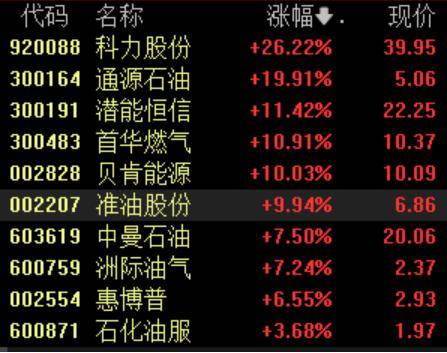
Group 1: Oil Market Overview - WTI crude oil futures surged over 7%, currently priced at $73.39, while domestic crude oil futures hit a limit up at 535.2 yuan per barrel [1] - Oil and gas stocks opened significantly higher, with Tongyuan Petroleum reaching a 20% limit up, and several other stocks like Beiken Energy and Zhun Oil also hitting their limits [1] Group 2: Stock Performance - Notable stock performances include: - Keli Co., Ltd. up 26.22% at 39.95 - Tongyuan Petroleum up 19.91% at 5.06 - Potential Energy up 11.42% at 22.25 - Beiken Energy up 10.03% at 10.09 - Zhun Oil up 9.94% at 6.86 [2] Group 3: Domestic Oil Price Adjustments - The next round of domestic oil price adjustments is set to open on June 17, with predictions of a price increase due to rising international oil prices [2] - The current oil change rate indicates a 2.25% increase, predicting a rise of 135 yuan per ton for gasoline and diesel, translating to an increase of 0.10 to 0.12 yuan per liter [3]




【国际大宗商品早报】多重利好推动油价上涨 伦锡大幅反弹
Xin Hua Cai Jing· 2025-06-03 23:43
Agriculture - Chicago futures market showed mixed results for corn, wheat, and soybeans on June 3, with corn up 0.06% to $4.39 per bushel, wheat down 0.56% to $5.36 per bushel, and soybeans up 0.7% to $10.41 per bushel [2] - The weather in the Midwest is expected to be warm and humid until June 18, which may create favorable growing conditions for crops [2] - Market focus is on potential crop yields in Europe, Russia, Canada, and the U.S. as weather conditions remain uncertain [2] Energy - International oil prices rose on June 3, with WTI crude up 1.42% to $63.41 per barrel and Brent crude up 1.55% to $65.63 per barrel [2] - The risk premium in oil prices has increased due to recent attacks in Ukraine and ongoing tensions between the U.S. and Iran regarding nuclear issues [3] - Canadian wildfires have impacted oil sands production by 344,000 barrels per day, approximately 7% of Canada's daily crude output [3] Metals - Gold prices fell by 0.60% to $3,376.9 per ounce on June 3, following a previous increase and amid profit-taking by investors [5] - The World Gold Council reported that global central banks purchased 12 tons of gold in April, a 12% decrease from March [5] - Most base metals on the London Metal Exchange saw price increases, with 3-month tin rising 2.96% to $31,450 per ton and 3-month copper up 0.24% to $9,638.5 per ton [5]
国际金价再创新高,国内市场炼焦煤稳中偏弱运行
China Securities· 2025-03-07 09:47
证券研究报告·行业动态 国际金价再创新高,国内市场炼 焦煤稳中偏弱运行 核心观点 1)美财政部欲重估黄金储备价值,国际金价再创新高。黄金市场 于上周见顶回调后又再度突破前高,连续两周创下历史新高纪 录,国际经济及政治层面因素的叠加是驱动黄金市场不断走强的 主要原因。而短期黄金市场多头情绪也在价格的持续走高中变得 更加谨慎,高位回调风险正在累积。 物流供应链:国际金价再创新高,国内市场炼焦煤稳中偏弱运行 美财政部欲重估黄金储备价值,国际金价再创新高。黄金市场于 上周见顶回调后又再度突破前高,连续两周创下历史新高纪录, 国际经济及政治层面因素的叠加是驱动黄金市场不断走强的主 要原因。而短期黄金市场多头情绪也在价格的持续走高中变得更 加谨慎,高位回调风险正在累积。由于近期对于美国财政部重估 黄金储备价值以应对持续扩大的赤字规模的讨论增多,这一举动 也被市场理解为特朗普政府为缓解外界对美国黄金储备真实性 产生的质疑。 国内市场炼焦煤稳中偏弱运行。现国内主流煤矿目前已全面复产 且产量递增,个别矿因井下受限暂未恢复正常生产,下月产量会 有明显恢复。随着焦炭连续降价九轮,中间洗煤及贸易企业谨慎 观望,部分焦企利润已有不同程 ...