
宏观流动性

Search documents
宏观金融数据日报-20251027
Guo Mao Qi Huo· 2025-10-27 06:24
Report Industry Investment Rating - No information provided Core View of the Report - The short - term shock adjustment of stock indices is mainly affected by intensified overseas disturbances and adjustments in some high - position sectors. As unfavorable factors such as trade frictions gradually ease, stock indices are expected to return to the upward channel. With policy support and abundant macro - liquidity, even if short - term macro uncertainties increase, the adjustment space of stock indices is expected to be limited. It is recommended to take a long - term long position [8] Summary by Relevant Catalogs Interest Rate and Bond Market - Interest rate products' closing prices and changes: DRO01 closed at 1.32 with a 0.52bp increase; DR007 at 1.41 with a 1.57bp decrease; GC001 at 1.40 with a 5.50bp decrease; GC007 at 1.57 with a 6.50bp increase; SHBOR 3M at 1.59 with no change; LPR 5 - year at 3.50 with no change; 1 - year treasury bond at 1.48 with a 0.25bp decrease; 5 - year treasury bond at 1.62 with a 0.82bp increase; 10 - year treasury bond at 1.85 with a 0.50bp increase; 10 - year US treasury bond at 4.02 with a 1.00bp increase [4] - Last week, the central bank conducted 8672 billion yuan of reverse repurchase and 1200 billion yuan of treasury cash fixed - deposit operations in the open market, with 7891 billion yuan of reverse repurchase maturing, resulting in a net investment (including treasury cash) of 1981 billion yuan [4] - This week, 8672 billion yuan of reverse repurchase will mature in the central bank's open market, with 1890 billion, 1595 billion, 1382 billion, 2125 billion, and 1680 billion yuan maturing from Monday to Friday respectively. Also, 7000 billion yuan of MLF will mature on Monday and 5000 billion yuan of 182 - day outright reverse repurchase will mature on Wednesday [5] Stock Market - Stock index closing prices and changes: CSI 300 closed at 4661 with a 1.18% increase; SSE 50 at 3046 with a 0.62% increase; CSI 500 at 7259 with a 1.62% increase; CSI 1000 at 7419 with a 1.52% increase. Futures closing prices and changes: IF current - month contract at 4648 with a 1.2% increase; IH current - month contract at 3048 with a 0.8% increase; IC current - month contract at 7212 with a 1.7% increase; IM current - month contract at 7369 with a 1.7% increase [7] - Futures trading volume and position changes: IF trading volume was 116181 with a 9.4% decrease, and position was 255413 with a 3.5% decrease; IH trading volume was 58979 with a 2.2% decrease, and position was 95329 with a 1.4% increase; IC trading volume was 137728 with a 5.1% decrease, and position was 243604 with a 4.2% decrease; IM trading volume was 224453 with a 13.8% decrease, and position was 349089 with a 7.0% decrease [7] - Last week, CSI 300 rose 3.24% to 4660.7; SSE 50 rose 2.63% to 3045.8; CSI 500 rose 3.46% to 7258.5; CSI 1000 rose 3.25% to 7419.2. Shenwan primary industry indices generally rose, with communication (11.5%), electronics (8.5%), power equipment (4.9%), machinery and equipment (4.7%), and media (4.3%) leading the gains, while only agriculture, forestry, animal husbandry and fishery (- 1.4%) and food and beverage (- 0.9%) declined. The daily trading volume of A - shares last week was 15749 billion, 17043 billion, 15180 billion, 15106 billion, and 17592 billion yuan respectively, and the average daily trading volume decreased by 3494.9 billion yuan compared with the previous week [7] Futures Premium and Discount Situation - IF premium rates for current - month, next - month, current - quarter, and next - quarter contracts are 3.70%, 3.75%, 3.06%, and 3.10% respectively; IH premium rates are - 1.19%, - 0.62%, - 0.35%, and - 0.30% respectively; IC premium rates are 9.04%, 9.19%, 9.20% respectively; IM premium rates are 9.47%, 11.05%, 11.58%, and 11.66% respectively. The values in parentheses are annualized premium and discount rates (green for premium, red for discount) [9]
资金跟踪系列之十六:个人 ETF仍是主要增量,两融整体净流出
SINOLINK SECURITIES· 2025-10-20 07:54
Macro Liquidity - The US dollar index has declined, and the degree of "inversion" in the China-US interest rate spread has narrowed. The nominal and real yields of 10Y US Treasuries have decreased or remained unchanged, driven by a decline in inflation expectations [2][13][19]. Market Trading Activity - Overall market trading activity has decreased, with the volatility of major indices showing mixed trends. The trading activity in sectors such as non-ferrous metals, electric vehicles, steel, electronics, automotive, and real estate remains above the 80th percentile [3][25]. - The volatility of major indices, including the Shanghai Composite and CSI 300, has increased, while the volatility of the ChiNext and STAR Market indices has decreased. Sectors like electronics, automotive, and chemicals have seen a rapid increase in volatility [3][31]. Analyst Predictions - Analysts have continued to raise net profit forecasts for the entire A-share market for 2025 and 2026. The proportion of stocks with upward revisions in net profit forecasts has increased across various sectors, including retail, finance, light industry, and public utilities [4][50]. - The net profit forecasts for major indices such as the CSI 300, CSI 500, and SSE 50 have been adjusted upwards for 2025 and 2026, while the ChiNext index has seen mixed adjustments [4][23][24]. Northbound Trading Activity - Northbound trading activity has decreased, with an overall net sell-off in A-shares. The trading volume ratio in sectors like non-ferrous metals, electronics, and banking has increased, while it has decreased in pharmaceuticals, machinery, and communications [5][29]. - Northbound trading has shown a net buying trend in sectors such as electronics, automotive, and electric vehicles, while net selling has occurred in computing, pharmaceuticals, and communications [5][33]. Margin Financing Activity - The activity of margin financing has dropped to its lowest point since mid-September 2025, with a net sell-off of 12.812 billion yuan. The main net buying has been in sectors like non-ferrous metals, military, and pharmaceuticals, while net selling has occurred in TMT, finance, and automotive sectors [6][35]. Fund Activity - The positions of actively managed equity funds have continued to increase, with significant net subscriptions in ETFs, primarily driven by individual investors. Active equity funds have mainly increased their positions in electronics, automotive, and media sectors, while reducing exposure in communications, finance, and real estate [6][8][52]. - The newly established equity fund scale has rebounded, with both active and passive funds seeing an increase in size. ETFs related to financials, non-ferrous metals, and electronics have been the main net buyers, while those related to communications, chemicals, and transportation have seen net selling [6][53].
资金跟踪系列之十六:个人 ETF 仍是主要增量,两融整体净流出
SINOLINK SECURITIES· 2025-10-20 07:25
Macro Liquidity - The US dollar index has declined, and the degree of "inversion" in the China-US interest rate spread has narrowed [2][13] - The nominal and real yields of 10-year US Treasuries have decreased or remained unchanged, with inflation expectations also falling [2][19] - Offshore dollar liquidity has tightened, while domestic interbank liquidity remains balanced and slightly loose [2][19] Market Trading Activity - Overall market trading activity has decreased, with the volatility of major indices showing mixed trends [3][25] - Trading heat in sectors such as non-ferrous metals, electric vehicles, steel, electronics, automotive, and real estate remains above the 80th percentile [3][25] - The volatility of the communication and electronics sectors remains above the 80th historical percentile [3][31] Analyst Predictions - Analysts have continued to raise net profit forecasts for the entire A-share market for 2025 and 2026 [4][43] - The proportion of stocks with upward revisions in net profit forecasts for 2025 and 2026 has increased [4][43] - Sectors such as retail, finance, light industry, and public utilities have seen upward revisions in net profit forecasts for 2025 and 2026 [4][43][44] Northbound Trading Activity - Northbound trading activity has decreased, with overall net selling of A-shares [5][29] - In the top 10 active stocks, the trading volume ratio for sectors like non-ferrous metals, electronics, and banking has increased [5][32] - Northbound trading has shown net buying in sectors such as electronics, automotive, and electric vehicles, while net selling occurred in computing, pharmaceuticals, and communications [5][33] Margin Financing Activity - Margin financing activity has dropped to its lowest point since mid-September 2025 [6][35] - The main net buying in margin financing has been in sectors like non-ferrous metals, military, and pharmaceuticals [6][38] - The proportion of financing purchases in sectors such as oil and petrochemicals, steel, and public utilities has increased [6][38] Fund Activity - The positions of actively managed equity funds have continued to rise, with net subscriptions in ETFs persisting [8][45] - Actively managed equity funds have mainly increased positions in sectors like electronics, automotive, and media [8][46] - New fund establishment has seen a rebound, with both actively and passively managed funds experiencing growth [8][50]
日度策略参考-20251017
Guo Mao Qi Huo· 2025-10-17 06:36
Report Investment Rating - The report does not provide an overall industry investment rating. However, specific ratings for some commodities are as follows: - Crude oil: Bearish [1] - Fuel oil: Bearish [1] Core Viewpoints - Short - term stock index is expected to fluctuate strongly, and attention should be paid to the possible meeting between Chinese and US leaders during the APEC meeting in South Korea at the end of this month. Asset shortage and weak economy are beneficial to bond futures, but the central bank has recently reminded of interest - rate risks [1]. - Gold is supported to remain at a high level due to factors such as the US government shutdown, Sino - US trade uncertainty, and the Fed's expected rate cut in October, but short - term high - level volatility risks should be noted. Silver price has risen and then fallen again, with increased short - term high - level volatility risks [1]. - Although global trade frictions suppress copper prices, copper prices are expected to continue to run strongly due to ongoing disturbances in copper mine supply and improved domestic and foreign macro - liquidity [1]. - The fundamentals of electrolytic aluminum are mixed, and its price is expected to fluctuate. Alumina production and inventory are increasing, and its fundamentals are weak, pressuring the spot price [1]. - The non - ferrous sector faces correction risks due to Sino - US trade frictions. Zinc prices are under short - term pressure, nickel prices are affected by macro factors in the short term, and stainless steel futures are expected to fluctuate in the short term [1]. - Agricultural product prices are affected by various factors such as trade frictions, policies, and supply - demand relationships, showing different trends of fluctuation [1]. - Energy and chemical product prices are also affected by multiple factors including production, trade policies, and market demand, with different price trends [1]. Summary by Commodity Categories Macro - finance - Stock index: Short - term strong - side fluctuation, beware of tariff policy changes, focus on the possible Sino - US leaders' meeting at the end of the month [1] - Bond futures: Asset shortage and weak economy are beneficial, but the central bank reminds of interest - rate risks [1] - Gold: Supported at a high level, short - term high - level volatility risks [1] - Silver: Short - term high - level volatility risks increased, expected to fluctuate [1] Non - ferrous metals - Copper: Expected to run strongly due to supply disturbances and improved liquidity [1] - Electrolytic aluminum: Mixed fundamentals, price to fluctuate [1] - Alumina: Weak fundamentals, price under pressure, focus on cost support [1] - Zinc: Short - term pressure, support if export window opens [1] - Nickel: Short - term macro - driven fluctuation, high - inventory suppression exists [1] - Stainless steel: Short - term fluctuation, pay attention to supply and macro changes [1] - Tin: Long - term low - buying opportunities, short - term facing callback risks [1] - Industrial silicon: Southwest in the wet season, northwest resuming production [1] - Polysilicon: Production increase in October, supply - demand imbalance [1] - Lithium carbonate: High demand in new energy fields [1] Black metals - Rebar: Lack of clear industrial drivers, low valuation, not recommended for directional trading [1] - Iron ore: Near - month contracts restricted by production cuts, far - month contracts have upward potential [1] - Glass: Supply surplus, price under pressure [1] - Soda ash: Follow glass, price under pressure [1] - Coking coal: Price bottom - finding not over, temporarily wait and see [1] - Coke: Similar logic to coking coal [1] Agricultural products - Palm oil: Near - month contracts lack new drivers, wait for production - reduction and inventory - clearance cycle [1] - Soybean oil: Cost pressure and de - inventory expectation coexist, wait and see [1] - Rapeseed oil: Possible negative speculation, unilateral wait - and - see, inter - month positive spread expected to rise [1] - Cotton: Short - term wide - range fluctuation, long - term pressure with new cotton listing [1] - Sugar: High sugar - making ratio may be adjusted, limited upside space [1] - Corn: Short - term limited rebound, pay attention to grain sales [1] - Ethanol: Tax - included ethanol close to raw sugar price, sugar - making advantage weakened [1] - Logs: Fundamentals declined, wait and see [1] - Live pigs: Supply increase, price outlook weak [1] Energy and chemicals - Crude oil: Bearish due to factors such as OPEC+ production increase and demand decline [1] - Fuel oil: Bearish, follow crude oil in the short term [1] - Asphalt: Supply is sufficient, demand may be over - estimated [1] - Natural rubber: Affected by trade policies and supply increase [1] - BR rubber: Supply is loose, downstream demand is weak [1] - PTA: Production decline due to plant maintenance [1] - Ethylene glycol: Low port inventory, but price under pressure [1] - Short - fiber: Factory devices returning, price - related changes in delivery willingness [1] - Urea: Limited upside space, cost - end support [1] - PVC: Supply pressure, price to fluctuate weakly [1] - Alumina: Short - term price bearish, medium - term bullish [1] - LPG: Suppressed by supply and demand factors [1] - Container shipping: Possible low - level rebound [1]
日度策略参考-20251015
Guo Mao Qi Huo· 2025-10-15 12:36
Group 1: Investment Ratings - There is no information about the report's industry investment rating in the given content. Group 2: Core Views - In the short term, stock index futures are expected to fluctuate strongly, but beware of the recurrence of tariff policies. Pay attention to the possible meeting between Chinese and US leaders during the APEC meeting in South Korea at the end of this month [1]. - Treasury bond prices are affected by the central bank's interest - rate risk warning, suppressing the upward space [1]. - Gold prices may fluctuate in the short term [1]. - Silver prices may fluctuate further once the physical shortage in London is alleviated [1]. - Copper prices are expected to continue to run strongly due to continuous disturbances in copper - mine supply and improved macro - liquidity, despite the suppression from global trade frictions [1]. - Alumina prices are expected to have limited downward space as they approach the cost line, although the fundamentals are weak with increasing production and inventory [1]. - The non - ferrous sector faces callback risks due to the intensification of Sino - US trade frictions and repeated risk - aversion sentiment. Zinc, nickel, stainless steel, etc. in the non - ferrous sector are affected by various factors such as trade uncertainties, policy changes, and inventory levels, and their prices are expected to fluctuate or be under pressure in the short term [1]. - For agricultural products, palm oil, soybean oil, and other varieties are affected by factors such as policies, reports, and inventory, and their prices have different trends. Cotton prices are expected to fluctuate widely in the short term and face pressure in the long term [1]. - In the energy and chemical sector, products such as crude oil, fuel oil, and asphalt are affected by factors such as OPEC production increase, demand seasonality, and tariff policies, with different price trends [1]. Group 3: Summary by Industry Macro - finance - Treasury bonds: Affected by the central bank's interest - rate risk warning, the upward space is limited [1]. - Gold: Prices may fluctuate in the short term [1]. - Silver: May fluctuate further once the physical shortage in London is alleviated [1]. Non - ferrous metals - Copper: Despite trade - friction suppression, prices are expected to run strongly due to supply disturbances and improved liquidity [1]. - Alumina: Fundamentals are weak, but the downward space is limited as it approaches the cost line [1]. - Zinc: Faces short - term pressure, but the opening of the export window may support the domestic price if the LME inventory continues to decline [1]. - Nickel: Prices are mainly affected by the macro - situation in the short term, with high - inventory pressure. Short - term trading is recommended, and there is still pressure from primary - nickel surplus in the long term [1]. - Stainless steel: Futures prices are expected to fluctuate in the short term. Pay attention to the actual production of steel mills [1]. - Tin: There is a risk of callback in the non - ferrous sector, but there are still opportunities to go long at low levels in the long term due to supply risks and demand support [1]. Black metals - Iron ore: The short - term fundamentals are not optimistic, with supply recovery and possible weakening demand, and high inventory [1]. - Coke: Similar to coking coal, the short - term is in a wait - and - see state [1]. - Coking coal: The price is still in the process of bottom - seeking, but it is not suitable to chase short positions for now [1]. Agricultural products - Palm oil: The Indonesian B50 policy may have a negative impact on near - month contracts, and the MPOB September report is expected to support prices [1]. - Soybean oil: The reduction of raw materials and oil - mill压榨 reduction support the price due to factors such as China's rare - earth export restriction and the expected reduction of US soybean ending stocks [1]. - Rapeseed oil: There is no new driving force, and it is recommended to wait and see [1]. - Cotton: Prices are expected to fluctuate widely in the short term and face pressure in the long term with the new - cotton listing [1]. - Sugar: The original - sugar price has bottomed out and rebounded, but the upward space is limited. It is recommended to short at high levels in the domestic market [1]. - Corn: New - season corn is under selling pressure, and the 01 contract is expected to oscillate and bottom [1]. Energy and chemicals - Crude oil: Affected by factors such as OPEC production increase, geopolitical situation, and demand seasonality [1]. - Fuel oil: Affected by factors such as OPEC production increase, demand seasonality, and US tariff threats [1]. - Asphalt: The short - term supply - demand contradiction is not prominent, and the demand for the 14th Five - Year Plan's construction rush is likely to be falsified [1]. - Rubber: Affected by factors such as US tariffs, supply increase, and weak market atmosphere [1]. - BR rubber: The raw - material fundamentals are loose, and the downstream trading is weak [1]. - PTA: The domestic production has decreased due to unit maintenance [1]. - Ethylene glycol: The port inventory is low, but the price is under pressure due to imports and device commissioning [1]. - Short - fiber: Factory devices are gradually returning, and the delivery willingness of market warehouse receipts has weakened [1]. - Styrene: The export sentiment has eased, and there is support at the cost end [1]. - PF: The price fluctuates strongly due to factors such as reduced market - price center and increased downstream demand [1]. - PVC: The price fluctuates weakly due to factors such as reduced maintenance and high near - month warehouse receipts [1]. - Calcined alumina: The short - term price is bearish, and the medium - term is bullish [1]. - LPG: The upward momentum is limited due to factors such as OPEC production increase and high domestic inventory [1]. Shipping - Container shipping (European line): The price may rebound at a low level, and it is expected to stop falling and stabilize [1].
黑色金属数据日报-20250930
Guo Mao Qi Huo· 2025-09-30 03:21
Report Summary 1. Report Industry Investment Rating - No specific industry investment rating is provided in the given reports. 2. Core Views - **Steel**: The futures prices of steel were slightly weak on Monday, with spot prices following the decline. Although the trading volume remained above 100,000 tons, speculative demand was lacking. As the long - holiday approached and restocking neared completion, the spot trading activity cooled further. Macro - level, US interest rate cuts are favorable for liquidity and risk appetite in the medium - term, but there is no obvious expected trading in the short - term. At the industry level, the peak - season demand for steel was flat, and the improvement in the apparent demand for building materials was marginal, unable to form a strong upward drive. With the approaching holiday, restocking is almost over, and cost support has temporarily ended. High steel production raises concerns about the future market. It is recommended to take a wait - and - see approach on the single - side and reduce positions during the holiday [2][7]. - **Silicon Iron and Manganese Silicon**: The fundamentals of silicon iron and manganese silicon are concerning. Silicon iron has high supply, weak demand, and neutral inventory, while manganese silicon has high supply, weak demand, and high inventory. Short - term alloy plant profits are near the break - even point, and the motivation to maintain production is high. Before the holiday, they mainly follow the black - metal sector. The weak fundamentals will suppress price increases. Industry self - discipline is not optimistic, and large - scale production cuts are unlikely. With the arrival of the peak seasons (Golden September and Silver October), the terminal demand needs verification, and the risk of a decline in iron - water and electric - furnace starts is accumulating, which may directly impact the demand for these two alloys [2]. - **Coking Coal and Coke**: The first round of coke price increases has been partially implemented, but the market trading sentiment has weakened due to the decline in the futures market. The coking - coal auction in the production areas has mostly fallen. The futures market of coking coal and coke has been weak, possibly due to concerns about weak terminal demand after the holiday. Although the fundamentals of steel are improving marginally before the holiday, the market is worried about the continuation of weak terminal demand after the holiday and the weakening of cost support. It is recommended to hold light positions during the holiday and sell on rallies for hedging [7]. - **Iron Ore**: The peak - season demand for steel has been flat, and the inventory has changed from accumulation to slight de - stocking, mainly due to the reduction in steel production. The flat demand cannot drive a strong rebound. High iron - water production throughout the year may lead to an oversupply of steel in the second half of the year if production is not reduced after the holiday. The support from inventory rotation for ore prices will disappear after the holiday, and the expected increase in iron - ore supply from Simandou restricts the price ceiling. The fundamentals of the black - metal market are expected to weaken after the National Day holiday, but the downward pressure is limited [7]. 3. Summary by Related Catalogs Futures Market - **Contract Closing Prices and Changes**: On September 29, for far - month contracts, RB2605 closed at 3155 yuan/ton, down 42 yuan (-1.31%); HC2605 at 3298 yuan/ton, down 39 yuan (-1.17%); J2605 at 1790 yuan/ton, down 72.5 yuan (-3.89%); JM2605 at 1239.5 yuan/ton, down 64.5 yuan (-4.95%). For near - month contracts, RB2601 closed at 3097 yuan/ton, down 42 yuan (-1.34%); HC2601 at 3289 yuan/ton, down 41 yuan (-1.23%); J2601 at 1647 yuan/ton, down 71.5 yuan (-4.16%); JM2601 at 1154 yuan/ton, down 60.5 yuan (-4.98) [1]. - **Cross - Month Spreads**: On September 29, RB2601 - 2605 was - 58 yuan/ton, down 1.00 yuan; HC2601 - 2605 was - 9 yuan/ton, down 2.00 yuan; J2601 - 2605 was 21.5 yuan/ton, up 1.00 yuan; JM2601 - 2605 was - 85.5 yuan/ton, down 0.50 yuan [1]. - **Spreads, Ratios, and Profits**: On September 29, the coil - to - rebar spread was 192 yuan/ton, down 7 yuan; the rebar - to - ore ratio was 3.95, up 0.01; the coal - to - coke ratio was 1.43, up 0.01; the rebar's on - paper profit was - 77.85 yuan/ton, up 15.65 yuan; the coking on - paper profit was 112.18 yuan/ton, up 11.03 yuan [1]. Spot Market - **Steel Spot Prices**: On September 29, the price of Shanghai rebar was 3220 yuan/ton, down 20 yuan; Tianjin rebar was 3210 yuan/ton, unchanged; Guangzhou rebar was 3290 yuan/ton, down 10 yuan; Tangshan billet was 2970 yuan/ton, unchanged. The price of Shanghai hot - rolled coil was 3340 yuan/ton, down 20 yuan; Hangzhou hot - rolled coil was 3370 yuan/ton, unchanged; Guangzhou hot - rolled coil was 3310 yuan/ton, down 20 yuan [1]. - **Other Spot Prices**: On September 29, the price of Qingdao Port's PB fines was 779 yuan/ton, down 14 yuan; Qingdao Port's super - special powder was 695 yuan/ton, down 15 yuan; Ganqimaodu's coking coal concentrate was 730 yuan/ton, down 15 yuan; Qingdao Port's quasi - first - grade coke was 1285 yuan/ton, unchanged; Hebei Tangshan's Mongolian No. 5 coking coal concentrate was 1422 yuan/ton, down [7]. - **Basis**: On September 29, the basis of HC was 51 yuan/ton, up 4 yuan; the basis of RB was 123 yuan/ton, down 3 yuan; the basis of J was - 74.37 yuan/ton, down 45.5 yuan; the basis of JM was 161 yuan/ton, up 42.5 yuan [1].
黑色金属数据日报-20250926
Guo Mao Qi Huo· 2025-09-26 03:30
Report Summary 1. Report Industry Investment Ratings - No specific industry investment ratings are provided in the reports. 2. Core Views - **Steel**: Steel market is oscillating without a clear single - side direction. Although the Steel Union data improved on Thursday with a short - term continuation of the structure of both supply and demand rising, there are still pressures such as high inventory and insufficient de - stocking slope. Suggest to wait and see or conduct range trading, and consider taking profit on basis long positions before National Day according to spot exposure [3]. - **Silicon Iron and Manganese Silicon**: Market sentiment has improved, but there are still concerns in the fundamentals. The industry has turned from losses to profits, supply is increasing, and terminal demand verification is pending. There is a risk of a decline in iron - water and electric - furnace start - up, and high inventory needs to be de - stocked [4]. - **Coking Coal and Coke**: The first round of coke price increase has started comprehensively, and coking coal spot prices continue to strengthen. The market is concerned about pre - holiday furnace material replenishment, but due to limited terminal demand improvement, the upward drive is limited. It is recommended to gradually close long positions before the holiday and use selling hedging if prices rise again [5][6]. - **Iron Ore**: There are continuous disturbances from bullish rumors. Support exists before the holiday, but the upside depends on steel demand. It is advisable to wait and see for now, and maintain the long - term view of buying on dips [6]. 3. Summary by Related Catalogs Futures Market - **Prices and Changes on September 25**: - **Rebar (RB)**: RB2605 closed at 3225 yuan/ton, up 8 yuan or 0.25%; RB2601 (near - month contract) closed at 3167 yuan/ton, up 10 yuan or 0.32% [1]. - **Hot - rolled coil (HC)**: HC2605 closed at 3366 yuan/ton, up 8 yuan or 0.24%; HC2601 closed at 3358 yuan/ton, up 8 yuan or 0.24% [1]. - **Other Contracts**: I2605 closed at 785.5 yuan/ton, up 4 yuan or 0.51%; J2605 closed at 1900 yuan/ton, up 30.5 yuan or 1.63%; JM2605 closed at 1328 yuan/ton, up 12 yuan or 0.91%. For near - month contracts, I2601, J2601, and JM2601 also had corresponding price changes [1]. - **Spread and Ratio**: - **Cross - month Spread**: RB2601 - 2605 was - 58 yuan/ton on September 25, with a change of 5 yuan; HC2601 - 2605 was - 8 yuan/ton, with no change [1]. - **Other Spreads and Ratios**: The coil - rebar spread was 191 yuan/ton, the rebar - ore ratio was 3.93, the coal - coke ratio was 1.43, the rebar disk profit was - 99.83 yuan/ton, and the coking disk profit was 118.12 yuan/ton on September 25, with corresponding changes [1]. Spot Market - **Prices on September 25**: - **Rebar**: Shanghai rebar was 3300 yuan/ton, up 10 yuan; Tianjin rebar was 3210 yuan/ton with no change; Guangzhou rebar was 3330 yuan/ton with no change [1]. - **Hot - rolled Coil**: Shanghai hot - rolled coil was 3420 yuan/ton, Hangzhou was 3430 yuan/ton, and Guangzhou was 3390 yuan/ton, all with no change [1]. - **Other Spot Goods**: Tangshan billet was 3030 yuan/ton with no change; the Platts Index was 106.1, up 0.4; various iron ore and coking coal spot prices also had specific values and changes [1]. - **Basis**: - On September 25, the basis of HC was 62 yuan/ton, down 1 yuan; the basis of RB was 133 yuan/ton, up 7 yuan; the basis of I was 26 yuan/ton with no change; the basis of J was - 187.37 yuan/ton, down 30 yuan; the basis of JM was 80.5 yuan/ton, down 10 yuan [1].
科创200ETF指数(588240)涨超2%,机构建议关注处于低位的创新药、医疗器械板块
Xin Lang Cai Jing· 2025-09-24 06:03
Group 1 - The core viewpoint of the news highlights a strong performance in the Sci-Tech Innovation Board, with the Sci-Tech 200 Index rising by 2.13% and individual stocks like ShenGong Co., Ltd. increasing by 20.01% [1] - The semiconductor sector is leading the gains, contributing to an overall rise in the technology sector, indicating a continuation of growth style in the market [1] - Institutions forecast that macro liquidity will improve, with the Federal Reserve's dot plot suggesting three interest rate cuts within the year, potentially driving global risk assets [1] Group 2 - The Sci-Tech 200 ETF Index closely tracks the Sci-Tech Innovation Board 200 Index, which selects 200 securities with smaller market capitalizations and better liquidity from the Sci-Tech Innovation Board [2] - The Sci-Tech 200 Index, along with the Sci-Tech 50 and Sci-Tech 100 indices, forms a series that reflects the overall performance of companies listed on the Sci-Tech Innovation Board across different market capitalizations [2]
A股再度“深V”!这是盘中相信“会反弹”的三个理由
Mei Ri Jing Ji Xin Wen· 2025-09-23 07:55
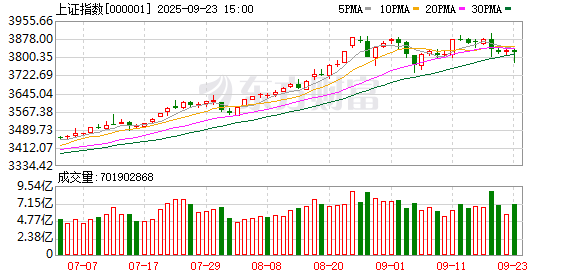
Market Performance - On September 23, the market experienced a rebound after a significant drop, with the ChiNext index rising by 0.21% while the Shanghai Composite Index fell by 0.18% and the Shenzhen Component Index dropped by 0.29% [2] - Over 4,200 stocks declined in the market, with a total trading volume of 2.49 trillion yuan, an increase of 372.9 billion yuan compared to the previous trading day [2] - The market saw a brief moment where the number of declining stocks exceeded 5,000, indicating high volatility [2] Technical Indicators - The Wind data indicated that the market indices, including the Wind All A Index and average stock price, approached the 30-day moving average, suggesting a weakening trend for most stocks [4] - The recent strong indices, such as the Shenzhen and ChiNext, experienced downward breaks of their 5-day or 10-day moving averages before slightly recovering [2][4] Market Sentiment and Expectations - There is a belief that a rebound is likely following the significant drop, supported by historical patterns of recovery after sharp declines [5] - The upcoming anniversary of the "9·24" market event is seen as a potential catalyst for market recovery, which could boost investor confidence [10] Fund Flows and External Influences - There were signs of capital inflow towards the end of the trading day, indicating a possible anticipation of market recovery [11] - External factors, such as the performance of US tech stocks, have influenced the A-share market, with some domestic tech stocks opening high but closing lower [11] Market Dynamics and Risks - Analysts suggest that the market's recent downturn may be attributed to profit-taking behavior ahead of the long holiday, particularly among leveraged funds [12] - The current financing balance stands at 2.4 trillion yuan, which, while not excessively high relative to market capitalization, indicates a significant amount of capital that could be affected by risk factors [12] Future Outlook - According to research from Huajin Securities, the market may see stronger performance in October and December due to potential policy shifts and expectations of liquidity easing from the Federal Reserve [15][16]

中金公司 大宗半小时
中金· 2025-09-17 00:50
Investment Rating - The report indicates a positive outlook for copper and gold, with expectations for copper prices to potentially break through $11,000 per ton in the fourth quarter of 2025 [2][15]. Core Insights - The current economic environment suggests limited upside for liquidity-driven asset price increases, but demand-side expectations remain cautiously optimistic [1][3]. - Gold and copper have performed well recently, with gold prices around $3,600 per ounce and copper prices nearing $10,000 per ton, benefiting from liquidity expectations and speculative positions [4][6]. - The report highlights the long-term value of gold as a safe-haven asset amid geopolitical uncertainties, despite short-term risks of liquidity premium corrections [8]. Summary by Sections Market Performance - Recent performance of the non-ferrous metals market has been positive, driven by macro liquidity and fundamental improvements [3]. - Different commodities have shown varied performance due to their fundamental conditions, with oil and iron ore facing supply excess, while gold and copper are more closely linked to financial indicators [5]. Federal Reserve Impact - The anticipated interest rate cut by the Federal Reserve in September is expected to positively impact gold and copper prices, although profit-taking risks may arise post-cut [6][7]. Supply and Demand Dynamics - Copper supply growth is expected to be low, with significant shortages anticipated by 2026, while electrolytic aluminum maintains high profitability due to slow overseas capacity release [2][16]. - Demand for copper has been supported by increased investment in power grid projects and a strong outlook in the renewable energy sector, despite some weakness in traditional demand [10][11]. Future Price Expectations - The report forecasts that copper prices will remain in a narrow range of $9,500 to $10,000 per ton in the second half of 2025, with potential upward pressure from improved liquidity and demand [9]. - The electrolytic aluminum price is projected to be around $2,750 per ton in the fourth quarter, supported by supply constraints [16]. Speculative Interest and Inventory Levels - Current speculative interest in the non-ferrous metals market, particularly copper, has decreased compared to earlier in the year, with inventory levels remaining manageable [11].
