
期限利差

Search documents
历史复盘:股牛期间的债市特征
GOLDEN SUN SECURITIES· 2025-08-21 01:35
Report Industry Investment Rating - Not mentioned in the report Core Viewpoints - The bond market is affected by the stock market, but the adjustment space is limited. Attention should be paid to stock market changes and fund duration to select the timing for increasing bond allocation [59] - Overall, during stock market rallies, government bond yields tend to move in sync with funds. If funds are generally loose, government bond yields show a long - term downward trend, with the term spread widening and the credit spread narrowing. In terms of fund diversion, household deposits often decrease year - on - year, bond fund shares may decline periodically but will recover in the later stage of the stock market growth. The scale of wealth management transferred to the stock market may be relatively limited, and the scale and proportion of insurance bond investment are expected to rise [4][58] Summary by Different Stock Market Rally Periods 2006 - 2007 Stock Market Rally - **Bond Market Performance**: Government bond yields rose significantly, fund prices increased, the term spread first narrowed, then widened, and then narrowed again, and the credit spread first narrowed and then widened. The Shanghai Composite Index rose from 1181 points at the beginning of 2006 to 6092 points in mid - October 2007. The 10 - year government bond yield rose from 3.1% to 4.5%, an increase of 139bps. R007 rose from 1.5% to a maximum of 7.1%. The government bond term spread first dropped from 140bp to 85bp in November 2006, then rose to 180bp at the end of June 2007, and then dropped to 122bp in mid - October 2007. The 1 - year medium - term note credit spread dropped from 138bp at the end of 2006 to 59bp in mid - August 2007 and then rose to 118bp in mid - October 2007 [1][8] - **Fund Diversion**: Household deposits decreased year - on - year, the shares of both stock - type and bond - type funds increased, and the balance of insurance bond investment rose. From the second quarter of 2006 to the third quarter of 2007, household deposits decreased by a cumulative 12857 billion yuan year - on - year. Stock - type fund shares increased from 1279 billion shares in January 2006 to 10112 billion shares in October 2007, an increase of 8833 billion shares. Bond - type fund shares increased by a cumulative 187 billion shares from 243 billion shares. The balance of insurance bond investment increased from 6600 billion yuan in December 2005 to 10420 billion yuan in June 2007, an increase of 3820 billion yuan [2][14][18] 2014 - 2015 Stock Market Rally - **Bond Market Performance**: Government bond yields decreased significantly, funds were generally loose, the term spread first narrowed and then widened, and the credit spread narrowed after fluctuations. The Shanghai Composite Index rose from 2024 points in mid - June 2014 to 5166 points in mid - June 2015. The 10 - year government bond yield dropped from 4.0% to about 3.6%, a decrease of 42bps. R007 first rose from 3.2% to 6.4% in late December 2014 and then dropped to 2.1%. The government bond term spread first narrowed from 63bp to 19bp in mid - October 2014 and then widened to 194bp in mid - June 2015. The 3 - year medium - term note credit spread narrowed from 136bp to 116bp overall [2][25] - **Fund Diversion**: Household deposits decreased year - on - year, the shares of stock - type and bond - type funds changed in opposite directions, the balance and proportion of insurance bond investment decreased, and the scale of wealth management increased. From July 2014 to June 2015, household deposits decreased by a cumulative 22655 billion yuan year - on - year. Bond - type fund shares increased by a cumulative 456 billion shares, while stock - type fund shares increased by a cumulative 1605 billion shares. The balance of insurance bond investment decreased from 35636 billion yuan in June 2014 to 35532 billion yuan in June 2015, and the proportion of bond investment dropped from 41.48% to 34.27%. The scale of bank wealth management products increased from 12.65 trillion yuan in June 2014 to 18.52 trillion yuan in June 2015 [2][33] 2024 - 2025 Stock Market Rally - **Bond Market Performance**: Government bond yields rose, funds were generally loose, and both the term spread and credit spread widened. The Shanghai Composite Index rose from 2863 points on September 24, 2024, to 3490 points on October 8, 2024, and then continued to fluctuate. From July 2025 to August 18, 2025, it rose from 3458 points to 3728 points. The 10 - year government bond yield first rose from 2.07% to 2.25%, then dropped rapidly to 1.60%, and since July 2025, it has been rising. R007 dropped from 2.03% on September 24, 2024, to 1.50% on August 18, 2025. During the two stock market rallies, the term spread widened by 16.5bp and 9.5bp respectively, and the 3 - year medium - term note credit spread widened by 21.5bp and 6.7bp respectively [2][42] - **Fund Diversion**: Household deposits decreased year - on - year, bond - type fund shares decreased, stock - type fund shares increased, the balance and proportion of insurance bond investment rose, and the balance of wealth management bond investment increased. In September 2024, household deposits decreased by 3257 billion yuan year - on - year, and in July 2025, they decreased by 7818 billion yuan year - on - year. Bond - type fund shares decreased by 7002 billion shares in October 2024, while stock - type fund shares increased by a cumulative 1319 billion shares in September and October 2024. The balance of life insurance company bond investment increased from 14.23 trillion yuan in September 2024 to 16.92 trillion yuan in June 2025, and the proportion increased from 49.18% to 51.90%. The balance of bank wealth management increased from 28.52 trillion yuan in June 2024 to 30.67 trillion yuan in June 2025, and the bond investment scale increased from 16.98 trillion yuan to 18.33 trillion yuan [3][50]
债市“跌麻了”!基金经理直言“压力大”
中国基金报· 2025-08-19 16:12
Core Viewpoint - The bond market is experiencing significant adjustments, with fund managers expressing concerns about pressure and actively shortening duration and adjusting structures to cope with future steepening of the yield curve [1][2][4]. Group 1: Market Conditions - The bond market faced a severe downturn on August 18, with 10-year and 30-year government bond yields rising by 5 basis points and 6 basis points respectively, closing at 1.79% and 2.06% [1]. - Despite a brief recovery earlier in August, the bond market has been under pressure again due to increased market risk appetite, with the 10-year government bond yield surpassing the high point from July [1][4]. Group 2: Fund Manager Insights - Fund managers are facing redemption pressures, particularly in bond funds, but they believe that the bond market does not have a foundation for a long-term decline, as the 10-year government bond yield of 1.8% reflects current expectations [2][9]. - The performance of pure bond funds has been poor, with average returns for medium to long-term pure bond funds at -0.19% and short bond funds at -0.03% [7]. Group 3: Factors Influencing the Bond Market - The bond market's adjustment is driven more by expectations rather than changes in the funding environment, with a potential shift from deflation to a mild inflation scenario impacting long-term bonds negatively [4][5]. - There is a notable lack of configuration funds from small and medium-sized banks, with a significant decrease in bond investment balances reported [4]. Group 4: Future Outlook and Strategies - Fund managers are adjusting their strategies to focus on shorter durations and are maintaining a neutral to high duration stance while reducing exposure to long-term rates [9]. - The overall sentiment is that while the bond market may not see significant positive catalysts in the short term, it remains within a range of support and resistance, with a cautious approach recommended [9]. Group 5: Recommendations for Investors - Fund managers suggest that credit bond funds may yield over 2% in the coming year, and investors should consider gradually increasing their exposure to these funds [11]. - For individual investors, maintaining a long-term perspective and potentially increasing allocations during market adjustments is advised, while also considering a balanced portfolio with some equity exposure [11].


固定收益点评:利率调整到位了吗?
Guohai Securities· 2025-08-18 12:32
Industry Investment Rating - No information provided Core Viewpoints - Since July, the long - end bond yields have risen and the yield curve has steepened. The adjustment of long - end rates is mainly due to the correction of deflation expectations, the rise of the stock market, and the improvement of market risk appetite. It is expected that when the 10 - year Treasury bond adjusts to around 1.80%, the bond market odds will be prominent, institutional trading willingness will increase, and the bond market may stabilize [8][17][29] Summary by Directory 1. Reasons for Recent Interest Rate Increases - The short - end interest rates have not changed significantly due to the continuous low - level of capital interest rates and the loose capital situation. Since April, the capital interest rate DR007 has continued to decline, and the inter - bank certificate of deposit rate has also shown a downward trend. Since August, the 1 - year inter - bank certificate of deposit rate has been running in the low - level range of 1.60 - 1.65% [11] - The "anti - involution" policy has led to an increase in inflation expectations and raised the long - end interest rate center. After the relevant policies were introduced in July, industries such as automobiles, photovoltaics, etc. started "anti - involution" actions, which increased inflation expectations [14] - The continuous rise of the stock market has suppressed the bond market. Since July, the stock market has accelerated its rise, the market risk preference has increased, and the long - end bond market has been suppressed [16] 2. Assessment of Interest Rate Adjustment - From the perspective of stock - bond correlation, the negative correlation between the Shanghai Composite Index and the 10Y Treasury bond yield is still strong. Since April this year, the negative correlation has been strong, and it is expected to remain so in the future, with the rise of equities continuing to suppress the bond market [19] - From the perspective of credit comparison, after the recent adjustment, as of August 15, the 10Y and 30Y Treasury bond yields have returned to a reasonable range compared with credit. The 10Y Treasury bond yield is 1.75%, slightly higher than the actual income of the first - home mortgage, and the 30Y Treasury bond yield is 2.05%, higher than the actual income of the second - home mortgage [20] - From the perspective of term spreads, the long - end interest rates still have room to rise. In previous similar adjustment periods, the term spreads increased by 25BP and 27BP respectively. In this round, from April 29 to August 15, the 10Y - 1Y term spread has increased by 21BP, and there is still 5BP of upward space [24]
超长债周报:30-10国债期限利差继续走阔-20250817
Guoxin Securities· 2025-08-17 05:56
Report Industry Investment Rating No relevant content provided. Core Viewpoints of the Report - Last week, the bond market tumbled again. Despite weak July economic data, the stock market reached 3700 points, suppressing bonds and causing ultra - long bonds to plunge, with the 30 - year Treasury yield hitting a short - term high. The trading activity of ultra - long bonds increased slightly, the term spread widened, and the variety spread narrowed [1][11][43]. - In the short term, the bond market will face a game between expectations and reality. The 10 - year Treasury will oscillate in the range of [1.65%, 1.75%]. The weak real fundamentals support the bond market, while policy changes and investor sentiment suppress it. Currently, the term spread of 30 - year Treasuries and the variety spread of 20 - year CDB bonds are both low, with limited spread protection [2][3][12]. Summary by Relevant Catalogs Weekly Review Ultra - long Bond Review - Last week, the bond market tumbled. Weak economic data in July, including rapid declines in consumption and investment and negative credit growth, were overshadowed by the stock market's rise to 3700 points, which comprehensively suppressed bonds. Ultra - long bonds plunged, and the 30 - year Treasury yield reached a short - term high. Trading activity increased slightly, the term spread widened, and the variety spread narrowed [1][11][43]. Ultra - long Bond Investment Outlook - **30 - year Treasury**: As of August 15, the spread between 30 - year and 10 - year Treasuries was 29BP, at a historically low level. In July, the economy faced downward pressure, with GDP growth at about 4.3% and deflation risks. The 10 - year Treasury will oscillate in the [1.65%, 1.75%] range. The current term spread is low, with limited protection [2][12]. - **20 - year CDB Bond**: As of August 15, the spread between 20 - year CDB bonds and 20 - year Treasuries was 2BP, at a historically extremely low level. Similar to the 30 - year Treasury situation, the short - term bond market faces a game between expectations and reality, and the current variety spread is low, with limited protection [3][13]. Ultra - long Bond Basic Overview - The balance of outstanding ultra - long bonds exceeded 22.8 trillion. As of July 31, the total amount of ultra - long bonds with a remaining term of over 14 years was 228,873 billion, accounting for 14.7% of all bonds. Local government bonds and Treasuries were the main varieties. In terms of remaining term, the 30 - year variety had the highest proportion [14]. Primary Market Weekly Issuance - Last week (August 11 - 15, 2025), the issuance of ultra - long bonds decreased significantly, with a total of 565 billion yuan. By variety, Treasuries were 350 billion, local government bonds were 178 billion, etc. By term, 20 - year bonds had the largest issuance at 436 billion [19]. This Week's Pending Issuance - The announced issuance plan for ultra - long bonds this week totals 2,953 billion. By variety, ultra - long Treasuries are 830 billion, and ultra - long local government bonds are 2,123 billion [26]. Secondary Market Trading Volume - Last week, ultra - long bonds were actively traded, with a turnover of 13,309 billion, accounting for 14.6% of all bonds. Compared with the previous week, the trading activity increased slightly, with the turnover and proportion of most varieties increasing [29]. Yield - Last week, the bond market tumbled. The 30 - year Treasury yield hit a short - term high. Yields of various ultra - long bonds increased, with the 30 - year Treasury yield rising by 9BP to 2.05%, and the 20 - year CDB bond yield rising by 6BP to 2.09% [43]. Spread Analysis - **Term Spread**: Last week, the term spread of ultra - long bonds widened but remained at a low absolute level. The 30 - year - 10 - year Treasury spread was 29BP, up 3BP from the previous week, at the 12% quantile since 2010 [51]. - **Variety Spread**: Last week, the variety spread of ultra - long bonds narrowed and was at a low absolute level. The spreads between 20 - year CDB bonds and Treasuries, and 20 - year railway bonds and Treasuries were 2BP and 6BP respectively, down 3BP and 5BP from the previous week, at the 3% and 4% quantiles since 2010 [52]. 30 - year Treasury Futures - Last week, the main 30 - year Treasury futures contract TL2509 closed at 117.48 yuan, a decline of 1.54%. The total trading volume was 870,600 lots, and the open interest was 151,500 lots, with trading volume increasing significantly and open interest decreasing slightly compared to the previous week [56].
7月零售、投资环比意外转负
HUAXI Securities· 2025-08-15 11:33
Economic Performance - July industrial added value growth slowed to 5.7%, down 1.1 percentage points from the previous month, while retail sales growth fell to 3.7% from 4.8%[2][3] - The weighted year-on-year growth rate of investment, retail, and export delivery value dropped to -0.1%, a decrease of 3 percentage points compared to the previous year[1] Demand and Supply Dynamics - The gap between supply and demand indicators reached 5.8 percentage points, the highest in recent years, indicating a significant demand shortfall[1] - July's industrial production and sales rate was 97.1%, down 0.2 percentage points year-on-year, showing a slight improvement compared to the previous month's decline of 0.3 percentage points[1] Export and Retail Trends - Export delivery value growth decreased to 0.8% in July from 4.0% in June, contributing approximately 0.09 percentage points to industrial added value growth, a drop of 0.35 percentage points from June[2] - Automotive retail sales plummeted to -1.5% in July, significantly impacting overall retail performance, which saw a reduction of 0.4 percentage points in its contribution[3] Investment Insights - Fixed asset investment growth for January to July was 1.6%, with a notable decline of 1.2 percentage points from the previous month, while equipment investment grew by 15.2%, down 2.1 percentage points[4] - July's fixed asset investment year-on-year dropped to -5.3%, influenced by extreme weather conditions affecting outdoor construction activities[4] Real Estate Market - Real estate sales area and sales value in July fell by 7.8% and 14.1% year-on-year, respectively, indicating a continued weakness in the sector[5] - New residential prices in July saw a month-on-month decline of 0.3%, with second-hand housing prices dropping by 0.5%, reflecting ongoing market challenges[5] Overall Economic Outlook - The overall economic data for July indicates a slowdown, with production showing resilience while demand remains weak[6] - The potential for new economic policies may arise in September and October, particularly in the real estate sector, as authorities seek to stabilize the market[5][8]
利率择时策略研究系列之二:“条件概率”视角下的期限利差新解
Shenwan Hongyuan Securities· 2025-08-13 08:17
Group 1 - The core viewpoint of the report emphasizes the long-term centrality of the yield spread between short and long-term bonds, indicating that the net financing ratio of credit bonds is a significant indicator of changes in the yield spread central [4][9][25] - The report identifies that the current net financing level of credit bonds is around 30%, suggesting that the 10-1Y yield spread may gradually rise to a range of 50-70 basis points [4][25] - The report discusses the impact of various factors on the yield spread fluctuations, categorizing them into monetary policy cycles, external shocks, and institutional behaviors, with a focus on the 10-1Y yield spread as a primary reference [4][79] Group 2 - The report introduces a "conditional probability" perspective for designing a timing strategy for the 10-1Y yield spread, utilizing 21 factor indicators across various dimensions such as funding conditions and institutional behavior [6][85] - Historical backtesting shows that since 2021, the weekly timing strategy has achieved a win rate of around 60%, indicating its effectiveness compared to conventional mean-reversion strategies [6][85] - The report highlights that the yield spread's fluctuations generally do not exceed 25 basis points under normal conditions, suggesting that simplistic historical upper and lower bounds may lead to misestimations in strategy design [4][79] Group 3 - The report outlines the relationship between the centrality of the yield spread and the net financing ratio of credit bonds, indicating that the latter has a leading role in predicting changes in the yield spread [20][25] - It details the historical phases of credit bond financing over the past 20 years, illustrating how changes in the net financing ratio correlate with shifts in the yield spread central [20][25] - The report notes that the yield spread may experience temporary deviations from the net financing ratio during exceptional circumstances, reflecting the influence of market dynamics [20][25] Group 4 - The report discusses the evolving dynamics of the ultra-long yield spread (30-10Y), emphasizing that institutional behaviors and the demand for long-duration assets are becoming increasingly significant [29][32] - It identifies that the trading volume of long-term bonds has increased, leading to a shift in the influence of the 30-year bond on the yield spread, indicating a growing demand for long-duration strategies [29][32] - The report suggests that the seasonal patterns of insurance premium income significantly impact the allocation of long-term bonds, affecting the ultra-long yield spread [33][41]
普通信用债性价比提升,平安公司债ETF(511030)备受关注
Sou Hu Cai Jing· 2025-08-12 02:11
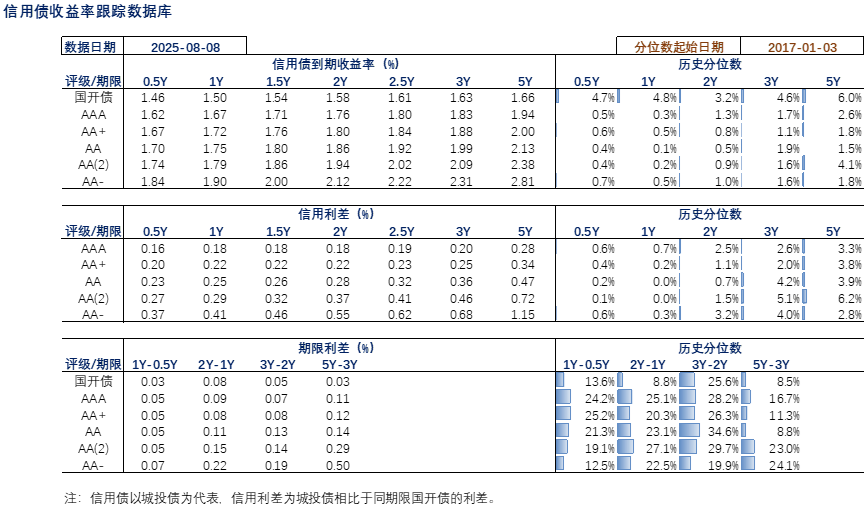
Group 1 - The core viewpoint indicates that the ordinary credit bonds have declined, with spreads continuing to compress, and AAA bonds with a maturity of 3 years or less are within the 3% percentile range, suggesting a focus on short to medium-term arbitrage [1] - Ordinary commercial paper bonds have seen a general decline in yields, with spreads compressing again, currently showing AAA 3-year spreads within the 10% percentile range, indicating limited cost-effectiveness [1] - The spreads for secondary bonds have also narrowed, remaining relatively tight but offering slightly better cost-effectiveness compared to ordinary commercial paper bonds [1] Group 2 - Data as of August 8, 2025, shows the yield rates for various credit bonds, with AAA bonds yielding 1.83% for 3-year maturities, and the historical percentile for this yield is at 0.3% [2] - The credit spreads for AAA bonds are reported at 0.20% for 3-year maturities, with a historical percentile of 2.6% [2] - The yield spread for AAA bonds over 1-year to 0.5-year is 0.05%, with a historical percentile of 24.2% [2]
超长债周报:资金面保持宽松,30,10国债期限利差走阔-20250811
Guoxin Securities· 2025-08-11 05:15
1. Report Industry Investment Rating No relevant content provided. 2. Core Views of the Report - Last week, the bond market rebounded slightly due to relatively loose liquidity, increased central bank repurchase operations, and successful issuance of new local bonds with higher yields than comparable old bonds [1][3][10][34]. - The trading activity of ultra - long bonds decreased slightly last week but remained quite active [1][3][10]. - The term spread of ultra - long bonds widened last week, while the variety spread showed mixed trends, and both were at relatively low absolute levels [1][3][4][10]. - For the 30 - year treasury bond, as of August 8, the spread between the 30 - year and 10 - year treasury bonds was 26BP, at a historically low level. The domestic economy showed resilience in June, but domestic demand was weak. The estimated GDP growth rate in June was about 5.2% year - on - year, up 0.1% from May, still higher than the annual target. However, the growth rates of social consumption and investment declined significantly in June. With deflation risks remaining, the bond market is expected to fluctuate narrowly [2][11]. - For the 20 - year CDB bond, as of August 8, the spread between the 20 - year CDB bond and the 20 - year treasury bond was 5BP, at a historically extremely low level. Similar to the 30 - year treasury bond situation, the bond market is expected to fluctuate narrowly [3][12]. 3. Summary by Relevant Catalogs 3.1 Weekly Review - Ultra - long Bond Review - The bond market rebounded slightly last week. Factors included relatively loose liquidity, increased central bank repurchase operations, and successful issuance of new local bonds with yields 5BP - 7BP higher than comparable old bonds [1][10][34]. - The trading activity of ultra - long bonds decreased slightly but remained quite active [1][10]. - The term spread of ultra - long bonds widened, and the variety spread showed mixed trends [1][4][10]. 3.2 Ultra - long Bond Investment Outlook 3.2.1 30 - year Treasury Bond - As of August 8, the spread between the 30 - year and 10 - year treasury bonds was 26BP, at a historically low level [2][11]. - In June, the domestic economy showed resilience, but domestic demand was weak. The estimated GDP growth rate in June was about 5.2% year - on - year, up 0.1% from May, still higher than the annual target. However, the growth rates of social consumption and investment declined significantly in June. In July, CPI was 0.0% and PPI was - 3.6%, indicating deflation risks [2][11]. - The strong stock market suppresses the bond market sentiment, but the domestic economy still faces downward pressure, and the fundamental factors supporting the bond market have not shown a turning point. The bond market is expected to fluctuate narrowly, and the term spread protection is limited [2][11]. 3.2.2 20 - year CDB Bond - As of August 8, the spread between the 20 - year CDB bond and the 20 - year treasury bond was 5BP, at a historically extremely low level [3][12]. - Similar to the 30 - year treasury bond situation, the domestic economy showed resilience in June but with weak domestic demand, deflation risks remained, and the bond market is expected to fluctuate narrowly. The variety spread protection is limited [3][12]. 3.3 Ultra - long Bond Basic Overview - As of July 31, the balance of ultra - long bonds with a remaining maturity of over 14 years was 22.8873 trillion yuan (excluding asset - backed securities and project revenue notes), accounting for 14.7% of the total bond balance [13]. - Local government bonds and treasury bonds are the main varieties of ultra - long bonds. Treasury bonds accounted for 26.5%, local government bonds 67.5%, policy - based financial bonds 2.0%, government agency bonds 1.9%, commercial bank sub - debt 0.3%, corporate bonds 0.5%, enterprise bonds 0.1%, medium - term notes 1.2%, private bonds 0.0%, and directional instruments 0.0% [13]. - The 30 - year variety has the highest proportion. Bonds with a remaining maturity of 14 - 18 years accounted for 26.5%, 18 - 25 years 26.9%, 25 - 35 years 40.9%, and over 35 years 5.7% [13]. 3.4 Primary Market 3.4.1 Weekly Issuance - Last week (August 4 - 8, 2025), the issuance of ultra - long bonds decreased slightly. A total of 140 billion yuan of ultra - long bonds were issued [18]. - By variety, treasury bonds accounted for 82 billion yuan, local government bonds 56 billion yuan, policy - based bank bonds 0 billion yuan, government - supported agency bonds 0 billion yuan, medium - term notes 0 billion yuan, corporate bonds 2 billion yuan, directional instruments 0 billion yuan, enterprise bonds 0 billion yuan, and bank sub - debt 0 billion yuan [18]. - By term, bonds with a 15 - year term accounted for 8 billion yuan, 20 - year 2 billion yuan, 30 - year 130.1 billion yuan, and 50 - year 0 billion yuan [18]. 3.4.2 This Week's Planned Issuance - The announced issuance plan for ultra - long bonds this week is 55.3 billion yuan in total. Ultra - long treasury bonds account for 35 billion yuan, ultra - long local government bonds 17.8 billion yuan, ultra - long corporate bonds 0 billion yuan, ultra - long medium - term notes 2.5 billion yuan, and ultra - long government - supported agency bonds 0 billion yuan [24]. 3.5 Secondary Market 3.5.1 Trading Volume - Last week, the trading of ultra - long bonds was quite active, with a trading volume of 1.119 trillion yuan, accounting for 13.5% of the total bond trading volume. By variety, the trading volume of ultra - long treasury bonds was 917 billion yuan, accounting for 43.3% of the total treasury bond trading volume; ultra - long local bonds 179.8 billion yuan, accounting for 56.7% of the total local bond trading volume; ultra - long policy - based financial bonds 6.4 billion yuan, accounting for 0.2% of the total policy - based financial bond trading volume; and ultra - long government agency bonds 4.2 billion yuan, accounting for 27.0% of the total government agency bond trading volume [26]. - The trading activity of ultra - long bonds decreased slightly last week. Compared with the previous week, the trading volume decreased by 362.7 billion yuan, and the proportion decreased by 2.5%. Among them, the trading volume of ultra - long treasury bonds decreased by 287.1 billion yuan, and the proportion decreased by 3.2%; ultra - long local bonds decreased by 42.6 billion yuan, and the proportion decreased by 1.7%; ultra - long policy - based financial bonds decreased by 5.7 billion yuan, and the proportion decreased by 0.2%; ultra - long government agency bonds decreased by 3.1 billion yuan, and the proportion decreased by 60.7% [26][27]. 3.5.2 Yield - Last week, the bond market rebounded slightly. In terms of treasury bonds, the yields of 15 - year, 20 - year, 30 - year, and 50 - year bonds changed by - 1BP, 0BP, 1BP, and - 1BP respectively, reaching 1.84%, 1.97%, 1.96%, and 2.00%. For CDB bonds, the yields of 15 - year, 20 - year, 30 - year, and 50 - year bonds changed by 2BP, 2BP, 1BP, and - 1BP respectively, reaching 1.96%, 2.02%, 2.06%, and 2.24%. For local bonds, the yields of 15 - year, 20 - year, and 30 - year bonds changed by 0BP, - 1BP, and 1BP respectively, reaching 2.01%, 2.08%, and 2.10%. For railway bonds, the yields of 15 - year, 20 - year, and 30 - year bonds changed by - 2BP, - 1BP, and 2BP respectively, reaching 2.04%, 2.08%, and 2.14% [34]. - For representative individual bonds, the yield of the 30 - year treasury bond active bond 24 Special Treasury Bond 06 changed by 3BP to 1.97%, and the yield of the 20 - year CDB bond active bond 21 CDB 20 changed by 4BP to 2.00% [35]. 3.6 Spread Analysis 3.6.1 Term Spread - Last week, the term spread of ultra - long bonds widened, and the absolute level was low. The spread between the 30 - year and 10 - year treasury bonds was 26BP, a change of 2BP from the previous week, and it was at the 10% quantile since 2010 [43]. 3.6.2 Variety Spread - Last week, the variety spread of ultra - long bonds showed mixed trends, and the absolute level was low. The spread between the 20 - year CDB bond and the treasury bond was 5BP, and the spread between the 20 - year railway bond and the treasury bond was 11BP, changing by 1BP and - 1BP respectively from the previous week, and both were at the 7% quantile since 2010 [48]. 3.7 30 - year Treasury Bond Futures - Last week, the main contract of the 30 - year treasury bond futures, TL2509, closed at 119.32 yuan, an increase of 0.92%. The total trading volume was 602,000 lots (a decrease of 181,003 lots), and the open interest was 152,600 lots (a decrease of 8,080 lots). The trading volume decreased significantly compared with the previous week, and the open interest decreased slightly [50].
超长债周报:资金面保持宽松,30-10国债期限利差走阔-20250811
Guoxin Securities· 2025-08-11 02:48
Report Industry Investment Rating No relevant content provided. Core Viewpoints - Last week, the bond market rebounded slightly due to relatively loose funding, increased central bank repurchase operations, and successful issuance of new local bonds with higher yields than comparable old bonds [1][3][10][34]. - The trading activity of ultra - long bonds decreased slightly last week but remained quite active [1][3][10]. - The term spread of ultra - long bonds widened last week, while the variety spread showed mixed changes [1][3][10]. - For the 30 - year treasury bond, as of August 8, its spread with the 10 - year treasury bond was 26BP, at a historically low level. The domestic economy showed resilience in June but with weak domestic demand. The estimated GDP growth rate in June was about 5.2% year - on - year, up 0.1% from May. However, the growth rates of social consumption and investment declined significantly. With deflation risks still present, the bond market is expected to fluctuate narrowly [2][11]. - For the 20 - year CDB bond, as of August 8, its spread with the 20 - year treasury bond was 5BP, at a historically extremely low level. Given the economic situation and deflation risks, the bond market is expected to fluctuate narrowly [3][12]. Summary by Directory Weekly Review Ultra - long Bond Review - The bond market rebounded slightly last week. Factors included loose funding, increased central bank repurchase, and successful local bond issuance with higher yields on new bonds [1][10][34]. - Trading activity of ultra - long bonds decreased slightly but remained active [1][3][10]. - The term spread of ultra - long bonds widened, and the variety spread showed mixed changes [1][3][10]. Ultra - long Bond Investment Outlook - **30 - year Treasury Bond**: The spread with the 10 - year treasury bond was 26BP as of August 8, at a low historical level. The domestic economy had resilience in June but weak domestic demand. The estimated June GDP growth was 5.2% year - on - year, up 0.1% from May. Social consumption and investment growth declined. With 7 - month CPI at 0.0% and PPI at - 3.6%, deflation risks persisted. The bond market is expected to fluctuate narrowly, and the term spread protection is limited [2][11]. - **20 - year CDB Bond**: The spread with the 20 - year treasury bond was 5BP as of August 8, at an extremely low historical level. Similar to the 30 - year treasury bond situation, the bond market is expected to fluctuate narrowly, and the variety spread protection is limited [3][12]. Ultra - long Bond Basic Overview - The balance of outstanding ultra - long bonds exceeded 22.8 trillion. As of July 31, 2025, the total amount of ultra - long bonds with a remaining maturity of over 14 years was 228,873 billion, accounting for 14.7% of all bonds. Local government bonds and treasury bonds were the main varieties [13]. - By variety, treasury bonds accounted for 26.5% (60,623 billion), local government bonds 67.5% (154,423 billion), etc. By remaining maturity, the 25 - 35 - year variety accounted for the highest proportion at 40.9% (93,594 billion) [13]. Primary Market Weekly Issuance - Last week (August 4 - 8, 2025), the issuance of ultra - long bonds decreased slightly, with a total of 1,400 billion issued. Compared with the previous week, the total issuance decreased [18]. - By variety, treasury bonds were 820 billion, local government bonds 560 billion, etc. By term, 30 - year bonds accounted for the largest share with 1,301 billion [18]. This Week's Planned Issuance - The announced ultra - long bond issuance plan for this week totals 553 billion. Ultra - long treasury bonds are 350 billion, ultra - long local government bonds 178 billion, etc. [24]. Secondary Market Trading Volume - Last week, ultra - long bonds were actively traded, with a turnover of 11,190 billion, accounting for 13.5% of all bond turnovers. The trading activity decreased slightly compared with the previous week [26]. - By variety, ultra - long treasury bonds had a turnover of 9,170 billion, accounting for 43.3% of all treasury bond turnovers; ultra - long local bonds 1,798 billion, accounting for 56.7% of all local bond turnovers, etc. [26]. Yield - The bond market rebounded slightly last week. Yields of different types of ultra - long bonds changed. For example, in treasury bonds, 15 - year yields changed by - 1BP to 1.84%, etc. [34]. - For representative individual bonds, the yield of the 30 - year treasury bond active bond 24 Special Treasury Bond 06 changed by 3BP to 1.97%, and the yield of the 20 - year CDB bond active bond 21 CDB 20 changed by 4BP to 2.00% [35]. Spread Analysis - **Term Spread**: The term spread of ultra - long bonds widened last week but remained at a low absolute level. The 30 - year - 10 - year treasury bond spread was 26BP, up 2BP from the previous week, at the 10% quantile since 2010 [43]. - **Variety Spread**: The variety spread of ultra - long bonds showed mixed changes last week and remained at a low absolute level. The 20 - year CDB bond - treasury bond spread was 5BP, and the 20 - year railway bond - treasury bond spread was 11BP, with changes of 1BP and - 1BP respectively from the previous week, at the 7% quantile since 2010 [48]. 30 - year Treasury Bond Futures - Last week, the main contract of the 30 - year treasury bond futures, TL2509, closed at 119.32 yuan, an increase of 0.92%. The total trading volume was 602,000 lots (- 181,003 lots), and the open interest was 152,600 lots (- 8,080 lots). The trading volume decreased significantly, and the open interest decreased slightly compared with the previous week [50].
债市机构行为周报(8月第1周):大行买长债了吗?-20250810
Huaan Securities· 2025-08-10 12:29
Report Information - Report Title: "Fixed Income Weekly: Have Large Banks Started Buying Long-Term Bonds? - Weekly Report on Bond Market Institutional Behavior (Week 1 of August)" [1] - Report Date: August 10, 2025 [2] - Chief Analyst: Yan Ziqi [3] - Analyst: Hong Ziyan [3] 1. Report Industry Investment Rating No industry investment rating information is provided in the report. 2. Report Core View - The bond market ran smoothly this week, with the 10-year Treasury yield slightly dropping to 1.69%, the funding rate staying around 1.42%, and the 5-year AAA medium - short note yield dropping to 1.91% [3][11] - Large banks continued to buy short - term bonds, and although they bought some long - term bonds, the volume was less than 10 billion yuan, so it's hard to say they have started buying long - term bonds. However, they have bought long - term local government bonds in multiple weeks since June, which may be related to duration balance and return requirements [3][4][12] - Funds further increased their purchases of credit bonds and Tier 2 capital bonds. With the easing of the funding situation, the bond market leverage ratio climbed, and there is still an opportunity for credit spreads to compress [4][13] 3. Summary by Directory 3.1 This Week's Institutional Behavior Review - **Yield Curve**: Treasury yields declined overall, with the 1Y yield down 2bp, 3Y down 3bp, 5Y down about 3bp, 7Y down 1bp, 10Y down 2bp, 15Y flat, and 30Y up 1bp. For CDB bonds, short - term yields declined and long - term yields increased, with the 1Y yield changing less than 1bp, 3Y down 1bp, 5Y down 1bp, 7Y changing less than 1bp, 10Y up 2bp, 15Y up 2bp, and 30Y up 1bp [14] - **Term Spread**: Treasury interest spreads rose, and the spreads widened overall; CDB bond interest spreads were stable, and the middle - term spreads widened [15][16][17] 3.2 Bond Market Leverage and Funding Situation - **Leverage Ratio**: It dropped to 107.51%. From August 4th to August 8th, it first decreased and then increased during the week. As of August 8th, it was about 107.51%, down 0.07 pct from last Friday and up 0.24 pct from Monday [21] - **Average Daily Turnover of Pledged Repurchase**: The average daily turnover of pledged repurchase this week was 8.1 trillion yuan, with the average daily overnight proportion at 89.87%. The average overnight turnover was 7.3 trillion yuan, up 1.53 trillion yuan month - on - month, and the overnight trading proportion was up 3.10 pct [27][28] - **Funding Situation**: Bank lending showed a fluctuating upward trend. As of August 8th, large and policy banks' net lending was 5.22 trillion yuan; joint - stock and urban/rural commercial banks' average daily net borrowing was 0.57 trillion yuan, and the net borrowing on August 8th was 0.74 trillion yuan. The net lending of the banking system was 4.47 trillion yuan. DR007 fluctuated upward, and R007 fluctuated downward [31] 3.3 Duration of Medium - and Long - Term Bond Funds - **Median Duration**: The median duration of medium - and long - term bond funds decreased to 2.81 years (de - leveraged) and 3.12 years (leveraged). On August 8th, the de - leveraged median duration was 2.81 years, down 0.02 years from last Friday; the leveraged median duration was 3.12 years, down 0.06 years from last Friday [45] - **Duration by Bond Fund Type**: The median duration (leveraged) of interest - rate bond funds decreased to 3.92 years, up 0.04 years from last Friday; the median duration (leveraged) of credit bond funds decreased to 2.89 years, down 0.07 years from last Friday. The de - leveraged median duration of interest - rate bond funds was 3.44 years, down 0.03 years from last Friday; the de - leveraged median duration of credit bond funds was 2.65 years, down 0.04 years from last Friday [48] 3.4 Category Strategy Comparison - **Sino - US Yield Spread**: It generally narrowed, with the 1Y narrowing by 8bp, 2Y by 10bp, 3Y by 6bp, 5Y by 9bp, 7Y by 7bp, 10Y by 6bp, and 30Y by 3bp [54] - **Implied Tax Rate**: It generally widened. As of August 8th, the CDB - Treasury spread widened by 2bp for 1Y, 2bp for 3Y, 1bp for 5Y, about 1bp for 7Y, 3bp for 10Y, about 2bp for 15Y, and less than 1bp for 30Y [55] 3.5 Bond Lending Balance Changes - On August 8th, the lending concentration of the active 10 - year Treasury bond increased, while the lending concentration trends of the second - active 10 - year Treasury bond, active 10 - year CDB bond, second - active 10 - year CDB bond, and active 30 - year Treasury bond declined. All institutions showed a decline [59]