美债利率

Search documents
有色金属行业报告:关税预期扰动不改黄金上行趋势
China Post Securities· 2025-06-03 02:23
Investment Rating - The industry investment rating is "Outperform the Market" and is maintained [2] Core Views - The report highlights that the gold price trend remains upward despite fluctuations caused by tariff expectations, with a strong focus on inflation resilience and long-term interest rates [5] - Copper prices are expected to continue fluctuating around a cost level of $9,350 due to tariff uncertainties and macroeconomic factors [6] - Aluminum prices are projected to rise, supported by strong domestic demand and inventory depletion [6] - Molybdenum prices are increasing due to tight supply and stable demand from the steel sector [7] - Rare earth prices are under short-term pressure but are expected to recover as export controls ease and mining quotas are issued [7] Summary by Sections Industry Overview - The closing index for the industry is at 4,668.39, with a weekly high of 5,020.22 and a low of 3,700.9 [2] Price Movements - Basic metals saw price declines: Copper down 1.03%, Aluminum down 1.39%, Zinc down 2.93%, Lead down 1.23%, and Tin down 6.73% - Precious metals experienced mixed results: Gold up 0.41%, Silver down 0.93%, Platinum down 9.60% [21] Inventory Changes - Global visible inventories showed a decrease: Copper down 11,442 tons, Aluminum down 12,499 tons, Zinc down 12,099 tons, Lead down 4,080 tons, Tin down 106 tons, and Nickel down 681 tons [26]
美欧关税风波再起,美债利率继续向上突破
HTSC· 2025-05-26 02:25
Economic Indicators - The Atlanta Fed's GDP Now indicates a 2.4% actual GDP growth rate for Q2 2025, with a -0.1% adjustment excluding gold impacts[1] - The actual personal consumption Nowcast rose to 3.7% last week, indicating strong consumer spending[1] - Initial jobless claims decreased to 227,000, below expectations, while continuing claims increased to 1.903 million, exceeding forecasts[1] Manufacturing and PMI Data - The US May PMI rose to 52.5, with both manufacturing and services PMIs at 52.3, surpassing expectations and previous values[2] - Eurozone and Japan's manufacturing PMIs also exceeded expectations, at 49.4 and 49 respectively, although service sectors showed weakness[2] Policy Developments - The US House passed the "Beautiful Act," which includes tax cuts, defense spending, and an increase in the debt ceiling, with fiscal expansion slightly exceeding expectations[3] - Trump threatened to impose a 50% tariff on the EU starting June 1, while Japan softened its stance on tariffs[3] Financial Market Trends - US stock markets experienced a pullback, with the S&P 500, Nasdaq, and Dow Jones down 2.6%, 2.5%, and 2.5% respectively[4] - The yield on 2-year, 10-year, and 30-year US Treasuries rose by 2bp, 8bp, and 15bp to 4.0%, 4.51%, and 5.04% respectively[4] - The US dollar index fell by 1.8% to 99.1, while the euro and yen appreciated by 0.9% to 1.13 and 1.3% to 143.3 respectively[4] Commodity Prices - COMEX gold futures increased by 5.6% to $3365.8 per ounce, while Brent crude oil rose by 0.7% to $65.6 per barrel[4]
【招银研究|资本市场快评】美债利率全线上升的原因及后市展望
招商银行研究· 2025-05-23 01:13
一、美债利率上行的原因 美东时间5月21日,美债利率全线上升,10年期美债利率突破4.6%,30年期美债利率突破5.0%,我们对此点评 如下: 第一,20年期美债拍卖结果较差,这是利率上行的导火索。 20年期美债最终得标利率为5.05%,相较4月高出 约20BP,也是自2023年11月以来首次突破5.0%整数大关,投标倍数同样出现了明显下滑。 第四,美国经济硬数据稳健,市场对通胀存在担忧,叠加美联储在降息问题上维持定力,基本面和货币政策对 利率偏空。 二、美债策略展望:短期波动不改震荡趋势,配置中短久期美债,回避长债 短期来看,上述利空因素可能将继续发酵,利率存在进一步冲高的风险,但美国评级下调等因素偏短期,影响 预计难以持久,同时美国经济在关税和通胀背景下仍有压力,认为美债利率不具备持续大幅上行的条件,维持 利率宽幅震荡的观点不变。考虑到美债票息收益可观,仍值得配置,建议维持中短久期美债的配置,以票息策 略为主,长久期债券建议回避,若10Y国债利率上升至4.7%-5%区间,可能是一个较好的配置窗口。 -END- 本期作者 陈峤 资本市场研究员 chenqiao426 @cmbch ina .com 刘东亮 ...

股指早报:20年美债拍卖遇冷,A股震荡反复-20250522
Chuang Yuan Qi Huo· 2025-05-22 11:52
股指早报 20 年美债拍卖遇冷,A 股震荡反复 2025 年 5 月 22 日 股指期货早报 2025.5.22 报告摘要: 海外方面,近期虽然美联储、美国财政部对穆迪下调美信用评级 进行了预期管理,但市场对美国财政问题的担忧并未消退。周三 160 亿美元的 20 年期美国国债拍卖最终得标利率为 5.047%,突破 5%大 关,反映投资者对美国国债的情绪进一步恶化。隔夜市场走势来看, 美债利率拍卖遇冷风险资产,美元指数进一步回落,10 年期美债收 益上升至 4.6%,黄金上涨,美三大股指跌幅均在 1%以上,纳斯达克 中国金龙指数下跌 0.72%,离岸人民币汇率升值。关注美国资产资金 流出后流入新兴市场的迹象。 国内盘面上看,周三大盘低开震荡上涨 0.21%,深成指上涨 0.44%,创业板指上涨 0.83%,市场呈现指数震荡反弹,但个股缺走弱 的走势。板块依旧是电风扇行情。从一级板块上看,煤炭、有色、电 力设备、银行涨幅靠前,美容护理、电子、社会服务、传媒跌幅靠前。 全市场 1615 只个股上涨,3599 只个股下跌。消息上看,中国与东盟 十国全面完成中国—东盟自贸区 3.0 版谈判。 整体来看,隔夜美 10 ...
红利港股ETF(159331)涨超0.4%,机构表示港股红利资产具备底仓配置价值,盘中溢价交易
Mei Ri Jing Ji Xin Wen· 2025-05-22 05:21
Group 1 - The core viewpoint is that Hong Kong dividend assets have value for bottom-line allocation, especially considering the downward pressure on the mainland economy and the historical performance of these assets during similar economic conditions [1] - The mainland economy is experiencing downward pressure, with a slowdown in private sector credit growth following the weakening of the "9.24" policy pulse and reduced necessity for policy hedging due to unexpected developments in US-China tariff negotiations [1] - Historically, during phases of weakened private sector credit, Hong Kong dividend assets have shown relative superiority [1] Group 2 - There is increasing uncertainty regarding the decline in US Treasury yields, as the US economy faces "stagflation" risks and the Federal Reserve remains in a wait-and-see mode, maintaining its stance during the May FOMC meeting [1] - The uncertainty surrounding Trump's policies has cast a shadow over US dollar credit, presenting challenges for the decline in US Treasury yields [1] - The Hong Kong dividend ETF (159331) tracks the Hong Kong Stock Connect High Dividend (HKD) Index (code: 930914), which selects high dividend yield securities listed in Hong Kong, primarily covering transportation, resources, and consumer sectors [1]
【德邦海外市场】积极信号有望释放——美联储5月利率决议前瞻
Sou Hu Cai Jing· 2025-05-06 23:35
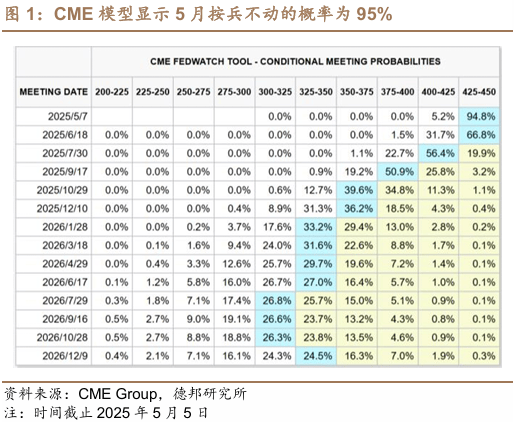
Key Points - The Federal Reserve is expected to maintain interest rates in May, with a 95% probability of no change, due to the resilience of the US economy and limited impact from tariffs on employment and inflation [1] - Current economic data shows signs of moderate weakening but no recession indicators, with significant layoffs in April not reflected in non-farm payroll data and strong PMI figures [1] - The focus will be on how Fed Chair Powell assesses the economic situation during the press conference, as any slowdown in employment and consumption could lead to recession risks [1] Outlook - The relationship between the White House and the Federal Reserve has eased, increasing the likelihood of the Fed sending positive signals [2] - Following strong non-farm payroll and PMI data, expectations for rate cuts have been delayed, and the Fed may have more room to stabilize market and economic expectations [2] - The upcoming FOMC meeting aims to provide a relatively positive signal to maintain market recovery since late April, reducing the potential for future interference from the Trump administration [2] Market Impact - The Fed's positive signals could lead to an increase in the probability of rate cuts if economic data weakens in the future [2] - The 10-year US Treasury yield and short-term rates are expected to trend downward, with US stocks entering a consolidation phase after volatility decreases [2] - It is suggested to gradually invest in US stocks, particularly in small-cap growth sectors, which may have greater upside potential compared to large-cap indices like the Dow and Nasdaq [2]
债市启明|美国经济成色究竟如何?
中信证券研究· 2025-05-06 05:47
文 | 明明 周成华 王楠茜 2 0 2 5年一季度美国GDP实际环比折年率从2 0 2 4年四季度的2 . 4%快速下降至- 0 . 3%,主要拖累为进 口增加、政府支出减少,同时美国消费韧性也在下降。4 月美国非农数据显示美国就业市场近期保 持了相对平稳,市场降息预期降温。若特朗普关税倾向不改,特朗普关税等政策对美国经济的负面 冲击预计将持续,未来美国就业市场、GDP增长难言乐观。 ▍ 2 0 2 5年一季度美国GDP实际环比折年率从2 0 2 4年四季度的2 . 4%快速下降至- 0 . 3%,主要拖累 为进口增加、政府支出减少。 从私人投资细分项来看,美国私人投资项中最高贡献项为私人库存增加,其次为企业投资项增 加,但其主要由关税政策下抢库存推动,企业未来库存预期实际上在下降。美国GDP私人存货变 化的领先指标出现下降迹象,中小企业的库存扩张计划预期在特朗普上台后也显著下滑。美国企 业累库行为未来或随着关税政策逐步落地而减弱,美国GDP私人存货变化对美国GDP的正向贡献 或将随之下降。 ▍ 美国企业投资或仍有一定韧性,但美国住宅投资受高利率抑制。 美国制造业核心资本品新订单从2 0 2 4年末开始提升 ...

中信证券:美国财政压力对美债影响几何?
news flash· 2025-04-29 00:17
Group 1 - The core viewpoint of the article is that the U.S. fiscal pressure is expected to impact U.S. Treasury yields, particularly with concerns over budget resolutions and potential government shutdowns [1] - The U.S. Congress passed a budget resolution for the fiscal year 2025 in April, but it lacks legal effect and cannot directly allocate funds [1] - If the budget bill is not passed by September 30, a temporary funding bill will be required to avoid government shutdown risks [1] Group 2 - The implementation of the Trump tax cuts this year is anticipated to further increase the U.S. fiscal deficit pressure [1] - Market concerns regarding fiscal pressure and inflation risks are likely to keep U.S. Treasury yields, particularly the mid-term premium and inflation expectations, elevated [1] - The 10-year U.S. Treasury yield is expected to remain above 4.0% for some time, with future downward movement dependent on Trump’s policies, the economic pressures in the U.S., and Federal Reserve statements [1]

债市启明|美国财政压力对美债影响几何?
中信证券研究· 2025-04-29 00:09
文 | 明明 周成华 王楠茜 虽然今年4月美国国会通过了2 0 2 5财年预算决议,但该决议并不具有法律效力也不能直接拨款。预计今年预算法案需要在9月3 0 日前通过,否则国会则需通过临时拨款法案以避免政府停摆风险。特朗普减税法案今年若落地,美国财政赤字压力将进一步攀 升。市场对于财政压力的担忧以及对于通胀风险的担忧将持续导致美债利率中期限溢价以及通胀预期部分高位运行,进而1 0年 期美债利率中枢或一段时间在4 . 0%以上,后续美债利率下行空间的打开或需观察特朗普政策、美国经济承压状况和美联储表 态。 ▍ 2 0 2 5年4月1 0日美国众议院以2 1 6票对2 1 4票通过了参议院修订的2 0 2 5财年预算决议。 预算决议是国会内部指导文件,设定了政府在特定时期内的财政收支预期,不具有法律效力、无需总统签署和直接拨款。只要 参众两院通过相同的预算决议,该年度决议即被采纳。预算决议主要为后续立法确定财政方向和规模,以及为国会内部的预算 协调和审议提供基础。按照《1 9 7 4年国会预算法》,预算决议应在4月1 5日前通过,但实际较多财年未有决议通过。若无新决 议通过,前一决议的支出限额和收入下限会自动在剩 ...
信用债|近期中资美元债干扰因素与参与时机
中信证券研究· 2025-04-23 23:58
Core Viewpoint - The recent fluctuations in the Chinese dollar bond market are primarily driven by changes in tariff policies, leading to liquidity tightening and an increase in long-term risk premiums, rather than changes in the credit risk of Chinese entities [1][2]. Market Fluctuations - Since April 2025, the U.S. Treasury rates have rapidly increased due to poor auction results, liquidity tightening, and rising risk premiums, with the 10-year U.S. Treasury yield reaching 4.48% on April 11, up 31 basis points from the beginning of the month [2]. - The overall yield of Chinese dollar bonds has risen significantly, with the iBoxx index reflecting substantial increases, reaching year-to-date highs [2]. Impact of U.S. Treasury Maturities - In 2025, the U.S. Treasury has a high maturity scale of $9.8 trillion, with a peak maturity period from April to July exceeding $1 trillion monthly, and Q2 alone accounting for $5.45 trillion [3]. - The concentrated maturity pressure may tighten market liquidity and increase refinancing costs, potentially affecting market confidence in U.S. fiscal health and raising risk premiums [3]. Tariff Policy Effects - The impact of new U.S. tariffs on Chinese dollar bonds is expected to be relatively small, as the majority of existing bonds are concentrated in real estate, urban investment, and financial sectors, which are less exposed to tariff impacts [4]. - The ability of companies to mitigate tariff impacts through production relocation and regional export transformation further reduces the direct shock from tariff policies [4]. Sector-Specific Analysis - Urban investment bonds are less affected by tariff changes, as regions with high export volumes are primarily located in coastal provinces, which have lower debt repayment pressures [5]. - Financial sector bonds, particularly those issued by major state-owned banks, are well-capitalized and have diversified client bases, minimizing the impact of potential declines in loan quality [5]. Investment Strategy - The current Chinese dollar bonds exhibit attractive value for allocation, especially in light of potential capital gains from rising expectations of U.S. Federal Reserve rate cuts [6]. - Focus is recommended on short-duration AT1 bonds from state-owned banks and high-yielding central enterprise AMC dollar bonds, which have a favorable pricing differential compared to domestic bonds [6].