美元信用
Search documents
美国传来2个消息,一好一坏,经济可能回到1970年,黄金继续暴涨
Sou Hu Cai Jing· 2025-11-12 13:57
Group 1 - The U.S. government has temporarily resolved the shutdown issue by passing a "temporary funding bill" that extends government operations until January 31 of the following year, ensuring funding for key programs like SNAP and veterans affairs [2] - The economic loss during the government shutdown has exceeded $10 billion, impacting business operations and citizens' lives [2] - Despite the short-term relief from the funding bill, the ongoing sharp divisions between the two political parties raise uncertainties about reaching a long-term agreement in the next three months, which could continue to affect the stability of the U.S. economy and financial markets [2][12] Group 2 - The San Francisco Fed President, Mary Daly, issued a strong warning about the U.S. economy potentially reverting to the stagflation path of the 1970s, rather than the prosperous path of the 1990s [4][6] - The 1970s stagflation period was characterized by high inflation, stagnant economic growth, and rising unemployment, with the Fed's premature easing of policies leading to a resurgence of inflation [6] - The current Fed's concerns suggest that excessive rate cuts could lead the U.S. economy back into stagflation, which has heightened market worries about the economic outlook [7][13] Group 3 - Following the news, gold prices surged significantly, and the Chinese yuan appreciated, reflecting global capital's concerns about the credibility of the U.S. dollar [9][14] - The ongoing increase in U.S. debt levels and high-interest rate policies have temporarily stabilized the dollar but have not prevented capital outflows [10] - The situation indicates that monetary credibility is influenced not only by interest rates but also by the overall economic reputation of the country [11] Group 4 - The temporary resolution of the government shutdown provides short-term benefits to the market, but the intensified political divisions create long-term policy uncertainties [12] - The Fed's warning about stagflation deepens market concerns regarding the U.S. economic outlook, which could have broader implications for the global economy [13][15] - For investors, gold and the yuan may emerge as significant safe-haven options amid the ongoing economic transformations [16]
第一创业晨会纪要-20251112
First Capital Securities· 2025-11-12 07:27
Industry Overview - Taiwan's NOR Flash storage manufacturer Winbond indicated a 50% increase in NOR Flash usage due to the rising demand from AI servers transitioning from HBM3E to HBM4, with plans to raise NOR Flash prices by up to 30% in Q1 next year [3] - The AIOT sector is experiencing rapid growth, as evidenced by the performance of major domestic listed companies, indicating a clear upward trend in storage demand over the next two years [3] Advanced Manufacturing - CATL has made significant supply chain moves, including a framework agreement with Jiangyuan Technology to secure a minimum capacity of 626,000 tons and strategic investments in Tianhua New Energy to ensure lithium salt supply [7] - In October, battery production increased by 22.4% month-on-month, with utilization rates nearing 90%. CATL reported a saturated energy storage capacity with a production of approximately 180 GWh in Q3, maintaining a utilization rate above 90% [7] - The asset expenditure growth for CATL and other companies in the sector indicates a strong commitment to expanding capacity and innovation, suggesting a new cycle of prosperity for lithium batteries and related industries [7] Consumer Sector - On Running reported a Q2 net sales of 749.2 million Swiss francs, a 32% year-on-year increase, with a gross margin of 61.5% [9] - The company adjusted its full-year sales guidance to 2.91 billion Swiss francs, expecting a growth of at least 31% year-on-year [9] - Brooks, a professional running brand, achieved a 17% sales growth in Q3, marking the ninth consecutive quarter of growth, supported by strong overseas market expansion [9] Precious Metals - Precious metal prices are expected to continue their upward trend, with silver showing stronger rebounds than gold due to easing market liquidity and a decline in the US dollar index [11][12] - The increasing proportion of gold reserves held by global central banks and the net inflow of funds into physical gold ETFs reflect growing concerns over dollar credit and geopolitical uncertainties [12] - Silver's recent strong performance is attributed to its relatively low gold-silver ratio and low COMEX exchange inventories, suggesting continued strength in the silver market [12]
美国歇业警示,债务非36万亿,实达230万亿,美元信用面临挑战
Sou Hu Cai Jing· 2025-11-09 19:43
Core Insights - The article highlights the growing concern over the U.S. national debt, which officially stands at approximately $38 trillion, while the present value of unfunded obligations, including Social Security and Medicare, is estimated to be around $230 trillion, indicating a significant gap between reported debt and actual financial commitments [3][7][25]. Group 1: Debt and Financial Obligations - Officially reported U.S. debt is approximately $38 trillion, primarily consisting of national debt and short-term borrowings [3]. - Analysts are comparing the present value of future commitments, such as Social Security and Medicare, which are not included in current liabilities, revealing a deeper financial issue [3][5]. - The rising interest expense, which has increased from 10% to 25% of income, is attributed to higher interest rates, impacting the ability to manage debt sustainably [11]. Group 2: Political and Economic Implications - There is a political debate regarding proposals to raise the retirement age, reflecting the tension between fiscal responsibility and electoral considerations [9]. - Local governments are feeling the strain of reduced federal transfers, leading to potential cuts in welfare programs, which directly affect community services [9][17]. - International investors are diversifying away from U.S. debt, indicating a loss of confidence in the dollar, with some shifting towards gold and other currencies [11][21]. Group 3: Future Projections and Risks - The Social Security fund is projected to deplete by 2034, highlighting the urgency for reform amidst political resistance [25]. - The article suggests that if major countries cease large-scale purchases of U.S. debt, the pressure on the dollar could increase, complicating the financial landscape [21]. - The ongoing reliance on temporary measures to raise the debt ceiling is seen as a short-term fix that does not address the underlying structural deficits [17].
美元的困境与人民币的机遇|国际
清华金融评论· 2025-11-09 08:11
Core Viewpoint - The article discusses the significant challenges facing the US dollar's credibility in the long term, highlighting a potential restructuring of the international monetary system if allied nations collectively lose confidence in the dollar [1][6][7]. Group 1: Federal Reserve's Interest Rate Decisions - In September, the Federal Reserve restarted interest rate cuts, lowering rates by 25 basis points, which is not directly indicative of a weakening dollar credit [3][4]. - The Fed's dual mandate of price stability and maximum employment is under pressure, particularly with deteriorating employment data and inflation concerns stemming from Trump's tariffs [3][4]. - The Fed's decision to cut rates was made despite external pressures for larger cuts, indicating a commitment to its established policy path [4]. Group 2: Challenges Facing the Dollar - The Federal Reserve is facing a triple dilemma: policy indecision, confusion in monetary policy expectations, and threats to its independence [1][5]. - Trump's interventions in Fed policy and potential changes in leadership could further undermine the Fed's independence and the dollar's credibility [5][6]. - The ongoing trade policies and tariffs under Trump's administration are eroding the dollar's international standing and could lead to a reconfiguration of the global monetary order [6][7]. Group 3: Global Monetary System Dynamics - The article notes a significant increase in gold prices, reflecting a shift towards a multipolar international monetary system, with emerging markets increasing their gold reserves [6][12]. - The decline in the dollar's share of global reserves does not automatically benefit other non-dollar currencies, as they face their own structural challenges [12][13]. - The potential for a "de-dollarization" trend is highlighted, particularly if allied nations lose faith in the dollar due to ongoing US economic policies [6][7]. Group 4: Implications for China - China is encouraged to recognize the opportunity presented by the US's declining global economic leadership and to enhance the international status of the renminbi [13][14]. - Strengthening the domestic economy and improving the financial market system are crucial for increasing the attractiveness of renminbi assets [14][15]. - Historical lessons from the euro and yen's internationalization processes emphasize the importance of economic strength and the establishment of a robust currency settlement function [16][17].
中加基金固收周报︱市场重新进入震荡区间
Xin Lang Ji Jin· 2025-11-06 07:46
Market Overview - A-shares experienced mixed performance last week, with major indices showing fluctuations and increased trading volume during adjustments [1] - Among the 31 Shenwan first-level industries, electrical equipment, non-ferrous metals, and steel performed relatively well [1] Macro Data Analysis - In September, industrial enterprise profits grew by 21.6% year-on-year, up from 20.4% in August, marking two consecutive months of double-digit growth [3] - The mining industry saw a profit decline of 29.3%, while manufacturing and electric heat water supply industries reported profit increases of 9.9% and 10.3%, respectively [3] - The automotive and computer communication equipment manufacturing sectors showed significant improvement, influenced by industry trends and policy support [3] - The accounts receivable period slightly shortened to 69.2 days, with a year-on-year increase of 3.3 days and a month-on-month decrease of 0.9 days, linked to a new fiscal tool worth 500 billion [3] Corporate Profit Growth - The cumulative year-on-year net profit growth for the entire A-share market and non-financial A-shares in Q3 2025 was 5.54% and 3.94%, respectively, showing an increase from H1 2025 [4] - The main board, ChiNext, and STAR Market reported net profit growth rates of +5.02%, +19.23%, and -5.01% in Q3 2025, reflecting a recovery from H1 2025 [4] - Key industries with strong net profit growth in Q3 included steel, non-ferrous metals, non-bank financials, electronics, and media [4] Market Strategy Outlook - The market experienced wide fluctuations last week, with marginal increases in trading volume during adjustments [5] - The proportion of public funds heavily invested in TMT sectors reached 40%, nearing historical highs [5] - The market is expected to remain volatile in the short term, with high-pressure adjustments on elevated sectors [5] - Long-term investment opportunities may arise from the ongoing AI competition and sectors with strong fundamentals, such as technology and domestic demand [5] - Defensive sectors are recommended for increased allocation, with a focus on dividend-paying stocks and stable assets like gold and agricultural products [5]
金价,反弹!
新华网财经· 2025-11-06 06:01
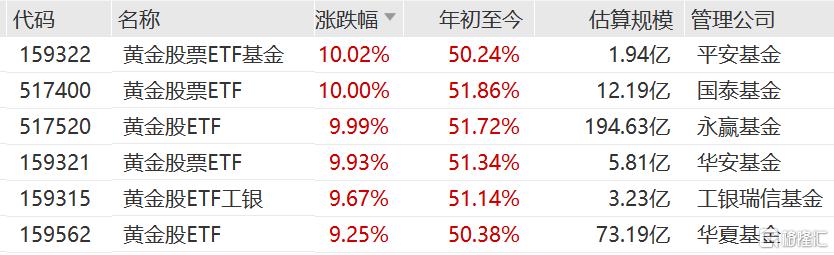
Core Viewpoint - The article highlights the rising gold prices and the positive outlook for gold stocks driven by market factors, including MSCI index adjustments and bullish predictions from financial institutions [1][3][5]. Group 1: Market Impact - The U.S. federal government shutdown has reached a new high, raising concerns among investors about the negative impact on the U.S. economy, which contributed to a decline in the U.S. dollar index and an increase in international gold prices [1]. - As of the latest close, the December gold futures price on the New York Commodity Exchange reached $3992.9 per ounce, marking a 0.82% increase [1]. Group 2: Gold Stocks Performance - Hong Kong gold stocks experienced a collective rebound, primarily driven by two favorable factors: the inclusion of multiple gold stocks in the MSCI index, which is expected to bring in passive capital inflows, and significant upward revisions of gold price forecasts by international institutions [3][4]. - MSCI's recent announcement included the addition of nine Hong Kong stocks, including Zijin Mining, to the MSCI China Index, which will take effect after November 24, 2025. This adjustment is significant for the gold sector as index funds typically reposition before new constituents are effective, leading to strong support for gold stocks [4]. Group 3: Future Gold Price Predictions - UBS's global research department predicts a target gold price of $4200 per ounce by 2026, with potential for prices to reach $5000 if the Federal Reserve's policies become overly dovish or lose independence [5]. - Long-term views from various financial institutions suggest that ongoing U.S. debt issues and weakening dollar credibility will enhance gold's monetary attributes, while central bank gold purchases and rising geopolitical risks in major economies will further boost gold's safe-haven appeal [5]. - Eastern Securities emphasizes that deteriorating fiat currency credibility and dual benefits from safe-haven demand will continue to drive gold prices upward, supported by weakening currencies in major economies [5].
兴业证券王涵 | 美国的政策空间在收缩
王涵论宏观· 2025-11-06 01:59
Core Viewpoint - The article discusses the softening of the U.S. stance towards China following the recent summit between the U.S. and Chinese leaders, attributing this shift to internal constraints faced by U.S. domestic policies, particularly the hollowing out of American manufacturing and the "decoupling" policies that have led to inflationary pressures and a decline in the credibility of the U.S. dollar [1][2][19]. Group 1: Economic Challenges - The hollowing out of U.S. manufacturing has resulted in a heavy reliance on imports, making the U.S. vulnerable to supply chain disruptions and increasing costs due to tariffs, which exacerbates inflationary pressures [8][10]. - The "decoupling" policies have revealed weaknesses in U.S. hard power, undermining the dollar's status as a global currency and complicating the U.S.'s ability to maintain its military and economic influence [10][12]. Group 2: Policy Constraints - U.S. monetary and fiscal policies face significant operational constraints due to persistent inflation and declining dollar credibility, limiting the effectiveness of potential policy combinations [11][12]. - Implementing a "dual expansion" of monetary and fiscal policies could lead to heightened inflation and further depreciation of the dollar, while a "tight fiscal and loose monetary" approach may exacerbate wealth inequality and social tensions [14][15]. Group 3: Long-term Implications - The inability to effectively manage these economic challenges suggests that the U.S. lacks the capacity for a prolonged economic confrontation with China, which is a fundamental reason for the softening of its stance [19].
美联储终于承认美债无力偿还,全球危机进入倒计时!抵押贷款支持证券的赎回本金,将被再投资于短期国债
Sou Hu Cai Jing· 2025-11-01 15:52
Core Viewpoint - The Federal Reserve's recent actions indicate a shift from traditional monetary policy to a role that resembles a lifeline for the U.S. Treasury, raising concerns about the sustainability of U.S. debt and its implications for the global financial system [1][3][7] Group 1: Federal Reserve Actions - The Federal Reserve will cease balance sheet reduction after December 1, 2023, and will reinvest maturing securities into short-term Treasury bonds, effectively postponing debt repayment [1][3] - The Fed's balance sheet remains around $8 trillion, contradicting claims of monetary tightening, and suggests a strategy of delaying financial obligations rather than addressing them [3][5] Group 2: U.S. Debt Situation - The total U.S. debt has surpassed $38 trillion, with a projected fiscal deficit exceeding $1.7 trillion for FY 2024, necessitating daily borrowing of over $4 billion [3][5] - Interest payments on U.S. debt are nearing $1 trillion annually, accounting for 13% of the federal budget, raising concerns about long-term fiscal sustainability [5][9] Group 3: Foreign Investment Trends - Major foreign holders of U.S. debt, such as Japan and China, are reducing their holdings, with Japan decreasing by approximately $18 billion and China by about $24 billion as of August 2024 [5][7] - The reduction in foreign investment raises questions about the Fed's ability to manage the bond market without external support [5][7] Group 4: Economic Implications - The U.S. economy's growth is sluggish, with a projected annualized GDP growth rate of only 2.1% for Q2 2024, while corporate profit growth is slowing and household savings are at historical lows [9][11] - The Fed's current policies may lead to a normalization of debt issues, potentially desensitizing the market to the underlying risks associated with U.S. debt [11]
大跳水:金价跌破3900美元!这到底是牛市终结,还是倒车接人?
Sou Hu Cai Jing· 2025-10-29 02:15
Core Viewpoint - The recent sharp decline in gold prices is attributed to a combination of reduced risk appetite, a strong dollar, and technical selling triggered by algorithmic trading [3][4][6]. Group 1: Reasons for Gold Price Drop - Decreased risk appetite due to improved geopolitical signals from the US-China interactions and potential ceasefire talks in Ukraine, leading to reduced demand for gold as a safe-haven asset [3]. - A strong rebound in the dollar index, driven by expectations of adjustments in Japan's yield curve control, which increased the cost of holding gold priced in dollars [4]. - Technical selling pressure as gold prices surged from $2,624 to $4,381 in 2025, prompting algorithmic trading to trigger sell-offs once the price fell below the critical support level of $1,900 [4]. Group 2: Impact on Different Stakeholders - For consumers looking to buy gold jewelry, the price drop presents an opportunity, with prices at around 1,198 RMB per gram, down from 1,245 RMB, allowing for potential savings [6]. - Investors holding gold ETFs or paper gold should remain calm and not panic sell, as the market may stabilize [6]. - For those considering buying physical gold bars, a phased approach is recommended, with suggested entry points at $1,880 and $1,850 per ounce to mitigate risks [6]. Group 3: Market Outlook - Short-term outlook suggests continued pressure on gold prices due to geopolitical factors and a strong dollar, with potential dips to $1,850 [8]. - Long-term prospects remain positive, with central banks continuing to accumulate gold, and expectations of interest rate cuts in the future could enhance gold's attractiveness as an investment [9]. Group 4: Institutional Price Targets - Goldman Sachs projects gold prices could reach $4,900 by the end of 2026, while JPMorgan suggests extreme scenarios could push prices to $5,055 [10]. - Citigroup indicates that as long as global central bank purchases exceed 1,000 tons annually, gold prices will steadily rise above $2,200 [10]. Group 5: Investment Strategies - For consumers needing gold jewelry, it is advisable to observe the market for two weeks and consider buying if prices fall below 1,180 RMB per gram [11]. - Investors in gold bars should adopt a dollar-cost averaging strategy, buying in increments as prices decline [11]. - For paper gold or ETFs, setting a stop-loss at $1,880 is recommended, but panic selling is discouraged [11].
中国的黄金为什么要存放在美国?不是被扣押,这4个真相更实在
Sou Hu Cai Jing· 2025-10-28 00:46
Core Viewpoint - The presence of Chinese gold in the United States is a standard practice within the global financial system, not a forced action or a sign of insecurity [1][12]. Group 1: Historical Context - The New York Federal Reserve's underground vault serves as a "public warehouse" for gold, housing nearly 7,000 tons from over 60 countries and international organizations, including China [4]. - The practice of storing gold in the U.S. began post-World War II as European nations sought to protect their gold from wartime destruction, establishing the U.S. as a "gold haven" [4][3]. Group 2: Transactional Efficiency - Storing gold in New York facilitates easier transactions; for instance, transferring gold between countries can be done without physical transport, significantly reducing costs [5][8]. - New York remains the primary hub for global gold trading, with 80% of transactions linked to the city, making it a vital location for efficient trading and settlement [8][7]. Group 3: Cost Advantages - The Federal Reserve does not charge storage fees for gold, only transaction fees, making it more economical than building and maintaining a private vault [9]. - The cost of constructing a vault capable of storing 100 tons of gold can reach hundreds of millions, while using New York's facilities offers substantial savings [9]. Group 4: Ownership and Security - The gold stored in New York is considered "custodial" rather than "collateral," meaning ownership remains with the depositing country, and the U.S. has no rights to use it [10]. - Countries like Germany have successfully repatriated gold from New York, demonstrating that retrieval is not an issue but rather a matter of convenience [10]. Group 5: Current Trends and Adjustments - Recent shifts in global finance, including rising U.S. debt and declining dollar confidence, have prompted countries, including China, to diversify their gold reserves [12]. - China's gold imports have surged, indicating a strategy to optimize reserve structures while maintaining a portion in New York for transactional efficiency [12][13]. Group 6: Broader Implications - The strategy of diversifying gold storage reflects a broader adjustment to reduce reliance on a single currency and enhance financial sovereignty [13]. - China's actions are aimed at increasing the international standing of the Renminbi, thereby gaining more control over gold storage and transactions in the future [13].