去美元化

Search documents
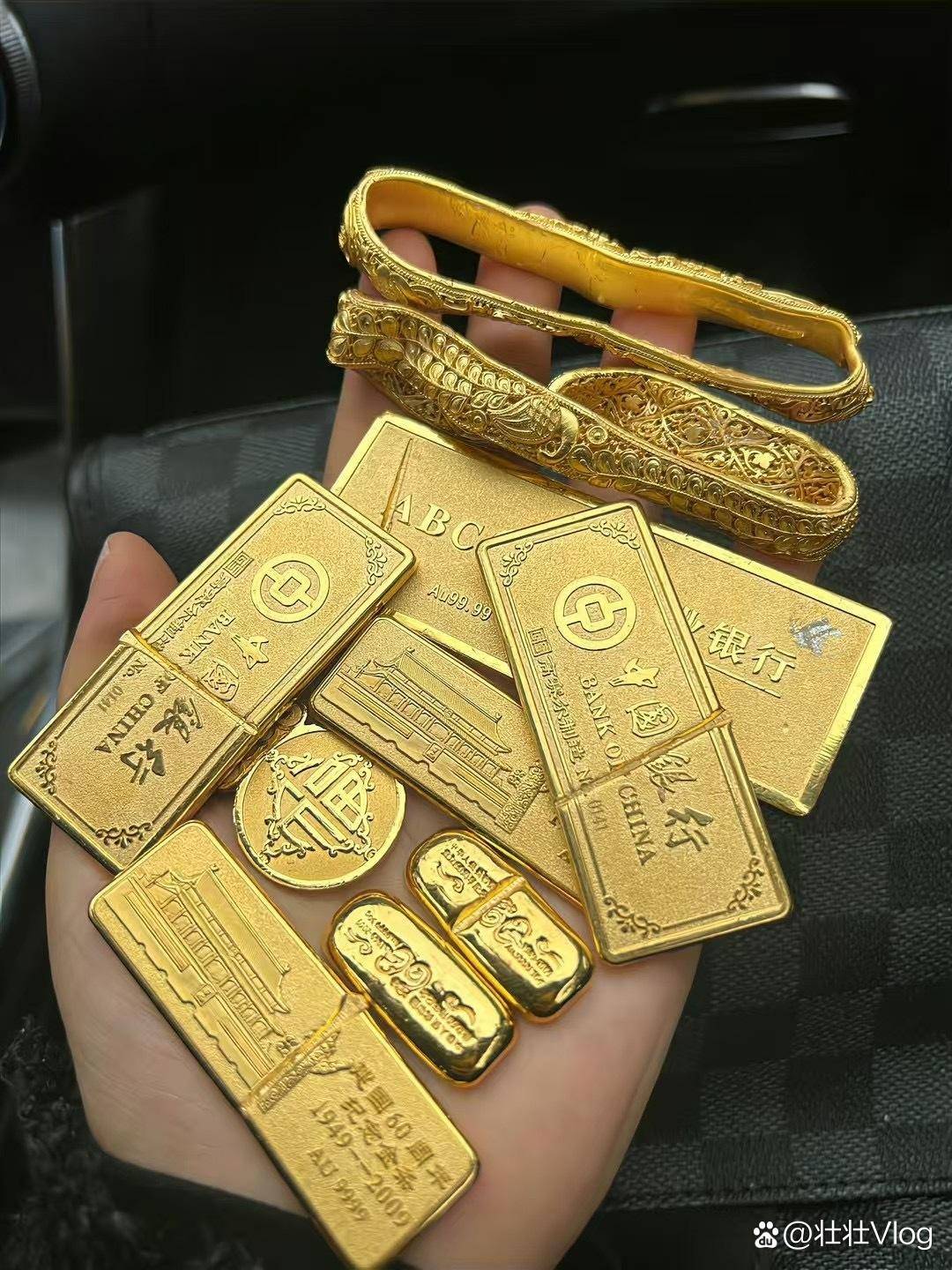
当所有人把钱换成了黄金。就会开始收割了。它就会从1600元一克慢慢降到300元一克,到时候黄金砸手里根本没人接盘,想变现都没门路。屏幕上那个数字红得刺眼,像是一记重锤砸在所有人的心口:金价从1600元一克自由落体至300元一克。这不仅是一个价格预测,更像是一部关于“财富蒸发8...
Sou Hu Cai Jing· 2026-02-06 02:17
Core Viewpoint - The article discusses the potential drastic decline in gold prices, predicting a drop from 1600 yuan per gram to 300 yuan per gram, which would represent an 80% evaporation of wealth [1]. Group 1: Market Dynamics - There are two contrasting trends in the gold market: widespread fear among retail investors about holding gold, and aggressive purchasing by central banks, which are accumulating gold bars at unprecedented rates [1][10]. - The article highlights that the market is not purely free, suggesting manipulation by major players, as evidenced by past actions of top traders at JPMorgan [2][3]. Group 2: Historical Context - Historical precedents show that significant drops in gold prices have occurred, such as in 1980 when prices fell over 65% due to high interest rates, and in 2013 when prices dropped significantly after retail investors entered the market [6][7]. - The article emphasizes that while fears of an 80% drop are prevalent, historically, gold prices have never fallen more than 65% in severe bear markets [9]. Group 3: Central Bank Actions - In 2024, global central banks purchased over 1000 tons of gold, double the average of previous years, indicating strong demand for gold as a non-sovereign asset amidst global uncertainties [10][11]. - China's central bank has been consistently increasing its gold reserves, which currently represent about 7% of its foreign exchange reserves, still below the global average, suggesting a strategic build-up rather than a retreat from gold [11]. Group 4: Investment Strategy - The article advises against panic selling or blind greed, recommending a balanced approach to gold investment, suggesting a portfolio allocation of 5% to 15% in gold as a wealth stabilizer [14]. - It encourages focusing on liquid assets like ETFs or bank-stored gold rather than high-premium jewelry, which may not be easily convertible to cash [14].

宝城期货贵金属有色早报(2026年2月6日)-20260206
Bao Cheng Qi Huo· 2026-02-06 01:48
1. Report Industry Investment Rating - Not provided in the given content 2. Core Viewpoint of the Report - The gold market is in a complex game stage of "unchanged long - term narrative but short - term valuation under pressure", and it's recommended to take a wait - and - see approach. The copper market is expected to be strong in the long - term, with the short - term impact of silver's decline weakening [3][5] 3. Summary by Relevant Catalogs Gold - **Short - term**: The short - term view is "shock", the medium - term view is "shock", and the intraday view is "weak". The recommended view is "wait - and - see". The core logic is that short - term panic selling has eased, and the long - term trend of de - dollarization remains unchanged. The gold market is in a complex game stage. The long - term core driving logic is still strong, but short - term prices have incorporated a lot of optimistic expectations, and any easing of macro risks may trigger profit - taking. Although gold followed silver down, it did not break Tuesday's low, showing short - term resistance to decline [1][3] Copper - **Short - term**: The short - term view is "strong", the medium - term view is "shock", and the intraday view is "weak shock". The recommended view is "long - term bullish". The core logic is that after the copper price experienced a callback due to macro - sentiment shocks, it showed strength. This is not only a repair after the release of panic in the silver market, but also a re - pricing of the long - term structural contradictions in the global copper market and the major shift in China's industrial policy. China has stopped more than 2 million tons of new copper smelting capacity and signaled to include copper concentrates in the national strategic reserve system, which has reversed the market's expectations of future supply growth. Although the sharp decline in silver may affect market sentiment, copper prices did not break Tuesday's low, and the overall marginal impact is weakening [1][5]
申万期货品种策略日报-铂、钯-20260206
Shen Yin Wan Guo Qi Huo· 2026-02-06 01:43
2026年02月06日 申万期货品种策略日报-铂、钯 | | | 申银万国期货研究所 | | | 陈梦赟(从业资格号:F03147376;交易咨询号:Z0022753) | | | | --- | --- | --- | --- | --- | --- | --- | --- | | | | | sunxm@sywgqh.com.cn | | 021-50585921 | | | | | | pt2606 | pt2608 | pt2610 | pd2606 | pd2608 | pd2610 | | | 现价 | 540.30 | 536.90 | 531.40 | 442.70 | 435.65 | 424.30 | | 期 | 前收盘价 | 599.85 | 592.00 | 585.70 | 461.00 | 456.75 | 450.60 | | 货 | 涨跌 | -46.75 | -39.10 | -42.70 | -8.90 | -11.00 | -18.05 | | 市 场 | 涨跌幅 | -7.96% | -6.79% | -7.44% | -1.97% | -2.46% | -4.08% ...
东吴证券晨会纪要2026-02-06-20260206
Soochow Securities· 2026-02-06 01:43
Macro Strategy - The report discusses the impact of liquidity shocks on commodity markets, highlighting that certain commodities, which are fundamentally supported by supply-demand improvements, have been "misjudged" during these shocks. As the risk environment stabilizes, these commodities may return to their fundamental pricing logic, presenting better entry opportunities compared to previous rotation phases [1][7]. - The report notes that silver futures have ended their downward trend, indicating that the liquidity shock is largely over. Silver has become a key indicator of market sentiment, with a strong upward trend observed since November 2025 [7]. Financial Products - The report reviews the performance of gold ETFs in January 2026, noting that macro data and policy expectations fluctuated throughout the month. The expectation of interest rate cuts provided temporary support for gold asset allocation, while rising policy uncertainty caused short-term disturbances [2][9]. - It highlights that as of January 30, 2026, the total market value of the Huaan Gold ETF reached 127.526 billion yuan, with a trading volume of 74.397 billion yuan on that day [2][10]. Fixed Income - The report analyzes the outflow of deposits in different scenarios, estimating that by the end of 2026, the total amount of term deposits could reach 197.60 trillion yuan under a high growth scenario, with an excess outflow of 21.5 trillion yuan compared to the baseline scenario [3][4][13]. - It emphasizes that the current market environment is leaning towards a "stock up, bond stable" dynamic, with the basic fundamentals and ample liquidity supporting the bond market [4][11]. Industry Recommendations - The report provides a forecast for Chery Automobile, predicting net profits of 18.4 billion yuan, 21.1 billion yuan, and 25.4 billion yuan for 2025-2027. It assigns a "buy" rating based on the company's strong momentum in new energy and stable export position [5][14]. - For Gaoce Co., it forecasts a net profit of -0.40 billion yuan for 2025, but maintains a positive outlook for 2026-2027 with expected profits of 1.27 billion yuan and 2.41 billion yuan, respectively, due to recovery in the photovoltaic industry and new business growth [6][17][18].
2026年2月6日,国内黄金9995价格多少钱一克?
Sou Hu Cai Jing· 2026-02-06 01:05
Core Viewpoint - The current decline in gold prices is contrasted by strong long-term bullish forecasts from institutions, indicating a complex market environment influenced by various factors [3][4][5]. Group 1: Current Market Prices - Domestic gold price (99.95%) is reported at 1096.14 CNY per gram, down 1.48% [1]. - International gold price stands at 4689.0 USD per ounce, down 4.1% [2]. Group 2: Influential Factors on Gold Prices - Institutional bullish outlook: JPMorgan forecasts that strong demand for gold from central banks and investors will drive prices to 6300 USD per ounce by the end of 2026, reinforcing market confidence in gold as a long-term asset [3]. - Federal Reserve policy expectations: The nomination of hawkish Kevin Walsh as the next Fed chair and disappointing private sector employment data have intensified bets on potential rate cuts by 2026, providing support for non-yielding assets like gold [4]. - De-dollarization and central bank purchases: Reports indicate that half of the global central banks are increasing their gold reserves as a strategic asset against a weakening dollar, with the People's Bank of China having increased its gold holdings for 14 consecutive months, providing a fundamental support for gold prices [5].
中金:“沃什冲击”如何改变全球市场?
Xin Lang Cai Jing· 2026-02-06 00:20
Group 1 - The Federal Reserve is unlikely to initiate "balance sheet reduction" in the short term, but the threshold for continued "expansion" and QE has significantly increased [1][5][10] - The nomination of Waller as the next Fed Chair has caused global asset volatility, with gold and silver prices dropping significantly [3][22] - The combination of "rate cuts + balance sheet reduction" proposed by Waller is seen as contradictory to the current economic growth and debt cost reduction goals of the Trump administration [5][10] Group 2 - The current financial conditions do not support Waller's immediate initiation of "balance sheet reduction," as previous reductions led to liquidity issues in the money market [8][10] - Waller's potential policies may be more dovish than the market currently anticipates, with a possibility of rate cuts exceeding expectations [12][19] - The focus on easing financial regulations may be necessary to prepare for future "balance sheet reduction" without compromising financial stability [13][25] Group 3 - The U.S. banking sector may benefit from the "Waller shock," as a steepening yield curve could improve bank profitability [25][26] - The potential for a temporary strengthening of the dollar exists, but the long-term trend of "de-dollarization" remains uncertain [29][39] - Chinese stocks and global commodities are currently under pressure, but there are expectations for a return to easing conditions, suggesting a buying opportunity [40][42]

近期金银价格暴跌 “元凶”是流动性风险?
Qi Huo Ri Bao· 2026-02-06 00:19
(文章来源:期货日报) "在货币属性层面,全球去美元化进程持续加速。"刘旭峰表示,2022年美国将俄罗斯踢出SWIFT系统 后,各国纷纷调整外汇储备结构,美元在全球央行外汇储备中的占比持续下滑,而黄金作为避险资产的 吸引力则显著提升。各国央行的购金行为也印证了这一趋势。尽管2025年购金节奏有所放缓,但全球央 行通过增持黄金对冲货币信用风险的需求仍在,2026年这一支撑逻辑将延续。 展望后市,刘旭峰认为,短线偏弱、中长线看涨。短线需警惕流动性风险发酵。中长线则聚焦二季度尤 其是5月前后,如果美联储降息节奏加快,贵金属价格有望企稳回升,"牛市"行情尚未终结。对比2000 —2011年在美元弱化背景下黄金价格近十倍的涨幅,当前在去美元化的逻辑下,贵金属价格仍有较大上 行空间。 针对黄金与白银走势差异的问题,刘旭峰解释称,白银的商品属性更强,受供需面突发性消息影响更 大,因此波动率远超黄金。中长期来看,白银同样受益于战略收储、产业需求增长及美联储货币宽松周 期,二季度后仍有企稳向上的机会。 最后,刘旭峰提醒投资者防范流动性风险,需关注市场资金量、借贷利差及资产联动走势。期货与期权 的组合使用可提升操作灵活性。在高波 ...
近期金银价格暴跌,“元凶”是流动性风险?
Xin Lang Cai Jing· 2026-02-05 23:57
从商品属性看,白银价格本轮上涨的核心驱动因素是战略储备与产业需求。2025年8月,美国将白银列 入关键矿产清单,引发全球战略收储预期。叠加人工智能、算力芯片等产业对白银的需求激增,白银 2025年全球缺口达3600吨,占需求端的10%,预计2026年缺口将进一步扩大,长期对价格形成强支撑。 热点栏目 自选股 数据中心 行情中心 资金流向 模拟交易 客户端 来源:期货日报 近期贵金属市场出现显著波动,国际金价与白银价格均经历大幅回调,市场震荡加剧。针对这一行情, 齐盛期货贵金属首席分析师刘旭峰在期货日报"大势观澜"直播访谈中,从商品、金融、货币三大属性切 入,解析了市场波动逻辑,并对后市走势作了展望。 谈及近期贵金属大跌,刘旭峰表示,核心症结在于流动性风险。当前海外金融市场现金流不足,美国隔 夜逆回购规模处于历史极低水平,银行准备金也跌破关键关口。市场流动性"弹药"紧缺时,一旦某类资 产暴跌,便可能引发止损踩踏,导致全品类资产承压,此次贵金属下跌正是这一逻辑的体现。不过,他 认为,流动性风险是否扩散仍需观察,短期市场在大幅下跌后存在超跌反弹的技术性修复需求,但外盘 黄金现货价格在5000~5100美元/盎司大概 ...

中金深度:“沃什冲击”如何改变全球市场?
Xin Lang Cai Jing· 2026-02-05 23:45
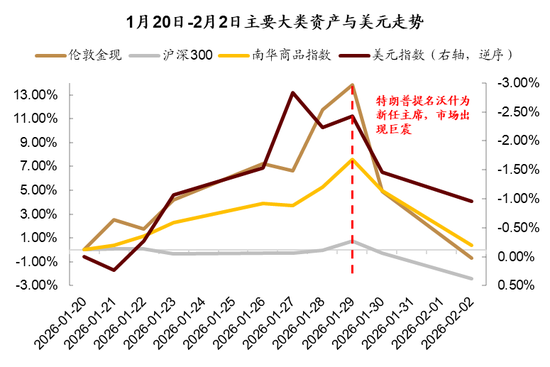
Group 1 - The Federal Reserve is unlikely to initiate "balance sheet reduction" in the short term, but the threshold for continued "balance sheet expansion" and QE has significantly increased [1][5][63] - If the Federal Reserve is unwilling to support fiscal easing through "balance sheet expansion," a new temporary monetary-fiscal coordination method may involve increasing the rate of interest cuts and the issuance of short-term bonds by the Treasury [1][10][69] - The potential for the Federal Reserve to cut interest rates may exceed market expectations, leading to a return of dollar easing trades in the short term [1][59][88] Group 2 - The nomination of Waller as the next Federal Reserve Chair has caused significant global asset volatility, with gold and silver prices dropping by 20% and 40% respectively, and a broad sell-off in stocks and commodities [2][60] - The past year has seen AI technology and dollar liquidity as the two main themes in global markets, with a restructuring of monetary order leading to a depreciation of the dollar [4][62] - If Waller successfully reduces the Federal Reserve's balance sheet, it could partially restore the dollar's credibility and delay the "de-dollarization" process, impacting global market trends [4][62] Group 3 - The "rate cut + balance sheet reduction" policy combination proposed by Waller is seen as contradictory, as balance sheet reduction is a tightening measure that conflicts with the current administration's goals of economic growth and reduced debt costs [5][63] - Market constraints indicate that balance sheet reduction would withdraw liquidity from the financial system, potentially leading to financial risks due to insufficient bank reserves [6][66] - Historical precedents show that previous balance sheet reductions have led to liquidity crises in the money market, suggesting that current financial conditions do not support Waller's proposed balance sheet reduction [8][66] Group 4 - The Federal Reserve's short-term policy focus may lean towards interest rate cuts rather than balance sheet reduction, with a dovish stance expected rather than a hawkish one [11][71] - Waller's potential policy priorities may include relaxing financial regulations to facilitate future balance sheet reductions, which could also help restore liquidity in the Treasury market [12][72] - The current financial regulatory framework constrains banks' balance sheet usage, and relaxing these regulations could improve efficiency and lower market-making costs [12][72] Group 5 - The U.S. banking sector may benefit from the "Waller shock," as continued interest rate cuts without QE or balance sheet expansion could steepen the yield curve, improving bank profitability [25][84] - The potential for a temporary economic overheating in the U.S. could support the banking sector, as traditional cyclical stocks may gain traction [28][87] - The dollar may experience a temporary strengthening, but the long-term trend of "de-dollarization" remains uncertain, influenced by the broader economic policies under Waller's leadership [29][39]
中金深度:“沃什冲击”如何改变全球市场?
中金点睛· 2026-02-05 23:41
Core Viewpoint - The Federal Reserve may find it difficult to "taper" in the short term, but the threshold for continued "expansion" and QE has significantly increased. If the Fed is unwilling to support fiscal easing through "expansion," a new temporary monetary-fiscal coordination method may involve increasing the rate of interest cuts while the Treasury increases short-term debt issuance [1][4][10] Group 1: Federal Reserve Policy Implications - The nomination of Waller as the next Fed Chair has caused global asset volatility, with markets reacting negatively to his hawkish stance on "rate cuts + tapering" [1][4] - The Fed's previous tapering cycle reduced its balance sheet from $8.9 trillion to $6.6 trillion, leading to liquidity issues in the money market, which prompted a shift back to "expansion" [5][7] - The current financial conditions do not support the initiation of a tapering process in the short term, as previous tapering led to liquidity shortages [7][9] Group 2: Market Reactions and Predictions - The market's simplistic interpretation of Waller as hawkish may lead to significant discrepancies in expectations, as the Fed's future policy may be more dovish than currently priced in [10][13] - The Fed's potential focus on rate cuts rather than tapering aligns with political pressures to lower debt costs, suggesting a possible increase in the magnitude of rate cuts beyond market expectations [10][11] - The Fed's future policy path may involve easing financial regulations to prepare for tapering without compromising financial stability [14][18] Group 3: Asset Class Implications - U.S. bank stocks may benefit from the "Waller shock," as a steepening yield curve would improve bank profitability [24][27] - The dollar may strengthen in the short term due to the Fed's potential actions, but the long-term trend of "de-dollarization" remains uncertain [28][34] - Chinese stocks and global commodities are currently under pressure but are expected to rebound as easing expectations return [34]