反内卷

Search documents
黄金白银再创历史新高,高手怎么看?下周A股迎来一个涨价题材!
Mei Ri Jing Ji Xin Wen· 2026-01-25 09:21
Market Performance - The Shanghai Composite Index has shown a flat performance this week, but there is a strong structural market with notable performances in gold, silver, and lithium batteries [1] - On Friday, spot silver in London broke through $100, and spot gold is approaching the $5,000 mark [1] Upcoming Events - The A-share market will enter a peak period for 2025 annual performance forecasts next week, with Tesla set to announce its fourth-quarter earnings after the U.S. market closes on January 28 [1][8] Investment Insights - Participants in the simulated stock trading competition have expressed optimism about precious metals due to the declining status of the U.S. dollar, complex geopolitical situations, and rising risk aversion stemming from trade wars [5] - The competition has highlighted the potential of the carbon-hydrogen resin and spherical silica powder industries [6] - The report from Shanghai Securities indicates that the expected release of the Rubin platform by Nvidia in 2026 will involve significant upgrades in upstream material systems [5] Price Adjustments - Passive component manufacturer Yageo announced a price adjustment for certain resistor products, with increases of approximately 15% to 20% effective from February 1, due to rising costs of chip product lines and precious metals [8]

化工品涨价逻辑下,哪些建筑公司有望受益?
GOLDEN SUN SECURITIES· 2026-01-25 08:49
Investment Rating - The report maintains a "Buy" rating for the companies mentioned, indicating a positive outlook for their stock performance in relation to the industry benchmark [4]. Core Insights - The chemical industry is expected to experience price increases due to improved supply-demand dynamics and a "de-involution" policy that encourages companies to avoid price wars and focus on profitability [10][22]. - The manufacturing sector shows signs of recovery, with the manufacturing PMI reaching 50.1% in December 2025, indicating a return to expansion [16][22]. - The inventory cycle in the chemical industry is transitioning from active destocking to passive destocking, which could lead to price support if demand improves [22]. Summary by Sections Supply Side Analysis - Investment growth in the chemical raw materials and products manufacturing sector has been declining since 2022, with a projected drop in investment growth turning negative by June 2025 [15]. - The construction of new capacity in the chemical industry has significantly decreased, influenced by energy consumption controls and environmental policies [15][22]. Demand Side Analysis - Although traditional demand remains weak, there is strong support for certain chemical products due to manufacturing restocking, pre-holiday inventory buildup, and increased exports [15][22]. - The manufacturing PMI data indicates a marginal improvement in demand, with production and new orders both showing positive trends [16]. Policy Impact - The "de-involution" policy initiated by the central government aims to prevent vicious competition, leading to a consensus among leading companies to stabilize prices by reducing production rates [22]. Company-Specific Insights - **China Chemical**: The company has a production capacity of 200,000 tons for both adiponitrile and caprolactam. Price rebounds in these products could significantly enhance its earnings [23]. - **Sandi Chemical**: The company is expected to benefit from price recovery in its core products, with a projected revenue of 730 million yuan in H1 2025 [30]. - **Donghua Technology**: The company has multiple high-end chemical projects that are expected to improve profitability and support stock valuation [37]. - **Southeast Net Rack**: The company produces 500,000 tons of polyester filament, with potential for revenue growth as prices stabilize [41]. Investment Recommendations - The report highlights key companies to watch, including China Chemical, Sandi Chemical, Donghua Technology, and Southeast Net Rack, all of which are positioned to benefit from the anticipated price increases in chemical products [10][45].


国盛证券:化工品涨价逻辑下 哪些建筑公司有望受益?
智通财经网· 2026-01-25 07:52
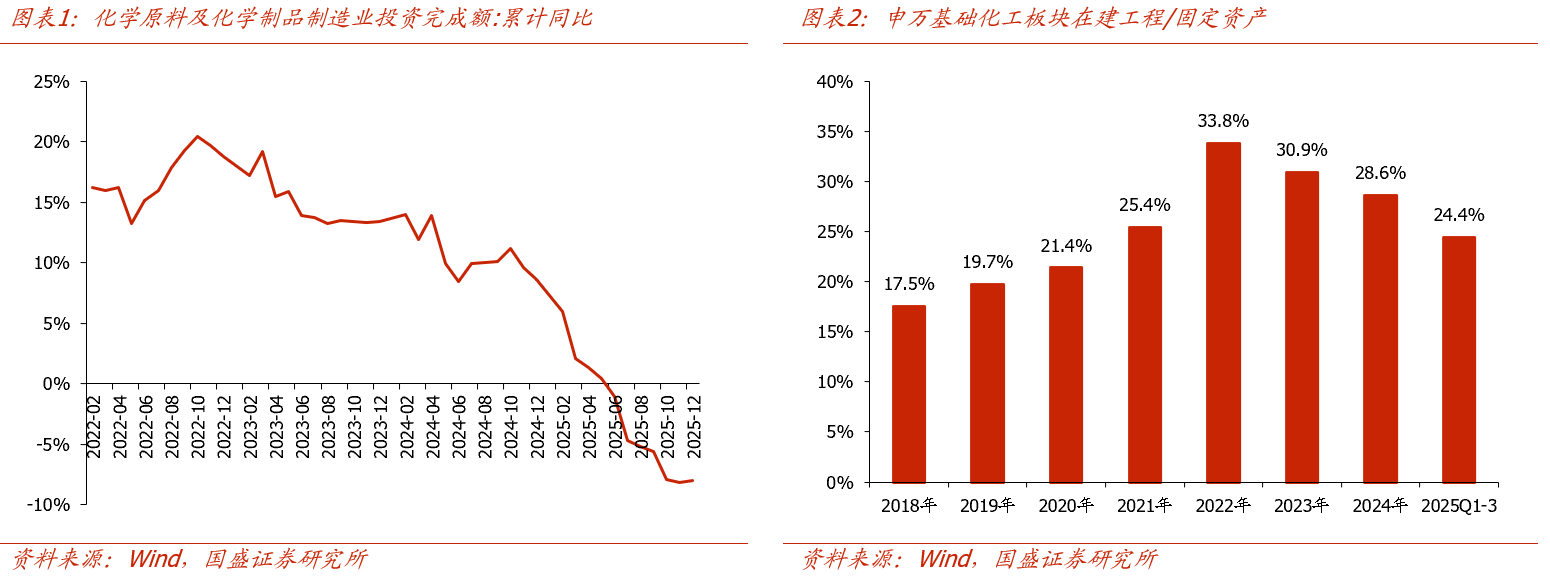
Core Viewpoint - The chemical industry is expected to experience price increases due to improved supply-demand dynamics and a shift towards "anti-involution" practices, benefiting certain construction companies that have extended their operations into the chemical sector [1][21]. Supply Side Summary - Investment growth in the chemical raw materials and products manufacturing sector has been declining since 2022, with a significant drop in investment growth turning negative by June 2025. The construction of new capacity in the chemical industry has notably decreased, with the share of ongoing projects in the basic chemical sector falling from 33.8% in 2022 to 24.4% in Q1-Q3 2025 [1]. - The reduction in new capacity is compounded by energy consumption controls and enhanced environmental policies set for 2025, alongside significant shutdowns of chemical facilities in Europe and Japan due to cost disadvantages, leading to an overall improvement in the global supply landscape [1]. Demand Side Summary - Despite weak traditional demand, certain factors such as manufacturing inventory replenishment, pre-Spring Festival stocking, increased exports, and growth in new manufacturing demands are providing strong support for some chemical products. The manufacturing PMI reached 50.1% in December 2025, indicating a return to expansion for the first time since April 2025 [3]. Inventory Cycle Summary - The chemical industry is transitioning from active destocking to passive destocking. Although there was a slight increase in inventory levels in the chemical raw materials and products sector in H2 2025, the inventory growth of finished products in downstream sectors has been declining since March 2025, indicating a significant inventory disparity within the supply chain [5]. - The current inventory structure shows moderate inventory levels upstream and low inventory levels downstream, suggesting that any improvement in demand could trigger rapid destocking of upstream chemical products, providing strong support for price elasticity [5]. Policy Environment Summary - The "anti-involution" policy introduced in July 2024 has shifted from a slogan to actionable industry measures, encouraging leading companies to avoid price wars and instead focus on maintaining price levels through reduced production rates [5]. Company-Specific Insights - **China Chemical (601117.SH)**: Positioned as a quality undervalued stock with strong cash flow, benefiting from the anti-involution trend. The company has a production capacity of 200,000 tons for both adiponitrile and caprolactam, with potential profit increases from price rebounds in these products [6]. - **Sandi Chemical (002469.SZ)**: Expected to see continued price improvements for existing chemical products under the anti-involution backdrop. The company has significant production capacities and is advancing new product lines that are anticipated to enhance profitability [11]. - **Donghua Technology (002140.SZ)**: The company is experiencing improved profitability in its industrial segment due to supply reductions stabilizing ethylene glycol prices. It has several high-end chemical projects in operation, contributing to revenue growth [15]. - **Southeast Net Framework (002135.SZ)**: The company produces polyester filament with a capacity of 500,000 tons. Price recovery in this segment is expected to contribute positively to performance [18]. Investment Recommendations - The chemical product price increase is supported by declining capital expenditures, environmental restrictions, and a shift in competitive dynamics. Companies such as China Chemical, Sandi Chemical, Donghua Technology, and Southeast Net Framework are highlighted as key beneficiaries of this trend [21].


建筑材料:投资、开竣工继续疲软,亟待政策积极主动
Huafu Securities· 2026-01-25 07:48
Investment Rating - The industry rating is "Outperform the Market" [7][66] Core Insights - The report indicates that the construction materials sector is experiencing a downturn in investment and construction starts, necessitating proactive policy measures to stabilize the market [3][5] - National real estate development investment is projected to be 8.3 trillion yuan in 2025, reflecting a year-on-year decrease of 17.2%, with new housing starts and completions also showing significant declines [3][12] - The report highlights that the easing of monetary policy in Europe and the U.S. may provide more room for China's monetary and fiscal policies, which could positively impact the real estate market [3][5] - The report emphasizes that the construction materials sector may benefit from supply-side reforms and a potential recovery in housing demand, leading to a stabilization of the real estate market [5][20] Summary by Sections Investment Highlights - The report notes that the construction materials sector is expected to see a turning point in capacity cycles due to accelerating supply-side reforms and a recovery in purchasing intentions driven by lower interest rates [5][20] - It suggests that the fundamental conditions of the real estate market are likely to stabilize, which may also lead to a recovery in post-cycle demand for construction materials [5][20] Recent High-Frequency Data - As of January 23, 2026, the average price of bulk P.O 42.5 cement is 333.4 yuan/ton, showing a month-on-month decrease of 0.8% and a year-on-year decrease of 15.1% [4][13] - The average price of glass (5.00mm) is reported at 1097.1 yuan/ton, with a year-on-year decline of 17.2% [4][21] Sector Review - The Shanghai Composite Index rose by 0.84%, while the Shenzhen Composite Index increased by 2.21%. The construction materials index saw a significant rise of 9.23% [4][54] - Sub-sectors such as glass manufacturing and fiberglass manufacturing experienced notable gains, with increases of 11.13% and 8.97%, respectively [4][54]
十大机构看后市:A股春季行情仍沿着既定路径前进,保持稳健,持股过节
Xin Lang Cai Jing· 2026-01-25 06:48
Group 1 - The A-share market is experiencing a spring rally, with the Shanghai Composite Index rising by 0.84% and the Shenzhen Component Index increasing by 1.11% [12] - Short-term market focus is on low-position sectors, particularly cyclical Alpha (non-ferrous metals, chemicals) expanding towards cyclical turning points in construction materials, oil, and steel [1][13] - The current profitability in non-ferrous metals, chemicals, and oil is nearing high levels, indicating increasing short-term resistance for cyclical trends [1][14] Group 2 - Global market risk appetite is on the rise, favoring equity assets, with recommendations for tactical overweight in A/H shares, US stocks, and gold, while suggesting underweight in US Treasuries and oil [2][15] - The upcoming economic work conference and the start of the 14th Five-Year Plan in 2026 are expected to lead to more aggressive economic policies and an expansion of the fiscal deficit [2][15] - The anticipated interest rate cut by the Federal Reserve in December and the stable appreciation of the RMB are favorable for China's monetary easing in early 2026 [2][15] Group 3 - The technology sector remains the main focus of the current bull market, driven by the AI wave, with recommendations to pay attention to the application of AI in specific sectors [3][16] - Value sector opportunities are also worth considering, including certain resource products and real estate [3][16] - Consumer services may receive temporary attention as part of the sector allocation strategy [3][16] Group 4 - The market is expected to remain stable with a focus on holding positions through the upcoming holiday, as historical data suggests a less than 50% probability of major index increases in the 20 trading days before the Spring Festival [4][17] - Post-holiday, a new upward momentum is anticipated, with higher probabilities of index increases in the following 20 trading days [4][17] - Key sectors to watch include electronics, power equipment, and non-ferrous metals, with a focus on both growth and defensive styles depending on market conditions [4][17] Group 5 - The spring rally is expected to enter its second phase, with the Shanghai Composite Index nearing 4200 points, reflecting a strong upward trend since late December [5][18] - The market is witnessing a divergence in fund flows, with significant inflows into margin financing while stock-type ETFs are experiencing outflows [5][18] - Attention is needed on macro policy expectations from the upcoming National People's Congress in March and the microeconomic fundamentals from the 2025 annual reports [5][18] Group 6 - The current average P/E ratios for the Shanghai Composite and ChiNext are 16.88 and 53.36, respectively, indicating a suitable environment for medium to long-term investments [8][20] - The market is expected to focus on performance and industry trends, with a likelihood of maintaining a slight upward trend in the Shanghai Composite Index [8][20] - Investment opportunities are suggested in sectors such as photovoltaic equipment, energy metals, batteries, and aerospace [8][20] Group 7 - The market is anticipated to continue its oscillation and consolidation phase, with ETF outflows and a temporary decline in margin financing [9][20] - Despite the market's cooling, overall trading enthusiasm remains, and a slow bull market expectation may lead to fluctuating market sentiments [9][20] - Investment opportunities are highlighted in the TMT sector, robotics, and non-ferrous metals, alongside a focus on banking and insurance due to favorable long-term funding conditions [9][20] Group 8 - The spring rally is expected to persist, with a significant increase in risk appetite in the A-share market, as evidenced by a 17-day consecutive rise in the Shanghai Composite Index [10][21] - The market liquidity environment is improving, supported by favorable external conditions and proactive internal policies [10][21] - Key investment themes include low-valuation high-dividend assets, technology-driven production, and domestic market expansion [10][21] Group 9 - The 2026 economic outlook is positive, with proactive monetary and fiscal policies expected to support stable economic growth and a continued "slow bull" market in A-shares [11][21] - February is anticipated to maintain the momentum of January's focus on technology and non-ferrous sectors, driven by the "14th Five-Year Plan" [11][21] - Investment opportunities are identified in sectors related to new productive forces, including AI, aerospace, and agriculture [11][21]
湘财证券:2月热点或将延续1月的科技、有色等方向
Xin Lang Cai Jing· 2026-01-25 06:37
Group 1 - The macroeconomic short and medium cycles in 2026 are expected to form an upward resonance pattern, with both cycles predicted to be in a rebound phase [1][7] - Factors contributing to this outlook include the easing of the China-US trade conflict, the upcoming implementation of the "14th Five-Year Plan," and the proactive fiscal and monetary policies set by the central government [1][7] - The People's Bank of China has introduced eight policy measures since January 2026, which, along with previous initiatives, are expected to support economic improvement in the first quarter of 2026 [1][7] Group 2 - In February 2026, market hotspots are likely to continue in the technology and non-ferrous metal sectors, with limited rapid shifts due to the timing of the Chinese New Year [2][8] - The Hong Kong stock market is expected to follow the A-share market, with a bullish outlook on technology stocks and a bearish view on the bond market [2][8] - The anticipated stability in the A-share market and supportive domestic policies are expected to positively influence market sentiment [2][8] Group 3 - The bond market is projected to experience a "bear flattening" trend, with limited capital flow into bonds due to the upward movement of the A-share market [3][9] - The commodity market is expected to see increased differentiation, with a bullish outlook on precious and strategic metals, while the oil market may experience short-term volatility [3][9] Group 4 - The year 2026 marks the beginning of the "14th Five-Year Plan," with the central bank's proactive measures expected to support steady economic growth and a "slow bull" market in A-shares [4][10] - The new economic cycle is anticipated to benefit upstream cyclical industries, with a focus on sectors related to the "anti-involution" trend and new productive forces such as AI and aerospace [4][10]
——基础化工行业周报(20260119-20260123):氨纶景气拐点来临,持续看好化纤板块景气上行-20260125
EBSCN· 2026-01-25 06:28
Investment Rating - The report maintains a rating of "Buy" for the basic chemical industry [5] Core Views - The report highlights that the spandex industry is at a turning point, with prices reaching historical lows and recent price increases indicating a recovery in the industry [1][2] - The report emphasizes the limited new capacity in the spandex sector and the exit of outdated capacity, suggesting a favorable supply-demand balance and a positive outlook for the spandex industry [2] - The "anti-involution" policy is expected to enhance the recovery of the "refining-chemical fiber" industry chain, with improvements in market competition and supply-demand dynamics [3] Summary by Sections Industry Overview - Spandex prices have dropped from a peak of 83,750 yuan/ton in 2021 to 23,600 yuan/ton in early January 2026, a decline of 72% [1] - The report notes that spandex production capacity in China is projected to grow from 925,000 tons in 2020 to 1,430,000 tons by 2025, with a compound annual growth rate (CAGR) of 7.6% [2] Supply and Demand Dynamics - The apparent consumption of spandex in China is expected to increase from 720,000 tons in 2020 to 1,060,000 tons by 2025, with a CAGR of 6.7% [2] - The report indicates that the spandex industry is entering a recovery phase due to the reduction in new capacity and the exit of outdated production [2] Policy Impact - The "anti-involution" policy aims to optimize market competition and improve the supply-demand balance in the refining and chemical fiber sectors [3] - The report suggests that the refining industry is nearing the end of capacity expansion, which is expected to improve supply-demand dynamics [3] Investment Recommendations - The report recommends focusing on leading companies in the polyester filament sector such as Hengli Petrochemical, Rongsheng Petrochemical, and Dongfang Shenghong, as well as spandex companies like Huafeng Chemical and Xinxiang Chemical Fiber [4]


渤海证券:扩内需、反内卷增量部署可期 市场延续震荡整理
Xin Lang Cai Jing· 2026-01-25 06:25
Market Review - Major indices showed mixed performance in the past five trading days (January 16 - January 22), with the Shanghai Composite Index rising by 0.24% and the ChiNext Index falling by 1.17% [1][5] - The CSI 300 Index decreased by 0.58%, while the CSI 500 Index increased by 2.00% [1][5] - Trading volume significantly shrank, with a total turnover of 13.80 trillion yuan, leading to an average daily turnover of 2.76 trillion yuan, a decrease of 683.469 billion yuan compared to the previous five trading days [1][5] Economic Data - The National Bureau of Statistics reported that fixed asset investment in December 2025 decreased by 3.8% year-on-year, a decline of 1.2 percentage points compared to January-November 2025 [1][5] - The year-on-year growth rate of social retail sales in December 2025 also slowed down, primarily due to policy rollbacks and high base effects [1][5] - Overall, the economic growth rate for 2025 showed a pattern of high growth followed by low growth, with the annual target being successfully achieved [1][5] Policy Insights - The National Development and Reform Commission emphasized strengthening domestic circulation as a key macro policy focus, with plans to formulate a strategy for expanding domestic demand from 2026 to 2030 [2][6] - In the context of "anti-involution," mechanisms for capacity exit will be improved to address supply-demand imbalances [2][6] - The Ministry of Finance announced an increase in the total fiscal policy for 2026, ensuring necessary expenditure intensity, with a structural tilt towards boosting consumption and social welfare [2][6] Investment Strategy - Recent market adjustments have led to continued net outflows from ETFs and margin trading, with a narrowing scope for thematic investments [3][7] - Despite this, overall market trading enthusiasm remains, and a prolonged consolidation process is expected, with potential fluctuations in market sentiment [3][7] - Investment opportunities are identified in the TMT sector and robotics due to ongoing capital expansion and domestic substitution processes, as well as in the non-ferrous metals sector supported by rising prices [3][7]
688599预计未来三年累计盈利近百亿
Shang Hai Zheng Quan Bao· 2026-01-25 02:24
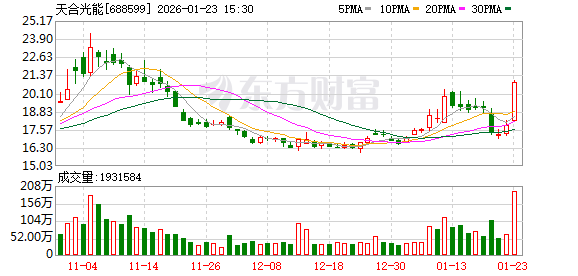
Core Viewpoint - Trina Solar has ambitious profit targets, aiming for a cumulative net profit of no less than 9.6 billion yuan over the next three years, despite forecasting a significant loss for 2025 [2][4][10]. Group 1: Performance Targets - The stock incentive plan includes performance targets of a net profit of at least 200 million yuan in 2026, 3.2 billion yuan in 2027, and 6.2 billion yuan in 2028, with a cumulative target of 9.6 billion yuan from 2026 to 2028 [4][6][8]. - The plan involves granting approximately 28.01 million restricted stocks, accounting for about 1.20% of the total share capital as of January 21, 2026, with a grant price of 10.05 yuan per share [6][7]. Group 2: Business Strategy and Market Outlook - The company plans to enhance its business structure by focusing on photovoltaic products, energy storage, system solutions, and digital energy services, aiming to transform from a photovoltaic manufacturer to a comprehensive energy solution provider [7][8]. - Trina Solar's optimism about the photovoltaic industry's recovery is based on industry self-discipline actions and the deepening of "anti-involution" measures, which aim for profitability across the entire industry chain [10][11]. Group 3: Industry Context - The photovoltaic industry is currently facing widespread losses, with many companies, including Trina Solar, forecasting significant losses for 2025 due to price declines and rising costs [11][12]. - The company is actively pursuing opportunities in the energy storage market and exploring applications in space photovoltaics, indicating a strategic shift to capture new growth areas [13][14].

委员通道直击丨李婧:破除“内卷式竞争”,向价值战蓝海突围
Nan Fang Du Shi Bao· 2026-01-25 01:39
Core Viewpoint - The concept of "anti-involution" has evolved from a social buzzword to a significant national strategic proposition since its introduction at the Central Political Bureau meeting in July 2024, emphasizing the need to prevent vicious competition in the market [2] Group 1: Industry Challenges - Companies are experiencing "involutionary competition," leading to a vicious cycle of price cuts that shrink profits, hinder R&D investment, and impede quality improvement, resulting in inefficient industry development [2] - This "involution" not only erodes corporate profits but also diminishes innovation motivation and the prospects for high-quality development [2] Group 2: Recommendations for Improvement - To break the cycle of "involution," competition should shift from low-level price and consumption battles to higher-level competition based on technology, quality, and business models [5] - Three key suggestions were made: 1. Use policy as a "navigational tool" to guide capital and innovation towards valuable sectors, with government support through targeted policies like special funds and innovation vouchers [5] 2. Utilize platforms as "boosters" to support collaborative innovation among enterprises, encouraging partnerships with universities and research institutions to reduce R&D costs and risks [5] 3. Create an environment that nurtures specialized and innovative enterprises, ensuring equal resource access and fostering a culture that encourages innovation while being tolerant of failures [5]