能源转型

Search documents
中金 | AI寻机系列05:燃机余热锅炉——能源转型催生增量蓝海
中金点睛· 2026-01-06 23:47
Core Viewpoint - The article highlights the increasing demand for gas-fired power generation in North America due to a surge in electricity needs driven by AI and data centers, leading to a favorable market for gas turbine combined cycle plants and heat recovery steam generators (HRSG) [2][3]. Group 1: North American Gas Turbine Market - The gap in gas turbines in North America is widening, with a significant increase in orders from leading overseas manufacturers expected by 2025, driven by the retirement of traditional units and the rising demand for data center power [3]. - The North American HRSG market is projected to see a rise in both volume and price by 2026, with a focus on domestic equipment manufacturers expanding into overseas markets [3]. - The global HRSG market is estimated to reach approximately $7.8 billion in 2024, with gas turbine HRSGs being a critical component in combined cycle power plants [3][18]. Group 2: Electricity Demand and Supply Dynamics - The electricity demand in the U.S. is experiencing a significant increase, with data center capacity expected to grow from 30 GW in 2020 to 53.7 GW by the end of 2024, and projections for 2030 ranging from 47 to 109 GW [4][6]. - Gas-fired power generation is becoming the preferred solution to address the electricity shortage, as it offers a shorter construction cycle, lower investment costs, and flexibility in operation [6]. - Major manufacturers like GE, Siemens, and Mitsubishi are reporting substantial increases in gas turbine orders, with GE's orders up 39% and Siemens' up 63% year-on-year [7][6]. Group 3: HRSG Market Characteristics - The efficiency of combined cycle power plants (CCPP) is significantly higher than traditional power plants, with CCPP achieving over 60% efficiency compared to 35-45% for conventional plants [8]. - The North American HRSG market is characterized by high concentration, with B&W and SPX holding about 50% of the market share, and a notable increase in order backlogs for these companies [13][10]. - The demand for HRSGs is expected to grow at a compound annual growth rate (CAGR) of approximately 4.8% over the next five years, driven by the electricity shortage and the need for efficient power generation solutions [10][18]. Group 4: Competitive Landscape and Opportunities - The competitive landscape for HRSG manufacturers is heavily reliant on systematic capabilities, with domestic leaders possessing the ability to design non-standard parameters and leverage experience from mature projects [3][10]. - The article suggests that the rising prices in the North American HRSG market and the accelerated pace of domestic companies entering overseas markets present significant opportunities for growth [3][10]. - The global HRSG market is expected to grow from $7.8 billion in 2024 to $12 billion by 2033, indicating a robust growth trajectory for the industry [18][20].


“十五五”我国能源转型有望迎来“光热时刻”
Xin Lang Cai Jing· 2026-01-06 19:29
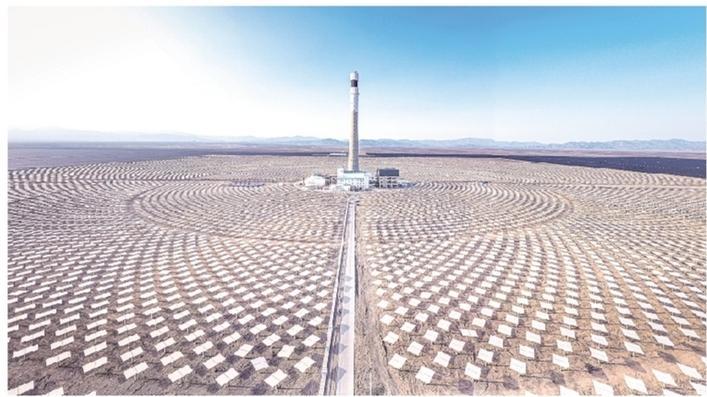
Core Viewpoint - The article discusses the promotion of concentrated solar power (CSP) development in China, highlighting its role in stabilizing renewable energy output and supporting the transition to a green energy system. The National Development and Reform Commission and the National Energy Administration have set clear goals for CSP, aiming for a total installed capacity of approximately 15 million kilowatts by 2030, with costs comparable to coal power [3][6]. Group 1: Advantages of CSP - CSP has dual functions of peak regulation and long-term energy storage, effectively mitigating the volatility of wind and solar power generation [3]. - CSP provides a stable and flexible energy supply, capable of continuous power generation for 24 hours, thus enhancing the reliability of electricity supply [4]. - CSP can support the grid by providing necessary inertia and reactive power, which is lacking in wind and solar power systems, thereby maintaining stability in high-renewable energy systems [5]. Group 2: Challenges and Opportunities - Despite advancements, CSP faces challenges such as high initial investment, weak market competitiveness, and underutilization of its system support value [6]. - The development of CSP must be tailored to local conditions, with a focus on optimizing project scales based on regional resource availability and power system structures [6]. - CSP technology can be applied in various scenarios, including enhancing the regulation capacity of large renewable energy bases and supporting multi-energy complementary systems [6]. Group 3: Cost Reduction and Policy Support - The average unit cost of CSP projects has been decreasing, with the cost for projects over 100 megawatts expected to be around 16,000 yuan per kilowatt by 2024, although it remains significantly higher than that of photovoltaic projects [7]. - Policies are being established to support cost reduction, such as a fixed grid price of 0.55 yuan per kilowatt-hour for demonstration projects in Qinghai, which is expected to stimulate industry growth [7]. - Recommendations include strengthening policy support, enhancing market mechanisms, and leveraging scale effects and technological innovation to reduce costs further [8][9]. Group 4: Sustainable Development - The industry should avoid "involutionary" cost-cutting and focus on rational competition to ensure quality and innovation, which are essential for sustainable development [9]. - It is crucial to ensure reasonable profits for investors and technology providers to drive the industry towards a quality and innovation-centric growth path [9].
哥伦比亚全国外贸协会分析2026年哥出口挑战
Shang Wu Bu Wang Zhan· 2026-01-06 16:44
Core Viewpoint - The Colombian National Foreign Trade Association indicates that the key to export growth in Colombia by 2026 lies in improvements in agriculture, manufacturing, and sanitary inspection capabilities [1] Group 1: Agriculture - Agricultural exports are expected to remain the main driver, particularly in the North American market, supported by tourism and consumer demand from the 2026 World Cup [1] - Potential export products include avocados, flowers, palm oil, cocoa, and beef, although some sectors face challenges due to sanitary standards and insufficient investment [1] Group 2: Manufacturing - The manufacturing sector is identified as a new growth area, with steel, paper products, soap, and food processing products highlighted as key segments [1] - There is a recommendation to stabilize markets in the US, Europe, and regional areas while accelerating expansion into emerging markets in Asia, the Middle East, and Africa [1] Group 3: Trade Dynamics - The association warns that due to government energy transition policies, exports of mineral and energy products are expected to continue declining [1] - After reaching a peak in 2025, coffee production and prices may face a downturn in 2026 [1] - Multiple factors may lead to export growth rates lagging behind imports, potentially widening the trade deficit and diminishing the contribution of foreign trade to economic growth [1]
谋求“A+H” 正泰电器资本布局再下一城
Xin Lang Cai Jing· 2026-01-06 16:24
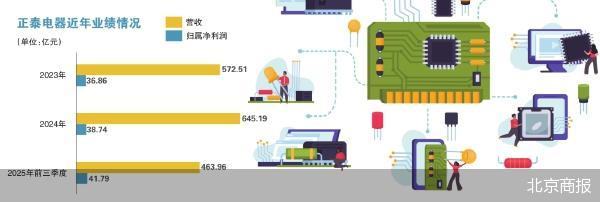
Core Viewpoint - Chint Electric plans to list H-shares in Hong Kong to enhance its international strategy and diversify financing channels, following the termination of its A-share spin-off plan [3][4]. Financial Performance - In 2023 and 2024, Chint Electric achieved revenues of approximately 57.25 billion yuan and 64.52 billion yuan, with corresponding net profits of about 3.69 billion yuan and 3.87 billion yuan [4]. - For the first three quarters of 2025, the company reported revenues of around 46.40 billion yuan, a slight decrease of 0.03% year-on-year, while net profit increased by 19.49% to approximately 4.18 billion yuan [4]. Debt and Assets - As of the end of the third quarter of 2025, Chint Electric's total short and long-term borrowings exceeded 30 billion yuan, with a debt-to-asset ratio of approximately 66.09% [4][6]. - The company's overseas assets have been increasing, reaching about 15.52 billion yuan by mid-2025, accounting for 10% of total assets [5]. Market Position and Strategy - Chint Electric is recognized as the first A-share listed company focused on low-voltage electrical equipment and is actively involved in the development and construction of household photovoltaic systems [3][4]. - The company aims to leverage the "A+H" structure to benefit from domestic policy incentives while utilizing the Hong Kong market for greater liquidity and capital access [3][8]. Recent Developments - Chint Electric's previous attempt to spin off its subsidiary, Chint Aneng, for a separate listing was halted in September 2025 due to the subsidiary's strong performance and growth prospects [4]. - The company has expanded its overseas operations, with a focus on localizing its business to better integrate into international markets [8].

一盎司银贵过一桶油,大宗商品迎来“银强油弱”新时代
第一财经· 2026-01-06 13:25
Core Viewpoint - The article discusses the contrasting trends in silver and oil markets, highlighting the recent surge in silver prices while oil prices remain subdued, indicating a potential shift in supply-demand dynamics and market perceptions of value in the context of energy transition [2][8]. Group 1: Market Trends - As of January 6, 2026, silver futures prices are around $77 per ounce, while WTI crude oil futures are at $58 per barrel, resulting in a silver-to-oil ratio of approximately 1.3, meaning one ounce of silver can purchase 1.3 barrels of oil [2]. - Over the past six months, oil prices have dropped over 32% from a high of $74 per barrel to a low of $50, while silver prices have doubled from around $40 per ounce to a peak of $80 [3]. - The last time silver was more expensive than oil was approximately 45 years ago, excluding extreme market conditions [4]. Group 2: Historical Context - In extreme market conditions, the silver-to-oil ratio reached 0.8 in 2020 during negative oil price events, while during the Hunt brothers' manipulation of the silver market from 1979 to 1980, silver prices surged from $6 to nearly $50, with oil prices ranging from $30 to $40 per barrel, resulting in a silver-to-oil ratio of about 1.25 to 1.67 [5]. Group 3: Current Market Dynamics - The current silver-to-oil ratio fluctuates between 1.2 and 1.3, with silver showing strong rebound momentum after a drop from its historical high, supported by increasing net long positions in COMEX silver futures [6]. - In contrast, oil prices have shown resilience against geopolitical events, with a significant decline of over 18% in 2025, marking the largest annual drop since 2020, as the market adjusts to a supply surplus [6][9]. - Venezuela's oil production, despite its vast reserves of 303 billion barrels, is currently limited to about 1 million barrels per day, contributing to the perception of a stable oil price environment [6]. Group 4: Supply-Demand Reassessment - The contrasting performance of silver and oil reflects a re-evaluation of the value of different commodities amid the accelerating energy transition, with silver being increasingly recognized for its financial attributes and industrial applications [8]. - Silver's demand is closely tied to global economic conditions, particularly in sectors like electronics and photovoltaics, while oil's demand remains weak due to ongoing inventory builds and increased production forecasts [9]. - Despite the anticipated energy transition, uncertainties such as insufficient clean energy infrastructure investment and traditional energy subsidies may slow the transition process, impacting future silver and oil price dynamics [9].

格隆汇2026全球视野十大核心资产之卡特彼勒
Xin Lang Cai Jing· 2026-01-06 13:12
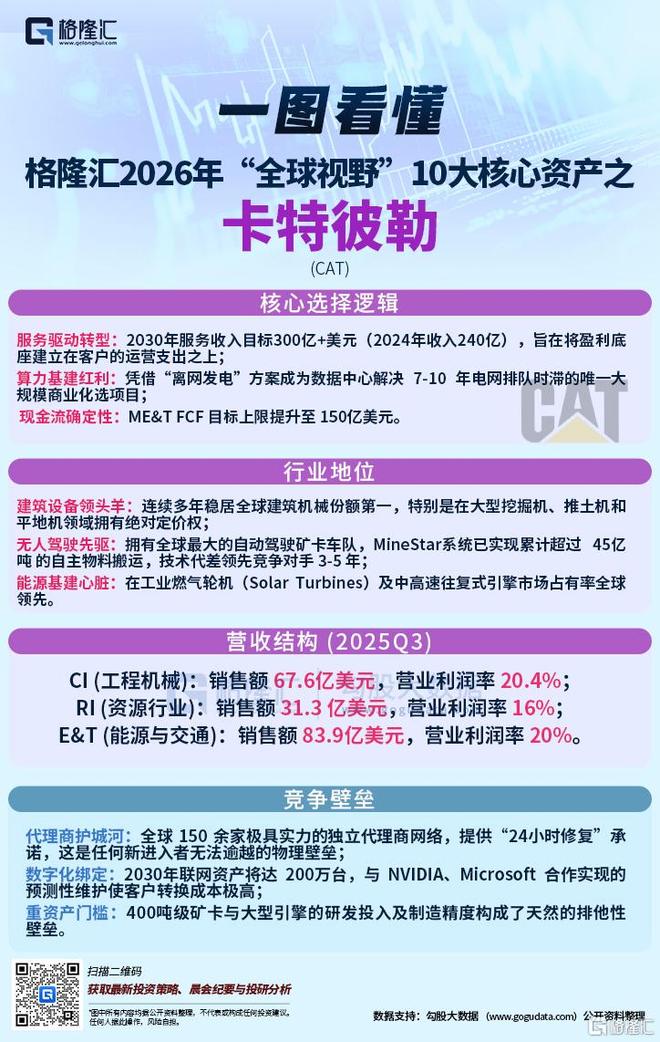
Core Insights - Caterpillar (CAT.US) has been selected as a benchmark asset in the industrial sector for the 2026 "Global Vision" top ten core assets by Gelonghui, driven by a recovery in global infrastructure investment, deepening energy transition, and explosive demand for AI computing power [1] Group 1: Company Transformation and Strategy - Caterpillar is transitioning from a traditional industrial stock reliant on cycles to a full lifecycle service provider, aiming for service revenue to reach $30 billion by 2030 and free cash flow from its ME&T (Machinery, Energy & Transportation) business to rise to $15 billion [1][5] - The company has set a target adjusted operating profit margin of 21%-25% by 2030, reflecting a shift towards higher-margin service revenues [1][17] Group 2: Competitive Advantages - Caterpillar's competitive edge is built on a robust global dealer network of over 150 independent dealers, providing 24/7 localized maintenance services, which significantly increases customer switching costs [5] - The company plans to connect 2 million assets by 2030, leveraging partnerships with tech giants like NVIDIA and Microsoft to enhance predictive maintenance through digital technologies [5][6] - High capital and R&D requirements for core products create significant barriers to entry for new competitors, ensuring Caterpillar maintains its pricing power in the market [5] Group 3: Industry Trends and Growth Drivers - Global construction spending is projected to grow by 25% over the next decade, with a 35% increase in civil infrastructure spending, providing a solid foundation for demand in the construction machinery sector [6][8] - The energy transition is expected to drive a surge in demand for key minerals, with projections indicating over 50% growth in demand for minerals like graphite and nickel by the mid-2030s [8] - The expansion of AI computing power is creating new opportunities in off-grid energy solutions, with Caterpillar's gas turbines positioned as essential infrastructure for data centers [8] Group 4: Business Segments and Financial Performance - The construction machinery segment reported sales of $6.76 billion in Q3 2025, with an operating profit margin of 20.4%, focusing on optimizing structure while maintaining high profitability [9] - The resource industry segment achieved sales of $3.11 billion in Q3 2025, benefiting from increased demand for key minerals and a significant need for equipment upgrades [11] - The energy and transportation segment generated $8.4 billion in sales in Q3 2025, closely aligned with the global AI industry, and is expected to double its gas turbine and large engine capacity by 2030 [11] Group 5: Financial Outlook and Valuation - Caterpillar's overall revenue growth is projected to reach 10%-12% by 2026, with ME&T free cash flow expected to approach $8 billion, reflecting improved profitability [17] - Long-term targets include a compound annual growth rate (CAGR) of 5%-7% in sales, with service revenues expected to double by 2030 [18] - The company is anticipated to achieve a revenue of $77.4 billion by 2027, with an EBITDA of $15.7 billion, suggesting a target price of $582 based on a 22x P/E ratio [18]

中联发展控股(00264) - 自愿公告 - 谅解备忘录
2026-01-06 12:45
自願公告 諒解備忘錄 香港交易及結算所有限公司及香港聯合交易所有限公司對本公告的內容概不負 責,對其準確性或完整性亦不發表任何聲明,並明確表示,概不因本公告全部 或部分內容而產生或因倚賴該等內容而引致的任何損失承擔任何責任。 本公告由中聯發展控股集團有限公司(「本公司」,連同其附屬公司,統稱 「本集團」)董事(「董事」)會(「董事會」)自願刊發。 諒解備忘錄 董事會宣佈,於二零二六年一月六日,本公司與鉑威有限公司(「合作方」) 訂立一份不具法律約束力的諒解備忘錄(「備忘錄」),據此,本公司擬與合 作方建立戰略合作夥伴關係,共同分享資源及探討在香港建立先進功率半導體 技術研發中心(「合作項目」)。研發中心將立足香港,面向全球,專注於成 為三代功率半導體領域的技術創新高地。研發中心將聚焦碳化硅(SiC)和氮化 鎵(GaN)等寬禁帶半導體技術,構建從材料研究到系統應用的完整研發體 系,推動功率電子技術的革新,服務全球能源轉型與綠色產業發展。研發中心 將圍繞四大核心方向開展系統化研發:一是產品設計,涵蓋高壓高頻芯片結構 創新、專用器件開發和先進仿真建模;二是測試與可靠性,建立國際標準測試 體系,深入研究失效機理與應用 ...
一盎司银贵过一桶油,大宗商品迎来“银强油弱”新时代
Di Yi Cai Jing· 2026-01-06 12:00
Core Viewpoint - The price dynamics of silver and oil have diverged significantly, with silver prices surging while oil prices remain subdued, indicating a potential shift in market sentiment and supply-demand dynamics in 2026 [1][4]. Group 1: Price Movements - As of January 6, 2026, COMEX silver futures are trading around $77 per ounce, while WTI crude oil futures are at $58 per barrel, resulting in a silver-to-oil ratio of approximately 1.3 [1]. - Over the past six months, oil prices have dropped over 32% from a high of $74 per barrel to a low of $50, while silver prices have doubled from around $40 per ounce to a peak of $80 [2]. - The last time silver was more expensive than oil was about 45 years ago, with historical instances showing significant fluctuations in the silver-to-oil ratio [2]. Group 2: Market Dynamics - The current silver-to-oil ratio fluctuates between 1.2 and 1.3, with silver showing strong rebound momentum despite a recent drop from its historical high [3]. - Financial institutions are increasing their net long positions in COMEX silver futures, indicating strong bullish sentiment, while oil prices are experiencing a decline due to oversupply concerns [3][5]. - The geopolitical situation in Venezuela has limited impact on oil prices, as the country’s production capacity is currently low, and global supply remains excessive [3][5]. Group 3: Supply and Demand Factors - The contrasting performance of silver and oil reflects a re-evaluation of their values amid changing supply-demand dynamics and macroeconomic conditions [4]. - Silver is increasingly recognized for its industrial applications, particularly in electronics and solar energy, which are expected to drive demand, although growth in solar installations is projected to slow down [4][5]. - Oil supply remains weak globally, with the U.S. Energy Information Administration projecting record-high oil production, reinforcing expectations of oversupply in the market [5]. Group 4: Future Outlook - Analysts suggest that while the silver-to-oil ratio may remain above 1.0, significant further increases are unlikely, with key factors such as OPEC+ production cuts and global energy policies influencing future price relationships [5].

国内高频 | 假期提振下人流出行走强(申万宏观·赵伟团队)
申万宏源宏观· 2026-01-06 11:19
Group 1: Industrial Production Trends - The industrial production shows a mixed trend, with an increase in blast furnace operation and apparent steel consumption. The blast furnace operating rate increased by 0.7% week-on-week and rose by 1.3 percentage points year-on-year to 90% [2] - The steel apparent consumption increased by 0.9% week-on-week and rose by 4.4 percentage points year-on-year to 220 million tons [2] - The social inventory of steel continued to decline, decreasing by 2.5% week-on-week [2] - The petrochemical and consumer chains are generally weak, with the soda ash operating rate decreasing by 1.7% week-on-week and down 4.3 percentage points year-on-year to -2.4% [6] - The PTA operating rate increased by 0.2% week-on-week but fell by 1.8 percentage points year-on-year to -8.4% [6] Group 2: Construction Industry Insights - In the construction sector, cement demand showed marginal improvement, with the grinding operating rate decreasing by 3.8% week-on-week and down 3.9 percentage points year-on-year to 4.7% [11] - The cement shipment rate decreased by 1.1% week-on-week but increased by 0.4 percentage points year-on-year to -1.4% [11] - Cement inventory continued to decline, with the inventory-to-capacity ratio decreasing by 1.7% week-on-week and increasing by 0.1 percentage points year-on-year to 0.5% [11] Group 3: Demand and Consumption Trends - The national commodity housing transaction remains at a low level, with the average daily transaction area in 30 major cities decreasing by 26.1% week-on-week and down 0.5 percentage points year-on-year to -26% [20] - The transaction in first and second-tier cities improved year-on-year, increasing by 1% and 7.6% respectively, while third-tier cities saw a decline of 21.2% year-on-year to -50.8% [20] - The port cargo throughput showed a rebound, with container throughput increasing by 2.4% year-on-year to 9% [25] - The intensity of human mobility increased, with the national migration scale index rising by 26 percentage points year-on-year to 35.1% [29] Group 4: Price Trends - Agricultural product prices showed differentiation, with egg and vegetable prices decreasing by 0.8% and 2.8% respectively, while fruit prices increased by 0.8% [48] - The industrial product price index increased by 0.6% week-on-week, with the energy and chemical price index decreasing by 0.2% and the metal price index increasing by 1.9% [54]

历史性时刻!紫金矿业市值破万亿,周期之王开启新时代?
Sou Hu Cai Jing· 2026-01-06 10:07
Core Insights - Zijin Mining's stock price surged over 6%, marking a historic moment as its A-share market capitalization surpassed 1 trillion yuan for the first time, representing a significant milestone for the company and the entire non-ferrous metals and resources sector [1][3] - The company's growth from a local mining enterprise in Fujian to a global giant in copper, gold, and lithium reflects the benefits of the commodity super cycle and a re-evaluation of the value of hard assets in the current market [3][4] - The breakthrough in market capitalization signifies a shift in industry and capital logic, highlighting the increasing scarcity premium for leading companies with top-tier resources and operational excellence amid global re-inflation and energy transition trends [4][6] Investment Strategy - For investors already holding Zijin Mining shares, it is advisable to consider them as a core asset and allow profits to run [5] - New investors are cautioned against chasing high prices and should wait for overall sector fluctuations to identify companies with quality resource reserves and reasonable valuations for potential entry points [5] - The market will demand higher performance accountability from Zijin Mining following its trillion-yuan milestone, indicating a need for careful monitoring of its earnings capabilities [5]