信贷

Search documents
4月金融数据点评:信贷“小月更小”
Tianfeng Securities· 2025-05-16 10:14
行业报告 | 行业专题研究 银行 证券研究报告 4 月金融数据点评:信贷"小月更小" 事件:2025 年 5 月 14 日,央行公布 2025 年 4 月金融统计数据。 (1)4 月人民币贷款新增 2800 亿,同比少增 4500 亿。 (2)4 月新增社融 1.16 万亿,同比少减 1.22 万亿,社融存量同比增速较 2025 年 3 月末提升 0.3pct 至 8.7%。 (3)4 月 M2 同比增长 8.0%,环比提升 1pct;新口径 M1 同比增长 1.5%, 环比下滑 0.1pct;M2-M1 增速剪刀差环比扩张 1.1pct 至 6.5%。 点评: 1.三重因素影响下,信贷"小月更小" 作为传统信贷小月,4 月增量回落本是正常现象。但今年 4 月信贷大幅同比 少增,与 3 月信贷超预期同比多增,形成鲜明对比。对于这一现象,我们 认为有以下三点原因: 其一,信贷前置发力导致储备项目透支严重。4 月对公中长贷新增 2500 亿, 远低于 2020-2024 年同期的均值 5115 亿,同比少增 1600 亿。 其二,季末信贷冲量后,季初月份集中到期压力较大。4 月对公短贷新增 -4800 亿,创历史 ...
国泰海通|宏观:政府加杠杆,缓解企业压力——2025年4月社融数据点评
国泰海通证券研究· 2025-05-15 14:33
Core Viewpoint - The financial data indicates that the policy side continues to exert efforts to stabilize growth, including accelerated issuance and utilization of government bonds, while also highlighting that the recovery speed of domestic demand, particularly in the household sector, still needs to be boosted [1][4][17]. Group 1: Social Financing and Credit - In April, new social financing amounted to 1.2 trillion yuan, a year-on-year increase of 1.2 trillion yuan, raising the social financing stock growth rate to 8.7%, the highest since March 2024 [1][4]. - The increase in social financing was significantly influenced by a low base from the previous year, where new social financing in April 2022 was -65.8 billion yuan [4]. - New credit in April was 280 billion yuan, a decrease of 450 billion yuan year-on-year, with corporate bill financing being the main support for credit in April, amounting to 834.1 billion yuan [8][10]. Group 2: Government Bonds and Fiscal Policy - From January to April, net financing of government bonds reached 4.85 trillion yuan, with April's net financing at 976.2 billion yuan, an increase of over 1 trillion yuan year-on-year [4]. - The Ministry of Finance initiated the issuance of special government bonds on April 24, with the issuance pace advanced by about one month compared to 2024, indicating ongoing support for stabilizing growth and domestic demand [4][17]. Group 3: Household Sector and Demand Recovery - In April, household loans decreased by 521.6 billion yuan, indicating a need for improvement in the willingness of households to leverage [14]. - The transaction area of commercial housing in 30 major cities saw a year-on-year growth rate drop to -12%, reflecting a cooling in market activity and the need for recovery in household balance sheets [14][17]. Group 4: Monetary Supply - M2 growth rebounded to 8.0%, up 1 percentage point from March, primarily due to a low base effect from the previous year [17]. - The decline in M1 year-on-year was slight at 1.5%, indicating a mixed trend in monetary supply [17].


2025年4月金融数据点评:政府债仍是最主要支撑项
Changjiang Securities· 2025-05-15 13:41
丨证券研究报告丨 固定收益丨点评报告 [Table_Title] 政府债仍是最主要支撑项——2025 年 4 月金融 数据点评 报告要点 [Table_Summary] 2025 年 4 月存量社融同比 8.7%,增速环比提升 0.3 个百分点,从增量结构上来看,政府债仍 为主要贡献项。2025 年 4 月 M1 同比增速为 1.5%,增速环比下降 0.1 个百分点;M2 同比增 速为 8.0%,增速环比提升 1 个百分点。存款结构方面,4 月为税收"大月",叠加政府债发行, 财政存款收大于支,对企业和居民存款形成一定的挤出效应,另外 4 月债市收益率下行或带动 居民存款分流至理财等非银机构。 分析师及联系人 [Table_Author] 赵增辉 马月 SAC:S0490524080003 SAC:S0490125010043 SFC:BVN394 请阅读最后评级说明和重要声明 %% %% %% %% research.95579.com 1 [Table_Title 政府债仍是最主要支撑项—— 2] 2025 年 4 月金融 数据点评 [Table_Summary2] 事件描述 2025 年 4 月人民币贷 ...
四月金融数据怎么看?招商宏观:社融与M2因低基数原因,增速环比明显提升
Sou Hu Cai Jing· 2025-05-15 04:23
Core Viewpoint - The financial data for April indicates a significant impact on credit due to external factors, with bills becoming a major support for credit growth [2][6]. Group 1: Credit and Loans - New RMB loans in April amounted to 280 billion, a decrease of 450 billion year-on-year, falling short of market expectations [7][11]. - The corporate sector showed a more pronounced impact from tariffs, with corporate loans increasing by 610 billion, down from 860 billion year-on-year [8]. - Bills financing accounted for 297.9% of the new credit in April, highlighting its critical role in supporting credit growth [8][13]. Group 2: Deposits - Total RMB deposits decreased by 440 billion in April, with significant changes in the structure, particularly in non-bank financial institutions which saw an increase of 1.57 trillion [12]. - The increase in non-bank financial deposits is attributed to a shift in investment preferences due to volatility in the bond market [12]. Group 3: Social Financing - Social financing increased by 1.16 trillion in April, with a growth rate of 8.7%, marking a significant rise due to a low base effect [13]. - Government bonds played a crucial role, with new issuance reaching 9.76 trillion, a year-on-year increase of approximately 1.07 trillion [13]. Group 4: Conclusions and Implications - The April data reflects a seasonal decline in credit, exacerbated by tariff impacts, with expectations of a potential decline in growth rates as base effects fade [6][17]. - The central bank is responding by increasing structural relending quotas to stimulate credit demand in the service sector [17].
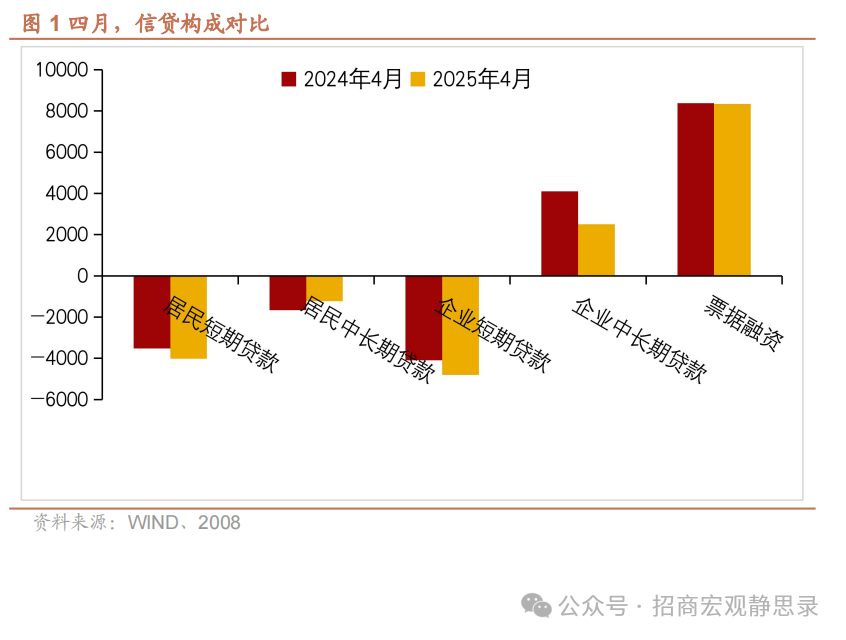
2025年4月金融数据点评:4月信贷大幅少增,社融、M2增速加快,一揽子金融支持政策将推动金融总量增速持续上行
Dong Fang Jin Cheng· 2025-05-15 03:23
Group 1: Loan and Financing Trends - In April 2025, new RMB loans amounted to 280 billion, a year-on-year decrease of 450 billion, primarily due to the over-issuance in March and ongoing local debt replacement effects[1][4][11] - The total social financing (TSF) in April was 1.1585 trillion, a year-on-year increase of 1.2243 trillion, driven by a low base from the previous year and significant government bond issuance[1][7][11] - The M2 money supply grew by 8.0% year-on-year, an increase of 1.0 percentage points from the previous month, indicating enhanced financial support for the real economy[1][9][11] Group 2: Economic Outlook and Policy Implications - The People's Bank of China announced a series of financial support policies on May 7, including interest rate cuts, which are expected to increase bank lending capacity by approximately 1 trillion[3][12] - The easing of the US-China trade tensions, as noted in the May 12 joint statement, may partially restore bilateral trade, although high tariffs will continue to pose challenges[3][12] - The expectation is for continued year-on-year increases in credit and social financing in May, with M2 growth also anticipated to accelerate[3][12][13] Group 3: Structural Changes in Loan Distribution - From January to April 2025, new loans totaled 10.06 trillion, a year-on-year decrease of 130 billion, largely influenced by local debt replacement factors[1][6][11] - The structure of loans has improved, with the proportion of loans to small and micro enterprises, manufacturing, and key service sectors increasing significantly[1][6]
4月金融数据解读、银行投资框架及观点更新
2025-05-14 15:19
Summary of Key Points from the Conference Call Industry Overview - The conference call primarily discusses the banking sector and its financial performance in April 2025, focusing on social financing, credit data, and macroeconomic indicators [1][2][3]. Core Insights and Arguments - **Social Financing and Government Influence**: In April, the new social financing scale was 1.1 trillion yuan, with government bond issuance contributing significantly, indicating reliance on government leverage for financing [2]. Government financing accounted for over two-thirds of the total new financing, highlighting a dependency on state support [2]. - **Weak Credit Performance**: Credit data fell short of expectations, with both corporate and personal loans showing significant year-on-year declines. Short-term corporate loans and non-bank loans decreased, while medium to long-term corporate loans continued to decline, reflecting weak economic demand [3][5]. - **Consumer Loan Trends**: Residential short-term loans dropped by 400 billion yuan year-on-year, indicating weak consumer spending and cautious home-buying intentions despite historically low mortgage rates [5]. The correlation between residential loans and real estate sales remains strong, with a noted decline in both categories [5]. - **Monetary Policy Adjustments**: The central bank's recent interest rate cut of 10 basis points aims to stabilize long-term residential loans. However, there is a noted outflow of deposits from both residents and enterprises, which may affect future lending dynamics [6][7]. - **M2 Growth and Financial Disintermediation**: M2 growth increased from 7% to 8% in April, driven by non-bank deposits. The financial disintermediation process has slowed, with M1 growth indicating ongoing deflationary pressures [8][9]. - **Loan Rate Dynamics**: The new corporate loan rate decreased to 3.2%, while personal mortgage rates remained stable at 3.1%. There is an oversupply of corporate loans, while personal loan demand is balanced [10][11]. - **Future Trends in Financing and Credit Structure**: A downward trend in social financing and credit growth is expected, with a focus on government financing and efficiency in resource allocation to avoid idle capital [12]. Additional Important Insights - **Investment Logic for Banking Stocks**: The investment rationale for banking stocks is based on asset quality, interest rate risk, and funding support. The banking sector is seen as stable, with dividend yields ranging from 4% to 6%, making it attractive compared to other asset classes [13][14][20]. - **Profit Stability Amid Economic Challenges**: Despite economic downturns and narrowing interest margins, banks can maintain stable profits through diversified operations and effective credit cost management. The expected profit growth for banks is stable or slightly positive, with dividend yields remaining consistent [16][20]. - **Valuation of Chinese Banks**: Current valuations of Chinese banks are not considered high, reflecting expectations of future ROE declines. The A-share and Hong Kong bank valuations indicate a correlation with ROE, suggesting that current prices already account for negative outlooks [27]. - **Impact of Geopolitical Factors**: Tariff issues and geopolitical relations are significant variables affecting the future performance of Chinese banks, influencing interest rates, credit demand, and asset quality [28]. - **Market Sentiment Towards Strong Banks**: Traditional banks with strong operational capabilities, such as China Merchants Bank and Ningbo Bank, are viewed favorably, although external economic factors may negatively impact their stock performance [25]. This summary encapsulates the key points discussed in the conference call, providing insights into the banking sector's current state and future outlook.
银行角度看3月社融:政府债维持高增,低基数下信贷增长有所恢复
ZHONGTAI SECURITIES· 2025-04-14 12:41
Investment Rating - The report maintains an "Overweight" rating for the banking sector [5][40]. Core Insights - The report highlights that the growth in social financing (社融) is supported by both credit and government bonds, with March's new social financing reaching 5.89 trillion yuan, exceeding expectations [6][14]. - The credit situation shows a recovery due to a low base effect, with new loans in March increasing by 3.64 trillion yuan, which is 550 billion yuan more than the same period last year [8][20]. - The report emphasizes the importance of government bond issuance, which maintained high growth, with new financing in March amounting to 1.5 trillion yuan, a year-on-year increase of 1 trillion yuan [18][31]. Summary by Sections Social Financing Overview - In March, social financing increased by 5.89 trillion yuan, which is 1.0544 trillion yuan more than the same month last year, and the stock of social financing grew by 8.4% year-on-year [6][14]. - The structure of new financing in March was composed of 64.5% from loans, 25.2% from government bonds, and -0.8% from corporate bonds [15][18]. Credit Situation - The report notes that the increase in credit is primarily driven by a low base effect, with new RMB loans increasing by 5.358 billion yuan year-on-year [18][20]. - The breakdown of new loans shows that corporate short-term loans increased significantly, while residential loans remained stable compared to last year [20][22]. Market Trends - The report indicates that M1 growth has improved, with M0, M1, and M2 growing by 11.5%, 1.6%, and 7.0% respectively in March [31][33]. - New deposits in March totaled 4.25 trillion yuan, with a year-on-year increase of 6.7%, although this was a decrease of 0.55 trillion yuan compared to the previous year [33][34]. Investment Recommendations - The report suggests focusing on bank stocks due to their dividend attributes, particularly large banks and quality city commercial banks [11][39]. - Two main investment themes are highlighted: high-dividend large banks and city commercial banks with strong regional advantages [11][39].





信贷不足VS财政拐点?——2月金融数据点评
赵伟宏观探索· 2025-03-16 16:22
Core Viewpoint - A more proactive fiscal policy may break the current weak expectation cycle, as the decline in M2 year-on-year is primarily due to weak growth in household demand deposits rather than insufficient corporate activity, indicating a shift in household asset allocation towards equity markets [2][9] Financial Data Summary - In February, new credit amounted to 10,100 billion, a year-on-year decrease of 4,400 billion, mainly dragged down by corporate medium and long-term loans. Household loans decreased by 3,891 billion, a year-on-year reduction of 2,016 billion, with short-term loans down by 2,741 billion and medium and long-term loans down by 1,150 billion [4][22] - The total social financing (社融) in February was 22,375 billion, a year-on-year increase of 7,416 billion, supported by a significant increase in government bond financing while loans decreased. New RMB loans were 6,528 billion, a year-on-year decrease of 3,245 billion [5][23] - The M2 year-on-year growth remained stable at 7.0%, with the new M2 year-on-year growth rate declining by 0.3 percentage points to 0.1%. In terms of deposit structure, household deposits increased by 6,100 billion, a year-on-year decrease of 25,900 billion, while corporate deposits decreased by 8,940 billion [5][28] Economic Outlook - The increase in social financing in February was supported by fiscal financing, but the delayed arrival of debt repayment funds and weak credit demand indicate that the recovery foundation is still not solid. A more proactive fiscal policy is expected to effectively break the current weak expectation cycle, with increased spending intensity and accelerated expenditure expected to stabilize social financing [3][21]
25年2月金融数据点评:化债影响再度显现
Ping An Securities· 2025-03-14 14:39
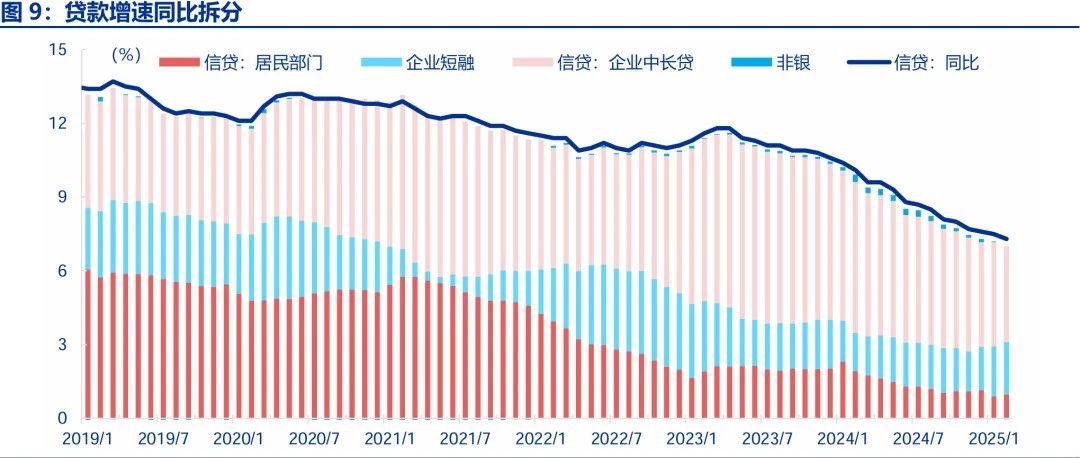
Investment Rating - The report does not explicitly provide an investment rating for the industry Core Insights - The February 2025 financial data indicates a significant increase in social financing, primarily driven by government bonds, while credit growth fell short of expectations [2][3] - The overall financial data for February reflects a weak performance, with a notable contraction in medium to long-term loans for enterprises due to debt reduction impacts [4][7] - The M1 growth rate showed an unexpected seasonal decline, suggesting weak consumer and investment sentiment among enterprises and residents [5][6] Summary by Sections Social Financing and Credit - In February 2025, new social financing amounted to 22,333 billion yuan, an increase of 7,374 billion yuan year-on-year, but 4,167 billion yuan lower than market expectations [2] - The increase in social financing was mainly attributed to government bonds, which contributed approximately 17,000 billion yuan, while new RMB loans were 6,506 billion yuan, reflecting a year-on-year decrease of 3,267 billion yuan [3] Loan Structure - Medium to long-term loans for enterprises saw a significant reduction, with new loans amounting to 5,400 billion yuan, a year-on-year decrease of 7,500 billion yuan [4] - Residential medium to long-term loans remained weak, with a decrease of 1,150 billion yuan, while short-term loans for residents decreased by 2,741 billion yuan [4] Deposit Structure - Corporate deposits increased significantly by approximately 21,000 billion yuan, while resident deposits decreased by about 26,000 billion yuan [6] - Non-bank deposits rose by 18,000 billion yuan, indicating a shift in investment preferences among non-bank entities [6] Market Strategy - The report suggests focusing on short-term credit bonds and similar short-duration, interest-bearing assets due to the overall weak financial data and the impact of debt reduction on credit quality [7][8]
2月新增信贷近万亿,专家:降准要灵活掌握时机
券商中国· 2025-03-14 10:02
3月14日,人民银行发布最新的金融和社会融资数据显示,今年前两个月,人民币贷款增加6.14万亿元,其 中,2月单月新增人民币贷款近万亿元;2月社融增量2.24万亿元,同比多增7416亿元。 每年2月基本上属于信贷小月,今年2月贷款增量达万亿元仍属于历史较高水平。业内专家强调,剔除春节因素 对贷款数据的影响,需要将1—2月贷款增量合并看待,从这个角度观察,今年以来贷款投放同样很不错,在去 年高基数上还实现了较快增长。 先看一组最新的信贷社融数据: 1、前两个月人民币贷款增加6.14万亿元。2月末,人民币各项贷款余额261.78万亿元,同比增长7.3%。结 构上看,普惠小微贷款、制造业中长期贷款增速均高于同期各项贷款增速。 2、前两个月人民币存款增加8.74万亿元,2月末,人民币存款余额310.97万亿元,同比增长7%。 3、初步统计,2025年前两个月社融增量累计为9.29万亿元,比上年同期多1.32万亿元。 4、2月末,广义货币(M2)同比增长7.0%,增速与上月持平;狭义货币(M1)同比增长0.1%,增速较上 月下降0.3个百分点。 5、2月企业新发放贷款(本外币)加权平均利率约3.3%,比上年同期低约40 ...