供给侧改革

Search documents
周期视角如何看反内卷?
2025-07-21 14:26
Summary of Conference Call Records Industry Overview - The records discuss the industrial sector, particularly focusing on industries such as steel, coal mining, construction materials, chemicals, and agriculture chemicals, highlighting the current economic conditions and challenges faced by these sectors [1][2][3][4]. Key Points and Arguments 1. **Current Economic Conditions**: Industrial product prices and overall price levels are declining, with capacity utilization rates in the first two quarters below the historical 10th percentile over the past five years, indicating a severe oversupply situation [1][2]. 2. **Supply-Side Reform**: Short-term supply contraction is critical to address the oversupply and low price environment. Industries with high concentration and state-owned enterprise (SOE) involvement are more likely to implement production cuts [1][5]. 3. **Cyclical Price Increases**: The recent price increases in cyclical products are primarily driven by policy catalysts and a bottoming out of supply-demand dynamics. Industries like steel, electrolytic aluminum, and rare earths show significant profit release potential [1][6]. 4. **Long-Term Investment Opportunities**: Agriculture chemicals and fine chemicals have reached a supply-demand bottom, making them suitable for long-term investment. Stocks in upstream sectors like steel and rare earths exhibit high price elasticity [7][8]. 5. **Specific Industry Potential**: Industries such as organic silicon and glyphosate are expected to see price increases due to supply disruptions and seasonal demand peaks [1][10]. 6. **Steel Industry Performance**: The steel industry is highlighted as a core sector with strong price elasticity and improved profitability, with over 60% of companies reporting profits in the first half of the year, a significant increase from below 20% in the previous year [11][12]. 7. **Globalization of Steel Industry**: The steel sector is becoming less constrained by domestic demand, with a shift towards becoming a global manufacturing representative. The implementation of supply-side reforms is expected to enhance industry conditions [13]. 8. **Impact of Anti-Internal Competition Policies**: Policies aimed at reducing internal competition are expected to significantly impact the construction materials sector, with specific measures to stabilize growth and eliminate outdated capacity [14][15]. 9. **Investment Focus in Construction Materials**: Investment opportunities should focus on traditional cyclical materials like cement, which may benefit from infrastructure demand, and growth sectors like photovoltaic glass [16][17]. 10. **Coal Industry Dynamics**: The coal sector faces significant challenges due to oversupply and the need for effective supply-side policies. Recommendations include focusing on stocks with high elasticity potential [31]. Other Important Insights - The records emphasize the importance of monitoring policy developments and their implications for various sectors, particularly in the context of supply-side reforms and anti-internal competition measures [6][14]. - The potential for price recovery in the steel and construction materials sectors is linked to broader economic recovery and demand stabilization [30]. - The records also highlight the need for companies to adapt to changing market conditions and regulatory environments to maintain competitiveness and profitability [20][21][24].
量化测算雅江工程对民爆、水泥、减水剂贡献及投资机会梳理
2025-07-21 14:26
Summary of Conference Call Notes Industry and Companies Involved - **Industry**: Explosives, Cement, and Admixtures - **Key Companies**: - High Hope Explosives - Yipuli - Guangdong Hongda - Poly United - Tibet Tianlu - Huaxin Cement - Qilian Mountain Cement - Conch Cement - Subote Core Insights and Arguments - **Yajiang Project Impact**: - Estimated total explosive usage for the Yajiang project is between 700,000 to 800,000 tons, significantly higher than the Three Gorges project [3][4] - The project will generate approximately 300 billion CNY in blasting service value, with demand expected to peak from the second half of 2026 to 2031 [3][4] - Annual average explosive usage is projected at 50,000 tons for packaged explosives and 100,000 tons for onsite mixed explosives [1][3] - **Beneficiaries in Explosives Sector**: - High Hope Explosives: Expected annual net profit increase of 300 million CNY - Yipuli: Expected annual net profit increase of 470 million CNY - Guangdong Hongda: Expected annual net profit increase of 150 million CNY - Poly United: Expected annual net profit increase of 70 million CNY [1][5] - **Cement Demand from Mottuo Hydropower Station**: - Anticipated cement demand of 20 to 30 million tons, with an average annual demand of 2.5 million tons over a ten-year construction period [1][6][7] - Peak demand could reach 4 million tons annually [1][7] - **Supply-Side Reform in Cement Industry**: - The cement industry is likely to undergo supply-side reforms due to: - Established experience from previous reforms in steel and coal sectors - High proportion of state-owned enterprises facilitating government coordination - Willingness of companies to reduce production during off-peak seasons to improve prices [9][10] - **Investment Recommendations**: - Focus on companies with stable performance and fundamental changes, such as Huaxin Cement A-shares - Target companies with strong profitability at value bottoms, like Conch Cement, which has a PB of 0.7 and cash reserves of approximately 70 billion CNY - Consider companies with strong safety margins and upward elasticity, such as Tapai Group and Shandong Shangfeng, which have high dividend yields [11][12] Other Important Insights - **Subote's Market Position**: - Subote holds a 90% market share in recent large infrastructure projects, with an estimated 60% to 70% share in the Mottuo Hydropower Station project, potentially increasing annual revenue by 200 to 300 million CNY [15][16] - The company has reversed a three-year decline in revenue and profit, outperforming the cement industry due to its high market share and technological advantages [16] - **Technological Innovations**: - Subote is developing new materials, including PEKK and energy-storing concrete technology, which could revolutionize the construction industry by enabling buildings to self-charge [17][18][19] - **Market Value of Admixtures**: - The overall market value for admixtures, including water-reducing agents, is estimated between 2 billion to 5 billion CNY, with a median of 3.5 billion CNY [14][12] This summary encapsulates the key points from the conference call, highlighting the expected impacts of the Yajiang project and Mottuo Hydropower Station on the explosives and cement industries, along with investment recommendations and insights into Subote's market position and technological advancements.


再看水泥机遇:反内卷与雅江共振
2025-07-21 14:26
Summary of Conference Call on Cement Industry Opportunities Industry Overview - The cement industry is currently experiencing stable profitability, with gross profit per ton maintaining a high level, although slightly lower than the same period last year, providing a fundamental support for investment [1][2][31] - The industry is expected to benefit from significant infrastructure projects, particularly the Yajiang Hydropower Station, which is projected to increase cement demand by 25 to 30 million tons [1][4][17] Key Points and Arguments Policy and Market Dynamics - The Central Economic Committee's meeting has prompted the cement industry association to respond quickly, indicating that the enforcement of overproduction governance policies will strengthen, potentially impacting supply significantly [1][3][7] - The anticipated "anti-involution" policy to be discussed in the upcoming Politburo meeting is expected to have a substantial impact on the performance elasticity of the cement sector if strictly implemented [1][7] - Environmental inspections have already begun in some provinces, which may accelerate the market clearing process and improve capacity utilization and profit elasticity [1][6][7] Infrastructure Investment - Infrastructure investment remains a key focus, with major projects like the Yajiang Hydropower Station and the Mêdog Town Yaxia project, which has a total investment of 1.2 trillion yuan, enhancing market expectations for demand driven by infrastructure [1][11][12] - The Yaxia project is expected to significantly increase the demand for construction materials, including cement, with estimates suggesting a need for approximately 25 to 30 million tons of cement [1][17] Supply and Demand Outlook - The cement industry is not currently in a loss-making state, with leading companies maintaining a gross profit per ton above 50 yuan, indicating a stable profitability outlook [2][9][31] - The supply side is expected to undergo significant changes in the second half of the year, including overproduction governance and potential mergers and acquisitions [10][33] - Despite a projected annual demand decline of about 5%, the supply side is still expected to exert pressure, with ongoing efforts to manage production levels [33][34] Additional Important Insights - The Yajiang project is anticipated to have a profound impact on the revenue elasticity of leading companies in the hydropower and infrastructure sectors, with expected revenue increases of 5% to 10% [16] - The local supply situation for cement is primarily managed by companies like Huaxin, which has a clinker production capacity of approximately 11.5 million tons, ensuring a steady supply for the Yaxia project [18][19] - The market is also seeing a significant demand for additives, particularly water-reducing agents, with projected needs reaching around 600,000 to 700,000 tons, translating to a total demand value of approximately 2 billion yuan [20][22] Conclusion - The cement industry is poised for growth driven by infrastructure investments and supportive government policies, with significant opportunities arising from major projects like the Yajiang Hydropower Station and the Yaxia project. The focus on overproduction governance and environmental compliance will further shape the market dynamics in the coming months [1][6][10][11][12]
从去产能到反内卷:历史镜鉴与当下破局
2025-07-21 14:26
蒙古煤贸易商受益于三季度蒙煤长协价格处于历史低位,当期货和现货价格上 涨时,其利润空间扩大。业绩向上的确定性较高,估值能够合理计算。此外, 需要关注蒙古煤通关量变化、9 月份重大事件对产量的影响以及国内产量变化 从去产能到反内卷:历史镜鉴与当下破局 20250721 摘要 焦煤股受市场情绪带动涨幅较大,现货升水现象显著,动力煤价格亦有 上涨空间,短期内对动力煤和焦煤价格走势持乐观态度,关注期货与现 货价格差异带来的投资机会。 蒙古煤贸易商受益于三季度蒙煤长协价格低位,期货和现货价格上涨扩 大其利润空间,业绩确定性较高,估值合理,但需密切关注蒙古煤通关 量、重大事件及国内产量变化对投资的影响。 历史上的三轮去产能周期显示,2016 年供给侧改革通过 276 天工作制 度等措施有效限制产量,推动秦皇岛动力煤价翻倍,为当前反内卷政策 提供了借鉴意义。 反内卷政策强调依法治理低价竞争,借鉴历史经验,有效限制国内产量 是关键,应关注政府出台强制性减产措施以推动行业健康发展和市场反 转。 供给侧改革显著提升煤炭行业投资,2016 年政策出台后两年内煤炭板 块涨幅超沪深 300 指数,表明政策对煤炭板块产生显著超额收益。 ...
反内卷下,哪些小金属受益?
2025-07-21 14:26
Summary of Key Points from Conference Call Industry Overview - The conference call discusses the small metals industry, particularly focusing on rare earth elements and molybdenum, highlighting the impact of supply-side reforms and market dynamics [1][3][4]. Core Insights and Arguments - **Supply-Side Reforms in Rare Earths**: The deepening of supply-side reforms in the rare earth sector is leading to accelerated consolidation among state-owned enterprises and external companies, limiting non-compliant smelting capacity, which is expected to drive up rare earth prices and increase industry concentration [1][4]. - **Molybdenum Demand Growth**: Molybdenum is anticipated to see strong demand growth due to its critical role in enhancing steel performance, particularly in the production of high-quality steel products. The procurement volume of molybdenum by leading steel mills is increasing despite a decline in pig iron production [1][3][5]. - **Price Projections**: Molybdenum prices are projected to rise to between 4,500 and 5,000 RMB per ton due to low inventory levels, strong demand from manufacturing and military sectors, and potential disruptions in global supply [2][10][11]. - **Impact of Manufacturing and Military Demand**: The demand for special steel, driven by manufacturing and military applications, is significantly increasing, compensating for the slowdown in stainless steel growth. This trend is expected to sustain high overall steel production levels [8][9]. Companies Benefiting from Reforms - **Key Beneficiaries**: Companies such as China Northern Rare Earth Group and China Guangxi Nonferrous Metals are expected to benefit from the supply-side reforms due to their capacity for asset injection. Additionally, Northern Rare Earth and Baotou Aluminum are positioned to gain from rising light and heavy rare earth prices [1][6]. - **Investment Recommendations**: The recommended order of investment focus is: China Northern Rare Earth, China Guangxi Nonferrous Metals, followed by Northern Rare Earth and Baotou Aluminum [6]. Future Trends in the Small Metals Market - **Market Trends**: Future trends include deepening supply-side reforms, increased demand driven by product upgrades, and strong consumption in energy-related sectors. These trends indicate new growth opportunities in the small metals market amid technological advancements and industrial restructuring [7]. Additional Important Insights - **Molybdenum Inventory Levels**: Molybdenum inventory is at a historical low, which, combined with strong demand and potential supply disruptions, suggests a high likelihood of price increases [11]. - **Investment Opportunities**: Companies like Huaxi Nonferrous Metals and Huayu Mining are highlighted as key investment opportunities in the small metals sector, with strong growth potential and favorable market conditions [14].
周期论剑 重启重大工程,重视周期机会
2025-07-21 14:26
Summary of Conference Call Records Industry Overview - The conference call primarily discusses the **construction materials** and **engineering machinery** industries, with a focus on the impact of major infrastructure projects on these sectors [1][5][25]. Key Points and Arguments Economic and Policy Outlook - The second half of the year is expected to focus on addressing structural issues while stabilizing overall demand, particularly in real estate and consumption [1][3]. - Monetary policy is anticipated to remain loose, with potential interest rate cuts and reserve requirement ratio reductions [1][3]. - Fiscal policy is unlikely to see significant short-term increases, but data from July and August will be crucial for potential support measures in September and October [1][3]. Major Infrastructure Projects - The restart of major projects, such as the Yarlung Tsangpo River hydropower project and the China-Kyrgyzstan-Uzbekistan railway, signals a significant opportunity for cyclical stocks, particularly in the construction materials sector [1][5]. - The Yarlung Tsangpo project has a total investment of **1.2 trillion** yuan, with a capacity of **60 million kilowatts**, indicating a strong push for stable economic growth over the next five years [1][9]. Construction Materials Sector - The construction materials industry is currently at a low point, with leading companies like Conch Cement, Oriental Yuhong, and China Jushi showing substantial profits but relatively low market valuations [1][7]. - Investors are advised to adjust their portfolios to include construction materials stocks, particularly focusing on leading companies to capitalize on potential demand changes [1][7][8]. - Recent performance of leading cyclical stocks, such as Conch Cement hitting its upper limit, indicates a positive trend [1][8]. Steel Industry Insights - The steel sector has seen significant price increases due to expectations of major infrastructure projects and supportive government policies [14][16]. - Recommendations for leading steel companies include Baosteel, CITIC Special Steel, and Hualing Steel, as they are expected to benefit from increased demand and reduced supply pressures [15][17]. Engineering Machinery Sector - The engineering machinery industry is experiencing positive growth, with July data showing stable domestic sales and an expected **10%** increase in exports [26]. - The Yarlung Tsangpo project is projected to drive significant demand for construction machinery, with total equipment investment estimated at **200 billion** yuan [25][26]. Market Reactions - The market has reacted positively to the announcement of major projects, with significant stock price increases for companies involved in hydropower and construction [11][12]. - The Yarlung Tsangpo project has garnered attention due to its high investment amount and the involvement of high-ranking officials, indicating strong governmental support [12][13]. Additional Considerations - The construction materials sector is advised to focus on high dividend yield stocks as a safety margin, with specific recommendations including Conch Cement and Taipai Group [8]. - The engineering machinery sector should consider companies like SANY, XCMG, and major suppliers of construction equipment, as they are expected to benefit from increased project activity [25][26]. Conclusion - The conference call highlights a cautiously optimistic outlook for the construction materials and engineering machinery sectors, driven by government support for major infrastructure projects and a stabilizing economic environment. Investors are encouraged to focus on leading companies within these industries to capitalize on emerging opportunities.
政策点火低仓单扇风,氧化铝期价强势上行
Wen Hua Cai Jing· 2025-07-21 14:17
Core Viewpoint - The aluminum oxide market is experiencing price increases driven by favorable policies, low inventory levels, and supply disruptions from Guinea, despite long-term oversupply concerns [2][10][15]. Group 1: Market Dynamics - The price of aluminum oxide has surged due to multiple factors, including supply-side reforms expected from the Ministry of Industry and Information Technology, which aims to stabilize growth in key industries [2]. - On July 18, aluminum oxide inventory dropped significantly to 6,922 tons, raising concerns about liquidity and potential short squeeze risks [2][7]. - The main contract for aluminum oxide reached a five-month high, with trading volume increasing to nearly 1 million lots [2]. Group 2: Supply Chain and Inventory - Guinea's rainy season is impacting bauxite supply, with a recent announcement of new reforms aimed at increasing transparency in bauxite pricing [4][5]. - Domestic bauxite inventory remains high, with port stocks at 27.04 million tons, despite a slight weekly decline [4]. - The overall supply of imported bauxite is under pressure, with a significant drop in shipments to China, down 36.8% week-on-week [5]. Group 3: Production and Capacity - Domestic aluminum oxide production capacity has increased, reaching a new high of 1.785 million tons as of early July, with production continuing to rise [11]. - New production capacities are expected to come online in the second half of 2025, potentially leading to a further oversupply situation [13]. - The overall inventory of aluminum oxide in China has increased to 3.989 million tons, indicating a trend of accumulation [13]. Group 4: Policy Impact - The "anti-involution" policy has positively influenced market sentiment, although its direct impact on the aluminum oxide sector may be limited due to the absence of significant outdated capacity [10]. - The current market dynamics suggest that while short-term prices may remain strong, long-term oversupply expectations could lead to price stabilization or declines [15].


冠通期货宏观与大宗商品周报-20250721
Guan Tong Qi Huo· 2025-07-21 14:16
Report Industry Investment Rating No relevant content provided. Core Viewpoints - Recently, the risk appetite in the capital market has remained positive, with the prices of risk assets generally rising. Overseas, the impact of US tariffs and internal strife on the capital market has faded, while geopolitical turmoil has had little impact. US inflation data reflects the impact of tariffs, but the increase in core CPI is lower than expected, causing little disturbance to the Fed's interest rate cut expectations. Most global stock markets have fluctuated and ended up rising, the BDI index has soared, the US dollar has rebounded slightly, non - US currencies are under pressure, and commodities have shown mixed performance. In China, the "anti - involution" market continues. The A - share market has stabilized above 3,500 points, and the pattern of strong domestic and weak overseas in the commodity market has been strengthened and spread. The domestic bond market has mostly declined, with a pattern of near - term strength and long - term weakness, while stock indices have generally risen. The domestic commodity market has shown mixed performance, with the Wind Commodity Index rising 1.84% weekly, and 8 out of 10 commodity sub - indices ending up rising [6]. - The current macro - logical mainline for domestic commodity and stock market trading is the continuation of the anti - involution market. The second - quarter macro data shows that the overall economy is resilient but the marginal trend is weakening. Real estate is still a drag, exports face challenges, consumption is the main driver, and price depression is intensifying. The market anticipates policy support, which strengthens the trading logic of the anti - involution market. The upcoming release of the "Top Ten Industry Steady - Growth Plan" by the Ministry of Industry and Information Technology and the commencement of the Yarlung Zangbo River Hydropower Project have further strengthened the anti - involution market. However, due to economic transformation requirements, the implementation of policies will focus on structural adjustment, supply optimization, and elimination of backward production capacity. The actual amount of eliminated production capacity may be limited, and the market trend is expected to be volatile, with hot sectors and varieties rotating rapidly. In terms of investment strategies, it is not advisable to go against the trend during the fermentation of the anti - involution market, and risks should be controlled when the market is overly optimistic [7][8]. Summary by Directory 1. Big - Asset Category - Overseas, the impact of US tariffs and internal strife on the capital market has become less significant, and geopolitical turmoil has had little impact. Most global stock markets have fluctuated and ended up rising, the BDI index has soared, the US dollar has rebounded slightly, non - US currencies are under pressure, and commodities have shown mixed performance. In China, the "anti - involution" market continues. The A - share market has stabilized above 3,500 points, and the pattern of strong domestic and weak overseas in the commodity market has been strengthened and spread. The commencement of the Yarlung Zangbo River Hydropower Project and the upcoming release of the Top Ten Industry Steady - Growth Plan have strengthened the anti - involution market, and domestic - priced commodities, especially industrial products, have seen a long - awaited general rise [11]. 2. Sector Express - The domestic bond market has mostly declined, with a pattern of near - term strength and long - term weakness, while stock indices have generally risen. The domestic commodity market has shown mixed performance, with the Wind Commodity Index rising 1.84% weekly, and 8 out of 10 commodity sub - indices ending up rising. Except for the non - ferrous and non - metallic building materials sectors, which declined, other commodities rose. The oilseeds, coking coal, steel, and energy sectors led the gains, and the market's characteristics of strong expectations and weak reality, as well as the strength conversion between domestic and international - priced commodities, have been strengthened [16]. 3. Fund Flow - Last week, funds in the domestic commodity futures market showed a slight net inflow. The energy, precious metals, grains, oilseeds, non - metallic building materials, and soft commodity sectors saw significant fund inflows, while the non - ferrous and agricultural and sideline products sectors had significant outflows [19]. 4. Variety Performance - Most domestic commodity futures rose last week. Among them, lithium carbonate, shipping index, and industrial silicon led the gains, while LPG, Shanghai lead, and urea led the losses [24]. 5. Volatility Characteristics - Last week, the volatility of the international CRB Commodity Index declined significantly, and the volatilities of the domestic Wind Commodity Index and Nanhua Commodity Index also decreased. Most commodity sub - sectors saw a decline in volatility, with the precious metals, soft commodities, non - metallic building materials, and grain sectors experiencing a significant drop, while the energy and oilseeds sectors saw a significant increase [30]. 6. Data Tracking - Internationally, most major commodities ended up rising, the BDI index soared again, copper, soybeans, and silver rose, crude oil and corn fell, the gold price fluctuated and ended flat, and the gold - silver ratio declined. Domestically, the asphalt production rate was stable, real estate sales remained weak, freight rates declined slightly, and short - term capital interest rates rebounded and then fluctuated. In the US, bond yields rose slightly, the China - US interest rate spread was under pressure, inflation expectations rebounded significantly, financial conditions were loose, the US dollar rebounded and then fluctuated, and the RMB exchange rate was stable [32][53][69]. 7. Macro Logic - Stock indices have all risen, valuations have increased collectively, and the risk premium ERP is under pressure. Commodity price indices have fluctuated upwards, inflation expectations have rebounded, and both expectations and reality have risen. In the US, the yield curve of Treasury bonds has become steeper, the term spread is stable, and both real interest rates and the gold price are oscillating at high levels. The US high - frequency "recession indicator" shows a split trend, the impact of tariffs on the economy is not obvious, and the 10Y - 3M Treasury bond spread fluctuates around zero [37][45][61]. 8. Fed Interest Rate Cut Expectations - The CME FedWatch tool shows that the probability of the Fed keeping the interest rate unchanged at 4.25 - 4.5% in July is 93.6%, slightly lower than last week's 94.7%. The probability of an interest rate cut starting in September is not high, and the highest probability scenario is two 25 - basis - point cuts in October or December, totaling 50 basis points for the year [75]. 9. US CPI Data - In June, the US CPI rose 2.7% year - on - year, slightly higher than the market expectation of 2.6% and higher than May's 2.4%, marking the largest year - on - year increase since February. The month - on - month increase was 0.3%, in line with expectations and higher than May's 0.1%. After excluding food and energy prices, the core CPI rose 0.2% month - on - month, accelerating from May's 0.1%. The year - on - year increase in core CPI was 2.9%, slightly lower than the market expectation of 3%. Some commodity prices have risen, indicating the impact of US tariff policies, while the decline in used and new car prices has hindered the rise of core CPI [83]. 10. China's First - Half Macro - Economic Data - In the first half of 2025, China's GDP reached 66.0536 trillion yuan, a year - on - year increase of 5.3% at constant prices. The added value of the primary, secondary, and tertiary industries increased by 3.7%, 5.3%, and 5.5% respectively. In the second quarter, the GDP increased by 5.2% year - on - year and 1.1% quarter - on - quarter. The overall economy is resilient but the marginal trend is weakening, with real estate being a drag, exports facing challenges, and consumption driving growth [92]. 11. China's CPI and PPI Data - In June, China's CPI rose 0.1% year - on - year, ending three consecutive months of decline, while the PPI decline widened to - 3.6%, remaining negative for 33 consecutive months. The continuous divergence between CPI and PPI reveals the complex structural roots of deflationary pressure in the Chinese economy. The decline in PPI is due to over - capacity, weak demand, and external shocks. The market anticipates policy support to break the deflationary spiral, which strengthens the trading logic of the anti - involution market [96][97]. 12. Ministry of Industry and Information Technology's Plan - The Ministry of Industry and Information Technology will implement a new round of steady - growth plans for ten key industries, including steel, non - ferrous metals, petrochemicals, and building materials, aiming to adjust the structure, optimize supply, and eliminate backward production capacity. The plan also includes supporting key industrial provinces to play a leading role. The background for the plan is the challenges faced by the industrial economy, and the approach is to combine steady - growth and transformation. Steady - growth aims to consolidate the foundation, while transformation focuses on improving development quality and cultivating new growth drivers. The plan will also optimize the development environment [101][104]. 13. Yarlung Zangbo River Hydropower Project - The Yarlung Zangbo River Hydropower Project officially started on July 19, 2025, in Nyingchi, Tibet. With a total investment of 1.2 trillion yuan, it plans to build five cascade power stations with a total installed capacity of 60 million kilowatts and an estimated annual power generation of about 300 billion kilowatt - hours. The project is crucial for national energy security and achieving the "dual - carbon" goal, can drive regional development, create employment opportunities, and enhance geopolitical influence. Its commencement, together with the upcoming industry plan, has strengthened the anti - involution market [108][110][111]. 14. This Week's Focus - Monday (July 21): China's 1 - year/5 - year loan prime rates, Japanese stock market closed. Tuesday (July 22): ECB releases bank lending survey report, Fed Chair Powell and Vice Chair for Supervision Bowman speak at a large - bank capital framework review meeting. Wednesday (July 23): Eurozone consumer confidence index for July, Trump may give a speech on artificial intelligence. Thursday (July 24): ECB announces interest rate decision and holds a press conference by President Lagarde, Eurozone PMI. Friday (July 25): Tokyo CPI for July in Japan, Russian central bank announces interest rate decision [115].
铁合金产业风险管理日报-20250721
Nan Hua Qi Huo· 2025-07-21 14:05
铁合金产业风险管理日报 2025/7/21 周甫翰(Z0020173)陈敏涛(F03118345 ) 投资咨询业务资格:证监许可【2011】1290号 铁合金价格区间预测 | | 价格区间预测(月度) | 当前波动率(20日滚动) | 当前波动率历史百分位(3年) | | --- | --- | --- | --- | | 硅铁 | 5300-6000 | 21.16% | 58.0% | | 硅锰 | 5300-6000 | 13.49% | 18.1% | source: 南华研究,同花顺 铁合金套保 | 行为导 | 情景分析 | | 现货敞 | 策略推荐 | 套保工具 | 买卖方 | 套保比例(%) | 建议入场区间 | | --- | --- | --- | --- | --- | --- | --- | --- | --- | | 向 | | | 口 | | | 向 | | | | 库存管 | 产成品库存偏高,担心铁合金下 | | | 为了防止存货跌价损失,可以根据企业的库存情况,做空铁合金 | SF2509、SM | | | SF:6200-6250、SM:6 | | 理 | | 跌 | 多 | ...
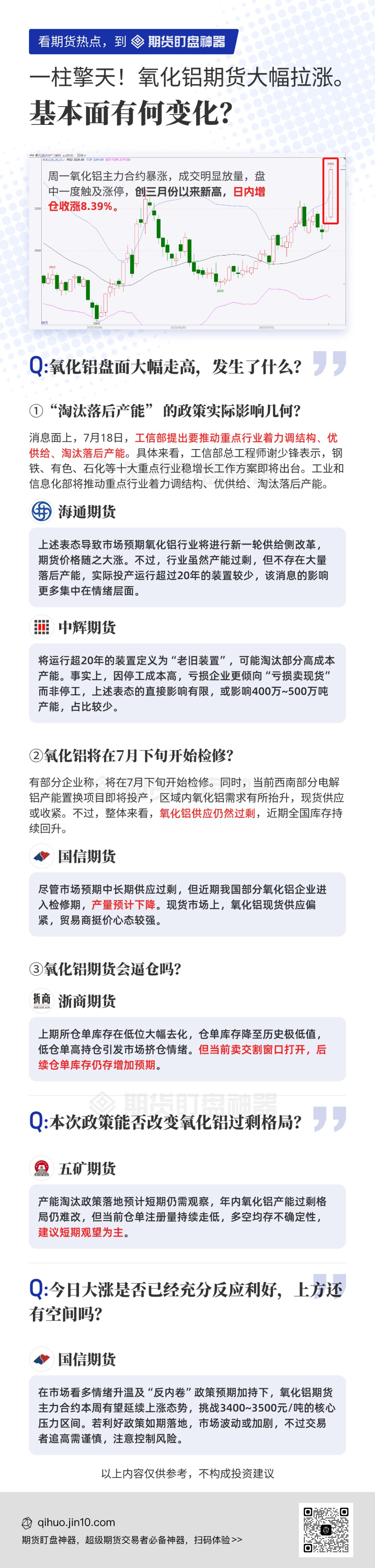
【金十期货热图】今日氧化铝期货盘中一度触及涨停!什么原因?后市能否继续看多?一图了解。
news flash· 2025-07-21 12:21
Group 1 - The market anticipates a new round of supply-side reform in the alumina industry, leading to a significant rise in futures prices, although the actual impact is more emotional than substantial due to limited old production capacity [4] - The definition of "old facilities" includes those in operation for over 20 years, with potential elimination of some high-cost capacity, but the direct impact is limited, affecting only 4 to 5 million tons of capacity, which is a small proportion [5] - Some companies are expected to begin maintenance in late July, which may tighten the current spot supply of alumina, although overall supply remains excessive with national inventories continuing to rise [6][7] Group 2 - Despite expectations of long-term supply surplus, some alumina companies are entering maintenance periods, leading to a projected decrease in production, while spot market supply is tightening and traders are maintaining a strong price support stance [7] - The low inventory levels at the Shanghai Futures Exchange have led to a significant reduction in warehouse receipts, creating a market squeeze sentiment, although the opening of the selling delivery window suggests an expectation of increased inventory in the future [8]