
以旧换新政策

Search documents
乘联分会:预计1月狭义乘用车零售总市场为180万辆左右 新能源渗透率达44.4%
智通财经网· 2026-01-22 22:45
Core Viewpoint - The retail market for narrow passenger vehicles in January is projected to be around 1.8 million units, reflecting a month-on-month decline of 20.4% but a slight year-on-year increase, with new energy vehicle sales expected to reach approximately 800,000 units and a penetration rate of 44.4% [1][2] Group 1: Manufacturer Sales Trends - Most manufacturers have a neutral to optimistic sales outlook for January, with major manufacturers, accounting for nearly 80% of total market sales, setting retail targets that are flat or slightly increased compared to the same period last year [2] - The narrow passenger vehicle retail market size for January is estimated at 1.8 million units, with a month-on-month decrease of 20.4% and a year-on-year increase of 0.3% [2] Group 2: Weekly Sales Trends - The market showed weak performance at the beginning of January due to the halving of the vehicle purchase tax subsidy, with an average daily retail of 30,000 units in the first week, reflecting declines both year-on-year and month-on-month [3] - Retail activity slightly recovered in the second week, with an average daily retail of 50,000 units, and further improved in the third week to an estimated 57,000 units as local trade-in subsidies began to take effect [3] - By the fourth week, with the implementation of subsidy policies and increased first-time purchase demand, the market is expected to regain growth momentum, with daily retail projected to reach 120,000 units [3] Group 3: Market Transition and Policy Impact - The Chinese economy is showing resilience and vitality, with total retail sales of consumer goods exceeding 50 trillion yuan, growing by 3.7% year-on-year, and the used car trade-in policy has significantly impacted the market, with over 11.5 million vehicles traded in [4] - A new round of trade-in subsidies for 2026 has been initiated, which is expected to provide stable support for the automotive market throughout the year [4] - The market is currently in a critical transition period due to policy changes, particularly the adjustment of new energy vehicle purchase tax subsidies from full exemption to a 50% reduction, leading to increased consumer hesitation and lower market heat in January [4]
以旧换新撬动发展新动能
Ren Min Ri Bao· 2026-01-22 21:57
Group 1 - The "new national subsidy" policy has rapidly taken effect, with significant consumer engagement, such as 16,324 transactions in Chongqing and nearly 16 million yuan in trade-ins in Fuzhou during the New Year holiday, showcasing the policy's impact on consumption upgrade and industrial transformation [1] - By 2025, the sales volume of related goods under the trade-in policy is expected to exceed 2.6 trillion yuan, benefiting over 360 million people, playing a crucial role in expanding domestic demand [1] - The recent notification on implementing large-scale equipment updates and consumer goods trade-in policies for 2026 aims to optimize support scope, subsidy standards, and implementation mechanisms [1] Group 2 - The urgent need for upgrading old residential areas and facilities in elderly care institutions is highlighted, with approximately 22,000 old communities built between 1980 and 2000, and a projected shortage of 46 million nursing beds for the elderly by 2035 [2] - The new policy includes support for installing elevators in old residential buildings and updating facilities in elderly care institutions, linking improvements in people's livelihoods with the expansion of domestic demand [2] - The policy encourages green transformation by linking subsidies to energy efficiency ratings and promoting the electrification of old vehicles, thereby fostering new consumption patterns and driving the development of green applications [2] Group 3 - The combination of optimizing supply and expanding demand is emphasized, with new consumption driving new supply and meeting new demands, facilitating industrial transformation [3] - The trade-in policy has expanded to include digital and smart products, as well as elderly-friendly home products, aligning with the trend of intelligent consumption and addressing health monitoring needs for the elderly [3] - The effective implementation of the trade-in policy is expected to create positive feedback across the economic system, enhancing domestic demand, fostering new growth drivers, and promoting industrial upgrades [3]
【乘联分会论坛】1月狭义乘用车零售预计180.0万辆,新能源预计80.0万辆
乘联分会· 2026-01-22 14:19
Core Viewpoint - The article discusses the performance and outlook of the Chinese passenger car market, highlighting the impact of policy changes and consumer behavior on sales trends in early 2026 [2][3][6]. Group 1: 2025 Market Review - In December 2025, the retail sales of narrow passenger cars reached 2.261 million units, a year-on-year decrease of 14.0% but a month-on-month increase of 1.6% [2]. - For the entire year of 2025, narrow passenger car retail sales hit a record high of 23.745 million units, with new energy vehicles (NEVs) accounting for 12.809 million units, representing a year-on-year growth of 17.6% and a penetration rate of 53.9% [2]. Group 2: January 2026 Market Outlook - January 2026 is expected to see a slight year-on-year increase in sales due to the release of pent-up demand from consumers returning home for the Spring Festival, despite uncertainties in the market [3]. - The national scrapping subsidy has been implemented, but the reduction in purchase tax has created a certain degree of overspending effect, leading to cautious consumer sentiment [3]. Group 3: Manufacturer Sales Trends - Most manufacturers have a neutral to optimistic sales outlook for January, with major manufacturers aiming for retail targets that are flat or slightly increased compared to the same period last year [4]. - The estimated retail market size for narrow passenger cars in January is around 1.8 million units, reflecting a month-on-month decrease of 20.4% but a year-on-year increase of 0.3% [4]. Group 4: Weekly Sales Trends - The car market started weak in early January due to the halving of the purchase tax subsidy, with daily retail sales averaging 30,000 units in the first week [5]. - Sales improved slightly in the second week, with daily retail reaching 50,000 units, and further recovery is expected in the following weeks as old-for-new subsidies are implemented [5]. Group 5: Transition to Normalization - The Chinese economy showed resilience in 2025, with total retail sales of consumer goods exceeding 50 trillion yuan, growing by 3.7% year-on-year [6]. - The old-for-new policy has significantly boosted sales, with over 2.6 trillion yuan in related sales and benefiting over 360 million people, including more than 11.5 million cars [6]. - The transition period in early 2026 is marked by a shift from strong policy stimulation to reliance on product strength and normalized consumption patterns, with the penetration rate for NEVs expected to hit a temporary low [6].


赛特新材(688398.SH)发预减,预计2025年度归母净利润同比减少57.89%到71.93%
智通财经网· 2026-01-22 11:17
智通财经APP讯,赛特新材(688398.SH)发布2025年年度业绩预减公告,预计2025年年度实现归属于母 公司所有者的净利润与上年同期(法定披露数据)相比,将减少4,467万元到5,550万元,同比减少57.89% 到71.93%。 本期业绩预减的主要原因:1受宏观环境和市场竞争影响,报告期主营产品真空绝热板销售均价同比下 降及内外销结构变化导致真空绝热板毛利率同比下降;报告期子公司维爱吉处于投资期,相应的固定资 产折旧费用同比增加;公司发行可转换公司债券计提利息费用以及银行贷款利息费用同比增加,导致公 司财务费用同比上升。报告期内,公司坚持以市场为导向,主营产品真空绝热板产销量延续良好的增长 态势。2026年,随着新版冰箱能效标准实施及以旧换新政策延续,将为公司主营产品渗透率的持续提升 创造有利条件。公司将积极应对机遇和挑战,优化业务布局,积极响应下游客户需求,并加快新产品落 地、拓展新应用领域;同时,强化日常运营管理,深化降本增效,以提升公司整体盈利能力。 ...

赛特新材发预减,预计2025年度归母净利润同比减少57.89%到71.93%
Zhi Tong Cai Jing· 2026-01-22 11:16
Core Viewpoint - The company, Sait New Materials (688398.SH), has announced a significant decrease in its expected net profit for the year 2025, projecting a reduction of 44.67 million to 55.50 million yuan, which translates to a year-on-year decline of 57.89% to 71.93% [1] Group 1: Reasons for Profit Decrease - The primary reasons for the profit decrease include a decline in the average selling price of the main product, vacuum insulation panels, due to macroeconomic conditions and market competition, leading to a decrease in gross margin [1] - The subsidiary, Weijiji, is currently in an investment phase, resulting in increased fixed asset depreciation expenses compared to the previous year [1] - The company has incurred higher financial expenses due to interest costs from convertible bonds and bank loans, contributing to the overall increase in financial costs [1] Group 2: Business Outlook and Strategies - Despite the profit decrease, the company reports a continued growth trend in the production and sales volume of vacuum insulation panels, driven by market demand [1] - The implementation of new refrigerator energy efficiency standards and the continuation of the old-for-new policy in 2026 are expected to create favorable conditions for the sustained increase in the penetration rate of the company's main products [1] - The company plans to actively respond to opportunities and challenges by optimizing its business layout, responding to downstream customer needs, accelerating the launch of new products, and expanding into new application areas [1] - There is a focus on enhancing daily operational management and deepening cost reduction and efficiency improvement efforts to boost overall profitability [1]
二〇二五年社会消费品零售总额突破五十万亿元
Ren Min Ri Bao· 2026-01-21 23:25
Group 1 - The total retail sales of consumer goods in China is projected to exceed 50.1 trillion yuan by 2025, with a growth rate of 3.7% [2] - Retail sales of goods are expected to grow by 3.8%, while catering revenue is anticipated to increase by 3.2% [2] - Final consumption expenditure is expected to contribute 52% to economic growth, continuing to serve as a primary engine for economic development [2] Group 2 - The "old-for-new" policy has significantly boosted retail sales, with home appliances and communication equipment retail sales both surpassing 1 trillion yuan in 2025, marking a historical high [2] - In 2025, over 129 million units of 12 categories of home appliances are expected to be replaced, and more than 91 million digital products are projected to be purchased [2] - Retail sales of household appliances and audio-visual equipment, as well as communication equipment, are expected to grow by 11% and 20.9%, respectively [2] Group 3 - The trend of consumption upgrading is evident, with sales of smart glasses, smartwatches, and smart bands increasing by over 40% [2] - The release of new products in fields such as smart connected vehicles and smartphones is accelerating, with domestic and international brands rapidly establishing flagship stores [2] - The "IP + consumption" trend is thriving, with sales of movie derivatives during the summer season in 2025 expected to double year-on-year [2] Group 4 - The "old-for-new" policy is facilitating industrial transformation and upgrading, effectively promoting the development of new productive forces [3] - Sales of first-level energy-efficient or water-efficient products among the 12 categories of home appliances account for over 90% [3] - The number of new types of home appliances is increasing, with 17.78 million new products expected in 2025, representing a year-on-year growth of 28.89% [3] - Home appliance companies are utilizing "5G + industrial internet" technology to significantly shorten order cycles, while smartphone companies are innovating in imaging, battery life, and AI technologies to enhance product value [3]

同比增长5.5%!四川2025年GDP6.77万亿元 汽车产量突破100万辆
Zheng Quan Shi Bao Wang· 2026-01-21 12:22
Economic Overview - In 2025, Sichuan's GDP is projected to reach 67,665.34 billion yuan, reflecting a 5.5% increase from the previous year [1] - The primary industry is expected to contribute 5,751.35 billion yuan, growing by 3.7%; the secondary industry is projected at 23,260.22 billion yuan, with a growth of 4.9%; and the tertiary industry is anticipated to reach 38,653.77 billion yuan, growing by 6.1% [1] Agricultural Production - Sichuan's total grain output for 2025 is estimated at 36,625 million tons, a 0.8% increase year-on-year [2] - The province expects to see 62.48 million pigs and 3.01 million cattle slaughtered, with increases of 1.6% and 1.1% respectively; however, sheep output is projected to decline by 15.2% [2] Industrial Performance - The industrial output value for Sichuan is expected to grow by 6.5% in 2025, with a product sales rate of 96.1% among large-scale industrial enterprises [2] - Notable growth in specific sectors includes automotive manufacturing (16.7%), electrical machinery (13.2%), and computer and electronic equipment (12.9%) [2] High-Tech Industry Growth - The added value of high-tech manufacturing is projected to increase by 12.3%, with significant contributions from electronics and communication equipment (20.2%) and aerospace manufacturing (19%) [3] - Large-scale industrial enterprises are expected to achieve revenues of 44,275.2 billion yuan, a 2.6% increase, and total profits of 3,005 billion yuan, growing by 3.1% [3] Consumer Market Trends - The total retail sales of consumer goods are projected to reach 29,135.4 billion yuan, reflecting a 5.1% increase [3] - The restaurant sector is expected to generate 4,026.7 billion yuan, growing by 3.7%, while retail sales of goods are anticipated to increase by 5.4% [3] Policy Impact - Sichuan has implemented various policies to stimulate economic recovery, including the "21 measures" and "18 measures" aimed at enhancing economic momentum [3] - The "trade-in" policy has significantly boosted sales in related sectors, with communication equipment retail sales increasing by 50.8% and new energy vehicle sales rising by 42.9% [3] Investment Trends - Fixed asset investment (excluding rural households) is projected to decline by 2.4%, with the primary industry seeing a 6.8% increase, while the tertiary sector is expected to decrease by 6.8% [4] - Real estate development investment is anticipated to drop by 8.5%, with a significant decline in new housing sales and construction area [4] Private Investment Dynamics - Private investment in Sichuan has shown resilience, growing by 2.1% in 2025, reversing a two-year decline [5] - The growth rate of private project investment is expected to reach 9%, indicating a narrowing decline in real estate development investment [5]
乘联分会:1月1-18日全国乘用车市场零售67.9万辆 同比下降28%
智通财经网· 2026-01-21 11:23
Group 1: Market Performance - From January 1 to 18, the national passenger car retail sales reached 679,000 units, a year-on-year decrease of 28% and a month-on-month decrease of 37% [1][5] - During the same period, the wholesale volume of passenger cars was 740,000 units, down 35% year-on-year and 30% month-on-month [1][9] - The retail sales of new energy vehicles (NEVs) in the same timeframe were 312,000 units, reflecting a 16% year-on-year decline and a 52% month-on-month decline [1][5] Group 2: Production Trends - In the first two weeks of January, the production of pure fuel light vehicles was 91,000 units, down 85% year-on-year and 77% month-on-month [1] - The production of hybrid and plug-in hybrid vehicles totaled 139,000 units, a year-on-year decrease of 65% and a month-on-month decrease of 75% [1] Group 3: Policy Impact - The National Development and Reform Commission announced a policy to implement large-scale equipment updates and a trade-in program, which is expected to boost domestic car consumption [5] - The subsidy for passenger car trade-ins is projected to decrease by 20% to 30% compared to 2025, indicating a structural adjustment in the policy [5][11] Group 4: Future Outlook - The market is expected to improve as local subsidy details and channels are fully launched, along with the gradual release of purchasing power before the Spring Festival [5] - The first month of the year typically sees a "New Year sales boost," and despite the current weak performance, there is an anticipation of a slight increase in year-on-year sales due to pre-orders and market dynamics [9][11]



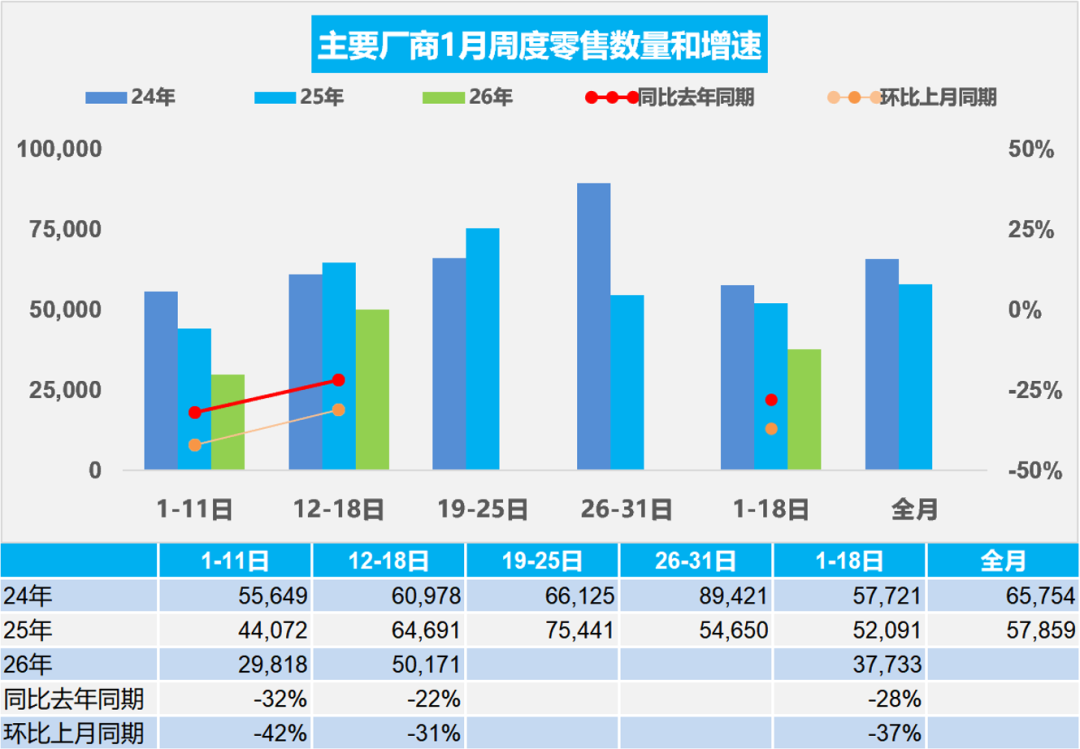
【周度分析】车市扫描(2026年1月12日-1月18日)
乘联分会· 2026-01-21 10:57
Group 1: Market Overview - From January 1 to 18, the national retail sales of passenger cars reached 679,000 units, a year-on-year decrease of 28% compared to the same period last year, and a month-on-month decrease of 37% [1] - The wholesale volume of passenger cars during the same period was 740,000 units, down 35% year-on-year and down 30% month-on-month [1] - In the new energy vehicle sector, retail sales were 312,000 units, a year-on-year decrease of 16% and a month-on-month decrease of 52% [1] Group 2: Production Trends - In the first two weeks of January, the production of pure fuel light vehicles was 91,000 units, down 85% year-on-year and down 77% month-on-month [2] - The production of hybrid and plug-in hybrid vehicles during the same period was 139,000 units, down 65% year-on-year and down 75% month-on-month [2] Group 3: Policy Impact - The National Development and Reform Commission announced a policy to promote large-scale equipment updates and trade-in subsidies, which is expected to boost domestic car consumption [5] - The subsidy for scrapping and updating passenger vehicles is projected to decrease by 20% to 30% by 2026, while commercial vehicle subsidies remain strong [5][10] Group 4: Sales and Wholesale Trends - The average daily retail sales for the first week of January were 30,000 units, down 32% year-on-year, while the second week saw an average of 50,000 units, down 22% year-on-year [5] - The wholesale average for the first week was 35,000 units, down 40% year-on-year, and for the second week, it was 51,000 units, down 28% year-on-year [8] Group 5: Economic Context - In 2025, the total retail sales of consumer goods reached 501.2 billion yuan, a year-on-year increase of 3.7%, while automotive consumption decreased by 2% [9] - The production of automobiles in December 2025 was 3.41 million units, a year-on-year decrease of 3%, while new energy vehicle production increased by 9% [10] Group 6: Engine Market Stability - Despite the rapid development of the new energy vehicle industry, the automotive engine market remains stable, with gasoline engines maintaining a dominant position [11] - The production of gasoline engines reached 21.13 million units in 2025, while diesel engine production decreased to 2.61 million units due to market adjustments and stricter environmental policies [11] Group 7: Pickup Truck Market Growth - In December 2025, the pickup truck market sales reached 52,000 units, a year-on-year increase of 8.8%, with total sales for the year at 589,000 units, up 11.8% [12] - The export of pickup trucks in December was 28,000 units, a year-on-year increase of 12%, with total exports for the year reaching 300,000 units, up 21% [13]

小摩:料今年以旧换新政策继续利好金属商品市场 推荐买紫金矿业等
Zhi Tong Cai Jing· 2026-01-21 03:49
Core Viewpoint - Morgan Stanley forecasts China's GDP growth to reach 5% year-on-year by 2025, driven primarily by consumption stimulation from the trade-in policy [1] Group 1: Economic Outlook - The growth trend in the commodity market is expected to continue into 2026, with global demand-driven metals (such as gold, copper, and lithium) outperforming domestic demand-driven sectors (like coal and steel) [1] - Supply disruptions and accelerated industry consolidation are anticipated to persist throughout the year [1] Group 2: Policy Impact - The trade-in subsidy policy is projected to extend into 2026, with incentives becoming more targeted and efficiency-focused, still providing substantial support for overall commodity demand [1] Group 3: Industry Preferences - The preferred order for the basic materials sector in 2026 is gold and copper, followed by aluminum, lithium, coal, and steel [1] - The materials sector is expected to continue outperforming the MSCI China Index in 2026 [1] Group 4: Investment Recommendations - Investors are advised to buy Zijin Mining (02899, 601899.SH) and to accumulate China Aluminum (02600, 601600.SH) and China Hongqiao (01378) on dips [1] - Luoyang Molybdenum (03993) may experience a temporary pause due to the issuance of convertible bonds [1]
