美联储货币政策

Search documents
金价猛涨!新一轮黄金大行情已开启,还在等回调的人要慌了
Sou Hu Cai Jing· 2026-02-26 19:16
Core Viewpoint - The international gold market is experiencing significant price increases, with gold prices surpassing $5200 per ounce, driven by strong demand from central banks, geopolitical risks, and expectations of lower interest rates from the Federal Reserve [1][3][4]. Group 1: Price Movements - London spot gold prices opened above $5200 per ounce, reaching a high of $5216, marking a daily increase of over 1% [1]. - The Shanghai Gold Exchange reported gold T D contracts at 1149.5 yuan per gram, with the main contract hitting 1152.98 yuan per gram [1]. - Retail prices for gold jewelry from brands like Chow Tai Fook and Lao Feng Xiang reached between 1566 to 1570 yuan per gram [1][3]. Group 2: Driving Factors - Central banks globally have been consistently purchasing gold, with a net purchase of 863 tons in 2025, establishing gold as a core asset for risk diversification [3]. - Ongoing geopolitical tensions in regions like the Middle East and Eastern Europe have increased market uncertainty, making gold a preferred safe-haven asset [3][4]. - Expectations of continued interest rate cuts by the Federal Reserve in 2026 are lowering the opportunity cost of holding non-yielding assets like gold, contributing to rising prices [4]. Group 3: Investment Trends - In January 2026, global physical gold ETFs saw an inflow of $19 billion, the highest monthly record, bringing total assets under management to $669 billion [6]. - Asian markets accounted for approximately $10 billion of the inflow, indicating strong investment interest despite high gold prices [6]. - Financial institutions have varying predictions for future gold prices, with UBS projecting a mid-2026 target of $6200 per ounce, while Goldman Sachs has a more conservative estimate of $5400 per ounce by the end of 2026 [6][7]. Group 4: Market Dynamics - The structure of the gold market is changing, with strong investment demand and a shift in central bank purchasing strategies from short-term to long-term [9]. - Despite high retail prices, demand for physical gold remains robust due to cultural factors and industrial applications [9]. - The supply of gold is not keeping pace with demand, leading to a widening gap between supply and demand [9]. Group 5: Consumer Behavior - Investor behavior is diverging, with some viewing price dips as buying opportunities, while others are more cautious and seeking better value in smaller, more transparent gold products [9][10]. - The gold recycling market is also growing, with recovery prices for 999 gold around 1120 to 1140 yuan per gram, prompting many to consider liquidating old jewelry [10]. Group 6: Market Volatility - Gold prices have shown extreme volatility, with significant fluctuations observed in late January and February 2026 [12]. - The disparity between international and domestic gold prices presents potential arbitrage opportunities for investors [12].


明后两天,大家要提前做好准备,金价可能更大变盘?
Sou Hu Cai Jing· 2026-02-26 18:59
2026年2月26日,黄金市场出现了一个极其罕见的信号:国际金价和国内金价正在"分道扬镳"。 就在昨天,2月25 日,国际现货黄金上涨了0.80%,而国内现货黄金却微跌了0.14%。 这种内外盘走势的鲜明反差,在近期的市场中 并不多见。 今天,2月26日,国际金价依然坚挺在5180美元/盎司上方,而国内基础金价则在1144元/克附近徘徊。 更让人惊讶的是,当你走进金店,周大福、潮宏基这些品牌的足金首饰标价已经高达1570元一克。 从国际原料价 到国内基础价,再到品牌零售价,同一克黄金的身价层层加码,价差最高能超过400元。 这种剧烈的价格分层和 走势分化,被许多市场观察者视为行情即将选择新方向的强烈变盘信号。 2月25日的行情数据清晰地记录了这种分化。 伦敦现货黄金价格在当天呈现探底回升的走势,开盘于5146.23美元/ 盎司,盘中一度下探至5136.47美元,但随后强劲反弹,最高触及5210.08美元,最终收于5186.20美元/盎司,较前 一日上涨了39.97美元,涨幅0.80%。 与此同时,上海黄金交易所的黄金T D价格报1146.5元/克,较前一交易日微 跌了0.13%。 国内黄金期货沪金主连合约报1 ...
CA Markets:博弈加剧!美联储降息预期分化,市场迎来波动窗口期
Sou Hu Cai Jing· 2026-02-26 02:37
Group 1 - The core expectation of the Federal Reserve's monetary policy is deeply contested, with a significant divide between institutional and market predictions regarding interest rate cuts in 2026 [1][3][5] - Morgan Stanley's report indicates that the Fed is expected to cut rates by only 25 basis points in 2026, contrasting sharply with the market's expectation of approximately 50 basis points [3][4] - The divergence in expectations stems from differing assessments of the U.S. economic fundamentals and inflation trends, with some institutions predicting a more cautious approach to rate cuts due to persistent inflation pressures [4][6] Group 2 - The latest dot plot from the Fed reveals a split among decision-makers, with 7 officials advocating for maintaining the current rate and 8 supporting at least two rate cuts within the year, marking the highest level of internal division in nearly six years [5][6] - The internal factions within the Fed include a pause faction, a dovish rate-cutting faction, and a potential rate-hiking faction, indicating a complex and fragmented policy landscape [6][7] - This fragmentation has led to increased uncertainty in market pricing, with analysts suggesting that the era of relying on Fed guidance for market direction is over [6][7] Group 3 - The divergence in Fed policy expectations is causing a reconfiguration of global asset pricing, affecting various markets including currencies, bonds, and equities [7][8] - The U.S. dollar index is experiencing volatility, reflecting the conflicting signals from the Fed regarding interest rate cuts, while U.S. Treasury yields are showing greater fluctuations in the short term compared to the long term [8][9] - Sectors sensitive to interest rates, such as real estate and technology, are particularly impacted by these expectations, with investment strategies needing to adapt to the changing landscape [8][10] Group 4 - Investors are advised to avoid unilateral bets on rate cuts and instead focus on tracking core economic data such as inflation and employment to inform their investment strategies [10][11] - Emphasis is placed on identifying structural opportunities in interest rate-sensitive sectors, with recommendations for diversifying investments across various asset classes to mitigate risks [11][12] - The current market environment necessitates a disciplined approach to portfolio management, with a focus on maintaining balance and avoiding excessive leverage [11][12]
贵金属专题报告:贵金属马年强势开局结构,牛市警惕高位波动
Guo Xin Qi Huo· 2026-02-25 11:07
Group 1: Report's Industry Investment Rating - Not provided in the content Group 2: Report's Core View - The precious metals market may show a strong oscillation pattern at high levels, with short - term fluctuations intensifying but a clear medium - term upward trend. Geopolitical risks and trade policy uncertainties form the core support, while the delay of the Fed's interest - rate cut expectations and the pressure of high - level profit - taking create temporary constraints. Macro - uncertainty premiums persist [3][28]. Group 3: Summary by Relevant Catalogs 1. Market Review - During the 2026 Spring Festival holiday, overseas precious metals markets first declined and then rose with intensified fluctuations. After the holiday, the domestic market made up for the gains. As of February 24, the Shanghai gold main contract rose 3.52% to 1150.50 yuan/gram, the Shanghai silver main contract soared 12.84% to 22327 yuan/kilogram. The platinum main contract on the GZFE rose 5.54% to 551.85 yuan/gram, and the palladium main contract rose 4.57% to 438.45 yuan/gram [5]. - Gold is stable due to its dual attributes of hedging and currency. Silver has strong speculative properties and high volatility. Platinum and palladium follow the overall precious metals market [6]. 2. Geopolitical Situation - Since February, geopolitical situations have been highly volatile. In the Middle East, the US - Iran negotiation first showed positive signs but then fell into a deadlock, increasing the risk of regional conflict. The next round of negotiation is set for February 26. In the Russia - Ukraine conflict, the new negotiation from February 26 - 27 is expected to make no substantial progress. Geopolitical risks provide a rigid support for precious metals [15][16][17]. 3. US Tariff Policy - During the Spring Festival, the US tariff policy evolved through judicial denial, quick replacement, and rate increase, intensifying global trade uncertainty. The policy's spill - over effects spread, and the conflict between the US and Europe became obvious, driving funds to allocate precious metals [18]. 4. Fed Monetary Policy - US macro data influence is weakened, and policy uncertainty dominates. The Fed officials have different views on interest - rate cuts, and the market expects the first rate cut to be postponed to the second half of the year. The legal risks and internal disputes of the Fed increase the uncertainty of rate - cut expectations, with a neutral - to - positive impact on precious metals [19][20][22]. 5. Capital Position - Capital flow and institutional expectations show that the precious metals market is dominated by macro - finance and hedging. Gold ETFs have seen continuous increases in holdings, and silver ETFs have rebounded. Platinum and palladium futures positions fluctuate following the market, with no clear one - sided bets [23][25][27]. 6. Future Outlook - The precious metals market may oscillate strongly at high levels. Gold is recommended to hold long - term positions; silver should be observed more, with light positions for speculative trading; platinum and palladium should be traded in short - term and light - position bands [28].
黄金ETF持仓量报告解读(2026-2-25)获利了结情绪升温 抑制金价
Sou Hu Cai Jing· 2026-02-25 08:22
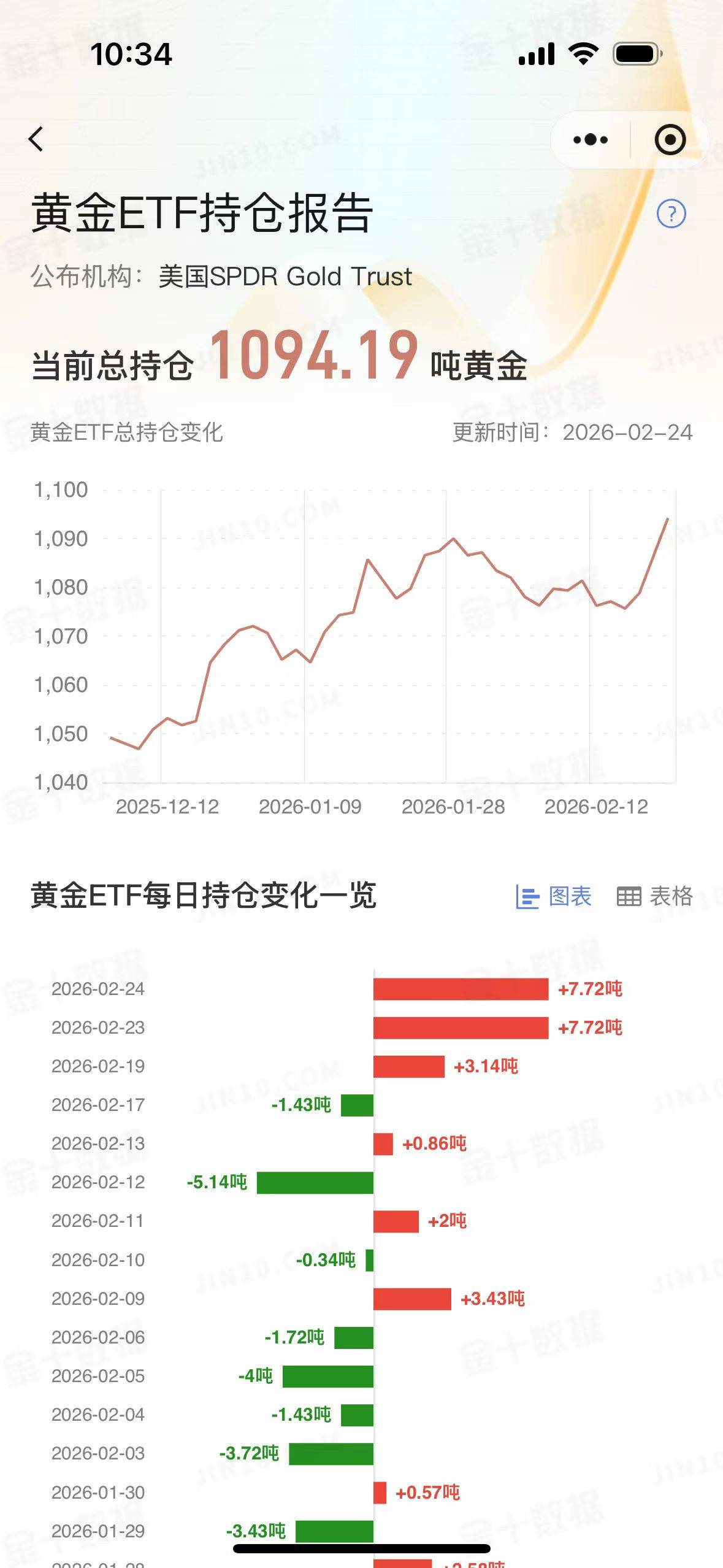
Core Viewpoint - The SPDR Gold Trust, the world's largest gold ETF, reported a significant increase in holdings, reaching 1,094.19 tons, with a daily increase of 7.72 tons, indicating strong investor interest in gold amid fluctuating prices and geopolitical tensions [5]. Group 1: Gold ETF Holdings - As of February 24, the total holdings of SPDR Gold Trust stand at 1,094.19 tons, reflecting a substantial increase of 7.72 tons from the previous trading day [5]. - The cumulative increase in gold ETF holdings over the past week is nearly 20 tons, suggesting a growing demand for gold as a safe-haven asset [5]. Group 2: Gold Price Movements - On February 24, spot gold prices experienced a decline, dropping to below $5,100 per ounce, closing at $5,142.45, a decrease of $85.30 or 1.63% [5]. - The recent rise in gold prices has led to profit-taking, which has contributed to the downward pressure on prices [5]. Group 3: Economic and Geopolitical Factors - The Federal Reserve officials have expressed hawkish views, indicating that interest rates should remain unchanged due to inflation concerns, which may impact gold prices [6]. - Geopolitical tensions and fluctuating tariff policies are providing support for gold prices, with recent developments in U.S. tariffs contributing to market uncertainty [6][7]. Group 4: Market Outlook - Analysts predict that gold prices are likely to consolidate above the $5,000 level in the short term, with potential upward movements if geopolitical tensions escalate [7]. - Technical indicators suggest that the upward trend in gold prices remains intact, with key resistance levels at $5,200, $5,249, and $5,300, while support is noted at $5,093 and $5,000 [7].
美伊对峙再升级!全球避险情绪升温,国际金价持续冲高
Hua Xia Shi Bao· 2026-02-25 05:40
华夏时报记者叶青北京报道 马年春节假期国际金价呈现剧烈震荡走势,假期伊始,受中东局势阶段性缓和、美联储1月会议纪要释 放鹰派信号影响,市场对美联储降息延迟的担忧快速升温,2月17日COMEX黄金期货价格一度下探至 4868美元/盎司;假期后半程,中东地缘风险骤然升温,避险资金大举涌入黄金市场,推动金价连续反 弹并完全收复前期失地。2月24日COMEX黄金期货延续涨势,盘中一度冲高至5269美元/盎司。 "春节期间地缘政治紧张引发的市场避险情绪,是本轮金价反弹走高的核心驱动力。一方面,美国总统 特朗普公开表态,考虑对伊朗实施有限军事打击,叠加以色列与哈马斯、也门胡塞武装等冲突持续外 溢,短期推升市场避险情绪大幅升温。另一方面,美国关税政策反复无常,进一步加剧了全球经济前景 的不确定性,大量资金涌入黄金市场进行风险对冲。"北京黄金经济发展研究中心研究员许亚鑫在接受 《华夏时报》记者采访时表示。 地缘政治持续升温 据新华社报道,2月23日,伊朗外交部发言人巴加埃在德黑兰例行记者会上表示,任何对伊朗的攻击都 将被视作侵略行为,发起方将承担相应后果。巴加埃表示,伊朗武装部队正保持高度警惕,伊方在推进 外交谈判的同时,密 ...
美伊对峙再升级!全球避险情绪升温,国际金价持续冲高|大宗风云
Hua Xia Shi Bao· 2026-02-25 02:55
本报(chinatimes.net.cn)记者叶青 北京报道 马年春节假期国际金价呈现剧烈震荡走势,假期伊始,受中东局势阶段性缓和、美联储1月会议纪要释 放鹰派信号影响,市场对美联储降息延迟的担忧快速升温,2月17日COMEX黄金期货价格一度下探至 4868美元/盎司;假期后半程,中东地缘风险骤然升温,避险资金大举涌入黄金市场,推动金价连续反 弹并完全收复前期失地。2月24日COMEX黄金期货延续涨势,盘中一度冲高至5269美元/盎司。 "春节期间地缘政治紧张引发的市场避险情绪,是本轮金价反弹走高的核心驱动力。一方面,美国总统 特朗普公开表态,考虑对伊朗实施有限军事打击,叠加以色列与哈马斯、也门胡塞武装等冲突持续外 溢,短期推升市场避险情绪大幅升温。另一方面,美国关税政策反复无常,进一步加剧了全球经济前景 的不确定性,大量资金涌入黄金市场进行风险对冲。"北京黄金经济发展研究中心研究员许亚鑫在接受 《华夏时报》记者采访时表示。 地缘政治持续升温 据新华社报道,2月23日,伊朗外交部发言人巴加埃在德黑兰例行记者会上表示,任何对伊朗的攻击都 将被视作侵略行为,发起方将承担相应后果。巴加埃表示,伊朗武装部队正保持高度 ...
IC外汇平台:美联储降息预期延长,SOFR利差为何罕见倒挂?
Sou Hu Cai Jing· 2026-02-25 02:43
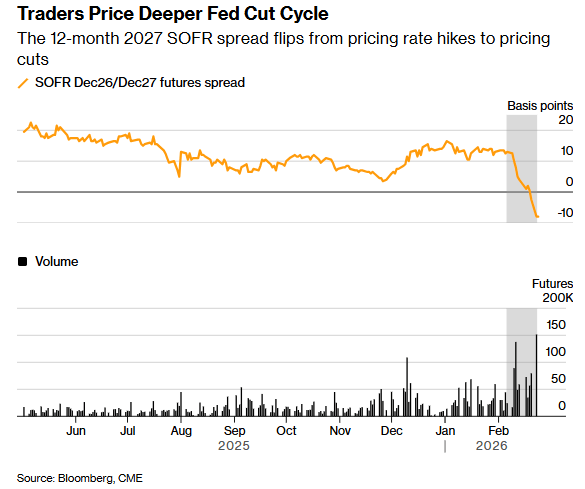
Group 1 - The core viewpoint indicates a significant shift in traders' expectations regarding the Federal Reserve's future monetary policy, with bets now placed on interest rate cuts in 2027 instead of previously anticipated rate hikes [1] - The SOFR futures spread, which reflects the market's expectations for Federal Reserve policy, has shown a deep inversion, signaling a pricing in of prolonged accommodative monetary policy [1] - Concerns regarding the impact of artificial intelligence on the labor market have intensified, influencing traders' policy expectations and leading to increased long-term Treasury prices [1] Group 2 - Specific data shows that the 12-month SOFR spread between December 2026 and December 2027 turned negative for the first time, indicating a shift from pricing in rate hikes to rate cuts [4] - The trading volume for the SOFR spread reached a historical high, reflecting heightened market attention to the change in policy expectations [4] - The SOFR options market is also showing similar easing expectations, with increased activity in hedging trades betting on multiple rate cuts in 2026 [4]
ETO Markets 外汇:美联储博弈降息预期 金价维持震荡
Sou Hu Cai Jing· 2026-02-24 05:57
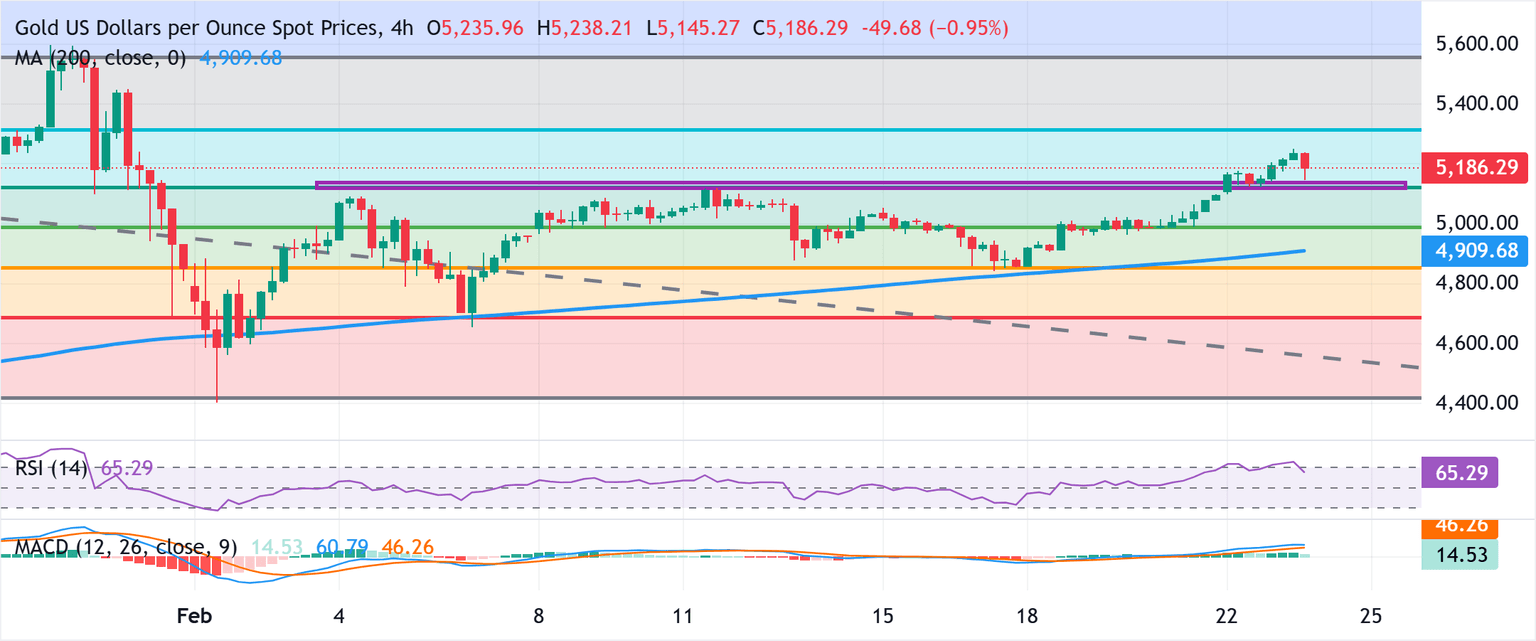
技术指标进一步印证上涨动能放缓。移动平均收敛发散指标(MACD)虽仍处于正值区域,表明多头趋势未逆转,但较近期峰值明显回落,推动金价上涨的 动力在减弱。相对强弱指数(RSI)当前读数65.78,从超买区间回落,与金价涨势放缓的态势一致,反映出市场做多力量趋于谨慎。 技术面来看,黄金当前有明确的阻力与支撑边界。5314.49美元的78.6%斐波那契回撤位,是当前多头面临的关键阻力;若金价未能维持在5123.17美元上 方,则表明动能进一步减弱,可能回调至200周期简单移动平均线附近。只要金价维持在4909.70美元的上升200周期均线上方,整体上行趋势就不会被打 破,最小阻力路径仍偏向上行。 贸易政策的不确定性,同样限制了黄金下跌空间。市场担忧贸易政策调整可能冲击全球经济复苏,这种情绪会抑制美元实质性升值。黄金与美元通常呈负相 关,美元升值乏力,自然减轻黄金下行压力。 从XAU/USD货币对4小时图表技术面观察,黄金多头仍占优势,但上涨动能已出现减弱。此前金价从200周期简单移动平均线(SMA)反弹后,成功突破 5100-5110美元水平阻力位。这一阻力区域恰好与61.8%斐波那契回撤位重合——该回撤位源于黄金 ...
假期风云激荡,银价油价飙升!国内期市开盘在即,贵金属稳了?谁将成为“黑马”?
Qi Huo Ri Bao· 2026-02-24 00:34
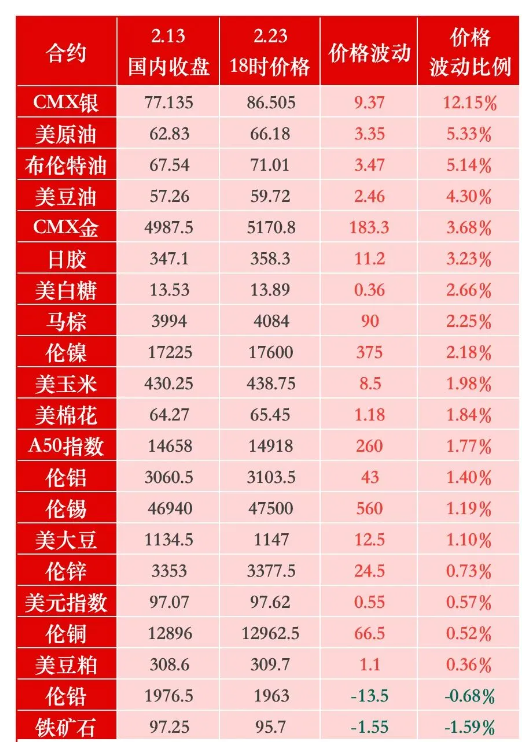
Core Viewpoint - The global macro environment remains turbulent during the Spring Festival holiday, with significant events such as changes in U.S. tariff policies and escalating geopolitical conflicts leading to sharp fluctuations in major asset prices, adding uncertainty to the domestic market's opening after the holiday [1] Market Reactions - During the Spring Festival, international markets experienced notable price movements, with commodities like silver, crude oil, and agricultural products showing significant changes [2] - The price of CMX silver increased by 12.15%, while Brent oil rose by 5.14% and U.S. soybean oil by 4.30% [2] Federal Reserve Policy Insights - The Federal Reserve is experiencing increased internal divisions regarding future monetary policy, with discussions around rate cuts, pauses, and hikes being mentioned [4][5] - Recent data indicates a 3.0% year-over-year increase in the core PCE price index, leading to a reduction in expectations for rate cuts [5][7] Stock Market and Precious Metals Outlook - Despite short-term volatility, the U.S. stock market is still in an economic expansion phase, with AI contributing positively to productivity [9] - Precious metals, particularly gold and silver, are expected to continue their upward trend, driven by both financial and industrial demand [11] Oil Market Dynamics - Geopolitical risks are identified as a primary driver of recent fluctuations in global oil prices, with potential military actions against Iran posing risks to oil supply routes [12][13] - The International Energy Agency reports a significant increase in global oil inventories, indicating a potential oversupply situation [13] Commodity Market Predictions - The precious metals sector is anticipated to see substantial increases post-holiday, with silver showing strong potential for recovery due to both financial and industrial factors [15] - The energy sector is expected to respond directly to international crude oil price movements, while the chemical sector may face challenges due to supply-demand mismatches [15] Risk Factors for Market Opening - The market is expected to open broadly higher with structural differentiation, focusing on potential rebound opportunities in precious metals and oil-related products [16] - Key risks include jump gap risks, position changes, and liquidity risks, necessitating cautious trading strategies [16]