财政主导

Search documents
黄金迎来历史性转折:三大驱动力引爆1979年以来最强涨势
Jin Shi Shu Ju· 2025-09-16 03:09
Core Viewpoint - The article discusses the potential shift towards a fiscal-led era in the U.S. economy, driven by ongoing political pressures on the Federal Reserve and rising inflation due to tariffs, which may lead to gold replacing the dollar as the primary store of value [1][4]. Group 1: Economic and Market Dynamics - Gold has seen a year-to-date increase of 31.38% as of the end of August, marking its best performance since 1979, positioning it as one of the strongest asset classes for the year [1]. - The U.S. government's approach to the Federal Reserve is a significant factor in gold's recent rise and the dollar's continued weakness [1][2]. - The labor market data indicates a more severe economic slowdown than expected, while inflation data remains complex and concerning [2]. Group 2: Federal Reserve Independence and Political Pressure - The struggle for control over the Federal Reserve has significant implications for gold and the dollar, with President Trump’s actions raising unprecedented legal and constitutional questions regarding presidential power and central bank independence [2][3]. - The dismissal of a Federal Reserve board member due to alleged mortgage fraud has sparked concerns about the independence of the Fed, which has historically not seen such dismissals since its establishment in 1913 [2][3]. - The current political climate may lead to a more politicized Federal Reserve, potentially transforming it into a tool for the White House [3][4]. Group 3: Inflation and Gold Demand - Inflation risks are increasingly driven by monetary and fiscal policies rather than demand, which is favorable for gold [2]. - The anticipated rise in commodity costs due to tariffs is expected to increase inflationary pressures, further boosting gold demand as a hedge against purchasing power erosion [3][4]. - The potential for negative real interest rates, driven by fiscal policies and regulatory easing, may enhance gold's appeal as a store of value [4][5]. Group 4: Future Outlook and Global Financial System - The article suggests that the current dollar-centric global financial system may become unsustainable, with a shift towards gold as a neutral reserve asset [4][6]. - The increasing trust in gold over fiat currencies is evidenced by central banks accumulating gold reserves, highlighting its role as a stable alternative in a changing monetary landscape [4][5]. - The anticipated economic policies, including the "Great and Beautiful" Act and tax cuts, are expected to stimulate the economy, further supporting gold's upward trajectory [5][6].

市场拉响警报!流动性引擎熄火、宏观数据开始转弱
智通财经网· 2025-09-15 05:51
Group 1 - The Federal Reserve has been implementing quantitative tightening (QT) since June 2022, contrasting with the widely discussed "monetary overexpansion" [1] - Despite the Fed's tightening policies and multiple increases in the federal funds rate, the M2 money supply has increased over the past year [1] - Analysts indicate that over 90% of the money increase is created by the banking system through significant credit expansion to households and private credit entities [1] Group 2 - There is a significant correlation between M2 money supply and asset prices, with Bitcoin and gold showing higher price elasticity compared to the S&P 500 index [1][3] - The current sustainability of monetary expansion is under challenge, with rising credit card and auto loan default rates indicating potential credit tightening [3] - The Federal Housing Administration (FHA) has seen a doubling in mortgage forbearance rates, with about 15% of FHA loans maintained through deferment or modification [3] Group 3 - The expected interest rate cuts by the Federal Reserve may have limited effects on economic stimulation, while fiscal policy is constrained by debt levels and deficit pressures [4] - Concerns about the independence of the Federal Reserve may arise due to political appointments, potentially leading to policies that directly serve government economic goals [4] - Market technical indicators suggest a warning signal, with the Nasdaq 100 ETF showing a larger "amplifier pattern" compared to 2022, indicating potential for significant market corrections [4] Group 4 - Investment strategies need to adapt to changing paradigms, with recommendations for increasing cash proportions to 60-70% and utilizing cash-secured put strategies for excess returns [4] - Conservative investors are advised to pause dividend reinvestment or use covered call options to reduce risk exposure amid high policy uncertainty [4] - Maintaining flexibility and pre-planning gradual investment strategies is crucial in the current economic environment [4]


美联储大战才刚启幕!降息只是特朗普阵营密谋的冰山一角
Jin Shi Shu Ju· 2025-09-12 08:15
Core Viewpoint - The article discusses U.S. Treasury Secretary Mnuchin's unexpected criticism of the Federal Reserve, focusing on the politicization of its operations rather than interest rate cuts [1][2]. Group 1: Criticism of the Federal Reserve - Mnuchin's article in "International Economy" criticizes the Fed for its "mission confusion," claiming that political factors have influenced its financial regulation and quantitative easing (QE) operations [1][2]. - He argues that QE has a questionable theoretical basis and leads to adverse economic outcomes, such as distorting markets and exacerbating income inequality by inflating asset prices for the wealthy [1][2]. Group 2: Call for Narrowing the Fed's Mandate - Mnuchin advocates for a "narrow mandate" for the Fed, suggesting it should cease asset purchases to achieve better economic outcomes and maintain the central bank's independence, which he deems crucial for U.S. economic success [2]. - This perspective aligns with other prominent figures close to President Trump, indicating a growing faction that supports narrowing the Fed's mission [2]. Group 3: Broader Implications and Concerns - The article highlights concerns about the potential impact of Trump's attacks on the Fed's independence and the credibility of monetary policy [3][4]. - It raises questions about whether Mnuchin can effectively halt or reduce asset purchases given the increasing U.S. deficit and the pressure for "fiscal dominance" [4]. - The article also speculates on how changes in leadership at the Fed could affect interest rate policies and asset purchases, particularly if Kevin Warsh were to replace Jerome Powell [4][5]. Group 4: Global Context and Future Outlook - The article notes that other central banks are also facing scrutiny regarding their expanded missions, with examples like the New Zealand central bank experiencing internal turmoil [5]. - It suggests that the upcoming Fed meeting will primarily focus on interest rates, but the underlying debates about the Fed's balance sheet and mission will continue to intensify as U.S. debt levels rise [5].
渐入财政主导,布局全球水牛
2025-09-09 02:37
Summary of Key Points from Conference Call Records Industry Overview - The records discuss the macroeconomic environment, particularly focusing on the U.S. economy and its transition into a fiscal dominance era, which is expected to influence global markets positively, especially in developed countries like the U.S., Europe, and Japan [2][3]. Core Insights and Arguments 1. **Fiscal Dominance Era**: The U.S. is entering a fiscal dominance era where monetary policy will need to align with fiscal policy, leading to increased economic demand through investments and maintaining ample liquidity, particularly in dollars [2][3]. 2. **Economic Cycles**: The nominal economic cycle is at a low point, with expectations of a new upward cycle due to fiscal and monetary policy coordination. Global liquidity, especially in dollars, is also expected to enter a new easing phase, benefiting asset prices [3][4]. 3. **Increased Demand for Resources**: The re-industrialization and re-militarization in the U.S. and Europe will lead to a trend increase in demand for global resources and capital goods, with corporate capital expenditures expected to accelerate [4][6]. 4. **U.S. Small Business Recovery**: Small businesses, which account for over half of U.S. employment, are showing signs of recovery, with improvements in operational conditions and potential wage growth due to rising turnover rates [7][11]. 5. **Real Estate Market Stimulus**: The Trump administration may declare a housing emergency to stimulate the real estate market, potentially lowering mortgage rates and implementing unconventional measures to encourage lending [9][11]. 6. **Corporate Investment Trends**: There is a notable rebound in corporate equipment investment and durable goods orders, driven by policies like the "Great America Act," which incentivizes capital expenditures [10][11]. 7. **Future Policy Environment**: The U.S. is expected to maintain high fiscal deficits (around 6.4% for FY2024) and a loose monetary policy, with M2 growth rebounding, indicating a supportive environment for economic growth [11][12]. 8. **Inflation Outlook**: Inflation is projected to rise in the coming months, with the Fed likely to increase its tolerance for inflation under the Trump administration, which could support economic growth [16][17]. 9. **Global Market Dynamics**: The records highlight a potential shift in global capital flows, with emerging markets, particularly China, expected to benefit from a weaker dollar and increased liquidity [30][34]. Additional Important Insights - **Liquidity Risks**: The current dollar liquidity cycle is at a low point, with risks of liquidity events if bank reserves fall below safe thresholds [23]. - **Impact of External Markets**: The selling pressure in European and Japanese bonds may transmit to the U.S. bond market, potentially triggering a liquidity shock [26]. - **Foreign Investment in China**: There is a resurgence of interest from foreign investors in the Chinese market, particularly in Hong Kong, indicating a positive outlook for future trading volumes [35]. - **A-Share Market Dynamics**: The A-share market's performance may not align with economic data, as historical patterns suggest stock prices often recover before real estate prices stabilize [37]. This summary encapsulates the key points and insights from the conference call records, providing a comprehensive overview of the current economic landscape and its implications for various markets.
热点思考 | 主权债务“迷你风暴”(申万宏观·赵伟团队)
申万宏源宏观· 2025-09-07 16:11
Group 1 - Recent adjustments in the sovereign debt markets of Europe and Japan have led to a global financial market risk-off sentiment, driven by political instability and rising expectations for fiscal easing [2][3][33] - The rise in long-term bond yields is primarily attributed to the rebound in inflation and the increase in medium- to long-term inflation expectations, with core CPI in major Western economies returning to the "3 era" [2][3][42] - The European Central Bank (ECB) and the Bank of Japan (BOJ) are marginally tightening their monetary policies, contributing to the rise in bond yields, while the Federal Reserve is still in a rate-cutting phase [3][53] Group 2 - The U.S. monetary market is undergoing a "stress test" due to the Federal Reserve's balance sheet reduction, the rebuilding of the Treasury General Account (TGA), and seasonal tax payments, raising concerns about a potential repeat of the 2019 repo crisis [4][58][61] - The liquidity environment in the U.S. monetary market is somewhat similar to that of September 2019, but the risk of a repeat crisis is considered manageable due to the gradual nature of the Fed's balance sheet reduction and the overall liquidity remaining ample [4][65][69] Group 3 - The risk of a "Treasury tantrum" in the U.S. is currently deemed controllable, with several factors supporting stability in the bond market, including the passage of the "Big and Beautiful Act" and improved fiscal conditions [4][78][79] - Long-term U.S. Treasury yields are expected to trend upward, driven by rising term premiums and a return to a "fiscal dominance" paradigm, with the frequency of simultaneous declines in stocks, bonds, and currencies likely to increase [5][83][84]


“流动性笔记”系列之三:主权债务“迷你风暴”
Shenwan Hongyuan Securities· 2025-09-07 03:44
Group 1: Sovereign Debt Market Adjustments - Recent adjustments in European and Japanese sovereign debt markets have led to a global risk-off sentiment, with UK 10-year bond yields rising to 4.85% and 30-year yields reaching 5.89%, the highest since 1998[14][22] - Political instability and expectations of fiscal easing in Europe and Japan are primary drivers of rising bond yields, with UK CPI inflation at 3.7% and Japan's core-core CPI at 3.4%[3][37] - The European Central Bank (ECB) and Bank of Japan (BOJ) are shifting towards tighter monetary policies, contributing to the upward pressure on long-term bond yields[4][41] Group 2: US Monetary Market Pressure Test - The US monetary market is undergoing a "stress test" due to the Federal Reserve's balance sheet reduction, TGA account rebuilding, and seasonal corporate tax payments, reminiscent of the 2019 repo crisis[5][45] - In September 2019, secured overnight financing rates (SOFR) spiked to 5.25%, highlighting liquidity shortages, with a similar environment emerging now but with manageable risks[49][50] - Current liquidity remains ample, and the Fed has tools to manage potential pressures, indicating that while risks exist, they are not imminent[56][61] Group 3: Reassessment of US Treasury Risks - The risk of a repeat of the "Treasury tantrum" is considered controllable, with factors such as a larger TGA funding gap and increased long-term debt issuance influencing market stability[6][63] - The US economy is projected to grow at around 5% in Q3 2023, but inflationary pressures remain, with Brent crude oil prices fluctuating around $90 per barrel[6][63] - The long-term outlook for US Treasury yields suggests an upward trend driven by fiscal dominance and rising term premiums, with market expectations for Fed rate cuts in 2026 being overly optimistic[66][68]
29年来首次!全球央行黄金储备反超美债,“去美元化”加速?
Mei Ri Jing Ji Xin Wen· 2025-09-06 02:58
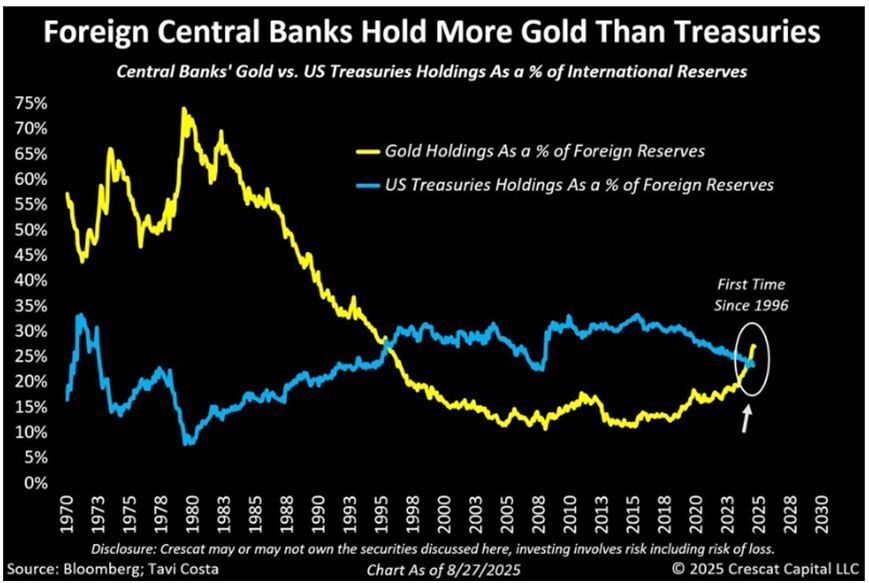
Core Viewpoint - Gold is challenging the foundation of the modern financial system, particularly U.S. Treasury bonds, as its share in central bank reserves has surpassed that of U.S. debt for the first time since 1996, indicating a significant shift in global reserve management strategies [1][4]. Group 1: Central Bank Behavior - Central banks are strategically increasing their gold reserves to reduce reliance on U.S. dollar assets, thereby diversifying potential risks associated with a single reserve currency [3][4]. - The World Gold Council (WGC) reported that global central banks have net purchased gold for 14 consecutive quarters, with annual purchases exceeding 1,000 tons since 2020, nearly double the average of the previous decade [4][7]. - A recent survey indicated that 95% of central banks plan to continue increasing their gold holdings in the next 12 months, the highest percentage since the survey began in 2019 [7]. Group 2: Gold Market Dynamics - Gold prices have surged, with a 36% increase in futures prices this year, significantly outperforming the S&P 500 and Bitcoin [10]. - August alone saw gold prices rise over 3.5%, marking a historical trend of consecutive monthly gains not seen since 1968 [10]. - Analysts suggest that the current gold market is in its third major bull cycle, potentially lasting for several years or even over a decade [10][11]. Group 3: U.S. Treasury Bonds - The bond market is experiencing a downturn, with long-term U.S. Treasury yields reaching levels not seen in decades, leading to significant declines in bond prices [13][15]. - The 2020s are projected to be the worst decade for U.S. Treasury bonds, particularly long-term bonds, as rising yields have resulted in a cumulative decline of over 40% for certain bond ETFs [13][15]. - Concerns about the sustainability of U.S. debt and fiscal discipline are growing, with warnings that the current trajectory could force the Federal Reserve into difficult decisions regarding inflation and interest rates [17][18]. Group 4: Future Price Predictions - Major financial institutions are bullish on gold prices, with Goldman Sachs raising its 2025 year-end target to $3,700 per ounce and suggesting potential peaks of $4,500 to $5,000 if political pressures undermine the Federal Reserve's independence [19]. - Bank of America and JPMorgan also predict significant increases in gold prices, with estimates reaching $4,000 per ounce by mid-2026 [19].
欧美长期国债再遇抛售潮,财政可持续问题或是罪魁祸首
Sou Hu Cai Jing· 2025-09-03 11:08
Core Viewpoint - The recent sell-off in long-term government bonds in the US and Europe is driven by investor concerns over fiscal sustainability and central bank's ability to control inflation, compounded by seasonal liquidity tightening and term premium effects [1][2][5]. Group 1: Market Reactions - Long-term bond yields in the US, UK, Italy, and France have risen significantly, with the US 30-year bond yield increasing by 5.3 basis points to 4.97%, marking a multi-year high [1]. - The negative sentiment in the bond market has spilled over into the stock market, with major indices such as the S&P 500, Dow Jones, and Nasdaq experiencing declines of 0.69%, 0.55%, and 0.82% respectively [1]. - The sell-off in bonds has been linked to a historical context where previous fiscal policies and trade tensions have led to significant fluctuations in bond yields [1][4]. Group 2: Economic Factors - OECD projects that sovereign debt issuance among its 38 member countries will reach a record $17 trillion by 2025, with the debt servicing cost as a percentage of GDP rising to 3.3% in 2024, up from 2.4% in 2021 [4]. - The US is particularly affected, with debt interest costs projected to reach 4.7% of GDP, raising concerns about fiscal sustainability [4]. - Political instability in countries like France and the UK is causing investor anxiety, with discussions around potential IMF assistance emerging [5]. Group 3: Market Dynamics - Seasonal liquidity tightening is identified as a contributing factor to the recent bond market downturn, as September typically sees increased bond issuance from governments and corporations, leading to supply-demand imbalances [6]. - The expectation of a strong US non-farm payroll report could influence market sentiment, with potential implications for Federal Reserve interest rate policies [6]. - Analysts suggest that the current rise in long-term bond yields may not be easily reversed, even with anticipated slight reductions in policy rates [7].
中金 | 美债季报:财政主导下的美债与流动性
中金点睛· 2025-09-01 23:41
Core Viewpoint - The article discusses the evolving economic landscape in the U.S., highlighting a potential shift towards a "fiscal dominance, monetary coordination" policy model, driven by rising inflation and increasing fiscal deficits, despite the market's expectations for interest rate cuts by the Federal Reserve [3][20][24]. Group 1: Economic Recovery and Inflation - The U.S. economy is experiencing a bumpy recovery, with consumer and business confidence gradually improving as policy uncertainties decrease [5][9]. - Inflation is expected to trend upwards towards the end of the year, primarily due to a "wage-inflation" spiral and tariff impacts, which may challenge traditional monetary policy approaches [16][18]. - The labor market is showing signs of recovery, with job vacancies increasing and wage growth potentially on the rise, indicating a solid foundation for consumer spending [9][12][16]. Group 2: Fiscal Dominance and Monetary Coordination - The article outlines a new policy model characterized by fiscal dominance, where fiscal policy increasingly influences monetary policy decisions, particularly in light of persistent fiscal deficits [20][24]. - The federal deficit for the current fiscal year reached $1.63 trillion by July, with projections suggesting it could rise to $1.92 trillion for the full year, indicating a significant fiscal burden [20][21]. - The article suggests that the current administration's pressure on the Federal Reserve to lower interest rates is a strategic move to reduce financing costs for both the government and private sectors, especially ahead of upcoming elections [26][29]. Group 3: Bond Market Dynamics - The article anticipates a significant increase in U.S. Treasury bond issuance, with projections of $1 trillion in net issuance for Q3 and $590 billion for Q4, primarily in long-term bonds [33][34]. - The demand for bonds is expected to be driven mainly by households, money market funds, and foreign investors, although recent trends show a decrease in holdings by money market funds [37][41]. - The article warns that if the Federal Reserve cuts rates while inflation rises, it could lead to higher long-term interest rates, with projections suggesting the 10-year yield could reach approximately 4.8% by year-end [4][45].

中金:若特朗普政府掌控美联储,潜在顺序及影响?
中金点睛· 2025-08-29 00:07
Core Viewpoint - The article discusses the increasing political influence of the Trump administration over the Federal Reserve, particularly through recent personnel changes that could undermine the Fed's independence and affect monetary policy decisions [2][3][4]. Group 1: Importance of the Board of Governors - The Federal Reserve Board of Governors consists of 7 members with a 14-year term, designed to minimize political interference [3]. - The President has the authority to fill vacancies but requires "just cause" to remove members, which typically refers to serious misconduct rather than policy disagreements [3][4]. - Control over the Board can indirectly allow the President to influence the appointment of regional Federal Reserve Bank presidents, thereby impacting the Federal Open Market Committee (FOMC) and monetary policy [3][4]. Group 2: Historical Context and Current Trends - Historically, the power to veto or dismiss regional Federal Reserve Bank presidents has never been exercised, but recent political divisions within the Board suggest a shift towards increased politicization [4]. - The independence of the Federal Reserve has been challenged during periods of significant political pressure, particularly in the 1960s and 1970s when fiscal dominance was prevalent [5]. Group 3: Potential Future Actions by Trump - If Trump gains control of 4 votes on the Board, he could significantly influence FOMC personnel decisions [6]. - The expected steps include securing a majority on the Board before the 2026 regional Federal Reserve Bank president elections, replacing current presidents, and establishing a dovish team aligned with Trump's policies [6]. - This could lead to the implementation of accommodative monetary policies, such as interest rate cuts and quantitative easing [6]. Group 4: Asset Implications - The article suggests that fiscal dominance may lead to a weaker dollar and benefit assets like gold, while also positively impacting emerging market equities [7]. - The anticipated economic recovery, coupled with low interest rates, could elevate inflation expectations and support sectors such as manufacturing, military, and energy infrastructure [7].