反内卷

Search documents
恒力石化20260115
2026-01-16 02:53
Summary of the Conference Call for Hengli Petrochemical Company Overview - **Company**: Hengli Petrochemical - **Industry**: Petrochemical Key Points and Arguments Financial Performance and Strategy - Hengli Petrochemical has significantly improved the profitability of industrial yarns, with prices recovering from a low of 700-800 RMB to around 3,000 RMB, benefiting from the petrochemical industry's anti-involution strategy [2][3] - The company plans to enter a debt reduction cycle starting in 2026, with a goal to reduce the debt ratio from 76% to approximately 60% within 3-4 years while maintaining stable dividends and advancing new capacity investments [2][5][16] - Capital expenditures are expected to substantially conclude by 2025, with a focus on utilizing strong operating cash flow to lower the debt ratio [5][6] Industry Dynamics - The Chinese petrochemical industry holds a competitive advantage globally due to high integration levels, cost competitiveness, and a favorable product structure, leading to the gradual exit of traditional production hubs in Europe, Japan, and South Korea [2][7] - The PX (paraxylene) industry is influenced by refining and gasoline products, with global refinery capacity optimization and rapid downstream PTA (purified terephthalic acid) expansion expected to maintain a tight supply-demand situation [2][9] Market Trends and Pricing - PTA prices have rebounded since late October 2025, with a price difference of approximately 300 RMB/ton, indicating some improvement in profitability, although not fully restored [2][10] - The polyester film industry has seen gradual profitability improvements since Q4 2025, with collaborative self-discipline among nine companies stabilizing the profit landscape [2][13][14] Future Development Focus - Hengli Petrochemical's future development priorities include reducing the debt ratio, maintaining stable dividends, and advancing new projects such as fine chemical parks and functional film production lines [2][8] - The company aims to optimize existing operations to enhance efficiency in response to changing market conditions [2][8] Supply Chain and Production Capacity - The supply side of the PX industry is constrained due to the lack of new refinery approvals in China and the aging of overseas refineries, compounded by carbon neutrality policies and geopolitical factors [2][9] - The overall global refining capacity is being optimized, but the rapid expansion of PTA is tightening supply further, with no significant new aromatic chain facilities expected in the near term [2][9] Collaboration and Industry Measures - The petrochemical industry is shifting towards reducing vicious competition and controlling supply to improve profit margins, with Hengli Petrochemical actively promoting anti-involution measures in PTA and industrial yarns [2][4][12] Engineering and Project Updates - As of Q3 2025, Hengli Petrochemical has approximately 33.7 billion RMB in construction projects, primarily in fine chemical parks and production lines, expected to complete the transition to fixed assets by mid-2026 [2][11] Additional Important Insights - The collaboration among companies in the polyester film sector has led to a stabilization of profitability, with a focus on optimizing processes to achieve better financial outcomes [2][13][14] - The overall outlook for the olefins sector remains positive, supported by diverse supply sources and strong demand across various applications, despite the cyclical nature of the market [2][15]

瑞银-中国股票市场及宏观经济展望
瑞银· 2026-01-16 02:53
Investment Rating - The report indicates a strong rebound in the Chinese stock market in 2025, with the total market capitalization of A-shares surpassing 100 trillion RMB and daily trading volume frequently exceeding 3 trillion RMB, leading to a historical high annual trading volume of 400 trillion RMB [4][5]. Core Insights - The attractiveness of Chinese assets is expected to further increase in 2026, supported by innovation capabilities, favorable policies, ample liquidity, and potential capital inflows from domestic and international institutional investors [5][6]. - Foreign investment interest in the Chinese stock market has significantly increased, with the number of overseas investors from Europe and the US rising by over 30% compared to last year [7]. - The overall earnings growth for A-shares in 2026 is projected to be around 8%, with a breakdown of 5% revenue growth, 4% valuation uplift, and 1% from buyback expectations [10][18]. Summary by Sections Market Performance - In 2025, the Chinese stock market showed a strong performance, with A-shares' total market value exceeding 100 trillion RMB and daily trading volumes reaching historical highs [4][5]. Future Outlook - The report anticipates that the attractiveness of Chinese assets will continue to rise in 2026, driven by strong innovation, supportive policies, and liquidity [5][6]. Foreign Investment - There is a notable increase in foreign interest in the Chinese stock market, with foreign holdings rising from a low of 2.6% at the end of 2023 to 1.3% currently [7]. Earnings Growth - The expected earnings growth for A-shares in 2026 is around 8%, with contributions from revenue growth, valuation uplift, and profit margin improvements [10][18]. Sector Preferences - Preferred sectors include AI, internet, brokerage, photovoltaic, and overseas companies, with a focus on the growth potential in these areas [11].
中原证券晨会聚焦-20260116
Zhongyuan Securities· 2026-01-16 00:15
Core Insights - The report highlights a downward adjustment in the central bank's re-lending and rediscount rates by 0.25 percentage points, effective January 19, 2026, with the one-year re-lending rate decreasing from 1.5% to 1.25% [4][8] - The report indicates a significant increase in the re-lending quota for technological innovation and transformation, raising it from 800 billion to 1.2 trillion yuan, with a focus on supporting small and medium-sized private enterprises [5][8] - The semiconductor industry is experiencing robust growth, with a 29.8% year-on-year increase in global semiconductor sales in November 2025, marking the 25th consecutive month of growth [19][20] - The gaming industry is steadily growing, with animation films leading box office growth, indicating a strong market demand [26][29] Domestic Market Performance - The Shanghai Composite Index closed at 4,112.60, down 0.33%, while the Shenzhen Component Index closed at 14,306.73, up 0.41% [3] - The average price-to-earnings (P/E) ratios for the Shanghai Composite and ChiNext indices are 16.88 and 53.38, respectively, indicating a favorable long-term investment environment [9][10] International Market Performance - The Dow Jones Industrial Average closed at 30,772.79, down 0.67%, while the S&P 500 and Nasdaq also saw declines of 0.45% and 0.15%, respectively [4] Industry Analysis - The chemical industry is experiencing a slowdown in price declines, with a focus on sectors such as pesticides and polyester filament [15][16] - The semiconductor sector is highlighted for its strong performance, with a 5.11% increase in December 2025, outperforming the broader market indices [18] - The food and beverage sector is under pressure, with a 4.05% decline in December 2025, particularly affecting traditional categories like liquor and meat products [22][23] Investment Recommendations - The report suggests focusing on sectors with strong growth potential, such as technology innovation and traditional industry recovery, while also highlighting opportunities in the semiconductor and gaming industries [9][10][20] - Specific investment opportunities are recommended in the beverage and snack sectors, particularly in companies like Baoli Food and Dongpeng Beverage [24][26]
多晶硅期货助推光伏产业转型
Jing Ji Ri Bao· 2026-01-15 21:30
Core Viewpoint - The multi-crystalline silicon futures market in China is experiencing significant fluctuations, reflecting the challenges faced by the photovoltaic industry in overcoming overcapacity and achieving high-quality development as it approaches its one-year anniversary [1] Industry Dynamics - Multi-crystalline silicon is a core raw material for the photovoltaic industry, and its supply-demand changes serve as a "barometer" for industry prosperity [1] - The photovoltaic industry is facing a "winter" in 2025 due to multiple internal and external factors, including increased trade barriers and stricter carbon footprint certifications [1] - The Chinese government is shifting its focus from price competition to technology and quality competition, which will increase export costs in the short term but is expected to eliminate outdated production capacity in the long run [1] Competitive Landscape - Internal competition remains intense, leading to imbalances in supply and demand, which puts pressure on the entire industry [2] - The government's "anti-involution" policy aims to address disorderly competition, with increasing calls for optimizing industry development and promoting capacity clearance [2] - The National Market Supervision Administration has engaged with industry associations and companies to enhance understanding of the "anti-involution" initiative [2] Market Reactions - The multi-crystalline silicon futures contract reached a peak of 62,200 yuan/ton in December 2025, while the spot market price hovered around 52,000 yuan/ton, indicating a significant market response to expectations of supply-side structural reforms and policy support [4] - The futures market has seen a 200% increase in warehouse receipts, indicating a strong market response and the establishment of a more robust trading environment [5] Regulatory Environment - The futures exchange has implemented regulatory measures against excessive trading and has increased oversight to ensure market stability [4] - The introduction of multi-crystalline silicon futures has provided a financial tool for companies to hedge against price volatility, marking a shift from traditional pricing models [8] Financial Implications - The participation of listed companies in hedging activities has increased, with significant investments planned for risk management [8] - The futures market is expected to enhance market transparency and allow companies to better manage pricing risks, thus improving operational stability [9] Future Outlook - The photovoltaic industry is anticipated to enter a critical phase of integration and capacity clearance in 2026, transitioning from quantity accumulation to quality improvement [10] - The development of a mature and rational financial derivatives market is essential for the Chinese photovoltaic industry to gain pricing power on a global scale [10]
主观多头管理人的年度回顾与展望
Xin Lang Cai Jing· 2026-01-15 14:15
Core Viewpoint - 2025 is expected to be a vibrant year for equity markets driven by policy shifts, ample liquidity, and the global AI wave, leading to a long-awaited valuation recovery and structural market trends [1][21] Group 1: Investment Strategies - Focus on identifying companies that exhibit both performance certainty and growth potential [22] - Emphasis on sectors with high growth prospects, particularly in new consumption and AI industries, while remaining cautious about valuation-driven stocks [23] - Investment in traditional industries like chemicals and aviation is seen as promising due to improved pricing power and demand recovery [22][24] Group 2: Sector Insights - The AI industry is viewed as a major support for the current industrial cycle, with a need to observe the iteration of AI models and their application effects [27][29] - The manufacturing sector's cyclical recovery is crucial for transitioning from valuation-driven to profit-driven market conditions [27][12] - The real estate sector is under scrutiny, with a focus on companies with low debt and high safety margins, while avoiding high-leverage developers [24][28] Group 3: Future Outlook - In 2026, the focus will be on new consumption, AI applications, and the benefits of the "anti-involution" policy, which is expected to enhance corporate profitability [20][35] - The investment landscape will prioritize structural opportunities and systematic allocation, with a shift from valuation recovery to profit growth as the main driver [34][35] - The potential for copper prices to reflect overall manufacturing sentiment is highlighted, alongside the need to monitor risks related to export barriers and domestic competition [36]
国金证券宋雪涛谈A股:当前主线是“科技与安全”,新机遇在“投资于人、反内卷与地产企稳”
Xin Lang Cai Jing· 2026-01-15 12:23
Core Viewpoint - The A-share market is currently influenced by the U.S. stock market, with a focus on technology and safety as the main themes driving growth in early 2025 [1][3]. Group 1: Market Trends - The A-share market has been following the U.S. stock market trends, indicating a "dream linkage" between the two [1][3]. - The two most scarce elements in the current market are growth and safety, which are essential for overcoming existing challenges [1][3]. Group 2: Investment Opportunities - Beyond technology and safety, new opportunities in the A-share market may arise from investing in human resources, countering internal competition, and stabilizing the real estate sector [5]. - These factors could lead to performance improvement and valuation recovery for many traditional enterprises and globally competitive Chinese companies, marking the beginning of a slow bull market [5].


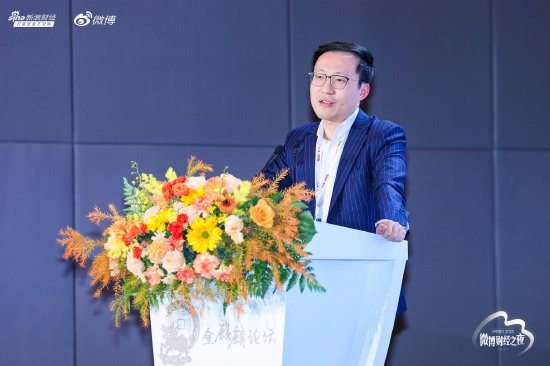
国金证券宋雪涛:希望在2026年马年马到成功,一起见证慢牛时刻
Xin Lang Cai Jing· 2026-01-15 12:17
Group 1 - The core viewpoint of the article is that the A-share market is currently influenced by the U.S. stock market, with a focus on technology and safety as the main themes driving growth in early 2025 [1][3][5] - The scarcity of growth and safety is highlighted as critical for investors, emphasizing the need for strategies to secure assets and capture resources from competitors [1][3] - The potential for new investment opportunities is identified, particularly in traditional enterprises and real estate stabilization, which could lead to performance improvement and valuation recovery for Chinese companies [5][6] Group 2 - The expectation is set for a slow bull market to begin, with hopes for success in 2026, indicating a long-term positive outlook for the A-share market [5] - The themes of technology and safety are reiterated as the best-performing themes in the A-share market since the beginning of the year [1][3] - The discussion reflects a broader trend of aligning with global market movements, particularly in the context of AI and technological advancements [1][3]
国投期货黑色金属日报-20260115
Guo Tou Qi Huo· 2026-01-15 11:50
1. Report Industry Investment Ratings - **Thread Steel**: ☆☆☆, representing a short - term multi/empty trend in a relatively balanced state with poor operability on the current market, suggesting to wait and see [1] - **Hot - Rolled Steel**: ☆☆☆, same as above [1] - **Iron Ore**: ☆☆☆, same as above [1] - **Coke**: ☆☆☆, same as above [1] - **Coking Coal**: ☆☆☆, same as above [1] - **Silicon Manganese**: ★★☆, indicating a clear upward trend and the market is fermenting [1] - **Silicon Iron**: ★★★, representing a clearer upward trend and there is still a relatively appropriate investment opportunity currently [1] 2. Core Views of the Report - **Steel**: The steel plate continued to fluctuate in a narrow range. The demand for thread steel increased slightly while production decreased, and the inventory accumulation slowed down. The demand for hot - rolled steel improved, production increased slightly, and inventory continued to decline. Steel mill profits were marginally repaired, blast furnaces were gradually restarted, and molten iron increased in the short - term. The overall domestic demand was still weak, but steel exports reached a new high in December. The supply - demand contradiction was not significant, and the market sentiment was cautious. The plate was expected to continue the range - bound pattern in the short term [2] - **Iron Ore**: The iron ore plate weakened. Global shipments decreased seasonally, the domestic arrival volume remained high in the short - term, and port inventory continued to increase. Terminal demand improved in the off - season, molten iron production increased from a low level, and steel mills' imported ore inventory increased but was still at a low level. The commodity market sentiment was volatile, and iron ore fundamentals were relatively loose. It was expected to fluctuate in the short term [3] - **Coke**: The price fluctuated during the day. Coke transaction prices rose sporadically, coking profits were average, and daily production increased slightly. Coke inventory hardly changed. The carbon element supply was abundant, downstream molten iron was likely to bottom out and rebound, and the demand for raw materials was at an off - season level. The coke plate was at a premium, and the price was likely to be strong in the short - term [4] - **Coking Coal**: The price fluctuated during the day. The Mongolian coal customs clearance was 1519 vehicles. Coking coal mine production decreased slightly, and mines resumed production well after New Year's Day. Spot auction transactions continued to improve, and the terminal inventory increased slightly. The total coking coal inventory increased significantly, and the production - end inventory increased greatly. The coking coal plate was at a premium to Mongolian coal, and the price was likely to be strong in the short - term [6] - **Silicon Manganese**: The price bottomed out and rebounded. Driven by the rebound of the plate, manganese ore spot prices increased. There were structural problems in manganese ore port inventory. Iron water production decreased seasonally, silicon manganese weekly production decreased slightly, and inventory decreased slightly. It was recommended to buy on dips [7] - **Silicon Iron**: The price bottomed out and rebounded. Affected by relevant policy documents, the price was relatively strong. The market expected an increase in coal mine supply guarantee, and there were expectations of a decline in power costs and semi - coke prices. Iron water production rebounded to a high - level range, export demand decreased, and metal magnesium production increased. Silicon iron supply decreased significantly, and inventory decreased slightly. It was recommended to buy on dips [8] 3. Content Summary by Related Catalogs Steel - **Market Performance**: The plate continued to fluctuate in a narrow range [2] - **Supply and Demand**: Thread steel demand increased slightly, production decreased, and inventory accumulation slowed down. Hot - rolled steel demand improved, production increased slightly, and inventory continued to decline. Steel mill profits were marginally repaired, and blast furnaces were gradually restarted [2] - **Downstream and Export**: Domestic demand was still weak, but steel exports reached a new high in December [2] - **Outlook**: The supply - demand contradiction was not significant, and the plate was expected to continue the range - bound pattern in the short term [2] Iron Ore - **Supply**: Global shipments decreased seasonally, the domestic arrival volume remained high in the short - term, and port inventory continued to increase [3] - **Demand**: Terminal demand improved in the off - season, molten iron production increased from a low level, and steel mills' imported ore inventory increased but was still at a low level [3] - **Market Sentiment and Outlook**: The commodity market sentiment was volatile, and iron ore fundamentals were relatively loose. It was expected to fluctuate in the short term [3] Coke - **Price and Production**: The price fluctuated, transaction prices rose sporadically, coking profits were average, and daily production increased slightly [4] - **Inventory**: Coke inventory hardly changed [4] - **Supply - Demand and Outlook**: The carbon element supply was abundant, downstream molten iron was likely to bottom out and rebound, and the demand for raw materials was at an off - season level. The coke plate was at a premium, and the price was likely to be strong in the short - term [4] Coking Coal - **Supply and Customs Clearance**: The Mongolian coal customs clearance was 1519 vehicles. Coking coal mine production decreased slightly, and mines resumed production well after New Year's Day [6] - **Transaction and Inventory**: Spot auction transactions continued to improve, and the terminal inventory increased slightly. The total coking coal inventory increased significantly, and the production - end inventory increased greatly [6] - **Supply - Demand and Outlook**: The carbon element supply was abundant, downstream molten iron was likely to bottom out and rebound, and the demand for raw materials was at an off - season level. The coking coal plate was at a premium to Mongolian coal, and the price was likely to be strong in the short - term [6] Silicon Manganese - **Price and Raw Materials**: The price bottomed out and rebounded. Driven by the rebound of the plate, manganese ore spot prices increased [7] - **Inventory and Production**: There were structural problems in manganese ore port inventory. Iron water production decreased seasonally, silicon manganese weekly production decreased slightly, and inventory decreased slightly [7] - **Recommendation**: It was recommended to buy on dips [7] Silicon Iron - **Price and Policy**: The price bottomed out and rebounded. Affected by relevant policy documents, the price was relatively strong [8] - **Cost Expectation**: The market expected an increase in coal mine supply guarantee, and there were expectations of a decline in power costs and semi - coke prices [8] - **Supply - Demand and Inventory**: Iron water production rebounded to a high - level range, export demand decreased, and metal magnesium production increased. Silicon iron supply decreased significantly, and inventory decreased slightly [8] - **Recommendation**: It was recommended to buy on dips [8]
A股缩量震荡!顺周期起舞,有色ETF华宝、化工ETF逆市创新高!热门赛道遇冷,通用航空ETF华宝跌超3%
Xin Lang Cai Jing· 2026-01-15 11:31
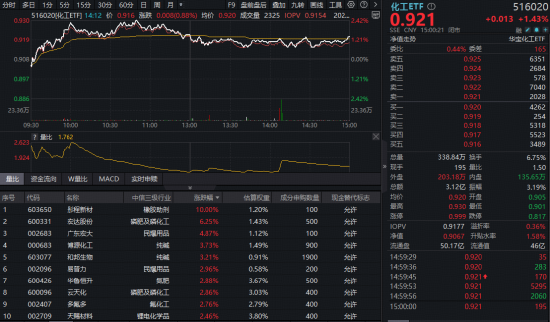
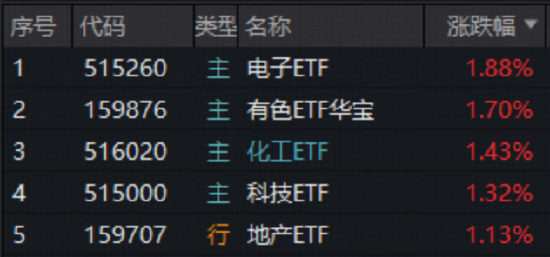
Market Overview - The A-share market experienced fluctuations on January 15, with the Shanghai Composite Index briefly falling below 4100 points before recovering at the close. The Shanghai Composite Index fell by 0.33%, while the Shenzhen Component Index rose by 0.41%, and the ChiNext Index increased by 0.56%. The total trading volume in the Shanghai and Shenzhen markets was 29.388 trillion yuan, a significant decrease of over 1 trillion yuan compared to the previous day [1][20]. Electronic Sector - The electronic sector saw a strong rally in the afternoon, with the electronic ETF (515260) rising by 1.88%. This ETF is heavily weighted in semiconductor and consumer electronics industries, and it recovered its 5-day moving average [3][23]. - The electronic sector attracted a net inflow of 16.862 billion yuan, leading all 31 primary industries in terms of capital inflow [3][23]. - Key stocks in the semiconductor sector, such as Unisoc and Huazhong Microelectronics, saw significant gains, with Unisoc hitting the daily limit of 10% [25][26]. Chemical Sector - The chemical sector also performed well, with the chemical ETF (516020) reaching a peak increase of 2.42% during the day, closing up 1.43%, marking a new three-year high [8][29]. - The basic chemical sector attracted a net inflow of 14.694 billion yuan, the highest among 30 primary industries, and has seen a cumulative net inflow of 254.049 billion yuan over the past 60 days [10][31]. - The chemical ETF has outperformed major indices since the beginning of 2025, with a cumulative increase of 48.29%, significantly higher than the Shanghai Composite Index's 22.7% and the CSI 300 Index's 20.75% [29][30]. AI and Semiconductor Trends - The U.S. government announced a 25% tariff on specific semiconductors, which may enhance domestic substitution sentiment in the market [25][27]. - The demand for AI computing power is expected to drive significant price increases in storage chips, with projections indicating a rise of up to 1800% for certain DDR chips by 2025 [27]. - The trend of "self-controllable" and AI synergy is anticipated to strengthen in the electronics industry, with a focus on domestic computing power and semiconductor equipment [27]. Investment Tools - The electronic ETF (515260) and its linked funds are effective tools for investors looking to gain exposure to core assets in the electronic sector, particularly in AI chips, automotive electronics, and 5G technologies [27]. - The chemical ETF (516020) is also highlighted as a strategic investment vehicle, covering various segments within the chemical industry, including AI computing and robotics [13][29].
化工板块逆市猛攻,单日吸金147亿元领跑全市场!化工ETF(516020)上探2.42%创近3年新高
Xin Lang Cai Jing· 2026-01-15 11:25
Group 1 - The chemical sector is showing strong performance, with the Chemical ETF (516020) reaching a new three-year high, closing up 1.43% after a peak intraday increase of 2.42% [1][10] - Key stocks in the sector include rubber additives, phosphorus chemicals, and soda ash, with notable gains from Tongcheng New Materials (up 10%), Hongda Co. (up 6.25%), and Guangdong Hongda (up 4.87%) [1][10] - Since the beginning of 2025, the Chemical ETF has outperformed major indices, with a cumulative increase of 48.29% compared to 22.7% for the Shanghai Composite Index and 20.75% for the CSI 300 Index [1][12] Group 2 - The basic chemical sector has attracted significant capital, with a net inflow of 14.694 billion yuan on a single day, leading all sectors in net inflow [4][14] - Over the past 60 days, the basic chemical sector has seen a total net inflow of 254.049 billion yuan, ranking second among all sectors [4][14] - The Chemical ETF has also been popular among investors, with a net subscription of over 310 million yuan in the last five trading days and more than 630 million yuan in the last ten days [6][14] Group 3 - Analysts from Huafu Securities predict that the chemical industry will experience a recovery in profitability in 2026, driven by supply-side reforms and new production capabilities in AI computing and robotics [15] - Tianfeng Securities notes that the chemical industry is entering a phase of capacity release, with a potential reversal in supply-demand dynamics expected in 2026 [15] - The Chemical ETF tracks the CSI Sub-Industry Chemical Theme Index, with nearly 50% of its holdings in large-cap leading stocks, providing investors with opportunities in various sub-sectors [16]