关税战

Search documents
国际经济协会秘书长:面对美关税战,东盟应选择战略性“脱钩”
Sou Hu Cai Jing· 2025-06-05 13:55
Core Viewpoint - The article argues that ASEAN should adopt a strategy of "doing nothing" in response to the U.S. government's tariff war, rejecting unequal negotiations to better protect its own interests and hold the U.S. accountable for its protectionist actions [1]. Group 1: Economic Impact of U.S. Tariffs - The article highlights that U.S. President Trump’s claims of Asian economies "stealing jobs" are unfounded, as the U.S. unemployment rate is projected to average 3.8% from 2021 to 2024, one of the lowest among developed countries [3]. - The U.S. GDP is expected to reach a record $29.3 trillion in 2024, maintaining its status as the world's largest economy, while the service sector contributes 81% of GDP and employs 79% of the workforce, indicating that manufacturing's role in job creation is minimal [3]. - ASEAN has significantly contributed to U.S. prosperity, supplying critical semiconductor and machinery components essential for U.S. manufacturing competitiveness [4]. Group 2: ASEAN's Response Strategy - ASEAN should not grant tariff concessions to the U.S., reaffirming its core values of non-alignment, multilateralism, and mutual respect [5]. - ASEAN should persuade the U.S. business community that an open and stable market aligns with long-term interests, as U.S. companies have profited significantly from ASEAN's openness [5]. - The article suggests that the ultimate burden of U.S. tariffs will fall on American companies reliant on Southeast Asian supply chains, which will face increased costs, logistical delays, and diminished competitiveness [5]. - ASEAN is encouraged to enhance economic resilience, improve regional integration, diversify trade partners, and expand strategic partnerships, while also promoting diversification in currency settlement and payment systems for a more autonomous future [5].


中方一句话,打了美国脸,中国稀土管制,让特朗普的关税战成笑话
Sou Hu Cai Jing· 2025-06-05 10:28
近段时间,白宫经常传出希望中美高层将要举行通话的消息,足以看出美国已迫不及待想和中国谈判。 可面对白宫方面声称中美高层或在本周通话的言论,中方的一句话,狠狠打了美国的脸。 中国手中的"稀土牌",成为了我们与美国的"关税战"中最好的反制手段。这从特朗普政府频频暴怒跳脚,出台一系列对华限制措施的表现可以看出来。 美国一边不断发起对华制裁,一边又企求对华通话,葫芦里卖的什么药呢?其实原因很简单,那就是美国迫切希望中国能放松稀土出口管制,被"卡脖子"的 美国,有些喘不过来气了。 6月2日,白宫新闻秘书莱维特言之凿凿,称特朗普在本周可能与中方领导人通话。而在此前,美财政部长贝森特等多名美国官员都表示中美两国元首将举行 通话。 咱们也不知道美国人是从哪得来的消息,把没影儿的事说得跟真的似的。6月3日,中国外交部例行记者会上,针对记者提问此事,外交部发言人林剑用简短 的一句话做出回应。 "我没有可以提供的消息。"短短几个字,已把中国的态度表达的十分清楚。美国所期待的中美高层通话,想和我们谈贸易问题,在我们没有看到美国做出实 质性让步,是绝无可能的。 美国"政客新闻网"做出分析称,特朗普政府之所以大肆散布中美将通话的消息,一 ...

【市场纵横】避险情绪缓和 黄金宽幅震荡
Sou Hu Cai Jing· 2025-06-05 10:00
Group 1: Market Overview - In May, gold prices experienced a downward adjustment, reaching a low of $3120, ending a streak of new highs since January, influenced by easing trade tensions and geopolitical risks [2] - Oil prices fluctuated, initially rising from $55.78 to around $64, but concerns over oversupply due to OPEC+ increasing production led to a bearish outlook [4][9] - The US dollar index fluctuated, peaking at 101.95 before falling to 99.41, with a significant decline of over 9% since January, raising concerns about the dollar's strength amid trade tensions and potential government shutdowns [6] Group 2: Commodity Performance - Gold remains in a long-term bull market, with expectations of further increases due to potential Fed rate cuts and geopolitical tensions, despite recent price adjustments [8][19] - Oil supply concerns are heightened as OPEC+ announced production increases, leading to predictions of further price declines, with a potential drop below $55 [9][27] - Copper prices are expected to remain volatile due to uncertainties from trade policies and economic conditions, with a projected trading range of $4.50 to $5.30 [10][28] Group 3: Economic Indicators - The US labor market showed resilience with April non-farm payrolls increasing by 177,000, despite the impact of trade tensions [11][13] - Inflation indicators showed a decrease, with April CPI at 2.3%, the lowest since February 2021, suggesting a potential easing of inflationary pressures [11][14] - Economic growth forecasts have been adjusted downward, with expectations of a 1.3% GDP growth rate for 2025, reflecting concerns over trade policies and economic stability [14][16] Group 4: Equity Market Trends - US stock markets rebounded in May, with the S&P 500 up 6.15% and the Nasdaq up 9.56%, as trade tensions eased and investor sentiment improved [29] - The Nikkei 225 index showed a recovery, reaching 38,700, supported by positive economic data and easing trade concerns [10][30] - Investor confidence in Japanese assets is rising due to the weakening of US debt and the attractiveness of Japanese financial assets amid global economic uncertainties [30][31]

香港置业:5月二手住宅注册量按月下跌 仍创半年次高
news flash· 2025-06-05 08:54
香港置业:5月二手住宅注册量按月下跌 仍创半年次高 金十数据6月5日讯,香港置业研究部董事王品弟表示,据土地注册处资料显示,5月二手住宅(包括二 手私人住宅及二手公营房屋)录3795宗注册,较4月的4427宗减少约14.3%;5月注册量主要反映4月份 市况,当时环球股市受关税战冲击,连带影响本港楼市交投放缓。尽管如此,宗数仍创半年次高。随着 5月关税战降温,加上近期按息回落,带动楼市气氛回暖,预计主要反映5月市况的6月注册量将会回 升。 ...
光大期货金融期货日报-20250605
Guang Da Qi Huo· 2025-06-05 03:32
1. Report Industry Investment Rating No relevant content provided. 2. Core Viewpoints of the Report - The overall economic data in April declined to some extent compared with March but remained resilient under the background of the tariff war. The year-on-year growth rate of social retail sales was 5.1%, which was significantly supported by the "trade-in" policy. The social credit demand in April was weak. The cumulative new RMB loans in April reached 10.06 trillion yuan, a year-on-year increase of 2.86%. The year-on-year growth rate of M2 in April was 8%. The joint statement issued by China and the United States laid a good foundation for further trade negotiations, exceeding market expectations. Recently, the three departments held a joint press conference. The central bank announced a reserve requirement ratio cut and interest rate cut policy to reduce the cost of the liability side of enterprises. The Financial Regulatory Administration emphasized that it would vigorously promote the entry of medium - and long - term funds into the market and support, stabilize and activate the capital market through a quasi - flat fund. The CSRC said it would optimize the fee model of active equity funds. The internal policy drive is the main line for the stock index in 2025. In terms of financial reports, in the first quarter, the decline rate of the full - market revenue growth of A - share listed companies narrowed for three consecutive quarters, but was still lower than the policy interest rate. The net profit increased year - on - year by about 4%, but the ROE was still in the stage of bottoming out and stabilizing. These measures are conducive to helping enterprises repair their balance sheets and promoting the stable development of the real economy, leading to a stable increase in stock market valuations. The stock index is expected to fluctuate [1]. - On the day of the bond futures closing, the 30 - year main contract rose 0.10%, the 10 - year main contract rose 0.09%, the 5 - year main contract rose 0.07%, and the 2 - year main contract rose 0.04%. The capital market remained loose, with DR007 rising 1BP to 1.56%. In June, it is difficult for the bond market to have a trending market. After macro - level disturbances, the bond market will fluctuate following the capital market and economic fundamentals again. After the reserve requirement ratio cut and interest rate cut, the capital market is unlikely to fluctuate significantly in the short term, the expectation of incremental policies in the short term has cooled, and the economic resilience remains. The bond market shows a sideways shock pattern again after adjustment [1][2]. 3. Summary by Relevant Catalogs 3.1 Research Viewpoints - **Stock Index Futures**: The stock index is expected to fluctuate. The internal policy drive is the main line in 2025. The measures are conducive to the stable development of the real economy and the stable increase of stock market valuations [1]. - **Bond Futures**: The bond market is expected to fluctuate. In June, it is difficult to have a trending market. After adjustment, it shows a sideways shock pattern [1][2]. 3.2 Daily Price Changes | Variety | 2025 - 06 - 04 | 2025 - 06 - 03 | Change | Change Rate | | --- | --- | --- | --- | --- | | IH (Stock Index Futures) | 2,673.6 | 2,668.6 | 5.0 | 0.19% | | IF (Stock Index Futures) | 3,842.4 | 3,824.8 | 17.6 | 0.46% | | IC (Stock Index Futures) | 5,688.8 | 5,638.4 | 50.4 | 0.89% | | IM (Stock Index Futures) | 6,054.0 | 5,998.0 | 56.0 | 0.93% | | Shanghai Composite 50 (Stock Index) | 2,690.8 | 2,687.3 | 3.5 | 0.13% | | CSI 300 (Stock Index) | 3,868.7 | 3,852.0 | 16.7 | 0.43% | | CSI 500 (Stock Index) | 5,739.0 | 5,694.8 | 44.2 | 0.78% | | CSI 1000 (Stock Index) | 6,123.2 | 6,070.0 | 53.1 | 0.88% | | TS (Bond Futures) | 102.40 | 102.35 | 0.044 | 0.04% | | TF (Bond Futures) | 106.04 | 105.96 | 0.075 | 0.07% | | T (Bond Futures) | 108.77 | 108.69 | 0.08 | 0.07% | | TL (Bond Futures) | 119.57 | 119.45 | 0.12 | 0.10% | [3] 3.3 Market News - On June 4, local time, the results of the South Korean presidential election were announced. Lee Jae - myung of the Democratic Party was elected president with a vote - share of 49.42% (17.2875 million votes). His term officially began at 6:21 am on June 4, and his inauguration ceremony was held at the National Assembly at 11 am on the same day [4]. 3.4 Chart Analysis - **Stock Index Futures**: There are charts showing the trends of IH, IF, IM, IC main contracts, and the basis trends of IH, IF, IC, IM [6][7][10][11]. - **Bond Futures**: There are charts showing the trends of bond futures main contracts, bond spot yields, basis, inter - period spreads, cross - variety spreads, and capital interest rates [13][15][17]. - **Exchange Rates**: There are charts showing the central parity rates of the US dollar, euro against the RMB, forward exchange rates, the US dollar index, euro - US dollar, pound - US dollar, and US dollar - yen exchange rates [20][21][24][25].
YiwealthSMI|基金公众号首个10W+!华夏基金27周年讲述四代人的财富故事
Di Yi Cai Jing Zi Xun· 2025-06-05 03:06
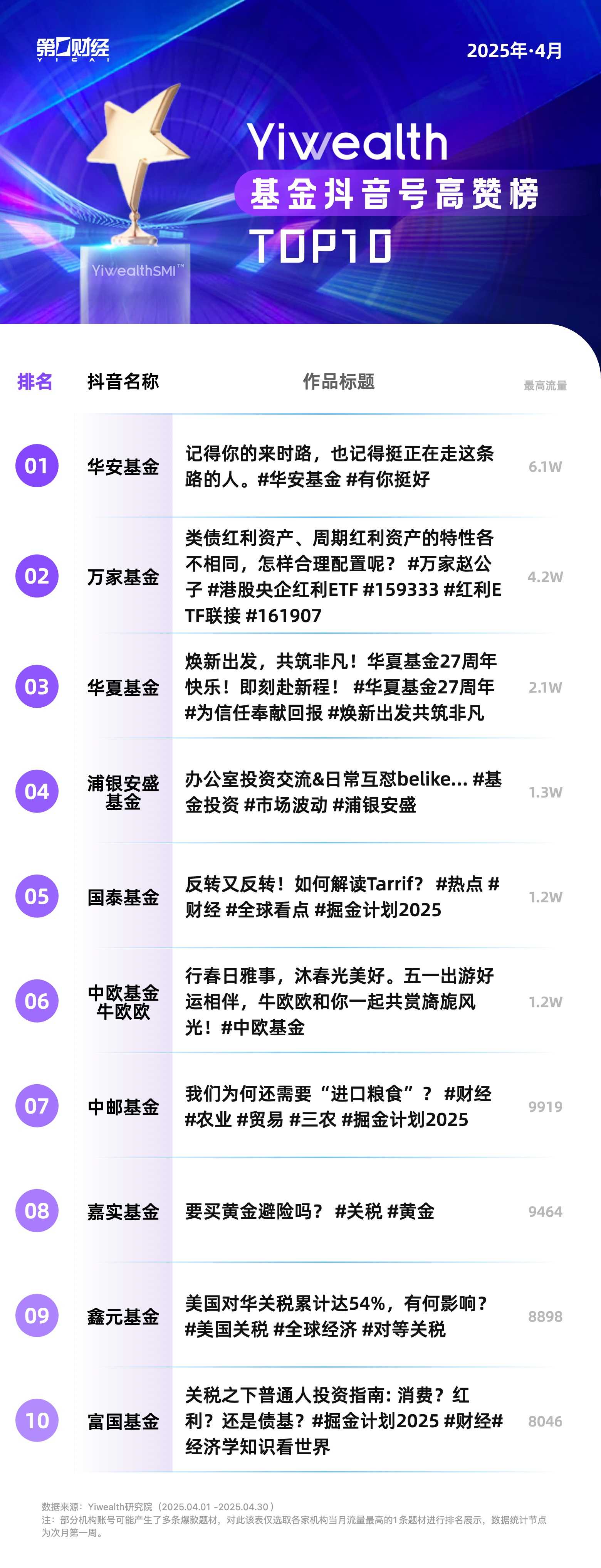
Group 1 - The fund social media index for April 2025 shows stability in the overall rankings, with few changes in the institutions listed [1] - New entrants include Xingzheng Global Fund and Huafu Fund, replacing Yongying Fund and Dongfanghong Asset Management from the previous month [1] - The trending topics on Douyin for funds have shifted with the seasons, highlighting the platform's ability to drive traffic through current events [1] Group 2 - The top content on video platforms includes diverse themes such as financial analysis, brand promotion, and event marketing, indicating a growing demand for varied financial content [2] - Notable performances include Guotai Fund discussing the implications of tariffs and Harvest Fund analyzing the investment value of gold amid market uncertainties [2] - Brand promotions from various funds, such as the 27th anniversary celebrations of Huaxia Fund, showcase their commitment to connecting with different generations of investors [2] Group 3 - The wealth account platform primarily features graphic content, with a notable live broadcast focusing on new product launches [3] - The top article on public accounts is a celebratory piece from Huaxia Fund, which achieved over 100,000 views, demonstrating effective cross-platform promotion [3] - Other popular content includes promotional activities centered around cash rewards, reflecting a strategy to engage users [3]

国际观察|翻番的钢铝关税 倍增的反制和反噬
Xin Hua She· 2025-06-04 16:18
反对声四起 根据美国国际贸易委员会数据,美国进口钢铁的主要来源地包括加拿大、墨西哥、巴西等,进口铝的主 要来源地是加拿大等。美提高钢铝关税引发加拿大、欧盟、日本等多方批评,欧盟表示可能对美方进行 反制。 加拿大总理办公室3日晚发表声明说,美方加倍征收钢铝关税"非法且不合理"。加拿大新政府正与美方 进行谈判,争取取消这些关税和其他关税。 加拿大钢铝业界强烈反对美方措施。加拿大钢铁生产商协会表示,提高关税将"对整个供应链造成大规 模破坏和负面影响"。 欧盟委员会发言人奥洛夫·吉尔2日重申,欧盟对美方的决定深表遗憾。这一决定为全球经济增加了更多 不确定性,提高了大西洋两岸消费者和企业的成本,也破坏了欧盟与美国达成谈判解决方案的努力。 他说,欧盟与美国的谈判正在进行,如果无法达成双方都可接受的解决方案,现有以及可能新增的欧盟 反制措施将于7月14日自动生效,或在必要时提前生效。 新华财经北京6月5日电(记者俞懋峰)美国白宫3日发布公告,以应对所谓"国家安全威胁"和提高国内 钢铝产业竞争力为由,宣布从4日起将进口自除英国外所有贸易伙伴的钢铝产品关税从目前的25%上调 至50%。 美国政府这一举措招致贸易伙伴批评和反对。 ...
想不到美国也有今天?特朗普罕见承认害怕,3路人马来京“求和”
Sou Hu Cai Jing· 2025-06-04 12:18
Group 1 - The core viewpoint of the article highlights the unintended consequences of the tariff war initiated by the Trump administration, which has led to economic difficulties for the U.S. and a need for negotiation with China [1][8] - The U.S. imposed a series of tariffs on Chinese exports, starting with a 10% tariff on February 1, increasing to 20% on March 3, and further to 34% on April 2, resulting in an overall average tariff rate of 157% on Chinese goods [3][5] - The tariff war has significantly impacted U.S. consumers, with the Consumer Price Index (CPI) rising due to increased costs on approximately 60% of imported goods, affecting low-income households the most [5][6] Group 2 - The tariffs have not revitalized U.S. manufacturing as intended; instead, companies like Ford and Apple have faced increased production costs and supply chain challenges [5][6] - Internationally, the U.S. has faced backlash from traditional allies like the EU and Canada, leading to retaliatory measures that have further isolated the U.S. in global trade [6][8] - In response to economic challenges and international isolation, the U.S. has sent representatives to Beijing to seek dialogue, indicating a recognition of the need to resolve the tariff conflict [8][9] Group 3 - The article emphasizes the importance of a country's inherent strength in international competition, noting that China's economic resilience and policy responses have effectively countered U.S. tariff pressures [9] - It suggests that countries should be wary of using hegemonic tactics for unfair gains, as such actions can ultimately backfire [9] - The future focus for China should be on promoting high-quality economic development and enhancing its position in global supply chains [9]