
智能驾驶

Search documents
中国智驾产业变迁:从封闭交付到普惠生态
雷峰网· 2025-12-25 09:24
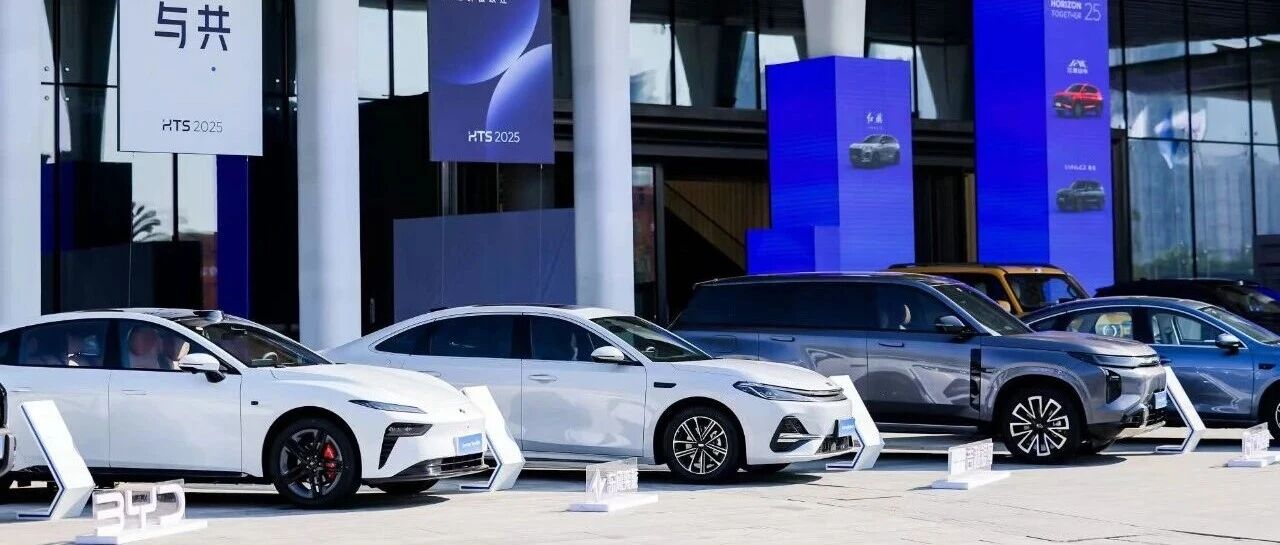
Core Viewpoint - Over the past decade, China's intelligent driving industry has transitioned from a closed chain to an inclusive ecosystem, driven by technological advancements and collaborative efforts among local companies [1][36]. Group 1: Industry Evolution - In 2011, Tesla's CEO Elon Musk dismissed BYD as a competitor, highlighting the significant gap in technology and product appeal between Chinese automakers and Tesla at that time [2][3]. - By 2024, Chinese automakers like BYD and Geely have surpassed Tesla in sales, becoming part of the top ten global car manufacturers, showcasing the rapid evolution of the industry [4]. - The core of Tesla's sustained optimism lies in its self-developed chips and intelligent driving capabilities, which have spurred a wave of research and development in China's intelligent driving sector [4]. Group 2: Key Players and Partnerships - The critical turning point for China's intelligent driving industry occurred between 2019 and 2020, marked by the emergence of companies like Horizon Robotics and Momenta, which began to establish themselves in the market [6]. - The collaboration between Changan Automobile and Horizon Robotics exemplifies how local companies are building flexible and open supply chain systems, enhancing their control over core technologies [10][12]. - The partnership between Li Auto and Horizon Robotics allowed for rapid development and deployment of advanced driving features, demonstrating the importance of open collaboration in overcoming technological challenges [13][17]. Group 3: Technological Advancements - The shift from Mobileye's closed delivery model to more open and collaborative approaches has catalyzed the development of local intelligent driving technologies, enabling companies to gain autonomy over their systems [9][18]. - Horizon Robotics' introduction of the Journey 5 chip, which offers high performance and supports advanced driving needs, has positioned the company to compete in the high-end intelligent driving market [23][24]. - The "HSD Together" model proposed by Horizon Robotics aims to enhance collaboration across the supply chain, significantly reducing development costs and time to market for automotive companies [27][28]. Group 4: Market Accessibility and Inclusivity - The evolution of intelligent driving technology is making advanced features more accessible to a broader range of consumers, breaking down price barriers that previously limited adoption to high-end vehicles [30][31]. - BYD's upcoming "Heavenly Eye" system, powered by Horizon Robotics' Journey 6 chip, aims to provide advanced driving capabilities across its entire model range, including lower-priced vehicles [30]. - The introduction of Horizon Robotics' HSD full-scene driving assistance system is set to make high-level intelligent driving features available in mid-range vehicles, promoting inclusivity in the market [31][33].


小米陈光:我们不想制造技术焦虑了
2 1 Shi Ji Jing Ji Bao Dao· 2025-12-25 08:24
Core Viewpoint - The smart driving industry is experiencing a "term overload" phenomenon, with various factions emerging around different models such as VLA (Vision Language Action), VA (Vision Action), and WA (World Action) [2] Group 1: Industry Trends - The industry is divided between proponents of VLA, like Li Auto and Yuanrong Qixing, and opponents like Huawei and Xiaopeng, who prefer WA [2] - Xiaomi is focusing on end-to-end development, showcasing significant potential in this area, despite starting later than competitors like Li Auto and NIO [3][6] - Xiaomi's end-to-end algorithm has evolved rapidly, with multiple versions released within a year, indicating a fast-paced development cycle [6] Group 2: Technological Development - Xiaomi's latest version of its HAD (Highly Automated Driving) system incorporates world models and reinforcement learning, enhancing its cognitive capabilities [3][4] - The introduction of world models and reinforcement learning is seen as a necessary evolution from simple data-driven approaches to more complex cognitive-driven methodologies [9][10] - Xiaomi's approach emphasizes maximizing the model's intelligence density within limited computational resources [8][15] Group 3: Team Structure and Strategy - Xiaomi's smart driving team has grown to over 1,800 members, reflecting a rapid scaling compared to competitors [6][12] - The team is divided into three groups focusing on different technological routes, including end-to-end, VLA, and other exploratory research [4][13] - Xiaomi's strategy is characterized by a gradual introduction of new technologies, prioritizing user experience over merely adopting the latest advancements [5][10] Group 4: Challenges and Responses - The integration of reinforcement learning faces challenges, such as ensuring the fidelity of world models and managing computational efficiency [4][33] - Xiaomi's team has encountered external criticism, which they view as a necessary part of their growth and development process [25][26] - The company aims to balance the introduction of new technologies with the need for practical, user-friendly solutions [10][11]

奥迪威(920491):头部智驾客户定点合同1.76亿元,我国首批L3级智驾准入获批打开增长空间
KAIYUAN SECURITIES· 2025-12-25 06:14
Investment Rating - The investment rating for the company is "Outperform" (Maintain) [3] Core Insights - The company has received a project designation from a leading intelligent driving system integrator, with a total contract value of RMB 176 million, expected to start mass production in December 2026 and last for three years [5] - The approval of China's first L3 level autonomous driving permits marks a significant step towards commercial application, enhancing the growth potential for the company in the intelligent automotive sector [6] - The company's new generation AKII ultrasonic sensors have achieved mass delivery, supporting the transition from L2 to L3 autonomous driving technologies [7] Financial Summary - Revenue projections for 2025-2027 are RMB 744 million, RMB 920 million, and RMB 1,116 million, respectively, with year-over-year growth rates of 20.6%, 23.6%, and 21.3% [9] - Net profit forecasts for the same period are RMB 104 million, RMB 128 million, and RMB 142 million, with corresponding year-over-year growth rates of 18.5%, 23.4%, and 10.5% [9] - The company's earnings per share (EPS) are projected to be RMB 0.74, RMB 0.91, and RMB 1.00 for 2025, 2026, and 2027, respectively, with price-to-earnings (P/E) ratios of 38.5, 31.2, and 28.2 [5][9]
ROBO+赛道热火重燃!九家产业链公司港股敲钟 募资金额超200亿
Xin Lang Cai Jing· 2025-12-25 05:16
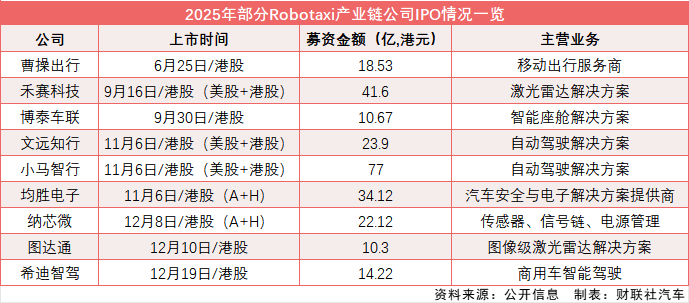
Core Insights - The competition in the Robotaxi sector is shifting towards commercial ecosystems and profitability as the technology matures, with companies focusing on rapid fundraising for innovation and market expansion [1] - As of December 25, 2025, at least nine companies in the Robotaxi industry chain have completed IPOs in Hong Kong, raising over 20 billion HKD in total [1] - The trend of companies going public in Hong Kong is driven by the need for funding to enhance R&D and to connect with global capital markets [5][6] IPO Overview - Companies that have completed IPOs include: - Cao Cao Mobility: June 25, 2025, raised 1.853 billion HKD [2] - Hesai Technology: September 16, 2025, raised 4.16 billion HKD [2] - Baidu's Apollo: November 6, 2025, raised 2.39 billion HKD [2] - Pony.ai: November 6, 2025, raised 7.7 billion HKD [2] - Others include Junsheng Electronics, Naxin Micro, and others with varying amounts [2] - Companies currently in the IPO pipeline include DeepWay, Mainline Technology, and others, indicating a robust interest in the sector [4] Industry Dynamics - The Robotaxi sector is experiencing a surge in interest due to supportive policies in China, indicating a potential turning point for market growth [5] - Cost remains a critical factor for the commercial viability of Robotaxi services, with significant financing from IPOs providing short-term relief for cash flow pressures [6] - Predictions suggest that advancements in technology will lead to a tenfold increase in computing power for autonomous driving products, facilitating rapid regional expansion [6] International Expansion - Companies like WeRide and Uber are collaborating to launch Robotaxi services in Dubai, highlighting the international competitive landscape [7] - The global competition in smart driving technology is intensifying, with expectations that the period from 2026 to 2030 will see significant advancements and competition in the Robotaxi market [7]
新股消息 承泰科技递表港交所 为中国车载前向毫米波雷达市场的最大国内供货商
Jin Rong Jie· 2025-12-25 02:57
Core Viewpoint - Chengtai Technology has submitted its listing application to the Hong Kong Stock Exchange, positioning itself as a leading supplier in the Chinese automotive millimeter-wave radar market, with significant market shares in both forward and overall radar segments [1][2]. Group 1: Company Overview - Chengtai Technology is the largest domestic supplier in China's automotive forward millimeter-wave radar market, holding a market share of 9.3%, and the third-largest in the overall millimeter-wave radar market with a share of 4.5% [1]. - The company specializes in the design, research and development, manufacturing, and commercialization of millimeter-wave radar products, integrating software and algorithm capabilities with radar hardware to enhance compatibility across different vehicle models [1][2]. Group 2: Business Model and Product Offerings - The company operates on a "business triad" model, focusing on high-quality hardware, agile software updates, and rapid delivery systems to meet the evolving demands of intelligent driving [2]. - Chengtai Technology has developed a range of millimeter-wave radar products to cater to various intelligent driving needs, with seven major radar models launched, including forward and corner radars [2][3]. Group 3: Client Engagement and Delivery Performance - The company has secured over 20 automotive clients, including leading OEMs in China, and has begun integrating its 5.5 generation 4D high-resolution radar products into advanced driving systems for major clients [3]. - Chengtai Technology boasts a significantly shorter average product delivery cycle of six to nine months for customized software, compared to the industry standard of 12 to 24 months, with some projects delivered within a month for established clients [3]. Group 4: Financial Performance - The company has demonstrated rapid revenue growth, achieving revenues of 57.65 million RMB, 157 million RMB, 348 million RMB, and 539 million RMB for the fiscal years 2022, 2023, 2024, and the first half of 2025, respectively [4]. - Corresponding gross profits for the same periods were 16.54 million RMB, 48.49 million RMB, 118 million RMB, and 74.51 million RMB [4].
承泰科技递表港交所 为中国车载前向毫米波雷达市场的最大国内供货商
Zhi Tong Cai Jing· 2025-12-25 02:45
Core Viewpoint - Chengtai Technology has submitted its listing application to the Hong Kong Stock Exchange, aiming to capitalize on its position as a leading supplier in the automotive millimeter-wave radar market in China [1] Group 1: Market Position - Chengtai Technology is the largest domestic supplier in China's automotive forward millimeter-wave radar market by shipment volume, holding a market share of 9.3% [1] - The company ranks as the third-largest supplier in the overall automotive millimeter-wave radar market in China, with a market share of 4.5% [1] Group 2: Product Development and Offerings - The company develops, manufactures, and sells radar products, integrating standard hardware with customized software to meet OEM requirements [4] - Chengtai Technology has created a matrix of millimeter-wave radar products to cater to various intelligent driving needs, with seven major radar models launched to date [5] - The fifth-generation 4D radar and the fifth-generation 4D high-resolution radar are among the most competitive products in the industry [5] Group 3: Business Model and Operations - The company operates on a "three-ring" business model focusing on high-quality hardware, agile software updates, and rapid delivery to enhance operational efficiency [4] - Chengtai Technology has a significantly shorter average product delivery cycle of six to nine months compared to the industry standard of 12 to 24 months [6] Group 4: Financial Performance - The company has shown rapid revenue growth, achieving revenues of 57.65 million RMB, 156.52 million RMB, 348.09 million RMB, and 538.52 million RMB for the years 2022, 2023, 2024, and the six months ending June 30, 2025, respectively [9] - Corresponding gross profits for the same periods were 16.54 million RMB, 48.49 million RMB, 118.47 million RMB, and 74.51 million RMB [9]
企业竞争或进入技术、盈利、商业落地等全面比拼新阶段
Xin Hua Wang· 2025-12-25 02:33
Core Insights - The intelligent driving industry is entering a "survival of the fittest" phase, where competition will focus on technology, profitability, and commercial viability [1][5][6] Market Restructuring - The intelligent driving company Haomo Zhixing has reportedly come to a complete halt, with many employees not receiving salaries for months. The company, backed by Great Wall Motors, once had a valuation exceeding 10 billion yuan but is now facing layoffs and executive departures [2] - Other companies like Zongmu Technology and Qingyan Weishi have also faced bankruptcy or deep restructuring despite previous funding rounds [2] Resource Concentration - The Ministry of Industry and Information Technology has conditionally approved two L3 autonomous driving models for trial operations in specific areas, marking a shift from "practice allowed" to "official road use" [3] - Companies like Yuanrong Qihang and Zhuoyue Technology have secured significant investments, indicating a trend of resource concentration towards leading firms [3] International Competition - Global giants like General Motors are seeking expertise from former employees of failed ventures to enhance their autonomous vehicle initiatives, reflecting a diverse technological approach in the industry [4] - The investment landscape has cooled significantly since its peak in 2021, with a notable shift towards funding established players rather than startups [4][5] Industry Challenges - Companies face significant challenges in establishing sustainable business models, with only a few profitable among the major listed intelligent driving firms [6][7] - The focus has shifted from merely technological capabilities to include cost control, compliance, and mass production capabilities as essential criteria for success [7] Future Outlook - The industry is expected to consolidate further, with independent autonomous driving companies facing increased pressure and potential mergers or acquisitions [5][6] - Predictions indicate a shift towards fully autonomous driving solutions in the next 5 to 10 years, driven by advancements in data and AI technologies [7][8]



2025年中国车载毫米波雷达行业发展历程、产业链、市场规模、竞争格局及未来趋势研判:国产替代进程加速,车载毫米波雷达规模将达99.29亿元[图]
Chan Ye Xin Xi Wang· 2025-12-25 01:33
Core Insights - The automotive millimeter-wave radar market is currently dominated by international leaders such as Bosch, Continental, and Aptiv, but domestic manufacturers are accelerating the localization process due to improved technology and product competitiveness [1][9] - The Chinese automotive millimeter-wave radar industry is experiencing strong growth, with the market size projected to increase from 2.318 billion yuan in 2015 to 8.822 billion yuan in 2024, representing a compound annual growth rate (CAGR) of 16.01% [1][10] - By 2025, the market size is expected to reach 9.929 billion yuan, driven by a more complete domestic supply chain, increased R&D investment, and growing demand for self-controlled solutions from downstream vehicle manufacturers [1][10] Industry Overview - Automotive millimeter-wave radar operates in the millimeter-wave frequency band, providing critical environmental perception data for autonomous and assisted driving by measuring distance, speed, and angle of targets [1][6] - The radar is categorized into corner radars and front radars, with corner radars used for cross-vehicle warnings and blind spot detection, while front radars are utilized for automatic emergency braking and adaptive cruise control [1][6] Industry Development History - The Chinese automotive millimeter-wave radar industry has undergone five development stages: the initial stage before 2013, preliminary development from 2014 to 2015, scale development from 2016 to 2020, high-quality development from 2021 to 2024, and technological equality from 2025 onwards [4][5] Market Trends - The global automotive millimeter-wave radar market is projected to grow from $2.262 billion in 2020 to $3.482 billion in 2024, with a CAGR of 11.39% [7][9] - By 2025, the global market size is expected to reach $4.195 billion, with front radars accounting for $2.181 billion and corner radars for $2.014 billion [7][9] Competitive Landscape - The industry features a diversified competitive landscape with international giants like Bosch, Continental, and Aptiv leading in high-end markets, while domestic companies such as Desay SV and Huayu Automotive are rapidly gaining market share through R&D and localized services [11][12] - Desay SV has maintained the largest market share in the domestic smart driving sector, achieving a revenue of 4.147 billion yuan in the first half of 2025, a year-on-year increase of 55.49% [12][13] - Huayu Automotive has a strong presence in various automotive components and has integrated millimeter-wave radar and other sensors to provide solutions for different levels of driving assistance [12][13] Future Development Trends - The future of automotive millimeter-wave radar is expected to focus on perception fusion and functional expansion, integrating with cameras and LiDAR for enhanced environmental perception [14] - The industry is also moving towards chip integration, with a trend towards single-chip solutions that reduce size, power consumption, and costs [15] - Additionally, the evolution of radar technology is shifting from hardware functionality to software-defined capabilities, allowing for customizable and upgradable perception models [16]


睿创微纳:领跑多维感知“新赛道” 激活区域光电产业生态圈
证券时报· 2025-12-25 00:20
Core Viewpoint - Ruichuang Micro-Nano has experienced explosive growth in performance, with revenue increasing from 685 million yuan in 2019 to 4.316 billion yuan in 2024, achieving a 630% growth over five years and an average annual compound growth rate of 44.50% [1] Group 1: Company Growth and Market Position - The company has established a full industry chain layout from chips to complete machines, showcasing strong market competitiveness and industry leadership [1] - Ruichuang Micro-Nano has raised approximately 2.7 billion yuan through capital operations, including IPO and convertible bonds, which has significantly supported its rapid development [3] - The company has released the world's first 8μm 1920×1080 infrared detector chip in 2021 and the world's first 6μm VGA infrared detector chip in 2024, driving advancements in small pixel infrared thermal imaging technology [3] Group 2: Industry Ecosystem and Regional Development - Ruichuang Micro-Nano plays a leading role in the "Yantai Optical and Magnetic Materials Industry Chain," contributing to a total output value exceeding 27 billion yuan by the end of 2024 [7] - The company benefits from a favorable business environment in Shandong Province, which supports the development of chip enterprises through various financial and policy measures [8] - The company has helped establish the Yantai Optical Sensing Industrial Park, attracting several industry-leading companies and creating thousands of high-quality jobs [8] Group 3: Expansion into New Markets - Ruichuang Micro-Nano is expanding its application fields into low-altitude economy, commercial aerospace, and intelligent driving, capturing market opportunities in these emerging sectors [10] - The company provides a variety of products for the drone industry, including thermal imaging modules and microwave RF chips, as the low-altitude economy rapidly develops [10] - In the intelligent driving sector, Ruichuang Micro-Nano is the first domestic infrared chip company to obtain AEC-Q100 automotive-grade certification, enhancing its offerings for automotive applications [11] Group 4: Future Strategy and Vision - The company aims to continue deepening its focus on "multi-dimensional perception + AI," maintaining a full industry chain layout from chips to complete machines [11] - Ruichuang Micro-Nano plans to leverage its core technologies in infrared detectors and thermal imaging modules to build and integrate the optoelectronic industry ecosystem [12]


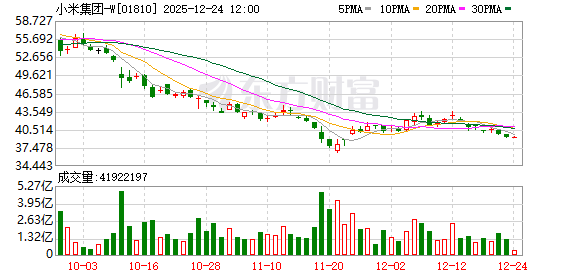
智能驾驶概念升温,浙江世宝走出7天5板,市场资金为何追捧?
Hua Xia Shi Bao· 2025-12-25 00:19
Core Viewpoint - The stock price of Zhejiang Shibao has surged significantly, driven by strong performance in the intelligent driving sector, marking it as a leading stock in this market [1][2]. Group 1: Stock Performance - Zhejiang Shibao's stock price increased from 11.95 yuan per share on December 15 to 20.42 yuan per share on December 24, representing a growth of over 70% in just seven trading days [1][2]. - The company achieved a remarkable "7 days 5 limit-up" performance, indicating strong market interest and investor confidence in the intelligent driving sector [1][2]. Group 2: Industry Context - The intelligent driving sector has gained momentum due to favorable policies and market demand, with the announcement of L3-level autonomous driving permits marking a significant milestone for the industry [2][3]. - The collective rise of stocks in the intelligent driving sector, including Zhejiang Shibao, reflects a broader market trend, with multiple companies experiencing simultaneous stock price increases [2]. Group 3: Company Fundamentals - Zhejiang Shibao has a strong foundation in the automotive steering system industry, with over 30 years of experience and a comprehensive product range covering commercial vehicles, passenger cars, and new energy vehicles [4][5]. - The company reported revenues of 24.62 billion yuan and a net profit of 1.50 billion yuan for the first three quarters of 2025, with year-on-year growth rates of 35.44% and 33.66%, respectively [5]. Group 4: Competitive Advantages - The company has developed a full range of products, including gear rack steering systems and electric power steering systems, enhancing its market position [6]. - Zhejiang Shibao employs lean production management techniques, which help reduce waste and production costs while maintaining flexibility in manufacturing [6]. - The company has invested significantly in research and development, with R&D expenditures increasing from 1 billion yuan in 2022 to 1.36 billion yuan in the first three quarters of 2025, supporting its technological leadership [7].
