
美债

Search documents
十年国债ETF(511260)昨日净流入超5.1亿,社融收敛与货币宽松预期支撑债市
Mei Ri Jing Ji Xin Wen· 2025-06-19 02:53
Group 1 - The core viewpoint indicates that May's inflation and export data are weak, leading to a continued loose state of interbank liquidity and a slight decline in government bond yields [1] - The U.S. inflation weakening and cooling employment have expanded expectations for Federal Reserve interest rate cuts, resulting in a significant decline in U.S. Treasury yields [1] - The 10-year Treasury yield is at 1.64%, with a change of -1.1 basis points from the previous week [1] Group 2 - There is an increasing probability of global economic recession risks due to uncertainties in the global macro environment and the Federal Reserve's monetary policy [1] - Domestic monetary policy easing is less than expected, leading to risks of rising funding prices, while the implementation of domestic growth stabilization policies is also below expectations, resulting in declining financing demand [1] - The intensification of overseas geopolitical conflicts contributes to a complex and severe global political situation, with ongoing deterioration and expansion of geopolitical tensions [1] Group 3 - The 10-year Treasury ETF (511260) employs an optimized sampling replication strategy to closely track the Shanghai Stock Exchange 10-year Treasury Index, selecting highly liquid government bonds to construct its portfolio [1] - The current average duration of the portfolio is 7.6 years, and it publishes a daily PCF list, ensuring transparency in holdings, making it suitable for medium to long-term investors seeking stable returns [1]
懂王的TACO困境:风箱老鼠,两头受气
Hu Xiu· 2025-06-11 23:32
Group 1 - The article discusses the challenges faced by the current administration, particularly in relation to trade negotiations and internal political dynamics [1][3][21] - The term "TACO" is introduced, symbolizing the administration's tendency to backtrack on strong positions, particularly in trade matters [1][5][9] - The administration's approach to immigration enforcement is causing discontent among its base, potentially jeopardizing support from key demographics [3][4][6] Group 2 - Recent trade negotiations with Japan have highlighted internal conflicts among U.S. representatives, leading to ineffective discussions and a lack of coherent strategy [10][12][14] - The article suggests that the administration's internal strife and lack of clear direction may hinder its ability to secure favorable trade agreements [14][23] - The potential for leveraging U.S. debt as a financial tool in trade negotiations is mentioned, indicating a complex interplay of economic strategies [8][24] Group 3 - The article emphasizes the importance of understanding the administration's fluctuating stance on trade and its implications for global economic relations [20][22][24] - It notes that the administration's focus on internal conflicts may detract from addressing external competitive pressures [21][22] - The conclusion suggests that the ongoing trade war could present opportunities for other economies to strengthen their positions [24][26]
美国被拿捏,特朗普放低姿态,石破茂一步不让,不出意外又谈崩了
Sou Hu Cai Jing· 2025-06-09 04:27
Group 1 - The core focus of the US-Japan tariff negotiations is the trade deficit, with Japan's strong stance against making unprincipled concessions to the US [1] - Japan holds significant leverage in the negotiations due to its substantial holdings of US Treasury bonds, which could impact the US economy if sold off [1] - Japan's proposal includes a comprehensive cooperation plan targeting China in key areas such as rare earths, semiconductors, and liquefied natural gas [3][5] Group 2 - Japan aims to reduce the trade deficit with the US while aligning with US efforts to counter China's technological advancements [3] - The internal divisions within the US negotiation team complicate the discussions, with differing views among key officials [5] - The historical context of US-Japan relations shows a shift from a subordinate relationship to a more balanced negotiation dynamic, with Japan leveraging its economic position [8]

关于美股、美债和美元,这是高盛最关注的16张图
华尔街见闻· 2025-06-07 10:55
Group 1 - The investment environment is characterized as "tricky, uneven but full of opportunities," influenced by rising inflation risks, high long-term interest rates, and strong performance in sectors like nuclear energy and defense [1] - The market has seemingly priced in the rebound of inflation, with Goldman Sachs predicting core PCE to rise from 2.5% to 3.6% by year-end due to tariffs [2][4] - The U.S. 30-year interest rates have shown some easing recently, but Goldman Sachs believes the market will remain vigilant during long-term bond auction cycles [7] Group 2 - The U.S. dollar faces challenges as it remains relatively expensive according to various valuation models, leading to a divergence between the dollar and U.S. Treasury yields [9][10] - The real estate sector presents a complex outlook, with long-term interest rate risks and weak supply-demand dynamics threatening builders' stocks, yet a long-term bullish trend indicates resilience [12] - Defense stocks have performed exceptionally well, with Goldman Sachs' Korean defense stock basket up 127% year-to-date, alongside strong performances from European and Japanese defense stocks [14][16] Group 3 - Global technology companies are showing superior earnings growth compared to non-tech firms, with significant changes in capital expenditure following the emergence of ChatGPT [20][22] - The gap between U.S. AI leaders and laggards continues to widen, with AI deployment following a pattern of "slow, slow, slow, then a rapid acceleration" [23] - Despite a significant increase in new issuance activities, companies are engaging in large-scale buybacks, indicating a strong market pricing dynamic [24][28] Group 4 - Value storage tools like gold and Bitcoin have performed well in terms of total return and Sharpe ratio, while U.S. high-yield bonds have also shown surprising Sharpe ratios [30] - The U.S. stock market has underperformed compared to global peers, with U.S. tech stocks showing unexpectedly slow performance since the beginning of the year [31]

中美谈妥几天后,特朗普瞄准国内,不到24小时,连下两道命令
Sou Hu Cai Jing· 2025-06-05 10:32
日内瓦联合声明发布后,中美贸易战虽然没有完全结束,但因为关税引发的紧张局势得到了极大缓解。不仅如此,特朗普还主动表示,由于不能和所有经济 体都进行谈判,所以要设定新的关税。不难发现,在关税问题上,特朗普似乎打算就此打住,至少不想让局面僵持下去。 因为特朗普这一系列政策的背后,根本目的还是解决财政问题。加征关税能够缓解财政压力的效果始终是有限,而且加税本身就只是手段,目的是为了以此 为要挟,施压他国在其他议题上让步,比如说美债"借旧还新"、"向美国支付更多保护费"等等。但由于中方的强势反击,在全球范围内起到了很好的示范效 应,日本、欧盟这些原本可以轻松讹诈的对象,如今对美国的态度都非常强硬。随着暂缓加征"对等关税"期限的临近,特朗普也只能作罢,给自己找台阶 下。 所以特朗普在对华主动让步,在关税问题上暂时"休兵"后,立马将目标瞄准国内。据观察者网报道,当地时间5月17日,特朗普在社交平台上发帖,严厉警 告美国最大的零售商沃尔玛,不得以关税为由涨价。而就在前不久,美国诸多零售巨头因为关税带来的成本上涨,不仅考虑涨价,而且还要在明细中标出消 费者因为关税所需要多支付的价格。这不仅可能会引发通胀反弹,而且这笔账还会被 ...

国泰海通证券:稳定币如何重塑全球货币和资产
智通财经网· 2025-06-03 23:02
Core Viewpoint - The recent legislative developments in the U.S. and Hong Kong regarding stablecoins signify a growing recognition and potential legitimization of stablecoins, primarily dollar-pegged, which may enhance the dollar's dominance in the cryptocurrency space [1][2]. Group 1: Stablecoin Market Overview - Stablecoins are typically pegged to stable assets like fiat currencies (mainly the dollar), precious metals, or other cryptocurrencies to maintain value stability [2]. - Since 2020, the stablecoin market has seen significant growth, with a current market capitalization of nearly $245 billion, driven by factors such as efficiency in payments, increased demand from the expanding cryptocurrency market, and geopolitical risks [2]. - The potential implementation of regulatory frameworks could provide new momentum for market development, enhancing the "social consensus" around stablecoins and attracting more investment [2]. Group 2: Impact on Global Currency System - The expansion of stablecoins, particularly dollar-pegged ones, reinforces the dollar's position in the global currency system, potentially impacting the value of more volatile fiat currencies [3]. - While the growth of the dollar stablecoin market may increase demand for U.S. Treasury bonds, its overall effect on short-term bonds is limited, as short-term rates are primarily influenced by Federal Reserve policies rather than market supply and demand [3]. - The current challenges facing U.S. fiscal policy, including persistent deficits and high interest payments, remain critical issues that stablecoin development cannot resolve [3].

Wind风控日报 | 美商务部长称关税不会消失
Wind万得· 2025-06-02 22:56
1 、商务部:敦促美方与中方相向而行,共同维护日内瓦经贸会谈共识 5 、特斯拉在法国销量暴跌 67% 创近三年新低 // 宏观预警 // // 今日关注 // 1 、商务部:敦促美方与中方相向而行,共同维护日内瓦经贸会谈共识 商务部新闻发言人就美方有关言论答记者问表示,《中美日内瓦经贸会谈联合声明》是双方 在相互尊重、平等协商原则下达成的重要共识,成果来之不。我们敦促美方与中方相向而 行,立即纠正有关错误做法,共同维护日内瓦经贸会谈共识,推动中美经贸关系健康、稳 定、可持续发展。如美方一意孤行,继续损害中方利益,中方将继续坚决采取有力措施,维 护自身正当权益。 // 中国债券预警 // 1 、郑裕彤家族所持新世界多只永续债急跌创新低 据券商中国,郑裕彤家族所持新世界突生变数。新世界发展早盘一度狂跌超 10% 。另外,新世 界多只永续债急跌创新低。究其主要原因,新世界于 5 月 30 日盘后公告称,四只永续债延迟派 息。分析师表示,永续债延迟派息不会引发违约,但需要偿还的总金额将会累积,因此长期而 言,新世界所面临的下行风险将仍然存在。 // 中国股票预警 // 1 、本周共有 38 家公司限售股陆续解禁 不包 ...

稳定币成1200亿美债‘接盘侠’,中国减持后美国找到新韭菜?
Sou Hu Cai Jing· 2025-06-01 00:30
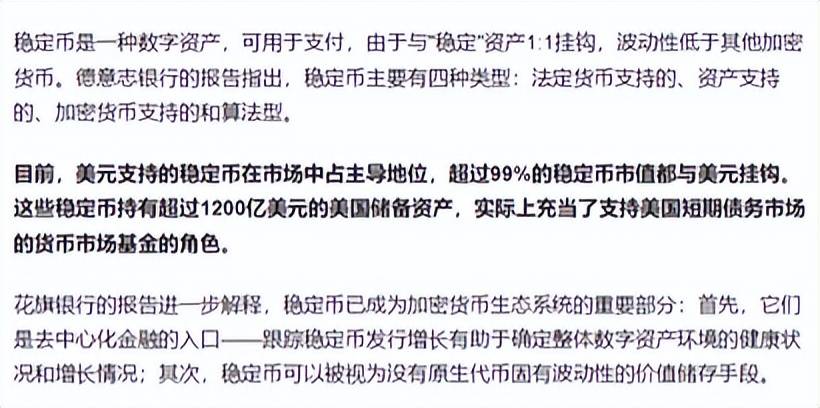
Core Viewpoint - Stablecoins are seen as a potential savior for the US dollar hegemony, possibly leading to a version 3.0 of dollar dominance globally [1][5]. Group 1: Stablecoin Overview - Stablecoins are a type of cryptocurrency that maintain a 1:1 peg to the US dollar, differing from highly volatile cryptocurrencies like Bitcoin and Ethereum [2][4]. - The issuance of stablecoins is strictly regulated, requiring a dollar backing for each stablecoin issued, which simplifies cryptocurrency transactions [2][4]. Group 2: Demand and Market Potential - The demand for stablecoins is rigid, increasing with the number of cryptocurrency traders, and Tether (USDT) has issued over 130 billion coins backed by approximately 130 billion dollars [4]. - Citigroup estimates that the stablecoin market could reach $3.7 trillion by 2030, with 60% of that potentially used to purchase US Treasury bonds, surpassing holdings by China and Japan [4][5]. Group 3: Implications for Dollar Hegemony - Stablecoins could become a core pillar of dollar hegemony 3.0, as they may facilitate global transactions and reinforce the dollar's dominance, especially in regions with limited banking access [5]. - The reliance on stablecoins in regions like Latin America, Southeast Asia, and Africa indicates a trend towards indirect use of the dollar, laying the groundwork for a new version of dollar hegemony [5]. Group 4: Challenges and Risks - The future of stablecoins and their role in dollar hegemony is uncertain, facing challenges such as the need for widespread adoption of cryptocurrencies and potential competition from stablecoins issued by other regions [6][9]. - The risks associated with stablecoins, including their reliance on private companies and the potential for high-risk investments, pose significant uncertainties for the stability of the dollar hegemony [10].
刘刚:“对等关税”后的全球市场2025下半年投资机会前瞻
2025-05-30 16:09
Summary of Conference Call Minutes Industry or Company Involved - Focus on the global market impact of the "reciprocal tariff" policy Core Points and Arguments - The recent tariff reduction from 145% to 10% exceeded expectations, alleviating short-term market concerns, but medium to long-term risks related to trade restrictions need monitoring, particularly around key dates in July and August [1][2] - The U.S. effective tax rate has decreased to 16-17%, indicating a significant shift in market dynamics [2] - The performance of U.S. stocks, particularly in the tech sector, has rebounded quickly, suggesting that previous recession fears may have been overstated [4] - The current market is characterized by limited upward momentum and constrained downside potential, indicating a state of indecision [2] - The liquidity shock is viewed as an occasional event that presents buying opportunities, with central bank interventions typically proving effective [4] Other Important but Possibly Overlooked Content - The recommendation to focus on sectors with strong end-demand and technology innovation, while also capitalizing on short-term trading opportunities in Hong Kong stocks [1] - The expectation that the core Personal Consumption Expenditures (PCE) inflation rate will decline to 3.5-4% by year-end, with the Federal Reserve potentially lowering rates 1-2 times in Q4 [4] - The suggestion to wait for U.S. Treasury yields to rise to 4.8-5% before making long positions, as the current yield of 4.5% is deemed unattractive [5][8] - The impact of tariff adjustments on China's market is projected to reduce GDP influence from 3% to 1-1.5%, with Hong Kong's earnings being less affected than A-shares [7][9] - Recommendations for gold investment strategies include dollar-cost averaging or grid trading, given the high levels of market congestion [6][9]