
宏观政策

Search documents
同比增长5.3%!刚刚,上半年GDP数据出炉!
21世纪经济报道· 2025-07-15 02:10
Core Viewpoint - The Chinese economy demonstrated resilience in the first half of the year, with a GDP growth of 5.3% year-on-year, supported by proactive macroeconomic policies [1]. Group 1: Economic Performance - The GDP for the first half of the year reached 660,536 billion yuan, reflecting a stable and improving economic operation [1]. - The implementation of more proactive macro policies has helped the economy withstand pressures and challenges [1]. Group 2: Monetary Policy - The monetary policy has been "appropriately accommodative," resulting in a significant increase in social financing by 4.74 trillion yuan, reaching a historical high of 21.79 trillion yuan for the same period [2].


国家统计局:上半年国民经济迎难而上、稳中向好
news flash· 2025-07-15 02:02
国家统计局表示,总的来看,上半年更加积极有为的宏观政策发力显效,经济运行延续稳中向好发展态 势,展现出强大韧性和活力。也要看到,外部不稳定不确定因素较多,国内有效需求不足,经济回升向 好基础仍需加力巩固。下阶段,要坚持以习近平新时代中国特色社会主义思想为指导,坚持稳中求进工 作总基调,完整准确全面贯彻新发展理念,加快构建新发展格局,统筹国内经济工作和国际经贸斗争, 坚定不移办好自己的事,进一步做强国内大循环,以高质量发展的确定性应对外部不确定性,推动经济 持续平稳健康发展。(统计局官网) ...
宝城期货股指期货早报-20250715
Bao Cheng Qi Huo· 2025-07-15 01:33
Report Industry Investment Rating - Not provided in the given content Core Views of the Report - For the IH2509 variety, the short - term view is a sideways movement, the medium - term view is an upward trend, and the intraday view is a sideways - to - bullish trend, with the overall view being sideways - to - bullish due to positive policy expectations providing strong support [1]. - For IF, IH, IC, and IM, the intraday view is sideways - to - bullish, and the medium - term view is an upward trend. The overall reference view is sideways - to - bullish. Since late June, the stock index has rebounded significantly, mainly driven by expectations of policy benefits in the second half of the year. In the short term, the upward momentum of the stock index has slowed down, but the trading volume is still at a relatively high level, and market risk appetite remains optimistic. The stock index will operate sideways - to - bullish in the short term [5]. Summary by Related Catalogs Variety View Reference - Financial Futures Stock Index Sector - For the IH2509 variety, the short - term is a sideways movement, the medium - term is an upward trend, the intraday is a sideways - to - bullish trend, and the overall view is sideways - to - bullish. The core logic is that positive policy expectations provide strong support [1]. Main Variety Price and Market Driving Logic - Financial Futures Stock Index Sector - Yesterday, each stock index had a narrow - range sideways adjustment. Since late June, the stock index has rebounded significantly, mainly driven by expectations of policy benefits in the second half of the year, including the optimistic expectation that the "anti - involution" policy will promote profit restoration in industries such as new energy and the supporting effect of macro - policies on economic demand. In the short term, the upward momentum of the stock index has slowed down, but the trading volume is still at a relatively high level, and market risk appetite remains optimistic. Attention should be paid to the policy guidance of the Politburo meeting in July. In general, the stock index will operate sideways - to - bullish in the short term [5].
兼论下半年市场风格展望:对小盘风格的三个理解误区
Haitong Securities International· 2025-07-13 14:28
Group 1 - The report identifies three misconceptions regarding the dominance of small-cap stocks, emphasizing that macro liquidity and quantitative funds are not the primary reasons for small-cap outperformance [1][6][7] - The recent outperformance of small-cap stocks is attributed to a significant influx of retail investor capital, which contrasts with institutional investment trends [21][22][24] - Historical data suggests that the relative profitability trends of large and small-cap stocks serve as leading indicators for style shifts, indicating that a fundamental turnaround is necessary for large-cap dominance to return [24][27] Group 2 - The report highlights that the perception of macro liquidity being beneficial for small-cap stocks is misleading, as historical instances show both large and small-cap stocks can outperform under similar liquidity conditions [7][16][18] - It is noted that the scale of quantitative private equity funds entering the market has not been as significant as perceived, and their activity is more a response to existing market conditions rather than a driving force [16][21] - The report argues that trading intensity does not effectively predict small-cap stock performance, as historical data shows that high trading volumes can still coincide with continued small-cap strength [18][25] Group 3 - The report concludes that the future switch between large and small-cap styles will likely depend on the confirmation of an upward trend in industry cycles, particularly in the context of the AI sector [24][27][28] - It emphasizes that the current market environment, characterized by a recovery in risk appetite since September 2024, has not yet fully aligned with fundamental improvements, suggesting a cautious outlook for small-cap stocks [21][24] - The report anticipates that as the AI industry cycle gains momentum, it may lead to a resurgence of large-cap technology leaders in the market [27][28]
粤开宏观:未雨绸缪:下半年中国经济形势展望及建议
Yuekai Securities· 2025-07-13 10:07
Economic Overview - China's economy is expected to grow at over 5% in the first half of 2025, supported by policies like the old-for-new consumption initiative and proactive fiscal measures[2] - The economy is projected to follow a "U-shaped" trajectory throughout the year, with growth pressures in the second half due to high base effects and external factors[2][9] Key Challenges - The actual tariff rate imposed by the US on China is approximately 40%, which may lead to diminishing export resilience as previous "rush to export" effects fade[10] - Real estate prices are declining, impacting consumer wealth and spending, with sales and investment in the sector showing negative growth since May[12] - Local government finances remain tight, with significant reliance on fiscal support to sustain growth, potentially limiting resources for the second half of the year[13] Policy Recommendations - Accelerate the issuance and utilization of special bonds and long-term treasury bonds to stimulate investment and consumption[3] - Optimize the old-for-new consumption policy to include the service sector, enhancing its effectiveness[3] - Implement measures to stabilize the real estate market, including the establishment of a central real estate stabilization fund[17] Fiscal and Monetary Measures - Fiscal policy will be a primary focus, with an emphasis on increasing spending to counteract external demand pressures[15] - The government plans to issue approximately 11.86 trillion yuan in new debt for the year, with 5 trillion yuan utilized in the first half and an estimated 5.5 trillion yuan for the second half[13] Inflation and Economic Sentiment - Consumer Price Index (CPI) growth was only 0.1% in June 2025, indicating low inflation, while Producer Price Index (PPI) has been in negative territory for 33 consecutive months[14] - The divergence between macroeconomic data and microeconomic sentiment may hinder economic recovery, necessitating stronger macroeconomic controls to promote reasonable price increases[14]
扩大内需,政策发力和改革加力相结合
Sou Hu Cai Jing· 2025-07-11 07:12
Group 1 - The article emphasizes the need for a long-term mechanism to boost domestic demand, combining short-term policy adjustments with medium to long-term institutional reforms [1] - It advocates for a more proactive macroeconomic policy, including an expansionary fiscal policy that ensures fiscal spending growth exceeds nominal GDP growth, positively impacting total demand [1] - The article suggests implementing a moderately loose monetary policy to maintain ample liquidity and support sectors like technological innovation and consumption [1] Group 2 - The article discusses the need for tax reform, specifically moving the consumption tax collection point to enhance local government incentives for boosting consumption [3] - It highlights the importance of enhancing the income distribution function of taxes to increase the income of low-income groups and expand the middle-income population [3] Group 3 - The article calls for the promotion of a unified national market by removing market access barriers and local protectionism, facilitating economic circulation [4] - It suggests improving the market entry environment for new industries and relaxing restrictions in essential service sectors like education and healthcare [4] Group 4 - The article stresses the interconnection between consumption and investment, noting that government investment can stimulate both sectors, especially in technology and infrastructure [5] - It highlights the importance of addressing weak areas in the economy, such as education and healthcare, to create a virtuous cycle of investment and consumption [6] Group 5 - The article points out that urbanization of the agricultural population is crucial for boosting consumption and expanding domestic demand, advocating for improved public services for this demographic [6] - It emphasizes the need for effective incentive mechanisms to encourage local governments to promote equal access to public services, thereby unlocking the consumption potential of nearly 300 million rural migrants [6]
华宝期货晨报铝锭-20250711
Hua Bao Qi Huo· 2025-07-11 03:07
Group 1: Report Industry Investment Ratings - No specific industry investment ratings are provided in the report. Group 2: Core Views of the Report - The view on finished products is that they will operate in a volatile and consolidating manner, with prices continuing to move downward in a volatile fashion, hitting new recent lows, and the price center of gravity continuing to shift downward due to weak supply - demand and pessimistic market sentiment. Winter storage is sluggish this year, providing weak price support [1][3]. - The view on aluminum ingots is that prices are expected to be relatively strong in the short - term, and attention should be paid to macro - sentiment and downstream start - up rates. There are pressures on the downstream start - up rates, and the price is expected to operate in a high - level range in the short - term, with subsequent attention on the inventory - consumption trend [1][4]. Group 3: Summary by Related Catalogs Finished Products - Yunnan - Guizhou region's short - process construction steel producers will have a shutdown and maintenance period during the Spring Festival from mid - to late January, with a resumption of production expected between the 11th and 16th day of the first lunar month, and an estimated impact on the total construction steel output of 741,000 tons during the shutdown. In Anhui, 1 out of 6 short - process steel mills stopped production on January 5, and most of the remaining mills will stop production around mid - January, with an estimated daily impact on output of about 16,200 tons during the shutdown [2][3]. - From December 30, 2024, to January 5, 2025, the total transaction (signing) area of newly - built commercial housing in 10 key cities was 2.234 million square meters, a 40.3% decrease from the previous week and a 43.2% increase year - on - year [3]. Aluminum Ingots - Macroscopically, the minutes of the Fed's last meeting boosted market optimism, with most policymakers believing that interest rate cuts later this year are appropriate. However, policymakers are still worried about the inflationary pressure brought by Trump's tariffs, and only a few officials think a rate cut could happen as early as this month [2]. - As of Thursday, the total built - in production capacity of metallurgical - grade alumina in China is 110.82 million tons/year, and the total operating production capacity is 88.57 million tons/year. The weekly start - up rate of alumina has decreased by 0.05 percentage points to 79.92% compared to last week, with some enterprises in Shandong and Guangxi undergoing maintenance and a decline in operating production capacity. As of the end of June, the inventory in alumina enterprises' factories increased by 81,000 tons [3]. - Affected by factors such as the high - temperature off - season, high aluminum prices, insufficient profit margins, and weak downstream demand, the start - up rate of the aluminum processing industry decreased by 0.1 percentage points to 58.6% compared to last week [3]. - On July 10, the inventory of electrolytic aluminum ingots in the main domestic consumption areas was 466,000 tons, a decrease of 12,000 tons from Monday and 8,000 tons from last Thursday. Although the ingot - casting volume of some electrolytic aluminum plants has increased, the arrival volume is still low, resulting in a short - term reduction in social inventory of aluminum ingots [3].
筑牢经济韧性底座 多维施策稳增长谋长远
Shang Hai Zheng Quan Bao· 2025-07-10 18:29
Economic Overview - The overall economic performance in the first half of the year is stable, supported by strong external demand and improving internal demand, with GDP growth expected to exceed 5% [2][3] - The first quarter saw a GDP growth rate of 5.4%, and the positive trend continued into the second quarter [2][3] - Key drivers of economic growth include the "old-for-new" consumption policy, large-scale equipment updates, and robust infrastructure investment [3][4] Consumption and Investment - The "old-for-new" policy significantly boosted consumption, with retail sales of consumer goods growing by 5% year-on-year from January to May [4][5] - Fixed asset investment increased by 3.7% during the same period, driven by strong service sector investment and equipment upgrades [4][6] - Exports grew by 6% from January to May, supported by "grabbing exports" and "turning exports" strategies [4][6] Monetary and Fiscal Policies - Monetary policy remained flexible and moderately loose, with a 0.5 percentage point reduction in the reserve requirement ratio in May, releasing approximately 1 trillion yuan in long-term liquidity [7][8] - Fiscal policy showed a high intensity and rapid pace, with government debt net financing increasing by 3.8 trillion yuan year-on-year from January to May [9][10] - The issuance of special bonds and ultra-long-term treasury bonds accelerated, with nearly 2.2 trillion yuan in new special bonds issued by the end of June [9][10] Future Outlook - In the second half of the year, there is still room for further interest rate cuts and reserve requirement ratio reductions to lower financing costs for the real economy [16][20] - New policy financial tools are expected to be introduced in the third quarter, focusing on technology innovation and digital economy sectors [16][17] - The government plans to dynamically adjust budgets and expand fiscal spending to counter global trade uncertainties and support employment [17][20]
CPI四连降终结 “内卷”行业价格回暖
Huan Qiu Wang· 2025-07-10 02:14
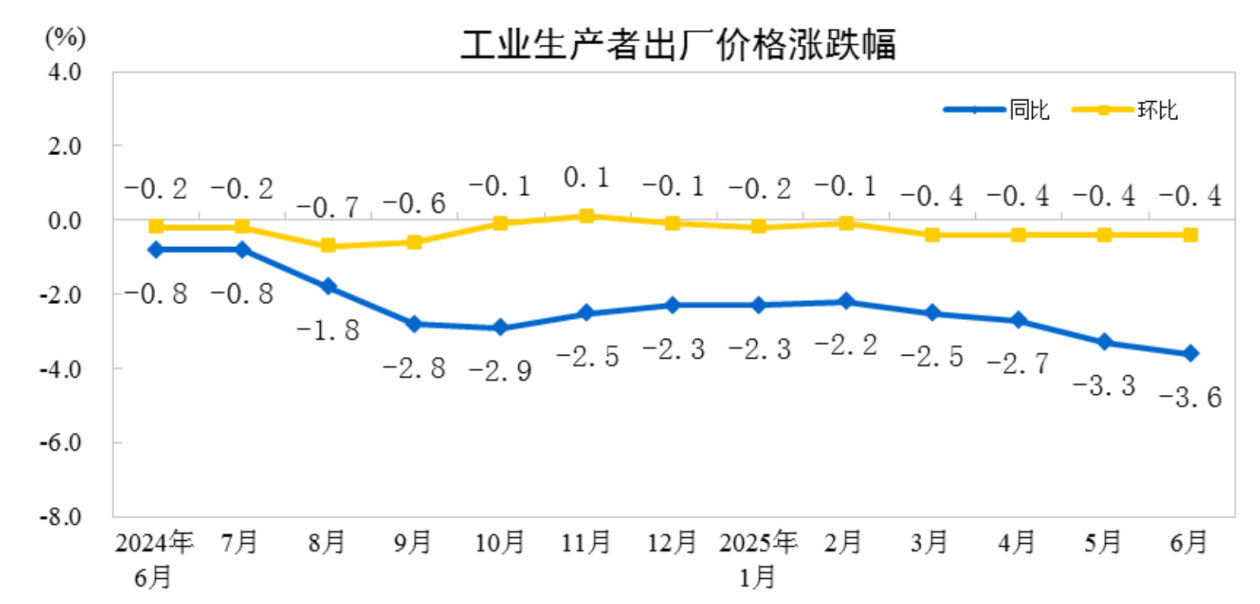
Group 1 - The Consumer Price Index (CPI) in June showed a slight increase of 0.1% year-on-year, ending four consecutive months of negative growth, primarily due to the recovery in industrial product prices and the gradual effects of consumption promotion policies [1][3] - The Producer Price Index (PPI) experienced a year-on-year decline of 3.6%, indicating continued weakness in domestic investment and export demand [1][3] - Positive changes were observed in previously competitive industries such as automotive and photovoltaic sectors, where prices began to stabilize and recover [1][4] Group 2 - The transition of CPI from negative to positive is attributed to reduced international input pressure and the effectiveness of domestic consumption promotion policies, alongside base effect considerations [3] - The core CPI, excluding food and energy, rose by 0.7%, reaching a 14-month high, indicating an increasing domestic demand influence on prices [3] - Despite the positive CPI movement, economists suggest that the core CPI remains in a low inflation environment, and significant changes in this trend are unlikely in the short term [3] Group 3 - The PPI saw a month-on-month decrease of 0.4%, with the year-on-year decline expanding by 0.3 percentage points to 3.6%, driven by seasonal price declines in certain raw material manufacturing sectors and increased green energy supply [3] - The automotive manufacturing sector, including both traditional and new energy vehicles, experienced a month-on-month price increase, with a notable narrowing of year-on-year price declines [4] - The Chinese government has introduced measures to support employment, indicating a focus on job stability alongside price monitoring, which includes increased unemployment insurance and expanded loan support for small and medium enterprises [4]
6月CPI同比由降转涨
Zhong Guo Zheng Quan Bao· 2025-07-09 20:47
Group 1: Consumer Price Index (CPI) Trends - In June, the Consumer Price Index (CPI) turned from a decline to an increase of 0.1% year-on-year after four consecutive months of decline [1][2] - The core CPI, excluding food and energy prices, rose by 0.7% year-on-year, marking a 14-month high [1][2] - The increase in CPI is attributed to the recovery in industrial consumer goods prices, which saw a narrowing decline from 1.0% to 0.5% year-on-year [1][2] Group 2: Producer Price Index (PPI) Trends - The Producer Price Index (PPI) decreased by 0.4% month-on-month and 3.6% year-on-year [1][2] - The decline in PPI is influenced by seasonal price drops in certain raw materials and the impact of high temperatures and rainfall on construction projects [2][3] - The year-on-year decline in PPI expanded by 0.3 percentage points compared to the previous month, reflecting pressures in export-oriented industries [3] Group 3: Policy Implications and Future Outlook - Experts suggest that macroeconomic policies should continue to promote domestic demand and improve supply-demand relationships to facilitate a reasonable price recovery [4] - The implementation of consumption-boosting measures, such as trade-in programs, is expected to support price levels in the second half of the year [4] - The potential for service consumption growth is anticipated to positively impact prices in sectors like dining, accommodation, and cultural tourism [4]