
美联储降息

Search documents
罕见!越涨越吸金
Ge Long Hui· 2025-09-18 07:21
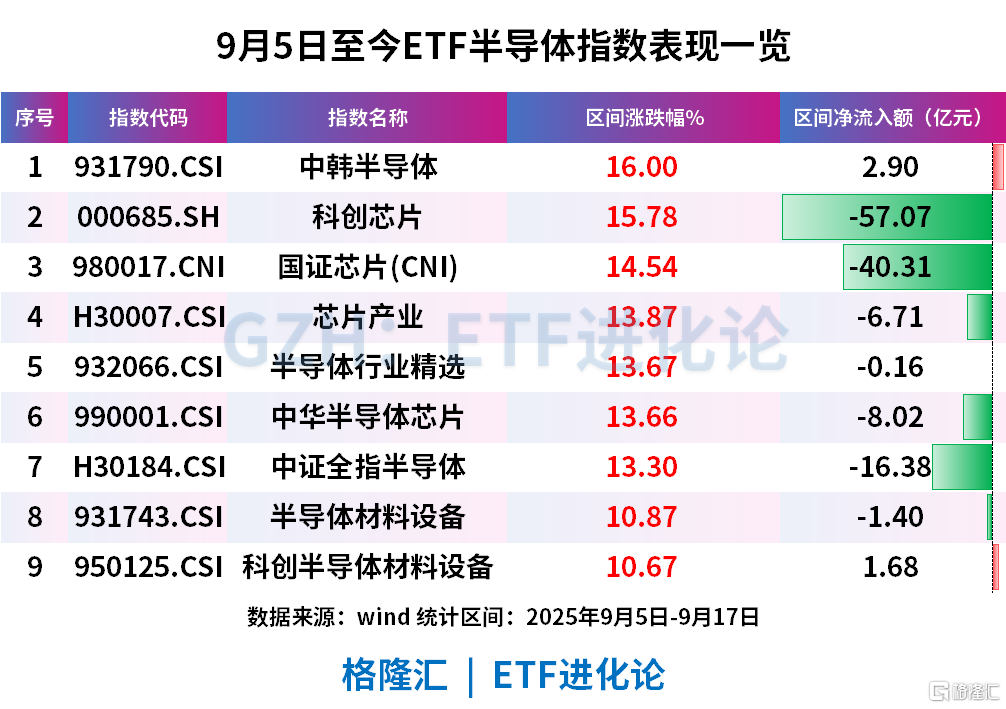
Group 1: Hong Kong Stock Market Performance - The Hong Kong stock market has seen a significant rise since September 5, with the Hang Seng Technology Index surging by 4% recently, and the Hang Seng Index briefly surpassing 27,000 points [1] - Baidu's stock has increased by 54% in September, reaching a new high for 2023, while Alibaba's market capitalization has returned to 3 trillion HKD, marking a near four-year high [1] - The semiconductor sector has also experienced a rebound, particularly after news that Alibaba and Baidu have begun using self-developed chips for AI model training, leading to accelerated growth in the sector [1] Group 2: Semiconductor Index and ETF Performance - The semiconductor index has shown a trend of "buying more as prices rise," with the China-Korea Semiconductor Index leading with a 16% increase and attracting 290 million CNY in net inflows [2][4] - The China-Korea Semiconductor ETF (513310) has seen a net inflow of 374 million CNY over six consecutive days, making it the top performer in its category [6][8] - The China-Korea Semiconductor Index combines 15 leading semiconductor stocks from both China and South Korea, highlighting the complementary strengths of both countries in the semiconductor industry [11] Group 3: Foreign Investment in Hong Kong Stocks - Foreign investors have been significant buyers in the Hong Kong stock market, particularly noted during a recent surge in the Hang Seng Technology Index, with Baidu and Alibaba attracting substantial capital inflows [12] - Despite a net inflow of 1.2 billion USD from mainland "southbound funds," the majority of buying activity was attributed to foreign investors, indicating a shift in market dynamics [12] - The performance of major tech stocks like Alibaba and Baidu remains strong, with their price-to-earnings ratios still at historically low levels, suggesting potential for further growth [13][15]

半导体强势爆发!中芯国际再创历史新高
2 1 Shi Ji Jing Ji Bao Dao· 2025-09-18 06:53
9月18日,A股三大指数早盘小幅下探后集体反弹,板块层面,半导体板块全线走强,中芯国际盘中续 创历史新高,早盘总市值一度突破1万亿元。截至午间休盘,汇成股份斩获20CM涨停,华海诚科、中 微公司、新相微、利扬芯片等涨超10%,中芯国际、华虹公司、兆易创新等个股涨超5%。 (文章来源:21世纪经济报道) 消息面上,隔夜美联储降息,叠加本土科技巨头纷纷入局自研AI芯片,双重催化半导体短期走势。 ...

机构:美联储降息料提振风险资产短期情绪
Ge Long Hui A P P· 2025-09-18 06:14
Core Viewpoint - The potential interest rate cut by the Federal Reserve may boost short-term market sentiment for risk assets, with the stock market expected to benefit [1] Group 1: Impact on Households and Businesses - The interest rate cut could provide moderate relief for American households and businesses [1] Group 2: Broader Policy Signals - The overall policy signal remains cautious rather than indicating a shift towards rapid easing [1]
中原陈永杰:施政报告与降息双重利好 预计香港全年楼价及租金升5%
智通财经网· 2025-09-18 06:12
Group 1 - The Federal Reserve has announced a rate cut of 0.25%, bringing the federal funds rate to a range of 4% to 4.25% [1] - Hong Kong's property market is expected to see a 30% quarter-on-quarter increase in transaction volume in Q4, driven by recent favorable policies and the interest rate cut [1] - Major banks in Hong Kong have reduced mortgage rates by 0.125%, with the best lending rate now at 3.375% [1] Group 2 - The recent policy report includes measures such as easing the new capital investment scheme, increasing non-local student quotas, and accelerating land supply, which are expected to benefit the property market in the long term [1] - The interest rate cut is anticipated to lower financing costs for businesses, aiding economic recovery and potentially increasing property investment as the attractiveness of fixed deposits diminishes [1] - The number of first-hand property transactions has exceeded 2,000 for two consecutive months, and the number of second-hand transactions facilitated by Centaline Property in September rose by 25% year-on-year [1]
黑色建材日报:降息靴子落地,多空博弈趋缓-20250918
Hua Tai Qi Huo· 2025-09-18 05:40
Report Industry Investment Rating No relevant content provided. Core Viewpoints - The steel market is under inventory pressure, with increased contradictions in the building materials fundamentals and pressured prices, while the plate demand remains resilient, and the price is relatively strong. After the Fed's interest rate cut, policies and expectations support steel prices. The iron ore market has significant growth in global shipments, a slight decline in arrivals, high pig iron production, and falling steel mill profits. The coking coal production resumes slowly, and the double - coking spot rebounds. The power coal market has rising prices in the producing areas due to increased demand, and the price is expected to be volatile in the short - term and supply - abundant in the long - term [1][3][5][7] Market Analysis Steel - Futures and spot: Steel futures prices fluctuated. Spot steel sales were generally weak, with better low - price transactions. The national building materials sales volume was 10,270 tons. Steel production and inventory increased. - Supply and demand logic: Building materials face increased fundamental contradictions and price pressure due to inventory. Plate demand is resilient, and prices are relatively strong. Fed's interest rate cut, anti - involution policies, holiday restocking expectations, and environmental protection policies support steel prices [1] Iron Ore - Futures and spot: Iron ore futures prices fluctuated. In the spot market, prices of mainstream imported iron ore varieties in Tangshan ports had slight fluctuations. Traders' quoting enthusiasm was average, and steel mills' purchases were mainly for刚需. The total national main port iron ore trading volume was 1.265 million tons, a 9.25% decrease from the previous day. The forward spot trading volume was 965,000 tons (7 transactions), a 21.54% decrease, with 545,000 tons from mines. - Supply and demand logic: Global iron ore shipments increased significantly, arrivals decreased slightly, pig iron production was high, and steel mill profits continued to decline. Considering the holiday restocking demand, iron ore consumption is resilient. Attention should be paid to the impact of floating cargo volume on arrivals and steel mills' pre - holiday restocking rhythm [3] Double - Coking (Coking Coal and Coke) - Futures and spot: Double - coking futures main contracts fluctuated. After the coke price cut, coking profits shrank, and production was relatively stable. This week, coking coal production growth slowed, inventory was basically decreasing, some mines were affected by environmental protection and over - production inspections, and Mongolian coal imports remained high. - Supply and demand logic: For coke, after the price cut, production in most areas was stable except in Tangshan. Downstream demand was resilient. For coking coal, downstream restocking demand was released before the National Day, inventory decreased continuously. With the Fed's interest rate cut and domestic policy expectations, double - coking is expected to be slightly strong in the short - term [5] Thermal Coal - Futures and spot: In the producing areas, coal prices continued to rise. Demand from the chemical and cement industries and civilian demand increased. With the rise in port prices, the purchasing enthusiasm of platforms and coal yards increased, and most mines had more coal - pulling trucks and a strong willingness to raise prices. In the port market, sentiment was good, some traders were reluctant to sell due to high shipping costs and tight resources, and prices of some high - quality coal varieties increased. The price decline of domestic coal narrowed, imported high - calorie coal was stable, and low - calorie coal prices rebounded, narrowing the price gap between domestic and imported coal. - Supply and demand logic: Production in the producing areas is gradually recovering, and daily power coal consumption is decreasing. The price will fluctuate in the short - term, and the supply will be abundant in the long - term. Attention should be paid to non - power coal consumption and restocking [7] Strategies Steel - Unilateral: Oscillation - Others: No cross - period, cross - variety, spot - futures, or option strategies [2] Iron Ore - Unilateral: Oscillation - Others: No cross - period, cross - variety, spot - futures, or option strategies [4] Double - Coking - Coking coal: Oscillation - Coke: Oscillation - Others: No cross - period, cross - variety, spot - futures, or option strategies [6]
美联储降息对股市的影响——美股、A股、港股
Hu Xiu· 2025-09-18 05:31
Core Viewpoint - The Federal Reserve's interest rate cut is anticipated, raising questions about the subsequent impact on stock markets, including US, A-shares, and Hong Kong stocks [1] Group 1: US Stock Market - The potential for opportunities in the US stock market post-rate cut is significant, as lower interest rates typically stimulate economic growth and increase corporate earnings [1] - Challenges may arise from inflation concerns and the potential for slower economic recovery, which could dampen investor sentiment [1] Group 2: A-Shares Market - A-shares may benefit from increased liquidity and investor confidence following the Fed's rate cut, potentially leading to a rally in stock prices [1] - However, the market could face headwinds from domestic economic conditions and regulatory changes that may impact growth prospects [1] Group 3: Hong Kong Stock Market - The Hong Kong stock market is likely to see a positive reaction to the Fed's rate cut, as it may attract foreign investment and boost local stocks [1] - Nonetheless, geopolitical tensions and local economic challenges could pose risks to sustained market performance [1]
邓正红能源软实力:美联储降息遇冷 国际油价不升反跌 库存数据暴露需求疲软
Sou Hu Cai Jing· 2025-09-18 05:03
Core Insights - The current oil price decline is attributed to a combination of weak demand signals and a complex interplay of financial policies and market confidence, leading to a negative feedback loop in the oil market [1][3][4] - The Federal Reserve's recent interest rate cut of 25 basis points, while typically supportive of energy demand, has been overshadowed by warnings of a weakening labor market, which has further dampened market sentiment [1][2] Group 1: Market Dynamics - Oil prices fell on September 17, with West Texas Intermediate crude settling at $64.05 per barrel, down 0.73%, and Brent crude at $67.95 per barrel, down 0.76% [1] - The market had largely priced in the 25 basis point rate cut, leading some investors to unwind hedges against larger cuts, which contributed to a stronger dollar and reduced the attractiveness of dollar-denominated commodities [2] - The U.S. Energy Information Administration reported a decrease in crude oil inventories by 9.285 million barrels, but a significant increase in distillate inventories by 4.046 million barrels, indicating a mixed demand outlook [2] Group 2: Soft Power Model Insights - The "soft power" model by Deng Zhenghong highlights a collapse in the oil market's composite soft power, driven by a disconnection between financial policies, industry inventories, and monetary systems [3][4] - The model identifies three nested contradictions: the counterproductive effect of policy soft power, the structural divergence in inventory levels, and the impact of a strong dollar on oil pricing dynamics [3][4] - The current state of the oil market reflects a structural imbalance, with physical supply chain factors and financial settlement dimensions both contributing to a decline in market stability and reliability [4] Group 3: Future Trends - Short-term volatility is expected as Federal Reserve policies and inventory data continue to influence market sentiment, with oil prices likely to fluctuate between $62 and $68 per barrel [5] - Mid-term prospects depend on the potential for further rate cuts and improvements in economic data, which could either accumulate soft power momentum or reinforce downward pressure [5] - Long-term transformations in energy power dynamics are anticipated, with new soft power tools such as asymmetric strikes and carbon tariffs likely to impact pricing systems [5]

PTA:成本支撑微涨,部分企业新增检修计划
Sou Hu Cai Jing· 2025-09-18 04:47
Core Viewpoint - The PTA market has seen a slight increase due to cost support driven by geopolitical risks and rising international oil prices, alongside the Federal Reserve's interest rate cuts [1] Group 1: Market Dynamics - Recent geopolitical risks have heightened concerns over oil supply from a European country, contributing to rising international oil prices [1] - The PTA processing fee remains near its annual low, indicating ongoing production losses for companies in the sector [1] - Some PTA companies have announced maintenance plans for October and November, which may positively influence market sentiment [1] Group 2: Future Outlook - Attention should be paid to the recovery of downstream demand, with expectations for a strong oscillation in the PTA market in the short term [1]

特朗普关税致贫65万美国人,如期降息25基点,中国资产迎来估值修复?
Sou Hu Cai Jing· 2025-09-18 04:02
Group 1 - The impact of tariffs is primarily affecting American consumers, who have already borne approximately 22% of the tariff costs, which could rise to 67% if the tariffs remain in place [1] - The Federal Reserve's interest rate cuts are seen as a potential solution, but the current economic environment is challenging, with high unemployment and inflation risks [1] - A potential global liquidity increase due to the Fed's rate cuts could lead to a reallocation of funds, benefiting non-US assets like A-shares and gold [1] Group 2 - The new interest rate cycle initiated by the Federal Reserve is expected to positively influence emerging markets, particularly in stock and real estate sectors [3] - Current valuations in A-shares and Hong Kong stocks are significantly lower than those in mature markets, indicating a potential for valuation recovery [3] - The average daily trading volume in the A-share market remains robust, suggesting that a new round of Fed rate cuts could further enhance market liquidity [3] Group 3 - Recent disclosures from public funds indicate that market leaders are optimistic about the second half of the year, despite a decrease in implied returns due to rising stock prices [5] - The overall Chinese stock market is not in a bubble state, but opportunities for easy gains are becoming scarcer [5] Group 4 - The global monetary easing cycle initiated by the Fed is likely to drive up risk asset prices, creating favorable conditions for a bull market [7] - The potential for a rate cut by the People's Bank of China could alleviate the interest rate gap between the yuan and the dollar, benefiting financial stocks [7] Group 5 - Historical data suggests that preemptive rate cuts by the Fed can support stock market strength, although current economic indicators show signs of weakness [9] - The contrasting performance of tech giants highlights market volatility, with significant investments from leaders like Elon Musk in Tesla, while companies like Nvidia face regulatory scrutiny [9] Group 6 - Upcoming decisions from global central banks could lead to significant currency market fluctuations, making it crucial for long-term investors to monitor the Fed's rate cut pace and US-China trade negotiations [10] Group 7 - The low interest rate environment is pushing investors to seek alternative assets, such as money market funds and bond funds, which offer more attractive returns compared to traditional savings [12] - The stock market's growth is drawing funds away from bank deposits, indicating a shift towards more dynamic investment opportunities [12] - The trend of financial disintermediation is becoming more pronounced, with a greater emphasis on direct financing and diversified investment channels [12]

美联储降息后美元波动加剧
Jin Tou Wang· 2025-09-18 04:00
Core Viewpoint - The article discusses the recent movements in the US dollar index following the Federal Reserve's decision to cut interest rates by 25 basis points, highlighting the cautious approach of the Fed towards future monetary policy adjustments [1] Group 1: Federal Reserve Actions - The Federal Reserve announced a 25 basis point interest rate cut, leading to a temporary drop in the dollar index to a new low of 96.224 since February 2022 [1] - Fed Chairman Jerome Powell indicated that the rate cut was a measure to manage risks associated with a potentially weak labor market, emphasizing that there is no immediate need to accelerate the easing process [1] - The latest dot plot suggests a potential further reduction of 50 basis points in the remaining two meetings of the year, with only one planned cut in 2026, indicating a cautious policy stance [1] Group 2: Market Reactions - Following the Fed's announcement, the dollar index rebounded to close at 97.074, marking a daily increase of 0.44% [1] - Analysts interpret the Fed's cautious outlook as a reflection of ongoing concerns regarding inflationary pressures and economic uncertainty, suggesting that monetary policy will remain data-dependent [1] Group 3: Technical Analysis - The dollar index has broken below a head-and-shoulders pattern and a trading range, currently experiencing a rebound after this breakdown [1] - Key support is identified at 96.37, which is the low point from July 1 and the lowest point of the year; a further drop below this level could target the 95.00 mark, with a measured decline from the head-and-shoulders pattern suggesting a potential drop to 94.44 [1]