美联储降息

Search documents
Stocks Stall After Wall Street Finally Gets Its Rate Cut
Barrons· 2025-09-17 20:07
Stock Market News From Sept. 17, 2025: Dow Gains After Fed Decision Last Updated: CONCLUDED Updated 2 hours ago Stocks Stall After Wall Street Finally Gets Its Rate Cut By Connor Smith The Federal Reserve finally cut interest rates, and Wall Street didn't know what to do with itself. The S&P 500 dipped 0.1%. The Dow Jones Industrial Average rose 260 points, or 0.6%. The Nasdaq Composite fell 0.3%. The major indexes initially spiked after the Federal Open Market Committee said it decided to lower the federal ...
今夜 无眠!美联储即将降息
Zhong Guo Ji Jin Bao· 2025-09-17 16:14
兄弟姐妹们啊,今晚,真的要无眠了!美联储要降息(凌晨2点),泰勒要加班! 先简单看看目前海外市场的表现。 美股分化 9月17日晚间,临近美联储降息关键节点,美股三大指数走势分化,道指涨超300点,纳指跳水跌约0.5%,标普500指数微跌。 中概股继续大涨,纳斯达克中国金龙指数涨超2%。 交易员普遍预期美联储将于本周首次降息,并给出未来几个月降息幅度与节奏的指引。 市场大体押注美联储将在周三降息25个基点,并几乎确信鲍威尔会释放进一步宽松的信号,以支撑疲软的劳动力市场。 这样的预期近来助推美股再创新高。按照安排,华盛顿时间下午2点将与利率决定同时发布最新经济预测,鲍威尔将在30分钟后召开新闻 发布会。 经济学家大多预计,官员们会在"点阵图"中为今年预留两次降息,与6月预测一致。这意味着本周之后今年或仅有一次降息,落在10月或 12月。 尽管"意外"空间不小,但期权交易显示,市场押注这次反应将比平常更平稳。摩根大通的Andrew Tyler表示,最可能的情形是降息25个基 点:只要鲍威尔偏鸽,并释放循序渐进的降息信号,标普500指数或将上涨0.5%~1%。 麦格理集团的Thierry Wizman表示:"考虑到数 ...


很多都不能说
Sou Hu Cai Jing· 2025-09-17 11:16
Group 1 - The article discusses the recent challenges in sharing content related to real estate and employment, highlighting censorship issues faced by the author [1] - There is a notable decline in national housing prices, but the author is restricted from discussing this topic in detail [1] - The return of Jack Ma to Alibaba has positively impacted market confidence, with his involvement in AI strategy and competition in the food delivery market being emphasized [1][2] Group 2 - The focus has shifted towards the investment market, with the author expressing a reluctance to share stock trading insights due to potential criticism from followers [2] - The upcoming Federal Reserve interest rate cut is anticipated to have significant implications for the market [2]

轩锋—黄金强势冲击3700低多保持,原油短期走强不追涨!
Sou Hu Cai Jing· 2025-09-17 03:13
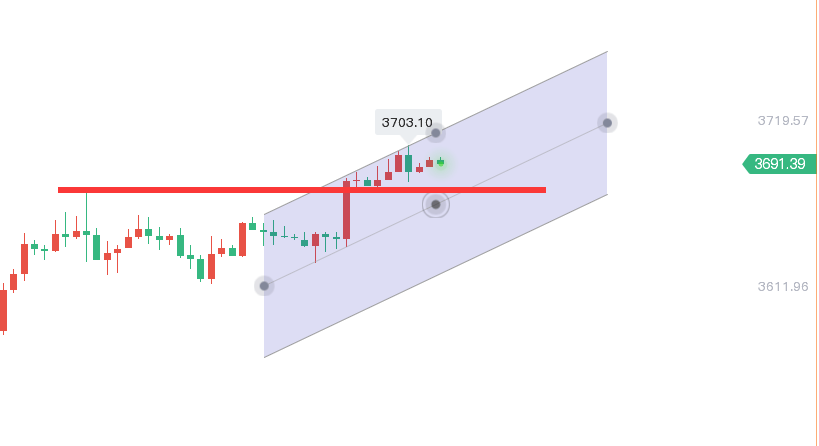
Group 1 - The expectation of an interest rate cut by the Federal Reserve is increasing, leading to a decline in the US dollar index, which supports gold prices [2] - Gold prices have reached a historical high of 3702, with fluctuations around 3674 and 3686, indicating strong market interest [2] - The market is advised to focus on the Federal Reserve's interest rate decision and potential support levels around 3675/80 [2] Group 2 - The API reported a larger-than-expected decline in US crude oil inventories, which, combined with interest rate cut expectations, has positively influenced market sentiment towards oil [4] - Crude oil prices rebounded from a low of 62.8 to a high of 64.7, breaking through a significant resistance level, although the sustainability of this trend is uncertain [4] - The market is advised to look for high and low trading opportunities around the 65 resistance level [4]
美联储降息刷屏!这波操作会让物价、股市跟着动吗?
Sou Hu Cai Jing· 2025-09-15 02:05
Group 1 - The Federal Reserve has lowered interest rates, aiming to stimulate the economy amid signs of sluggish growth and a less vibrant job market [2][3] - The unemployment rate appears manageable, but the job market's vitality is declining, leading to concerns that action is needed [2] - Lower interest rates make loans cheaper for businesses, encouraging them to borrow for expansion and innovation, which could boost economic activity [2] Group 2 - The downside of lower interest rates includes a decrease in the attractiveness of the US dollar, potentially leading foreign investors to seek better returns elsewhere [3] - There is a risk of inflation due to increased money supply, which could raise living costs for consumers [3] - The impact of the Federal Reserve's decision extends globally, potentially prompting other central banks to adjust their monetary policies, complicating the global economic landscape [3][4] Group 3 - The depreciation of the US dollar may lead to upward pressure on the Chinese yuan, affecting export competitiveness while benefiting importers [3] - There is potential for capital inflows into China, which could drive asset prices up in the stock and real estate markets, presenting both opportunities and risks for investors [3]

宏观经济点评:降息周的市场悬念
Minsheng Securities· 2025-09-14 09:54
Group 1: Market Outlook - The Federal Reserve's upcoming interest rate cut is expected to influence China's capital market, potentially leading to a stable upward trend in A-shares, which may outperform U.S. stocks[1] - Since late June, A-shares have shown a synchronized performance with U.S. stocks, with A-shares experiencing upward movements following U.S. stock market highs[1] - The resilience of the A-share market reflects increasing attractiveness and inclusivity, as evidenced by its performance in both the overall market and technology sectors[1] Group 2: Monetary Policy Insights - The Federal Reserve is likely to cut rates by 25 basis points due to weak employment and manageable inflation, despite complex inflation dynamics compared to last year[2] - Domestic interest rate cuts may be delayed as economic pressures and market sentiment are better than in Q3 of last year, reducing the urgency for immediate cuts[2] - There remains potential for domestic rate cuts in Q4 as economic pressures increase and the Fed continues its rate-cutting trajectory[2] Group 3: Fiscal Policy and Economic Indicators - The fiscal revenue shortfall has expanded by approximately 680 billion yuan compared to the initial budget, indicating a need for enhanced fiscal and monetary policy coordination in Q4[3] - The early issuance of local government debt quotas aims to stabilize expectations and guide local governments in project preparation, particularly in light of the current fiscal constraints[4] - The rising youth unemployment rate may trigger further monetary easing, as historical trends suggest that increasing unemployment often leads to rate cuts[6]
国泰海通海外策略:美联储降息,资产价格如何演绎?
Zhi Tong Cai Jing· 2025-09-10 22:57
Core Viewpoint - The Federal Reserve's interest rate cuts significantly impact the performance of equity, debt, and currency assets, while the relationship with commodity prices is less clear [1][2] Equity Market - Equity assets have a higher success rate during preemptive rate cuts, while they are likely to decline during crisis-driven cuts [1][2] - The success rate of equities improves one month after a preemptive rate cut, and the performance during crisis-driven cuts is closely related to the recovery of fundamentals [2] Debt Market - U.S. Treasury yields are more likely to decline during crisis-driven rate cuts, while the trend during preemptive cuts is uncertain [1][2] - After rate cuts, U.S. Treasury yields typically decrease, while the trend for Chinese bonds is generally downward, with no clear pattern for German and Japanese bonds [2] Currency Market - The strength of the U.S. dollar is inconsistent in the early stages of rate cuts, but after 2-3 months, the dollar tends to depreciate under recessionary cuts and appreciate under preemptive cuts, with the Chinese yuan showing relative independence [1][2] - The average appreciation of the euro and yen is noted during these periods [2] Commodity Market - The relationship between commodity prices and interest rate cuts is weak, with gold showing a higher average increase during crisis-driven cuts and greater elasticity in price increases [1][2] - Oil prices are less correlated with rate cuts and are more influenced by supply and demand dynamics [1]

金鹰基金:资金博弈加剧市场波动 外围流动性改善添底气
Xin Lang Ji Jin· 2025-09-01 06:37
Group 1 - The A-share market experienced high volatility with increased trading volume, driven by policy support and mid-term performance catalysts, particularly in real estate, agriculture, and power equipment sectors [1] - The ChiNext index showed strong performance, with average daily trading volume rising to 2.98 trillion yuan, indicating a shift in market dynamics [1] - The market style favored growth sectors over cyclical, consumer, and financial sectors, with technology growth leading the gains [1] Group 2 - Jin Ying Fund suggests focusing on sectors with potential for future profit improvement, including technology, innovative pharmaceuticals, non-bank financials, and non-ferrous metals [2] - In the technology sector, AI is at a high emotional trading point, with both domestic and overseas developments being encouraged, particularly in AI applications and advanced semiconductor processes [2] - The military industry may see rotation opportunities due to upcoming events like the September 3 military parade and the formulation of the 14th Five-Year Plan [2] Group 3 - As the market strengthens, non-bank financial sectors such as brokerage, insurance, and financial IT are expected to see improvements in both valuation and performance [2] - With expectations of a Federal Reserve rate cut and a dual easing of overseas monetary and fiscal policies by 2026, sectors benefiting from external demand, such as innovative pharmaceuticals and non-ferrous metals, may present investment opportunities [2] - The focus on policy-driven industries like photovoltaics is anticipated to strengthen in the future, reflecting a shift away from internal competition [2]
外资投行:市场上涨可持续吗?
淡水泉投资· 2025-08-26 09:49
Core Viewpoint - The A-share market has seen accelerated upward momentum since late June, with the Shanghai Composite Index surpassing 3,800 points, reaching a ten-year high, driven by improved market sentiment and increased foreign institutional interest in Chinese stocks [1]. Group 1: Market Uptrend Sustainability - The sustainability of the current market rally is a key topic among institutions, with overseas entities attributing the rise to several factors, including improved macroeconomic expectations and targeted consumption policies [4]. - The 10-year and 30-year government bond yields have been on the rise since June, indicating a more optimistic outlook among investors, which has facilitated a shift of funds from the bond market to the stock market [4]. - The focus on micro-level structural highlights, such as AI computing power, innovative pharmaceuticals, robotics, and smart driving, is seen as crucial for supporting overall market profitability [7]. - Significant inflows of incremental capital have contributed to liquidity, with long-term funds like insurance capital entering the market, resulting in over 1 trillion yuan in new capital [10]. - Upcoming policy catalysts, such as the Fourth Plenary Session of the 20th Central Committee and the next five-year growth plan, are expected to provide clearer insights into the "anti-involution" policy and its implications for economic rebalancing [10]. Group 2: "Anti-Involution" Policy Focus - The "anti-involution" policy has gained significant attention from foreign institutions, with discussions centered on its timing, similarities and differences with the 2016-2018 supply-side reform, and key areas of focus [14]. - The policy aims to alleviate supply chain financing risks, curb excessive investment expansion, enhance product quality, and optimize resource allocation, thereby strengthening the long-term resilience of the Chinese economy [14]. - The current economic recovery foundation is still fragile, leading to expectations that the impact of this policy on economic growth may be less significant than that of the previous supply-side reform [15]. Group 3: Foreign Investor Sentiment - Foreign investor interest in the Chinese stock market has reached a near-high level, driven by factors such as the need to diversify risks from the U.S. market and the potential for renminbi appreciation [16]. - In July, net inflows from foreign capital into the Chinese stock market accelerated to $2.7 billion, up from $1.2 billion in June, primarily led by passive funds [17]. - As of late July, passive funds had accumulated a total inflow of $11 billion into the Chinese stock market for the year, surpassing the $7 billion for the entire year of 2023 [17]. - The trend of capital inflows has continued into August, with hedge funds net buying Chinese stocks at the fastest pace in seven weeks [19]. - Despite the recovery in foreign capital sentiment, active funds remain underweight in their allocation to Chinese stocks, indicating potential for further inflows [21].