
周期

Search documents
【金工】行业主题基金净值回调,周期主题、商品ETF资金大幅净流入——基金市场与ESG产品周报20260309(祁嫣然/马元心)
光大证券研究· 2026-03-09 23:07
Market Performance Overview - In the week from March 2 to March 6, 2026, oil prices surged while domestic equity market indices experienced a pullback [4] - The oil and petrochemical, coal, and public utilities sectors saw the highest gains, while media, non-ferrous metals, and computer sectors faced the largest declines [4] Fund Product Issuance - A total of 12 new funds were established in the domestic market this week, with a combined issuance of 13.464 billion units [5] - The new funds included 3 bond funds, 6 equity funds, 2 mixed funds, and 1 fund of funds (FOF) [5] - Overall, 45 new funds were issued across various types, including 19 equity funds, 9 FOFs, 8 bond funds, 8 mixed funds, and 1 international (QDII) fund [5] Fund Product Performance Tracking - The net value of industry-themed funds declined across the board this week, with financial and real estate-themed funds performing relatively better [6] - As of March 6, 2026, the net value changes for various themed funds were as follows: financial and real estate -1.10%, cyclical -1.66%, industry rotation -2.30%, pharmaceuticals -2.43%, consumer -2.59%, balanced industry -2.62%, new energy -2.72%, national defense and military -3.54%, and TMT -4.53% [6] ETF Market Tracking - This week, stock ETFs saw a net inflow of funds, with significant increases in cyclical theme ETFs, while mid-cap and large-cap broad-based ETFs experienced notable reductions [7] - The median return for stock ETFs was -2.37%, with a net inflow of 1.424 billion yuan [7] - Hong Kong stock ETFs had a median return of -3.89% and a net inflow of 3.039 billion yuan, while cross-border ETFs had a median return of -2.30% and a net inflow of 1.031 billion yuan [7] - Commodity ETFs had a median return of -0.33% and a substantial net inflow of 13.181 billion yuan [7][8] - Broad-based ETFs maintained net inflows, while other categories experienced net outflows, particularly mid-cap theme ETFs, which saw a total outflow of 17.252 billion yuan [7] ESG Financial Product Tracking - This week, 13 new green bonds were issued, with a total issuance scale of 20.777 billion yuan [9] - The domestic green bond market has steadily developed, with a cumulative issuance scale of 5.29 trillion yuan and a total of 4,569 bonds issued as of March 6, 2026 [9] - The domestic market currently has 210 ESG funds with a total scale of 154.846 billion yuan [9] - In terms of fund performance, the median net value changes for active equity, passive equity index, and bond ESG funds were -2.46%, -0.69%, and +0.10%, respectively, with clean energy, low-carbon environmental protection, and green electricity-themed funds performing better [9]


2026公募投资展望:这些方向被看好 新一轮布局已然展开
Zhong Guo Zheng Quan Bao· 2026-02-20 03:08
Group 1 - A-shares are presenting structural opportunities at the beginning of 2026, with public funds initiating a new round of investment amidst economic recovery and accelerated industrial upgrades [1][7] - Major institutions believe that sectors such as artificial intelligence, semiconductors, and consumption have structural opportunities [1][7] Group 2 - There is an expectation of significant inflow of incremental funds into A-shares in 2026, supported by manufacturing investment and capital expenditure adjustments [2][8] - The domestic demand side, driven by fiscal policies, particularly the structural changes in special bonds, will influence A-share pricing [2][8] - The current environment is characterized by expanding liquidity and increased risk appetite, with a focus on fiscal and monetary policies [2][8] Group 3 - The AI sector is a focal point for public fund strategies, with expectations for continued strong performance in the AI industry chain in the first half of 2026 [4][10] - Significant advancements in AI models, such as Google Gemini 3 and Banana, are expected to boost market confidence and drive demand for AI computing power [4][10] - The semiconductor industry is rapidly evolving, driven by AI large models, with a focus on domestic production and R&D [5][11] Group 4 - The consumption sector is anticipated to see a resurgence in investment opportunities in 2026, driven by the release of wealth effects and an upgrade in high-end and service consumption demand [5][11] - The cyclical industry narrative is expected to undergo a transformation in 2026, influenced by policy-driven "anti-involution" and the reshaping of global supply chains [5][12]
2026公募投资展望:这些方向被看好
Zhong Guo Zheng Quan Bao· 2026-02-19 10:53
Group 1 - A-shares are presenting structural opportunities amidst fluctuations, with public funds initiating a new round of investments in sectors like artificial intelligence, semiconductors, and consumption due to moderate economic recovery and accelerated industrial upgrades [1] - The manufacturing investment and A-share capital expenditure contraction are driving supply-demand rebalancing, providing support for corporate profits, while fiscal changes in special bonds will impact A-share pricing [2] - The market is expected to continue attracting significant incremental capital inflows in 2026, with major contributions from insurance funds and financing, while individual investors are primarily high-net-worth individuals with high-risk preferences [2] Group 2 - The AI sector is a focal point for public fund strategies, with expectations for continued strong performance in the AI industry chain in the first half of 2026, driven by breakthroughs in AI model capabilities and significant growth in annual recurring revenue from AI-native applications [4] - The semiconductor industry is experiencing rapid changes driven by AI large models, with a focus on domestic production and R&D, while non-AI semiconductor sectors may face pressure [5] - The consumption sector is anticipated to see a resurgence in investment opportunities in 2026, driven by the release of wealth effects and an upgrade in high-end and service consumption demands [5]
开局之年如何布局?工银瑞信12位投研强将解码2026投资十大关键词
Cai Fu Zai Xian· 2026-02-04 03:34
Core Insights - The article emphasizes the importance of capturing investment opportunities aligned with China's 14th Five-Year Plan, focusing on high-quality development and technological self-reliance [1][2] Investment Strategies - The investment landscape for 2026 is shaped by the "14th Five-Year Plan," which serves as a guiding framework for strategic investments, emphasizing high-quality development and innovation [2] - Key investment opportunities are identified in three main sectors: traditional industries (e.g., chemicals, shipbuilding), emerging industries (e.g., AI, energy storage), and frontier technologies (e.g., embodied intelligence, nuclear fusion) [2] Innovation in Pharmaceuticals - Chinese innovative pharmaceutical companies are expected to experience significant growth, with the total amount of License-out agreements projected to exceed $121.6 billion by 2025, doubling from 2024 [3] - The introduction of AI models is anticipated to shorten drug development cycles and enhance success rates, leading to a revaluation of the innovative drug sector [3] Hong Kong Market Outlook - The Hong Kong stock market is viewed positively, with major investment banks highlighting the resilience and vitality of the Chinese economy, making it a preferred choice for asset allocation [4][5] - The analysis of Hong Kong tech assets reveals two main investment themes: a return to EPS growth and cash flow recovery, alongside a focus on leading internet platforms and emerging industries like smart driving [5] AI Industry Insights - AI is positioned as a transformative force comparable to previous industrial revolutions, with significant growth potential as applications become more widespread [6] - The commercialization of AI applications, particularly in smart driving and robotics, is expected to gain momentum, presenting investment opportunities in related companies [6] Renewable Energy Sector - The renewable energy sector is forecasted to continue its upward trend, with significant opportunities in lithium battery technology and new materials, particularly solid-state batteries [7] - The chemical industry is also expected to see a recovery in profitability, driven by demand growth and supply-side reforms [7] Financial and Real Estate Sector - The financial and real estate sectors are showing signs of recovery, with a rebound in second-hand housing transactions and improved profitability for insurance companies [8] - Investment opportunities are emerging in quality real estate firms and banks with strong wealth management capabilities [8] Consumer Sector Trends - The consumer sector is experiencing a shift, with new growth areas such as smart home products and outdoor lifestyle gaining traction [11] - The changing demographics and consumer preferences are expected to drive growth in sectors like travel, healthcare, and wellness [11] Fixed Income Investment Strategies - The fixed income market is anticipated to remain stable, with a focus on short-term and medium-term bond funds for liquidity and steady growth [14] - The overall bond market is expected to exhibit a fluctuating pattern, influenced by monetary policy and economic data [14]
量化专题报告:从基金视角把握“主题”到“主线”的机会
Guolian Minsheng Securities· 2026-01-29 09:33
- The report introduces a quantitative model named "Mainline Industry Combination" which is constructed based on the alpha performance of heavy stocks held by industry-focused funds and their commonality in industry distribution. The model identifies high alpha industry-focused funds by calculating the monthly excess returns of their heavy stocks relative to their respective industry indices, synthesizing monthly alpha values, and applying a linear time decay weighted scoring system to select the top 20% of funds. It then verifies consensus at the industry level by analyzing the concentration of these selected funds in specific industries, determining potential mainline industries for investment[28][29][30] - The report evaluates the "Mainline Industry Combination" model as effective in capturing core market trends during clear industry cycles, such as food and beverage in 2016, pharmaceuticals in 2019-2020, and TMT in 2024-2025. However, its performance is limited during periods of rapid industry rotation or unclear market mainlines due to signal bias or increased empty positions[36][39][42] - The backtesting results of the "Mainline Industry Combination" model show an annualized return of 20.91% from 2016 to January 2026, with an annualized excess return of 14.62% compared to equity-biased fund indices. The model demonstrates high annual win rates, particularly during clear industry trend periods, but faces challenges in accumulating excess returns during rapid market rotations[36][38][39] - The report introduces another quantitative model named "Industry Rotation Fund Combination," which is constructed by identifying non-industry-focused funds with high industry turnover rates. The model calculates the turnover rate of fund holdings by comparing the proportion of heavy stocks in different industries across consecutive periods, and selects the top 30% of funds with the highest turnover rates. Further, it uses factor backtesting to identify funds with high dynamic returns and small-cap stock preferences, forming a combination of the top 10 funds with the highest scores[61][64][68] - The "Industry Rotation Fund Combination" model is evaluated as highly adaptable to volatile markets with frequent industry rotations, complementing the "Mainline Industry Combination" model. It performs better in periods lacking clear market mainlines, such as 2018 and 2023, by actively switching industries to adapt to changing market trends[68][69][70] - The backtesting results of the "Industry Rotation Fund Combination" model show an annualized return of 15.05% from 2016 to January 2026, with an annualized excess return of 8.60% compared to equity-biased fund indices. The model demonstrates strong adaptability in volatile markets, achieving higher excess returns during periods of rapid industry rotation[68][69][70] - The report combines the two strategies, "Mainline Industry Combination" and "Industry Rotation Fund Combination," to form a comprehensive model named "Capturing Industry Opportunities Combination." This model adjusts its strategy based on market liquidity changes, using the monthly change in the average daily trading volume of the CSI 800 Index over the past 200 trading days as a leading indicator. When market liquidity expands, the mainline strategy is preferred, while the rotation strategy is favored during liquidity contraction. The combined model achieves an annualized return of 19.61% and an annualized Sharpe ratio of 0.77, with an annualized excess return of 13.32% compared to equity-biased fund indices[72][73][76]
公募基金重点产品、策略回顾与展望:主动超额延续,固收增强突围
Ping An Securities· 2026-01-27 09:09
1. Report Industry Investment Rating - The report does not explicitly mention the industry investment rating. 2. Core Viewpoints of the Report - ETFs will continue to develop, with a trend of diversification and intensified competition. Active equity funds are expected to continue to generate excess returns in 2026, and institutional confidence in them has increased. For fixed - income enhanced funds, attention should be paid to the balanced and flexible medium - volatility strategy, and new - stock income contributions are expected to rise [2]. 3. Summary by Directory ETF Review and Outlook - **Issuance and Scale**: Passive equity funds continued large - scale issuance, but the growth rate slowed. In 2025, the issuance scale of active and passive equity funds was 165.7 billion shares and 411.9 billion shares respectively, with year - on - year increases of 130.04% and 69.97%. By the end of the third quarter of 2025, the scale of active and passive equity funds was 4.04 trillion yuan and 4.71 trillion yuan respectively, up 21.91% and 38.34% from the end of the previous year [5]. - **Fund Flows**: In 2025, funds flowed from broad - based ETFs to industry - themed ETFs. In 2026, satellite/commercial space, non - ferrous metals, and AI - themed ETFs had significant net inflows. Technology - themed ETFs had the highest net inflows in 2025, followed by financial real - estate and cyclical - themed ETFs [8][10]. - **Learning from Overseas**: Referring to the development of the US fund industry, the trend of ETF development will continue. Although the scale will maintain stable growth, the growth rate may slow down. Some active managers can consider the US active ETF model [13]. - **Policy Impact**: Policies have optimized the product registration and benchmark setting mechanisms, reduced fees, and encouraged the development of passive equity products. The future development of ETFs will be diversified and competitive [15]. Active Equity Fund Review and Outlook - **Performance**: In 2025, the scale of active equity funds stopped falling and rebounded, and both the overall market and industry - themed active equity funds outperformed passive equity funds. In the long run, overall market funds and active management funds in cyclical, pharmaceutical, and technology themes can achieve relatively stable excess returns [20]. - **Excess Return Characteristics**: Active equity funds have significant excess returns when the growth style is dominant and when new industrial trends emerge. There is a certain correlation between the concentration of active equity fund holdings and excess returns. In 2026, active equity funds are expected to continue to generate excess returns, and the proportion of institutional holdings has stopped falling and rebounded [23][26]. - **Performance Back - testing of Technology Bottom - Position Varieties**: As of December 31, 2025, the annual net value of selected technology bottom - position varieties increased by 74.02%, significantly outperforming the CSI TMT index by 29.55 percentage points. The position adjustment operations in the first three quarters of 2025 were more focused and offensive [29][31]. - **Performance Back - testing of Pharmaceutical Bottom - Position Varieties**: As of December 31, 2025, the annual net value of selected pharmaceutical bottom - position varieties increased by 43.06%, significantly outperforming the Shenwan Pharmaceutical Index by 31.12 percentage points. The positions in 2025 significantly over - allocated the innovative drug sector and were flexibly adjusted [36][41]. - **Policy Impact**: Policies have strengthened benchmark constraints, bound the interests of managers, fund managers, and investors, and guided active equity funds to return to the origin of investment. Active and passive management will co - exist, and theme - stylization may be an important way for active funds to break through in the future [42]. Fixed - Income Enhanced Fund Review and Outlook - **Focus on the Balanced and Flexible Medium - Volatility Fixed - Income + Strategy**: In the context of the continuous decline of the risk - free interest rate, the scale of wealth management is expected to continue to expand, and fixed - income enhancement is an important direction for the overflow of wealth - management funds. The medium - volatility fixed - income enhancement strategy can better play the advantage of diversified asset allocation and should be focused on [48]. - **New - Stock Income Contribution**: In 2026, as the A - share market is expected to continue to recover slowly, the new - stock income contribution is also expected to increase [50]. - **FOF Funds**: The scale of FOF funds has significantly rebounded, and the proportion of passive products in FOF holdings has continued to increase. The asset allocation of FOF is becoming more diversified [52]. - **Performance Review of Fixed - Income Enhancement Strategies**: The medium - high - volatility balanced strategy outperformed the secondary bond fund index in 2025. The rotation strategy aiming for absolute returns also outperformed the ChinaBond Composite Wealth Index in 2025 [61][65]. - **Policy Impact**: Policies encourage the development of equity - containing medium - low - volatility products and asset - allocation products, and promote the coordinated development of equity and fixed - income investments. They also encourage long - term investment [69].
布局2026年 科技成长仍是主角?公募最新投资策略来了
天天基金网· 2026-01-05 08:41
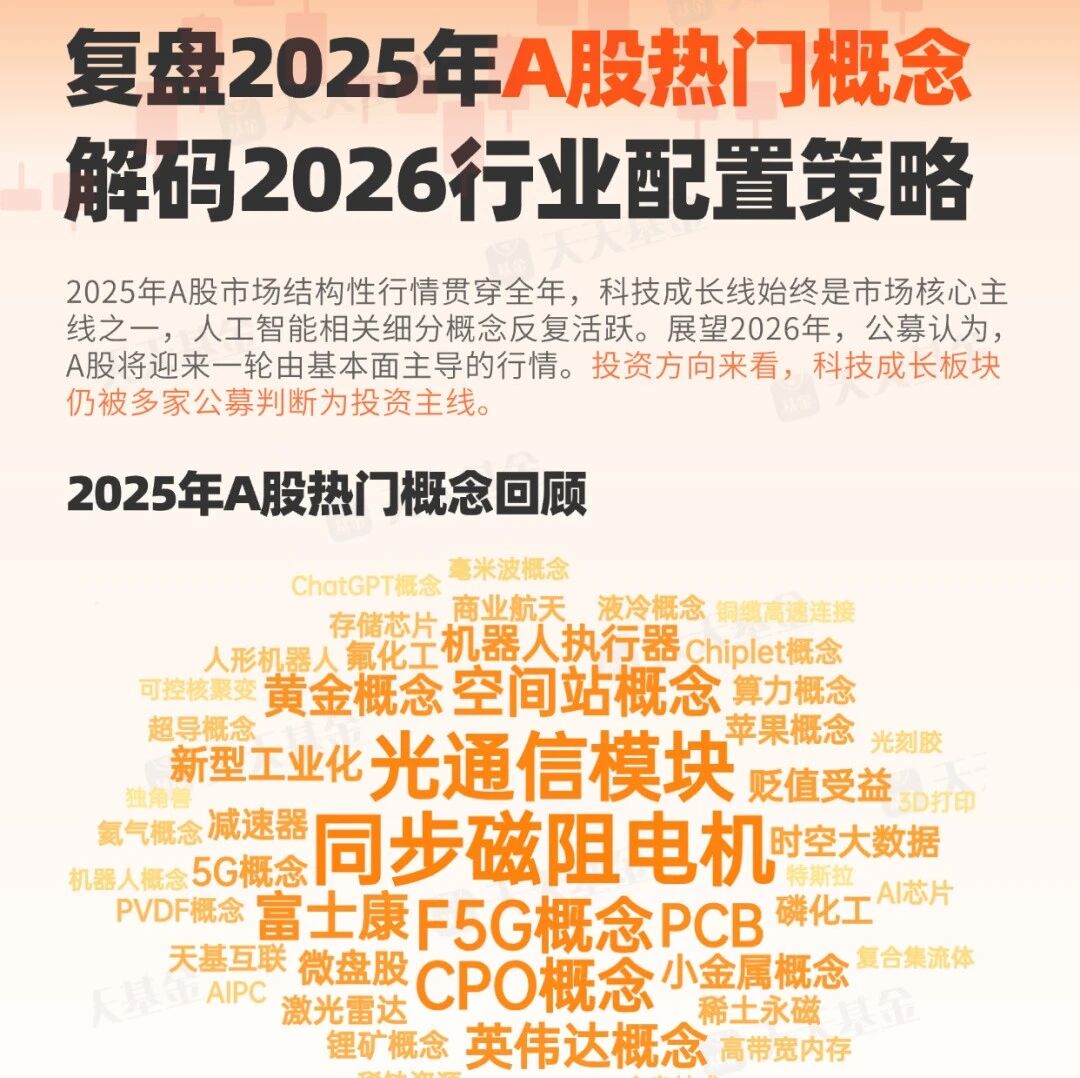
Core Viewpoint - The A-share market in 2025 experienced a structural trend with technology growth as a core theme, particularly in artificial intelligence-related sectors. Looking ahead to 2026, public funds anticipate a market driven by fundamentals, with technology growth remaining a key investment focus [1][8]. Summary by Sections 2025 A-share Market Overview - The A-share market in 2025 was characterized by a clear rotation of concept sectors, with major themes alternating and a rapid iteration of hotspots. Over 90% of concept indices saw an increase, with the synchronous reluctance motor achieving the highest growth at 165.05%, followed by optical communication modules at 156.02% [11]. 2026 Investment Outlook - Public funds predict a fundamental-driven market in 2026, with technology growth sectors still viewed as the main investment line. HSBC Jintrust Fund suggests a potential market rebalancing, shifting from TMT to lower-positioned industries with profit recovery potential. Investors focusing on safety margins should consider midstream manufacturing, consumption, and cyclical sectors [9][11]. Sector-Specific Insights - CITIC Prudential Fund indicates that a solid growth style may persist throughout the year, but broad market rallies may end. Companies with genuine technological barriers and commercialization capabilities in AI applications, domestic substitution, and overseas expansion are expected to attract market attention due to their high growth potential [12]. - Zhongjia Fund emphasizes that technology, particularly AI, remains a focus for aggressive sectors in 2026, combining short-term performance with long-term narratives. Other sectors of interest include event-driven stocks and stable, defensive attributes in Hong Kong dividends, finance, agriculture, and precious metals [12].
可转债市场周观察:权益推动下转债突破前高,估值冲高回落
Orient Securities· 2025-12-30 03:14
Research Conclusion - The report remains optimistic about the trading opportunities of convertible bonds, expecting a sideways shock and a slight strengthening in the equity market, with the market shifting from a two - end trend of technology + dividends to mid - cap blue - chips [6][9]. Core Viewpoints - This week, the ChiNext and STAR Market drove the small and medium - cap stocks stronger, and convertible bonds followed the upward trend. The high - priced equity - like bonds continued to rise. The 100 - yuan premium rate oscillated between 30% - 34% as previously predicted and was difficult to break through the previous high. Although the current cost - performance of convertible bonds is low, there are still trading opportunities under the optimistic expectation of the equity market [6][9]. - The strengthening factors of the equity market this week include the continuous popularity of the commercial space and optical module sectors, the strengthening of metal prices, and the significant increase in the share of CSI A500 ETF. After the uncertain events are settled, the market starts to rise with oscillations and the sentiment turns positive. The subsequent equity market will be in a sideways shock and slightly strengthen, and the market trend will shift to mid - cap blue - chips [6][9]. Summary by Directory 1. Convertible Bond Views - Driven by the equity market, convertible bonds broke through the previous high, and the valuation rose and then fell. The 100 - yuan premium rate oscillated between 30% - 34% and was difficult to break through the previous high. Despite the low cost - performance and small - scale redemption behavior, the trading opportunities of convertible bonds are still promising under the optimistic equity market [9]. - The equity market tried to break through upward again this week. With the settlement of uncertain events, the market started to rise with oscillations. The subsequent equity market will be in a sideways shock and slightly strengthen, and the market trend will shift to mid - cap blue - chips in industries such as cycles, consumption, and manufacturing [9]. 2. Convertible Bond Review 2.1 Market Overall Performance - This week, the equity market was strong, with all broad - based indexes rising. The CSI 500 rose 4.03%, the ChiNext Index rose 3.90%, and the CSI Convertible Bond Index rose 1.64%. In terms of industries, non - ferrous metals, national defense and military industry, and power equipment led the rise, while beauty care, social services, and banks led the decline. The average daily trading volume increased by 210.457 billion yuan to 1.96 trillion yuan [12]. 2.2 Significant Increase in Trading Volume, Good Performance of High - priced and Small - cap Convertible Bonds - This week, convertible bonds rose significantly, the 100 - yuan premium rate rose and then fell, and the average daily trading volume increased significantly to 78.563 billion yuan. The CSI Convertible Bond Index rose 1.64%, the parity center rose 0.4% to 101.7 yuan, and the median conversion premium rate rose 1.3% to 32.4%. High - priced and small - cap convertible bonds led the rise, while high - rated and double - low convertible bonds performed weakly [6][19].
【申万宏源策略 | 一周回顾展望】宏观环境“还原”,A股向上空间受限未变
申万宏源研究· 2025-12-15 01:18
Core Viewpoint - The A-share market has reverted to its previous state before late October, but the upward potential remains constrained. The only industry showing short-term upward movement is optical connectivity, while concerns about the decline in capital expenditure among leading US tech companies in 2026 persist, impacting the AI industry chain [2][3]. Group 1: Market Environment and Trends - Since late November, the macro environment for the A-share market has "reverted," reflecting the characteristics seen before late October. However, the upward space remains limited, with only optical connectivity showing potential for upward breakthroughs [2][3]. - The expectation for stable growth has been adjusted downward, and the anticipated return of the Federal Reserve's easing policies has led to a resurgence in optical connectivity, while other tech growth sectors are experiencing a rebound [2][3]. - The market is currently in a high-level oscillation phase, with the structural characteristics reverting to those observed before late October [2][3]. Group 2: Economic Policy Insights - The core idea of the 2025 Central Economic Work Conference is to "practice internal skills to cope with external challenges," with a focus on maintaining policy momentum in 2024 and potential marginal improvements in 2026 [5][6]. - Key policy points include addressing issues related to development and transformation, emphasizing quality and efficiency, stimulating domestic demand, and promoting technological innovation in key regions [6][7]. - The market anticipates that if economic results improve in the first half of 2026, additional efforts to stabilize growth in the second half are likely [5][7]. Group 3: Market Outlook and Investment Opportunities - The medium-term outlook remains a "two-stage bull market," with the first stage (tech structural bull) already at a high level, and the market currently in a quarterly high-level oscillation phase [7][8]. - The first half of 2026 is expected to favor cyclical and value styles, while the second half may see a comprehensive bull market driven by fundamental improvements and technological trends [7][8]. - Spring market trends are expected to focus on small-scale opportunities, particularly in optical connectivity and other tech sectors, with potential for new high-level oscillation phases [8].

光大期货:12月9日金融日报
Sou Hu Cai Jing· 2025-12-09 01:17
Market Overview - The market opened higher and saw the ChiNext Index rise over 3% during the day, closing with a gain of 2.6% [1] - The total trading volume exceeded 2 trillion, with over 3,400 stocks in the Shanghai, Shenzhen, and Beijing markets showing gains [1] - The Shanghai Composite Index rose by 0.54% and the Shenzhen Component Index increased by 1.39% [1] Economic and Sector Insights - The market is refocusing on fundamental logic as liquidity conditions since June have stabilized, with optimistic growth expectations for AI and technology sectors [1] - Hardware manufacturing in the tech sector is experiencing significant price increase expectations due to supply-demand mismatches, indicating strong mid-term profitability [1] - Traditional economic sectors, particularly consumption and cyclical themes, are still in a recovery phase, making it difficult for them to enter a bull market in the short term [1] International Market Dynamics - Overseas tech stocks show mixed expectations, with Nvidia providing strong earnings guidance while Google's upgraded model raises questions about the profitability of AI applications [1] - The upcoming change in the Federal Reserve chairmanship and potential unexpected interest rate cuts in 2026 could continue to support the tech sector [1] Bond Market Analysis - The 30-year bond futures contract fell by 0.29%, while the 10-year contract rose by 0.02% [2] - The People's Bank of China conducted a 122.3 billion yuan reverse repurchase operation with a stable interest rate of 1.4% [2] - The overall funding environment remains loose, but expectations for interest rate cuts are low, leading to a slight upward trend in bond yields [2] Precious Metals Market - Gold and silver prices in London showed weak fluctuations, with the gold-silver ratio around 72.2 [3] - The market is cautious ahead of the Federal Reserve's meeting, with a consensus forming around a potential rate cut in December [3] - There are concerns about technical pullback risks in silver, platinum, and palladium due to crowded long positions, which may lead to larger price adjustments compared to gold [3]