
石油化工

Search documents
【图】2025年9月江苏省石油沥青产量数据分析
Chan Ye Diao Yan Wang· 2026-01-04 05:28
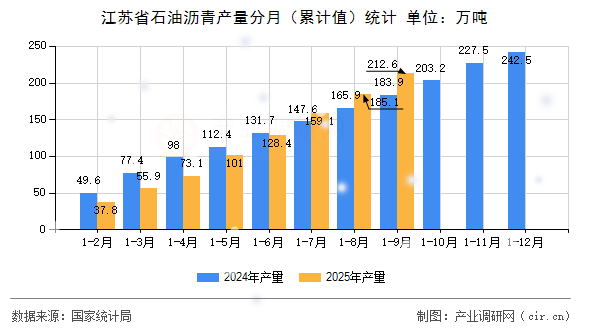
Group 1 - The core viewpoint of the article highlights the significant growth in petroleum asphalt production in Jiangsu Province during the first nine months of 2025, with a total output of 212.6 million tons, representing a 15.6% increase compared to the same period in 2024 [1] - The growth rate of petroleum asphalt production in Jiangsu is notably higher than the national average, exceeding it by 4.2 percentage points, and accounts for 7.6% of the national output of 2,787.6 million tons [1] - In September 2025 alone, Jiangsu's petroleum asphalt production reached 27.5 million tons, marking a substantial 52.8% increase year-on-year, with a growth rate 26.7 percentage points higher than the national average [2] Group 2 - The data indicates that the increase in Jiangsu's petroleum asphalt production is particularly pronounced in September, with a year-on-year growth rate of 93.8 percentage points compared to 2024 [2] - The statistics are derived from large-scale industrial enterprises, defined as those with annual main business revenues of 20 million yuan or more [6]

【图】2025年8月广西壮族自治区原油加工量统计分析
Chan Ye Diao Yan Wang· 2026-01-04 03:23
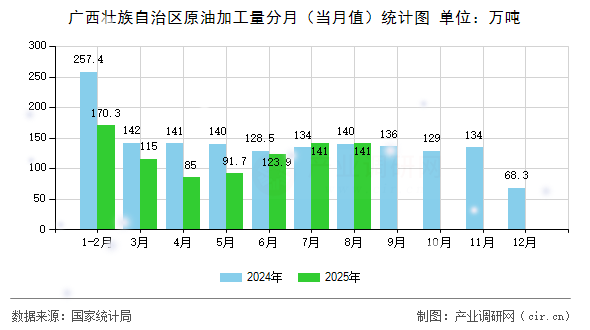
摘要:【图】2025年8月广西壮族自治区原油加工量统计分析 图1:广西壮族自治区原油加工量分月(当月值)统计图 2025年1-8月原油加工量统计: 原油加工量:867.8 万吨 2025年8月原油加工量统计: 原油加工量:141.0 万吨 同比增长:0.7% 增速较上一年同期变化:高0.7个百分点 据统计,2025年8月广西壮族自治区规模以上工业企业原油加工量与上年同期相比增长了0.7%,达141.0 万吨,增速较上一年同期高0.7个百分点,增速较同期全国低6.9个百分点,约占同期全国规模以上企业 原油加工量6346.5万吨的比重为2.2%。 详见下图: 据统计,2025年1-8月,广西壮族自治区规模以上工业企业原油加工量与上年同期相比下降了19.9%, 达867.8万吨,增速较上一年同期低18.9个百分点,增速较同期全国低23.1个百分点,约占同期全国规模 以上企业原油加工量48807.2万吨的比重为1.8%。详见下图: 同比增长:-19.9% 图2:广西壮族自治区原油加工量分月(累计值)统计图 注:主要能源产品产量月度统计范围为规模以上工业法人单位,即年主营业务收入2000万元及以上的工 业企业。 产业调 ...
【图】2025年8月中国液化石油气产量数据
Chan Ye Diao Yan Wang· 2026-01-04 01:50
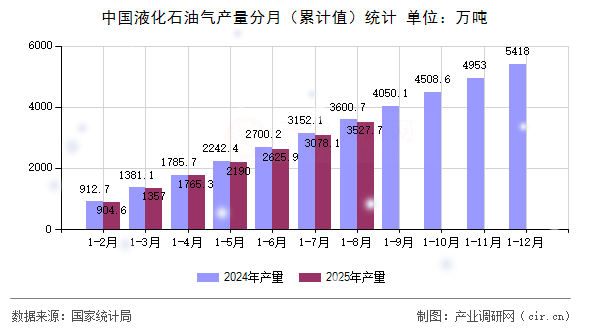
Group 1 - The core viewpoint of the articles indicates a decline in China's liquefied petroleum gas (LPG) production in the first eight months of 2025 compared to the same period in 2024, with a total output of 35.277 million tons, representing a decrease of 2.1% and a slowdown of 7.4 percentage points in growth rate [1] - In August 2025, the LPG production reached 4.495 million tons, which is a 0.9% decrease compared to August 2024, with the growth rate also slowing by 3.3 percentage points [2] Group 2 - The data reflects the output from large-scale industrial enterprises, defined as those with annual main business income of 20 million yuan or more [6]
我国持续扩大高水平对外开放 调整部分商品关税税率税目
Jing Ji Ri Bao· 2026-01-03 23:31
Core Viewpoint - The "2026 Tariff Adjustment Plan" aims to scientifically adjust import provisional tax rates, optimize tariff categories, and continue implementing agreement and preferential tax rates, which will support the development of new productive forces, meet the growing needs of the people, expand high-level opening-up, and promote high-quality development [1] Group 1: Import Provisional Tax Rate Adjustments - The plan will implement lower-than-most-favored-nation tax rates on 935 items to enhance the linkage between domestic and international markets and expand the supply of quality goods [1] - Key components include reducing import tariffs on critical components and advanced materials to promote high-level technological self-reliance and the construction of a modern industrial system [2] - Tariff reductions on resource-based products like lithium-ion battery recycled black powder aim to support the green transformation of the economy and society [1][2] Group 2: Tax Category Optimization - The total number of tariff categories will be adjusted to 8,972, with new categories added for emerging products such as intelligent bionic robots and bio-aviation kerosene [3] - The adjustment will help industries and enterprises accurately grasp trade data and assess overseas market trends, facilitating the formulation of effective development strategies [3] - Continued implementation of preferential tax rates for goods from 34 trade partners and zero-tariff treatment for 43 least developed countries reflects China's commitment to deepening economic cooperation and regional integration [3]
我国持续扩大高水平对外开放
Xin Lang Cai Jing· 2026-01-03 22:20
Group 1 - The 2026 Tariff Adjustment Plan aims to scientifically adjust import provisional tax rates, optimize tariff categories, and continue implementing agreement and preferential tax rates, which will help lead the development of new productive forces and meet the growing needs of the people [1] - The plan includes three main aspects: adjusting import provisional tax rates, optimizing tariff categories, and continuing to implement agreement and preferential tax rates [1] - In the adjustment of import provisional tax rates, 935 items will have provisional tax rates lower than the most-favored-nation rate, enhancing the linkage between domestic and international markets [1] Group 2 - The adjustment in the petrochemical sector includes items such as bio-aviation kerosene and lithium-ion battery recycled black powder, reflecting the national policy to support the green and low-carbon transition of fossil energy [2] - The reduction of import tariffs on medical products like artificial blood vessels and diagnostic kits for infectious diseases aims to improve public health and enhance the well-being of the population [2] - The adjustment of tariffs on certain medical devices is expected to increase the supply of quality products and reduce the medical burden on consumers [2] Group 3 - The optimization of tariff categories will include new entries such as intelligent bionic robots and bio-aviation kerosene, with the total number of tariff categories reaching 8,972 [3] - The plan continues to implement agreement tax rates for certain imported goods from 34 trade partners, promoting regional integration and economic cooperation [3] - China aims to provide 100% zero-tariff treatment for products from 43 least developed countries, showcasing its commitment to global development amidst rising trade protectionism [3]
沙特阿美申请将原油转化为石化产品专利,可生成包括轻质烯烃和BTX的石化产物流
Jin Rong Jie· 2026-01-03 13:28
Group 1 - The core point of the article is the patent application by Saudi Aramco, Valencia Polytechnic University, and the Spanish National Research Council for a method and system to convert crude oil into petrochemical products [1] Group 2 - The patent, published under CN121263501A, was applied for on April 2023 [1] - The method involves introducing crude oil into a reactive distillation unit to remove Conradson carbon and metals, generating a distillate stream with a lower average boiling point than the crude oil [1] - The distillate stream is then continuously delivered in gaseous form to a catalytic cracking reactor, where it is cracked to produce petrochemical products including light olefins and BTX [1] - The catalytic cracking reactor operates at temperatures between 300°C and 800°C, utilizing magnetic induction heating through sensor materials dispersed throughout the reactor [1]
【图】2025年8月江西省液化石油气产量数据
Chan Ye Diao Yan Wang· 2026-01-03 10:02
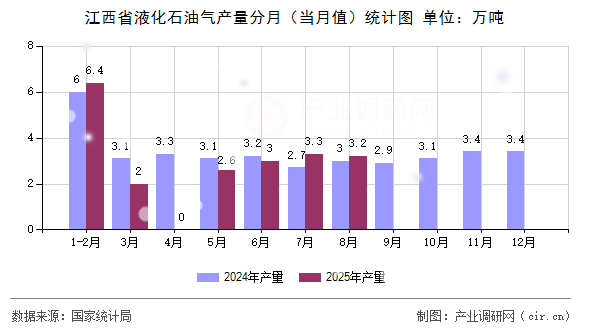
Core Insights - In August 2025, Jiangxi Province's liquefied petroleum gas (LPG) production reached 32,000 tons, marking a year-on-year increase of 10.0% and a growth rate that is 14.2 percentage points higher than the same period last year [1] - For the period from January to August 2025, the total LPG production in Jiangxi Province was 206,000 tons, reflecting a year-on-year decline of 15.5%, although the growth rate was 4.4 percentage points higher than the previous year [1] Monthly Production Data - August 2025 LPG production: 32,000 tons, with a year-on-year growth of 10.0% and a growth rate 14.2 percentage points higher than the previous year [1] - National comparison: Jiangxi's LPG production accounted for 0.7% of the national total of 4,495,000 tons, with a growth rate 10.9 percentage points higher than the national average [1] Cumulative Production Data - January to August 2025 LPG production: 206,000 tons, with a year-on-year decline of 15.5% and a growth rate 4.4 percentage points higher than the previous year [1] - National comparison: Jiangxi's cumulative LPG production represented 0.6% of the national total of 3,527,700 tons, with a growth rate 13.4 percentage points lower than the national average [1]
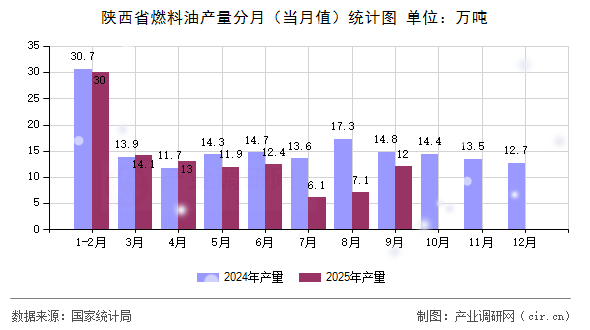
【图】2025年1-9月陕西省燃料油产量统计分析
Chan Ye Diao Yan Wang· 2026-01-03 07:33
Core Insights - The fuel oil production in Shaanxi Province for September 2025 was 120,000 tons, representing a year-on-year decrease of 19.0% and a decline of 27.2 percentage points compared to the same month last year [1] - For the period from January to September 2025, the total fuel oil production reached 1,068,000 tons, showing a year-on-year decline of 18.8% and a decrease of 29.4 percentage points compared to the same period last year [4] Monthly Production Analysis - In September 2025, the fuel oil production accounted for 3.3% of the national total fuel oil production of 3,594,000 tons [1] - The production decline in September was 17.1 percentage points lower than the national average [1] Cumulative Production Analysis - From January to September 2025, the production represented 3.3% of the national total fuel oil production of 31,977,000 tons [4] - The decline in production for this period was 15.8 percentage points lower than the national average [4]
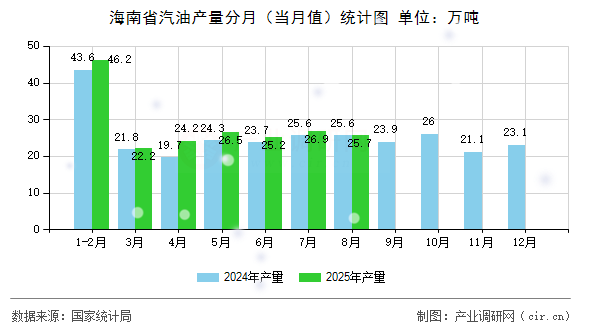
【图】2025年8月海南省汽油产量数据
Chan Ye Diao Yan Wang· 2026-01-03 06:39
Group 1 - The core point of the article highlights the gasoline production statistics in Hainan Province for August 2025, showing a production of 257,000 tons, which represents a year-on-year growth of 0.2% but a decrease in growth rate by 3.4 percentage points compared to the previous year [1] - In the cumulative statistics from January to August 2025, Hainan's gasoline production reached 1,968,000 tons, reflecting a year-on-year increase of 6.7%, which is 2.5 percentage points higher than the previous year, indicating continued growth [1] - Hainan's gasoline production accounted for 1.9% of the national gasoline production of 13,477,000 tons during the same period, showing a higher growth rate compared to the national average by 12.4 percentage points [1]
责任关怀:“星星之火”渐燎原
Zhong Guo Hua Gong Bao· 2026-01-03 04:11
Core Viewpoint - The oil and chemical industry is advancing towards high-quality development through the implementation of responsibility care, which enhances health, safety, and environmental (HSE) performance while fulfilling social responsibilities [1][2][4] Group 1: Policy and Framework - During the "14th Five-Year Plan" period, the industry aims to achieve the "100 parks and 1,000 enterprises" goal, establishing a robust self-regulatory system and enhancing technological innovation [1] - Several policy documents have been issued to guide the implementation of responsibility care, including the "Guiding Opinions on Promoting High-Quality Development of the Petrochemical Industry" and the "Implementation Plan for the Innovative Development of the Fine Chemical Industry (2024-2027)" [1] - A comprehensive "1+6+X" standard system for responsibility care has been established, providing fundamental guidelines for enterprises [1] Group 2: Expansion and Collaboration - By the end of 2024, the number of commitment units for responsibility care is expected to exceed 1,000, including 96 chemical parks and 986 enterprises, creating a collaborative framework involving government support and industry associations [2] - The promotion of responsibility care at the park level has effectively engaged enterprises, as demonstrated by events like the "World Environment Day" in Nanjing, which attracted over 300 participants [2] - Notable practices have emerged, such as the "five-in-one" work model in the Shanghai Chemical Industry Park and the establishment of a unique responsibility care practice system in the Tianjin South Port Industrial Zone [2] Group 3: Industry Achievements - The industry has recognized over 300 green factories, 600 green products, and more than 10 green supply chain enterprises, contributing to the gradual establishment of a dual-carbon standard system [3] - Safety incidents in the industry have decreased significantly, with 364 accidents and 452 fatalities reported, marking a 41% and 38% reduction compared to the previous five-year period [3] - Companies are actively responding to the "Healthy China" initiative by implementing comprehensive occupational health management, aligning corporate and employee interests [3] Group 4: Social Responsibility and Environmental Impact - The industry has made significant strides in relocating hazardous chemical production facilities from densely populated areas, resulting in a substantial reduction in safety and environmental risks [4] - Companies are engaging in social welfare activities, providing support to impoverished rural areas, and ensuring energy and fertilizer supply security [4] - The development of responsibility care is yielding benefits for both corporate growth and societal progress [4]