
能源

Search documents
有色板块短周期动量下降:商品量化CTA周度跟踪-20251118
Guo Tou Qi Huo· 2025-11-18 11:58
Report Summary 1. Report Industry Investment Rating No relevant information provided. 2. Core Viewpoints - This week, the proportion of short positions in commodities has rebounded, mainly due to the decline in the factor strength of the precious metals and non - ferrous sectors, while the black sector has recovered. The black sector is relatively strong in cross - section, while the non - ferrous and agricultural sectors are relatively weak [3]. - The comprehensive signals of methanol, float glass, iron ore, and lead have different trends this week, with methanol and float glass showing long signals, iron ore showing a short signal, and lead maintaining a short signal [5][8][11]. 3. Summary by Related Content Commodity Market Overview - In the precious metals sector, the time - series momentum of gold has declined, and the trading volume of silver has decreased significantly, with an expanding divergence at both ends of the cross - section. In the non - ferrous sector, the position factor has decreased marginally, the cross - section momentum divergence has narrowed, and lead is relatively weak in the cross - section. In the black sector, the positions of iron ore and rebar have decreased slightly, but the short - term momentum time - series has recovered, and rebar is relatively strong in the cross - section. In the energy sector, the short - term momentum factor has declined, and the chemical sector is at the relatively strong end of the cross - section. In the agricultural products sector, the cross - section divergence of oil and meal has narrowed, and the overall long - term momentum has stabilized slightly [3]. Strategy Net Value and Fundamental Factors - **Methanol**: Last week, the supply factor increased by 0.57%, the demand factor decreased by 0.40%, the inventory factor strengthened by 0.58%, and the synthetic factor increased by 0.45%. This week, the comprehensive signal has turned long. In terms of fundamental factors, the supply side has turned neutral, the demand side has weakened from a long signal to neutral, the inventory side is long, and the spread side is slightly bearish [5]. - **Float Glass**: Last week, the profit factor increased by 0.05%, the spread factor weakened by 0.36%, and the synthetic factor decreased by 0.26%. This week, the comprehensive signal is long. The supply side is neutral, the demand side is slightly bearish, the inventory side is long, and the spread side has weakened significantly from a long signal to neutral [8]. - **Iron Ore**: Last week, the supply factor decreased by 0.2%, the inventory factor strengthened by 0.3%, and the comprehensive factor increased by 0.06%. This week, the comprehensive signal has turned short. The supply side remains bearish, the demand side has turned bearish, the inventory side has turned neutral, and the spread side remains neutral [11]. - **Lead**: Last week, the supply factor decreased by 0.18%, the demand factor weakened by 0.17%, the inventory factor decreased by 0.16%, the spread factor weakened by 0.07%, and the synthetic factor decreased by 0.14%. This week, the comprehensive signal remains short. The supply side has turned neutral, the inventory side remains bearish, and the spread side remains bearish [11].
天富能源:陈志勇辞去副总经理兼董事会秘书等职务
Mei Ri Jing Ji Xin Wen· 2025-11-18 10:20
Group 1 - The core point of the article is the resignation of Mr. Chen Zhiyong from his positions as Deputy General Manager, Board Secretary, and member of the Investment Decision Committee due to reaching the statutory retirement age [1] - Tianfu Energy's revenue composition for the year 2024 is as follows: Industrial sector accounts for 77.75%, Construction enterprises for 11.03%, Commercial sector for 10.21%, and Other business income for 1.01% [1] - As of the report date, Tianfu Energy has a market capitalization of 11.2 billion yuan [1]

【11月18日期货收评】贵金属再次走弱
Sou Hu Cai Jing· 2025-11-18 08:20
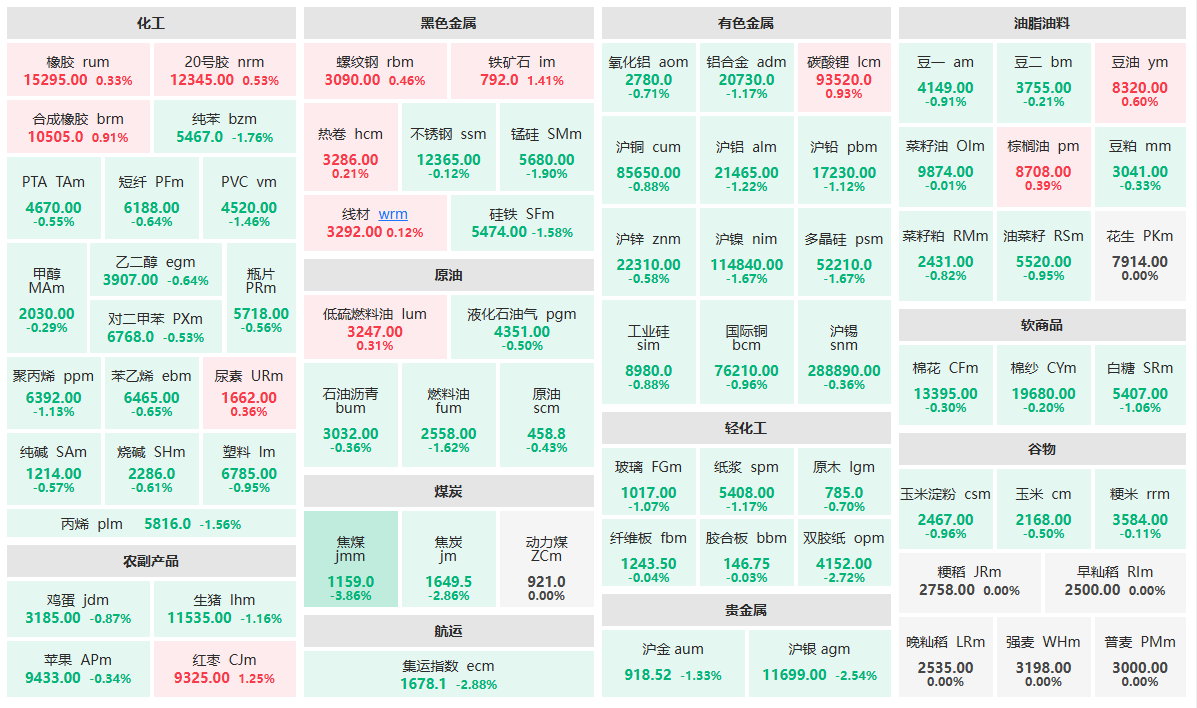
农产品板块,白糖、生猪跌超1%,红枣涨超1% 智通财经:瑞银投资银行中国股票策略研究主管王宗豪在2026年展望报告中指出,预计中国股市将迎来又一个丰年,因包括创新领域发展等许多有利的驱动 因素将继续支撑市场。MSCI中国指数明年末目标位为100,较当前有14%的上涨空间。 智通财经:下任美联储主席的热门人选、现任美联储理事沃勒周一表示,支持在12月的政策会议上再次降息。他称,他越来越担心劳动力市场及招聘活动急 剧放缓。他表示,"劳动力市场依旧疲软,且已接近增长失速的临界水平",同时剔除关税影响后的通胀 "已相对接近" 美联储2%的目标水平。 | | 化工 | | | 黑色金属 | | | 有色金属 | | | 油脂油料 | | --- | --- | --- | --- | --- | --- | --- | --- | --- | --- | --- | | 橡胶 rum | | 20号胶 nrm | 螺纹钢 rbm | | 铁矿石 im | 氧化铝 aom 铝合金 adm | | 碳酸锂 lcm | ə qalında qal | 豆二 bm | | 15295.00 0.33% | | 12345.00 ...

湛江规上工业增速创年内新高
Nan Fang Ri Bao Wang Luo Ban· 2025-11-18 08:06
Group 1 - BASF's new 2-Ethylhexanol (2-EH) facility in Zhanjiang has officially commenced production, marking a significant milestone in the integrated base's development [1] - Zhanjiang's GDP growth rate for the first three quarters of this year is 5.0%, ranking third in the province, with industrial added value increasing by 10.4%, the highest growth rate in the province [1] - The industrial sector is a key driver of high-quality development in Zhanjiang, with major projects in green steel, green petrochemicals, green energy, and modern agriculture contributing to this growth [1][2] Group 2 - Zhanjiang's industrial development is transitioning from quantity expansion to quality improvement, with a resilient growth pattern and strong potential [2] - The city has seen significant contributions from the mining sector, with new oil fields coming online and increasing production rates [2] - The city's small-scale industrial sector has also shown growth, with a 6.5% increase in added value in the first three quarters of this year [2] Group 3 - Industrial parks in Zhanjiang are becoming strong engines for development, facilitating the transition to high-value-added products [3] - The industrial parks have reported an 11.9% increase in industrial added value year-on-year, showcasing robust momentum [4] - Zhanjiang's green petrochemical and modern agricultural industries have surpassed a total output value of 100 billion yuan, contributing to a modern industrial system [4] Group 4 - Technological transformation is a key strategy for Zhanjiang's industrial upgrade, with significant investments in industrial upgrades showing a 33.3% increase year-on-year [4] - The new materials sector is also emerging, with a new production base expected to generate an annual output value of 2 billion yuan [4] - Major projects are driving industrial growth, with Zhanjiang positioned to leverage its industrial capabilities for future development [5]
日度策略参考-20251118
Guo Mao Qi Huo· 2025-11-18 06:12
Report Industry Investment Ratings - Not provided in the given content Core Views of the Report - The current macro - level is in a relatively vacuum period, A - shares lack a clear upward main line, trading volume remains low, and short - term market divergence is expected to be gradually digested during the index's shock adjustment, waiting for a new driving main line to push the index up further [1] - Asset shortage and weak economy are beneficial to bond futures, but the central bank has recently warned of interest - rate risks, suppressing the upward trend, and the market is expected to fluctuate within a certain range [1] - The recent cooling of the market's expectation of a Fed rate cut in December has led to a callback in copper, aluminum, and other non - ferrous metal prices, but the callback range of copper is expected to be limited. For different non - ferrous metals, there are different fundamental factors affecting their prices [1] - For various commodities such as steel, energy, and agricultural products, their prices are affected by factors such as seasonality, supply - demand relationship, cost, and macro - sentiment, and most of them are expected to fluctuate in the short term, with different risk and opportunity characteristics [1] Summary by Related Catalogs Stock and Bond Markets - A - shares lack a clear upward main line, trading volume is low, and short - term divergence will be digested during shock adjustment, waiting for a new driving factor [1] - Asset shortage and weak economy are beneficial to bond futures, but short - term interest - rate risks suppress the upward trend [1] Non - ferrous Metals - Copper price has a limited callback due to the cooling of the Fed rate - cut expectation in December [1] - Aluminum price has a callback due to the cooling of the Fed rate - cut expectation and limited industrial - side drive [1] - Alumina production and inventory are increasing, and the price fluctuates around the cost line [1] - Zinc has support below due to low LME inventory and signs of improvement in the domestic fundamentals [1] - Nickel price may fluctuate weakly in the short term due to macro - weakness and high inventory, and the long - term surplus pattern of primary nickel continues [1] - Stainless steel futures are looking for a bottom in shock, and short - term operations are recommended, paying attention to selling - hedging opportunities [1] - Tin is still bullish in the long - term despite short - term pressure from the Fed rate - cut expectation [1] Precious Metals and New Energy - Precious metals may be under pressure in the short term due to the hawkish statements of Fed officials, and attention should be paid to the upcoming US economic data [1] - Industrial silicon: Northwest production capacity is resuming, Southwest start - up is weaker than usual, and it is affected by polysilicon [1] - Polysilicon: There is an expectation of production - capacity reduction in the long - term, and terminal installation increases marginally in the fourth quarter [1] - Lithium carbonate: It may fluctuate due to the approaching peak season of new energy vehicles, strong energy - storage demand, and high hedging pressure [1] Steel and Iron Ore - For steel products, the off - season effect is not obvious, but the industrial structure is still loose, and attention should be paid to the upward pressure on prices after the macro - sentiment is realized [1] - Iron ore: Direct demand is okay, with cost support, but supply is high, inventory is accumulating, and the price rebound space is limited [1] Agricultural Products - Palm oil is expected to run weakly due to the increase in production in the first half of November [1] - Soybean oil has support from domestic consumption demand and export window, but the CBOT soybean's retracement of policy premium has a short - term negative impact [1] - Rapeseed oil: The inability of Canada to cancel tariffs on Chinese electric vehicles and plans to increase biodiesel production capacity make it difficult for Canadian rapeseed to be exported to China in the short term, and the basis is stable and slightly strong [1] - Cotton market is currently in a situation of "having support but no driver", and future attention should be paid to relevant policies and planting conditions [1] - Sugar: Global sugar supply turns from shortage to surplus, and Zhengzhou sugar is expected to be under pressure and follow the trend of raw sugar [1] - Corn: Short - term spot prices are firm, but the selling pressure is postponed, and the upward drive of the futures price is weak [1] - Soybean meal: The short - term upward expectation lacks impetus, and the market may start to trade the selling pressure of South American new crops from December to January [1] Energy and Chemicals - Fuel oil: Affected by OPEC+ production increase, geopolitical factors, and trade policies, it is expected to fluctuate [1] - Asphalt: The short - term supply - demand contradiction is not prominent, and it is expected to decline due to factors such as the possible falsification of the "14th Five - Year Plan" construction demand [1] - Rubber: Different types of rubber have different price trends affected by factors such as cost, supply - demand, and market atmosphere [1] - PTA and related products: Their prices are affected by factors such as gasoline profit, device maintenance, and raw - material cost [1] - Ethylene glycol: Its price is affected by the decline of crude oil price, the increase of coal price, and the strong expectation of domestic device commissioning [1] - Other chemicals: Their prices are affected by factors such as supply - demand relationship, cost, and device maintenance [1]
资金两手抄底,两日爆买恒生互联网ETF超16亿,上演“13连吸金”,自由现金流ETF近一周净流入超10亿
Ge Long Hui· 2025-11-18 05:58
Group 1 - The Hong Kong and A-shares market experienced a deepening decline, with the Hang Seng Technology Index falling by 1.86% and the Hang Seng Internet ETF down by 0.56% as of the report time [1] - Recent market conditions have seen a surge in risk aversion, with a comprehensive sell-off in the US market, leading to the S&P 500 and Nasdaq both falling below their 50-day moving averages [1] - The Hang Seng Internet ETF has seen a continuous inflow of funds for 13 days, accumulating 1.66 billion yuan in the last two days, indicating strong investor interest in internet stocks [1] Group 2 - The Free Cash Flow ETF, which is noted for its low fees, declined by 1.66% and currently has a total size of 6.656 billion yuan, making it the largest in its category [2] - Key holdings in the Free Cash Flow ETF include China National Offshore Oil Corporation, SAIC Motor, Shaanxi Coal and Chemical Industry, and Gree Electric Appliances [2]
宏观日报:中游开工延续分化-20251118
Hua Tai Qi Huo· 2025-11-18 03:16
Industry Overview Upstream - Nickel prices declined, while aluminum prices slightly rebounded in the non-ferrous sector [2] - Glass prices slightly decreased in the black sector [2] - Egg prices slightly dropped in the agricultural sector [2] Midstream - The PX开工率 remained at a high level, while the PTA开工率 continued to decline in the chemical industry [2] - Power plant coal consumption was low, and inventory increased in the energy sector [2] - The asphalt开工率 decreased in the infrastructure sector [2] Downstream - Commodity housing sales in second - and third - tier cities declined seasonally in the real estate sector [3] - The number of domestic flights remained stable at a high level in the service sector [3] Macroeconomic Data Production Industry - From January to October, the added value of the equipment manufacturing industry increased by 9.5% year - on - year, contributing over half and becoming the main engine driving industrial growth [1] - In the energy and key raw materials fields, high - quality coal production capacity continued to be released, but due to the global AI boom, there was a shortage and significant price increase in chips, with some prices rising by up to 60% compared to September [1] Service Industry - In October 2025, banks settled foreign exchange worth 1519.4 billion yuan and sold foreign exchange worth 1394 billion yuan. From January to October 2025, banks cumulatively settled foreign exchange worth 14794.1 billion yuan and sold foreign exchange worth 14220.1 billion yuan [1] - From January to October 2025, the national general public budget revenue was 18649 billion yuan, a year - on - year increase of 0.8%; the national general public budget expenditure was 22582.5 billion yuan, a year - on - year increase of 2% [1] - The national government - sponsored fund budget revenue was 3447.3 billion yuan, a year - on - year decrease of 2.8%; the national government - sponsored fund budget expenditure was 8089.2 billion yuan, a year - on - year increase of 15.4% [1] Key Industry Price Indicators | Industry | Indicator | Price on 11/17 | YoY | | --- | --- | --- | --- | | Agriculture | Spot price of corn | 2174.3 yuan/ton | 0.80% | | | Spot price of eggs | 6.4 yuan/kg | - 1.54% | | | Spot price of palm oil | 8700.0 yuan/ton | - 0.37% | | | Spot price of cotton | 14799.2 yuan/ton | - 0.28% | | | Average wholesale price of pork | 18.0 yuan/kg | - 0.72% | | Non - ferrous metals | Spot price of copper | 86553.3 yuan/ton | 0.01% | | | Spot price of zinc | 22380.0 yuan/ton | - 0.79% | | | Spot price of aluminum | 21920.0 yuan/ton | 1.94% | | | Spot price of nickel | 119033.3 yuan/ton | - 2.16% | | Ferrous metals | Spot price of aluminum | 17343.8 yuan/ton | - 0.25% | | | Spot price of rebar | 3164.3 yuan/ton | 1.00% | | | Spot price of iron ore | 800.0 yuan/ton | 1.58% | | | Spot price of wire rod | 3297.5 yuan/ton | 0.00% | | | Spot price of glass | 13.8 yuan/sq.m | - 1.43% | | Non - metals | Spot price of natural rubber | 14900.0 yuan/ton | 1.42% | | | China Plastic City price index | 769.1 | - 0.54% | | Energy | Spot price of WTI crude oil | 60.1 dollars/barrel | 0.57% | | | Spot price of Brent crude oil | 64.4 dollars/barrel | 1.19% | | | Spot price of liquefied natural gas | 4202.0 yuan/ton | - 0.94% | | | Coal price | 834.0 yuan/ton | 0.85% | | Chemical | Spot price of PTA | 4647.0 yuan/ton | 0.03% | | | Spot price of polyethylene | 6991.7 yuan/ton | 0.36% | | | Spot price of urea | 1630.0 yuan/ton | 0.15% | | | Spot price of soda ash | 1218.6 yuan/ton | 0.89% | | Real estate | Cement price index (national) | 137.7 | 0.95% | | | Building materials composite index | - | 1.11% | | | Concrete price index (national) | 90.8 | - 0.14% | [33]
能源化工期权:能源化工期权策略早报-20251118
Wu Kuang Qi Huo· 2025-11-18 02:23
1. Report Industry Investment Rating - No relevant content provided 2. Core Viewpoints of the Report - The energy - chemical sector is mainly divided into energy, alcohols, polyolefins, rubber, polyesters, alkalis, and others. Strategies suggest constructing option combination strategies mainly as sellers and spot hedging or covered strategies to enhance returns [2][8] 3. Summary by Relevant Catalogs 3.1 Futures Market Overview - The report presents the latest prices, price changes, price change rates, trading volumes, volume changes, open interests, and open interest changes of various energy - chemical option underlying futures contracts, such as crude oil, liquefied petroleum gas (LPG), methanol, etc. For example, the latest price of crude oil SC2601 is 462, with a price increase of 1 and a price change rate of 0.24% [3] 3.2 Option Factors - Volume and Open Interest PCR - The report provides the volume and open interest PCR data of various energy - chemical options, which are used to describe the strength of the option underlying market and whether the underlying market has a turning point. For example, the open interest PCR of crude oil options is 0.80, indicating a relatively weak recent crude oil market [4] 3.3 Option Factors - Pressure and Support Levels - From the perspective of the exercise prices with the largest open interest of call and put options, the report determines the pressure and support levels of various energy - chemical option underlying assets. For example, the pressure level of crude oil is 540 and the support level is 460 [5] 3.4 Option Factors - Implied Volatility - The report shows the implied volatility data of various energy - chemical options, including at - the - money implied volatility, weighted implied volatility, and its changes. For example, the at - the - money implied volatility of crude oil options is 24.12%, and the weighted implied volatility is 26.46% with a change of - 0.17% [6] 3.5 Strategy and Recommendations 3.5.1 Energy - related Options - **Crude Oil**: - **Fundamentals**: US crude oil inventories showed different trends, with an overall increase in total, strategic, and commercial inventories, and a decrease in Cushing area inventories. - **Market Analysis**: The price showed a complex trend of rise and fall from August to November. - **Option Factors**: Implied volatility fluctuated above the average, open interest PCR was below 0.80, indicating a weak market, and the pressure and support levels were 540 and 460 respectively. - **Strategies**: Construct a short - biased call + put option combination strategy for volatility, and a long collar strategy for spot hedging [7] - **LPG**: - **Fundamentals**: The LPG market was relatively strong, with a rebound in the external market and a marginal tightening of the domestic fundamental situation. - **Market Analysis**: The price showed a trend of decline, rebound, and then consolidation from August to November. - **Option Factors**: Implied volatility dropped significantly to below the average, open interest PCR was around 0.80, indicating a weak market, and the pressure and support levels were 4500 and 4250 respectively. - **Strategies**: Construct a neutral - biased call + put option combination strategy for volatility, and a long collar strategy for spot hedging [9] 3.5.2 Alcohol - related Options - **Methanol**: - **Fundamentals**: Supply was expected to increase, and inventory might accumulate slightly. - **Market Analysis**: The price showed a weak downward trend from August to November. - **Option Factors**: Implied volatility fluctuated around the historical average, open interest PCR was below 0.80, indicating a weak and volatile market, and the pressure and support levels were 2500 and 2000 respectively. - **Strategies**: Construct a bear spread strategy for direction, a short - biased call + put option combination strategy for volatility, and a long collar strategy for spot hedging [9] - **Ethylene Glycol**: - **Fundamentals**: Production increased slightly, and port inventory increased significantly. - **Market Analysis**: The price showed a weak downward trend from August to November. - **Option Factors**: Implied volatility fluctuated below the average, open interest PCR was around 0.70, indicating strong short - side power, and the pressure and support levels were 4500 and 4050 respectively. - **Strategies**: Construct a bear spread strategy for direction, a short - volatility strategy for volatility, and a long collar strategy for spot hedging [10] 3.5.3 Polyolefin - related Options - **Polypropylene**: - **Fundamentals**: Production increased, and capacity utilization rose. - **Market Analysis**: The price showed a weak downward trend from August to November. - **Option Factors**: Implied volatility dropped to around the average, open interest PCR was around 0.70, indicating a weak market, and the pressure and support levels were 7000 and 6300 respectively. - **Strategies**: Construct a bear spread strategy for direction, and a long collar strategy for spot hedging [10] 3.5.4 Rubber - related Options - **Rubber**: - **Fundamentals**: Tire production capacity utilization showed different trends, and inventory turnover days changed. - **Market Analysis**: The price showed a weak consolidation trend from August to November. - **Option Factors**: Implied volatility rose sharply and then dropped to below the average, open interest PCR was below 0.60, and the pressure and support levels were 16000 and 15000 respectively. - **Strategies**: Construct a short - biased call + put option combination strategy for volatility [11] 3.5.5 Polyester - related Options - **PTA**: - **Fundamentals**: Some PTA plants had production adjustments, and the operating rate changed. - **Market Analysis**: The price showed a trend of decline, rebound, and then consolidation from August to November. - **Option Factors**: Implied volatility fluctuated above the average, open interest PCR was around 0.70, indicating a volatile market, and the pressure and support levels were 4700 and 4300 respectively. - **Strategies**: Construct a neutral - biased call + put option combination strategy for volatility [11] 3.5.6 Alkali - related Options - **Caustic Soda**: - **Fundamentals**: The average capacity utilization rate of caustic soda plants decreased slightly, with different trends in different regions. - **Market Analysis**: The price showed a weak downward trend from August to November. - **Option Factors**: Implied volatility was at a relatively high level, open interest PCR was below 0.80, indicating a weak and volatile market, and the pressure and support levels were 3000 and 2200 respectively. - **Strategies**: Construct a bear spread strategy for direction, and a long collar strategy for spot hedging [12] - **Soda Ash**: - **Fundamentals**: The inventory of soda ash manufacturers increased year - on - year. - **Market Analysis**: The price showed a weak consolidation trend from August to November. - **Option Factors**: Implied volatility was at a relatively high historical level, open interest PCR was below 0.60, indicating strong short - side pressure, and the pressure and support levels were 1860 and 1100 respectively. - **Strategies**: Construct a bear spread strategy for direction, a short - volatility combination strategy for volatility, and a long collar strategy for spot hedging [12] 3.5.7 Other Options - **Urea**: - **Fundamentals**: Enterprise inventory decreased, and port inventory increased. - **Market Analysis**: The price showed a trend of wide - range fluctuation, decline, and then rebound from August to November. - **Option Factors**: Implied volatility fluctuated slightly around the historical average, open interest PCR was below 0.60, indicating strong short - side pressure, and the pressure and support levels were 1800 and 1600 respectively. - **Strategies**: Construct a neutral - biased call + put option combination strategy for volatility, and a long collar strategy for spot hedging [13]
India's goods trade deficit in October shatters records, beating estimates, as gold imports surge 200%
CNBC· 2025-11-18 02:04
Core Insights - India's goods trade deficit reached a record high of $41.7 billion in October, driven by a surge in gold imports and the impact of U.S. tariffs on exports [1][2] Trade Deficit and Imports - The trade deficit significantly exceeded Reuters poll estimates of $28.8 billion and surpassed the previous record of $37.8 billion set in November 2024 [2] - Gold imports in October amounted to $14.7 billion, marking an increase of nearly 200% compared to the same month last year, with consumers estimated to have spent $11 billion during the five-day festival period [2] Exports and Tariff Impact - Exports to the U.S. declined for the second consecutive month, falling 8.5% year-on-year in October to $6.3 billion due to the 50% tariffs implemented at the end of August [3] - Despite the decline, the U.S. remained the largest export destination for India, with shipments worth $52 billion in the first seven months of the fiscal year [3] - Key exports such as gems and jewelry fell by 29.5% to $2.3 billion, while engineering goods decreased by 16.7% to $9.4 billion [4] Future Outlook - Merchandise imports are expected to decrease in November and December 2025 as gold imports decline post-festival season, alongside a potential increase in exports [5] - India's current account deficit is projected to widen to 2.4-2.5% of GDP in the third quarter of the fiscal year ending March 2026, with a CAD to GDP ratio of around 1.2% for fiscal year 2026 if U.S. tariffs remain in place [6] Trade Negotiations - Ongoing trade negotiations between the U.S. and India have yet to yield a deal, although both sides are softening their positions, with hints from U.S. President Trump about potential tariff reductions [7] - India has increased oil and gas purchases from the U.S. to address the trade surplus and is expected to buy agricultural products as well [7]
中国期货每日简报-20251118
Zhong Xin Qi Huo· 2025-11-18 01:47
1. Report Industry Investment Rating No information provided in the report. 2. Core Views - On November 17th, equity index futures declined while CGB futures rose; lithium carbonate hit the daily limit up, with precious metals leading the decline [2][9][12]. - For lithium carbonate, the market remains tight in Nov - Dec; potential easing in Dec if Jianxiawo resumes production soon. Long - term demand is positive, and a bullish bias is recommended with buying on dips after corrections [18][19]. - For gold, short - term price is expected to consolidate within a range due to Fed's uncertainty. Long - term, gold price center is expected to shift upward as it hedges against dollar credit risks [25][26][27]. - For silver, short - term price is projected to consolidate within a range, supported by tight overseas spot supply. Long - term, it benefits from dollar credit contraction and global economic recovery [34][35]. 3. Summary by Relevant Catalogs 3.1 China Futures 3.1.1 Overview - Financial futures: IH and IF fell approximately 1%, while TL gained 0.3% [9][12]. - Commodity futures: Top three gainers were lithium carbonate (9.0% rise, 8.9% position increase m - o - m), SCFIS(Europe) (6.7% rise, 2.2% position increase m - o - m), and iron ore (1.8% rise, 0.2% position increase m - o - m). Top three decliners were silver (4.1% drop, 1.1% position decrease m - o - m), gold (3.1% drop, 10.5% position decrease m - o - m), and polysilicon (2.9% drop, 6.2% position decrease m - o - m) [10][11][12]. 3.1.2 Daily Raise - Lithium Carbonate: Rose 9.0% to 95,200 yuan/ton on Nov 17th. Supply is restricted by ore shortage, demand is currently robust, and social inventories are destocking. A bullish bias is recommended with buying on dips [16][17][19]. 3.1.3 Daily Drop - Gold: Fell 3.1% to 929.46 yuan/gram on Nov 17th. Short - term price may consolidate due to Fed's uncertainty, while long - term price center is expected to rise [24][25][27]. - Silver: Fell 4.1% to 11,933 yuan/kilogram on Nov 17th. Short - term price is expected to consolidate with support from tight overseas supply, and long - term it benefits from economic recovery [33][34][35]. 3.2 China News 3.2.1 Macro News - The 22nd issue of Qiushi Journal on November 16 published an important article by Xi Jinping titled "Develop New Quality Productive Forces According to Local Conditions" [39]. - China's Foreign Ministry stated that Premier Li Qiang has no arrangements to meet with Japanese leaders during the G20 summit [39]. 3.2.2 Industry News - CSRC Chairman Wu Qing emphasized efforts to make the capital market more resilient, with more inclusive systems, higher - quality listed companies, more effective regulation, and deeper opening - up [40].