家用电器

Search documents
红利低波100为啥这么牛?
雪球· 2025-05-10 03:18
风险提示:本文所提到的观点仅代表个人的意见,所涉及标的不作推荐,据此买卖,风险自负。 2.1 什么是红利低波100指数 ? 红利低波100指数 ( 代码 : 930955 ) 是中证红利低波动100指数的简称 , 由中证指数有限公司于 2017年5月26日发布 , 是一只以 " 高股息和低波动 " 为核心逻辑的指数 。 作者: 王博雅投资 来源:雪球 1 引言 红利低波100指数是仅有的2个五星级红利指数之一 。 它可以看做中证红利的升级版 , 在保持优秀分散性 的情况下实现了更高的收益和更低的波动 , 因此在市场上备受关注 。 图1 沪深300 、 中证红利与红利低波指数全收益对比 在之前 , 我已经对追踪中证红利的基金进行了分析。 今天我将对红利低波100指数进行简介 , 然后从 费用 、 规模 、 流动性 、 收益与分红频率 等几个关键角 度 , 对红利低波100ETF进行横评 , 看看谁最好 ! 2 红利低波100指数简介 红利低波100指数构成逻辑如下 : 1 中证全指中过去一年日均成交金额前 80%的公司 。 这是为了避免流动性过差 。 2 过去三年连续现金分红 。 这是为了确保公司具有良好的分红 ...


金融工程周报:主力资金流入汽车行业,情绪高涨
Shanghai Securities· 2025-05-09 13:25
Investment Rating - The report indicates a positive investment rating for the automotive industry, highlighting it as one of the sectors with significant net inflows of capital [2][9]. Core Insights - The automotive sector has seen a net inflow of 27.05 billion in the past 5 days, making it the top industry for capital inflow [9]. - The report utilizes a model that assesses industries based on six factors: capital, valuation, sentiment, momentum, overbought/oversold conditions, and earnings, with the automotive sector scoring high in these evaluations [13][14]. - The consensus stock selection model identified stocks such as Baiyang Co., Zhongchong Co., and Hunan Silver as top picks based on high-frequency capital flow and price movement similarity [16][17]. Industry Capital Inflow Statistics - In the past 5 days, the automotive industry led with a net inflow of 27.05 billion, followed by home appliances with 8.44 billion and machinery equipment with 5.26 billion [9]. - Over the past 30 days, the automotive sector experienced a net outflow of 446.97 billion, indicating a contrasting trend compared to the recent 5-day performance [10][12]. A-Share Industry Rotation Model - The A-share industry rotation model ranks the automotive sector among the top performers, alongside non-bank financials and communications, based on a composite score derived from the six factors [14][15]. - The automotive sector received a high score in capital and valuation, indicating strong investor interest and favorable market conditions [15]. Consensus Stock Selection - The consensus stock selection model highlighted industries such as feed, precious metals, and animal health II as high-performing sectors, with specific stocks selected based on their capital flow and price movement [16][17].
金融工程周报:主力资金流入汽车行业,情绪高涨-20250509
Shanghai Securities· 2025-05-09 12:20
Quantitative Models and Construction Methods 1. Model Name: A-Share Industry Rotation Model - **Model Construction Idea**: The model is built using six factors: capital, valuation, sentiment, momentum, overbought/oversold, and profitability, to create a scoring system for evaluating industries comprehensively [13] - **Model Construction Process**: - **Capital Factor**: Uses the main net inflow rate of industry funds as the primary data source - **Valuation Factor**: Based on the valuation percentile of the industry over the past year - **Sentiment Factor**: Proportion of rising constituent stocks serves as the main data source - **Momentum Factor**: Uses the MACD indicator as the primary data source - **Overbought/Oversold Factor**: Relies on the RSI indicator as the key data source - **Profitability Factor**: Based on the consensus forecast EPS percentile of the industry over the past year [13] - **Model Evaluation**: The model provides a comprehensive scoring mechanism to assess industry performance, effectively identifying high-performing and low-performing industries [13] 2. Model Name: Consensus Stock Selection Model - **Model Construction Idea**: The model combines momentum, valuation, and price increase frequency factors with high-frequency capital flow data to select stocks with the highest similarity between capital flow trends and stock price trends [16] - **Model Construction Process**: - Identify high-performing secondary industries over the past 30 days - Calculate momentum factors, valuation factors, and price increase frequency for stocks within these industries - Use high-frequency minute-level data to calculate capital inflow/outflow changes for each stock - Select the top three secondary industries and pick five stocks from each based on the highest similarity between capital flow trends and stock price trends [16] --- Model Backtesting Results 1. A-Share Industry Rotation Model - **Top Scoring Industries**: Non-bank financials, communication, and automotive scored the highest, with total scores of 8, 8, and 7, respectively - **Low Scoring Industries**: Building materials, social services, and steel scored the lowest, with total scores of -10, -5, and -5, respectively [14][15] 2. Consensus Stock Selection Model - **Selected Industries**: Feed, precious metals, and animal health II were identified as the top-performing secondary industries - **Selected Stocks**: - Feed: Baiyang Co., Zhongchong Co., Zhenghong Technology, Bangji Technology, Guibao Pet - Precious Metals: Hunan Silver, Xiaocheng Technology, Western Gold, Hunan Gold, Shandong Gold - Animal Health II: Jinhe Bio, Haili Bio, Kexian Bio, Shengwu Co., Ruipu Bio [17] --- Quantitative Factors and Construction Methods 1. Factor Name: Capital Factor - **Construction Idea**: Measures the main net inflow rate of industry funds to assess capital movement trends [13] - **Construction Process**: Calculate the net inflow of main funds for each industry and normalize the data to create a scoring metric [13] 2. Factor Name: Valuation Factor - **Construction Idea**: Evaluates the relative valuation of an industry based on its historical percentile over the past year [13] - **Construction Process**: Calculate the percentile of the industry's valuation over the past year and assign scores accordingly [13] 3. Factor Name: Sentiment Factor - **Construction Idea**: Uses the proportion of rising constituent stocks to gauge market sentiment [13] - **Construction Process**: Calculate the percentage of rising stocks within an industry and normalize the data for scoring [13] 4. Factor Name: Momentum Factor - **Construction Idea**: Leverages the MACD indicator to measure momentum trends [13] - **Construction Process**: Compute the MACD values for each industry and assign scores based on the strength of momentum [13] 5. Factor Name: Overbought/Oversold Factor - **Construction Idea**: Uses the RSI indicator to identify overbought or oversold conditions [13] - **Construction Process**: Calculate RSI values for each industry and assign scores based on thresholds for overbought/oversold conditions [13] 6. Factor Name: Profitability Factor - **Construction Idea**: Assesses profitability using the consensus forecast EPS percentile over the past year [13] - **Construction Process**: Calculate the percentile of the consensus forecast EPS for each industry and assign scores accordingly [13] --- Factor Backtesting Results 1. Capital Factor - **Top Scoring Industries**: Automotive (+3), Non-bank financials (+2), Communication (+2) [15] 2. Valuation Factor - **Top Scoring Industries**: Automotive (+3), Non-bank financials (+3), Communication (+2) [15] 3. Sentiment Factor - **Top Scoring Industries**: Communication (+3), Automotive (+1), Non-bank financials (-2) [15] 4. Momentum Factor - **Top Scoring Industries**: Non-bank financials (+3), Communication (+1), Automotive (+1) [15] 5. Overbought/Oversold Factor - **Top Scoring Industries**: Non-bank financials (+3), Communication (+3), Automotive (+3) [15] 6. Profitability Factor - **Top Scoring Industries**: Automotive (+3), Non-bank financials (+3), Communication (+3) [15]
广东VS江苏:风格迥异的TOP2
Huachuang Securities· 2025-05-09 12:13
Economic Comparison - In 2024, Guangdong's GDP reached 14.16 trillion yuan with a growth rate of 3.5%, while Jiangsu's GDP was 13.7 trillion yuan with a growth rate of 5.8%, narrowing the GDP gap to 462.5 billion yuan from 968.3 billion yuan the previous year[19] - Guangdong's GDP concentration is higher, with the last two cities contributing only 4% of the total GDP, the largest disparity among 24 provinces, while Jiangsu's last two cities contribute 21%, ranking fifth in terms of balance[22] Fiscal Dynamics - From 2019 to 2024, Jiangsu's average net contribution to the central government was approximately 280 billion yuan annually, while Guangdong's was about 780 billion yuan, resulting in an annual gap of 500 billion yuan, equivalent to 25.7% of Guangdong's average fiscal revenue[3] - In 2024, Guangdong's local revenue accounted for 22.6% of its total, while Jiangsu's was only 2.5%, the lowest among 31 provinces, indicating a more centralized fiscal structure in Guangdong[4] Infrastructure Investment - Jiangsu's infrastructure growth rate was 13.3% in 2024, significantly higher than Guangdong's 0.2%, which reflects a divergence in investment trends since 2022[53] - In 2024, Jiangsu's investment in electricity and heat production grew by 98.7%, while Guangdong's was only 3.9%[56] Real Estate Sector - In 2024, Jiangsu's land finance dependency was 49%, compared to Guangdong's 31%, indicating a higher reliance on land finance in Jiangsu[11] - From 2020 to 2024, Jiangsu's land-related revenue decreased from 1.28 trillion yuan to 900 billion yuan, a drop of 3.8 billion yuan, while Guangdong's fell from 1.16 trillion yuan to 520 billion yuan, a reduction of 6.4 billion yuan[11] Consumer Spending - Since the pandemic, Guangdong's consumer spending growth has lagged behind Jiangsu's, attributed to differences in income growth and consumer behavior[12] - In 2024, Jiangsu's rural residents had a higher disposable income compared to Guangdong, contributing to a more robust consumption pattern in rural areas[12] Industrial Structure - Guangdong's industry is more downstream, producing 44% of the nation's industrial robots and 39% of optical electronic devices, while Jiangsu focuses on midstream production, contributing 33% of chemical fibers and 46% of ships[13] - In 2024, Jiangsu's exports to Belt and Road countries accounted for 47.5% of its total exports, surpassing Guangdong's nearly 40%[13]
A股三大股指低收:银行股再度走强 两市成交11920亿元
Xin Lang Cai Jing· 2025-05-09 07:30
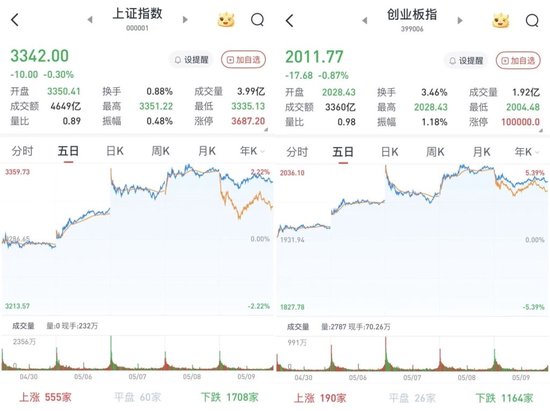
Market Overview - The three major A-share indices opened slightly lower on May 9, with the Shanghai Composite Index down 0.3% to 3342 points, the ChiNext Index down 0.87% to 2011.77 points, and the STAR Market 50 Index down 1.96% to 1006.32 points [3][4] - A total of 1212 stocks rose while 4061 stocks fell across the exchanges, with a total trading volume of 11.92 billion yuan, a decrease of 1.014 billion yuan from the previous trading day [4][5] Sector Performance - Bank stocks continued to rise, with several banks reaching new highs, including China Construction Bank and Jiangsu Bank, both gaining over 2% [6] - The semiconductor sector faced significant declines, with companies like Huahong Semiconductor and Espressif Systems dropping over 7% [6] - The textile and apparel sector showed strong performance, with multiple stocks hitting the daily limit or rising over 10% [6] - The real estate sector performed poorly, with several companies declining over 3% [7] Market Sentiment and Outlook - Analysts expect the market to maintain a steady upward trend in the short term, supported by structural monetary policy and anticipated fiscal measures aimed at boosting domestic demand [8][9] - The market is likely to experience a structural rally driven by both policy and earnings, with a focus on sectors with high earnings certainty and clear policy catalysts [9] - The military and defense sector is expected to benefit from ongoing geopolitical tensions, with growth potential in military trade and increased competitiveness of Chinese military products [10]




北交所日报!(2025.05.08)-20250509
Yin He Zheng Quan· 2025-05-09 06:01
-40% -20% 0% 20% 40% 60% 80% 100% 北证50 沪深300 ⚫⚫⚫⚫⚫⚫ 资料来源:iFinD,中国银河证券研究院 请务必阅读正文最后的中国银河证券股份有限公司免责声明。 2 10 图1:北证成交额与换手率情况(截至2025.05.08) ■成交金额(合计/亿元) ●换手率(算数平均/%) 600 16.0 14.0 500 12.0 400 10.0 300 8.0 6.0 200 4.0 100 2.0 0 0.0 03-11 03-14 04-15 02-10 8T 70 ET 70 02-26 03-03 03-06 03-19 03-24 03-27 04-07 04-10 04-18 04-23 04-28 05-06 01-02 01-15 02-05 02-21 04-01 01-23 01- 01 可证券|CGS 中国银河证券|CGS 北交所日报 资料来源:iFinD,中国银河证券研究院 图2:北证与 A 股各行业当日涨跌幅(算数平均/%/ 2025.05.08) ■北交所算数平均涨跌幅 ■A股算数平均涨跌幅 12 10 8 6 4 2 0 -2 -4 北交所日 ...
北交所日报-20250508
Yin He Zheng Quan· 2025-05-08 13:18
Market Performance - The average daily change for the North Exchange (北证) and A-shares (A股) shows significant fluctuations, with the North Exchange experiencing a maximum increase of 29.99% for the top-performing stock on May 8, 2025[9] - The trading volume for the North Exchange reached a total of 600 billion CNY, with an average turnover rate of 16% as of May 8, 2025[7] Stock Highlights - The top ten stocks by increase on May 8, 2025, had an average market capitalization of 19.06 billion CNY, with the highest PE ratio recorded at 570.74 for Tongyi Aerospace (通易航天) despite a negative net profit[9] - Conversely, the bottom ten stocks by decrease had an average market capitalization of 32.48 billion CNY, with the largest drop of -7.57% for Qiule Seed Industry (秋乐种业)[10] Valuation Insights - The PE ratio for the North Exchange companies varies significantly across industries, indicating diverse valuation levels, with some sectors like electronics showing extremely high PE ratios, such as 2,690.19 for Huiwei Intelligent (慧为智能)[11] - The valuation trends for the North Exchange compared to the Sci-Tech Board and Growth Enterprise Market indicate a competitive landscape, with the North Exchange showing a steady increase in valuation metrics[12] Risks and Considerations - Potential risks include lower-than-expected policy support, insufficient technological innovation, intensified market competition, and overall market volatility[14]
财经深一度|总体业绩显韧性、技术创新势头强——上市公司年报、一季报亮点盘点
Sou Hu Cai Jing· 2025-05-08 13:07
Core Insights - The overall performance of listed companies in the Shanghai and Shenzhen stock markets shows resilience, with significant growth in various sectors driven by government policies and market reforms [2][3]. Group 1: Company Performance - 74% of listed companies achieved profitability in 2024, with 48% experiencing positive profit growth [2]. - In Q1 2025, listed companies reported a net profit of 1.5 trillion yuan, a year-on-year increase of 3.6%, which is 5.9 percentage points higher than the annual report [2]. - The operating revenue of listed companies accounted for 56% of GDP in 2024, highlighting their importance in the national economy [2]. Group 2: Sector Highlights - The home appliance and automotive sectors saw net profit growth of 7.1% and 11.1% respectively in 2024, with improvements from previous reports [2]. - The transportation sector's net profit increased by 11.5%, with airports and airlines showing remarkable growth of 75.6% and 69.3% in net profits [2]. - The express delivery industry experienced a revenue growth of 11.7% and a net profit increase of 22.7% [2]. Group 3: R&D and Innovation - Listed companies maintained high levels of R&D investment, totaling 1.6 trillion yuan in 2024, a 3.1% increase year-on-year [7]. - The proportion of R&D expenses to operating revenue reached 2.6%, up by 0.1 percentage points from 2023 [7]. - Companies focusing on strategic emerging industries accounted for over half of all listed companies, with significant investments in sectors like new information technology and high-end equipment manufacturing [7]. Group 4: Shareholder Returns - In 2024, cash dividends announced by 3,472 listed companies totaled 1.66 trillion yuan, marking a 7.2% increase year-on-year [13]. - The total dividend amount for the fiscal year reached 2.39 trillion yuan, with a historical high dividend yield of 3.59% for the CSI 300 index [13]. - The number of companies announcing interim dividends increased significantly, with 985 companies declaring a total of 699.47 billion yuan, representing 4.3 times the number and 2.7 times the amount from 2023 [13][14].
2025年一季报业绩变化有何投资指引?
ZHONGTAI SECURITIES· 2025-05-08 12:46
Group 1 - The overall performance of A-shares stabilized in Q1 2025, with a notable improvement in non-financial sectors, where the net profit growth rate reached 5.13%, significantly higher than the previous year's growth rate [11][15][19] - Among 30 industries, 17 showed a year-on-year increase in net profit growth, particularly in the TMT (Technology, Media, and Telecommunications) sector, which saw substantial revenue and profit growth [3][29] - The financial sector exhibited a mixed performance, with state-owned banks under pressure while non-bank financial institutions showed a significant recovery, with a net profit increase of 21.30% [38][40] Group 2 - Price pressures persist across various industries, with 23 out of 30 industries having a sales net profit margin below 10%, indicating ongoing challenges despite some sectors experiencing a "turnaround" [4][41] - The steel, non-ferrous metals, and basic chemicals sectors have shown significant profit improvements, indicating a recovery from previous downturns [4][44] - The consumer electronics sector benefited from government policies, with household appliances seeing a net profit increase of 25.12% in Q1 2025, exceeding expectations [4][44] Group 3 - From a PB-ROE perspective, 14 out of 30 industries showed improved ROE compared to the previous year, particularly in the TMT sector, where electronic and media industries saw significant gains [5][45] - The communication sector within the technology industry has substantial valuation recovery potential, while the non-ferrous metals and basic chemicals sectors also show signs of potential recovery [5][48] - Public utility sectors maintain stable performance and low valuations, indicating strong long-term investment value [5][49] Group 4 - Future industry allocation should focus on three main lines: the sustained growth of the TMT sector, the recovery of low-position cyclical stocks, and the stability of defensive sectors [6][54] - The TMT sector is expected to benefit from ongoing policy support, particularly for private technology enterprises, while low-position cyclical stocks like oil and non-ferrous metals are showing signs of recovery [6][54] - Defensive sectors such as public utilities and transportation are projected to remain stable amid ongoing economic pressures, providing a strong safety margin for investors [6][55]
A股“掌门”薪酬曝光:13名董事长年薪超千万,药企霸榜前三甲
Di Yi Cai Jing· 2025-05-08 04:12
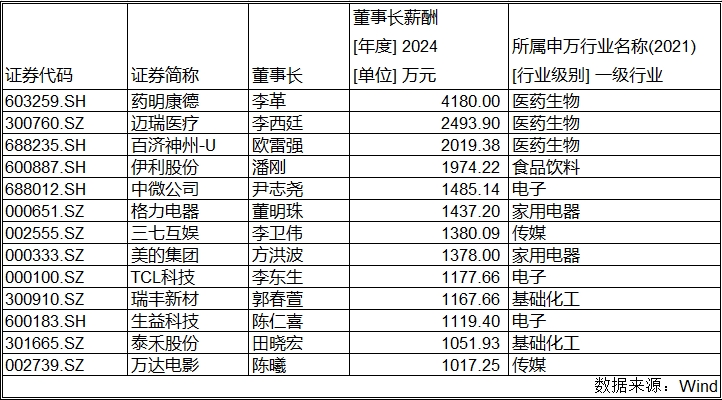
Core Insights - The average annual salary of A-share chairpersons shows a significant concentration in the range of 1 million to 2 million yuan, with 1,402 individuals, accounting for one-third of the total [1][4] - The total disclosed annual salary for 4,231 listed companies reached 5.789 billion yuan, with 13 chairpersons earning over 10 million yuan [1][4] - The number of chairpersons with annual salaries exceeding 10 million yuan has decreased from 27 in 2022 to 16 in 2023, and further down to 13 in 2024 [4] Salary Distribution - The top three highest-paid chairpersons are from the biopharmaceutical industry, with WuXi AppTec's chairman earning 41.8 million yuan, followed by Mindray Medical's chairman at 24.939 million yuan, and BeiGene's chairman at 20.1938 million yuan [2][3] - The salary distribution is characterized by an olive-shaped curve, with fewer individuals earning higher salaries; for instance, there are 381 individuals earning between 2 million and 3 million yuan, and only 67 earning between 4 million and 5 million yuan [6] Salary Changes - A total of 3,765 chairpersons had comparable salaries from 2023 to 2024, with 1,377 experiencing a decrease (37%) and 1,985 seeing an increase (58%) [8] - Notable salary reductions were observed among high-earning chairpersons, with some experiencing declines of over 90% due to poor company performance [9][10] Industry Performance - The salary trends reflect a dichotomy in industry performance, with high salaries in thriving sectors like media, electronics, and pharmaceuticals, while industries like real estate and finance are facing salary cuts [11][13] - The average salary for chairpersons in the media industry was 1.78 million yuan, the highest among 31 sectors, while the average salary in the construction and defense sectors was below 1 million yuan [12][13]