
科技

Search documents
进化的伯克希尔
Xin Lang Cai Jing· 2025-11-17 11:21
Core Insights - Warren Buffett announced his retirement during Thanksgiving, leading to significant market reactions and discussions about Berkshire Hathaway's future direction [2] - Berkshire's Q3 report revealed a $10.6 billion reduction in Apple holdings and a substantial increase in investments in Google, indicating a shift in investment strategy under new leadership [2][15] - Historical data shows that Buffett's investment philosophy has evolved from focusing on undervalued tangible assets to recognizing the importance of intangible value [3][19] Investment Philosophy Evolution - Buffett's early investment strategy was heavily influenced by Benjamin Graham, focusing on companies trading below their net liquidation value, primarily during the industrial era [6][14] - Over time, Buffett began to prioritize companies with strong brand value and management quality, reflecting a shift towards recognizing the economic value of goodwill and intangible assets [8][9] - The transition to the information age saw Buffett adapt his investment approach to include technology and light-asset business models, culminating in significant investments in companies like Apple [11][12][13] Current Challenges and Future Outlook - Berkshire Hathaway faces challenges due to its large asset management scale, making it difficult to find suitable investment opportunities in small-cap stocks [15][16] - The company holds $380 billion in cash, over 30% of total assets, as a strategy to maintain a safety margin amid limited investment opportunities [16] - Under new CEO Greg Abel, Berkshire is expanding its investment circle, as evidenced by recent investments in technology companies, indicating a willingness to adapt to changing market dynamics [17][20]



刚刚!中国股票,突传利好
中国基金报· 2025-11-17 11:20
Core Viewpoint - Morgan Stanley expects a moderate increase in the Chinese stock market in 2026, with key indices set at 27,500 for the Hang Seng Index, 9,700 for the State-Owned Enterprises Index, and 4,840 for the CSI 300 Index, representing potential upsides of approximately 4%, 4%, and 5% respectively compared to the closing levels on November 17 [2]. Group 1 - The report highlights that 2026 will be a stabilization period following significant gains this year, with the CSI 300 Index having risen about 17% year-to-date, indicating a potential for a second consecutive year of growth [2]. - Factors influencing market performance include the quality and sustainability of corporate earnings, ongoing deflationary pressures, and global macroeconomic uncertainties [2]. - The report emphasizes that for the market to break current levels, it must address concerns regarding corporate earnings quality, limited room for further valuation expansion, and increased global macroeconomic uncertainties [2]. Group 2 - Despite short-term challenges, Morgan Stanley anticipates a stable and sustainable growth trend for the Chinese market in 2026 [3]. - The MSCI China Index has risen over 10% since the upgrade of the outlook in March [3]. - Stock selection will be crucial, with recommendations to overweight high-quality internet and technology leaders while reducing exposure to real estate, consumer staples, and energy sectors [3].

华尔街共识浮现?摩根大通刚划出“关键防线”,高盛也警告标普6725点为多空分水岭
华尔街见闻· 2025-11-17 10:43
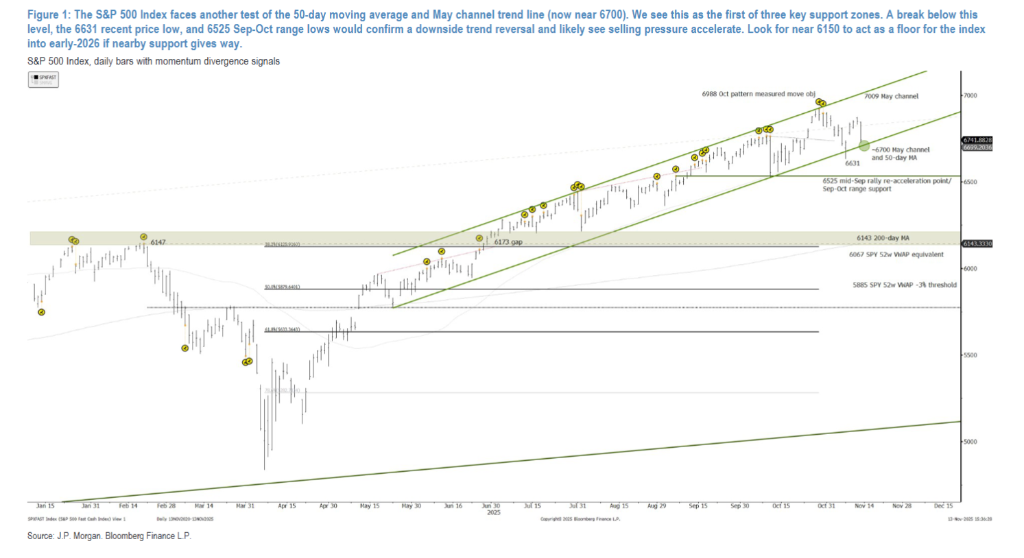
Core Viewpoint - Wall Street's top investment banks are establishing a new "bull-bear divide" as market sentiment becomes increasingly cautious [1] Group 1: Market Trends and Technical Levels - Goldman Sachs identifies 6725 points as a critical technical inflection point for the S&P 500 index; a breach could signal the end of a positive market trend that has persisted since February [2] - JPMorgan warns that the S&P 500 index faces key support levels at 6700, 6631, and 6525 points; breaking these levels could confirm a downward trend, potentially lasting until early 2026 [3][9] - The report highlights that the Nasdaq 100 and Russell 2000 indices have also breached short-term momentum thresholds, indicating a potential for significant selling pressure from algorithm-driven commodity trading advisors (CTAs) [7] Group 2: Upcoming Market Events - The market is preparing for significant events, including Nvidia's earnings report, which could lead to a market capitalization fluctuation of up to $300 billion, and the first U.S. government employment report in two and a half months [4] Group 3: Defensive Rotation and Sector Performance - There is a notable shift of funds from growth sectors to defensive sectors, with the VIX index rising above 23 for the fourth time since April, indicating increased market anxiety [11] - In the technology, media, and telecommunications (TMT) sectors, short selling has outpaced long buying, while defensive sectors like healthcare and consumer staples have seen stronger demand [11] - Despite the defensive shift, overall stock exposure has not significantly decreased, suggesting persistent market volatility [11] Group 4: Momentum Factor and Market Risks - A sharp decline in the momentum factor has been observed, with Goldman Sachs' momentum index experiencing one of its worst trading periods in a decade, raising concerns about potential instability [13] - The report indicates that despite the poor performance of the momentum factor, investor exposure remains high, which could lead to larger-scale deleveraging and asset repricing if selling continues [13]



【招银研究】美联储降息预期收敛,国内经济逆风加大——宏观与策略周度前瞻(2025.11.17-11.21)
招商银行研究· 2025-11-17 10:00
Group 1: Overseas Macro Strategy - The end of the US government shutdown and hawkish signals from some Fed officials led to a slight increase in US Treasury yields, while gold initially rose before falling, and the US dollar slightly retreated [2] - The US stock market is expected to transition from a phase driven by both earnings and valuation to one primarily driven by corporate earnings growth, amidst increased market volatility [2] - Over 80% of S&P 500 companies exceeded earnings expectations in the third quarter, providing market support despite high valuations [2] - The narrative surrounding AI's potential to drive a fourth industrial revolution is yet to be validated, suggesting a need for cautious adjustment of annual return expectations to single-digit levels [2] - A diversified investment strategy is recommended, focusing on sectors such as industrials, utilities, energy, and healthcare, in addition to technology stocks [2] Group 2: US Treasury Bonds - Short-term market focus is on upcoming US economic data, although the validity of data during the government shutdown is limited [3] - Medium to long-term outlook suggests a downward shift in the central tendency of Treasury yields, with a continuation of a bull steepening yield curve [3] - Investors are advised to maintain positions in 2-5 year Treasury bonds, with long-term bonds recommended for purchase when the 10-year yield exceeds 4.2% [3] Group 3: Currency and Gold - The US dollar lacks fundamental support to stabilize above the 100 mark, with expectations of downward pressure due to a loose trading environment [3] - The Chinese yuan is expected to appreciate slightly, influenced by the Fed's rate cut cycle and easing US-China trade tensions [3] - Gold is in a short-term adjustment phase but remains bullish in the long term, with expectations of continued Fed rate cuts and ongoing central bank gold purchases [4] Group 4: Domestic Macro Strategy - Domestic economic pressures are increasing, with significant declines in real estate transaction volumes and prices, particularly in first-tier cities [6] - Financial growth has slowed, with a decrease in both public and private financing demand, and a drop in the growth rate of RMB loans to 6.5% [6] - Export dynamics remain stable, with a 6.3% year-on-year increase in average cargo throughput in October, indicating resilience in certain export categories [7] - Recent government meetings have focused on enhancing the adaptability of supply and demand in consumer goods, signaling a shift towards a more balanced policy approach [7] Group 5: Monetary Policy and Bonds - The central bank's monetary policy report indicates a focus on optimizing structural tools and emphasizing price-based regulation over quantity targets [8] - The bond market is expected to maintain a low-volatility, oscillating trend, with the 10-year Treasury yield stabilizing around 1.8% [9] - The outlook for the bond market suggests a steep yield curve, with a central tendency around 1.8% and potential fluctuations between 1.6% and 1.9% [10] Group 6: A-shares and Hong Kong Market - The A-share market experienced a slight decline, with the Shanghai Composite Index closing at 3990 points, influenced by weak economic data and reduced Fed rate cut expectations [10] - The Hong Kong market showed a 1.26% increase in the Hang Seng Index, with expectations of continued upward movement post-adjustment [11] - The overall outlook for both A-shares and Hong Kong stocks remains cautiously optimistic, with anticipated liquidity improvements and positive developments in US-China trade negotiations [11]

华尔街共识浮现?摩根大通刚划出“关键防线”,高盛也警告标普6725点为多空分水岭
Hua Er Jie Jian Wen· 2025-11-17 06:53
Core Viewpoint - Wall Street's top investment banks are establishing a new "bull-bear divide" as market sentiment becomes increasingly cautious, with Goldman Sachs identifying 6725 points on the S&P 500 index as a critical technical inflection point that, if breached, could signal the end of a positive market trend lasting several months [1][2]. Group 1: Market Trends and Indicators - Goldman Sachs' report emphasizes that the S&P 500 index's 6725 points is crucial; falling below this level could mark a second negative trend since February of this year [1][2]. - JPMorgan has warned that if the S&P 500 breaches key support levels of 6700, 6631, and 6525 points, it would confirm a downward trend, potentially leading to market adjustments lasting until early 2026 [1][2]. - The Russell 2000 index is showing the most concerning breakdown pattern, indicating a bearish trend and opening up space for further declines [1][3]. Group 2: Systematic Selling Risks - The report highlights that the market's technical structure is precarious, with algorithm-driven Commodity Trading Advisor (CTA) funds likely to lead the next phase of selling [2]. - Goldman Sachs' analysis indicates that the short-term momentum thresholds for the Nasdaq 100 and Russell 2000 indices were breached last week, with CTAs expected to sell approximately 20% of their NDX and RTY positions in the coming week [2]. - A critical level for CTAs is set at 6442 points; if breached, it could trigger over $32 billion in sell orders within a week, potentially causing significant market turmoil [2]. Group 3: Defensive Sector Rotation - Evidence suggests that funds are shifting from growth sectors to defensive sectors, with the VIX index rising above 23, marking the fourth occurrence since April [5]. - In the Technology, Media, and Telecommunications (TMT) sector, short selling has outpaced long buying, while defensive sectors like healthcare and consumer staples have seen stronger demand from long buyers [5]. - Despite this defensive trend, overall stock exposure has not significantly decreased, indicating persistent market volatility [5]. Group 4: Technology Sector Concerns - There is a surge in demand for hedging against declines in large-cap technology stocks, with the implied volatility spread between the Nasdaq 100 and S&P 500 indices nearing a one-year high [7]. - Nvidia's recent volatility has been notably higher than the average for small-cap stocks, raising concerns given its market capitalization of approximately $4.6 trillion compared to the average market cap of Russell 2000 constituents at $1.7 billion [7]. - A sharp decline in momentum factors has been observed, with Goldman Sachs' momentum index experiencing one of its worst trading periods in a decade, raising concerns about potential broader market instability [7].
所长早读-20251117
Guo Tai Jun An Qi Huo· 2025-11-17 06:20
1. Report Industry Investment Rating No relevant content provided. 2. Core Views of the Report - The stock index futures market is in a slow - bull trend. Although the US technology stocks are adjusting, it is not a reversal. In China, the economic data in October weakened, but the policy expectation will turn positive before the Politburo meeting in December, and the slow - bull trend of the market will continue [8][9]. - For copper, short - term price increases are limited, but in the long term, it is advisable to buy on dips. The weakening of raw material supply tension, the increase in recycled copper supply, and the high domestic refined copper production are the current situations. However, long - term consumption has strong growth logic [10]. - In the pig market, the de - stocking drive is emerging, and the reverse - spread strategy has entered the right - hand side. The demand increment from slaughter pre - stocking is lower than expected, and there may be a social - end sell - off in the second half of the month, leading to a potential acceleration of the decline in spot prices [12]. - Regarding lithium carbonate, the shipment volume at the mine end is increasing, and there is a risk of a month - on - month weakening in demand, with limited upside potential. The demand in the energy storage sector remains strong, but there is a slight month - on - month decline, and the power demand will enter a seasonal off - season [14][15]. 3. Summaries by Related Catalogs 3.1 Stock Index Futures - The Shanghai Composite Index reached a ten - year high on Friday last week but declined in the late session. The adjustment of US technology stocks during the earnings season has dragged down the AI sector, and the market style has shifted to value sectors such as banks and consumption [8]. - Although the capital expenditure of US technology giants is large, it is still far from the level of the 2000 dot - com bubble. Some technology giants' earnings have exceeded expectations, and the overseas adjustment is not a reversal [9]. - In China, the economic data in October continued to weaken. Before the Politburo meeting in December, the market's policy expectations will turn positive, and the slow - bull trend of the market will continue [9]. 3.2 Copper - Macroscopically, the US government shutdown has ended, but the hawkish statements of Fed officials have weakened the expectation of interest rate cuts. In the long run, preventive interest rate cuts by the Fed may lead to a decline in the US dollar and support prices [10]. - Fundamentally, the logic of raw material supply tension is continuously weakening, the supply of recycled copper has increased marginally, and the processing fee for crude copper has started to rise. Domestic refined copper production remains high [10]. - The current demand has weakened, but the long - term logic is still strong. High copper prices have suppressed downstream demand and terminal consumption, but domestic active fiscal policies and the long - term demand from AI data centers and power grid upgrades will drive copper consumption [10]. 3.3 Pig - Since November, the market has been trading on the expectation of increased demand due to the temperature drop in the second half of the month, but the demand increment from slaughter pre - stocking is lower than expected, and the time for concentrated bacon - curing to boost demand is around the Winter Solstice [12]. - From the supply side, the group sales in the middle of the month have been poor for many consecutive days, the slaughter progress is slow, and a passive pressure - bar situation has formed. The weight of the存栏 has increased significantly due to the large - scale entry of secondary fattening in October [12]. - Although farmers have a sentiment of reluctant to sell, the price difference between fat and lean pigs has shown a reverse - seasonal weakening trend, and the loss from pressure - bar has increased. There may be a social - end sell - off in the second half of the month, and the spot price may accelerate its decline [12]. 3.4 Lithium Carbonate - On the demand side, the energy storage demand remains strong, but the winning bid data from October to November shows a slight month - on - month decline. The growth rate of new energy vehicle sales in October has slowed down, and December will enter a traditional seasonal off - season [14]. - On the supply side, since October 27, the shipment volume of Australian mines has been above the annual average for three consecutive weeks. Australian mining companies have increased supply by improving recycling efficiency, and this incremental supply is expected to be gradually released by the end of this year or in the first quarter of next year [15]. - In the short term, the de - stocking trend will continue, but with the increase in supply and the entry of power demand into the seasonal off - season, the upside space is expected to be limited [15].
期指:震荡整固
Guo Tai Jun An Qi Huo· 2025-11-17 02:47
Report Summary 1. Report Industry Investment Rating - Not provided in the report. 2. Core Viewpoints - On November 15, all four major stock index futures contracts declined. IF dropped 1.6%, IH dropped 1.19%, IC dropped 1.52%, and IM dropped 1.08% [1]. - On this trading day, the total trading volume of stock index futures declined, indicating a decrease in investors' trading enthusiasm. The total trading volume of IF decreased by 1,880 lots, IH decreased by 4,658 lots, IC decreased by 15,612 lots, and IM decreased by 22,224 lots. In terms of positions, the total positions of IF increased by 5,374 lots, IH increased by 806 lots, IC increased by 1,308 lots, and IM increased by 1,057 lots [2]. 3. Summary by Relevant Catalogs 3.1. Stock Index Futures Data Tracking - **IF Contracts**: The closing prices of IF2511, IF2512, IF2603, and IF2606 all declined, with decreases of 1.60%, 1.56%, 1.48%, and 1.43% respectively. The trading volumes of IF2511 and IF2512 decreased, while those of IF2603 and IF2606 increased. The positions of IF2511 decreased, while those of IF2512, IF2603, and IF2606 increased [1]. - **IH Contracts**: The closing prices of IH2511, IH2512, IH2603, and IH2606 all declined, with decreases of 1.19%, 1.22%, 1.22%, and 1.29% respectively. The trading volumes of IH2511 and IH2512 decreased, while those of IH2603 and IH2606 showed different trends. The positions of IH2511 decreased, while those of IH2512, IH2603, and IH2606 increased [1]. - **IC Contracts**: The closing prices of IC2511, IC2512, IC2603, and IC2606 all declined, with decreases of 1.52%, 1.56%, 1.54%, and 1.51% respectively. The trading volumes of IC2511, IC2512, IC2603, and IC2606 all decreased. The positions of IC2511 decreased, while those of IC2512, IC2603, and IC2606 increased [1]. - **IM Contracts**: The closing prices of IM2511, IM2512, IM2603, and IM2606 all declined, with decreases of 1.08%, 1.22%, 1.27%, and 1.27% respectively. The trading volumes of IM2511, IM2512, IM2603, and IM2606 all decreased. The positions of IM2511 decreased, while those of IM2512, IM2603, and IM2606 increased [1]. 3.2. Trend Intensity - The trend intensity of IF and IH is 1, and the trend intensity of IC and IM is also 1. The range of trend intensity is an integer in the [-2, 2] interval, where -2 represents the most bearish view and 2 represents the most bullish view [6]. 3.3. Important Drivers - In October, China's industrial added - value of large - scale industries increased by 4.9% year - on - year, with an expected increase of 5.2% and a previous value of 6.5%. From January to October, the industrial added - value of large - scale industries increased by 6.1% year - on - year [6]. - China's total retail sales of consumer goods in October were 4,629.1 billion yuan, a year - on - year increase of 2.9%, with an expected increase of 2.7% and a previous value of 3%. From January to October, the total retail sales of consumer goods were 41,216.9 billion yuan, an increase of 4.3%. Excluding automobiles, the retail sales of consumer goods increased by 4.9% [6]. - From January to October, China's fixed - asset investment (excluding rural households) was 40,891.4 billion yuan, a year - on - year decrease of 1.7%, and the previous value decreased by 0.5%. Among them, private fixed - asset investment decreased by 4.5% year - on - year [6]. - From January to October, the average urban survey unemployment rate in China was 5.2%. In October, the urban survey unemployment rate was 5.1%, a decrease of 0.1 percentage points from the previous month. The urban survey unemployment rate in 31 large - scale cities was 5.1%, a decrease of 0.1 percentage points from the previous month. The average weekly working hours of enterprise employees in the country were 48.4 hours [7]. - The State Council held a meeting to study the in - depth implementation of "two major" construction and promote consumption policies. The meeting pointed out that "two major" construction should be planned and promoted in the overall situation of the 15th Five - Year Plan, and artificial intelligence integration and empowerment should be strengthened [7]. - The Minister of Finance stated that during the 15th Five - Year Plan period, the proactive fiscal policy should be sufficient in intensity, precise in implementation, and coordinated in policies, and should focus on boosting consumption, expanding effective investment, and promoting the construction of a unified market [7]. - The Shanghai Composite Index rose and then fell, dropping 0.97% to 3,990.49 points, with a weekly decline of 0.18%. The Shenzhen Component Index dropped 1.93%, with a weekly decline of 1.4%. The ChiNext Index dropped 2.82%, with a weekly decline of 3.01%. The total trading volume of A - shares was 1.98 trillion yuan, compared with 2.07 trillion yuan the previous day [7]. - In the US stock market, the Dow Jones Industrial Average dropped 0.65% to 47,147.48 points, the S&P 500 Index dropped 0.05% to 6,734.11 points, and the Nasdaq Composite Index rose 0.13% to 22,900.59 points. Most Chinese concept stocks declined [8].
海外市场 | 美联储降息预期降温,黄金价格跌破4100美元
Sou Hu Cai Jing· 2025-11-17 02:46
Group 1 - The U.S. stock market showed mixed performance last Friday, with the Dow Jones and S&P 500 slightly down, while the Nasdaq index increased by 0.13% [1] - Technology stocks had varied movements, with Nvidia and Microsoft seeing gains, while some Chinese concept stocks faced pressure and the Nasdaq Golden Dragon China Index significantly retreated [1] - The Federal Reserve ended a 43-day pause, potentially signaling the end of a lack of relevant economic data, with CME predicting a less than 50% probability of a rate cut in December [1] Group 2 - Market attention is focused on Nvidia's earnings report and signals from the Federal Reserve, as their outcomes may influence sentiment in the technology sector [1] - In the medium to long term, the AI industry chain and the valuation recovery of Chinese concept stocks remain the main focus for capital allocation, although short-term volatility risks should be monitored [1] - Gold prices have corrected, with spot gold in London falling below $4,100 per ounce [1]
大跌原因找到了,大佬好一招深藏不露!
Sou Hu Cai Jing· 2025-11-17 01:48
Group 1 - The core viewpoint of the article highlights the significant impact of the Federal Reserve's recent decisions on global markets, leading to a negative market reaction [1] - The U.S. government's decision to end the shutdown is perceived as positive; however, the announcement of withholding economic data for October has caused unease among investors [3] - Several Federal Reserve officials have expressed concerns about high inflation, with market expectations for a rate cut in December being less than 50% [3] Group 2 - The current market trend is driven by liquidity, and the Federal Reserve's intention not to cut rates could lead to market corrections, as the U.S. economy is heavily reliant on financial bubbles [5] - In the A-share market, the influx of overseas funds and capital from the real estate sector is providing support, despite a 14.7% decline in real estate investment from January to October [8] - The A-share market showed resilience, with most stocks rising before a late sell-off, indicating that the market's core strength remains intact despite external pressures [10][14] Group 3 - The market's recent high was accompanied by increased profit-taking behavior, suggesting that short-term trading dynamics are dominating the market [11] - Although 70% of stocks declined today, the short-selling pressure was not dominant, indicating that the drop may not reflect underlying market weakness [12] - Institutional investors remain optimistic about future market conditions, which is a key factor supporting the A-share market [16][19] Group 4 - Despite the market's inability to maintain its strength, there are still active hotspots, with a similar number of stocks hitting the daily limit as in previous days, reflecting high participation from funds [19] - The article discusses the phenomenon of "institutional shaking" where large funds manage to stabilize their positions through strategic trading, which is crucial for maintaining market momentum [23] - Understanding the behavior of funds is emphasized as a valuable insight for investors, as it can provide clarity on market movements and potential opportunities [25]

两部门发布赴日安全提醒;比特币抹去今年以来所有涨幅|南财早新闻
2 1 Shi Ji Jing Ji Bao Dao· 2025-11-16 23:13
Investment News - Bitcoin price dropped to $93,778.6, a decrease of 1.82% in the past 24 hours, erasing all gains made this year [4] - The A-share market continued its consolidation pattern, with a noticeable rebalancing of styles. Analysts predict that the speed of sector rotation may accelerate in the short term, suggesting a balanced allocation strategy for growth and value styles. Key sectors of interest include price-increasing resource products and new consumption, while technology growth sectors are focusing on storage and AI software applications [4] - The pace of IPO reviews for technology companies has accelerated this year, with some companies taking less than six months from acceptance to registration, indicating ongoing regulatory support for tech innovation. As of November 21, 14 IPO companies have been scheduled for meetings this month, marking a new monthly high for the year [4] Financial Sector - As of the end of the third quarter, the balance of insurance fund investments reached 37.46 trillion yuan, with stock holdings valued at 3.62 trillion yuan, an increase of 1.19 trillion yuan compared to the end of last year, representing a nearly 50% growth. In the third quarter alone, insurance funds increased their stock holdings by 552.4 billion yuan, with bank stocks being the most favored [5] Company Developments - Huawei is set to release a breakthrough technology in the AI field on November 21, which will unify resource management and utilization across different computing powers through software innovation [7] - Lei Jun reiterated Xiaomi's commitment to safety in automotive design through multiple social media posts, emphasizing that safety is a fundamental principle [7] - Xingyin Financial Asset Investment Co., Ltd. was established as the first shareholding bank financial asset investment company in the country, aimed at supporting the optimization of capital structures and reducing leverage for tech and private enterprises [7]