钾肥

Search documents
周期半月谈 - 聚焦资源品与行业自律
2025-12-08 00:41
Summary of Key Points from Conference Call Records Industry Overview - The focus is on the non-ferrous metals industry, particularly copper, aluminum, and the construction materials sector, as well as the gold market and its outlook [1][2][4][5][6][9]. Non-Ferrous Metals - **Copper Market**: Short-term price surge due to U.S. tariff expectations leading to an expanded price gap between LME and COMEX. The U.S. market pricing is deviating from fundamentals. By 2026, the U.S. siphoning effect may create tight inventory risks in non-U.S. regions, but a return to fundamental pricing could occur if LME experiences warehouse congestion or tariff expectations decrease, leading to potential oversupply risks [1][5]. - **Aluminum Market**: Prices are expected to follow copper trends, with global supply affected by electricity shortages. Domestic production has peaked, and high overseas energy costs, along with investment cycle constraints, will likely lead to a decline in supply growth from 2025 to 2030. A bull market is needed to strengthen price incentives, with occasional events also pushing prices up [1][5]. Gold Market - The outlook for the gold market remains optimistic, driven by central bank purchases, ETF investments, and potential gold tokenization. Gold prices are expected to rise significantly by 2026, with current stock valuations between 10 to 13 times earnings being attractive [1][4]. Construction Materials - The construction materials sector is experiencing supply contraction under profit pressure. Recommendations include focusing on consumer building materials and leading fiberglass companies. Differentiation in product offerings is allowing some companies to achieve excess profits, with leading float glass companies expected to balance supply through self-initiated repairs, aiding profit recovery [1][6][7][8]. Fiberglass Industry - Demand for fiberglass is projected to grow in the high single digits, with approximately 400,000 tons of new domestic supply expected next year, while about 100,000 tons of overseas capacity will exit annually. High-end products remain scarce, and leading companies like China National Building Material and China Jushi are recommended [3][9]. Cement Industry - The cement industry is controlling supply through production limits and peak-shifting measures. By the end of 2025, a net reduction of over 50 million tons of capacity is anticipated, with a potential overall capacity reduction of over 10% in 2026 if monitoring and enforcement measures are effective. The industry is expected to see a moderate recovery in profit margins [11]. Phosphate and Potash Markets - Phosphate demand is significantly driven by the growth in energy storage, with total demand for power and storage batteries expected to reach 450 to 500 GWh by 2026, translating to a demand for 4.3 to 5 million tons of phosphate rock. The potash market is also expected to see stable growth, with limited new supply and high import dependence from China, leading to favorable price expectations [22][24]. Chemical Industry - The chemical industry is currently at a cyclical low but is expected to enter an upward phase starting late 2025. Industry self-discipline measures are enhancing price elasticity, with recent price increases observed in various chemical products [25][26][27]. Investment Opportunities - Recommended investment opportunities include potassium and phosphorus fertilizers, which are supported by strong fundamentals and global agricultural and renewable energy growth. Related fine chemicals like refined phosphoric acid and yellow phosphorus also show significant investment potential due to their wide applications [28].


周期演绎到了什么阶段?
2025-12-08 00:41
Summary of Key Points from Conference Call Records Industry Overview Potash Market - The potash market is experiencing short-term supply-demand tightness, with inventory levels significantly below safety lines. As of the end of November, potash inventory was approximately 2.3 million tons, a 25% year-on-year decrease, far below the historical safety line of 4 million tons [3][4] - The price of newly signed contracts for potash is $348 per ton, reflecting a $3 increase from the previous year, indicating a continued tight market in 2025 [3] - Limited global new production capacity is expected to maintain market tightness, with only a few companies in Laos contributing to new capacity [3][5] New Energy Pricing Mechanism - There are significant regional disparities in the results of the new energy pricing mechanism across provinces, with Gansu achieving a low price of 0.19 yuan/kWh, while Shanghai aligns with coal benchmark prices at 0.41 yuan/kWh [6] - High abandonment rates of new energy in regions like Gansu and Xinjiang pose challenges for project profitability, leading to a significant drop in medium- and long-term contract prices [7][8] Construction Materials Sector - The construction materials sector has seen a year-on-year decline in revenue and performance in the first three quarters of 2025, although the decline has narrowed compared to last year. Leading companies are achieving success through retail transformation and product expansion [10] - The demand for construction materials in 2025 is expected to be stable, with more demand coming from renovations of second-hand homes and existing properties [11] - The sector is witnessing a price increase trend in waterproofing, gypsum board, and coatings, driven by market consolidation and the exit of smaller players [11][12] Company-Specific Insights Recommended Companies - **Yara International**: Expected to expand its potash production capacity to 2 million tons by the end of 2024, with further contributions from expansions planned for 2026 [5] - **Oriental Tower**: Currently has a production capacity of 1 million tons and is accelerating its XDL project, which is anticipated to unlock growth potential [5] Construction Materials Leaders - Companies like **Three Trees**, **Oriental Yuhong**, and **Beixin Building Materials** are shifting focus from large B-end businesses to faster-growing small B and C-end channels, improving cash flow and profitability [12] - **Tubaobao**, a leading board manufacturer, is noted for its strong cash flow and high dividend yield, making it a suitable long-term investment [15] - **Beixin Building Materials** is actively pursuing overseas expansion to mitigate domestic demand downturns, with plans for acquisitions and product diversification [13][14] Market Challenges and Opportunities Coal Industry - The price of thermal coal has decreased to 791 yuan/ton, reflecting a year-on-year decline due to insufficient demand and accumulated inventory [16][17] - Coal companies face challenges with pricing mechanisms, including a floating long-term pricing structure that limits profitability [18] Real Estate Market - The real estate market in 30 key cities is experiencing stagnant transaction volumes, with a continuous decline in the de-stocking rate [19] - Core cities are seeing significant pressure on new home sales and declining second-hand home prices, leading to liquidity risks for some major real estate companies [20][21] - Despite the challenges, there are trading opportunities in undervalued central enterprises and companies with improving operational quality [23] Conclusion - The potash market is expected to remain tight, with limited new capacity and rising prices. The new energy sector faces profitability challenges due to regional pricing disparities. The construction materials sector is adapting to market changes, with leading companies focusing on retail and overseas expansion. The coal industry is under pressure from pricing mechanisms, while the real estate market presents both risks and opportunities for investors.
中企海外寻钾进入加速收获阶段,有机硅行业协同再进一步
Guotou Securities· 2025-12-07 12:06
Investment Rating - The report maintains an investment rating of "Outperform the Market - A" for the chemical industry [4] Core Insights - The potassium fertilizer market is expected to remain tight globally, with a focus on the growth potential of companies seeking overseas potassium resources [2] - The organic silicon industry is entering a new price increase cycle, supported by collaborative production cuts among manufacturers [3] Summary by Sections 1. Key Insights of the Week - The potassium fertilizer contract price for 2026 has been set at $348 per ton, indicating a slight increase from the previous year, reflecting a tight supply-demand situation [2] - The organic silicon intermediate price has risen to 13,700 yuan per ton, an increase of 2,600 yuan per ton since the implementation of the joint price support plan [3] 2. Chemical Sector Performance - The chemical sector index has shown a slight increase of 0.1% in the past week, underperforming compared to the Shanghai Composite Index [22] 3. Individual Stock Performance in the Chemical Sector - Among 424 stocks in the chemical sector, 159 stocks rose while 262 fell, with notable gainers including Longgao Co. (+23.3%) and Shuangxing New Materials (+21.8%) [29] 4. Key News and Company Announcements - Jiangnan Chemical plans to acquire 100% of Xi'an Qinghua Civil Explosive Materials Co. for 645 million yuan [32]




近2000亿主力资金狂涌!化工板块震荡盘整,机构看好三大主线布局机会
Xin Lang Cai Jing· 2025-12-05 02:50
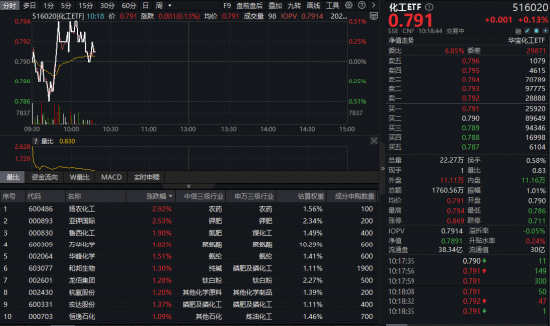
Group 1 - The chemical sector experienced fluctuations on December 5, with the chemical ETF (516020) showing a price increase of 0.13% [1][9] - Key stocks in the sector, including agricultural chemicals, potassium fertilizers, and polyurethane, saw significant gains, with Yangnong Chemical and Yaqi International both rising over 2% [1][9] - The basic chemical sector has attracted substantial capital recently, with a net inflow of over 2.2 billion yuan on the day, ranking fifth among 30 sectors [12][13] Group 2 - The chemical ETF (516020) has a price-to-book ratio of 2.32, which is at a relatively low level compared to the past decade, indicating potential value for long-term investment [4][11] - Future demand in the chemical industry is expected to recover gradually, driven by improvements in macroeconomic conditions and consumption stimulus policies [5][6] - Investment opportunities may arise in sectors such as organic silicon, polyester filament, and phosphate chemicals, which are expected to benefit from favorable supply-demand dynamics and government policies [12][13] Group 3 - Salt Lake Co. reported stable operations in its lithium salt project, achieving a daily output of 60-70 tons with a purity of over 99.7%, indicating strong production performance [10][11] - The basic chemical sector has seen a cumulative net inflow of 196.8 billion yuan over the past 60 days, ranking third among 30 sectors [12][13] - The chemical ETF (516020) provides exposure to a diversified range of chemical sub-sectors, with nearly 50% of its holdings in large-cap leading stocks [13]





亨斯迈MDI装置意外停车,己内酰胺减产逐步落地价格拉涨 | 投研报告
Zhong Guo Neng Yuan Wang· 2025-12-04 02:03
Industry Overview - The chemical sector's overall performance ranked 13th this week (2025/11/24-2025/11/28) with a change of 2.98%, positioned in the upper-middle of the market. The Shanghai Composite Index rose by 1.40%, while the ChiNext Index increased by 4.54%. The Shenwan Chemical sector outperformed the Shanghai Composite by 1.58 percentage points but underperformed the ChiNext by 1.56 percentage points [1]. Key Insights - The chemical industry is expected to continue its trend of divergence in 2025, with recommendations to focus on synthetic biology, pesticides, chromatography media, sweeteners, vitamins, light hydrocarbon chemicals, COC polymers, and MDI [1]. Synthetic Biology - A pivotal moment for synthetic biology is anticipated, driven by energy structure adjustments. Traditional chemical companies will face competition based on energy consumption and carbon tax costs. Companies that adopt green energy alternatives and leverage integrated and scaled advantages are likely to reduce energy costs and expand into larger overseas markets. The demand for bio-based materials is expected to surge, leading to potential profitability and valuation increases. Key companies to watch include Kasei Bio and Huaheng Bio [1]. Refrigerants - The implementation of quota policies is expected to usher in a high-growth cycle for third-generation refrigerants. Starting in 2024, the supply of these refrigerants will enter a "quota + continuous reduction" phase, while second-generation refrigerants will be phased out more rapidly. The demand for refrigerants is projected to grow steadily due to the development of heat pumps, cold chain markets, and the expansion of the air conditioning market in Southeast Asia. Companies with high quota shares, such as Juhua Co., Sanmei Co., Haohua Technology, and Yonghe Co., are expected to benefit significantly [2]. Electronic Specialty Gases - Electronic specialty gases are critical to the electronics industry and represent a core component of domestic industrialization. The domestic market is experiencing rapid upgrades in wafer manufacturing, but there is a mismatch with the fragmented and insufficient capacity of high-end electronic specialty gases. Companies that establish high-end capacity and possess substantial technical reserves are likely to seize opportunities for growth. Demand is driven by integrated circuits, displays, and photovoltaics. Key players include Jinhong Gas, Huate Gas, and China Shipbuilding Gas [3]. Light Hydrocarbon Chemicals - The trend towards light raw materials in the global olefin industry has been significant over the past decade, with a shift from heavy naphtha to lighter low-carbon alkanes like ethane and propane. This transition is characterized by shorter processes, higher yields, and lower costs. Light hydrocarbon chemicals also align with global low-carbon and energy-saving initiatives. Companies in this sector, such as Satellite Chemical, are expected to see their values reassessed [4]. COC Polymers - The industrialization of COC/COP (cyclic olefin copolymer) is accelerating in China, driven by domestic companies achieving breakthroughs after years of R&D. The shift of downstream industries, such as consumer electronics and new energy vehicles, to domestic sources is increasing the demand for these materials. The market is currently constrained by high prices, but domestic companies are expected to break through and expand market space. Key company to watch is Acolyte [5]. Potash Fertilizers - Potash fertilizer prices are expected to rebound as the industry enters a destocking cycle. Canpotex has withdrawn new quotes, and Nutrien has announced production cuts, leading to a short-term decline in supply. The termination of the Black Sea Grain Export Agreement has increased the prices of wheat and corn, boosting the demand for potash fertilizers. Companies like Yara International, Salt Lake Potash, and Zangge Mining are positioned to benefit from this trend [6]. MDI Market - The MDI market is characterized by oligopoly, with demand steadily improving due to the expansion of polyurethane applications. The global MDI production capacity is concentrated among five major chemical giants, which account for 90.85% of total capacity. Despite current price fluctuations, MDI remains a high-margin product. Companies like Wanhua Chemical are expected to benefit from a favorable supply structure as demand recovers [7]. Price Tracking - The top five price increases this week included methanol (East China) at 6.27%, NYMEX natural gas (futures) at 5.90%, and caprolactam (East China CPL) at 5.49%. The top five price decreases included liquid chlorine (East China) at -7.82% and propylene oxide (East China) at -5.85% [8]. Supply Side Tracking - This week, 168 chemical enterprises had their production capacities affected, with 9 new repairs and 3 restarts reported [9].
锂电储能迎利好催化,化工ETF(516020)盘中涨超1%!机构:化工板块2026年或迎“戴维斯双击”
Xin Lang Cai Jing· 2025-12-03 02:39
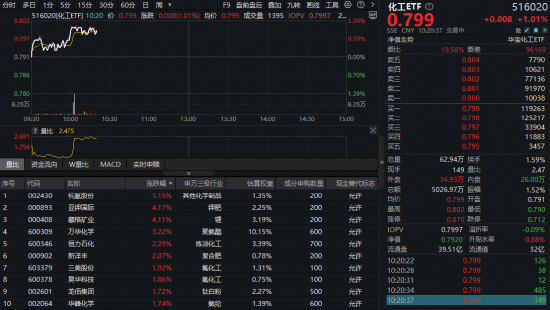
Group 1 - The chemical sector has regained momentum, with the Chemical ETF (516020) experiencing a maximum intraday increase of 1.39% and closing up 1.01% [1][6] - Key stocks in the sector include Hangzhou Oxygen Plant, which surged over 5%, and other significant gains from Yara International and Zangge Mining, both exceeding 4% [1][6] - The domestic first large-capacity all-solid-state battery production line has been completed and is in small-batch testing, potentially doubling battery energy density by 2026 [1][6] Group 2 - CITIC Securities highlights strong investment enthusiasm in energy storage, with policies supporting capacity compensation and a high growth rate in demand for renewable energy [3][8] - The chemical sector is currently viewed as having a favorable cost-performance ratio, with the Chemical ETF's price-to-book ratio at 2.33, placing it in the lower 39.73% of the last decade [3][9] - China Galaxy Securities anticipates a negative growth in capital expenditure for the chemical industry starting in 2024, with supply-side contraction expected due to the "anti-involution" trend and the clearing of outdated overseas capacity [4][10] Group 3 - The Chemical ETF (516020) tracks the CSI segmented chemical industry theme index, covering various sub-sectors, with nearly 50% of its holdings in large-cap leading stocks like Wanhua Chemical and Salt Lake Potash [4][10] - The ETF provides a more efficient way to capitalize on the rebound opportunities in the chemical sector, with a balanced exposure to different chemical sub-sectors [4][10]
“十五五”钾肥内外发力保粮安——中国无机盐工业协会会长王孝峰一席谈
Zhong Guo Hua Gong Bao· 2025-12-02 02:34
Core Viewpoint - The security of potassium fertilizer supply is crucial for national food security and agricultural resource supply, with the Chinese potassium fertilizer industry facing challenges of import dependence and resource endowment during the 14th Five-Year Plan period [1] Market Structure - The global potassium fertilizer market is highly concentrated, with Canada, Belarus, and Russia accounting for 70% to 80% of global exports, indicating that policy changes or geopolitical tensions in these countries could threaten global supply chain security [2] - Global potassium chloride prices have experienced fluctuations in 2024, characterized by low-level oscillation, collective increases, and subsequent high-level pullbacks, highlighting market uncertainty [2] Supply Chain Risks - Despite challenges in resource endowment, China's potassium fertilizer production reached 5.795 million tons in 2022, with a projected production of 5.25 million tons in 2024, but the country remains a net importer, with imports expected to reach 7.592 million tons, a 45.6% increase from the previous year [3] - The concentration of import sources is a significant issue, with Canada, Belarus, and Russia making up 75% of China's total potassium fertilizer imports, posing potential risks to the supply chain [3] - Domestic potassium fertilizer prices have shown volatility, with a peak price of 3,399 yuan/ton expected in July 2025, following a low of 2,178 yuan/ton in April 2024 [3] Strategic Layout - The Chinese potassium fertilizer industry has established a supply security strategy for the 14th Five-Year Plan, implementing a "3:3:3" strategy to optimize supply structure, aiming to shift from a current 4:5:1 ratio to a 3:4:3 ratio [4] - The strategy focuses on stabilizing existing production capacity, consolidating stable import channels, and expanding overseas base construction to ensure a steady supply [4] Technological Innovation - The potassium fertilizer industry has significant potential for technological innovation, particularly in resource utilization from complex salt lake compositions, which contain various underdeveloped valuable trace inorganic elements [5] - Industry experts emphasize the need for integrating smart technologies with salt lake development to overcome key technological bottlenecks, enhancing core competitiveness [5] - The implementation of the 14th Five-Year Plan is expected to significantly improve the supply security capabilities of the potassium fertilizer industry, supporting national food security and promoting high-quality industry development [5]
如何看大化工的投资机会?
2025-12-01 00:49
Summary of Conference Call on Chemical Industry Investment Opportunities Industry Overview - The chemical industry is currently experiencing historically low gross margins per ton due to rapid domestic capacity expansion leading to oversupply, while demand has not significantly decreased, indicating potential improvement in supply-demand dynamics in the future [1][2][3] - Companies are proactively reducing capital expenditures, with expectations of continued negative growth in capital expenditures for chemical listed companies from 2024 to 2026 [1][2] Supply and Demand Dynamics - Both domestic and international supply sides are showing signs of contraction. Domestically, companies are reducing capital expenditures due to poor profitability, while internationally, the Russia-Ukraine conflict has increased energy costs in Europe and led to operational difficulties for global chemical leaders, accelerating the shutdown of production lines [1][3] - The demand side is expected to recover, with the U.S. entering a rate-cutting cycle, followed by China and the UK, which may lead to a resonance in demand between China and the U.S. [1][3] Emerging Opportunities - New industries such as renewable energy, energy storage, photovoltaics, and AI are expected to drive incremental demand for chemical products, with the industry projected to enter an upward cycle from 2026 to 2027 [1][3] - Recommended sectors include: - **Bottom Elastic Products**: Organic silicon and industrial silicon benefiting from high energy consumption characteristics and energy-saving trends (e.g., Hengsheng Silicon, Xin'an Chemical, Xingfa Group) [1][4] - **Soda Ash**: Benefiting from anti-dumping policies despite expansion (e.g., Boyuan Chemical) [1][4] - **PTA and Polyester Filament**: Stable growth in end-user demand (e.g., Tongkun, Xinfengming) [1][4] Investment Recommendations - Focus on quality stocks with bottom valuations and potential volume growth, such as Wanhua Chemical, Hualu Hengsheng, Longbai Group, and Huahong New Materials [2][4][7] - Growth companies in tires and new materials are also worth attention, such as Sailun Tire, Xin Nuobang, and Shengquan Group, which benefit from AI, new energy development, and domestic substitution [5] Strategic Outlook for 2026 - The strategy for the petrochemical industry in 2026 will adopt a top-down framework due to prolonged low margins (10%-20%) and the completion of capital expenditures in 2023 and 2024 [6][7] - Anticipation of three rate cuts by the Federal Reserve in 2026, reducing rates to around 3%, is expected to support a soft landing for the global economy [6] Key Focus Areas in Petrochemical Sector - The PTA sector is highlighted as a key area of focus, with optimism regarding market corrections and support from national policies [7][8] - Attention should also be given to cyclical sectors, including private refining companies like Satellite Chemical, Baofeng Energy, and Hengli Petrochemical, which are expected to experience reversals [8] Additional Investment Opportunities - Other notable investment opportunities include the POE market and Xinjiang coal chemical stocks, which are expected to perform well due to stable operations and significant profit margin potential [11] - Companies like Aerospace Engineering and 3D Chemical are highlighted for their safety margins and potential valuation recovery due to supportive policies [11]
【基础化工】钾肥大合同签订,看好行业景气度持续——行业周报(20251124-20251128) (赵乃迪/周家诺/胡星月)
光大证券研究· 2025-11-30 23:06
点击注册小程序 查看完整报告 特别申明: 本订阅号中所涉及的证券研究信息由光大证券研究所编写,仅面向光大证券专业投资者客户,用作新媒体形势下研究 信息和研究观点的沟通交流。非光大证券专业投资者客户,请勿订阅、接收或使用本订阅号中的任何信息。本订阅号 难以设置访问权限,若给您造成不便,敬请谅解。光大证券研究所不会因关注、收到或阅读本订阅号推送内容而视相 关人员为光大证券的客户。 报告摘要 2026年钾肥大合同签订,中国继续保持全球钾肥"价格洼地" 根据中农集团消息,2025年11月23日中方钾肥进口谈判小组与食安供应链有限公司(迪拜)就2026年钾肥年度 进口合同价格达成一致,合同价格为348美元/吨(CFR),中国继续保持了全球钾肥"价格洼地"。该合同价格 相较于2025年钾肥大合同价格上涨约2美元/吨。此次钾肥大合同签订时间较往年显著提前,一方面将有效保证 我国冬储及春耕的钾肥需求,另一方面也反映出由于当前钾肥供需偏紧厂商提前锁价。 本订阅号是光大证券股份有限公司研究所(以下简称"光大证券研究所")依法设立、独立运营的官方唯一订阅号。其他任 何以光大证券研究所名义注册的、或含有"光大证券研究"、与光大证券研 ...

长江大宗2025年12月金股推荐
Changjiang Securities· 2025-11-30 10:45
Group 1: Metal Sector - Huaxi Nonferrous is expected to see net profit growth from CNY 6.58 billion in 2024 to CNY 11.40 billion in 2026, with a PE ratio decreasing from 37.28 to 21.52[10] - The company has a projected capacity increase to 0.6 million tons of tin and 1 million tons of antimony by 2027, benefiting from resource consolidation trends in Guangxi[12] Group 2: Construction Materials - Huaxin Cement's net profit is forecasted to rise from CNY 24.16 billion in 2024 to CNY 36.73 billion in 2026, with a PE ratio dropping from 17.21 to 11.32[10] - The company has diversified its growth strategy, focusing on overseas markets and stabilizing its aggregate business[28] Group 3: Transportation - ZTO Express is projected to achieve net profits of CNY 88.17 billion in 2024, increasing to CNY 104.11 billion by 2026, with a PE ratio improving from 13.39 to 11.34[10] - The "anti-involution" measures in the express delivery sector have led to a recovery in profitability, with significant improvements in average ticket prices since August 2025[33] Group 4: Energy Sector - ChuanTou Energy's net profit is expected to grow from CNY 45.08 billion in 2024 to CNY 52.59 billion in 2026, with a PE ratio decreasing from 15.93 to 13.65[10] - The company benefits from its stake in Yalong River Hydropower, which contributes significantly to its earnings[73] Group 5: Chemical Sector - Yara International's net profit is projected to increase from CNY 9.50 billion in 2024 to CNY 39.34 billion in 2026, with a PE ratio decreasing from 42.50 to 10.27[10] - The company is positioned as a leader in overseas potash mining, with significant reserves in Laos[49]