
房地产

Search documents
回购近亿!京基智农强势护盘彰显长期信心
Quan Jing Wang· 2026-01-28 01:25
Group 1 - The company has repurchased a total of 5.438 million shares, accounting for 1.03% of its total share capital, with a total transaction amount of 94 million yuan, indicating management's confidence in the company's intrinsic value [1] - The company has secured a special loan of 100 million yuan to support its share repurchase, enhancing its financial capability and commitment to executing the buyback plan [1] Group 2 - The company reported a net cash flow from operating activities of 525 million yuan and total assets exceeding 10.4 billion yuan, providing a financial buffer for share buybacks and dividends [2] - Recent adjustments in real estate policies, such as lowering the minimum down payment for commercial real estate from 50% to 30%, are expected to improve market liquidity and create favorable conditions for the company's real estate business [2] Group 3 - The company is making significant strides in the technology sector by planning to take a controlling stake in the national-level specialized "little giant" Huibo Robotics, which is expected to achieve a minimum annual revenue growth of 30% from 2026 to 2028 [3] - The establishment of a joint research institute for embodied robotics marks the company's entry into the trillion-yuan market, aligning with national policies that promote innovation and development in the robotics industry [3] Group 4 - The company's actions reflect strong confidence in its fundamentals and a commitment to long-term strategic development, with a focus on transitioning from a cyclical stock to a growth stock as the robotics business develops and the livestock industry recovers [4] - The combination of share buybacks and stable dividend returns demonstrates the company's efforts to prove its long-term value, making it a noteworthy investment opportunity [4]

沙河股份(000014.SZ):拟收购晶华电子70%股权,本次交易尚处于筹划阶段
Ge Long Hui· 2026-01-28 00:53
格隆汇1月28日丨沙河股份(000014.SZ)在投资者互动平台表示,为提高上市公司资产质量,提升业务规 模和盈利水平,公司拟收购晶华电子70%股权,本次交易尚处于筹划阶段,具体交易方案尚需进一步协 商、推进和落实,最终能否达成合作并签署正式协议尚存在不确定性。 ...
渤海证券研究所晨会纪要(2026.01.28)-20260128
BOHAI SECURITIES· 2026-01-28 00:29
Macro and Strategy Research - The profit growth of industrial enterprises in 2025 is supported by new momentum and anti-involution policies, with a marginal increase in profit growth rate by 0.5 percentage points to 0.6% year-on-year [2][3] - In December 2025, the profit of industrial enterprises increased by 5.3% year-on-year, reversing from negative to positive with an 18.4 percentage point recovery [3] - The industrial added value in December 2025 grew by 5.2% year-on-year, driven by resilient exports and high-tech industries [3] - The revenue profit margin for industrial enterprises in 2025 was 5.31%, a year-on-year decrease of 1.5%, but the decline was less severe than in the previous months [3] - Among 41 industrial sectors, 16 sectors achieved positive profit growth in 2025, with notable growth in black metal smelting, non-ferrous metal mining, and high-tech manufacturing [4] - The end of three consecutive years of negative profit growth for industrial enterprises is attributed to support from new momentum sectors and the implementation of anti-involution policies [4] Fixed Income Research - The issuance scale of credit bonds increased, with corporate bonds remaining stable and other types of bonds seeing growth [6][8] - Credit bond yields generally declined, with credit spreads for medium and short-term notes narrowing [8] - The overall market sentiment remains optimistic, with a focus on adjusting strategies in response to market fluctuations and maintaining a cautious approach to ticket strategies [8] Fund Research - The number of equity funds increased to 7,583 by the end of Q4 2025, with a total scale of 94,572.12 billion, a decrease of 277.04 billion from the previous quarter [11] - Active equity funds saw a slight decrease in positions, with a notable decline in mixed and flexible allocation funds [11][12] - The allocation in the main board decreased significantly, while the allocation in the Sci-Tech Innovation Board and Growth Enterprise Market increased [12] - The top five industries with increased holdings included non-ferrous metals and communications, while electronics and biomedicine saw a decrease [12] Industry Research - The geopolitical situation has led to strong performance in gold prices, with expectations for continued upward pressure due to uncertainties [14][15] - The steel industry is expected to see improved profitability due to steady growth policies and demand in shipbuilding and construction [15] - The copper industry is anticipated to maintain a favorable outlook, supported by supply constraints and demand from key sectors like electric power and new energy vehicles [16] - The aluminum sector is expected to benefit from improved supply dynamics and demand from the new energy vehicle sector [16] - The rare earth industry is projected to see a revaluation of related companies due to China's export control upgrades and strategic importance [17]
中指研究院:2025年12月百城二手住宅均价同比下跌8.36%
智通财经网· 2026-01-27 23:53
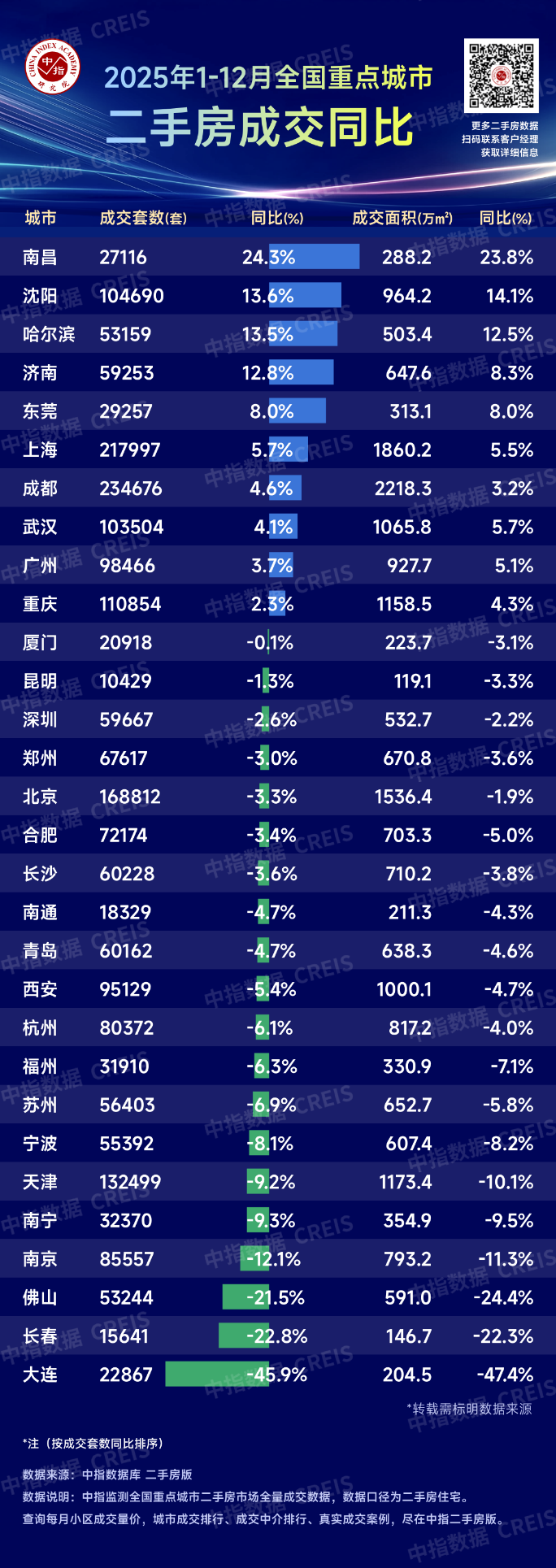
Core Insights - The report from the China Index Academy indicates that the average price of second-hand residential properties in 100 key cities dropped to 13,016 yuan per square meter in December 2025, reflecting a month-on-month decline of 0.97% and a year-on-year decrease of 8.36% [1][5][8] - In contrast, the average price of new residential properties in December 2025 was 17,084 yuan per square meter, showing a month-on-month increase of 0.28% and a year-on-year increase of 2.58% [1][5] - The rental market experienced a downturn, with the average rent in 50 cities falling to 34.16 yuan per square meter per month, down 0.60% month-on-month and 3.62% year-on-year [1] Second-hand Housing Market Performance - In December 2025, the total number of second-hand housing transactions in major cities showed varied performance, with cities like Nanchang and Shenyang experiencing significant year-on-year increases of 24.3% and 13.6%, respectively [2][3] - Conversely, cities such as Shenzhen and Beijing saw declines in transaction volumes, with year-on-year decreases of 2.6% and 3.3%, respectively [3][8] - The overall trend indicates that while some cities are recovering, many are still facing challenges in the second-hand housing market [5][9] New Housing Market Trends - The new housing market saw structural price increases in December 2025, driven by the introduction of high-end improvement projects in cities like Shenzhen, Beijing, and Shanghai [1][5] - The average price of new homes rose by 0.28% month-on-month, contrasting with the decline in second-hand housing prices [1][5] Rental Market Analysis - The rental market remains subdued, with average rents declining in December 2025, reflecting low demand during the traditional off-peak season [1][5] - The rental price drop of 0.60% month-on-month and 3.62% year-on-year indicates ongoing pressure in the rental sector [1][5] Price Index Overview - The cumulative decline in second-hand residential prices across 100 cities in 2025 was 8.36%, with the decline in second-tier cities being the most pronounced at 9.08% [5][8] - The report highlights that first-tier cities experienced a smaller decline of 6.72%, indicating a relative resilience compared to lower-tier cities [5]

最高4379%!业绩大幅预增
Zhong Guo Zheng Quan Bao· 2026-01-27 23:25
Company News - Ningbo Fubang expects a net profit attributable to shareholders of 50 million to 70 million yuan in 2025, representing a year-on-year growth of 3099.59% to 4379.43%. The increase is driven by a focus on core business and rising silver prices, leading to improved revenue and profitability [5][6]. - Huatu Shanding anticipates a net profit attributable to shareholders of 280 million to 420 million yuan in 2025, reflecting a year-on-year increase of 428.38% to 692.57% [5]. - Zhenlei Technology forecasts a net profit attributable to shareholders of 123 million to 145 million yuan in 2025, indicating a year-on-year growth of 529.64% to 642.26% [5]. - Shijia Photon expects a net profit of approximately 342 million yuan in 2025, representing a year-on-year increase of around 425.95% [6]. - Nanya New Materials projects a net profit attributable to shareholders of 220 million to 260 million yuan in 2025, with a year-on-year growth of 337.20% to 416.69% [6]. - Yihua Co. anticipates a net profit of 310 million to 390 million yuan in 2025, reflecting a year-on-year increase of 149.66% to 214.09% [6]. - Jiayuan Group expects a net profit attributable to shareholders of 600 million to 680 million yuan in 2025, indicating a year-on-year growth of 133.36% to 164.47% [6]. - Guotai Haitong forecasts a net profit attributable to shareholders of 27.533 billion to 28.006 billion yuan in 2025, representing a year-on-year increase of 111% to 115% [6]. - Shenwan Hongyuan anticipates a net profit attributable to shareholders of 9.1 billion to 10.1 billion yuan in 2025, reflecting a year-on-year growth of 74.64% to 93.83% [6]. - Muxi Co. expects a revenue of 1.6 billion to 1.7 billion yuan in 2025, with a year-on-year increase of 115.32% to 128.78%, but anticipates a net loss of 650 million to 798 million yuan, narrowing losses by 43.36% to 53.86% compared to the previous year [6]. Market Developments - Jia Shitang announced that its shareholder, China Everbright Industrial Group, is planning a change in company control, leading to a suspension of trading starting January 28, with an expected duration of no more than two trading days [7]. - Vanke A announced that its largest shareholder, Shenzhen Metro Group, will provide a loan of up to 2.36 billion yuan to repay bond principal and interest, with a term of 36 months [7]. - Pianzaihuang's controlling shareholder plans to increase its stake in the company through a centralized bidding process, with a total investment of no less than 300 million yuan and no more than 500 million yuan [8]. - Zhongwei Semiconductor announced a price adjustment for MCU and Norflash products, with an increase of 15% to 50% due to rising costs and supply chain pressures [8][9]. - Yingxin Development plans to acquire 60% of Guangdong Changxing Semiconductor for 520 million yuan, which will enhance its revenue and profitability in the storage chip business [8].


四大证券报头版头条内容精华摘要_2026年1月28日_财经新闻
Sou Hu Cai Jing· 2026-01-27 23:19
Group 1 - The core viewpoint of the news is that various sectors are experiencing significant changes, including a notable increase in revenue for GPU companies and shifts in investment strategies among public funds [1][2][5][6][14]. Group 2 - Muxi Co., a leading GPU company, expects a substantial revenue increase of 115.32% to 128.78% in 2025, projecting revenue between 1.6 billion to 1.7 billion yuan, despite anticipating a net loss of 650 million to 798 million yuan [1]. - The public fund FOF has shifted its holdings, replacing the Huazhong Gold ETF with the Haifutong Zhongzheng Short-term Bond ETF as the most heavily held fund by the end of Q4 2025 [2]. - The industrial profits of large-scale enterprises in China are expected to return to positive growth in 2025, with an overall increase of 0.6% compared to 2024, marking a turnaround from three consecutive years of decline [5]. - The gold market is experiencing a significant price surge, with international gold prices exceeding $5,100 per ounce, leading to a notable increase in demand for gold-related ETFs [6][13]. - The automotive industry in China is facing challenges with profit margins declining to 4.1% in 2025, indicating a trend of increased revenue but higher costs [14].
美被曝向以色列通报对伊朗行动准备进展;美元指数大跳水,国际油价涨3%,黄金涨破5180美元;“杰出女企业家”熊海涛被留置调查丨每经早参
Mei Ri Jing Ji Xin Wen· 2026-01-27 23:16
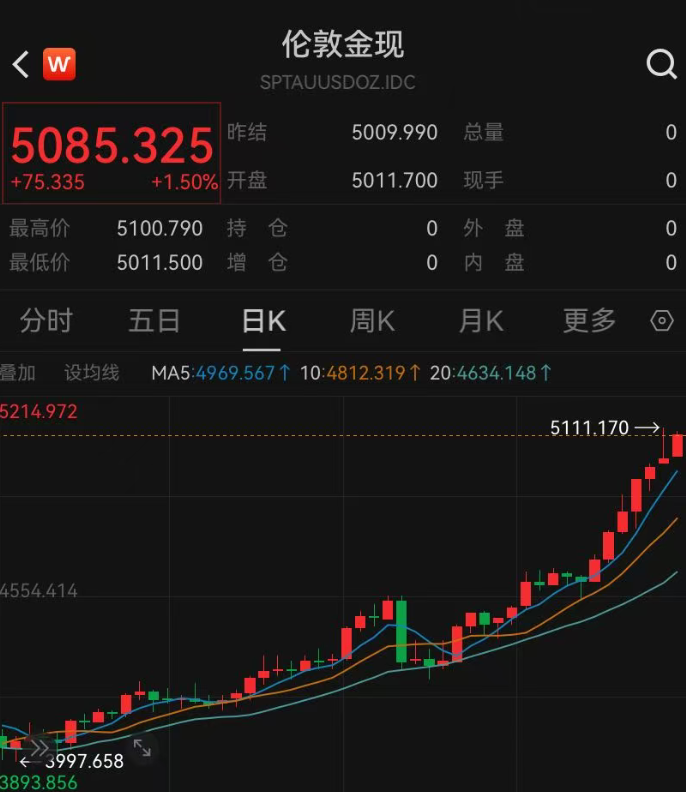
每经记者|陈晴 每经编辑|陈柯名 王瀚黎 王晓波 国际贵金属延续强势,其中黄金再创历史新高,现货黄金盘中最高触及5187.96美元/盎司,截至发稿时,现货黄金涨3.33%,报5174.95美元/盎司; COMEX黄金期货涨1.87%,报5177.4美元/盎司。现货白银涨8.11%,报112.32美元/盎司。 欧洲主要股指收盘涨跌不一,英国富时100指数上涨0.58%,德国DAX指数下跌0.1%,法国CAC40指数上涨0.27%。 标题点睛 当地时间27日,消息人士称,近日,美国向以色列通报其针对伊朗可能采取军事行动的准备情况。美方表示,相关准备工作预计将在两周内完成,并可能 在未来数月内出现适合采取行动的"机会窗口"。美方同时强调,这并不意味着必须等所有准备工作结束后才会采取行动。如果美国总统特朗普下达命令, 美方行动可能提前进行,但目前这一选项并未被视为迫在眉睫。不过美以官方尚未证实上述消息。 1月27日晚间,美元指数大跳水。美元指数一度跌至95.51创2022年2月份的最低水平,本月累计跌幅扩大至超2.2%。 国际贵金属延续强势,其中黄金再创历史新高,现货黄金盘中最高触及5187.96美元/盎司,截至发稿 ...

“金融女神”李蓓称上个月已清空黄金,未来10至20年不值得投资
Mei Ri Jing Ji Xin Wen· 2026-01-27 22:54
Group 1: Gold Market Insights - Gold prices have surged significantly, recently surpassing $5000 per ounce, making it a standout in the market [1] - Notably, renowned fund manager Li Bei has sold all her gold holdings, indicating a potential shift in market sentiment [3][5] - Li Bei's analysis suggests that the logic of central banks increasing gold reserves, which drove the gold price up since 2000, has reversed, with the Russian central bank starting to sell gold, signaling a long-term cycle shift [5] - According to Li Bei, gold is currently overvalued, with historical valuation metrics indicating a peak [5] - From a long-term investment perspective, Li Bei believes gold may not be a worthwhile investment over the next 10 to 20 years, citing high opportunity costs and potential declines in RMB-denominated gold prices due to RMB appreciation [7] Group 2: Investor Behavior and Market Risks - Investors are cautioned against viewing gold solely as an "anti-inflation tool," as historical data does not support the notion that gold consistently outperforms stocks [8] - The World Gold Council anticipates that the gold market will enter a new phase of dynamic balance by 2026, emphasizing the need for investors to adopt rational strategies and avoid impulsive trading [8] - Li Bei warns that ordinary investors should be cautious of high volatility and exchange rate fluctuations in the gold market, advocating for diversified investment strategies [8] Group 3: Real Estate Market Outlook - Li Bei predicts a "once-in-a-decade opportunity" in the real estate sector due to significant supply-side clearing and cyclical recovery [9] - The number of active companies in the land market has dwindled to single digits, indicating a contraction in new land acquisitions [9] - Despite the overall real estate market not returning to peak levels, it is expected to stabilize at a long-term equilibrium of 1 billion square meters [9] - Li Bei notes that the real estate sector has shown signs of marginal improvement, with rental yields aligning with financing costs and a decline in second-hand housing listings [9] - The potential for a recovery in the real estate market could be accelerated by significant policy changes, with opportunities arising from market share expansion and profit recovery for surviving firms [10]
多维施策齐发力 房地产政策组合拳释放需求潜力
Xin Lang Cai Jing· 2026-01-27 21:04
Core Viewpoint - The recent supportive policies in the real estate sector have led to a noticeable recovery in market activity across several cities, with significant increases in transaction volumes and buyer confidence observed in both first-tier and some hot cities [1][2][3][4] Group 1: Market Activity - In Beijing, the transaction volume for second-hand properties increased by 33% from December 24, 2025, to January 25, 2026, compared to the previous month [1] - In Shanghai, the second-hand housing transaction volume rose by 15% as of January 20, 2026, indicating a stabilization in prices and a recovery in market confidence [2] - Other cities, such as Wuhan, Dalian, and Qingdao, also reported increases in average second-hand housing prices, with Wuhan at 10,763 yuan/sqm (up 0.74%), Dalian at 10,835 yuan/sqm (up 1.84%), and Qingdao at 11,876 yuan/sqm (up 0.51%) [2] Group 2: Policy Support - Various cities have implemented measures to optimize the real estate market, including extending the maximum term for public housing loans to 30 years and allowing direct relatives to withdraw public funds for home purchases [4] - The central government and local authorities have introduced multiple supportive measures, including credit support and tax incentives, to stabilize the housing market [3][4] - The expectation is that the policy environment will remain accommodative, with potential adjustments in purchasing qualifications and financial support in major cities [4] Group 3: Market Outlook - The real estate market is expected to continue its gradual recovery, supported by favorable policies and a decrease in buyer costs, with a shift from browsing to action among potential buyers [3][4] - The market is anticipated to experience a mild recovery post-holiday, as the effects of policies take time to manifest in actual transactions [4]
买房再卖房,无法享受退税优惠
Xin Lang Cai Jing· 2026-01-27 16:54
Core Viewpoint - The Ministry of Finance and two other departments have extended the personal income tax policy to support residents in improving housing conditions, specifically for those who sell and then buy a new home within a specified timeframe [1][2]. Group 1: Tax Policy Details - From January 1, 2026, to December 31, 2027, taxpayers who sell their own housing and purchase a new home within one year of the sale will receive a tax refund on the personal income tax paid on the sale [1]. - If the amount of the new home purchased is greater than or equal to the amount from the sale of the current home, the entire personal income tax paid will be refunded. If the new home amount is less, the refund will be proportional to the new home amount relative to the sale amount [1]. Group 2: Conditions for Tax Refund - The sequence of transactions is crucial; taxpayers must sell their home before buying a new one to qualify for the tax refund. If they buy a home first, they will not be eligible for the refund [1]. - The timing for the sale of the current home is based on when the personal income tax is paid, while the purchase date for a new home is determined by the contract registration date for new homes or the tax payment date for second-hand homes [1]. Group 3: Geographic Restrictions - Taxpayers cannot claim the tax refund if they sell a home in one city and buy a new home in another city, even within the same province. The sale and purchase must occur within the same city administrative area [2]. Group 4: Required Documentation - To apply for the tax refund, taxpayers must submit a tax refund application form along with necessary documents, including identification, housing transaction contracts, and property certificates for both the sold and purchased homes [2].