
能源

Search documents
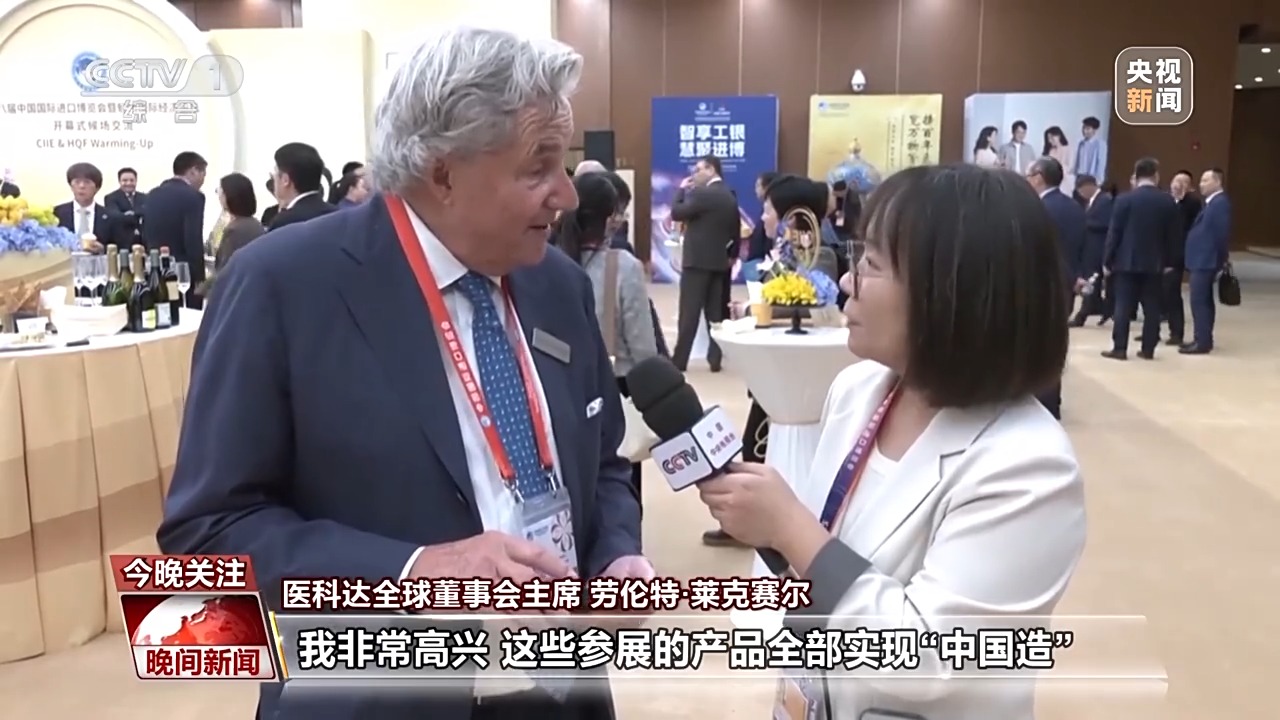
进博全球参展商热议中国“十五五”:世界新机遇
Yang Shi Xin Wen· 2025-11-07 05:17
Core Insights - The ongoing China International Import Expo (CIIE) highlights global exhibitors' discussions on China's "14th Five-Year Plan," which is seen as a new opportunity for international collaboration and innovation [1][3][4]. Group 1: Industry Perspectives - Medical technology company Medtronic emphasizes the significance of the "14th Five-Year Plan" in promoting innovation and global cooperation, viewing it as a substantial win-win opportunity [3]. - ConocoPhillips' executives are engaging in discussions about the green development aspects of the "14th Five-Year Plan," identifying numerous collaboration opportunities [4]. - Alfa Laval's CEO notes that the five-year plan presents exciting elements that not only benefit domestic development but also showcase an international perspective, creating new opportunities for the company [6]. Group 2: Market Opportunities - The consensus among attendees at the expo is to seize new opportunities in the Chinese market over the next five years, focusing on sectors such as the silver economy, health, new consumption scenarios, and smart manufacturing [6][8]. - AstraZeneca's global executive expresses confidence in China's growth prospects due to its comprehensive manufacturing industry, indicating that increased investment in China will benefit global operations as well [8]. - Danone's North Asia and Oceania president highlights the plan's emphasis on technological upgrades and high-level openness, which boosts confidence and motivation for continued investment and capacity expansion in China [8]. Group 3: International Collaboration - The Armenian ambassador to China believes that the new five-year plan will effectively address challenges and pave the way for higher quality development, presenting new cooperation opportunities for countries, including Armenia [10].

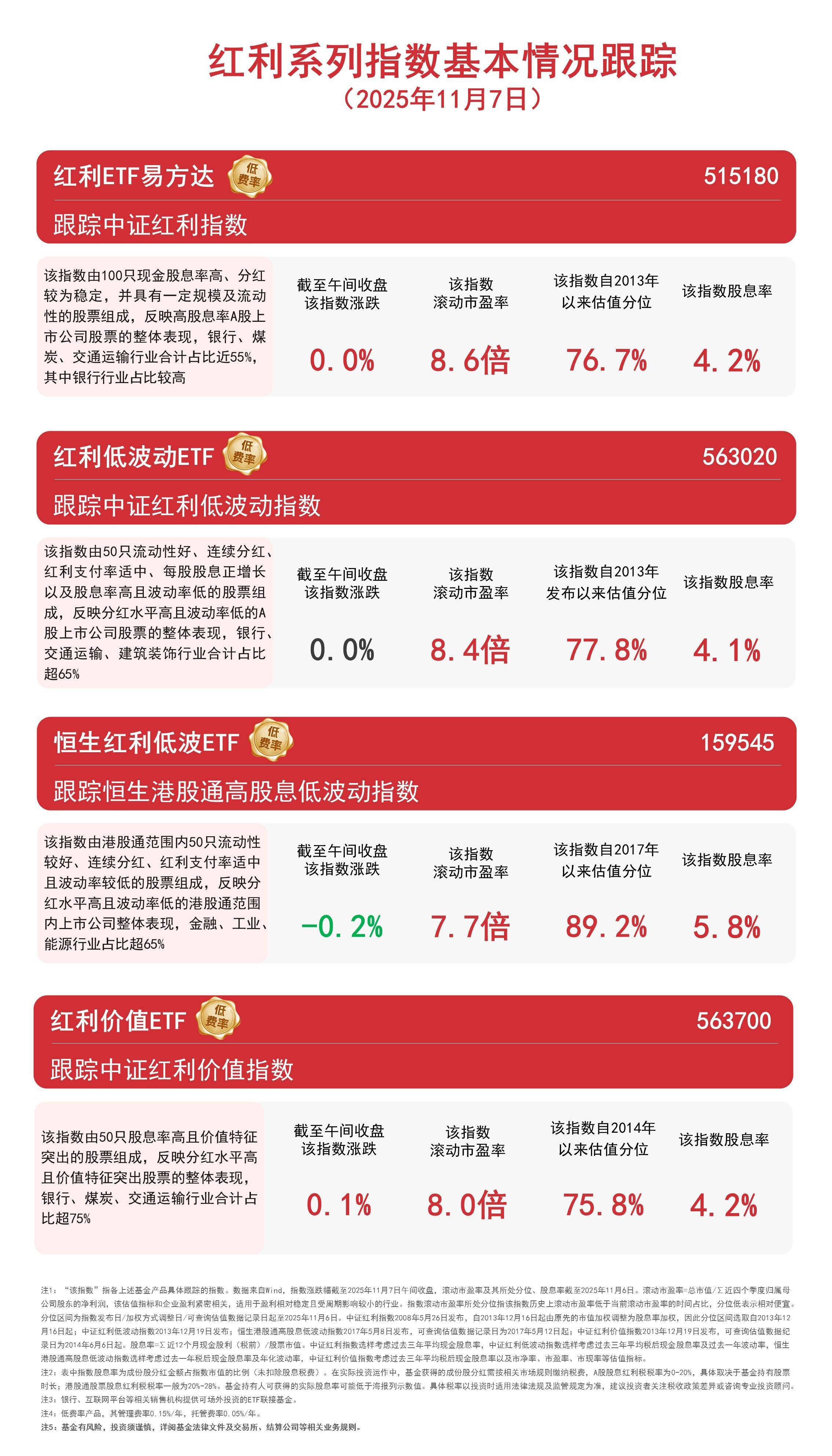
红利板块窄幅震荡,红利ETF易方达(515180)、红利低波动ETF(563020)等产品获资金持续布局
Sou Hu Cai Jing· 2025-11-07 04:56
Core Viewpoint - The dividend sector is experiencing slight fluctuations, with various indices showing minimal changes, while specific ETFs are attracting significant capital inflows [1][3][5]. Group 1: Market Performance - The CSI Dividend Value Index increased by 0.1%, and the CSI Dividend Index rose by 0.04% as of the midday close [1]. - The CSI Dividend Low Volatility Index remained nearly flat, while the Hang Seng High Dividend Low Volatility Index decreased by 0.2% [1]. - The Hang Seng Dividend Low Volatility ETF (159545) saw a net subscription of nearly 20 million units in half a day, marking a total net inflow exceeding 200 million yuan over the past six trading days [1]. Group 2: ETF Inflows - The Hang Seng Dividend Low Volatility ETF (159545) is not the only one attracting attention; the E Fund Dividend ETF (515180) and the Dividend Low Volatility ETF (563020) also received significant capital, with each seeing net inflows exceeding 300 million yuan over the past week [1]. - The overall trend indicates a strong interest in dividend-focused ETFs, reflecting investor preference for stable income amid market fluctuations [1]. Group 3: Index Composition - The indices mentioned are composed of stocks that have good liquidity, consistent dividend payments, moderate dividend payout ratios, positive growth in earnings per share, and low volatility [3][5]. - The sectors contributing significantly to these indices include banking, transportation, and construction, which together account for over 65% of the composition in the A-share market [3]. - In the Hong Kong stock market, financial, industrial, and energy sectors also represent over 65% of the composition in the relevant indices [5].
【AI纪要】特斯拉2025年年度股东大会
Xin Lang Cai Jing· 2025-11-07 03:43
Core Points - Tesla's shareholder meeting approved a compensation plan for Elon Musk, supported by over 75% of shareholders, which includes a stock incentive plan valued at $1 trillion contingent on achieving specific performance targets [3] - The company achieved significant milestones in its automotive and energy sectors, with Model Y being the best-selling vehicle globally for two consecutive years and a doubling of energy deployment to 31 GWh in 2024 [4] - The board of directors, including Ira Ehrenpreis and Kathleen Wilson-Thompson, was re-elected, although some shareholders raised concerns about their ties to Musk [3][4] Business Performance and Annual Achievements - Automotive business: Model Y maintained its position as the global sales leader, with a new version set to launch in early 2025. The safety performance of the global fleet improved significantly, with one accident occurring every 6.8 million miles, ten times safer than the U.S. average [4] - Energy business: Deployment reached 31 GWh in 2024, doubling from 2023, supported by AI-driven services like virtual power plants [4] - Sustainability: Tesla helped consumers reduce nearly 32 million tons of greenhouse gas emissions, a 70% increase year-over-year, and advanced a closed-loop economy across its supply chain [4] Company Governance and Shareholder Proposal Voting Results - Company proposals included the election of three Class III directors for a three-year term, approval of executive compensation, and the reappointment of PricewaterhouseCoopers as the independent auditor for 2025 [5][6][7] - Shareholder proposals included a request for sustainability metrics to be tied to executive compensation, which was opposed by the board and did not pass [11] Future Product and Technology Strategy - Tesla's core strategy focuses on "AI and robotics for sustainable prosperity," with key areas including the production of the Optimus humanoid robot, set to begin mass production in 2026 [12] - Full Self-Driving (FSD) updates are planned, with significant advancements expected in the next few months, and the CyberCab, a fully autonomous vehicle, is set to begin production in April 2026 [14] - AI chips are being developed to optimize Tesla's AI software stack, with the AI5 chip expected to be produced by TSMC and Samsung in 2026 [15] Investor Q&A and Business Outlook - Production targets include an annual capacity of 2.6-2.7 million vehicles by the end of 2026, with cash reserves exceeding $40 billion [19] - Tesla plans to expand its insurance business and utilize data from FSD to adjust pricing dynamically [19] - Long-term visions include using the global Tesla fleet as distributed AI nodes and exploring space solar energy generation [21]


中泰期货晨会纪要-20251107
Zhong Tai Qi Huo· 2025-11-07 02:18
Report Industry Investment Rating No relevant content provided. Core Viewpoints of the Report - Based on fundamental analysis, some commodities are in a trend of short - selling, some are oscillating with a bearish or bullish bias, and some are in a neutral oscillation state. Based on quantitative indicators, commodities are classified as bearish, oscillating, and bullish [2][4]. - The A - share market shows a unilateral upward trend, and the Fed's interest - rate cut expectation is rising. The bond market still has upward momentum. The black market maintains a bearish view in the medium - term (winter). Different commodities in other sectors have their own trends and investment suggestions [10][11][13]. Summary by Relevant Catalogs Macro News - China aims to achieve the goals of Hainan Free Trade Port construction, and the Ministry of Commerce responds to the issue of Nexperia. Chongqing adjusts its administrative divisions, and new stock indices are released. The polysilicon industry may undergo major integration, and China promotes international cooperation in new - energy storage. The US employment situation is severe, leading to an increased expectation of interest - rate cuts. Indonesia restricts nickel ore processing, Saudi Aramco cuts crude oil prices for Asia, and the US updates its critical minerals list [6][7][8]. Macro Finance Stock Index Futures - The index weakens during the capital rotation. The A - share market rises unilaterally, and the expectation of the Fed's interest - rate cut in December exceeds 70%. The fourth - quarter monetary policy is expected to be further loosened [10]. Treasury Bond Futures - The implementation of monetary policy intensification is in progress, and bonds still have upward momentum. The capital market is balanced and loose, and the market discusses the reform of public - fund fees. The symbolic significance of the central bank's bond - buying is more important than the actual scale [11]. Black Iron Ore and Steel - In the medium - term (winter), a bearish view is maintained. The market may return to fundamentals in the short - to - medium term. The winter market may rebound first and then decline, and the willingness to store steel for the winter may be affected. The demand for building materials is weak, while the demand for coils is acceptable. The supply of molten iron remains high, and the valuation of steel products is at a low level [12][13]. Coking Coal and Coke - The prices of coking coal and coke may continue to oscillate in the short term. The supply of coking coal may shrink in the short term, but the weakening demand for steel during the off - season may limit the price increase [15]. Ferroalloys - The black sector shows a short - term increase, but the supply - demand situation has not improved significantly. It is not recommended to chase the rise, and short - selling at the upper limit of the range is advisable [16]. Non - ferrous Metals and New Materials Zinc - High - level short positions should be held. The domestic zinc inventory decreases, and the zinc price oscillates at a high level. The downstream demand is cautious, and the global zinc price shows a downward trend [20]. Lithium Carbonate - The expected resumption of production of the Jianxiawo lithium mine may affect market sentiment, but the short - term supply - demand situation is still strong, and the price is expected to rise after the expected resumption of production [21]. Industrial Silicon and Polysilicon - Industrial silicon oscillates within a range with no prominent supply - demand contradiction. Polysilicon also oscillates within a narrow range, with the lower limit supported by policy expectations and the upper limit restricted by the progress of capacity mergers [22]. Agricultural Products Cotton - The cotton price oscillates at a low level due to increasing supply pressure and weak demand. The domestic cotton price rebounds but is limited by the actual supply [26]. Sugar - The domestic sugar market is bearish due to increasing supply and falling international sugar prices. However, the cost of domestic sugar production provides some support, and short - selling or waiting is recommended [28]. Eggs - The egg futures are strong due to the expectation of capacity reduction. The spot price may rise slightly in November, but the increase is expected to be limited. An oscillating trading strategy is recommended [30]. Apples - The apple price oscillates strongly. The acquisition of late - maturing Fuji apples is in the later stage, and the price is stable. The inventory is lower than last year [32]. Corn - The corn market has large differences in the futures market. The spot price rebounds, but the supply pressure remains. Attention should be paid to the selling pressure in November and the release of policy - supported wheat [33]. Red Dates - Temporarily wait and see. The weakening of the spot market in the sales area affects the purchase price of new dates, and the futures market oscillates [34]. Pigs - The supply pressure of pigs continues, and the spot price is likely to oscillate weakly. Short - term waiting and seeing is recommended [35]. Energy and Chemicals Crude Oil - The oil price is expected to oscillate. The supply - demand contradiction is not obvious, and OPEC +'s measure to postpone production increase has limited support for the oil price [37]. Fuel Oil - The price of fuel oil follows the oil price. The supply is abundant, and the demand is weak. The focus of trading is the supply - side concerns after the sanctions on Russia [38]. Plastics - Polyolefins are expected to oscillate weakly due to large supply pressure. However, the losses of production enterprises may provide some support [38][39]. Rubber - The rubber price rebounds due to weather influence. It is in the seasonal peak season, but there is still upward pressure. Appropriate reduction of short - call and short - put positions is recommended [42]. Synthetic Rubber - The short - selling positions in the synthetic rubber market are closed, and the price rebounds slightly. However, caution is still needed when going long, and the short - call strategy can be continued [43]. Methanol - The methanol market fluctuates greatly due to factors such as the arrival of Iranian goods, gas restrictions in Iran, and inventory reduction in China. The short - term contract is recommended to be traded with a bearish oscillation strategy, and the long - term contract can be slightly long - positioned after the emergence of a rebound driver [44][45]. Caustic Soda - The caustic soda market is in an oversupply situation. The electricity price provides some support for the futures price. An oscillating trading strategy is recommended [46]. Asphalt - The asphalt price is expected to oscillate with an enlarged amplitude. The oil price is in an oscillating state, the inventory reduction speed is expected to slow down, and geopolitical factors may increase the price volatility [46][47]. Polyester Industry Chain - The polyester industry chain may be strong in the short term. The supply - reduction expectation of PX is increasing, and the prices of PTA, ethylene glycol, short - fiber, and bottle - chip follow the upward trend [48]. Liquefied Petroleum Gas (LPG) - The supply of LPG is abundant, and the demand is difficult to exceed expectations. A bearish view is maintained in the medium - to - long term. The price of LPG is expected to weaken relative to crude oil next week [49]. Pulp - The pulp market is stable. The spot trading improves slightly, but the factory demand is difficult to increase significantly. Short - selling at a high level can be considered if the port inventory reduction continues [50]. Logs - The log market is bearish. The spot price decreases, and the inventory is expected to increase. The market is expected to maintain a weak supply - demand balance [50]. Urea - The release of the fourth - batch of urea export quotas may boost the market sentiment in the short term. Attention should be paid to short - selling opportunities after the release of bullish sentiment [50][51][52].
为推动构建开放型世界经济贡献智慧力量
Ren Min Ri Bao· 2025-11-06 22:11
Core Viewpoint - The eighth China International Import Expo (CIIE) is being held in Shanghai, featuring the Hongqiao International Economic Forum, which focuses on "open cooperation for new opportunities and shared futures" and aims to contribute to the reform of the global economic governance system [1][2]. Group 1: Global Economic Openness - The flagship report "World Openness Report 2025" was released, indicating a slight decline in the global openness index for 2024 to 0.7545, with developed economies decreasing by 0.25% and emerging markets increasing by 0.42% [2]. - China's openness index has risen from 0.5891 in 1990 to 0.7634 in 2024, marking a nearly 30% increase over 35 years, positioning China as a leader in global openness [2]. Group 2: Multilateral Cooperation - The forum emphasizes "revitalizing multilateral cooperation," focusing on global trade restructuring, supply chain resilience, and deepening cooperation among developing countries [6]. - The United Nations Industrial Development Organization commended China's efforts in expanding trade with developing countries and providing zero-tariff policies for the least developed nations [6]. Group 3: Innovation and Technology - The forum discusses the importance of innovation as a primary driver of development, addressing trends in artificial intelligence, green trade, and sustainable development [8]. - Experts highlight the need for collaboration in AI development to ensure safety and ethical standards, with China recognized for its leadership in advanced manufacturing and electric vehicle technology [9].
半导体ETF收跌超2.3%,领跌美股行业ETF
Mei Ri Jing Ji Xin Wen· 2025-11-06 22:06
Group 1 - The semiconductor ETF declined by 2.34% on November 6, indicating a negative trend in the sector [1] - Global technology stock index ETF and consumer discretionary ETF also fell by over 2.3%, reflecting broader market weakness in technology and consumer sectors [1] - The technology industry ETF decreased by 2.01%, while the internet stock index ETF dropped by 1.99%, further highlighting the downturn in technology-related investments [1] Group 2 - In contrast, the energy sector ETF experienced a gain of 0.97%, suggesting a divergence in performance between energy and technology sectors [1]
德国9月工业产出环比增长1.3%
Xin Hua She· 2025-11-06 15:16
Group 1 - Germany's industrial output increased by 1.3% month-on-month in September, recovering from a 3.7% decline in August, but the overall industrial output for Q3 decreased by 0.8% [1][2] - The construction sector saw a month-on-month decline of 0.9% in September, while the energy sector experienced a growth of 1.3%. Excluding construction and energy, industrial output rose by 1.9% [1] - The automotive industry, Germany's largest industrial sector, reported a month-on-month output increase of 12.3% in September, following a significant 16.7% decline in August due to summer factory closures and production line adjustments [1] Group 2 - Year-on-year, Germany's industrial output fell by 1% in September, indicating that the recovery is primarily influenced by fluctuations in the automotive sector and does not signify a fundamental turnaround for German industry [2] - The overall manufacturing sector remains weak, particularly in energy-intensive industries such as chemicals, glass, and paper, which are either stagnant or experiencing output declines [2] - The Kiel Institute for the World Economy noted that the industrial output growth in September was below expectations and insufficient to compensate for the previous month's losses, with new orders remaining stable [2]
拜登预言成真,让特朗普干完这四年,美国将会成为“世界老二”?
Sou Hu Cai Jing· 2025-11-06 10:45
Economic Impact - The Trump administration's tariffs generated an additional $118 billion in revenue and reduced the fiscal deficit by $41 billion, but the overall economic outlook for the U.S. is deteriorating while China's economy is steadily improving [2][4] - The trade war initiated in April 2018 led to chaos in global supply chains, with companies like Apple reporting a 12% increase in supply chain costs, which were passed on to consumers, resulting in an increase of over $3,000 in annual expenses for an average American household [5][6] Inflation and Employment - As of October 2023, inflation remains high at around 3.5%, with the Federal Reserve assessing a 45% chance of economic recession, while JPMorgan predicts a recession probability exceeding 50% [6][8] - The U.S. added 20% fewer jobs than expected in the first half of the year, with the unemployment rate rising from 4.1% to 4.8%, and projections suggest it could reach 5.3% by year-end [8] Geopolitical Influence - The "America First" policy has diminished U.S. diplomatic credibility, leading to a perception of the U.S. as a "troublemaker" among traditional allies, and has resulted in a 10% increase in EU trade with China while trade with the U.S. decreased by 5% [10][11] - The shift towards "de-dollarization" is evident, with countries like Saudi Arabia considering transactions in yuan, indicating a decline in the dollar's dominance as the global reserve currency [11][13] Societal and Political Dynamics - The internal division within the U.S. is exacerbated by a lack of trust in institutions, with rising social tensions and a perception of a "trust deficit" affecting economic foundations [13][15] - The spread of misinformation has led to a disconnect between public perception and economic reality, with 40% of respondents believing the economy is improving despite declining GDP growth and rising unemployment [18][20] Future Projections - The OECD predicts that by 2028, China's GDP may surpass that of the U.S., while the World Economic Forum forecasts a decline in the U.S. share of global GDP from 23% to 20% by 2029, supporting the notion of the U.S. becoming the "world's second" economy [20][22]

五市经济增速跑赢全省 湛江梅州工业增长快
Nan Fang Ri Bao Wang Luo Ban· 2025-11-06 09:04
Economic Growth - Five cities, Meizhou, Zhanjiang, Chaozhou, Shanwei, and Qingyuan, have economic growth rates exceeding the provincial average of 4.1%, with rates of 6.0%, 5.0%, 5.0%, 4.5%, and 4.4% respectively [2] - Meizhou's economic growth accelerated significantly from 3.6% last year to 6.0% this year, maintaining the highest growth rate in the province [2] - Zhanjiang's economic growth also improved from 1.2% last year to 5.0% this year, indicating a strong recovery [2] Industrial Performance - Meizhou's industrial added value increased by 9.0%, with significant contributions from the power, electronic information, and mechanical manufacturing sectors, which grew by 7.7%, 24.7%, and 9.6% respectively [3] - Zhanjiang led the province with a 10.4% increase in industrial added value, driven by the green steel, petrochemical, and energy industries [3] - Other cities like Yunfu, Heyuan, Qingyuan, and Shaoguan also reported industrial growth rates above the provincial average of 3.5% [3] Infrastructure and Investment - Infrastructure investment in cities such as Chaozhou, Jieyang, Zhanjiang, and Meizhou grew significantly, with rates of 28.4%, 17.3%, 14.8%, and 13.9% respectively [5] - Industrial investment in Maoming surged by 30.7%, attributed to the implementation of various industrial projects [5] - Industrial technological upgrades also saw substantial growth, with Maoming, Meizhou, and Yangjiang reporting increases of 67.1%, 48.5%, and 39.0% respectively [5] Agricultural and Consumer Market - Agricultural output in cities like Shaoguan, Chaozhou, and Shanwei grew above the provincial rate of 4.9%, with respective growth rates of 6.2%, 6.2%, and 5.8% [6] - The tourism and consumption sectors showed positive trends, with Shantou's tourist turnover increasing by 8.1% and accommodation facilities seeing a 20.3% rise in overnight visitors [7] - Real estate sales also experienced growth, with Yangjiang's sales area increasing by 15.9% and Chaozhou's real estate development investment rising by 46.6% in September [7]
德国9月工业产出增幅远逊预期 复苏动能依然薄弱
Xin Hua Cai Jing· 2025-11-06 08:31
Core Insights - Germany's industrial output in September increased by 1.3% month-on-month, significantly below the market expectation of 3% [1] - The August data was revised down to a month-on-month decline of 3.7% [1] - Year-on-year, September's industrial output decreased by 1.6%, with the previous value further revised down to a decline of 3.6% [1] Industry Performance - The automotive manufacturing sector showed a strong rebound with a 12.3% increase, serving as a major driving factor for the overall industrial output [1] - Other sectors displayed mixed performance: data processing equipment, electronics, and optical products saw a 5.1% increase, while machinery manufacturing declined by 1.1% [1] - Excluding energy and construction, September's industrial output rose by 1.9%, with capital goods output increasing by 3.8%, while consumer and intermediate goods only saw a slight increase of 0.2% [1] Quarterly Analysis - In the third quarter, industrial output decreased by 0.8% compared to the second quarter, indicating that short-term momentum has not effectively accumulated [1] - Despite factory orders experiencing their first growth in five months, suggesting potential economic stabilization, the sustained recovery of the manufacturing sector is crucial for Germany to overcome output contraction challenges [1] External Pressures - The German economy is currently facing multiple external pressures, including increased tariffs from the United States, weak global demand, and cumbersome domestic administrative procedures [1]